

Key Takeaways
Stop blaming immigrants for job scarcity; trace who controls investment and hiring.
Jobs respond to demand. More people create workers, but they also buy food, use schools, build homes, and support local businesses. A Pew study cited by Chomsky found no consistent pattern linking more foreign-born workers to harm or benefit for native-born employment. During the Great Depression, unemployment rose above 20 percent even as immigration was very low. The number of jobs is not fixed by the number of people.
Capital moves, too. Deindustrialization, deregulation, and outsourcing reshaped work from the 1970s onward. Companies shifted production abroad or replaced secure manufacturing jobs with lower-paid service work. Immigration is one part of this larger employment system, not a stand-alone explanation for job loss.
The useful distinction is between a local labor-market shock and the national number of jobs. A newcomer may compete directly with an established worker in a particular occupation, while population growth and spending can expand demand elsewhere. That is not a contradiction; it is a reason to ask who bears short-term costs and who captures the gains. The book’s focus on capital mobility also redirects attention toward decisions with greater scale: plant closures, subcontracting, and public policy. Aggregate employment patterns alone, however, cannot rule out concentrated harm in specific places or occupations.
Protect wages by organizing workers, not keeping migrants legally vulnerable.
Status shapes bargaining power. Chomsky uses the term dual labor market for an economy divided between relatively protected jobs and a secondary tier marked by low pay, weak protections, and little advancement. Immigrants and other excluded workers are concentrated in that less regulated tier. Their competition with low-paid citizens is real, but it is intensified by their lack of rights and employers’ ability to use that vulnerability.
History complicates the union story. Early mainstream unions often backed racial immigration restrictions and defended advantages for white members. The AFL-CIO began changing course in 1993, endorsing immigrant rights and organizing. The newer approach emphasized shared remedies, including stronger wage floors, health care, and labor-law reform, rather than blaming workers competing at the bottom.
This argument treats worker vulnerability as an institutional design problem, not a cultural trait. That perspective helps explain why employers may benefit when one group can be threatened with deportation while another fears replacement. It also makes solidarity practical: workers with different legal statuses often face the same employer decisions. Still, organizing across status lines is difficult when workers have unequal access to legal remedies and public voice. Rights on paper matter most when workers can safely use them, so enforcement and protection against retaliation are central to the book’s proposed shift.
Count taxes paid and services used before calling immigrants a public drain.
Contributions are easy to miss. Immigrants pay sales, property, and gasoline taxes, and many also have income and payroll taxes withheld. Chomsky cites a 2005 estimate that Social Security received about $7 billion annually through payroll taxes paid under false or mismatched numbers. Undocumented workers generally cannot claim the benefits tied to those contributions.
Costs are unevenly distributed. Immigrants tend to be of working age and use fewer federal services than citizens, while local governments may face costs for schools, transport, and emergency care. Children who are U.S. citizens can qualify for food assistance even when their parents cannot. First-generation immigrants may initially contribute less in taxes because wages are low; studies cited in the book found contributions rising with income and across generations.
Fiscal arguments often confuse a government’s balance sheet with a community’s welfare. A local school may face immediate costs, while the gains from a young workforce or future taxpayers accrue across a wider area and over time. This mismatch is a familiar problem in public finance, where costs and benefits fall on different budgets. It also warns against treating immigrants as one uniform category: income, age, legal status, and family structure change the calculation. The book’s evidence challenges the simple drain narrative, but it does not imply that every locality experiences identical costs or receives equal compensation.
Follow remittances through the economy before calling them money lost.
Most earnings stay local. Remittances are money migrants send to relatives or communities in their country of origin. Chomsky reports that Latin American immigrants sent more than $30 billion home in 2004 and more than $50 billion in 2005. The typical sender sent roughly 10 percent of annual income, meaning about 90 percent was spent in the United States.
The effects travel in several directions. Families use remittances for food, health care, education, clothing, and home repairs. Some money supports local projects, while some buys imported goods or flows to transfer companies. In El Salvador, rising remittance-funded consumption also coincided with greater imports, which could weaken local job creation. Remittances can ease hardship, but they do not automatically repair the economic conditions that prompted migration.
The key insight is to follow money through connected markets rather than treating a border as a sealed container. A transfer may support a household, a local shop, an international bank, and an exporter in different proportions. That is a more realistic account than either celebration or denunciation. It also raises a useful policy question: do transfers build durable local capacity, or mainly help families cope within an economy that offers too few opportunities? The answer depends on how money is used and on the institutions surrounding it, not simply on whether funds cross a national boundary.
Treat immigration law as a political boundary, not a timeless moral test.
The rules changed by race. The first U.S. naturalization law, in 1790, restricted citizenship to free white people. From 1880 to World War I, about 25 million Europeans arrived without visas or passports; only about 1 percent were turned back. Asian immigrants faced a very different regime, including exclusion from entry and citizenship. The legal meaning of belonging was never consistent across groups.
The border acquired new powers. The 1924 law created the Border Patrol and made unauthorized entry a crime, turning an open-border system into one that could label people illegal. Later laws built new quotas and preferences. Chomsky argues that many people today have no practical route to a visa, even when they have family ties. Legality therefore reflects political choices about access, not simply an individual’s character.
Law is both a rule system and a tool that distributes membership. Historical comparison makes its contingency visible: practices once treated as ordinary can later be condemned, while present rules can feel inevitable simply because they are familiar. That does not mean every violation is morally equivalent, or that borders cannot be administered. It does mean that moral judgment should examine what the rules permit, whom they exclude, and whether people have a realistic lawful route. A legal category can describe a person’s status without settling the harder question of whether the system producing that status is just.
Trace migration routes back to empire, recruitment, and economic restructuring.
Migration follows connections. Poverty alone does not explain why some countries send many migrants and others send few. Puerto Rico, which has been under U.S. rule, sent a large share of its population to the mainland. U.S. investment and labor recruitment helped make that movement possible. Operation Bootstrap, a program that encouraged U.S. businesses to move labor-intensive production to Puerto Rico, linked local economic change to mainland employers.
The Philippines shows the same pattern. U.S. colonial rule established English-language nursing education, and U.S. hospitals later recruited Filipino nurses to meet staffing needs. Many stayed. These cases show how political ties, cultural links, direct recruitment, and labor demand can create migration pathways. The book’s central claim is that migration is often a result of global economic relationships, not merely a personal choice to seek a richer country.
This approach resembles migration-systems analysis: movement becomes more likely where earlier trade, military, colonial, or family ties have created routes and expectations. It is stronger than a simple push-and-pull story because it asks how the push and the pull were historically produced. It also shifts the question from why individuals leave to why certain destinations and occupations become connected. The framework should not flatten migrants into passive products of empire, though. People make choices within these structures, and personal safety, ambition, family obligations, and adventure can matter alongside economic pressure.
Ask who gets called assimilated, and what racial place assimilation assigns.
Assimilation has not meant the same thing for everyone. Chomsky contrasts European immigrants, whose descendants increasingly became accepted as white, with Asian and Latino immigrants, who generally cannot cross that social boundary. For people of color, adapting to U.S. society can mean learning a racial hierarchy that keeps them disadvantaged, rather than gaining the upward mobility associated with the classic immigrant success story.
The book illustrates this with schools and identity. Studies of Latino adolescents found that newer arrivals often held strong educational hopes, while some lost optimism as they encountered racial and economic barriers. A study of West Indian immigrants cited by Chomsky found better economic outcomes among people who maintained a distinct ethnic identity. The argument is not that learning social norms is harmful, but that assimilation alone cannot undo unequal treatment.
The section makes assimilation an empirical question rather than a simple measure of cultural effort. If groups with long histories in the country remain disadvantaged, limited integration cannot be the whole explanation. The focus on identity also challenges the assumption that cultural difference is merely a temporary obstacle to success. At the same time, group averages conceal wide variation, and maintaining ethnic ties does not guarantee mobility. The strongest lesson is narrower: cultural adaptation and equal opportunity are separate processes, so policy should not mistake visible similarity for evidence that structural barriers have disappeared.
Expand English instruction without forcing children to abandon their first language.
Learning English is already a priority. The book describes long waiting lists for adult English classes, in some cases lasting years. In 2000, 18 percent of the U.S. population spoke a language other than English at home; more than half of that group spoke Spanish, and more than half of non-English speakers were also proficient in English. The visibility of Spanish does not show that English is not being learned.
Bilingual education need not delay learning. Chomsky argues that students can learn academic subjects in their first language while developing English. Research reviewed in the book suggests that academic language takes years to develop and that instruction in a familiar language can support, rather than obstruct, English acquisition. English-only campaigns often presented bilingual schooling as a choice between English and subject knowledge, a framing the cited research disputes.
Language policy works best when it distinguishes conversational fluency from the more demanding vocabulary and literacy needed for school subjects. Treating both as the same skill can lead schools to move children into English-only instruction before they can access the curriculum. The book’s larger contribution is to reject a zero-sum model: competence in one language need not subtract from competence in another. Program quality still matters, and bilingual education is not one uniform method. The useful public question is how well a particular model develops English and academic learning, not whether multilingualism itself is a threat.
Test refugee compassion against the nationalities actually admitted.
Refugee policy has been selective. Chomsky notes that most of the roughly three million refugees admitted since World War II came from Cuba, Vietnam, and the former Soviet Union. For much of the Cold War, refugee status was shaped by opposition to Communist governments, rather than applied evenly to people fleeing danger.
Haitians and Cubans reveal the disparity. In the 1980s and 1990s, Cubans arriving by sea often received favorable treatment, while Haitians fleeing repression and poverty were frequently detained or returned. In the 1980s, asylum applications from Nicaragua were approved at a much higher rate than those from El Salvador or Guatemala, whose governments had U.S. support. These cases show how political alliances influenced judgments about who counted as a refugee.
A humanitarian standard is credible only when it can survive cases that are politically inconvenient. The comparison between nationalities shows how the label of refugee can become entangled with foreign policy: the same hardship may be interpreted as political persecution in one setting and economic desperation in another. That is not proof that every case is identical; asylum decisions require individual evidence. It is a reason to demand consistent criteria, transparent procedures, and meaningful review, so that the applicant’s claim is not silently discounted because of the government they are fleeing.
Read anti-immigrant votes as mobilized signals, not settled consensus.
Polls and elections measure different things. In the book’s account, people living in areas with more immigrants were less likely to describe them as a burden. Only 4 percent named immigration as the most important problem in their local community, even as public debate grew heated. The wording of survey questions also changed responses, especially when questions paired immigration with crime, services, or deportation.
Proposition 187 shows how campaigns mobilize fear. California’s 1994 initiative passed with 59 percent of votes cast, but fewer than half of eligible voters participated. Voters were disproportionately older, white, and conservative. Chomsky argues that the campaign’s rhetoric, and even some opponents’ efforts to blame federal border enforcement, reinforced the premise that immigrants themselves were the problem.
Public opinion is not a single fixed quantity. It is shaped by question wording, media attention, who turns out to vote, and which groups feel strongly enough to organize. This makes campaign outcomes politically consequential without making them a full census of public conviction. The book’s evidence invites a more careful reading of mandates: a decisive result can coexist with low turnout and weak concern in everyday life. Still, measured attitudes can change, and proximity alone does not guarantee acceptance. The practical task is to contest misleading frames rather than assume moderate views will speak for themselves.
Judge border policy by safety and migration patterns, not spectacle.
Enforcement changed routes more than demand. After Operation Gatekeeper began in 1994, crossings shifted toward remote desert areas. Chomsky cites roughly 3,000 deaths between 1995 and the end of 2004, followed by nearly 500 more in 2005. The cost of an unauthorized crossing rose from about $500 in 1993 to $2,500 in 2004, increasing the role of smugglers.
Harder crossings changed family patterns. Research cited in the book found no statistically significant reduction in unauthorized crossings. Instead, migrants stayed longer because returning home and crossing again became riskier; more women and children also joined the population. The book further notes that many people who committed terrorist attacks entered on valid visas, so border fencing alone could not prevent their entry.
A policy should be assessed against its stated goals and its side effects. If the goal is fewer crossings, a visible wall or expanded patrol presence may signal action while leaving the economic demand for workers untouched. If the goal is public safety, the relevant question is whether resources reduce actual threats, not whether they make entry more difficult for everyone. The book’s case is strongest on unintended consequences, especially risk displacement. Its broader claim that border security has no relationship to terrorism is too categorical; screening, intelligence, and policing can matter, but they are distinct from militarizing a border.
Reduce forced migration by expanding rights and making livelihoods sustainable.
Humane policy starts with rights. Chomsky proposes reversing punitive provisions of the 1996 immigration law, decriminalizing border crossing, and extending legal protections so employers cannot use deportation threats to suppress workers. She also points toward stronger public services, corporate accountability, and fairer global economic relationships. The goal is not simply to lower migration, but to reduce the desperation that makes leaving feel unavoidable.
The epilogue makes the stakes concrete. In Colombia’s Guajira region, a massive coal mine displaced farming communities, contaminated water, and damaged crops and livestock. Residents described losing land and the ability to support their families. The case shows how economic development can destroy local livelihoods while generating wealth elsewhere. Chomsky argues that protecting communities and distributing resources more fairly is a more humane response than making borders deadlier.
The final proposal links immigration policy to labor standards, public investment, and the protection of communities facing displacement. That is a broader agenda than border administration, but the connection is persuasive: people’s ability to remain safely at home depends on work, land, services, and political security. The challenge is institutional scale. A national immigration law cannot by itself rebalance global production or restore a damaged local economy. Yet limited reforms can still reduce exploitation and danger while wider economic changes are pursued. The argument is strongest when migration reduction is treated as a possible consequence, not the moral purpose of justice.
Analysis
The book’s most important move is to replace the isolated immigrant with a system of relationships. It connects hiring practices to immigration status, status to citizenship law, and migration routes to colonial history, recruitment, and global investment. That chain matters because it changes the explanatory target. Instead of asking why newcomers cause social strain, readers are asked who creates insecure work, who benefits from it, and why legal protections stop at particular boundaries.
Its account of citizenship is especially powerful. Rights appear not as a stable national inheritance but as institutions distributed unevenly and revised through political struggle. The historical record of racial exclusions makes present-day categories look less natural, though historical analogy needs care: different groups and legal regimes are not interchangeable. Comparison is most useful when it reveals a recurring mechanism, such as using exclusion to weaken bargaining power, rather than claiming identical experience.
The book also encourages causal discipline. Coinciding increases in immigration and inequality do not establish that immigration caused falling wages. Chomsky redirects attention toward deregulation, outsourcing, and the erosion of labor protections. That is a valuable corrective, but localized competition can still matter, and the aggregate evidence presented does not settle every occupational or regional effect. A strong policy debate should hold both scales in view: individual workers can face displacement even when immigration is not the principal cause of national job trends.
Finally, the book’s moral argument is grounded in material consequences. Border enforcement can shift danger onto migrants, while legal status can make workers easier to exploit. Its proposed alternative is not a technical fix but a broader test of policy: does it protect people and reduce the conditions that make migration desperate? The 2007 statistics and policy context should be read as historical evidence, not as a current census. The central analytical framework remains useful because it asks readers to trace outcomes back to the institutions producing them.
Review Summary
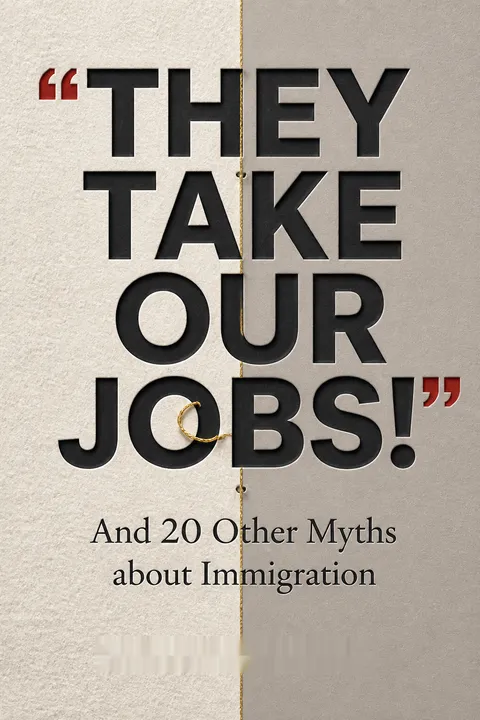
"They Take Our Jobs!" And 20 Other Myths About Immigration receives mostly positive reviews for its well-researched debunking of common immigration myths. Readers appreciate Chomsky's historical context, clear writing, and thorough analysis of complex issues. Many find the book eye-opening and informative, praising its ability to challenge misconceptions. Some critics feel it lacks sufficient citations in places or may not change strongly held opposing views. Overall, reviewers recommend it as an important resource for understanding immigration debates, though some note its leftist perspective.
People Also Read








Glossary
Dual labor market
Protected and unprotected job tiersA model of employment divided into a primary sector and a secondary sector. Primary jobs generally offer stronger regulation, safer conditions, benefits, stability, and recognized organizing rights. Secondary jobs tend to pay less, offer little security or advancement, and provide weaker protections. The book uses the concept to explain why immigrants and other marginalized workers are concentrated in more vulnerable work.
Race to the bottom
Competition to lower business costsA competitive process in which governments and communities try to attract or retain companies by offering lower wages, taxes, and regulatory costs. The book argues that workers and places are pressured to accept poorer conditions because businesses can move production to locations with cheaper labor or fewer protections. This dynamic occurs across countries and within the United States.
Neoliberalism
Market-first economic policyIn the book, neoliberalism describes policies that reduce public spending and regulation, privatize state-owned enterprises, encourage foreign investment, and prioritize exports and market competition. Chomsky argues that these policies weakened social protections in the United States and many poorer countries, while contributing to inequality, insecure work, and migration.
Remittances
Money migrants send homeFunds that migrants send to relatives or communities in their country of origin. Families may use them for food, health care, education, housing, or other needs. Remittances can support households and local projects, but their broader effects vary: spending may also support imports, financial transfer businesses, or economic patterns that do not create enough local jobs.
Operation Gatekeeper
U.S. border enforcement operationA U.S. border enforcement initiative launched in 1994 that concentrated policing and physical barriers around the San Diego crossing area. Chomsky describes how enforcement redirected crossings toward more dangerous desert routes. The operation is used to illustrate how border policy can increase deaths, crossing costs, and reliance on smugglers without significantly reducing migration.
Internal colonialism
Subordination within a stateA concept used by scholars to describe how groups incorporated into a country through conquest or other unequal processes can remain politically, economically, and socially subordinated. The book applies it to the histories of people such as Native Americans, Mexican Americans, Puerto Ricans, and African Americans, whose presence cannot be explained simply as voluntary immigration.
FAQ
What's "They Take Our Jobs!" by Aviva Chomsky about?
- Debunking Myths: The book addresses 21 common myths about immigration in the United States, challenging misconceptions and providing historical context.
- Economic Impact: It explores the economic roles of immigrants, arguing against the belief that they take jobs from American citizens.
- Legal and Racial Issues: Chomsky examines the legal framework and racial dynamics that have historically shaped U.S. immigration policy.
- Historical Context: The book provides a historical perspective on how U.S. policies have influenced immigration patterns and attitudes.
Why should I read "They Take Our Jobs!" by Aviva Chomsky?
- Informed Perspective: Gain a well-researched understanding of immigration issues, debunking common myths with factual evidence.
- Historical Insight: Learn about the historical context of immigration laws and their impact on current policies.
- Broader Understanding: The book offers insights into the economic, legal, and racial aspects of immigration, providing a comprehensive view.
- Challenge Preconceptions: It encourages readers to question and rethink widely held beliefs about immigrants and their role in society.
What are the key takeaways of "They Take Our Jobs!" by Aviva Chomsky?
- Myth Busting: The book systematically debunks myths about immigrants taking jobs, not paying taxes, and being a drain on the economy.
- Economic Contributions: Immigrants contribute significantly to the economy, often taking jobs that are hard to fill and paying taxes.
- Legal Discrimination: U.S. immigration laws have historically been shaped by racial and economic discrimination.
- Global Context: Immigration is part of a larger global system influenced by historical and economic factors.
How does Aviva Chomsky debunk the myth that immigrants take American jobs?
- Global Economy: Chomsky argues that the global economy makes the concept of "American jobs" outdated, as jobs are not confined by national borders.
- Job Creation: Immigrants often create jobs by increasing demand for goods and services, which can lead to more employment opportunities.
- Economic Shifts: The decline in certain job sectors is more related to economic shifts like deindustrialization and deregulation than to immigration.
- Elastic Job Market: The job market is elastic, meaning that population growth can lead to job creation rather than job scarcity.
What does Aviva Chomsky say about immigrants and taxes in "They Take Our Jobs!"?
- Tax Contributions: Immigrants, regardless of their legal status, pay various taxes, including sales, property, and income taxes.
- Social Security: Many undocumented immigrants contribute to Social Security without being able to claim benefits, effectively subsidizing the system.
- Informal Economy: While some immigrants work in the informal economy, this is not unique to them and also includes citizens.
- Economic Benefit: Overall, immigrants contribute more in taxes than they consume in public services, especially at the federal level.
How does "They Take Our Jobs!" address the myth that immigrants are a drain on the economy?
- Economic Contribution: Immigrants contribute to the economy by filling essential roles and paying taxes.
- Local vs. Federal Impact: While immigrants may use local services, they contribute significantly to federal taxes, often more than they receive in benefits.
- Generational Accounting: The book discusses how the descendants of immigrants contribute more in taxes over time, balancing initial costs.
- Misconceptions: Chomsky argues that the perception of immigrants as a drain is based on misconceptions and selective data.
What insights does Aviva Chomsky provide on U.S. immigration laws?
- Historical Discrimination: U.S. immigration laws have historically been shaped by racial and economic discrimination, favoring certain groups over others.
- Legal Complexity: The book explains the complexity of immigration laws and how they create arbitrary distinctions between "legal" and "illegal" immigrants.
- Policy Impact: Chomsky discusses how policies have been used to control and exploit immigrant labor while denying them rights.
- Reform Needs: The book advocates for more humane immigration policies that recognize the contributions of immigrants.
How does "They Take Our Jobs!" explore the relationship between immigration and race?
- Racial Constructs: Chomsky examines how racial constructs have influenced immigration policies and public perceptions.
- Historical Context: The book provides historical examples of how race has been used to justify exclusionary immigration laws.
- Assimilation Challenges: It discusses the challenges faced by immigrants of color in assimilating into a society structured by racial inequality.
- Ongoing Issues: The book highlights how racial dynamics continue to affect immigration debates and policies today.
What does Aviva Chomsky say about the global context of immigration?
- Colonial Legacy: Immigration patterns are influenced by historical colonial relationships, with people moving from former colonies to colonizing countries.
- Economic Inequality: Global economic inequality drives migration, as people seek better opportunities in wealthier countries.
- Policy Influence: U.S. foreign and economic policies have contributed to conditions that drive immigration from certain regions.
- Interconnected Systems: The book emphasizes that immigration is part of a larger global system shaped by historical and economic factors.
What are the best quotes from "They Take Our Jobs!" and what do they mean?
- "Immigrants are blamed for a host of social ills and compared unfavorably to previous generations of immigrants." This quote highlights the scapegoating of immigrants for societal problems, despite their contributions.
- "The prosperity of some within our borders has always depended on the cheap labor of others from both inside and outside our borders." It underscores the historical reliance on immigrant labor for economic growth.
- "There is no real logic to excluding people from rights based on immigration or citizenship status." This challenges the fairness of laws that deny rights to immigrants.
- "Expanding democratic rights downward benefits everyone, especially those at the lower end." It advocates for extending rights to immigrants as a means of improving society as a whole.
How does Aviva Chomsky address the myth that immigrants don't assimilate?
- Language Acquisition: Immigrants are learning English at similar rates to past generations, with many becoming bilingual.
- Cultural Integration: While immigrants maintain cultural ties, they also integrate into American society, contributing to its diversity.
- Racial Barriers: The book discusses how racial barriers, rather than a lack of assimilation, often hinder immigrants' upward mobility.
- Generational Changes: Over generations, immigrant families tend to assimilate more fully, with children and grandchildren adopting American cultural norms.
What solutions does Aviva Chomsky propose for immigration issues in "They Take Our Jobs!"?
- Policy Reform: Chomsky advocates for humane immigration policies that recognize the contributions of immigrants and provide pathways to legalization.
- Economic Justice: Addressing global economic inequality is crucial to reducing the need for migration and improving conditions in immigrants' home countries.
- Rights Expansion: Extending full legal rights to immigrants would reduce exploitation and improve their ability to contribute to society.
- Global Cooperation: The book calls for international cooperation to create a more equitable global system that addresses the root causes of migration.
About the Author
Other books by Aviva Chomsky
Download PDF
Download EPUB
.epub digital book format is ideal for reading ebooks on phones, tablets, and e-readers.








