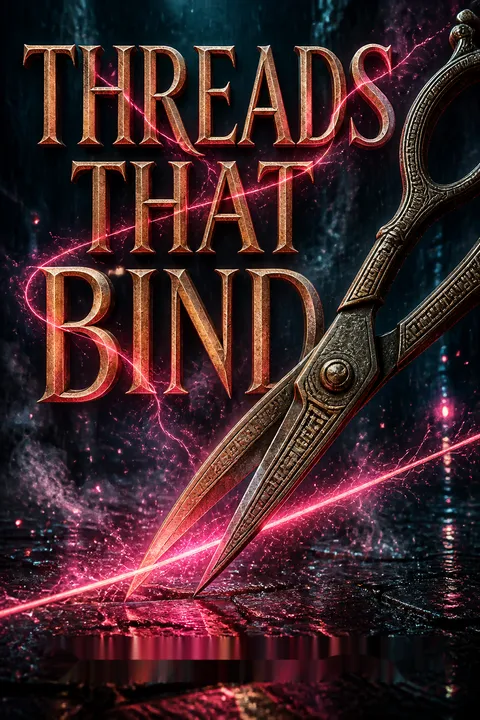


Plot Summary
Prologue
In Alante, an elderly woman crosses the flooded streets with a shopping cart, fearing a creature that clings to girls’ shadows. She ties an invisible knot against Fate, a gesture that cannot protect her. At home, an unseen attacker covers her mouth and cuts the life-thread she cannot see.
Her neighbor hears the struggle, but the woman’s final sound is the snap of a thread. The murder opens the story with an impossibility: someone has severed a life-thread, yet the victim’s killer speaks as if death is not the end.
The prologue turns a familiar protective ritual into a measure of powerlessness. The woman’s knot offers a small human answer to a force she cannot see, while the attacker’s severed thread makes the rules of the world feel suddenly vulnerable. Her upper-class coat and modest groceries also place fear across the city’s class divisions: the danger reaches beyond the impoverished district where it will soon become a public mystery. Most importantly, the scene plants a contradiction before Io can explain it. A cut life-thread should mean death, yet the attacker’s words suggest continued purpose. The murder is both a threat and a question.
The Dead Thread
Private investigator Io Ora watches a client’s husband, Jarl Magnussen, meet his assistant in a secret apartment. Through the Quilt, the web of attachments only her Fate-born family can see, she notices another figure with a single severed life-thread. Io runs to intervene and finds Jarl dead, his lover hiding, and the attacker an old woman whose own life-thread hangs loose.
The woman attacks Io, accusing the people around her of crimes and wielding the severed thread like a weapon. Io escapes when the attacker falls from a window into the floodwater. Then a young man arrives, and a bright thread inside Io pulls taut toward him. She recognizes him as the person she is destined to love, though she has avoided meeting him for years.
The mystery begins by making Io’s professional skill inseparable from moral risk. Her sight lets her identify the killer’s impossible condition, but it cannot tell her why the woman believes she is delivering justice. The fate-thread’s sudden connection to Edei makes private destiny collide with public danger at the very moment Io has barely survived. That collision is not simply romantic coincidence. Io has long treated the thread as a promise she can keep at a distance; now it points toward a person who may have his own attachments and choices. The case asks whether seeing a bond gives Io the right to act on it.
A Cutter's Necessary Choice
After the police escort Io home, they scrutinize her and her sister Ava because Io is a cutter, a power the public fears. Edei Rhuna, the man from the apartment, arrives with a summons from Bianca Rossi, the Fortuna gang’s ruler. Bianca has already captured the attacker, and Io confirms the old woman’s life-thread is severed even though she is still moving.
The woman hints at other killers and turns her thread on Bianca. A gang member’s shot fails to stop her, so Io cuts the woman’s thread with one of her own, ending her life and saving Bianca. The cost is personal: Io loses her affection for a favorite pastry. Bianca hires her to investigate the killings and insists Edei work beside her.
Io’s choice makes the mechanics of her power emotionally legible: cutting is not a clean act of force but an exchange that removes a piece of her own attachments. The lost pastry thread is small beside a life, yet its triviality sharpens the cost. Bianca immediately treats the rescue as evidence that Io belongs on the case, while the police treat her very capacity to cut as grounds for suspicion. Those competing judgments set the social terms of the novel. Io is useful to powerful people precisely where she is distrusted, and she must decide whether necessity excuses the arrangements they impose on her.
The Missing Registry
Edei briefs Io on two earlier killings in the Silts, both of men with other-born powers and both linked to the same uncanny strangulation. Their investigation points toward a deliberate pattern, not an isolated attacker. At Jarl’s apartment, they find journalist Xenophon Atreidis already searching the scene.
He reveals that the police have removed other-born records from public access, an abrupt change connected to Commissioner Luc Saint-Yves’s proposed Initiative for a New Order.
The Initiative promises to enlist other-born in policing, but the missing records could conceal the killers’ identities. Io concludes that the evidence they need is probably inside police headquarters. Edei agrees to help her break in, turning a detective’s inquiry into a direct challenge to the city’s authorities.
The registry’s disappearance converts a supernatural mystery into a question about who controls public knowledge. The same records that expose other-born residents to discrimination could also identify the women, so their removal is simultaneously protective and suspicious. Io and Edei cannot simply trust the official investigation, yet they do not have enough evidence to accuse the Commissioner. Their break-in is therefore not heroic certainty but a gamble driven by institutional opacity. Xenophon’s reporting adds another pressure: a story can uncover abuse, but it can also frame a vulnerable group as dangerous. The case is already about the politics of evidence as much as the murders.
Files Above the Flood
Io and Edei cross a narrow construction beam into police headquarters and search the Commissioner’s office. The files identify the first killer as Emmeline Segal and the older attacker as Drina Savva; neither woman appears in the other-born registry.
Both had been linked twelve years earlier to the same alleged kidnapper, Horatio Long. A separate file gives Io the shock of finding her estranged sister Thais’s current address in the wealthy Hill district. Before they can investigate further, officers converge on the office.
Io and Edei escape along an exposed ledge and scaffold while police fire at them. Edei is hit in the shoulder. To get away, Io cuts a thread belonging to her childhood friend Rosa Santos, who is now among the officers pursuing them.
The break-in produces two kinds of exposure. The case files reveal that the presumed supernatural killers had ordinary identities and a history of attempted abduction, while Thais’s address reveals that Io’s family story has continued without her knowledge. Io’s attention shifts at the worst possible moment, and the consequences are bodily: Edei is shot and Rosa loses a bond to her grandmother when Io cuts the wrong thread. This is the first clear demonstration that Io’s power can harm people she loves even when she means to protect them. The escape advances the investigation, but it leaves her more entangled in the relationships she has avoided.
The Docks' Bait
Bianca’s gang locates Horatio Long running illegal chimerini fights at the Docks, and Io and Nico pose as wealthy visitors to question him. Horatio is not merely a former kidnapper: he is a grace-born, able to bend another person’s will through an invisible thrall. He uses it to lead Io away from the crowd and tries to rob her.
Io resists by grabbing his life-thread and forcing him to release his hold. Under pressure, Horatio admits that he was hired years earlier to kill Emmeline, Drina, and a girl named Raina, but let them escape. Before Io can question him further, Raina attacks. She kills Horatio and nearly strangles Io, who is saved when Edei and Nico reach the beach.
The encounter makes coercion the case’s central moral problem. Horatio’s thrall turns apparent cooperation into captivity, just as the wraiths’ claims of justice may conceal someone else’s control. Io survives by using her own power as a threat, an unsettling mirror of the man she is investigating. Horatio’s confession supplies a direct link to the killers’ past, but Raina’s arrival prevents easy closure. Her attack also complicates the image of the wraiths: they are dangerous, yet their violence appears rooted in a history that powerful people tried to bury. Io can no longer treat the case as a routine investigation.
The Muses' Prophecy
Io and Edei visit the House of Nine, where the Muse sisters confirm that they instructed Horatio to remove the women twelve years earlier because their artists’ visions seemed to predict disaster. The Muses cannot identify who transformed the women, but they say the killers carry divine power.
Instead of explaining how to save Raina, they demand that Io ask what thread she will cut, claiming their artists have repeatedly pictured her ending the world. Io leaves without giving them the answer. Outside, a phobos-born man named Aris Lefteriou traps her and Edei in terror and interrogates them about what the Nine know. Edei breaks free long enough to strike Aris, and Io keeps hold of one of his threads, giving them a trail to follow.
The Nine weaponize uncertainty by making their knowledge feel both sacred and compulsory. Their prophecy threatens to turn Io’s defining ability into a predestined catastrophe, while their refusal to answer her practical question keeps her dependent on their authority. Edei’s anger at their manipulation helps Io see that mystique does not make power benevolent. Aris’s attack then shows that the political world is listening closely to what the Muses know, especially the question of who made the women. Io’s refusal to ask the prophecy’s question is a small but meaningful act of agency. She chooses evidence and immediate responsibility over an answer designed to frighten her.
The Candidate's Fiancée
Following Aris’s thread leads Io, Edei, Nico, and Chimdi to the Teatro Blanco, where Saint-Yves presents his Initiative to wealthy supporters. He introduces Thais Ora as his fiancée and a leading other-born volunteer.
Io has not seen her sister since Thais left two years earlier, and the public announcement makes their distance suddenly visible. The group follows the Initiative team into the rain, but Aris’s people search for them. Rosa, now working undercover for journalist Xenophon, helps Io and Edei escape into a shelter.
There Rosa explains that she joined the Initiative’s security team to investigate Saint-Yves, and found evidence that Emmeline and Drina had volunteered for it. She also learned that Saint-Yves had unsuccessfully prosecuted the victims before their deaths.
Thais’s public appearance turns a private wound into a political complication. Io must assess a sister who has built a new life beside a man already implicated by the evidence, without yet knowing whether either is culpable. Rosa’s return offers a contrasting model of intimacy: she can challenge Io directly, but she also helps her escape when danger becomes immediate. The Initiative’s promise of inclusion now sits beside the fact that its volunteers became victims and its leader’s old cases overlap with the murders. These details create suspicion without certainty, a pressure that forces Io to distinguish what she knows from what she fears.
A Friend Behind the Gun
As the pursuers search the shelter, Aris names the murdered men and signals that Saint-Yves is tied to the case. At dawn, Rosa explains that the police had classified Emmeline and Drina as Initiative volunteers, then marked the records for destruction.
Saint-Yves had also tried to prosecute Jarl, Minos, Konstantin Fyodorov, and Horatio, but every case was dismissed before trial. Her findings make him a plausible suspect, though not a proven killer.
Io and Edei bring the evidence to Bianca, who orders them to abandon the inquiry rather than risk war with the Commissioner. Io refuses, condemns Bianca’s retreat, and leaves with Ava. The sisters take refuge at Amos’s café, where Ava argues that protecting their family may require them to stop investigating.
Rosa’s reporting gives the mystery its strongest institutional pattern so far, but it still does not establish who controls the wraiths. The distinction matters: a failed prosecution can create motive, yet suspicion is not proof. Bianca’s order to stop is more than self-preservation; it exposes how the Silts survive by accepting a local ruler’s limits in place of faith in distant authorities. Io rejects that bargain, while Ava sees the danger it invites into their home. Their disagreement is not courage versus cowardice. It is a conflict between protecting people already at risk and refusing to let safety depend on silence.
Coffee Before the Attack
Io goes to Thais’s home on Hanover Street, hoping to warn her about Saint-Yves and the Initiative. Thais greets her warmly, apologizes for their estrangement, and invites her in, but her affection hardens when Io explains the evidence against her fiancé.
Thais insists Saint-Yves is trying to rebuild a fairer system and refuses to leave him. During a meeting at the house, Raina arrives and attacks Saint-Yves. Thais fights to protect him, and Io pulls Raina away, but the wraith turns on Thais.
With her sister in immediate danger, Io cuts Raina’s life-thread and kills her. In the aftermath, Io finds Fortuna brass knuckles on Raina’s body and hides them, fearing they will implicate Bianca’s gang. Thais comforts Io, while Saint-Yves suspects the attack is part of a larger plot.
The attack collapses Io’s roles as investigator and sister into one decision. She has spent the case trying to save the wraiths from whoever directs them, but when Raina threatens Thais, Io chooses the life in front of her. The choice is necessary and still costly; it ends the only direct route to Raina’s testimony. Thais’s brief tenderness gives Io a glimpse of reconciliation, but their disagreement over Saint-Yves remains unresolved. The brass knuckles deepen the uncertainty rather than settle it, because they could implicate Bianca or have been planted to do exactly that. Every act of protection now risks becoming evidence against someone else.
Bianca's Red Memory
Io, Edei, and Rosa enter Bianca’s dream through a dream palace, hoping her memories will clarify the Moonset Riots and the killings. They witness Bianca’s younger self recruiting other-born men to stop a massacre, including several men later murdered by the wraiths. In the memory, Bianca uses a red mist to return a dying girl to battle.
Io recognizes the sign of a keres-born, someone who can affect violent death, and realizes Bianca helped shape the Riots’ final violence. Before they can see more, Aris enters the dream and the vision turns against them. They wake as police raid the room. Saint-Yves arrests Bianca, and the public learns of her hidden power. With Bianca in custody, the Silts begin to erupt into unrest.
The dream gives Io evidence, but not the simple answer she expects. Bianca’s power connects her to death and survival at once: she can prolong a soldier’s life, yet that rescue sends the girl back into battle. The memory therefore resists a clean division between protector and perpetrator. Aris’s intrusion also shows that even private recollection is vulnerable to political force. Bianca’s arrest appears to settle the question publicly, but it destabilizes the Silts instead. The plot’s deeper concern emerges here: a society hungry for a single guilty figure may mistake the exposure of one secret for the resolution of a history.
The Furies' Last Day
After Bianca’s arrest, the election victory for Saint-Yves heightens tension in the Silts. Io and Edei visit Nina Panagou, the woman who survived Drina’s attack. Nina confirms she fought in the Moonset Riots and explains that the supposed rogue gang was actually the Order of the Furies. The Fury-born had executed other-born without trials, and Bianca’s fighters killed them in return.
The wraiths are seeking vengeance for the destruction of their line. Io and Edei then reach Bianca’s cell and find her life-thread severed, though she is still alive. Believing the Nine may know how to save her, they take Bianca from the jail and carry her to the House of Nine. Their rescue attempt brings them into the heart of the mystery’s next violence.
Nina’s account overturns the civic legend that the Moonset Riots were a gang war with an anonymous enemy. The secret was not simply who fought, but that a supposedly impartial institution had become an execution force. Bianca’s later reputation as the Silts’ savior rests on a founding act that the district could not safely discuss. Yet the wraiths’ vengeance does not restore justice; it repeats the same logic of punishment without trial. Finding Bianca’s severed thread puts that contradiction in the present tense. Io must rescue someone she suspects of grave wrongdoing because allowing her to die would make the new cycle of violence irreversible.
The Nine Pay in Blood
At the House of Nine, Bianca breaks free before the Muses can help her. Her severed thread becomes a whip, and she kills five of the sisters and several guards. Io is badly hurt while Edei gets the surviving Muses out. When Bianca turns on Io, Io recognizes that she is still capable of thought and persuades her to stop.
Bianca remembers that the Nine helped orchestrate the Furies’ destruction and insists she was never told the full plan. Io also realizes someone arranged Bianca’s escape from the cell, knowing she would bring the wounded woman to the Muses. Bianca agrees to help Io expose that hidden enemy. Io calls Thais to the greenhouse, gathers Bianca’s scattered life-thread, and prepares to force a confession.
The massacre transforms the Nine from distant arbiters into participants in the violence they once tried to manage. Bianca’s attack is brutal, but her regained self-possession prevents the scene from becoming a simple monster-versus-victim encounter. Io does not absolve Bianca; she recognizes that the woman can still choose what to do next. This distinction is crucial to the novel’s ethics. A person’s history explains the conditions of an action without erasing responsibility for it. The staged rescue also reveals an adversary who understands Io’s compassion and uses it as bait. Her strength now depends on seeing care as a choice others may exploit.
The Sister's Confession
Thais arrives at the greenhouse, where Io has seized her threads and refuses to let her leave. Under pressure, Thais admits that she chose women with diluted Fury ancestry and, following instructions from an unseen patron, rewove their threads into weapons. She believed the process would restore the Furies, but the women’s life-threads frayed and they died.
Thais says she acted to avenge the murdered order and protect the world. Bianca, Rosa, Ava, and Saint-Yves emerge to witness the confession, while Rosa photographs it. Thais then reveals that Io’s earlier manipulation of her home-thread helped convince her to join the cause. Io releases Thais’s threads. Thais calls Ava to her side, and the greenhouse goes dark as gunshots sound.
The confession turns the sisters’ intimate history into part of the political conspiracy. Thais has repeated the pattern Io feared: she attached herself to a grand cause, accepted coercive means, and called the harm necessary. But Io’s own past manipulation gave Thais a real grievance, not merely an excuse. The confrontation refuses the comfort of assigning all guilt to one person. Io’s decision to release Thais’s threads is ethically significant because she stops using the same power that made their family rupture possible. The blackout leaves the family’s bonds unresolved, but Io has at least abandoned control as a substitute for trust.
The Thread Beyond Alante
In the darkness, Saint-Yves fires at the fleeing sisters and hits Edei in the abdomen; a bullet also wounds Io’s leg. Bianca slows Edei’s bleeding with her keres-born power while Rosa summons help and Samiya rushes to treat him. Io sees that the hidden patron’s thread, which she took from Thais, leads beyond the city.
Edei urges her to follow it before the police seal Alante, promising he will find her once he recovers. Io leaves him in Samiya’s care and crosses the rooftops with Bianca. At the city’s edge, Bianca asks for vengeance against whoever made her into a wraith. Io agrees to help if Bianca helps her find the gods, whose existence the case has finally made impossible to dismiss.
The ending converts the mystery’s answer into a new obligation. Io now has a tangible trail to the beings who manipulated Thais, the Furies, and the wraiths, but following it requires leaving Edei while he is gravely wounded. Their parting does not resolve their feelings; it tests whether affection can survive without possession or certainty. Bianca’s alliance is similarly unstable, founded on shared enemies rather than trust. The cat bridge recalls Io’s fear of edges, but this time she crosses because remaining still would mean accepting another person’s version of justice. The final choice is not destiny fulfilled. It is a chosen risk.
Analysis
Threads That Bind builds its murder mystery around a world where relationships are literally visible, then refuses the easy conclusion that visibility equals understanding. Io can read the brightness of a bond, but not its moral meaning. Her investigative gift makes her attentive to connection while leaving her vulnerable to misjudging motive, especially when family loyalty, romance, and political power overlap. The Quilt is not an objective verdict. It is evidence that still requires interpretation.
The novel’s deepest conflict is between justice and the authority to define it. The Order of the Furies, the Nine, Bianca, Thais, and Saint-Yves all claim that their actions protect the world or restore order. Each claim is entangled with real harm. The Fury-born commit executions without trial; Bianca’s response saves the Silts while contributing to their destruction; Thais pursues justice by transforming vulnerable women into weapons. These choices do not become equivalent, but the story insists that good intentions cannot erase consequences. Nor does injury automatically make a person incapable of wrongdoing.
Io’s personal arc gives this political argument its intimate form. She begins by treating fear as a reason to delay, and love as a bond she should either obey or cut. Her histories with Thais and Edei teach her that neither fate nor loyalty grants ownership over another person. She learns to admit what she has done without turning shame into a life sentence, and to accept that loving someone does not absolve their cruelty. The final choice to pursue the gods is therefore not passive submission to prophecy. Io acts because she has decided the buried truth matters, even when the cost is separation from the people she loves.
The ending leaves justice unfinished. The hidden gods remain beyond reach, Bianca’s vengeance is still active, and Edei is left behind to recover. That incompletion is essential: the book does not confuse solving a case with repairing a system. It closes on a new alliance and a chosen crossing, carrying forward the question of whether power can be made accountable before its next victims are turned into instruments.
Review Summary
Threads That Bind received mixed reviews, with many praising its unique magic system, intriguing world-building, and incorporation of Greek mythology. Readers enjoyed the fast-paced mystery and complex characters. Some found the romance compelling, while others felt it was unnecessary. Critics noted issues with pacing, information overload, and confusing plot elements. The book's ending left many eager for the sequel, though some were disappointed to learn it wasn't a standalone. Overall, it's recommended for fans of YA fantasy and Greek mythology retellings.
People Also Read


Characters
Io Ora
Fate-reading investigatorThe youngest of three moira-born sisters, Io is a private investigator who sees the Quilt of attachments between people and can cut threads, including life-threads. She has a remarkable memory for connections and an instinct for patiently watching until a pattern emerges, but anxiety and fear of rejection often make her postpone difficult choices. Her many bright threads reflect a capacity for attachment that she sometimes treats as a liability. She cares deeply for her sisters and her childhood friend, yet has learned to hide truths when she fears their judgment. Io’s central tension is between seeing bonds as fate and recognizing that love, loyalty, and responsibility still require choices.
Edei Rhuna
Gentle gang lieutenantA Sumazi immigrant and Bianca Rossi’s trusted second, Edei works in the Fortuna gang while trying to limit the violence around him. He is observant, steady under pressure, and attentive to the small details other people miss. His loyalty is shaped by practical gratitude: Bianca gave him and Samiya a chance to establish themselves in Alante when prejudice and immigration barriers left them vulnerable. Edei’s interest in folklore and stories reveals a mind drawn to patterns across cultures, while his instinct to protect others can pull him into danger. He values personal choice, a conviction that complicates his loyalties to both Bianca and Io.
Thais Ora
Ambitious eldest sisterThais is Io and Ava’s eldest sister, who took on adult responsibilities after their parents died. A gifted weaver, she can create and alter threads, and she has long believed that disciplined work can improve both a person and the world around them. Her ambition is tied to a deep desire to escape the limits imposed on other-born people and to find a place where her abilities matter. She can be fiercely protective and generous, but her certainty about what is best for others can become controlling. Thais’s ideals and her need for recognition often pull in opposite directions, making her both an inspiring presence and a difficult family authority.
Ava Ora
Peacekeeping middle sisterAva is the middle Ora sister, a singer and drawer who can strengthen or weaken the feelings attached to a person’s threads. Warm, playful, and socially perceptive, she often uses humor and practical care to keep her family close. Her reluctance to choose sides is partly a form of compassion, but it can also leave painful truths unspoken. Ava is more ambitious than her easygoing manner suggests, and her musical aspirations give her a strong sense of identity beyond the family. She loves Io fiercely and wants to keep her safe, though protection sometimes means asking Io to avoid risks Ava cannot bear to share.
Bianca Rossi
Silts gang queenBianca rules the Silts through the Fortuna gang, combining theatrical authority with a practical concern for the district’s safety. She has built a system that keeps bridge extortion and predatory gangs in check, but she expects loyalty and enforces her rules with force. Her reputation is both an asset and a warning: residents depend on her where city officials will not help them, while outsiders see a ruthless criminal. Bianca’s command of a room comes from understanding that people often accept dangerous protection when the alternatives are worse. Beneath her polished control lies a complicated relationship to the violence that made her power possible.
Rosa Santos
Dream-reading journalistIo’s oldest friend, Rosa is an oneiroi-born woman who can influence sleep and enter dreams. She is quick-witted, loyal, and unafraid to confront Io when avoidance begins to damage their friendship. Rosa wants to become an investigative journalist, and her undercover work gives her access to political circles that would otherwise shut her out. Her ambition does not erase her affection for Io, though it sometimes places them on opposite sides of a dangerous operation.
Luc Saint-Yves
Reform-minded commissionerAlante’s Police Commissioner and a candidate for mayor, Saint-Yves promotes a new police initiative that would recruit other-born investigators and officers. He is charismatic, polished, and politically astute, with a personal history in the Iceberg Corps and the law. His public case for reform appeals to people who want a fairer system, but his rise depends on winning the confidence of groups with very different interests. Saint-Yves sees himself as a practical reformer, a self-image that can make his methods and compromises difficult for others to judge.
Raina
Young thread-wielding killerRaina is a young woman whose life-thread has been severed, leaving her with abnormal strength and a thread she can use as a weapon. She pursues people she believes have committed grave crimes and speaks with the certainty of someone acting on a higher mandate. Her appearances suggest that her violence is connected to older events and that she is not acting entirely alone. Raina is frightening in close combat, but her insistence on justice hints at a history that has been hidden from her victims and from the city.
Nina Panagou
Surviving witnessNina is Jarl Magnussen’s assistant and secret partner, a guarded woman who survives the attack that kills him. She is protective of her family and cautious around the police, whose attention can be dangerous for people in the Silts. Her past connects her to the violence of the Moonset Riots, though she has spent years keeping that history private. Nina’s reluctance to speak is not simple evasiveness; silence is a survival strategy shaped by an agreement enforced through fear.
Samiya
Horus-born healerSamiya is a Sumazi horus-born doctor who can heal injuries. She is Edei’s former partner and housemate, and she provides medical care to the Fortuna gang despite their rough surroundings. Her commitment to treating patients includes helping women with reproductive care, even when that work draws threats. Samiya is clear-eyed about the compromises immigrant other-born make to secure residency and safety. She values Edei deeply but does not treat him as her possession, and she expects people to take responsibility for their loyalties.
Horatio Long
Dockside fight promoterHoratio is an ex-sailor and black-market operator who runs chimerini fights and takes jobs from whoever can pay. His grace-born power allows him to influence people through a supernatural thrall. He is practiced at turning danger into profit, and his past dealings with vulnerable women make him central to the old history behind the present killings. Horatio’s survival depends on assuming that everyone has a price and that the powerful will protect him when necessary.
Aris Lefteriou
Phobos-born security chiefAris heads security for Saint-Yves and can overwhelm people with terror when he catches their gaze. He is disciplined, capable, and convinced that his actions are defensive, even when he is stalking and interrogating others. His position gives him access to the Commissioner’s plans and places him between the Initiative and those investigating it. Aris is accustomed to being feared, but he also resents the assumption that his power makes him automatically villainous.
Xenophon Atreidis
Investigative newspaper reporterXenophon writes for The Truth of Alante and has a taste for political scoops. Once Io’s schoolmate and antagonist, he has become a reporter willing to pursue stories the city’s polished institutions would rather suppress. His confidence can curdle into smugness, but his instinct for hidden connections makes him useful to Rosa’s work and to the investigation.
Nico
Fortuna storytellerA young Fortuna member, Nico is a talkative redhead with a gift for turning a cover story into convincing theater. His humor helps ease the strain of dangerous work, and his loyalty to Edei and the gang is practical rather than grand. He is willing to accompany Io into risky situations, even when he knows he is not the strongest person in the room.
Chimdi
Fortuna ceramic artistChimdi is a skilled Anoch ceramic artist and Fortuna member whose intricate sculptures once drew the attention of the Nine. She is blunt, capable, and deeply wary of people who claim to offer help while expecting control in return. Her past dealings with the Muses shape her distrust of powerful patrons, while her friendship with Edei and Nico gives her a place among people who value her beyond her art.
The Nine
Housebound Muse sistersThe Nine are descendants of the Muses, a rare sisterhood whose powers allow them to learn truths through artists and their work. They maintain an aura of mystique and exert enormous influence over Alante’s cultural life. Their knowledge can be valuable, but their services come with terms, and they are skilled at presenting self-interest as divine necessity. The Muses regard their interpretations as authority, a posture that makes it difficult for others to challenge their decisions.
Jarl Magnussen
Murdered investment brokerJarl is an investment broker whose private life becomes the first case Io is investigating when he is killed. He is connected to both his wife, Isidora, and his assistant, Nina. His death reveals that the murders may target corrupt or compromised other-born men.
Amos Weinstein
Café owner and confidantAmos owns a coffee shop in Parsley Square and gives Io and Ava a place to stay when their apartment becomes unsafe. A veteran of the Iceberg Corps, they are thoughtful, generous, and more observant of Io’s romantic feelings than she realizes. Their café offers practical shelter as well as a rare pocket of calm in the Silts.
Plot Devices
The Quilt
Makes bonds visibleThe Quilt is the web of silver threads that moira-born people can see extending from a person toward what they love or value. Io uses it to follow suspects through buildings, read emotional attachments, locate people, and identify life-threads. The threads make private relationships visible, but they do not automatically reveal the truth of those relationships. Io can see a connection without knowing what it means, and her interpretations remain subject to error. The Quilt also limits her in physical danger: focusing on it can make her less aware of the ordinary world around her.
Fate-threads
Destiny meets consentA fate-thread appears before its connection has been consciously formed and points toward a person or bond a moira-born is destined to love. Io has known for years that her thread leads to Edei, but she avoids seeking him out because she does not want to impose a supposed destiny on someone who has not chosen her. The thread shapes their attraction and gives Io a way to locate him, yet it cannot settle whether their feelings are freely chosen. It embodies the story’s central conflict between prediction and agency.
Severed life-threads
A weapon and a warningA life-thread normally connects a person to life itself. Io’s established understanding is that cutting one causes death, so the walking killers with severed threads are an impossible sight. The wraiths wield their loose threads like whips, strangling victims while their own bodies decay. Their condition drives the murder mystery and raises questions about who altered the known limits of other-born powers. Bianca’s unusual state eventually demonstrates that the phenomenon can combine with another power in a way Io has never seen.
Other-born powers
Myth becomes daily lifeThe children of surviving gods inherit powers associated with their divine ancestors, usually in sibling groups. Moira-born can weave, draw, or cut threads; grace-born can enthrall; oneiroi-born influence sleep and dreams; horus-born heal; and phobos-born induce terror. These defined abilities shape employment, discrimination, law, and criminal tactics across Alante. Their limitations make the world feel governed by rules, which is why the wraiths’ new abilities are so disturbing. The system also exposes how society labels some powers useful, others criminal, and still others desirable.
Roosters' Silence
Enforces a buried historyAfter the Moonset Riots, the surviving gang leaders agree not to identify the force responsible for the slaughter or expose what happened. The vow helps the Silts rebuild without immediate reprisals, but it also prevents victims and survivors from obtaining public accountability. Bianca enforces the silence within her gang, while the hidden history gives the present murders their motive and context. The device shows how a community can use secrecy to prevent one cycle of violence while preserving the injustice that fuels the next.
Threads That Bind Series
Download PDF
Download EPUB
.epub digital book format is ideal for reading ebooks on phones, tablets, and e-readers.








