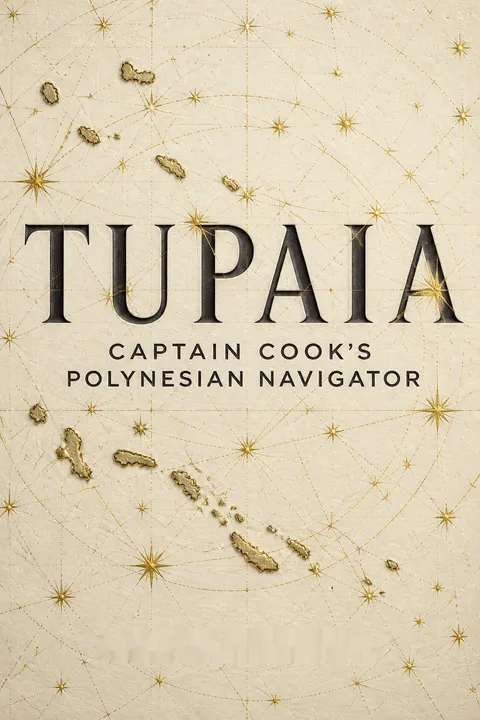


Key Takeaways
Put Tupaia back at the center of Cook's Pacific voyage
A missing co-navigator. For centuries, the famous painting of Joseph Banks bargaining with a Maori man for a crayfish had no known artist. A letter in Banks's papers eventually identified the artist as Tupaia, the Tahitian who sailed with Cook. The painting is a fitting entry point: Tupaia was not simply a passenger but a navigator, priest, diplomat, interpreter, and artist whose knowledge shaped the voyage.
Credit followed the records. Tupaia died in Batavia before the Endeavour returned to England. Cook's official report did not name him, although Cook had relied on his expertise and had acknowledged his usefulness elsewhere. The biography reconstructs Tupaia's life from European journals alongside Polynesian histories, showing how a central contributor could become a footnote when others controlled the written account.
What's striking is that restoring Tupaia's place requires more than adding a neglected name to a familiar expedition. It changes what counts as the expedition's achievement: Cook's voyage depended on knowledge and relationships that the European record treated as background. This is a recurring problem in institutional histories, where the person who files the report often becomes the person credited with the work. The evidence supports a history of unequal recognition, though it does not prove that every omission was a coordinated attempt to erase Tupaia.
Learn navigation as a living system, not a line on a chart
A trained wayfinder. Tupaia began learning navigation as a child, first through stories and then by travelling with experienced navigators. He memorized routes, expected sailing times, star bearings, currents, swells, weather, birds, and signs of reefs. His task was not merely to steer a canoe. He continually estimated where it was and how to reach a destination, even when that place was unfamiliar.
The sea supplied evidence. A cloud reflecting a distant lagoon, a shift in water color, or a change in the swell could reveal land beyond sight. Tupaia could also use the changing outline of an island behind him to check the direction of travel. This was a rigorous system of observation and memory, even though it did not use the instruments or coordinates familiar to European navigators.
Tupaia's practice resembles what researchers call distributed cognition: thinking is spread across a person, learned routines, and features of the environment. The horizon, stars, currents, and bird flight were not scenery but navigational instruments. That perspective challenges the assumption that sophisticated knowledge must be written down or measured in European units. At the same time, the surviving accounts are uneven. They describe what Tupaia noticed more clearly than the full teaching system that enabled him to interpret it.
Translate the ritual before treating a first encounter as aggression
Signals crossed badly. When the British ship Dolphin reached Tahiti in 1767, islanders paddled out carrying plantain shoots associated with peace. The British, sick with scurvy and alarmed by unfamiliar actions, responded to tension with gunfire. At Matavai Bay, a ceremonial exchange escalated into a bombardment that killed and wounded Tahitians. The Europeans read the event as an attack; they did not understand the local signals and obligations shaping it.
A flag meant something else. The British pennant was red, a color sacred to Oro, and its shape resembled a Tahitian royal emblem. Islanders treated it with reverence, while the British mistook their response for hostility. Tupaia later joined the pennant to a sacred royal girdle, incorporating the foreigners' arrival into Tahitian history. Contact was never just a meeting of people. It was a collision of meanings, backed by unequal weapons.
This episode shows why intent cannot be inferred from gestures alone. In cross-cultural encounters, a signal has meaning within a shared protocol, and outsiders may mistake a formal act for a threat. Yet interpretation should not soften the violence: the British possessed overwhelming firepower and repeatedly used it. Cultural confusion helps explain the clash, but it does not make the consequences symmetrical or absolve the choices made by the armed visitors.
Read Tahitian politics as a network, not a single throne
There was no island monarch. Tahiti was divided among districts, chiefs, and rival families. Purea was a powerful noblewoman with an independent claim to rank, and Tupaia became her adviser after arriving as a refugee from Raiatea. When Captain Wallis met her, he mistook her for the queen of the whole island. Tupaia recognized the opening and helped her perform the role Wallis expected, securing trade and political advantage.
A gift could change rank. Wallis wrapped Purea in blue cloth, an unfamiliar color that also recognized her prestige through a local practice of presenting cloth. Tupaia later stitched the Dolphin's red pennant to the maro ura, a sacred royal girdle, turning a foreign emblem into a record of local power. But Wallis sailed away without visiting Purea's district, weakening the alliance she and Tupaia had worked to build.
The episode is a sharp lesson in political translation. Wallis's mistaken idea of a single sovereign did not simply distort Tahitian society; it gave Purea and Tupaia a role they could use. Power here was distributed through lineage, land, ritual, and alliance, rather than concentrated in one office. Their maneuvering also complicates any portrait of Indigenous people as passive recipients of European influence. The limits are important: a successful performance could create an opening, but it could not guarantee that a foreign captain would honor the relationship.
Judge Tupaia's map by its navigation system, not European geometry
A different kind of chart. Tupaia drew a chart containing dozens of Pacific islands, some unknown to Europeans. It did not show latitude, longitude, scale, or distances in the way European navigators expected. Tupaia measured distance through sailing time and organized knowledge around routes and islands. His map may have functioned less as a picture of the world than as a guide to connected passages across it.
The wrong test obscured the evidence. Cook and Banks recorded little about the chart and did not ask Tupaia to explain how he had arranged the islands. Cook instead followed his orders south to search for a hypothetical continent, despite Tupaia's repeated advice to sail west among islands he knew. The chart's meaning remains debated because the people who could have explained it were not asked to do so.
This is a case of incompatible standards of proof. A map designed for a European navigator's coordinate system may be useful for plotting a course, while a route-based chart may preserve a different kind of knowledge. Rejecting one because it fails the other's purpose is a category error. The book's interpretation is persuasive, but its caution matters: without Tupaia's explanation, modern readers cannot confidently reconstruct every feature or intended use. The lost conversation is part of the historical evidence.
Give the interpreter room to turn a standoff into conversation
A shared language changed the meeting. In New Zealand, Maori and Tupaia could understand one another because their languages shared Polynesian roots. When Cook's party met armed warriors after a Maori man had been killed, Tupaia spoke across the river, explained the strangers' intentions, and helped make a tense exchange possible. He could not prevent every death or settle every dispute, but his presence repeatedly gave both sides a way to ask questions and negotiate.
Trust traveled with his name. Tupaia's conversations with Maori included ancestry, religion, and the homeland known as Hawaiki. He also helped interpret practical exchanges, including the return of three young fishermen taken aboard the Endeavour. His reputation spread along the coast. When Cook's second expedition returned, Maori mourned Tupaia, whose name had become more familiar than that of the captain to many people who had encountered the ship.
An interpreter does more than substitute words. Tupaia also explained intentions, recognized local status, and helped create enough trust for people to remain in conversation. That role resembles mediation in conflict resolution, where parties need a credible bridge before they can bargain over facts. But an intermediary is not a magic shield. The Europeans still killed people, seized men, and sometimes ignored Tupaia's counsel. The story makes his contribution clearer without making him responsible for controlling the violence around him.
Respect local claims before labeling a failed exchange theft
Not every gift was currency. At the Endeavour River in Australia, the Guugu-Yimidhirr people showed little interest in the beads, cloth, and other objects Europeans offered. They did respond warmly when a fish accidentally fell into their canoe. Later, they came aboard to claim two sea turtles, a valued seasonal food that they believed belonged to them. The sailors stopped them, and the disagreement led to a fire and a breakdown in relations.
Tupaia could not translate everything. He helped the visitors sit down and communicate through gesture, but he did not speak the local language. The Guugu-Yimidhirr were not simply waiting to be impressed by European goods. Their priorities and rules for sharing were different, and the visitors did not understand them. The encounter ended with the Europeans keeping the turtles and the local people withdrawing from contact.
The turtle dispute exposes a basic weakness in the idea that trade is a universal language. A transaction depends on shared beliefs about ownership, value, and entitlement. The British offered objects that meant little locally, then treated resistance as disorder rather than as a claim. This distinction is useful well beyond history: a refusal may be an informed boundary, not a failure to understand. The account also shows the limit of Tupaia's expertise. His Polynesian fluency did not make every Indigenous society legible to him.
Treat Tupaia's drawings as historical arguments, not curiosities
Pictures carried knowledge. Tupaia drew ceremonial figures, musicians, canoes, and scenes of everyday life. His famous sketch of Banks bargaining with a Maori man captures a contest over a crayfish, but it also records a first encounter from a Polynesian observer's point of view. Other drawings preserve details that European artists did not record, including the arrangement of a mourner's costume and the movement of performers.
The map held history too. Tupaia's chart included short notes and ship drawings that may refer to earlier European arrivals, peaceful trade, and the deaths of visitors. These annotations suggest that his geographical knowledge included remembered events, not just island locations. Because the Endeavour's journals barely discuss the chart and its captions, much of their meaning is still uncertain. The images survive, but the conversations that could explain them do not.
Visual records are often treated as illustrations of written history, but Tupaia's work can be read as a source with its own questions and emphases. His drawings preserve observations that ship journals overlooked, while the chart links place to memory. This is a useful reminder that archives do not consist only of official prose. Still, an image should not be made to say more than its evidence supports. The captions and scenes invite interpretation, but missing explanations leave some conclusions necessarily provisional.
Count the costs the expedition's official success left out
A different diet, a preventable illness. Tupaia struggled with the Endeavour's salted meat, porridge, and hard biscuits, which differed sharply from the fresh foods familiar to him. As the voyage continued, he developed scurvy. During the ship's crisis on the Great Barrier Reef, he caught and ate fish, then improved; the book argues that the fresh fish supplied nutrients missing from his diet. In Batavia, he died after further illness, shortly after his young companion Taiata died.
The official measure was selective. Cook later claimed that no man had been lost to sickness during the voyage, while Tupaia and the astronomer Charles Green had suffered scurvy. Cook eventually attributed Tupaia's death partly to his refusal of food and medicine, and described him as difficult. His account preserves the voyage's commander's judgment, but not a neutral measure of who suffered or how the expedition depended on Tupaia.
The ending connects bodily harm to institutional accounting. A measure can be technically narrow and still shape public memory: if scurvy is excluded from the category of sickness, a claim of success can coexist with a seriously ill crew member. This is not proof that Cook deliberately falsified the record, especially given uncertainty about dates and diagnoses. It does show why historical claims should be tested against the categories used to produce them, and why the people excluded from those categories deserve attention.
Analysis
This biography is both a life story and a challenge to the familiar structure of exploration history. Its central correction is not simply that Tupaia deserves more praise. The voyage itself looks different when Polynesian navigation, political knowledge, and linguistic skill are treated as essential forms of expertise rather than as assistance to European discovery. Cook's charts and journals remain significant, but they record only part of the intellectual work that made the voyage possible.
The narrative is strongest when it compares sources: ship logs, later recollections, Polynesian traditions, surviving objects, and Tupaia's drawings. That method makes absences meaningful without pretending that every silence has one explanation. It also allows ordinary encounters, such as the exchange over cloth or the dispute over turtles, to reveal different systems of value and authority. The book is especially effective at showing that misunderstanding was not merely linguistic. It was institutional and political, shaped by the Europeans' assumptions about kingship, trade, ownership, and what counted as a map.
Its most important qualification is also its greatest vulnerability. Tupaia's inner life is largely reconstructed from records written by people who misunderstood or marginalized him. The author flags uncertainty, but some scenes and motives remain informed inference rather than directly documented fact. The book's account of his death and Cook's intentions around credit are particularly difficult to settle from the surviving evidence. That does not weaken the case for Tupaia's importance; it clarifies what kind of claim can responsibly be made.
Tupaia should not be recast as a flawless hero who simply rescued Europeans from their ignorance. He was a strategic political actor with ambitions, loyalties, and grievances. His alliances shifted, and his knowledge could not prevent violence or make every community understandable. That complexity strengthens the biography. It restores agency without replacing one simplified legend with another, and it asks readers to see exploration as a contested collaboration whose records preserve unequal shares of credit.
Review Summary
Tupaia is praised as a fascinating and well-researched biography of an extraordinary Polynesian navigator who played a crucial role in Captain Cook's first voyage. Readers appreciate the book's engaging narrative, detailed insights into Polynesian culture, and its portrayal of Tupaia's invaluable contributions often overlooked by Cook and Banks. The author's thorough research and accessible writing style are commended, though some find certain sections dry or speculative. Overall, the book is highly recommended for its fresh perspective on Pacific exploration history and its recognition of Tupaia's significance.
People Also Read






Glossary
arioi
traveling artists and performersThe arioi were a prestigious society of traveling entertainers, artists, and performers in Polynesia. Members were selected for qualities such as intelligence, beauty, oratory, and skill. They carried religious traditions, especially the worship of Oro, between islands. Tupaia belonged to the society and served as a navigator during its voyages.
mana
prestige and sacred powerMana is a form of authority and spiritual prestige recognized in Polynesian society. It could be associated with rank, ancestry, sacred relationships, and important achievements. In the book, European actions such as presenting cloth could unintentionally acknowledge a person's mana, while the authority of chiefs and priests shaped how encounters and gifts were understood.
tapu
sacred restricted statusTapu describes a sacred status that places a person, object, or place under restrictions. A person's head was especially tapu because it was connected to the spirit. The concept helps explain why sacred objects, ritual places, and bodily contact required care, and why actions Europeans considered harmless could be deeply offensive.
maro ura
feathered royal girdleThe maro ura was a sacred feather-covered girdle associated with the installation of a paramount chief in Tahitian society. Its ceremonial use affirmed the chief's connection to the gods. New sections were added over time, and the garment also served as a memory aid through which priests could recount important events. Tupaia guarded one during his exile.
marae
sacred ceremonial placeA marae is a sacred place used for ceremonies, gatherings, and relationships with the gods. In Tahiti, major marae could include paved courts, altars, and a stepped platform. Maori use of the term referred to an open communal place for addressing people. The word therefore describes related but not identical forms across Polynesian societies.
ahu
stepped sacred platformAn ahu is the raised platform at a Tahitian marae, often built in steps and associated with religious ritual. Tupaia designed the great ahu at Mahaiatea, aligning it with important stars so it could support observation of seasonal signs. Its scale demonstrated both religious authority and extensive organized labor.
Hawaiki
ancestral homeland in traditionHawaiki is the ancestral homeland remembered in Polynesian traditions. Tupaia described it as an island north of Tahiti and connected it with the origins of people, plants, and animals. Maori also retained traditions of Hawaiki after their ancestors settled New Zealand, making the name a point of recognition between Tupaia and Maori.
rahui
ritual resource restrictionA rahui is a customary restriction placed on the use of particular resources, often to conserve them for a specified purpose. In the book, Purea declared a rahui to reserve food for a major coronation feast. Violating it would have challenged the political and ceremonial authority behind the event.
Download PDF
Download EPUB
.epub digital book format is ideal for reading ebooks on phones, tablets, and e-readers.








