

Key Takeaways
Read distress as a survival alarm, not proof that you are defective
Symptoms have a history. Harper’s central argument is that anxiety, anger, depression, and addictive behavior can begin as ways the brain tries to protect a person from danger, loss, or chronic stress. A response that once helped someone get through a situation can become painful or disruptive when it keeps firing in safer circumstances. Seeing the protective purpose does not mean every reaction is harmless, or that every mental health condition comes from trauma.
Trade shame for investigation. Instead of asking what is wrong with you, ask what the response may be trying to manage, what circumstances set it off, and what support could make a different response possible. Harper presents self-compassion as compatible with accountability: understanding a reaction can help someone change it without treating themselves as weak or broken.
What's valuable here is the distinction between explaining behavior and excusing its consequences. A survival response can be understandable and still harm the person experiencing it or people around them. That distinction makes compassion practical rather than sentimental: it lowers shame enough to support curiosity, while leaving room for responsibility. The idea also has limits. A trauma-informed lens can reveal overlooked causes, but it should not become a universal explanation that crowds out biology, present-day conditions, or other diagnoses.
Ask whether danger is happening now or being remembered
The past can color the present. Harper describes the amygdala as connecting emotionally charged memories with cues that resemble earlier events. The brainstem can then mobilize fight, flight, or freeze responses before deliberate thought has much influence. A familiar smell, place, or sound may therefore bring on a powerful reaction even when the original danger is absent.
Check the current evidence. Stimulus discrimination is the ability to distinguish a real threat from a cue that only resembles one. Harper’s example is a person who associates flowers with a painful bereavement and panics when encountering them later. The useful question is not whether the reaction is real. It is whether the present situation contains the danger the body predicts. That pause can help the thinking brain assess what is happening now.
The alarm analogy makes an involuntary reaction easier to understand without treating it as a character flaw. It also suggests a useful sequence: notice the alarm, orient to the present, then evaluate the situation. The account of separate brain regions can sound more like a relay race than neuroscience actually is. Brain systems interact continuously, and conscious reasoning does not simply switch an alarm off. The metaphor works best as a guide to experience, not a literal map of control.
Restore safety before asking yourself to retell the trauma
Healing has a sequence. Drawing on Judith Herman, Harper organizes recovery into three broad tasks: safety and stabilization, remembrance and mourning, and reconnection. First, build enough safety and coping ability to handle strong reactions. Then, if and when the person is ready, process the experience and its emotional meaning. Finally, reconnect with relationships, activities, and identities beyond the trauma.
These are not deadlines. Harper describes the first month after trauma as especially important for support and processing, and roughly three months as a common period for regaining equilibrium. Those figures are general observations, not a personal timetable. Ongoing danger, daily demands, and isolation can obstruct recovery. Retelling a traumatic story without sufficient support may intensify distress, so the person’s readiness and sense of control matter.
The framework’s strongest feature is its insistence that safety precedes intensive recollection. It resists the idea that disclosure alone is healing and gives both helpers and survivors a way to ask what kind of support is needed now. The phases are best treated as overlapping priorities, not a staircase with a fixed finish line. People may revisit earlier needs, and some may choose not to narrate every detail. Recovery should increase agency, not impose a prescribed story.
Practice grounding while calm, so it is reachable under stress
Return attention to the present. Grounding means using attention and the senses to reconnect with the current moment when distress pulls someone into fear, memory, or shutdown. Harper suggests simple options: notice colors in the room, feel both feet on the floor, track the breath, name familiar objects, or focus on a soothing sound or texture. Coping cards can hold a short reminder or exercise for moments when it is hard to remember what helps.
Rehearse before the alarm. Skills are harder to learn during intense distress, so Harper recommends trying them during calmer moments and keeping the methods that suit the individual. Grounding is not a command to suppress emotion. Its purpose is to help someone notice, in the body and surroundings, that the present moment is different from the remembered threat.
This approach treats coping as a practiced skill rather than a test of willpower. Preparing a cue in advance also reduces the number of decisions required during distress, when attention may be narrowed. The book’s range of mental, physical, and soothing options respects individual differences. No single sensory exercise is universally calming, however. For some people, focusing on breath or bodily sensations can intensify discomfort, so choice and permission to switch techniques are essential.
Interrupt the loop that keeps fear alive through avoidance and rumination
Protection can become a trap. After a frightening event, avoiding reminders may bring immediate relief. Repeated avoidance can also make a person’s world smaller and strengthen the expectation that the cue is dangerous. Rumination can maintain distress in a different way, by replaying the event or trying to solve it endlessly. Harper argues that both patterns can keep a painful memory active rather than help someone process it.
Choose supported contact, not force. The book describes emotions as brief signals, and suggests that continued thoughts and behaviors can prolong the distress that follows. Its claim that an emotion is meant to last about 90 seconds is best understood as a rough teaching device, not a precise rule. The practical point is to notice a feeling without immediately escaping it or feeding it, while using grounding and support to stay within tolerable limits.
The distinction between immediate relief and long-term freedom is central: a strategy can work in the short run while reinforcing a fear in the long run. Still, avoidance is sometimes necessary protection, especially when danger is ongoing, and deliberate exposure should not be improvised for every person or memory. The 90-second figure risks implying that persistent distress is a personal failure. Feelings vary, and trauma responses are not reliably switched off by waiting. The more durable lesson is to approach difficult material safely and gradually.
Put anxious beliefs on trial instead of treating them as facts
Separate the event from its interpretation. Harper presents Seligman’s ABCDE exercise as a way to examine pessimistic thinking. Write down the event, the belief it triggered, and the emotional or behavioral consequence. Then dispute the belief by checking evidence, considering alternatives, putting the outcome in proportion, and asking whether the belief is useful. Finally, notice whether the new perspective changes how the situation feels or how a person responds.
Use questions, not forced cheerfulness. Anxiety can be an embodied response to a real or anticipated threat, so the goal is not to declare everything fine. It is to test catastrophic predictions against what is known. Harper also describes learned optimism through how people explain setbacks: whether they see them as permanent, all-encompassing, or proof of personal failure. A more specific explanation can leave room for action.
This exercise turns vague reassurance into an observable process: identify a prediction, inspect its evidence, and assess what happens when the interpretation changes. That can create useful distance from anxious thought without requiring a person to deny emotion. The method is less helpful if disputation becomes another demand to think positively. Some dangers are real, and some uncertainty cannot be argued away. A sound application distinguishes distorted predictions from genuine problems that require practical action.
Trace anger to the hurt or unmet need beneath it
Anger is information, not an order. Harper describes anger as an action-oriented response that can help protect someone from harm. It becomes costly when the feeling is treated as a command to retaliate. Her AHEN prompt asks a person to look beneath anger for possible hurt, a frustrated expectation, or an unmet need. A small inconvenience and a violation of emotional or physical safety may feel very different once the underlying issue is named.
Respond after the first surge. Ask whether the expectation was reasonable, whether the situation needs to be addressed, and what response could protect people from further harm. Anger can be useful when it signals danger or injustice, but lashing out can reinforce a state of constant alertness and damage relationships. Understanding what the feeling points to creates room to choose an action rather than simply react.
The model is useful because it redirects attention from the intensity of anger to the information it may contain. It also challenges the cultural habit of treating anger as both inevitable and virtuous. Yet anger does not always conceal one of the prompt’s underlying causes, and the search for a hidden feeling should not invalidate anger about genuine mistreatment. The model works as an inquiry, not a verdict. Naming the source matters most when it leads to a proportionate, safe response.
Treat addiction as coping that has begun to control your life
Look beyond the substance. Harper draws on Gabor Maté’s broad account of addiction: a repeated behavior may become compulsive, difficult to control, persistent despite harm, and accompanied by craving or distress when unavailable. The behavior can involve a substance, an activity, or another repeated pursuit. A key warning sign is when it takes time, energy, or resources away from relationships and other parts of life.
Build alternatives, not shame. Harper frames addictive behavior as a coping strategy that may once have offered relief but now causes harm. She discusses both abstinence and harm reduction, arguing that the right approach depends on the person and the behavior. Adding meaningful activities and supportive relationships can help expand life beyond the addiction. Some withdrawals can be medically dangerous, so stopping certain substances may require professional care.
The coping lens helps explain why simply demanding that someone stop may leave the underlying need untouched. The attention to relationships also makes impairment more concrete than a label alone. At the same time, describing addiction as a broad spectrum should not blur the particular risks of different substances or behaviors. Harm reduction and abstinence are not interchangeable in every case, and a person’s preferred goal must be considered alongside medical risk, safety, and available support.
Measure depression by lost pleasure, not sadness alone
Notice what has gone missing. Harper distinguishes depression from ordinary sadness by emphasizing anhedonia, the reduced ability to experience pleasure. Depression may also involve low energy, changes in sleep or appetite, difficulty concentrating, guilt, pain, irritability, or thoughts of death. The book notes that a clinical diagnosis of major depressive disorder includes persistent symptoms over at least two weeks, but a checklist cannot replace professional assessment.
Do not mistake suffering for weakness. Harper describes depression as a response that can arise amid biological vulnerability and stressful experience, not as a failure of character. Her exercise asks readers to name one valued part of life they most want back, using that desire as a starting point for seeking support. Thoughts of suicide or death deserve prompt attention from a qualified professional or trusted support person.
Anhedonia is a useful distinction because depression is not simply feeling sad after a loss; it can alter the capacity to enjoy and engage with life. Still, it is one clue, not a self-diagnosis, and depression has varied presentations and causes. The chapter’s stress-response explanation can reduce blame, but it should not suggest that identifying a trauma will necessarily resolve symptoms. The practical strength is its combination of validation with encouragement to seek help.
Let grief include every loss, without demanding a hopeful ending
Loss is wider than death. Harper includes the end of relationships, changes in identity or lifestyle, and other major transitions as possible sources of grief. She names forms that can be overlooked: grief before an expected loss, grief others do not recognize, grief postponed until later, and grief displaced onto a seemingly smaller event. Unrecognized grief can leave people ashamed of how much they hurt or unsure whether they are allowed to mourn.
Offer presence, not a slogan. Harper advises listeners to make specific offers of help, listen without comparing losses, and accept a refusal without pressure. Rituals can also give a loss a meaningful marker when ordinary customs do not fit. Support does not require finding a lesson or silver lining. It can mean acknowledging that pain is real and staying available while the grieving person finds their own way through it.
The chapter makes room for losses that social customs often rank or dismiss, including painful relationships and changes that are partly welcome. That wider definition can help people seek support before grief becomes isolated. Its guidance for helpers is equally practical: specific offers reduce the burden of deciding what to ask for, while quiet presence avoids turning another person’s loss into a performance of reassurance. Not every loss needs a ceremony, but the choice to create one can restore a sense of recognition.
Choose coordinated care that fits the person, not a single doctrine
Treatment is not one-size-fits-all. Harper discusses talk therapy, medication, peer and family support, and complementary approaches. She presents medication as a possible tool that can reduce symptoms while other work proceeds, not as a moral failure or automatic cure. She also stresses finding a provider with relevant training and a style that fits, and changing providers when the relationship is not helping.
Check the evidence and risks. The book favors whole-person care and encourages readers to discuss options with qualified clinicians. That is different from treating every listed approach as equally established. Supplements can vary in quality and may interact with medication, while some alternative therapies have limited evidence. Prescription treatment should not be stopped or changed without consulting the clinician responsible for it.
The emphasis on choice and provider fit counters the false choice between medication and personal agency. Care can include symptom relief, relationships, and attention to the circumstances that sustain distress. The caution is that the book’s generous survey of complementary practices sometimes gives unevenly supported methods similar weight. Integrative care is most useful when openness is paired with evidence checks, clear goals, monitoring, and coordination among the people involved.
Analysis
The book’s most persuasive move is to replace a moral vocabulary of weakness with a functional question: what problem was this response trying to solve? That shift can reduce shame without denying harm, and it connects the individual’s symptoms to relationships, daily stress, memory, and bodily arousal. Its practical advice follows from that frame. Stabilize first, use concrete grounding tools, process painful material with support, and rebuild relationships and activities that give life structure beyond the symptom.
Its neuroscience is best read as accessible metaphor rather than a precise account of brain control. The portrayal of a thinking cortex negotiating with an alarm system captures how overwhelming emotion can feel, but modern neuroscience describes distributed, interacting networks rather than a single rational region being hijacked by one emotional center. Likewise, the claim that emotions should pass in 90 seconds is too categorical to serve as a universal biological rule. It may encourage observation, but could also make persistent distress seem like a failure of self-management.
The book’s trauma-informed stance is compassionate, but trauma should not become a master explanation. Mental health conditions emerge through interacting genetic, developmental, social, and biological influences. A small proportion of conditions caused by one faulty gene does not establish that environment is the sole or dominant cause. The same evidence discipline applies to complementary treatments: a holistic plan can be valuable, but acupuncture, supplements, neurofeedback, and energy practices do not all have the same quality of support or risk profile.
The lasting contribution is therefore less a claim that every symptom has one root than a method for approaching distress with curiosity, agency, and care. The strongest version of the book’s message pairs that humane stance with careful diagnosis, realistic evidence standards, and professional help when symptoms are severe or dangerous.
Review Summary
Unfuck your brain received mixed reviews, with an average rating of 3.32 out of 5. Some readers appreciated the author's blunt, informal style and found the content helpful for understanding mental health issues. Others criticized the excessive profanity, poor audio quality, and lack of substantial advice. Many felt the author was trying too hard to be edgy or cool. Some readers found the book informative and relatable, while others felt it lacked depth and practical strategies for addressing mental health concerns.
People Also Read


Glossary
Stimulus discrimination
Distinguishing present dangerThe ability to assess whether a current cue signals an actual threat or merely resembles something associated with past danger. Harper uses the term to explain why a person may react intensely to a reminder even when the original event is no longer happening. Practicing this distinction can help orient attention toward present conditions.
Safety and Stabilization
Building safety and copingThe first task in the trauma-recovery framework Harper draws from Judith Herman. It focuses on restoring a sense of safety, developing ways to manage intense reactions, and becoming grounded enough to approach painful memories without being overwhelmed. The emphasis is on preparation and control, not immediate retelling.
Remembrance and Mourning
Processing trauma and lossThe second task in Herman’s framework as presented by Harper. It involves making space to remember and process a traumatic experience, including the emotions connected to it. This work may happen with a therapist, a trusted person, a support group, or in writing, when the person has adequate support and feels ready.
Reconnection
Reengaging with lifeThe third task in the trauma-recovery framework. Reconnection means restoring relationships, activities, and parts of identity that trauma may have narrowed or displaced. The experience remains part of a person’s history, but no longer has to define every part of life. Harper emphasizes that reconnection should occur at the person’s pace.
AHEN
Anger inquiry promptHarper’s memory aid for examining what may underlie anger. It directs attention to possible emotional injury, expectations that were frustrated, and needs that were not met. The prompt is meant to help someone understand what the anger signals before deciding how to respond, not to imply that every instance of anger has the same cause.
ABCDE model
Belief-checking exerciseA structured exercise associated in the book with Martin Seligman’s work on learned optimism. It asks a person to identify an adverse event, the belief it prompted, and the consequences, then dispute the belief and notice the effect of that reconsideration. Disputation can examine evidence, alternatives, proportion, and usefulness.
Grounding
Returning to the presentA group of attention-based practices for reconnecting with the current moment during distress. Methods can focus on surroundings, bodily sensations, movement, breath, or soothing sensory cues. In Harper’s account, grounding helps a person recognize that a distressing memory is not the same as present danger. Techniques should be chosen according to what feels tolerable.
Anhedonia
Reduced ability to feel pleasureA loss or marked reduction in the ability to experience pleasure or interest. Harper presents anhedonia as a central feature of depression, distinguishing it from sadness alone. It can appear alongside other symptoms such as fatigue, sleep changes, low concentration, guilt, or irritability, and should be assessed in context rather than used as a standalone diagnosis.
OASIS
Anxiety screening scaleThe Overall Anxiety Severity and Impairment Scale, a brief self-report measure Harper describes for reflecting on anxiety over the previous week. It asks about frequency and intensity of anxiety, avoidance, and interference with work, home responsibilities, and relationships. The book notes that the score is not a definitive boundary between having and not having an anxiety problem.
FAQ
What's "Unfuck Your Brain" about?
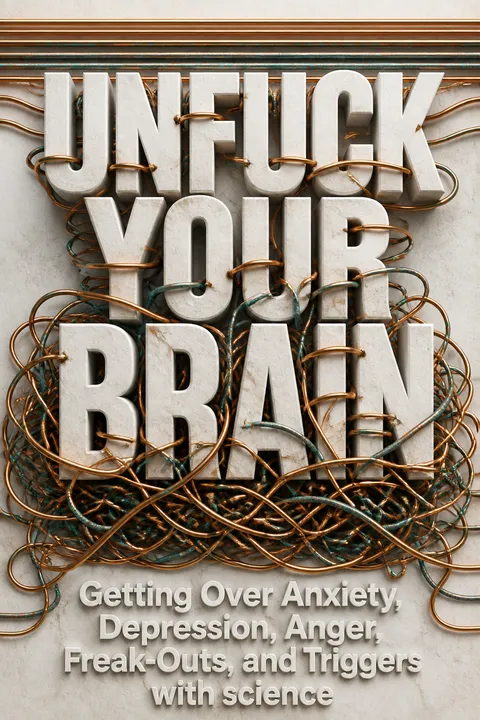
- Overview: "Unfuck Your Brain" by Faith G. Harper is a self-help book that uses science to help readers overcome anxiety, depression, anger, freak-outs, and triggers.
- Focus on Trauma: The book emphasizes understanding how trauma rewires the brain and how this affects mental health.
- Practical Advice: It provides practical advice and exercises to help readers retrain their brains and manage their mental health more effectively.
- Holistic Approach: Harper combines traditional therapy with complementary therapies, offering a holistic approach to mental wellness.
Why should I read "Unfuck Your Brain"?
- Understanding Mental Health: The book offers insights into how mental health issues develop and how they can be managed.
- Empowerment: It empowers readers by explaining that their feelings are normal and can be addressed with the right strategies.
- Practical Tools: Provides actionable tools and exercises to help readers take control of their mental health.
- Relatable Language: Written in a conversational and often humorous tone, making complex topics accessible and engaging.
What are the key takeaways of "Unfuck Your Brain"?
- Trauma's Impact: Trauma can rewire the brain, leading to mental health issues, but understanding this can help in healing.
- Adaptive Strategies: Emotions like anger and anxiety are adaptive strategies for survival, not signs of weakness.
- Retraining the Brain: It's possible to retrain the brain to respond differently to stressors and triggers.
- Holistic Healing: Combining traditional therapy with complementary practices can enhance mental health recovery.
How does Faith G. Harper explain trauma in "Unfuck Your Brain"?
- Definition of Trauma: Trauma is described as an event that disrupts one's understanding of the world, leading to a traumatic response.
- Brain Rewiring: Trauma can cause the amygdala to hijack the brain, leading to heightened emotional responses.
- Healing Process: Healing involves understanding the trauma, processing it, and retraining the brain to respond differently.
- Importance of Support: Emphasizes the need for relational support and time to process trauma for effective healing.
What methods does "Unfuck Your Brain" suggest for managing anxiety?
- Grounding Techniques: Use mental, physical, and soothing grounding techniques to stay present and manage anxiety.
- Self-Training: Practice learned optimism by challenging negative thoughts and reframing them positively.
- Breathing Exercises: Focus on breathing to calm the nervous system and reduce anxiety symptoms.
- Mindfulness Meditation: Incorporate mindfulness practices to disrupt storytelling and reduce anxiety.
How does "Unfuck Your Brain" address anger management?
- Understanding Anger: Anger is an instinctive response to perceived threats, meant to protect us.
- AHEN Model: Use the AHEN model to identify if anger is triggered by hurt, unmet expectations, or unmet needs.
- Cultural Influence: Recognizes that cultural norms can influence how anger is expressed and perceived.
- Practical Steps: Offers steps to evaluate and address anger constructively, minimizing harm to oneself and others.
What is the role of addiction in "Unfuck Your Brain"?
- Addiction as Coping: Addiction is seen as a coping mechanism that becomes problematic when it replaces relationships.
- Understanding Addiction: Addiction involves compulsive engagement, impaired control, and persistence despite harm.
- Treatment Approaches: Discusses both abstinence-based and harm-reduction approaches to addiction treatment.
- Mindful Engagement: Encourages mindful engagement with addictive behaviors to regain control and make healthier choices.
How does "Unfuck Your Brain" differentiate between depression and grief?
- Depression vs. Grief: Depression is a biochemical response characterized by anhedonia, while grief is a natural response to loss.
- Triggers and Predispositions: Depression often requires a genetic predisposition and a triggering event, while grief is a response to specific losses.
- Healing from Depression: Emphasizes the importance of addressing trauma and finding personalized treatment paths for depression.
- Honoring Grief: Stresses the importance of allowing space for grief to prevent it from becoming traumatic.
What are the recommended complementary therapies in "Unfuck Your Brain"?
- Acupuncture and Acupressure: These therapies stimulate certain points on the body to promote healing and reduce pain.
- Massage and Chiropractic Care: Used to reset the nervous system and help individuals reconnect with their bodies.
- Energy Healing: Techniques like Reiki and reflexology are suggested for releasing trauma held in the body.
- Biofeedback and Neurofeedback: These methods help individuals learn to control bodily and brain responses to stress.
What are the best quotes from "Unfuck Your Brain" and what do they mean?
- "Our behaviors are responses to the bullshit we have to deal with day in and day out." This highlights the idea that mental health issues are often adaptive responses to stress and trauma.
- "You are not fundamentally, unfixably broken." Emphasizes the book's message of hope and the possibility of healing and recovery.
- "Healing trauma means working through our shit, rather than trying to overpower it." Suggests that understanding and processing trauma is more effective than trying to ignore or suppress it.
- "You deserve every opportunity to heal." Reinforces the importance of self-compassion and the right to seek healing and support.
How does "Unfuck Your Brain" suggest building self-compassion?
- Self-Compassion Exercises: Encourages treating oneself with the same kindness and understanding as one would a friend.
- Mindfulness Practices: Use mindfulness to become aware of thoughts and feelings without judgment.
- Positive Self-Talk: Develop mantras and positive affirmations to counter negative self-talk.
- Forgiveness: Emphasizes forgiving oneself for past mistakes as a crucial step in healing.
What is the significance of storytelling in "Unfuck Your Brain"?
- Storytelling Brain: The brain is wired to create stories, which can influence how we perceive and react to the world.
- Reframing Stories: Changing the narrative we tell ourselves can help rewire the brain and improve mental health.
- Default Mode: The brain's default mode is storytelling, which can be disrupted through mindfulness and meditation.
- Creating New Narratives: Encourages creating new, positive stories to replace negative or traumatic ones.
About the Author
Other books by Faith G. Harper




Download PDF
Download EPUB
.epub digital book format is ideal for reading ebooks on phones, tablets, and e-readers.








