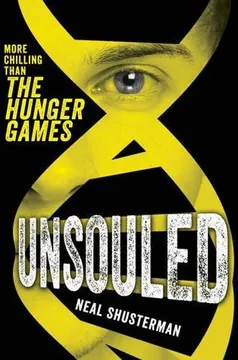


Plot Summary
Prologue
When the Unwind Accord ends the Heartland War, scientist Janson Rheinschild10 sees his medical work turned into a legal means of dismantling unwanted teenagers. He and his wife,9 Sonia,9 had developed the technology to save lives, and Janson10 founded Proactive Citizenry to prevent its abuse. Now a new chairman has signed the agreement without them.
Sonia9 tries to comfort Janson,10 but he insists they share responsibility for what their research has enabled. As feral teens roam streets abandoned by failing schools, he resolves to undo the harm. The law has not yet taken effect, but the couple understands that the machinery is already in motion.
The opening gives the dystopia a human origin without making its creators innocent. Janson and Sonia intended their research to protect life, yet Janson’s insistence that they share responsibility recognizes how good intentions can become a form of moral shelter. The Accord does not arrive as a sudden eruption of cruelty. It turns an existing technology into policy while ordinary social breakdown supplies its justification. Their private grief is set against public language about order and safety, establishing the book’s central pressure: institutions can make violence feel like administration, especially when the people harmed have already been declared disposable.
The Ostrich on the Highway
Connor Lassiter1 is driving fugitive Lev Calder2 toward Ohio, hoping Sonia,9 a former safe-house keeper, can point them toward a way to challenge unwinding. An ostrich bursts onto the Kansas highway, wrecking their stolen car and tearing open Connor’s1 chest.
A patrol officer spots the crash, so the two fugitives escape through a broken fence into an ostrich farm. They hide in an abandoned trailer, where Connor’s1 memories of the airplane Graveyard’s defeat sharpen his guilt over the children he failed to save.
He goes into nearby Heartsdale alone to find a car and medical supplies. At the supermarket, a teenage cashier recognizes him, attacks him, and knocks him unconscious. Connor1 wakes bound in a storm cellar, in the hands of an admirer12 whose idea of friendship begins with kidnapping.
The accident makes the journey’s danger absurdly physical: Connor is not defeated by a sophisticated trap but by a farm bird and a road he should not have been driving on while exhausted. That randomness suits his condition. He has survived extraordinary violence, yet remains vulnerable to ordinary mistakes. His guilt over the Graveyard also complicates his familiar role as rescuer. He is not simply charging toward another cause; he believes earlier losses happened on his watch. Argent’s capture then reverses the power dynamic, forcing Connor to experience the helplessness he has imposed on others in the name of keeping them safe.
Grace Turns the Raid
The cashier, Argent Skinner,12 wants Connor1 as a partner in his imagined outlaw life. Argent’s sister,5 Grace,5 secretly loosens Connor’s1 restraints, but Connor1 waits rather than risk leaving her exposed.
When authorities surround the property after Argent12 posts a photograph of his captive, Grace5 claims her brother12 is the fugitive and helps Connor1 hide among sacks of potatoes. Connor1 and Grace5 overpower a deputy, trade clothes, and escape in his squad car.
Lev,2 who has tracked the green convertible to the house, recognizes Connor1 in disguise and runs toward the police car. Connor1 brakes too late and hits him. Lev’s2 shoulder is dislocated and his side badly bruised. Unable to risk a hospital, Connor1 turns west for Arápache land, where Lev2 says they may find sanctuary.
Grace’s intelligence becomes visible precisely because others underestimate her. Her plan succeeds by exploiting the authorities’ assumption that she cannot understand what is happening, while her bond with Connor grows through the trust he shows when he refuses to use her as a disposable escape route. Lev’s collision with Connor converts loyalty into bodily risk. The scene does not treat their friendship as frictionless: Lev’s attempt to follow him nearly leaves him gravely injured, and Connor must choose between continuing the mission and caring for the person who came after him.
Cam Beneath the Spotlight
Camus Comprix,4 a composite boy assembled from the body parts and neural material of many unwound teens, attends a Washington gala as Proactive Citizenry’s celebrated achievement. A confrontation with Senator Marshall’s daughter turns the evening into a political victory when Senator Cobb backs Cam’s4 patron, Roberta Griswold.15
On a lecture tour, Cam4 answers questions about identity with polished confidence, but alone he dreams of the many unwinding procedures that made him. General Bodeker offers him a fast route into the military. At lunch, Cam4 learns Proactive Citizenry has sold its interest in him to the military, which regards him as property.
When courts refuse to recognize his independent legal identity, Roberta15 demonstrates that even his signature can be Wil Tashi’ne’s.18 Cam4 accepts the military offer, but the bargain leaves him questioning whether he exists as a person or a product.
Cam’s public success depends on presenting multiplicity as harmony, while his private experience is closer to involuntary noise. His admirers treat his unusual body as spectacle, and powerful institutions treat it as a strategic asset. Both responses deny him ordinary self-determination, though one arrives wrapped in praise and the other in contract language. The signature demonstration is especially unsettling because it makes identity concrete: Cam can intend to write his own name and still produce another person’s. His crisis is not merely whether he feels human; it is whether anyone will let his feeling count as evidence.
Risa's Narrow Escape
Risa Ward,3 injured and alone in a Wyoming barn, is caught in a cable trap set by a parts pirate. She provokes him into rushing her, then kills him with a pitchfork. With her wrist still trapped and coyotes feeding on his body, she reaches his phone and calls the Tyler Walker Foundation.
Cyrus Finch,14 known as CyFi,14 brings her to a Nebraska commune where people share transplanted pieces of Tyler Walker and try to make a community from an imposed division. Risa3 leaves after eight days, unwilling to mistake refuge for action.
In Omaha, she fights off three young men in an alley. Salon owner Audrey shelters her, changes her hair and eye color, and tells her how unwinding saved Audrey’s cancer-stricken son. When Risa3 hears a Juvey-cop boast about capturing an AWOL, she leaves the salon determined to help resist the system.
Risa’s survival depends on a difficult balance between accepting care and refusing to be defined by it. At the commune, she encounters people whose shared bodily inheritance offers consolation, but she cannot settle into their explanation of what has been done to them. Audrey’s story is harder to dismiss because it reveals the intimate bargain behind public support for unwinding: a parent may condemn the system and still rely on it to save a beloved child. Risa’s anger therefore becomes more precise. She can recognize desperation without confusing it with justice, and she leaves safety with a clearer understanding of why the practice persists.
Starkey's Borrowed Academy
Mason Starkey,6 a fugitive who once led the Stork Club, keeps his plane-crash survivors moving by dressing them as Camp Red Heron, then the more permanent Egret Academy. His false-school disguises and stolen money let the group travel without drawing attention.
At Cold Springs Harvest Camp, Starkey6 hides armed storks in an unwind transport truck and attacks from inside the gates. The camp’s prisoners join the uprising, and hundreds escape. Starkey6 divides them, sending nonstorks toward the open gate while recruiting the storks into his brigade.
Hayden Upchurch,8 a former Graveyard ally, is among the rescued, but Starkey6 tests him by ordering him to execute the camp director, Menard. Hayden8 refuses. A frightened young boy takes the gun and kills Menard instead, leaving Hayden8 free but disturbed by the movement’s first victory.
Starkey’s theatrical instincts are both protective and politically dangerous. The fake academy turns visibility into camouflage, while the rescue gives abandoned teenagers a role that feels larger than mere survival. But Starkey’s recruitment strategy makes liberation conditional: escape is offered to everyone, belonging and revenge to the storks. The execution exposes the cost of his leadership. Hayden’s refusal preserves a moral boundary, yet the crowd’s demand for action ensures that violence proceeds through someone else. Starkey can call the operation a rescue, but from the beginning he is shaping a community in which loyalty is measured by willingness to harm.
MoonCrater's Bloody Victory
At MoonCrater Harvest Camp, Hayden8 designs a quieter escape through the lava caves beneath the dormitory. The diversion draws guards toward the front gate while his team leads nearly three hundred Unwinds out through underground utility passages. Starkey6 stays behind.
He binds six camp workers beneath ceiling fans, promises one woman she will survive to carry his warning, then kicks away the other five prisoners’ chairs. The massacre kills workers and children, but the news blames Connor Lassiter,1 feeding public fear and calls for harsher unwinding laws.
Afterward, a covert force raids the Stork Brigade’s mine and extracts Starkey6 by helicopter. Instead of imprisoning him, a powerful man offers weapons and support for further attacks. Starkey6 returns to his followers with new backing, while Bam7 and Hayden8 begin to see that his campaign may be serving someone else’s purpose.
The contrast between Hayden’s cave plan and Starkey’s hangings distinguishes rescue from spectacle. Hayden uses knowledge of the camp’s architecture to reduce casualties; Starkey turns the same operation into a public image designed to outlast the escape itself. The misinformation that assigns blame to Connor shows how violence can be politically useful even when its perpetrators are not the people blamed. Starkey’s secret sponsor makes the danger larger still. His self-image as a liberator leaves him susceptible to anyone who praises his methods, because recognition feels like proof that his cause is righteous.
The Reservation's Old Wound
Lev2 and Connor1 reach the Arápache Reservation, where healer Elina16 treats Lev’s2 internal bleeding and broken ribs. Lev2 has been there before: parts pirates once cornered a group of young people in the woods, and Wil Tashi’ne,18 Elina’s son18 and a gifted musician, offered himself to save the others.
Lev2 was blamed for the tragedy and driven away. Now the family’s welcome is cautious, while Connor1 grows impatient to reach Sonia9 in Ohio. The Juvenile Authority publicly identifies Connor1 and Lev,2 making the household’s shelter more dangerous.
A shot through the Tashi’ne16 home warns them to leave. Attorney Chal arranges a misleading political asylum claim through the Hopi, diverting officials long enough for the fugitives to move to Wil’s fiancée11 Una’s11 guitar shop. Lev2 recognizes that his return has reopened a wound the reservation never healed.
The reservation offers sanctuary, but not innocence. Lev’s history there ties his survival to Wil’s sacrifice, and that connection makes belonging feel morally costly rather than comforting. Elina’s care and the family’s reluctance coexist; Lev must accept both without forcing them into a simple verdict about whether he deserves to return. Connor’s impatience reflects a different coping style. He measures safety against the children still at risk elsewhere, while Lev needs time to recover and reckon with the past. The gunshot makes these private conflicts public, showing how one person’s refuge can become another person’s perceived danger.
A Song Across the Wall
After hearing that Connor1 is alive, Cam4 uses his access to Proactive Citizenry’s hidden records to investigate the organization, then follows fragments of Wil Tashi’ne’s musical memory toward the Arápache Reservation.
Wil’s18 hands and musical skill are part of Cam’s4 body, though he has no personal memories of Wil’s18 loved ones. At Una’s11 guitar shop, Cam4 finds a hidden key and plays one of Wil’s songs. Una11 mistakes the music for Wil’s18 return, then knocks Cam4 unconscious and ties him in an old sweat lodge, trying to force him to remember her.
Connor1 discovers them and stops Una11 from cutting off Cam’s4 hands with a chainsaw. Cam4 gives Connor1 access to his concealed files on Proactive Citizenry. Their distrust remains, but Connor1 agrees to take him along rather than leave him captive.
Music acts here as both inheritance and intrusion. Cam’s body preserves Wil’s practiced movements, yet the memories that would make those movements relational are absent. Una experiences the performance as a return of someone she loved, then confronts the cruel gap between familiar hands and an unfamiliar person. Her captivity of Cam is wrong, but it grows from grief rather than simple malice. Connor’s intervention matters because he recognizes Cam’s helplessness despite his own hostility. The resulting alliance is pragmatic, not reconciled: shared opposition to Proactive Citizenry temporarily outweighs the injuries each character carries.
Argent's Pirate Apprenticeship
After Connor1 escapes Heartsdale, the burned and disgraced former Juvey-cop Jasper Nelson13 recruits Argent12 to help hunt him and Grace.5 Argent12 invents a false lead about a woman in New Orleans, using Nelson’s13 appetite for revenge to prolong their trip.
He tries to prove his usefulness by capturing two AWOLs, but Nelson13 orders him to release them because they are not the prize he wants. Nelson’s13 infected animal bites and sun damage worsen as the pair chase Argent’s12 fabricated clues. In Pittsburgh, Nelson13 collapses from fever after threatening to kill Argent.12
Argent12 pays a doctor, nurses him, and uses the dependence to secure a place beside him. Nelson13 teaches him parts-pirate methods, then tranqs him when Argent12 withholds Grace’s5 tracking-chip code. Their uneasy partnership continues toward Canada, still aimed at the fugitives.
Argent’s pursuit is less a clean transition into villainy than an attempt to borrow purpose from someone more dangerous. Nelson offers a model of power that seems to promise escape from Argent’s humiliating small-town life. Argent responds with manipulation, then care, and his behavior refuses to settle into a single moral category. Nelson, meanwhile, treats vulnerability as an inconvenience that can be controlled, yet becomes physically dependent on the young man he dismisses. Their partnership mirrors the book’s larger pattern: people who feel disposable seek value through systems that may consume them.
Lev Chooses His Ground
When Connor1 prepares to leave for Ohio, Lev2 decides he will not go with him. He believes the Arápache could influence other tribes and wants to help them oppose the laws tightening around unwinding.
At a public concert, Lev2 names the two parts pirates connected to Wil’s18 abduction and calls for help bringing them to justice. Una11 steps forward as his first ally, and the crowd’s applause gives Lev2 a beginning rather than a guarantee. Connor1 leaves with Grace5 and Cam,4 accepting Arápache identities supplied by Elina.16
Lev’s2 choice is not a retreat into comfort. He stays where his history is painful and his welcome uncertain because he thinks he can make that community act. Connor,1 meanwhile, must continue toward Sonia9 without the friend2 who helped him survive the journey.
Lev’s decision separates solidarity from sameness. He and Connor remain committed to resisting unwinding, but they no longer assume that the same route serves both of them. Lev chooses local political work over another flight, turning his history with the reservation into a reason to engage rather than disappear. His public appeal also changes the scale of his agency: the former tithe, fugitive, and would-be clapper asks a community to act with him. The applause is only an opening gesture, but it marks a shift from being carried by events to deliberately recruiting others into responsibility.
The Akron Reunion
On the road to Akron, Connor1 and Cam4 examine the hidden files and discover that Proactive Citizenry funds campaigns on opposing sides of unwinding debates, keeping the public focused on competing forms of bodily exploitation instead of rejecting the practice.
At Sonia’s9 antique shop, Connor1 finds Risa3 already living in the hidden safe-house network. Their reunion is tender but uneasy, with Cam’s4 presence sharpening old feelings. That night, a Proactive Citizenry team breaks into the house. Grace5 hides Risa3 beneath a bed and Connor1 in another room; the intruders tranq Connor1 but find Cam,4 whom they came to retrieve.
Cam4 does not identify his companions. Roberta15 takes him away, claiming the organization is recovering stolen property. Connor1 wakes later beside Risa,3 grateful that she is alive and troubled that Cam4 has been returned to the people who made him.
The reunion refuses the fantasy that love can restore an earlier, safer world. Connor and Risa still matter deeply to each other, but each has learned to survive through guardedness, and Cam’s presence makes their shared history impossible to simplify. The files offer a political explanation for the confusion around public debate: the system can absorb disagreement by offering people a choice between versions of the same harm. Cam’s capture then tests the others’ assumptions about him. His silence protects them, but it does not settle whether he can be trusted or what the organization will do to reclaim him.
The Printer in the Shop
With Cam4 gone, Connor,1 Risa,3 and Grace5 ask Sonia9 what she knows about Janson Rheinschild,10 her husband10 and the erased founder of Proactive Citizenry. Sonia9 explains that their original neurografting research was meant to save lives, but the organization embraced the Unwind Accord and buried their work.
Janson10 later developed a different answer: a machine that could grow living organs layer by layer, eliminating the demand for harvested bodies. Sonia9 says the medical manufacturer that bought the patent destroyed the plans and equipment.
In her cluttered shop, Grace5 notices the old computers and connects Sonia’s9 explanation to the possibility that a printer may remain hidden there. Sonia’s9 reaction confirms the possibility, but the novel ends before the group can locate or use it.
The final revelation shifts the struggle from moral appeal to material possibility. Sonia’s account explains why Proactive Citizenry feared Janson: not because he could shame the industry, but because his alternative could make it obsolete. The organ printer reframes the earlier political conflict. The system is not sustained only by cruelty or prejudice; it is also protected by economic dependence and manufactured scarcity. Grace’s insight is significant because she connects evidence others overlook, extending her intelligence beyond escape tactics into strategic vision. Yet the machine is only a possibility at the close. Hope has acquired a concrete shape, not a guaranteed outcome.
Epilogue
Years before Connor1 and Risa’s3 journey, Sonia9 stores a small organ printer prototype after Janson10 dies and Proactive Citizenry erases the Rheinschilds10 from public history. Janson10 had sold the larger design to a medical company, believing it would end the need for harvested organs, but the company concealed the technology.
Sonia9 gives much of the money to young people forming an underground resistance, then leaves the country with the prototype hidden among her belongings. The device had already replaced Austin’s missing fingers. Sonia9 drives toward an uncertain new life, carrying the one piece of Janson’s10 work that his enemies failed to destroy.
The epilogue turns the novel’s final possibility into a concealed inheritance. Sonia’s choice to hide the prototype is not a victory over the system; it is a way to keep an alternative alive after public institutions have been captured or corrupted. Her departure also distinguishes survival from surrender. She cannot yet continue Janson’s fight, but she refuses to let his work vanish with him. The printer’s small scale matters: history is not preserved only in monuments or official records. A device in a box, entrusted to no one and nearly forgotten, can become the seed of a future that the powerful tried to prevent.
Analysis
UnSouled treats bodily autonomy as a political question made intimate. Its central violence is not only the surgery performed on teenagers, but the network of ordinary decisions that makes the surgery seem reasonable: a parent fears losing a child, a voter fears crime, a company seeks profit, and a state wants a quick answer to social disorder. Those motives differ in scale and sincerity, yet they can converge on the same vulnerable bodies. The book is especially attentive to how benevolent language conceals coercion. A harvest camp can be landscaped like a refuge; a manufactured person can be praised as an achievement while denied legal standing; even an apparent argument against unwinding can preserve the system by redirecting public anger toward another version of it.
The characters resist this machinery through sharply different forms of agency. Connor1 acts, often before he has examined what his urgency is doing to others. Lev2 learns that survival need not mean following Connor’s1 route. Risa’s3 caution is earned by betrayal and danger, but she must keep it from becoming paralysis. Grace,5 whom others dismiss, repeatedly perceives the strategic shape of a crisis. Cam4 makes the most literal challenge to fixed identity: he is a person assembled from many, yet his longing to be recognized cannot be satisfied by applause or by the talents he inherited. Their conflicts suggest that personhood is not secured by biological purity, legal status, or public approval. It is practiced through responsibility, attention, and the capacity to change.
The book’s ending does not resolve the struggle. Instead, it identifies what would make resistance more than a series of escapes: an alternative to the economics that reward harvesting bodies. Janson’s10 organ printer is a technological hope, but the epilogue keeps that hope fragile, hidden, and dependent on people willing to carry it forward. The final question is not whether innovation can save society by itself. It is whether a society built around profitable harm will permit a humane alternative to become real.
Review Summary
UnSouled is widely considered the weakest installment in the Unwind Dystology, often described as a transitional "stepping stone" between books two and four. Readers appreciate the character development, world-building, and multiple perspectives, particularly praising new character Grace and continued focus on Connor, Lev, Risa, and Cam. Many felt the pacing was slower and the plot less resolved than previous entries. Despite its shortcomings as a standalone, most readers remained invested and eagerly anticipated the finale, crediting Shusterman's layered storytelling and complex ethical themes for keeping them engaged throughout.
People Also Read





Characters
Connor Lassiter
The relentless fugitiveConnor is a young fugitive whose escape from unwinding has made him a symbol larger than his actual influence. He carries guilt over the children lost when the airplane Graveyard fell, and he turns that guilt into motion: find Sonia9, expose the machinery behind unwinding, keep the people beside him alive. His instincts are quick in a crisis, but stillness leaves him alone with anger, fear, and questions about the parents who signed his order. A grafted arm makes those questions bodily as well as moral. Connor has changed from a reckless boy into a leader who can choose restraint, yet he still mistakes constant action for responsibility.
Lev Calder
The survivor seeking purposeLev was raised as a tithe, someone expected to accept unwinding as a religious offering, before escaping into a life shaped by danger and political violence. He is observant, compassionate, and notably able to find hope when Connor1 sees only the next threat. That optimism is not innocence: Lev has endured rejection by his family, the consequences of becoming a clapper, and the painful memory of Wil Tashi’ne18. He longs for ordinary adolescence, but also wants his survival to mean more than self-preservation. His quiet humor and patience often steady Connor1, while his own choices reveal a growing willingness to turn hard-earned experience into public action.
Risa Ward
The guarded resistance medicRisa is a pianist, medic, and fugitive who relies on disciplined observation rather than trust. Growing up in state care taught her to defend herself and to read danger quickly, but those strengths can harden into overconfidence. She has loved Connor1 while resisting the idea that affection should decide her choices, and she has also tried to understand Cam4 without accepting the institution that created him. Risa’s opposition to unwinding is personal and practical: she has tended children at risk and knows that good intentions can still serve a cruel system. She can accept help when she must, but she is most at ease when she has a task that protects someone else.
Camus Comprix
The composite humanCam is a young person assembled from the bodies and neural material of many unwound teenagers. Proactive Citizenry displays him as proof of medical possibility, while his own experience is a confusing blend of skills, memories, impulses, and absences. He is witty, perceptive, and skilled at performing confidence, especially when audiences treat him as a marvel. Beneath that poise is a persistent question about whether his identity belongs to him or to the people who built and promote him. His attachment to Risa3 is bound up with a desire to feel real, but his capacity for reflection gives him room to question the ways he seeks recognition.
Grace Skinner
The underestimated strategistGrace is Argent’s older sister12, a young woman others dismiss because of her low-cortical designation and her halting, informal manner. She is far more observant and strategically gifted than her brother12 believes. Grace reads people, notices details others miss, and understands that a diversion can work better than a direct confrontation. Her loyalty is not blind: she escapes the violence and control of her home while deciding for herself whom to help. Her humor, love of games, and refusal to be treated as helpless give her a distinctive kind of authority among the fugitives.
Mason Starkey
The charismatic rebel leaderStarkey leads the Stork Club, a group of adopted children who fear being unwound despite being raised in families. He is a gifted organizer and illusionist who understands how costumes, money, and confident storytelling can make a group disappear in plain sight. Starkey’s desire to protect his followers is real, but so is his hunger for recognition and control. He distributes hope carefully, keeps information close, and treats spectacle as a tool of leadership. His talent for turning grievance into collective purpose makes him compelling to other fugitives, while his conviction that he is destined for greatness makes his methods increasingly difficult to challenge.
Bam Covalt
Starkey's fierce secondBam is Starkey’s6 tall, tough second-in-command and one of the most capable organizers in the Stork Brigade. She is blunt, physically formidable, and more attentive to the group’s immediate needs than to public image. Her loyalty to Starkey6 comes from their shared history and the trust he once placed in her, but she is not incapable of doubt. She notices casualties, fear, and the gap between the Brigade’s language of rescue and its treatment of others. Bam’s struggle is whether loyalty means supporting a leader or refusing to let his mission excuse everything he does.
Hayden Upchurch
The reluctant tacticianHayden is a former Graveyard organizer with a sharp mind, a gift for dry humor, and a history of helping other fugitives survive. At Cold Springs, he is isolated and falsely regarded as a collaborator because camp officials manipulate appearances. He understands that a rescue can become another source of danger if it produces unnecessary casualties or strengthens public support for crackdowns. Hayden’s instinct is to question grand claims and look for workable alternatives. His knowledge of technology and logistics makes him useful, but his skepticism puts him in tension with leaders who prefer obedience.
Sonia Rheinschild
The hidden safe-house keeperSonia is a scientist turned antique-shop owner who has spent years keeping fugitives out of the reach of authorities. She shares with her husband10, Janson10, a history of developing the biotechnology that made unwinding possible, but she does not romanticize their intentions. Sonia is practical, guarded, and often sharp with people who mistake her age for helplessness. She understands how institutions erase inconvenient people and how the truth can become dangerous once it is spoken. Her continued sheltering of young fugitives reflects a stubborn form of responsibility: she cannot undo the past, but she can still act against its consequences.
Janson Rheinschild
The remorseful inventorJanson is a gifted scientist whose work helps make comprehensive tissue and neural transplantation possible. He is idealistic enough to believe ethical oversight can restrain powerful technology, yet perceptive enough to recognize when that belief has failed. His bond with Sonia9 is rooted in shared research and shared accountability. Janson’s response to the misuse of their discoveries is restless and self-punishing; he would rather pursue a concrete correction than accept consolation. His story embodies the tension between inventing a tool and accepting responsibility for the institutions that decide how to use it.
Una
The grieving luthierUna is an Arápache guitar maker and Wil Tashi’ne’s18 longtime companion. She is skilled with her hands, guarded with strangers, and closely attached to the music and memories she shared with Wil18. Lev’s2 return brings back affection as well as unresolved pain, while Connor’s1 mission presses her to take risks she would rather avoid. Una’s grief can make her act harshly, but it also reveals how fiercely she protects the people and traditions she considers her own. Music offers her a language for loss that ordinary explanations cannot supply.
Argent Skinner
The would-be outlawArgent is Grace’s younger brother5, a resentful supermarket clerk who dreams of becoming a figure of consequence. He mistakes forceful admiration for friendship and initially treats Connor1 as a ticket out of his stagnant life. Argent is cruel to Grace5 and quick to justify his behavior, yet he is not simply a confident predator. His insecurity leaves him vulnerable to people who offer status, adventure, or a chance to prove himself. He is clever enough to manipulate Nelson13 when necessary, though his appetite for danger repeatedly places him under someone else’s control.
Jasper Nelson
The freelance parts pirateNelson is a former Juvey-cop who now hunts fugitives for rewards and black-market profit. He describes himself as principled, but his sense of integrity coexists with a willingness to threaten, capture, and sell young people. Nelson values control and takes satisfaction in deciding who has power over whom. His pursuit of Connor1 is personal as well as professional, making him impatient with anyone who complicates the hunt. He is experienced and dangerous, but physical illness and his dependence on Argent12 expose how quickly a hunter’s authority can become precarious.
Cyrus Finch
The divided-hearted advocateCyrus Finch, known as CyFi, carries part of Tyler Walker’s brain and lives with an inner voice shaped by Tyler’s memories and distrust. He founded a community for people who share Tyler’s transplanted parts, offering them belonging and a way to mourn. CyFi is warm, humorous, and politically experienced, having spoken publicly against the treatment of teenagers. He knows that people may need rituals even when those rituals look strange to outsiders. His changing speech and mood make the boundaries between his own identity and Tyler’s difficult to read, but his care for Risa3 and Lev2 is unmistakably his.
Roberta Griswold
Cam's polished handlerRoberta is the scientist and administrator who helped create Cam4 and now manages his public life. She is composed, socially deft, and adept at steering conversations away from questions that threaten her work. Her affection for Cam4 is real, but it exists alongside a belief that she knows what is best for him. That mixture makes her both maternal and controlling. Roberta thinks in terms of access, influence, and damage control, and she often interprets Cam’s4 desire for independence as a problem to manage rather than a claim to respect.
Elina Tashi’ne
The reservation healerElina is an Arápache healer and Wil’s mother18. She combines medical training with traditional practices, treating Lev2 with a carefulness shaped by years of community care. Her feelings about Lev2 are complicated by the history surrounding Wil18, and she does not offer easy reassurance when she is uncertain. Elina values responsibility to family and tribe, but she is capable of revisiting past decisions when new circumstances demand it. Her restraint can seem cold to outsiders, yet her actions show a steady willingness to protect people who have few safe choices.
Pivane
The tradition-minded protectorPivane is Elina’s brother-in-law16, a hunter and a guardian of Arápache traditions. He is wary of the outside world and cautious about the risks Lev’s2 return brings to the reservation. His reserve hides deep feeling, especially where Wil18 and Lev2 are concerned. Pivane shows care through practical acts: food, shelter, and arrangements that protect the fugitives without requiring grand declarations.
Wil Tashi’ne
The musician rememberedWil is Elina’s son16, Una’s longtime companion11, and a gifted Arápache musician. His guitar playing shaped the lives of the people close to him, including Lev2, and his memory remains present through music and shared grief. Wil represents a bond between artistic skill and personal connection: the notes can be learned, but the relationships that gave them meaning cannot be transferred so easily.
Jeevan
The Brigade's computer mindJeevan is a clever, anxious member of Starkey’s6 group who uses computer skills to help the fugitives finance their escape and plan their movements. He is more comfortable solving technical problems than living with the human consequences of the Brigade’s decisions. His talent makes him valuable, but his dependence on Starkey’s6 approval can keep him from challenging the leader.
Hannah
The cautious local allyHannah is a teacher who helped Connor1 and Risa3 during their earlier flight. She later provides shelter while raising Dierdre, a storked child entrusted to her care. Hannah is compassionate but attentive to the risks her choices impose on the child and her household. Her help is grounded in practical responsibility, not a desire to become part of the resistance.
Plot Devices
Unwinding and grafting
Bodies become contested propertyIn this society, a legal order can divide a teenager’s body into usable parts, while transplanted organs, limbs, and neural tissue preserve aspects of the donor in someone else. This technology drives the central danger, but it also complicates the meaning of identity. Connor1 carries a grafted arm with another boy’s motor habits; Cam4 is composed of many people’s material and skills. The process is presented as painless and socially useful, even as the narrative follows the people denied control over it. Its effects reach beyond surgery into law, family, economics, and the question of who is allowed to count as a person.
The clapper detonator
Applause becomes a weaponA clapper carries explosive material that detonates when the hands come together. The threat turns an ordinary social gesture into a source of public fear and makes clappers targets for suspicion. Lev’s2 history as a clapper gives the device personal and political weight: the ability to destroy himself does not erase the grief and anger that led him there. The technology also lets political campaigns portray vulnerable teenagers as hazards, encouraging surveillance and crackdowns. Its use is therefore both a physical danger and a means of shaping how the public interprets youth resistance.
Cam's musical memory
Inherited skill becomes a clueCam’s4 body includes Wil Tashi’ne’s18 hands and the neural pathways associated with music. Cam4 can play with Wil’s18 learned ability despite lacking the memories that gave those songs their personal meaning. Music consequently works as a sensory map: familiar movements and melodies lead Cam4 toward the Arápache Reservation and bring Una11 face to face with an inheritance she cannot easily accept. The device deepens the story’s distinction between possessing a skill and possessing a life. Cam’s4 performance can preserve a trace of Wil18, but it cannot automatically restore Wil’s18 relationships or make Cam4 identical to him.
Competing political campaigns
Debate protects the status quoAdvertisements, ballot initiatives, news reports, and public-service campaigns repeatedly frame unwinding as a choice between competing policies. The campaigns appear to argue against one another, but Cam’s4 recovered records show that Proactive Citizenry supports messages on opposing sides. This strategy keeps citizens debating which forms of bodily division are acceptable instead of questioning whether the practice should exist at all. The inserted advertisements also give the narrative a view of how propaganda enters daily life: not as a single command, but as repeated stories that make exploitation sound practical, compassionate, or inevitable.
The organ printer
A technological alternativeJanson Rheinschild’s10 proposed machine would build living organs from cultured cells, potentially replacing the demand for organs harvested from teenagers. The idea appears late as the missing possibility that could make the unwinding industry obsolete. It links the book’s ethical conflict to material incentives: if society can obtain replacement organs another way, the economic argument for dividing young people loses force. The epilogue confirms that a small prototype survived after the larger work was suppressed. Although the characters have not yet recovered it or proved what it can do, its existence gives their resistance a concrete avenue beyond protest.
Download PDF
Download EPUB
.epub digital book format is ideal for reading ebooks on phones, tablets, and e-readers.








