

Key Takeaways
Treat America's founding promises and slaveholding foundations as one story
Monticello held both truths. Thomas Jefferson wrote that people were born equal while owning more than one hundred enslaved people. Around 130 worked at Monticello in the mid-1770s, when he drafted the Declaration of Independence. He knew slavery was wrong, yet ordered punishment, sold people, and did not free Sally Hemings, who bore his children. The contradiction was not merely personal: Southern states threatened to abandon the new nation rather than accept limits on slavery, and the founders compromised to keep the Union together.
A promise became a weapon. In 1791, Black scholar Benjamin Banneker challenged Jefferson with the very equality he had proclaimed. Later freedom movements, from Frederick Douglass to Martin Luther King Jr., likewise used the country’s stated ideals to demand rights it denied them.
What's striking is that the founding ideal matters here not because it excuses the founders, but because it gives the excluded a language for challenging power. A promise can become politically useful even when its author refuses to honor it. That distinction prevents two easy errors: treating Jefferson as either a flawless hero or a figure whose words have no value. The book's account also insists on agency. Jefferson's choices were constrained by politics, but they were still choices, and contemporaries such as Banneker made that clear.
Losing the Civil War did not stop the South from winning its history lesson
Defeat became a story. Southern leaders said the Civil War defended states' rights, although secession declarations identified slavery as the central cause. After the war, the Lost Cause recast Confederate defeat as noble resistance and Reconstruction as unjust punishment. The mythology spread through schools, books, and monuments. Confederate statues multiplied during the early twentieth century and again in the 1950s, periods of organized opposition to Black political gains.
Memory shapes public space. At Montgomery's National Memorial for Peace and Justice, Bryan Stevenson and the Equal Justice Initiative honor 4,400 Black people documented as lynching victims. Their work counters a landscape that long celebrated Confederate leaders while neglecting their victims. The contest over statues and school curricula is therefore not simply about symbols. It is a struggle over whose account of the past becomes public knowledge.
The account makes historical memory feel less like a passive archive and more like infrastructure: monuments and textbooks help define who belongs, whose suffering counts, and what political arrangements seem legitimate. That is a powerful way to understand why correcting the record can provoke such resistance. The challenge is that new memorials cannot, by themselves, repair the harms they document. The book's strongest implication is that commemoration gains force when paired with changes to institutions and public education, rather than treated as a substitute for them.
The frontier myth turned Indigenous dispossession into a story of national renewal
The land was not empty. The book estimates that more than 70 million people lived in the Americas when Columbus arrived in 1492, and that nearly 90 percent of Indigenous people across the continents died afterward, from violence, displacement, and disease. Yet colonizers described the land as a fresh beginning. The idea of manifest destiny later cast westward expansion as a divinely favored advance of civilization, obscuring the people already living there.
Expansion had a purpose. President Andrew Jackson pushed Indigenous nations from their homelands, often through coercive treaties and military force. When the Supreme Court ruled in favor of Cherokee sovereignty, Jackson ignored the decision; the forced removal that followed became known as the Trail of Tears. The land seizure also made room for plantation agriculture and slavery, tying conquest to the expansion of White power.
The frontier story is more than a patriotic legend. It makes dispossession appear like opportunity by starting the national story at the moment settlers arrive, not where Indigenous history begins. That framing can turn policy choices into seemingly natural progress. The book is careful to distinguish mass death caused by disease from deliberate violence, an important distinction that should not be lost in the broader argument. Naming the myth does not require flattening every cause; it requires refusing to let a narrative of renewal erase the people who paid for it.
Track how racial backlash shifts from open terror to respectable policy
Backlash changes its vocabulary. When Black Americans gained rights, resistance often followed: violence after emancipation, segregation after Reconstruction, and coded political appeals after the civil rights movement. At a 1965 debate, conservative intellectual William F. Buckley argued against equal rights while presenting White political dominance as prudent and realistic. Politicians increasingly used language about states' rights, law and order, and personal responsibility to defend arrangements that preserved racial hierarchy without openly defending segregation.
Parties reorganized around the conflict. The civil rights laws helped drive White Southern conservatives from the Democratic Party toward the Republicans. Nixon's law-and-order politics and later Republican campaigns built on that shift. In a 2016 survey cited by Gelin, seven in ten Trump voters said Whites, rather than Black Americans, were the primary victims of discrimination. The rhetoric had changed, but racial grievance remained politically useful.
The chapter's key insight is about political adaptation: an idea can survive by changing its public language. This helps explain why explicit racial slurs are an incomplete measure of racial politics. Policy arguments can be sincerely held and still produce unequal outcomes, so analysis needs to examine both stated intent and institutional effect. At the same time, race does not explain every voter or every policy choice on its own. The book is most persuasive when it shows how racial appeals connect to party strategy, rather than treating them as a complete account of political behavior.
Follow coercion after emancipation, from convict leasing to militarized policing
Freedom did not end forced labor. After slavery, Southern states used convict leasing: Black people were arrested for minor or fabricated offenses and hired out to private employers, often for brutal, unpaid work. In Alabama, unpaid Black labor still generated 73 percent of state revenue two decades after the Civil War began. The system was not identical to slavery, but it revived coercive labor and helped preserve racial control.
Policing carried the pattern forward. In the late twentieth century, zero-tolerance policing targeted minor offenses, while federal programs supplied local police with military equipment. The book traces that escalation through the treatment of Rodney King and George Floyd. Video evidence of Floyd's killing helped spark protests involving around 30 million Americans in 2020, yet the political momentum for police reform soon faced a strong backlash.
The historical comparison is useful because it directs attention to function: who is controlled, who profits, and which institutions enforce the rules. It should not be mistaken for a claim that modern policing and slavery are the same institution. Their legal forms and lived realities differ profoundly. The continuity lies in recurring patterns of coercion and unequal protection. The book also shows that public scrutiny can expose violence, but visibility alone does not guarantee reform; political organization and durable changes in policy are needed to make evidence matter.
Racism can make a society destroy shared goods rather than share them
The pool became a political test. When courts ordered public swimming pools to integrate, some White communities drained them, filled them with concrete, or closed them altogether. In Montgomery, the city shut its parks, zoo, and pool rather than share those resources with Black residents. Economist Heather McGhee calls this pattern drain the pool politics: abandoning a common benefit when equal access becomes possible.
The losses spread beyond the excluded. Federal housing and veteran programs helped many White families build wealth while excluding Black families through redlining and discriminatory rules. After the civil rights movement, White support for public investment fell sharply: from 60 percent in 1960 to 35 percent in 1964. The result was weaker public services, segregated suburbs and schools, and fewer shared resources for poor White and Black communities alike.
This argument reframes racism as more than hostility toward a group. It can also shape collective decisions, reducing the quality of public goods even for people who are not directly excluded. The drained pool makes that cost concrete: a community loses something valuable to preserve a boundary. Still, the numerical shift in support for government investment does not prove that racial attitudes alone caused every change in policy. The book's case is strongest when it links survey evidence to specific decisions about housing, schools, and public spaces.
Defend historical truth before censorship teaches citizens a false national past
Control the story, constrain the debate. Timothy Snyder uses the term memory laws for rules that shape acceptable accounts of history, often by discouraging discussion and encouraging self-censorship. Gelin traces how American nationalists studied Hungary's authoritarian politics and how similar tactics appeared in campaigns against teaching about racism. In 2021, Republicans in 24 states introduced more than 80 bills to restrict such teaching.
The restrictions reach beyond one theory. Critical race theory is a specialized academic approach to how racism operates in institutions and daily life, but the political campaign against it has been used to target broader lessons about slavery, segregation, and discrimination. Books including Toni Morrison's Beloved and Art Spiegelman's Maus faced bans. The book argues that when teachers fear punishment for presenting evidence, patriotic storytelling can replace history.
The danger is not only that particular facts disappear. Vague rules can make teachers and institutions censor themselves before anyone formally intervenes, narrowing what citizens can discuss. That makes the defense of historical inquiry a democratic concern, not merely an academic one. The comparison with Hungary helps readers notice the borrowing of political tactics, though comparisons should clarify rather than collapse differences between countries. A useful standard is whether a curriculum permits evidence, disagreement, and complexity, instead of prescribing a flattering conclusion in advance.
When leaders delegitimize votes, ordinary partisans can become democracy's attackers
A mob did not act alone. On January 6, 2021, Trump supporters attacked the Capitol to stop Congress from certifying Joe Biden's victory. The book emphasizes that most participants were not members of organized extremist groups: only about one in seven belonged to groups such as the Oath Keepers or Proud Boys. Many were ordinary Republican supporters, drawn into a campaign that falsely described the election as stolen.
The political response mattered. Trump delayed condemning the violence, and most Republican members of Congress still opposed certifying the election results. The assault was followed by efforts to change voting rules and replace election officials with loyalists. Gelin's warning is that democracy can be weakened through official procedures as well as street violence. When political leaders teach supporters that legitimate losses are fraud, attacks on the system can be recast as acts of patriotism.
The book shifts attention from the spectacle of the riot to the normalization surrounding it. That is analytically important: institutions can survive an attack on one day and still be weakened by officials who excuse it or undermine trust in elections. The distinction between organized extremists and ordinary supporters does not make the event less serious; it explains how a fringe tactic can gain reach. A careful account should also distinguish the actions of participants from those of voters who merely supported a candidate, while examining the leaders who encouraged the false claim.
California shows diversity can strengthen the commons, but organizing makes it possible
A political shift was built. California was once a stronghold of conservative politics. In the 1990s, Governor Pete Wilson campaigned against immigrants and backed Proposition 187, which sought to deny undocumented residents public services. The backlash helped mobilize Latino voters and organizers. Unions and civil-rights groups built broader coalitions, and the Republican Party lost ground as the state became more diverse.
The alternative is real, not flawless. By 2020, 72 percent of California voters said immigration was good for the state. Gelin also notes that violent crime fell between 1980 and 2019 even as the population doubled and the White share declined. Yet California still has deep inequality, segregation, and housing problems. Its value as an example is not that diversity automatically solves conflict, but that political organizing can make tolerance and public investment more durable.
California challenges the claim that demographic diversity inevitably destroys trust or democratic cooperation. Its experience suggests that coalitions, locally rooted leadership, and inclusive labor organizing can make pluralism politically viable. It is not a controlled experiment, however: the state's economic growth and distinctive institutions complicate any simple cause-and-effect conclusion. The strongest lesson is therefore practical rather than deterministic. Diversity does not produce tolerance by itself, and demographic change does not dictate authoritarian backlash. Political choices shape whether difference becomes a shared civic resource or a weapon.
Analysis
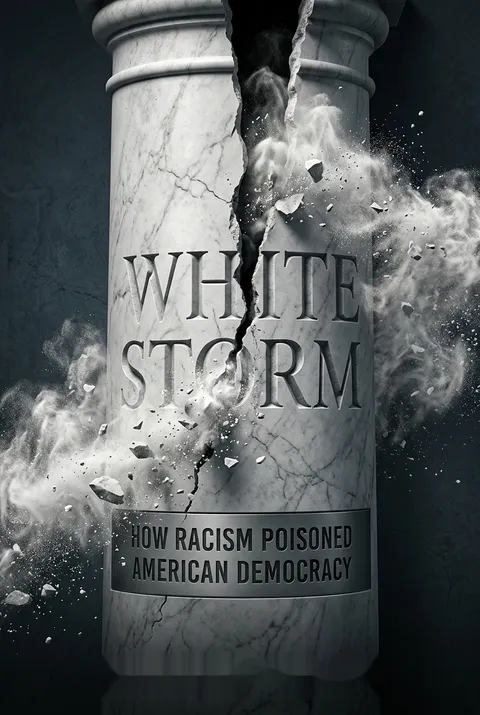
Gelin's central argument is that racism is not a sealed chapter of American history. It is a political force repeatedly adapted to new conditions, from slaveholding compromises to Lost Cause mythology, from segregation to coded appeals about crime and government, and from voter intimidation to contemporary attacks on election legitimacy. His narrative gains force by moving between intimate evidence and institutional scale: a child lynched for her father's attempt to vote, a pool filled with concrete rather than integrated, a police killing recorded on a phone, and a mob assaulting the Capitol. Each example makes an abstract system legible.
The book's most useful contribution is its account of feedback loops. Progress for Black Americans often triggers backlash; backlash then reshapes laws, public memory, party coalitions, and shared institutions. Racism harms its targets most directly, but it can also persuade White voters to reject services and protections that would benefit them. That helps explain why racial politics cannot be separated neatly from economic policy or democratic stability.
The argument is strongest when it identifies mechanisms and historical sequences. Some broad claims about motives and causation require more caution: survey correlations do not establish why every voter acts, and the presence of racism in a policy's history does not make it the only force shaping that policy. California offers a persuasive counterexample to demographic fatalism, but not proof that diversity itself causes prosperity or tolerance. The account is best read as a forceful map of recurring political choices, not a single-variable explanation of every American conflict. Its ending therefore avoids both easy optimism and inevitability: history constrains the present, but it does not predetermine what citizens and institutions do next.
Review Summary
The White Storm receives overwhelmingly positive reviews (4.66/5), praised for its thorough research tracing American racism from slavery to January 6th. Readers appreciate Gelin's accessible writing and detailed historical analysis, including discussions of Thomas Jefferson, James Baldwin, police militarization, and the Republican Party's evolution. Several reviewers note the book's emotional impact and importance for understanding current events. One critique mentions the book doesn't address recent attempts by politicians to rectify past racist statements. Originally published in Swedish, reviewers find it relevant for all audiences despite some Sweden-specific references.
People Also Read



Glossary
Lost Cause
Confederate defeat mythologyA post-Civil War narrative that portrayed the Confederacy as defending a noble Southern society and states' rights rather than slavery. It cast Reconstruction as unjust and recast Confederate leaders as patriots. The book describes its spread through histories, schools, and monuments, especially during periods of resistance to Black political progress.
manifest destiny
Expansion framed as providenceA nationalist belief that the United States was destined to expand across the continent. In the book, the idea turns the seizure of Indigenous land into a story of civilization and renewal, obscuring the people already living there and the violence and forced removals that enabled expansion.
convict leasing
Forced labor through imprisonmentA post-emancipation system in which states imprisoned Black people, often for minor or fabricated offenses, and leased their labor to private employers. Workers endured unpaid, coercive labor under brutal conditions. The book presents the system as a successor form of racial control, while distinguishing it from slavery itself.
White flight
White retreat from integrationThe movement of White families from integrated cities and neighborhoods into predominantly White suburbs. The book emphasizes that this was not simply a series of private choices: public subsidies, discriminatory housing rules, highway construction, and school boundaries helped make separation possible and entrenched racial inequality.
drain the pool politics
Abandoning goods rather than sharingHeather McGhee's metaphor for political choices that dismantle or withdraw public resources when Black people gain access to them. The book illustrates it with communities that closed or destroyed public pools after integration. The resulting loss affected White residents too, weakening shared facilities and the idea of a common future.
zero tolerance
Aggressive enforcement of minor offensesA policing approach that targets minor offenses and public disorder in the hope of preventing serious crime. The book explains that advocates of the related broken-windows theory emphasized community trust and local responsibility, but many departments applied the idea through aggressive stops and arrests, contributing to distrust and mass incarceration.
memory laws
Rules controlling public historyTimothy Snyder's term for laws or official measures that steer how people may understand the past, often through vague restrictions that discourage discussion and produce self-censorship. In the book, contemporary campaigns against teaching racism and slavery are compared with nationalist strategies in Hungary and Russia.
custodial democracy
Order maintained through containmentA model associated in the book with political scientist Charles Murray's vision of separating an underclass from affluent society rather than addressing its poverty. It relies on social isolation, punitive policing, and imprisonment to keep marginalized people out of view while preserving the appearance of normal democratic life.
wages of whiteness
Status benefits attached to whitenessW. E. B. Du Bois's concept for the psychological and social advantages White people receive from racial hierarchy, even when they are economically poor. In the book, it helps explain how poor White Southerners could support a system dominated by wealthy slave owners because it still preserved their higher status relative to Black people.
Download PDF
Download EPUB
.epub digital book format is ideal for reading ebooks on phones, tablets, and e-readers.








