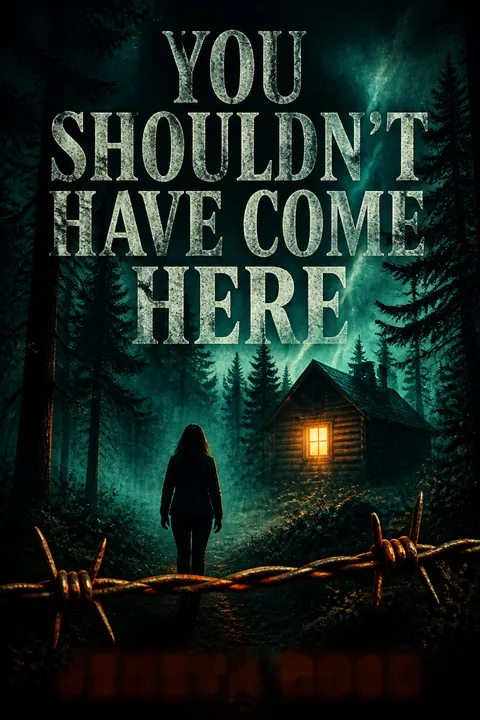


Plot Summary
The Ope at Gunslinger
Grace Evans is driving west from New York when her nearly empty car forces her to stop at Gunslinger 66, a lonely Wyoming gas station. The scarred attendant watches her closely and follows her toward the pump; with no phone service, she flees before filling the tank.
By dusk she reaches the ranch she booked online, where Calvin Wells greets her with a strong handshake and an easy promise of hospitality. His sprawling property, with its river, animals, and mountains, is the isolation she came for. Yet as she follows him inside, Grace feels a brief, unexplained drop in her stomach. She presses on, choosing the ranch despite the warning her body seems to offer.
The opening makes a small act of travel feel like a test of control. Grace chooses a destination through an impulsive vacation ritual, but her first real encounter with Wyoming is not freedom so much as vulnerability: an isolated pump, an unnerving stranger, and no signal to call for help. Her decision to continue to Calvin's ranch establishes the novel's central tension between chosen risk and actual danger. The beautiful landscape is inviting, but its distance from ordinary safeguards also makes it a place where a visitor can disappear.
No Signal, No Exit
Calvin shows Grace to a bedroom still decorated with his mother's old furnishings, then gives her a tour of the house. A padlocked basement door is explicitly off-limits, and taxidermied animals watch from the living-room walls. Grace finds women's underwear in a dresser; Calvin says it belonged to Lisa, his former girlfriend, who died in a car accident after they had broken up.
He quickly changes the subject. When Grace discovers that the ranch has neither working Wi-Fi nor cell service, she cannot tell her friend she arrived safely. Calvin offers a landline, but she decides not to make an issue of it. The house feels comfortable enough to sleep in, yet every convenience comes with a limit she did not expect.
The ranch introduces its threat through omissions rather than overt violence. The locked basement, unexplained belongings, and dead animals are ordinary enough to be dismissed one at a time, which encourages Grace to manage her discomfort instead of acting on it. Her isolation is also negotiated socially: Calvin presents the lack of service as rural normality, while Grace reframes her unease as an inability to disconnect. The scene shows how hospitality can soften scrutiny. What makes the house unsettling is not simply what it contains, but how easily its host decides what a guest may know.
Betty Knows Her Name
The next day Calvin takes Grace around the ranch, showing her the garden, animals, and river. She is curious about his life and agrees to try fishing and horseback riding. When she later visits Betty's Boutique for practical clothes, the shopkeeper identifies her as Calvin's guest before Grace has given her name. Betty calls Calvin a good man and says she will see Grace again, then watches her through the shop window.
As Grace reverses out of her parking space, her car's check-engine light flashes and the engine begins to shake. The coincidence unsettles her: Betty knows who she is, and now her only transportation is failing. Calvin promises that his brother Joe can inspect the car, leaving Grace dependent on the ranch for help.
Grace's growing participation in ranch life is paired with a narrowing of her choices. She is willing to learn unfamiliar skills, and Calvin's attentiveness makes that openness feel rewarding. But Betty's knowledge of her arrival exposes the small town's invisible network, where a visitor is legible before she has introduced herself. The car trouble then converts social unease into practical dependence. The episode's force comes from the way a seemingly benign welcome becomes hard to distinguish from surveillance, while Grace's insistence on being self-sufficient has fewer and fewer ways to express itself.
The Pit Beyond the Drive
That evening, Calvin forgets to secure the chickens and ducks. A raccoon kills several birds before he drives it off, and Grace helps him clean the bloody pond edge and secure the survivors. Their shared work deepens their attraction.
The next morning Calvin teaches her to fish; she catches a large walleye and enjoys the victory. Later, while running beside the road, Grace hears rustling and falls into a concealed pit filled with dead animals, including a freshly killed elk. Calvin pulls her out as she vomits and shakes.
He explains that predators drag prey there, but he cannot identify what made the latest kill. Overhead, vultures circle. The ranch's beauty remains, but Grace can no longer experience it without imagining what may be hidden beneath the grass.
The animals establish a physical vocabulary for the novel's human dangers. The raccoon and the unseen predator act according to survival, without explanation or remorse; their violence is simply part of the ranch's daily economy. Grace's willingness to help Calvin initially brings them closer, but the carcass pit changes the emotional meaning of that closeness. She has crossed from observing rural life to being dropped into its waste. The scene also trains the reader to treat concealment as an active force: long grass hides a pit, and the people around Calvin may be hiding things just as effectively.
A Horse Breaks the Calm
Calvin later takes Grace riding, carefully explaining the saddle and how to guide Gretchen. Grace's fear of heights makes her tense in the saddle. When the horse breaks into a run, Grace cannot stop her; Gretchen rears and throws her onto the hard ground. Calvin carries her to the truck and insists on taking her to Dr. Reed, despite her protests.
The doctor diagnoses a mild concussion, notes her delayed answers, and recommends an MRI. Grace refuses, but he tells her not to drive. Calvin pays the bill and buys her ice, medicine, food, and a teddy bear. His care is tender and constant, though Grace's dependence on him grows at the same time as her car trouble leaves her less able to leave.
The riding accident makes Grace's bodily vulnerability impossible to treat as a passing mood. She has built her identity around competence and control, yet a frightened horse can override instruction and intention in seconds. Calvin responds by taking charge, which is genuinely helpful but also reinforces the imbalance between host and guest. The doctor's concern adds a second uncertainty: Grace's memory and judgment may be impaired, so she cannot fully trust her own perceptions. The teddy bear turns care into an intimate gesture, making protection feel comforting even as dependence becomes more consequential.
Briana's Empty Check-In
That night a sheriff arrives looking for Briana Becker, a traveler whose family has reported her missing. Briana had booked a stay at Calvin's ranch, but Calvin says she never arrived; Grace confirms she has not seen the woman in the photograph.
The sheriff leaves without finding a reason to detain anyone. Grace has recently heard what sounded like a woman's scream, though Calvin dismissed it as a fox's mating call. The next day, Calvin takes her fishing, and she catches a walleye while his friend Charlotte watches them with obvious jealousy.
Grace enjoys the attention but keeps thinking about the missing traveler. When Calvin says Briana never checked in, his answer is plausible, yet it does not explain why the sheriff came to the ranch at all.
The missing-person inquiry reframes earlier details without resolving them. The scream might be an animal, the sheriff might be following a weak lead, and Calvin's account may be accurate; each explanation remains possible. This uncertainty is important because the novel makes suspicion accumulate through context rather than proof. Grace's concussion further complicates her confidence in what she heard. Meanwhile, Charlotte's jealousy gives the ranch a social history that Grace has not been told. The scene places private attraction beside public investigation, suggesting that a charming host can be both emotionally intimate and an object of scrutiny.
Darts, Whiskey, and Blood
Calvin brings Grace and his brother Joe to the Rustic Pine Tavern, where Grace quickly proves herself a skilled dart player. Charlotte arrives, drinks heavily, and dances with Calvin, while Joe dances with Grace. The mood breaks when Grace shoves Joe away and slaps him.
Calvin immediately punches his brother, knocking him down and drawing blood. Grace calls the episode a misunderstanding, but she will not tell Calvin what Joe did. On the drive home, Calvin takes the drunk Charlotte inside while Grace waits in the truck.
He refuses to explain Joe's behavior, gripping the steering wheel as he drives. Grace's attraction has not disappeared, but his silence makes her wonder what his brother is capable of and why Calvin is so reluctant to discuss him.
The tavern exposes the gap between Calvin's easy public manner and the violence in his family. Grace can hold her own in a room full of strangers, yet Joe's advance or behavior crosses a boundary she answers with force. Calvin's response is immediate and protective, but he then withholds the context that might help her understand the danger. The scene also gives Charlotte a visible claim on Calvin, complicating the romantic triangle before Grace knows its history. In a town where everyone seems connected, a social evening becomes a test of allegiance, and Grace leaves with more questions than she arrived with.
The Birthday Under Stars
On Calvin's birthday, Grace helps prepare the barbecue, while Betty, Charlotte, Joe, and Deputy Wyatt gather at the ranch. The day carries a private weight: it is also the anniversary of Lisa's death, though Calvin has not explained that yet.
After the guests leave, Calvin creates a candlelit picnic in the pasture, and he and Grace sleep together. In the quiet afterward, he says his parents died in a house fire and that Lisa died when Joe's truck struck an elk.
Calvin presents Joe as the driver and admits that some people believe the crash was deliberate because there were no skid marks. Grace is moved by his grief and takes his hand. His tenderness persuades her to trust him, even as the stories he tells leave important questions unanswered.
The birthday scene binds intimacy to a carefully curated account of loss. Calvin's grief appears sincere, and the anniversary gives his desire for companionship a credible emotional foundation. Yet Grace receives his family history in fragments, at the moment when she is least inclined to challenge him. The romance therefore works as both connection and interpretive pressure: she wants his account to be true because believing it makes their closeness possible. The pasture's open sky seems to promise freedom, but the conversation narrows what Grace knows. Their bodies draw together while the facts remain unevenly shared.
A Lion in Daylight
The morning after their night together, Grace wakes alone in the pasture to find a mountain lion stalking her. Calvin shoots it before it can attack. A sheriff arriving moments later questions them again about Briana, whose abandoned car has now been found nearby. After he leaves, Calvin introduces Albert, an older man staying at the ranch, as a last-minute Airbnb guest.
Grace had not been told another guest would share the house and is rattled by his presence. Calvin says he must have missed her request for a private stay. The lion's attack can be explained by the food left outside, and the sheriff's questions by Briana's car, but Grace notices a pattern: each new explanation asks her to trust Calvin while making her feel less secure.
The attack briefly makes Calvin's promise of protection real: his gun saves Grace from an immediate, visible threat. That rescue strengthens the bond even as it arrives amid a wider pattern of danger and concealment. The sheriff's return places the missing woman closer to the ranch, while Albert's sudden appearance undermines Grace's understanding of the booking she made. These competing risks prevent a simple division between protector and threat. Calvin can be both the person who intervenes and the person who controls what Grace is told, a contradiction that keeps her emotionally attached while her instincts sharpen.
A Lock on the Wrong Side
Charlotte visits and tells Grace that she and Calvin slept together before Grace arrived. Calvin admits it was a single encounter and says it meant nothing, but the omission deepens Grace's distrust. Charlotte later tells Calvin she slept with Joe and threatens to expose what she knows; he grips her arm, then knocks her to the ground when she punches him.
The next day Wyatt confronts Calvin over Charlotte's injured head, and Grace defends Calvin, though she has not heard the whole story. That night Albert wanders into Grace's bed while drunk. Calvin calls it a mistake and promises to install a lock. He does, but puts it on backward, so Grace can be locked inside her room. His failures of honesty and protection now overlap.
This sequence turns romantic jealousy into a crisis of credibility. Charlotte's disclosure is not only about sex; it shows that Calvin has been editing the past to preserve Grace's image of him. His physical altercation with Charlotte makes that concealment more threatening, while Grace's defense of him reveals how strongly attraction still shapes her judgment. Albert's intrusion then violates the privacy of the room where she is meant to feel safest. The reversed lock is an especially potent domestic detail: a device designed to protect can instead restrict. The novel's suspense grows from these reversals of care.
Joe Sets the Curtains Burning
While Calvin takes Albert into town, Joe arrives at the ranch bloodied after a fight with Wyatt. He tells Grace that their father abused their mother and that the family was damaged long before the parents died. Then he smashes a phone, pours liquid over the curtains, and sets the house on fire, claiming he is saving Grace from Calvin.
She tries to reach emergency services, but Joe tears the phone from the wall. Calvin returns, knocks Joe down with a fire extinguisher, and puts out the flames. Police arrest Joe for arson. During the confrontation, Joe insists their parents did not die in the fire as Calvin claimed. Grace hears the accusation but cannot tell whether Joe is revealing the truth or using the chaos to wound his brother.
Joe's arson makes the family history a present-tense danger rather than a buried story. His violence is alarming, but his claim that he is protecting Grace destabilizes the familiar roles: Calvin is no longer automatically the safe brother, and Joe is not merely the threat. The fire literalizes the way the Wells family has managed its past by concealing it, while the destroyed phone cuts Grace off from outside help at the worst moment. Her inability to assess Joe's credibility is not a failure of intelligence; it is the result of competing accounts delivered under pressure.
Bri in the Basement Ledger
After the police leave, Grace picks the basement lock and searches the clutter Calvin forbade her to see. She finds taxidermied predators, a notebook listing Airbnb guests, a collection of weapons, and Bri Becker's name with a check-in date but no departure. Outside, Betty appears in a dazed state and warns Grace that the house harms those who stay there, then begs her not to tell Calvin she came.
The next day, Calvin denies that Bri was ever a guest and shows Grace a ledger in which her name is absent. He admits to lying about Albert and other small things, framing himself as foolish rather than dangerous. Grace cannot prove what she saw, but she does not believe the blank page.
The basement turns suspicion into material evidence, though not evidence Grace can easily use. Bri's entry, the weapons, and the mounted animals make Calvin's home look less like an eccentric ranch than a curated system of control. Betty's warning echoes Grace's own unease but is compromised by Betty's mental health and medication, giving Calvin room to dismiss both women. When the ledger appears blank, the conflict shifts from what happened to whose perception counts. Grace is isolated not only from help, but from the shared facts that would let her trust her own judgment.
The Bees Take Albert
After Calvin takes Albert to town, the older man is found dead near Betty's beehives, his body swollen from an apparent severe allergic reaction. Betty is devastated, while Calvin says Albert must have wandered into the apiary drunk. Their argument reveals that Betty knew Calvin's parents did not simply die in a fire.
She admits she withheld the truth to protect him; Joe had said their mother killed their father and then herself. Grace connects this with Joe's account of Lisa's crash and begins to suspect Calvin's version of both tragedies. Though her car is nearly ready, she stays for one final dinner. When Calvin kisses her without invitation, she rejects him, then dreams he attacks her with a fishing hook.
Albert's death brings the ranch's hazards into an increasingly suspicious pattern, but the text leaves its cause unsettled. The more important shift is Betty's confirmation that Calvin's account of his parents' deaths was incomplete. Grace now has reason to revisit every story he has told, including the crash that killed Lisa. Her decision to remain for dinner is practical as much as emotional: she is still waiting for a working car. The unwanted kiss ends the remaining illusion that desire alone can restore trust, while the violent dream converts the fishing lesson into an image of entrapment.
The Knife and the Confession
Grace packs to leave, but Calvin has not repaired her car; when she reaches it, he drags her back toward the house and strikes her. She bites his finger, breaks free, and runs inside, where she finds a knife in his bedroom. Calvin becomes dizzy and paralyzed after she has drugged him, leaving him able to speak but not fight. She makes him explain Bri's disappearance.
He admits Bri is alive, locked in a shed behind the apiary. He also confesses that he was driving when Lisa said she planned to leave for Alaska. He unfastened her seat belt and deliberately crashed into an elk, then moved Joe into the driver's seat to frame him. Grace stabs Calvin repeatedly, ending his control over her and the ranch.
The final confrontation reverses the novel's power structure. Calvin has relied on isolation, physical strength, and the authority of the host; Grace answers with preparation and a refusal to accept his version of events. Her drugging of him gives her the time to extract two decisive truths: Bri is captive, and Joe was framed for Lisa's death. The confession does not make Grace a conventional rescuer, however. She kills Calvin rather than summoning help, choosing an ending governed by her own judgment. The scene exposes how closely the thriller's competing forms of violence have been intertwined.
Avery Leaves Wyoming
After killing Calvin, Grace discovers mounted heads bearing the names of women he had hosted, including Briana and Grace. She dyes her hair, removes her blue contacts, and reveals that Grace Evans was an assumed identity: she is Avery Adams, a serial killer who chose Calvin as her target. Avery finds Briana alive in the locked shed and cuts her free, but refuses to take her along, leaving the exhausted woman behind.
She drives away in Calvin's truck, returns to Gunslinger 66 for the identity she dropped there, then blows up the station, erasing the trail and the attendant. At home near Chicago, Avery resumes life with her husband and children. A new itch signals that her private ritual is not finished.
The ending refuses the comfort of a clean reversal in which a victim becomes a hero. Avery did rescue Bri, but she also abandons her, revealing that compassion is subordinate to her own ritual and survival. Calvin's trophy display confirms his predation, yet Avery's final narration makes clear that she is not simply his opposite. Both turn other people into objects within a private logic, though Avery's violence is deliberate and self-fashioned while Calvin's is tied to a history of abuse and grievance. Her return to domestic life is chilling because the ordinary family scene conceals, rather than cures, the appetite she carries.
Analysis
The novel builds suspense by making intimacy and evidence compete. Grace's attraction to Calvin is not a detour from the mystery; it is the means by which she becomes dependent on the person she may need to distrust. Calvin's care is concrete and persuasive, from cooking to paying for medical treatment, while his control emerges through subtler acts: withheld information, a broken car, and an unsafe lock. The reader is asked to interpret the same gestures as affection or containment, often with no immediate way to settle the question.
The rural setting gives this uncertainty material force. A missing phone signal is not symbolic decoration when Grace cannot call for help. Predators, animal carcasses, the river, and the bee yard make death part of the ranch's everyday landscape, allowing human violence to hide inside what looks like ordinary hardship. The townspeople's overlapping loyalties further complicate truth. Betty, Charlotte, Joe, Wyatt, and Calvin all know different pieces of the past, but none offers a complete account at once.
The final reversal makes the reader reconsider not only Calvin but Grace. Her apparent independence and emotional reserve are partly performances, and her ability to read people serves a lethal purpose. Yet the story does not flatten the two killers into equivalents. Calvin's violence is entwined with family abuse, entitlement, and a desire to keep people from leaving. Avery describes her own killing as chosen practice, then abandons Bri despite having freed her. Her return to husband and children makes ordinary domestic affection coexist with deliberate cruelty. The book's sharpest unease comes from that coexistence: monstrosity does not announce itself through a strange appearance or an isolated landscape. It can pass as hospitality, romance, neighborliness, or a life that seems perfectly balanced.
Review Summary
You Shouldn't Have Come Here received mixed reviews, with polarized opinions. Some readers found it entertaining and praised its unexpected twists, while others criticized the slow pacing, unrealistic characters, and clichéd writing. Many felt it was more of a romance than a thriller until the final chapters. The ending was divisive, with some finding it brilliant and others calling it far-fetched. Overall, the book was described as a quick read with a unique plot, but lacking in suspense and character development for many readers.
People Also Read







Characters
Grace Evans
The guarded city travelerGrace arrives from New York with a polished wardrobe, a demanding banking job, and a habit of organizing her life tightly. Her annual dart-at-a-map vacation is one of the few ways she deliberately welcomes uncertainty. She is observant, physically confident, and inclined to test people rather than accept appearances at face value. At the ranch, she is drawn to Calvin's attention and to the quiet life he represents, but she does not surrender her independence easily. Her curiosity can lead her into danger, while her capacity to adapt helps her navigate unfamiliar surroundings. Grace's emotional tension lies in wanting both intimacy and control, especially when the people around her offer protection on terms she has not chosen.
Calvin Wells
The attentive ranch hostCalvin runs his family's Wyoming ranch, tends its animals and garden, and rents rooms to travelers. His warmth is practical: he cooks, offers rides, fixes problems, and remembers small comforts. He is also lonely, deeply attached to the land, and burdened by grief over his parents and former girlfriend. Calvin wants to be needed and is quick to imagine lasting intimacy, which makes him both generous and possessive. His relationship with Grace exposes his difficulty distinguishing care from control. The ranch is his home, livelihood, and emotional inheritance, and his identity is bound to the family stories he has chosen to preserve.
Joe Wells
Calvin's resentful brotherJoe is Calvin's younger brother, a capable mechanic whose parents left the ranch to Calvin despite Joe's years of work there. He is muscular, competitive, and eager to be noticed, but resentment and shame complicate his loyalty to his family. A serious accident has left gaps in his memory and changed his temperament, making other people uncertain about what he remembers and what he might do. Joe's closeness to Calvin is strained by old favoritism, grief, and the unresolved consequences of the night Lisa died.
Charlotte
Calvin's protective friendCharlotte has known Calvin since childhood and helps him with ranch work, including gathering eggs. She is also close to his family and feels responsible for his well-being after repeated losses. Her feelings for Calvin complicate her friendship with him, especially when a new guest occupies his attention. Charlotte can be warm and capable, but jealousy makes her guarded and sharp with Grace. Her unresolved relationship with Deputy Wyatt adds another layer to her loyalties and frustrations.
Betty
The town's watchful neighborBetty owns the local boutique and keeps honeybees on Calvin's land. She is a familiar, maternal presence in his life and often speaks as though she has a stake in protecting him. Her friendliness is mixed with an instinct for town gossip and a wary eye for newcomers. Betty's mental health and medication affect how others interpret her warnings, complicating her role as a source of information. She cares deeply for Calvin, but her protectiveness sometimes leads her to withhold truths she believes might hurt him.
Briana Becker
The missing travelerBriana is a traveler whose disappearance brings law enforcement to Calvin's ranch. She had planned a cross-country trip and was expected home by her family. Her absence becomes a troubling presence in Grace's stay, connecting the ranch's private life to a wider investigation. Though Briana is initially known through a photograph and a missing-person report, her story gives the people around her a concrete reason to question what they have been told.
Lisa
Calvin's former girlfriendLisa was Calvin's on-again, off-again girlfriend. Her death in a car accident remains central to his grief and to the way people in Dubois treat him. Calvin remembers their relationship as intense and unfinished, while the anniversary of her death gives his birthday a private weight. Lisa's past also connects the Wells family to the town's conflicting accounts of responsibility, memory, and blame.
Sheriff Almond
The persistent investigatorSheriff Almond investigates Briana's disappearance and returns to Calvin's property as new information emerges. He is cautious, direct, and alert to inconsistencies, though the evidence available to him is limited. His presence offers Grace a possible route to help, but the ranch's isolation and the shifting accounts around it make intervention difficult. He is willing to revisit a lead rather than accept a convenient answer.
Wyatt Miller
The local deputyWyatt is a deputy in Dubois and Charlotte's former partner. He is rough-mannered, loyal to Joe, and more emotionally invested in town relationships than his casual manner suggests. His friendship with Joe makes him a witness to the Wells family's past, while his feelings for Charlotte keep him close to Calvin's circle. Wyatt's bluntness can expose tensions others would rather ignore.
Albert
The erratic older guestAlbert is an older, heavy-drinking man who arrives at the ranch needing a place to stay. His disheveled manner and blunt humor make him seem intrusive, but he can also show unexpected candor. He carries serious allergies and a medical bracelet, details that matter in a property where bees are kept. His presence creates a fresh strain on Grace's sense of privacy and security.
Dr. Reed
The country doctorDr. Reed is the local physician who examines Grace after her fall from Gretchen. He is experienced, practical, and cautious about head injuries, even when patients resist further testing. His familiarity with Calvin reflects the small town's close network of relationships.
Patsy
The clinic receptionistPatsy works at the clinic front desk and has known Calvin since he was a boy. She handles Grace's billing after the riding accident and notices when Grace struggles to recall basic information. Her role is brief, but her concern reinforces how closely the town watches over Calvin.
Gunslinger 66 attendant
The wary gas-station clerkThe scarred, one-eyed attendant runs the isolated Gunslinger 66 station. His attention unsettles Grace during her first stop in Wyoming, and the station later becomes a place where her identity is tested. He is a small but memorable presence at both ends of her journey.
Plot Devices
The remote ranch
Isolation made tangibleCalvin's ranch is both a working farm and a short-term rental, but its distance from town gives its guests little access to outside help. Cell service is absent, the Wi-Fi is unavailable, the roads are sparsely traveled, and Grace's car fails soon after she arrives. The property also contains hazards that belong naturally to rural life, from predators to the river and bees. These details make the setting more than atmosphere: each inconvenience increases reliance on Calvin and makes leaving harder. The ranch's beauty draws Grace in, while its physical and social isolation allows suspicion to grow without immediate confirmation.
The guest ledger
A paper trail in doubtThe notebook in Calvin's basement records people who have stayed at the ranch. Grace finds Briana Becker's name with a check-in date and no checkout, which contradicts Calvin's statement that Briana never arrived. When he later shows Grace a ledger without her name, the record becomes a contest over perception and credibility. The ledger is ordinary evidence, but its apparent disappearance makes it impossible for Grace to rely on what she has seen. It also links the ranch's rental business to the novel's central question: whether a guest can leave once the host controls the room, the records, and the story.
The missing traveler
Suspicion with a human faceBriana Becker's disappearance first reaches Grace through Sheriff Almond's questions and a photograph. Her booked stay at Calvin's ranch gives the investigation a direct connection to the setting, while Calvin's denial keeps the clue unresolved. The discovery of Briana's abandoned car intensifies concern, but the sheriff still cannot establish what happened to her. The missing-person plot makes Grace's unease more concrete: the possibility of danger is no longer limited to strange noises, old belongings, or a faulty car. Briana's absence becomes the test of whether Grace can trust Calvin's account or her own growing suspicion.
Ranch wildlife and trophies
Nature mirrors human dangerThe ranch's animals shape both daily life and the novel's imagery. Raccoons kill chickens, an unseen predator leaves a pit full of carcasses, a horse throws Grace, and a mountain lion attacks her in the pasture. The mounted heads inside the house turn the same animals into silent witnesses, their fixed eyes watching the guests. These events initially seem like the ordinary risks of ranch life, but they steadily erode the line between the wild outside and the danger within the home. The living predators can be understood through instinct; the human beings around the ranch make choices and conceal their reasons.
Grace's borrowed identity
The final reversalThe novel presents Grace Evans as a New Yorker on vacation, encouraging readers to interpret her guardedness as caution and her interest in Calvin as attraction. After Calvin's death, she reveals that Grace is an assumed identity and that she is Avery Adams, a serial killer who deliberately chose him as a target. The revelation changes the meaning of her research, composure, and ability to manipulate the people around the ranch. It does not erase Calvin's crimes or make Avery a conventional hero. Instead, it exposes a second predator who has been present in the narrative all along, using a convincing social persona to move through ordinary life.
FAQ
Synopsis & Basic Details
What is You Shouldn't Have Come Here about?
- Remote Ranch Retreat: A woman named Grace seeks a peaceful escape at a remote Wyoming ranch she found on Airbnb, hoping to leave behind her hectic city life.
- Enigmatic Host: She meets the ranch owner, Calvin, a handsome and mysterious man who seems welcoming but harbors secrets about his past and the ranch itself.
- Unsettling Discoveries: As Grace explores the ranch, she encounters unsettling events and discovers hidden truths, leading her to question her safety and the true nature of her host.
Why should I read You Shouldn't Have Come Here?
- Twisty Thriller: The book is a suspenseful thriller with unexpected twists and turns, keeping readers engaged and guessing until the very end.
- Complex Characters: The characters are complex and flawed, with hidden motivations and secrets that add depth to the story.
- Atmospheric Setting: The remote Wyoming ranch setting creates a sense of isolation and unease, enhancing the suspense and tension of the narrative.
What is the background of You Shouldn't Have Come Here?
- Geographic Isolation: The story is set in the remote and isolated landscape of Wyoming, which plays a significant role in creating a sense of unease and vulnerability.
- Cultural Contrast: The contrast between Grace's city life and the rural setting of the ranch highlights the differences in values and lifestyles, adding to the tension.
- Personal History: The ranch has a history of tragedy and loss, which is tied to Calvin's past and the secrets he keeps, creating a sense of foreboding.
What are the most memorable quotes in You Shouldn't Have Come Here?
- "You don't have to worry about any of that here. I'll keep you safe, Grace.": This quote from Calvin establishes a false sense of security, foreshadowing the danger Grace will face.
- "They're only strangers at first.": This line reveals Calvin's manipulative nature and his tendency to blur the lines between guest and something more.
- "I'm a big girl. I can take care of myself.": This quote highlights Grace's independence and determination, which are crucial to her survival.
What writing style, narrative choices, and literary techniques does Jeneva Rose use?
- Dual POV: The story is told from the alternating perspectives of Grace and Calvin, creating suspense and allowing readers to see the characters' conflicting motivations.
- Foreshadowing: Rose uses subtle hints and clues to foreshadow future events, building tension and keeping readers guessing.
- Atmospheric Descriptions: The author uses vivid descriptions of the setting to create a sense of isolation and unease, enhancing the overall suspense of the story.
Hidden Details & Subtle Connections
What are some minor details that add significant meaning?
- Cracked Window: The cracked window in Grace's room, which she cuts herself on, foreshadows the fractured nature of the relationships and the danger she is in.
- Taxidermy Mounts: The taxidermy mounts in the living room, with their eyes following Grace, symbolize the constant surveillance and the feeling of being watched.
- Padlocked Basement Door: The padlocked basement door, which Calvin claims is off-limits, creates a sense of mystery and foreshadows the dark secrets hidden within the ranch.
What are some subtle foreshadowing and callbacks?
- Gunslinger 66 Attendant: The creepy gas station attendant's menacing behavior foreshadows the danger Grace will face at the ranch, creating a sense of unease from the beginning.
- "You shouldn't have come here": The title itself serves as a constant reminder of the danger Grace is in, foreshadowing the tragic events that will unfold.
- The Missing Woman: The mention of Bri Becker's disappearance early in the story foreshadows the dark secrets and the potential danger Grace is in.
What are some unexpected character connections?
- Betty and Calvin: Betty's close relationship with Calvin, almost like a second mother, adds a layer of complexity to the story and reveals the close-knit nature of the community.
- Charlotte and Wyatt: The history between Charlotte and Wyatt, and their shared connection to Calvin, creates tension and adds to the complex web of relationships.
- Albert and Calvin: The revelation that Albert is Calvin's uncle, not a random Airbnb guest, adds a layer of deception and highlights the extent of Calvin's lies.
Who are the most significant supporting characters?
- Charlotte: Her jealousy and protectiveness of Calvin create tension and add to the overall sense of unease.
- Sheriff Almond: His investigation into Bri Becker's disappearance adds a sense of urgency and danger to the story.
- Betty: Her close relationship with Calvin and her knowledge of the town's secrets make her a significant figure in the story.
Psychological, Emotional, & Relational Analysis
What are some unspoken motivations of the characters?
- Calvin's Need for Control: Calvin's need for control stems from his past traumas and his desire to maintain power over his surroundings and the people in his life.
- Grace's Desire for Escape: Grace's desire for escape from her hectic city life is driven by a need for peace and a sense of control over her own life.
- Charlotte's Obsession: Charlotte's obsession with Calvin is driven by her own insecurities and her desire to possess him, leading to her manipulative behavior.
What psychological complexities do the characters exhibit?
- Calvin's Duality: Calvin exhibits a duality, presenting a charming and welcoming facade while harboring a dark and manipulative nature.
- Grace's Paranoia: Grace's paranoia and heightened sense of awareness are a result of her past experiences and her growing unease at the ranch.
- Joe's Resentment: Joe's resentment towards Calvin stems from his feelings of being overlooked and his belief that he was unfairly blamed for the accident.
What are the major emotional turning points?
- The Night Swim: The night swim in the river marks a turning point in Grace and Calvin's relationship, where their mutual attraction intensifies, but also highlights the underlying tension.
- The Discovery of the Pit: The discovery of the pit of dead animals intensifies Grace's fear and suspicion, leading her to question Calvin's true nature.
- The Revelation of Lisa's Death: The revelation of Lisa's death and the circumstances surrounding it adds a layer of tragedy and complexity to Calvin's character.
How do relationship dynamics evolve?
- Grace and Calvin: Their relationship evolves from a seemingly innocent connection to a dangerous game of cat and mouse, with trust and betrayal at its core.
- Calvin and Joe: The relationship between Calvin and Joe is marked by resentment and a history of conflict, which ultimately leads to a violent confrontation.
- Grace and Charlotte: The relationship between Grace and Charlotte is characterized by jealousy and suspicion, highlighting the tension between the outsider and the insider.
Interpretation & Debate
Which parts of the story remain ambiguous or open-ended?
- Calvin's True Nature: The extent of Calvin's psychopathy and his true motivations remain somewhat ambiguous, leaving readers to question the depth of his darkness.
- The Missing Woman's Fate: While Bri Becker is found, the full details of her experience and the extent of Calvin's involvement in her disappearance are left somewhat open-ended.
- The Future of the Ranch: The future of the ranch and the community after the events of the story is left ambiguous, leaving readers to wonder about the long-term impact of the tragedy.
What are some debatable, controversial scenes or moments in You Shouldn't Have Come Here?
- The Graphic Violence: The graphic violence in the final confrontation may be considered controversial by some readers, raising questions about the author's use of violence.
- The Portrayal of Mental Illness: The portrayal of Betty's mental health and her actions may be seen as controversial, raising questions about the author's sensitivity to mental health issues.
- The Relationship Dynamics: The complex and often manipulative relationships between the characters, particularly between Grace and Calvin, may be seen as controversial, raising questions about the nature of love and obsession.
You Shouldn't Have Come Here Ending Explained: How It Ends & What It Means
- Grace's Survival: Grace's survival is a testament to her resilience and resourcefulness, highlighting her ability to overcome adversity and emerge stronger.
- Calvin's Downfall: Calvin's downfall is a result of his own lies and manipulations, emphasizing the consequences of deception and the destructive nature of unchecked power.
- A New Beginning: Grace's escape and new identity symbolize her transformation and her ability to move on from the trauma she experienced, suggesting a new beginning.
About the Author
Other books by Jeneva Rose





Download PDF
Download EPUB
.epub digital book format is ideal for reading ebooks on phones, tablets, and e-readers.








