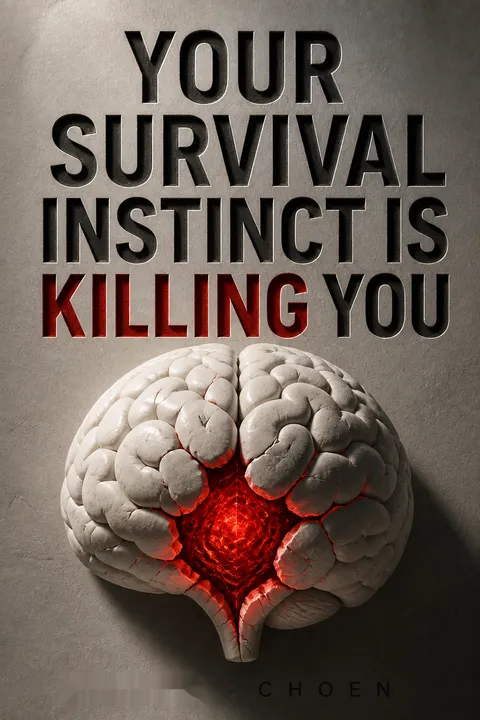


Key Takeaways
Train your alarm to distinguish discomfort from actual danger.
A body caught in a loop. Schoen argues that the survival response can treat ordinary discomfort as a threat, then reinforce the very symptoms or habits meant to bring relief. He opens with Mikael, a man whose hiccups had persisted for more than two years and were causing seizures. With brain surgery being considered, Schoen used hypnosis and imagery centered on coolness. The hiccups stopped during the session and did not return, according to the account.
A lesson, not a cure-all. Schoen interprets Mikael’s case as evidence that new sensations and associations can interrupt entrenched patterns. His larger proposal is to help the body learn that discomfort does not automatically mean danger. The anecdote is striking, but one case cannot establish a reliable treatment for chronic symptoms. Persistent or severe symptoms still require appropriate medical evaluation.
What's compelling is the shift from asking only how to suppress a symptom to asking what keeps a response going. That question can complement medical care by drawing attention to learned fear, context, and bodily feedback. The story also shows why a patient's experience should not be dismissed as imaginary: a symptom can be real even when its persistence is shaped by stress or expectation. At the same time, the dramatic result risks making a complex condition sound simple. The useful principle is openness to mind-body interactions, not assuming that hypnosis or reframing can replace diagnosis or treatment.
Remove some instant stimulation before it shrinks your patience.
The Cozy Paradox. Schoen uses this term for the mismatch between lives filled with convenience and people increasingly distressed by small delays or discomforts. He links the pattern to fast food, microwaves, search engines, and constant digital contact. A book-era example contrasts about 8,000 available foods in the 1970s with more than 40,000 by the time he was writing. He also cites experiments in which exposure to fast-food logos was associated with more impatient choices.
A cultural feedback loop. If every want is met quickly, waiting can start to feel like a problem rather than an ordinary part of life. Schoen argues that expectation spreads beyond food or information to work, relationships, and entertainment. The practical response is not to reject technology, but to create some deliberate gaps: put the phone away during a meal, or let a question remain unanswered until the hike is over.
The book's strongest cultural insight is that convenience can change expectations, not merely save time. That makes the ordinary pause a useful place to notice whether an urge is genuine or simply accustomed to immediate service. The account also connects individual habits to commercial environments designed to capture attention and stimulate demand. A caution is warranted: the cited logo experiments do not show that technology alone causes broad social impatience, and historical comparisons can romanticize earlier eras. Still, deliberately choosing some friction can restore a sense of agency without pretending that modern conveniences are inherently harmful.
Track the buildup before a specific stressor pushes you over threshold.
Agitance accumulates quietly. Schoen defines agitance as a growing background state of activation that may precede recognizable discomfort. It differs from stress in his model: stress has a specific source, such as a deadline, while agitance can build across many small imbalances. Signs might include irritability, poor concentration, restless evenings, or repeatedly checking messages. His Agitance Checklist asks about such habits to help readers notice the buildup.
The collision matters. Andrea, a busy executive, routinely worked late and slept poorly without considering herself stressed. In a hot conference room, she suddenly felt trapped and panicked. Schoen sees the room as the immediate stressor and her accumulated agitance as the background that made the reaction more likely. The point is to respond to early signals rather than wait for a crisis to make the pattern undeniable.
This distinction resembles the difference between a triggering event and the accumulated load that makes a system vulnerable to it. It gives readers a more useful question than simply asking whether work feels stressful: what has been quietly consuming recovery time? The checklist is a practical prompt, not a validated diagnostic instrument, and a high score should not be treated as a clinical diagnosis. The model is most useful when it encourages observation without self-blame. A crowded schedule, illness, caregiving, or financial strain may all contribute, and not every sign of overload can be solved by personal habit changes.
Do not let short-term escape teach fear to spread.
Relief can reinforce avoidance. Schoen describes maladaptive habits as attempts to create immediate safety, even when they make life narrower over time. Bethany first drank to get through a turbulent flight, then relied on medication, and eventually avoided flying. The relief helped in the moment, but the fear remained, and she began using medication in other situations too. Schoen calls attention to this spread from one trigger to others.
Separate treatment from the loop. The example is not a reason to stop prescribed medication or to force exposure without support. It illustrates how avoidance can teach a person that a situation is unsafe unless a protective ritual is present. The same pattern can occur with food, sleep, or symptoms: a behavior reduces distress now, then becomes harder to do without. Schoen's proposed alternative is gradually learning to tolerate discomfort while rebuilding confidence and using appropriate care.
The pattern maps onto negative reinforcement: an action becomes more likely because it removes distress in the short term. That explains why a protective behavior can feel effective and still carry a long-term cost. The framing is most responsible when it distinguishes an entrenched avoidance loop from sensible accommodation or medical treatment. A person who avoids a genuinely dangerous situation is not necessarily trapped in fear, and medication can be an important part of care. The key question is whether relief is restoring function or progressively making ordinary life depend on more rules and safeguards.
Treat learned triggers as associations that can be retrained.
The body learns context. Schoen explains conditioning as learning that links an experience with a cue, so a cue can later evoke an automatic response. Bethany's turbulent flight linked flying with fear; Andrea began reacting to stuffy rooms after a panic episode. In state-dependent learning, a familiar setting or condition can become tied to a response. Schoen also describes the Let Down Effect, his term for symptoms that appear after a stressful period, such as getting sick on vacation.
Associations can broaden. A reaction first linked to one situation may generalize to similar situations. Schoen also discusses research in which rats developed a conditioned immune response after a medication was repeatedly paired with sweetened water. He uses this to argue that learning can influence bodily processes as well as conscious behavior. These examples support paying attention to patterns and cues, but they do not mean every illness is psychological or that all physical symptoms are learned.
Conditioning offers a valuable bridge between experience and automatic response: people need not consciously choose a reaction for it to be patterned. This can reduce shame and make careful tracking of context worthwhile. The book's extension from behavior to immune responses is intriguing, but translating animal conditioning research into broad claims about human illness requires caution. A symptom's timing may reflect many biological and environmental factors. The most grounded application is to notice recurring links, discuss them with qualified clinicians when health is involved, and avoid treating correlation as proof that a person has caused their own illness.
Lower baseline arousal with routines, pauses, and deliberate limits.
Make recovery ordinary. Schoen offers fifteen ways to manage agitance, including setting technology limits, slowing down, allowing unstructured time, keeping a regular sleep schedule, moving the body, and reducing multitasking. The common thread is to stop adding stimulation to a system that already has little room to recover. He suggests trying small, repeatable changes rather than attempting a total life overhaul.
Short pauses count. Schoen developed the Schoen Breath Technique as a brief relaxation exercise, using a comfortable inhale, a short hold, and several gentle exhalations. He recommends practicing it during the day, especially when agitation begins to rise. He also describes a study in which participants trained in self-hypnosis healed faster after a minor skin challenge than a comparison group. These practices are presented as ways to support regulation, not as substitutes for medical care or solutions to every external stressor.
The practical value here is cumulative rather than dramatic. Regular sleep, breaks from devices, and single-tasking create predictable opportunities for recovery, which can make coping strategies easier to access under pressure. This is consistent with a broader systems principle: habits and surroundings can reduce the demand placed on moment-to-moment self-control. The book sometimes implies that a brief technique can produce wide physiological benefits, and such claims should be interpreted in proportion to the specific studies described. Small routines are still worth testing because they are inexpensive, adjustable, and do not require believing that every stressor is self-generated.
Practice discomfort and safety at once, not comfort instead.
Build a broader response. Schoen's central retraining method is to let discomfort coexist with another experience, such as relaxation, gratitude, compassion, or focused challenge. He calls this duality: noticing more than one sensation or emotional state at the same time, rather than treating discomfort as the only thing happening. He recommends beginning with a moderately uncomfortable situation, not one that produces panic, and repeating the practice over time.
Use more than one route. Schoen suggests first calming the body with his breathing exercise, then recalling a source of gratitude or support while attending to the discomfort. Naming both experiences can help a person recognize that discomfort and safety are not mutually exclusive. He also describes pairing discomfort with a strategic game or a personally meaningful image of strength. The aim is not to deny pain or force positivity, but to reduce the sense that discomfort must dictate every action.
This approach has an important advantage over simple reassurance: it does not ask a person to prove that distress is absent before acting. The practice instead widens attention, leaving room for discomfort and for evidence of safety or purpose. That is a useful alternative to all-or-nothing thinking. Gratitude and imagery will not fit every person or every situation, however, and attempts to impose positivity can feel invalidating. The method is strongest when chosen freely, used at a manageable intensity, and paired with professional support when symptoms are severe or trauma-related.
Rehearse under manageable pressure to make skill available when stakes rise.
Performance depends on regulation. Schoen argues that fear can interfere with recall, judgment, and execution, even when the underlying skill is strong. He cites a study comparing Special Forces soldiers with regular infantry during survival training: both showed a stress response, but the Special Forces soldiers' measured neuropeptide Y levels returned toward baseline more quickly. Schoen interprets this as evidence of trained recovery, rather than an absence of fear.
Practice the real conditions. Jenna, a strong student, developed test anxiety that disrupted sleep and concentration. Her work with Schoen included lowering everyday agitance and practicing test questions under time pressure. The aim was to make the exam setting less unfamiliar, not to eliminate every anxious thought. Similar rehearsal can help with presentations, auditions, and workplace decisions, provided the pressure increases gradually and the exercise targets the actual task.
The key performance lesson is that preparation should include the conditions under which a skill must be used, not just the skill in isolation. That principle applies to exams, public speaking, and high-stakes decisions. Stress exposure can be productive when it is graded and followed by recovery; overwhelming practice can instead deepen avoidance. The Special Forces comparison is suggestive, but group differences do not prove that one particular training method caused resilience. Schoen's practical advice is most persuasive when understood as deliberate, realistic rehearsal rather than a promise that anyone can become immune to pressure.
Choose challenging, bounded discomfort, not suffering for its own sake.
Adversity is not automatically growth. Schoen writes that grief during the breakup of his marriage forced him to reconsider his instinct to escape pain. He came to see that tolerating distress could help him change, but that unmanaged suffering could also overwhelm and immobilize. He distinguishes chosen, manageable challenges from relentless hardship, which can erode a person's capacity to cope.
Hardiness has ingredients. Schoen recounts research on 450 telephone-company managers facing industry upheaval. In his account, about one-third adapted well, and their outlook included commitment, a sense of control, and treating change as a challenge. He extends the idea to relationships: intimacy and friendship require tolerating vulnerability rather than withdrawing at the first sign of emotional risk. The lesson is not to seek pain, but to approach meaningful challenges in doses that allow learning, support, and recovery.
The distinction between challenge and harm matters. Resilience is not a moral prize for enduring the most pain, and an individual's response to adversity depends on resources, history, health, and support. The book's emphasis on agency is valuable when it helps people choose a tolerable next step, rather than judge themselves for struggling. Social connection is especially important here: discomfort may be easier to face when it is shared and acknowledged. Growth is a possibility, not an obligation, and some experiences call first for safety, treatment, or practical assistance rather than a search for lessons.
Analysis
Schoen's most useful contribution is a practical reframing: discomfort is not always evidence of danger, and efforts to abolish it can become habits that shrink a person's life. The book connects this idea across symptoms, eating, sleep, relationships, technology, and performance. Its narrative cases give readers a recognizable sequence: background strain accumulates, a trigger sparks alarm, a behavior provides relief, and repetition makes the pattern feel inevitable. The proposed alternative is not stoicism. It is to notice the buildup, reduce avoidable activation, and practice tolerating moderate discomfort while remaining connected to safety, purpose, and other people.
The model is strongest as a behavioral lens and weakest when presented as a total explanation of illness. The book's account of a primitive limbic brain overpowering a rational brain is accessible, but contemporary neuroscience describes interacting, distributed networks rather than three neatly separate brains. Dopamine also has more complex roles than a simple comfort meter, and the book's broad links between modern convenience and chronic disease should be read as hypotheses rather than settled causes. Its striking clinical stories, including Mikael's resolved hiccups, illustrate possibilities but cannot establish general effectiveness. Nor should readers infer that symptoms are self-created or that medication is a failure. Physical illness, social adversity, and structural stressors require appropriate care and support.
The most defensible application is modest and testable: identify a recurring trigger, notice what happens before and after it, and experiment with a small change that expands choice rather than demanding perfect calm. Rehearse important tasks under tolerable pressure, and seek help when distress exceeds what self-guided practice can safely address. Understood this way, the book's central idea is not to glorify discomfort. It is to prevent fear of discomfort from quietly making more decisions than the person does.
Review Summary
Your Survival Instinct Is Killing You receives mixed reviews. Some praise its insights on managing discomfort and stress, appreciating the scientific approach and practical strategies. Others find it repetitive and overhyped, criticizing the author's self-promotion and pseudo-scientific claims. The book's core message about increasing distress tolerance and embracing discomfort resonates with many readers. However, some question the effectiveness of the proposed techniques and find the content unoriginal. Overall, readers appreciate the book's perspective on modern stress but have varying opinions on its execution and usefulness.
People Also Read









Glossary
The Cozy Paradox
Comfort alongside rising sensitivitySchoen's name for the apparent contradiction that greater access to convenience and comfort can coincide with less tolerance for discomfort. He argues that repeated quick relief may encourage people to expect immediate solutions, making ordinary delays or unease feel more threatening. He presents this as a cultural pattern, not a diagnosis.
agitance
Accumulated background activationSchoen's term for a buildup of unsettled activation that may remain below awareness until it contributes to noticeable discomfort. He distinguishes it from stress, which he defines as linked to a particular event or demand. Irritability, restlessness, difficulty slowing down, and disrupted sleep can be signs of rising agitance in his framework.
externalization
Dependence on outside reference pointsSchoen uses externalization for a growing reliance on outside influences, expectations, stimulation, and measures of value at the expense of inner needs and beliefs. He argues that this can lead people to pursue choices that feel misaligned with their well-being, while increasing agitation and dependence on external forms of relief.
Conditioned Powerlessness
Feeling immobilized by learned fearSchoen's term for a state in which repeated maladaptive responses and reliance on external forms of safety leave a person feeling unable to manage the survival response. In his account, avoidance and quick relief weaken confidence in one's capacity to face discomfort, making reactions feel automatic and difficult to change.
Let Down Effect
Symptoms after stress subsidesSchoen's term for physical or emotional symptoms that appear during or after a stressful period, including on vacation, after a deadline, or following a major event. He proposes that the body's response to changing stress levels and learned associations may contribute. The term describes his framework, not a formal diagnosis.
duality
Coexisting uncomfortable and safe feelingsIn Schoen's method, duality means noticing discomfort while also experiencing another sensation or state, such as calm, gratitude, or connection. The goal is not to erase the unpleasant feeling, but to prevent it from monopolizing attention and dictating behavior. He uses this practice to help pair discomfort with safety.
brain community
Multiple systems working togetherSchoen's metaphor for engaging both emotional and reflective processes, along with bodily sensations, when responding to discomfort. Rather than relying only on reasoning or trying to suppress emotion, the approach brings several kinds of experience into the same response, with the aim of making discomfort feel less absolute.
Schoen Breath Technique
Brief paced-breath relaxation exerciseA breathing exercise Schoen developed to help reduce agitation. It involves a comfortable nasal inhale, a short breath hold, and several gentle, spaced exhalations through the lips, repeated for a few cycles. He recommends using it when agitation begins to rise and presents it as a self-regulation practice, not medical treatment.
Survivalist Strategy of the 21st Century
Retraining responses to discomfortSchoen's name for an approach that combines bodily calming, attention to discomfort, and experiences such as gratitude, social support, challenge, or compassion. It aims to help emotional and reflective responses work together, so discomfort is less likely to trigger automatic avoidance. Practice begins with manageable situations and builds gradually.
FAQ
1. What is Your Survival Instinct Is Killing You by Marc Schoen about?
- Core premise: The book explains how our ancient survival instinct, meant to protect us from real threats, now overreacts to modern discomforts, leading to chronic stress, unhealthy habits, and diminished well-being.
- Mind-body connection: Schoen explores the biological and psychological mechanisms behind fear and discomfort, focusing on how the limbic brain drives behaviors like anxiety, insomnia, and addiction.
- Goal of the book: The author provides practical strategies to retrain the brain, increase tolerance for discomfort, and transform fear into a source of personal power in the 21st century.
- Modern relevance: The book addresses why, despite unprecedented comfort, rates of anxiety, depression, and chronic illness are rising.
2. Why should I read Your Survival Instinct Is Killing You by Marc Schoen?
- Universal applicability: The book offers tools and insights relevant to anyone seeking to improve health, resilience, and decision-making in a stressful world.
- Scientific yet accessible: Schoen bridges neuroscience, psychology, and real-life stories, making complex concepts understandable and actionable for both lay readers and professionals.
- Empowerment and growth: Readers learn to build resilience, expand their comfort zones, and enhance performance under pressure without relying on medication or avoidance.
- Addresses modern challenges: The book provides strategies to counteract the negative effects of technology, societal pressures, and the "Cozy Paradox" of modern life.
3. What are the key takeaways from Your Survival Instinct Is Killing You by Marc Schoen?
- Survival instinct misfiring: Our hardwired fight-or-flight response is often triggered by minor discomforts, leading to maladaptive habits and health issues.
- Discomfort threshold matters: Modern comforts have lowered our ability to tolerate discomfort, making us more reactive and less resilient.
- Retraining is possible: Practical methods—like mindfulness, the Schoen Breath Technique, and gratitude pairing—can help raise discomfort thresholds and reduce chronic stress.
- Integration of brain systems: Aligning the emotional (limbic) and rational (cerebral) brains is key to managing fear and making better decisions.
4. What is the "survival instinct" according to Marc Schoen in Your Survival Instinct Is Killing You?
- Primitive brain function: The survival instinct is rooted in the limbic system, triggering fight-or-flight responses to perceived threats.
- Modern misfiring: In today’s world, this instinct often overreacts to minor discomforts, causing chronic stress and unhealthy behaviors.
- Behavioral impact: It drives conditions like panic attacks, insomnia, overeating, and addictions by interpreting discomfort as danger.
- Need for retraining: Understanding and managing this instinct is essential for health and well-being.
5. How does discomfort relate to the survival instinct in Your Survival Instinct Is Killing You?
- Discomfort as a trigger: Both physical and emotional discomfort can activate the survival instinct, leading to fear and defensive reactions.
- Types of discomfort: The book distinguishes between acute (obvious) and chronic (subtle, insidious) discomfort, with the latter often fueling maladaptive habits.
- Lowered tolerance: Modern lifestyles have reduced our discomfort threshold, keeping the survival instinct in a heightened, unhealthy state.
- Cycle of dysfunction: This leads to a self-perpetuating cycle of stress, illness, and poor decision-making.
6. What is "agitance" and how does it affect health and behavior in Your Survival Instinct Is Killing You?
- Definition of agitance: Agitance is a subtle, often unconscious state of inner agitation that builds up before discomfort becomes noticeable.
- Role in discomfort: Rising agitance increases irritability, fatigue, and vulnerability to stress, making the survival instinct more reactive.
- Health consequences: High agitance lowers our tolerance for discomfort, fueling chronic stress and maladaptive habits.
- Management strategies: Recognizing and reducing agitance is crucial for maintaining emotional balance and resilience.
7. What is the "Cozy Paradox" in Your Survival Instinct Is Killing You and why is it important?
- Concept explained: The Cozy Paradox describes how modern comforts have paradoxically lowered our tolerance for discomfort, making us hypersensitive to minor stressors.
- Negative consequences: This hypersensitivity leads to overactivation of the survival instinct, resulting in stress-related illnesses and poor decision-making.
- Modern relevance: The paradox explains why anxiety and chronic illness are rising despite increased comfort and convenience.
- Solution focus: Schoen advocates for raising discomfort thresholds and managing agitance to break this cycle.
8. How does Marc Schoen explain the brain’s role in fear and discomfort in Your Survival Instinct Is Killing You?
- Three-brain model: Humans have the reptilian (brain stem), limbic (emotional), and cerebral (rational) brains, with the survival instinct mainly in the limbic system.
- Limbic dominance: The limbic brain reacts quickly and emotionally, often overriding rational thought and leading to fear-driven behaviors.
- Fractionation risk: When the limbic and cerebral brains are misaligned, maladaptive habits and poor discomfort management result.
- Retraining goal: The book emphasizes creating alignment and cooperation between these brain regions for healthier responses.
9. What are maladaptive habits and how do they form according to Your Survival Instinct Is Killing You?
- Definition: Maladaptive habits are unhealthy behaviors developed to manage discomfort and fear, such as addictions, compulsions, insomnia, and avoidance.
- Formation process: These habits often start as coping mechanisms but become entrenched through conditioning and repeated pairing with discomfort.
- Examples: Overeating, excessive technology use, substance abuse, and compulsive checking are common maladaptive habits discussed.
- Long-term harm: While they provide short-term relief, these habits perpetuate stress and undermine health.
10. How does conditioning influence habits and health in Your Survival Instinct Is Killing You?
- Types of conditioning: The book covers classical and operant conditioning, as well as subtypes like pairing, generalization, and state-dependent learning.
- Unconscious impact: Much of this conditioning happens without our awareness, shaping emotional responses and even physical health.
- Reconditioning potential: Understanding these processes is key to breaking maladaptive habits and creating healthier neural pathways.
- Practical application: The book offers strategies to consciously recondition responses to discomfort and stress.
11. What practical methods does Marc Schoen recommend in Your Survival Instinct Is Killing You to retrain the survival instinct?
- Tolerance building: Techniques to increase discomfort tolerance include mindfulness, hypnosis, and the Schoen Breath Technique.
- Fifteen strategies: These range from technology breaks and embracing imperfection to practicing gratitude and short bouts of exercise.
- Brain community: Methods like labeling discomfort, practicing duality, and gratitude pairing help align the limbic and cerebral brains.
- Lifestyle adjustments: Reducing reliance on external stimuli and embracing discomfort as growth opportunities are emphasized.
12. What is the Survivalist Strategy of the 21st Century in Your Survival Instinct Is Killing You and how does it work?
- Horizontal brain approach: This strategy involves both the limbic and cerebral brains equally, rather than relying solely on rational control.
- Duality and integration: It teaches experiencing discomfort alongside feelings of safety or gratitude, building resilience and reducing fear responses.
- Practical exercises: Techniques include the Schoen Breath Technique, gratitude pairing, and imagining one’s inner warrior to reframe discomfort.
- Performance benefits: This approach helps transform discomfort into a source of power, improving decision-making and performance under pressure.
Download PDF
Download EPUB
.epub digital book format is ideal for reading ebooks on phones, tablets, and e-readers.








