

Key Takeaways
A secret signal is valuable only while the market has not heard it.
A wire creates an edge. The book opens with a horse-racing results service that sent winners to bookmakers before ordinary bettors could learn them. The delay let bookies reject bets on horses that had already won while accepting bets on losers. Information had value because one side knew the result first, not because the message was inherently useful. Decades later, physicist John Kelly used a similar “private wire” as a model for a bettor receiving imperfect tips and asked how much of a bankroll to stake on them.
An edge has an expiration date. The same principle applies to markets: once a signal becomes public or competitors exploit it, prices and odds adjust. The book’s central idea is that information can be converted into wealth, but only when it is both actionable and not already reflected in the wager.
This is a useful way to separate information from advantage. A fact can be accurate, important, and widely known, yet yield no excess return if everyone has already acted on it. The same distinction appears in cybersecurity, where a vulnerability matters strategically only before it is patched, and in science, where a discovery changes practice when it alters decisions. The constraint is that secrecy alone does not establish truth. A private tip may be wrong, manipulated, or too costly to exploit, so speed must be paired with verification and a realistic estimate of uncertainty.
Measure information by surprise, not by how meaningful a message sounds.
Shannon counts uncertainty. Claude Shannon’s information theory treats information as a reduction in uncertainty, rather than as meaning or importance. A familiar, predictable message carries little new information; an unlikely message requires more information to specify. A bit measures the information needed to distinguish between two equally likely possibilities. In wartime, Shannon worked on SIGSALY, a secure telephone system that scrambled speech with random noise and could be decoded only with matching key records.
Noise is part of the problem. Shannon used entropy, a measure of uncertainty, to describe information and randomness. His theory showed how messages could be compressed and transmitted reliably even through noisy channels. Kelly recognized that the mathematical structure also described a gambler receiving uncertain tips: errors in the message reduce the usable information, just as noise limits communication.
The surprising strength of this framework is its refusal to confuse meaning with measurable uncertainty. That makes it portable across engineering, gambling, and finance: a signal’s value depends partly on how much uncertainty it removes. Yet communication theory does not, by itself, tell whether a message is relevant to a decision. A surprise can be statistically informative and economically useless. Good analysis therefore needs two stages: quantify the signal, then establish a causal link between that signal and a payoff.
Let your estimated edge determine your stake, not your confidence.
Kelly sizes the wager. The Kelly criterion is a method for choosing the fraction of a bankroll to stake when a bet has a positive expected advantage. In a simplified form, the wager fraction equals the edge divided by the payoff odds. If a bettor believes a horse has a better chance than the public odds imply, Kelly recommends staking more than zero, but not the whole bankroll unless the outcome is genuinely certain.
Compounding changes the objective. Kelly’s key measure is long-run compound growth, not the average dollars won on one bet. Proportional stakes shrink after losses and grow after gains. That allows wealth to compound while reducing the chance that a losing streak ends the game. The rule is not a method for discovering an advantage. Without an edge, its prescribed wager is zero.
This is a decision rule that links belief to exposure, a connection also found in Bayesian decision theory: confidence matters only insofar as it changes a choice and its consequences. The warning is that precise-looking position sizes can hide imprecise beliefs. If an estimated edge is overstated, the formula faithfully turns that error into an oversized bet. In practice, calibration matters as much as calculation. A forecast should be judged against its historical accuracy, not against the confidence with which it is delivered.
Even a real casino advantage cannot protect you from bad execution.
Counting changed blackjack. Ed Thorp used computer analysis to show that card probabilities shift as cards leave the deck. By tracking the remaining mix, a player could raise bets when conditions favored the player and reduce them when they did not. Backed by bookie Manny Kimmel and associate Eddie Hand, Thorp tested the system in Nevada. A $10,000 bankroll grew to about $21,000 in roughly thirty hours of play, despite cheating, losses, and Kimmel’s refusal to quit during a losing streak.
Casinos adapted quickly. Dealers shuffled early, managers barred players, and casinos changed rules or used multiple decks to make counting less effective. Thorp and Shannon also built a small roulette predictor, using the ball’s motion and wheel tilt, but fragile wires and operational risks kept the experiment from becoming a serious casino operation. A mathematical edge still required accuracy, discipline, and the ability to keep playing.
The casino stories make a clean distinction between theoretical advantage and operational advantage. A strategy that works on paper can fail when observation is difficult, rules change, or a partner breaks discipline. This resembles “implementation shortfall” in professional trading: friction between a model and the real world can consume the predicted gain. The practical lesson is not that calculation is futile, but that testing must include the whole system, including human behavior, adversarial responses, and the cost of executing each decision.
Exploit mispricing only when the hedge survives costs and changing conditions.
Arbitrage narrows risk. Ed Thorp moved from casinos to markets after learning that public tips and newspaper headlines did not reliably create an edge. He studied warrants, which let holders buy stock at a fixed price, and found some priced too cheaply relative to the underlying shares. By buying the warrant and short-selling an appropriate amount of stock, he could reduce exposure to ordinary price movements. This adjustment became known as delta hedging.
The opportunity was real, but limited. Thorp and Jay Regan’s Princeton-Newport fund combined computer models with hedged trades in warrants, convertible bonds, and other securities. From 1969 to 1988, its reported annual compound return after fees was about 15.1 percent, versus 8.8 percent for the S&P 500, with much lower volatility. But trading costs, scarce securities, changing contract terms, and competitors could all erode a mispricing before it paid.
Hedging is powerful because it asks a sharper question than “Will this asset rise?” It asks whether two related prices are out of line and whether the relationship can be traded safely enough to capture the gap. That logic resembles relative-value strategies in many fields, from comparing energy prices across locations to detecting inconsistent measurements. The limitation is that “related” does not mean identical. A hedge can fail when the relationship itself changes, and a small theoretical spread may not survive transaction costs, financing, or delays.
Maximize compound growth only if its drawdowns fit your actual life.
Growth is not comfort. The Kelly criterion favors the strategy with the highest geometric mean, or compound growth rate. That can differ sharply from the strategy with the highest average one-period return. Daniel Bernoulli explored the same issue through the St. Petersburg wager, a coin game with a mathematically infinite expected payout but an entry price most people would not pay. His proposed explanation was diminishing utility: an extra dollar matters less to someone who already has more wealth.
The debate is about objectives. Paul Samuelson argued that maximizing long-run growth does not make Kelly best for everyone. A Kelly portfolio may have a higher long-run median outcome, yet still suffer severe temporary losses. A person saving for a near-term expense may rationally prefer a slower-growing, steadier portfolio. The most mathematically efficient strategy is not automatically the most suitable one.
This disagreement is more than a technical quarrel. It exposes the difference between optimizing a measurable proxy and choosing a life one actually wants. Compound return is observable; peace of mind, future obligations, and the value of avoiding a painful loss are harder to quantify. Behavioral economics also suggests that people judge losses relative to reference points, not just total wealth. The caution is to avoid treating discomfort as proof that a strategy is irrational. It may be evidence that the strategy optimizes the wrong objective.
Reduce position size when your probability estimates or correlations are fragile.
Fractional Kelly buys resilience. Full Kelly betting can produce dramatic swings even when the edge is genuine. Betting half the Kelly amount lowers the compound growth rate, but also sharply reduces the risk of a major bankroll decline. Diversification can help further when bets are genuinely independent. Thorp’s hedge fund sought many positions with limited exposure to broad market movements, producing a steadier record than a single sequence of large bets.
LTCM mistook a model for a safety net. Long-Term Capital Management used heavy borrowing to magnify small bond-market spreads. When Russia defaulted in 1998, trades that had seemed diversified began losing together. The fund lost about 90 percent of its peak value, and a consortium of financial firms supplied $3.625 billion to manage an orderly unwinding. Models based on short histories and familiar market ranges had not captured how correlations could change in a panic.
This is a direct lesson in model risk. Diversification works only when the holdings do not all depend on the same hidden assumption. Under stress, investors often sell whatever they can, making distinct assets behave alike just when protection is most needed. Fractional sizing provides room for estimates to be wrong, while stress tests ask how losses cluster rather than merely how often each asset fluctuates. Still, no formula can guarantee safety when markets become illiquid or the model omits the relevant scenario.
An information edge can become a legal and organizational liability.
Not every signal is legitimate. The book’s story begins with racing wires serving bookmakers and later follows information advantages onto Wall Street. Ivan Boesky paid investment banker Martin Siegel for confidential merger tips, while Michael Milken’s network connected financiers, traders, and corporate dealmakers. Their use of private information became part of a major insider-trading investigation.
A successful fund also crossed a line. Princeton-Newport Partners used “stock parking,” temporarily transferring securities with an understanding they would be bought back, in order to alter the fund’s tax reporting. Prosecutors used RICO, a law originally aimed at organized crime, against the securities firm. Several partners were convicted, but the convictions were later overturned on appeal. The episode shows that a profitable strategy can be undermined by misconduct, weak oversight, or a partnership whose leaders do not know what others are doing.
The narrative complicates the romantic image of the lone genius with a private signal. Information advantages depend on institutions that define ownership, confidentiality, and fair access. A rule-breaking edge can damage counterparties and corrode the trust required for markets to function. At the same time, the overturned convictions caution against treating an indictment or initial verdict as a final moral or legal judgment. Technical ingenuity needs governance: clear controls, documented decisions, and accountability for how an edge is obtained.
Require many repeatable decisions before declaring that skill beat luck.
A winning record can mislead. Claude Shannon’s investments reportedly grew by about 28 percent annually over decades, but much of the gain came from a few exceptional technology-company choices. Such a record is impressive, yet concentrated success is hard to distinguish from luck without a complete, repeatable account of the decisions. Warren Buffett’s coin-toss parable makes the statistical point: in a huge population, some people will appear extraordinarily successful by chance alone.
Scale strengthens the evidence. Thorp’s statistical-arbitrage work made many small, computer-guided trades rather than relying on one prediction. His later fund reportedly returned about 18 percent annually after fees from 1994 to 2002. A Hong Kong horse-racing team likewise analyzed large datasets and refined its forecasts as other bettors copied its methods. In both cases, repeated decisions and adaptation mattered more than a striking anecdote.
This is a defense of replication, not a dismissal of expertise. A track record becomes more persuasive when there are many decisions, a transparent mechanism, and performance that survives costs and changing conditions. That standard echoes scientific validation: a memorable result is a hypothesis, not a conclusion. Yet repeated success is not conclusive if the data were selected after the fact or the strategy was tuned to past noise. Robust evaluation needs out-of-sample testing and honest accounting for failed approaches, not only the winners that remain visible.
Analysis
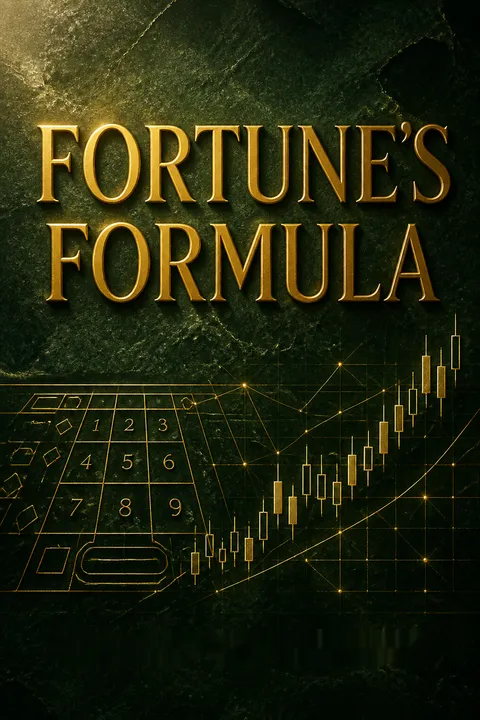
Fortune’s Formula is a history of one deceptively compact question: when someone knows more than the market, how much should that knowledge change a bet? Poundstone builds the answer through a relay of characters and institutions. Racing wires make information a weapon; Shannon turns uncertainty into a measurable quantity; Kelly connects information to compounding; Thorp carries the mathematics from blackjack into financial markets. The book’s narrative strength lies in showing that these are not separate inventions. Each depends on the same asymmetry between what is known and what others believe.
The deepest contribution is not a promise of easy profit, but a framework for separating three problems that are often blurred together: identifying an edge, estimating its reliability, and sizing exposure so that error does not end participation. Kelly answers the third problem only after the first two have been solved. That conditionality matters. A formula cannot rescue a false probability estimate, a changing market relationship, an execution bottleneck, or a dishonest organization.
The book also stages a valuable disagreement between growth and utility. Maximizing compound wealth is a coherent objective, but it is not neutral. It tolerates volatile paths and prioritizes long-term survival over comfort, near-term needs, or a particular spending goal. The dispute between Kelly advocates and economists such as Samuelson is therefore partly about mathematics and partly about whose preferences a model is allowed to assume.
Finally, the historical arc refuses a simple triumph story. Thorp’s methods show that markets can contain exploitable inefficiencies, while casinos, rival traders, and changing conditions steadily narrow them. LTCM demonstrates how sophistication can magnify fragility when assumptions fail together. The durable lesson is disciplined skepticism: measure the signal, test it repeatedly, price the frictions, and leave room for the possibility that the model is wrong.
Review Summary
Fortune's Formula receives mostly positive reviews for its engaging narrative blending mathematics, gambling, and finance. Readers praise Poundstone's ability to explain complex concepts in an accessible way, weaving together stories of scientists, mobsters, and Wall Street. Many find the book fascinating and enlightening, particularly regarding the Kelly criterion and its applications. Some criticize the book for being too formulaic or lacking depth in certain areas. Overall, reviewers appreciate the book's unique perspective on risk and investing.
People Also Read









Glossary
Kelly criterion
compound-growth position sizingA rule for choosing how much of a bankroll to wager or invest when an opportunity has a positive edge. It aims to maximize long-run compound growth while avoiding total ruin under its assumptions. Because the rule depends on accurate probabilities and payoffs, practitioners often use less than the full Kelly stake when estimates are uncertain or volatility is uncomfortable.
entropy
measure of uncertaintyIn Shannon’s information theory, entropy measures the uncertainty in a stream of possible messages or outcomes. More predictable events carry less information; less predictable events carry more. Shannon’s measure is mathematically related to the entropy used in thermodynamics, though the fields interpret it in different contexts.
equivocation
ambiguity in received informationA measure of uncertainty about whether a received message correctly represents what was sent. Equivocation can arise from noise, mistakes, ambiguity, or deception. In Kelly’s betting analogy, unreliable tips reduce the usable information available to the bettor and should reduce the estimated edge and the size of the wager.
gambler’s ruin
bankruptcy before recoveryThe risk that a gambler loses the entire bankroll before a favorable long-run expectation can help. Even a fair or advantageous game can produce a losing streak, and a player with limited funds may be forced to stop while a wealthier opponent continues. Betting systems that escalate stakes after losses can accelerate rather than prevent ruin.
efficient market hypothesis
prices reflect available informationA family of theories claiming that security prices incorporate information quickly enough that investors cannot reliably earn excess returns using specified information sets. The weak form concerns past prices, the semistrong form includes public information, and the strong form includes private information. The debate concerns how efficiently markets process information, not whether investors can make money at all.
delta hedging
offset option price exposureA method of reducing the effect of small changes in an underlying stock’s price on an option or warrant position. The trader buys or sells a calculated amount of the stock to offset the option’s price movement. The hedge must be adjusted as prices and the option’s sensitivity change, and it does not eliminate every kind of risk.
St. Petersburg wager
infinite expected payout puzzleA coin-toss game in which the prize doubles with every consecutive tail before the first head. The mathematical expected payout is infinite, although people would pay only a finite amount to play. Daniel Bernoulli used the puzzle to examine diminishing subjective value, risk, and why expected dollars alone do not explain choices.
Value at Risk
probabilistic loss estimateA risk-reporting measure that estimates how much a portfolio might lose over a specified period at a chosen probability threshold. For example, a one-day estimate can describe a loss that should be exceeded only a certain fraction of the time under the model. It depends on assumptions and does not, by itself, describe the severity of losses beyond the stated threshold.
fat tails
more frequent extreme outcomesA feature of a probability distribution in which very large gains or losses occur more often than a standard normal distribution predicts. In financial markets, fat tails mean that a model based on ordinary fluctuations can badly underestimate crashes or sudden changes in correlations. They are especially dangerous when a strategy uses leverage.
statistical arbitrage
model-based relative-value tradingA trading approach that uses statistical analysis and computer models to identify securities that appear temporarily mispriced relative to one another or to historical patterns. Positions are often paired, with one asset bought and another sold short, to reduce broad market exposure. Returns depend on whether the relationship persists, whether execution costs are low enough, and whether competitors erase the opportunity.
FAQ
What's Fortune's Formula about?
- Intersection of gambling and finance: The book explores how mathematical principles apply to both gambling strategies and financial theories.
- Key figures and stories: It highlights the contributions of influential individuals like Claude Shannon, Edward Thorp, and John Kelly, Jr., in understanding probability and risk.
- Scientific betting systems: Focuses on the development of systems that have successfully beaten casinos and Wall Street, emphasizing information theory and the Kelly Criterion.
Why should I read Fortune's Formula?
- Unique perspective on risk: Offers insights into applying mathematical concepts to real-world scenarios in gambling and investing.
- Historical context: Provides a historical overview of gambling and finance, illustrating the evolution of these fields.
- Practical applications: Readers can learn strategies like the Kelly Criterion to make informed betting or investment decisions.
What are the key takeaways of Fortune's Formula?
- Importance of information: Accurate information is crucial for successful bets or investments, as shown through the stories of Shannon and Thorp.
- Kelly Criterion explained: A formula that helps determine the optimal size of bets to maximize growth while minimizing risk.
- Randomness and unpredictability: Highlights the inherent randomness in gambling and stock markets, suggesting patterns are difficult to predict.
What is the Kelly Criterion as described in Fortune's Formula?
- Definition of the Kelly Criterion: A formula used to determine the optimal size of a series of bets, maximizing the expected logarithm of wealth.
- Formula application: Calculated as edge/odds, where edge is the expected advantage and odds are the public odds.
- Risk management: Helps avoid ruin by ensuring only a proportion of the bankroll is bet, allowing for sustainable growth.
How did Claude Shannon contribute to gambling strategies in Fortune's Formula?
- Pioneer of information theory: Shannon's work laid the foundation for quantifying information to make better decisions in uncertain environments.
- Roulette prediction machine: Collaborated with Edward Thorp to develop a device predicting roulette outcomes, applying his theories practically.
- Impact on gambling: His insights into randomness and information shaped modern gambling strategies.
What role did Edward Thorp play in Fortune's Formula?
- Innovative blackjack player: Applied the Kelly Criterion to blackjack, using card counting to gain an edge over casinos.
- Author of Beat the Dealer: Popularized card counting and mathematical strategies in gambling.
- Transition to investing: Applied similar strategies in the stock market, achieving remarkable returns.
How does Fortune's Formula address the concept of arbitrage?
- Definition of arbitrage: Explains arbitrage as exploiting price differences in different markets to secure a profit without risk.
- Historical examples: Provides context with examples of early financiers like Jay Gould exploiting arbitrage opportunities.
- Modern implications: Connects historical practices to contemporary trading strategies, showing the relevance of arbitrage today.
How does Fortune's Formula illustrate the relationship between gambling and investing?
- Shared principles: Draws parallels between gambling strategies and investment techniques, relying on probability and risk assessment.
- Mathematical foundations: Emphasizes using mathematical rigor, like the Kelly Criterion, to guide decision-making.
- Behavioral insights: Explores psychological factors influencing both gamblers and investors, highlighting the importance of understanding human behavior.
What is the significance of the St. Petersburg wager in Fortune's Formula?
- Concept of expected value: Illustrates the paradox of expected value in gambling, where theoretical payout can be infinite.
- Daniel Bernoulli's contribution: Discusses Bernoulli's insights into risk and utility, emphasizing irrational behavior in uncertain outcomes.
- Application to modern finance: Principles from the wager are relevant to understanding risk and decision-making in gambling and investing.
How does Fortune's Formula explain the concept of utility?
- Subjective value of money: Utility refers to the subjective value individuals place on money, varying based on wealth and circumstances.
- Diminishing returns: Discusses how utility from additional wealth decreases as one becomes richer, leading to Bernoulli's logarithmic utility function.
- Practical implications: Helps investors and gamblers make better decisions by recognizing not all monetary gains are equally valuable.
What role does risk play in Fortune's Formula?
- Central theme: Explores how to manage and quantify risk in gambling and investing.
- Risk of ruin: Emphasizes avoiding ruin through strategies like the Kelly Criterion, balancing potential gains against catastrophic losses.
- Psychological factors: Illustrates how human behavior influences decision-making in uncertain environments.
How does Fortune's Formula address the concept of overbetting?
- Definition of overbetting: Occurs when risking more than prudent, often leading to significant losses and potential ruin.
- Consequences of overbetting: Illustrates catastrophic outcomes, such as LTCM's collapse due to excessive leverage.
- Kelly Criterion as a safeguard: Adhering to the Kelly Criterion helps avoid overbetting, aligning risk-taking with long-term financial goals.
About the Author
Other books by William Poundstone





Download PDF
Download EPUB
.epub digital book format is ideal for reading ebooks on phones, tablets, and e-readers.








