

Plot Summary
A Queen in Captivity
Three days after the battle in the Seeing Forest, Ayna1 wakes in a luxurious room, grieving Myron,2 the Crow King2 who died saving her. Her wounds are healing, but her strength and water magic have vanished. Ephegos,3 once her friend and now her captor, keeps her weak and refuses to explain why he has brought her to a Flame residence.
When he orders her to dress for a visitor, Ayna1 discovers a black crow marked across her shoulder, though she cannot remember receiving it. Ephegos3 calls her a widow and promises her a future she will not want. Ayna1 cannot escape, but she makes one decision: she will not let him see her break.
Ayna’s first prison is not simply the locked room; it is the story she tells herself about Myron’s death. She treats survival as a debt she must repay by enduring, while Ephegos exploits her grief to make helplessness feel deserved. The crow mark quietly disrupts that certainty. It places a physical question on her body before she has the strength to investigate it, making the body a record of forces her conscious mind cannot yet understand.
The General Returns
Ephegos3 binds Ayna1 to a chair before admitting General Adrian Katrijanov,8 the Tavrasian officer who helped capture her and destroy the life she had built at sea. Katrijanov8 recognizes her as Ivan Milevishja’s daughter and invokes the death sentence attached to her family’s treason, though he says her punishment will be worse than execution.
Their meeting confirms that Ephegos3 is working with Tavras as well as the Flames. A human warrior named Kaira6 later brings Ayna1 food and reveals they are near the Tavrasian border, where Flame leaders are divided over Ephegos’s3 growing influence. In a locked room below, Crow guard Herinor4 explains that he has been bound by a bargain to obey Ephegos,3 then cuts Ayna1 to disguise what he is doing.
The polished room and the military visit reveal two systems of control operating at once. Ephegos uses intimate knowledge and magical coercion; Katrijanov uses law, rank, and inherited guilt. Ayna’s body becomes their shared territory, inspected and restrained by men who claim authority for different reasons. Herinor’s bargain complicates the simple division between captor and ally: his violence is real, but his choices are constrained. In this world, intention matters, yet it cannot erase what an action does to its victim.
A Mark Calls Home
Myron2 is alive, newly restored from death, and searching the Seeing Forest for Ayna1 with his cousin Royad9 and the few Crows who remain loyal. His people are exposed to Flame hunters, while his own returned powers are difficult to control. When the crow tattoo on his shoulder sears with pain, he senses Ayna1 calling from far away and abandons the plan to wait until morning.
At the forest’s edge, Askarean general Astorian10 confronts the Crows for leaving their territory. Astorian10 is also searching for his missing mate, Princess Cliophera,5 called Clio.5 Myron2 bargains with him: help find both women, and Myron2 will take his people out of Askarea. The bargain turns a dangerous pursuit into a wary alliance.
Myron’s resurrection does not restore his former certainty. He has power again, but the urgency of finding Ayna makes that power dangerous even to those beside him. The mark gives grief a direction: instead of circling the image of her death, he can follow a signal toward her life. Astorian’s arrival also shifts the story from private rescue to shared vulnerability. Two former enemies recognize that losing a mate has made them legible to each other in a way old political loyalties never did.
The Road to Meer
Ephegos3 tells Ayna1 that her destination is King Erina’s7 court in Meer, not the coast she longs to reach. Kaira6 admits she intends to travel with her, and follows the carriage after Ephegos3 refuses to take her openly. Herinor4 guards Ayna1 while repeatedly drugging her, leaving her sick and too weak to escape across the open Plithian Plains.
In Meer, Herinor4 gives her a concealed knife before escorting her into the palace. Erina7 receives Ayna1 with the manners of the boy she once knew, but his court has already arranged her return as a political possession. When Ayna1 is sent to her rooms, she finds Clio5 alive, disguised as a servant and trapped in the same palace.
The journey strips away Ayna’s usual forms of agency one by one. She cannot choose the destination, trust the food, or rely on strength, so she turns to observation and small concealed resources. The knife matters less as a weapon than as proof that someone has left her a choice, however narrow. Meer also returns her to the social world she once fled. Its elegant manners do not soften coercion; they make it easier to present captivity as a welcome.
The Heir Beneath the Name
Erina7 explains that Ayna1 is not merely a merchant’s daughter: her father was the last publicly known male heir of the old Milevishja royal house, which the ruling Jelnedyns tried to erase by spreading the surname across Tavras. A document shows that Ivan hired an assassin to kill Erina’s7 family, the same evidence that led to his execution.
Erina7 also reveals that their fathers once arranged a secret childhood betrothal, meant to merge the rival bloodlines. He now wants Ayna1 to marry him and produce heirs, extinguishing any separate Milevishja claim. He puts a ring on her finger and uses her hope of seeing Myron2 to compel her compliance. The history turns her family’s shame into a claim the current king7 fears.
The revelation does not cleanse Ayna’s father or make Erina’s rule illegitimate by itself. Instead, it exposes how power controls memory: the Jelnedyns made a royal name ordinary, then treated the surviving heir as a criminal. Erina’s marriage plan converts a political dispute into a bodily solution, absorbing Ayna’s lineage through childbirth. Ayna is forced to confront an inheritance that is neither innocent nor voluntary. The question is no longer only whether she belongs at court, but who gets to define what her blood means.
A Husband Behind Bars
At the engagement celebration, Ayna1 sees Myron2 in the throne room, bruised and magically restrained beside Erina.7 The apparent death she has mourned gives way to shock, relief, and fear: Myron2 is alive, but Erina7 can use him to enforce the marriage.
She also recognizes matching crow marks on their shoulders, marks that ache when they are near each other. Erina7 publicly presents Ayna1 as his future bride, while Myron2 must sit helplessly through the announcement. Their brief exchange of glances becomes their only safe contact.
During the same gathering, Kaira6 reaches Ayna1 through an unexpected mental connection, revealing that she has been listening for her thoughts and searching for a way out. The engagement is both spectacle and hostage-taking.
The reunion offers no uncomplicated relief. Myron’s survival restores hope, but it also gives Erina a more effective instrument of control. Their matching marks make private feeling physically consequential, yet the crowded banquet forces them to conceal what that connection means. Kaira’s mental link introduces a different kind of intimacy, one that Ayna has not chosen and must learn to assess. The scene’s emotional pressure comes from competing forms of exposure: the court watches Ayna as a bride, while the marks and thoughts disclose truths she cannot safely speak.
The Crow Within
Ephegos3 and Katrijanov8 bring Ayna1 to the torture chamber, where Myron2 is strapped down and injected with a serum that restores his senses while suppressing his magic. They explain that Erina7 hopes to use magic-nullifying compounds to conquer Askarea, and that Ayna’s1 captivity is meant to keep Myron2 obedient.
Ephegos3 tests a second serum on her, then has Katrijanov8 cut and strike her while Myron2 is forced to watch. Under the drug’s effects, Ayna’s1 senses sharpen and her body changes into a black crow. She attacks Ephegos,3 but Herinor4 catches and carries her away before she can escape. He then frees Myron,2 who is too injured to move unaided, and gives him a chance to flee.
The experiment turns the captors’ attempt at control into an involuntary awakening. Ayna’s new body is frightening because it arrives through pain and without consent, but it also breaks the assumption that she is merely a human object to be traded. The serum’s political purpose widens the stakes beyond her marriage: Erina is preparing to make magical beings vulnerable on a mass scale. Herinor’s actions remain morally tangled. He helps Myron while being unable to directly free Ayna, showing how a bargain can narrow responsibility without erasing it.
Sisters in the Dark
Clio5 and Kaira6 help Ayna1 escape the palace dressed as a servant, using concealed corridors and Kaira’s6 distraction of a guard to pass through a side gate. They hide in an abandoned shed while the drug works its way out of Ayna1 and Clio.5 There, Kaira6 reveals that Ayna’s1 mother, Elenja, was also her mother, making the two women half-sisters.
Kaira6 had recognized Ayna’s1 identity after hearing Ephegos3 discuss her family, then chose to risk her position to follow her. Herinor4 has arranged the hiding place and continues helping indirectly, exploiting gaps in his bargain with Ephegos.3 The revelation gives Ayna1 family again, but it also makes Kaira’s6 danger personal: her choice to help now places both sisters in the same fight.
Kinship arrives not as a sentimental cure but as a new obligation formed under pressure. Ayna has spent much of her life losing family, so Kaira’s revelation gives her a relationship she must build rather than simply inherit. Kaira’s loyalty is not based on shared history; it grows from choosing Ayna despite the risks of Flame politics. Herinor’s indirect assistance offers another model of care: he cannot openly defy his bargain, but he keeps finding ways to protect people around its edges.
Rain Reclaims the Two
After Herinor4 carries him from the dungeon, Myron2 finds Ayna,1 Clio,5 and Kaira6 at their refuge. Ayna1 and Myron2 reunite in the rain, confirming that each is alive and that their matching marks connect them more deeply than either understood. Their physical closeness restores a measure of trust and helps Ayna’s1 water magic and Myron’s2 fae powers begin to return.
They cannot remain hidden: Royad,9 Silas,11 and Astorian10 are still prisoners, and Erina7 plans to use Astorian10 against Askarea. Clio5 refuses to leave her mate10 behind, while Kaira6 maps a route back into the palace. Herinor4 agrees to help the group enter without directly violating his bargain. The reunion becomes a pause before a rescue attempt, not an escape from responsibility.
The intimacy between Ayna and Myron is not a substitute for action; it gives each a moment to experience safety after captivity has made every touch suspect. Their bond is both comfort and vulnerability, since each can sense the other’s pain. The group’s decision to return rejects the easy fantasy that personal escape ends political responsibility. Yet the rescue plan also carries emotional risk: loyalty may be brave, but without restored power and reliable information it can become another way to lose one another.
Back Through the Gate
Kaira6 gets the group through a palace side entrance by drawing on her connection with Julj, while Herinor4 silently removes the guards who could expose them. In the dungeon, Myron2 locates the cells and uses returning magic to break open the stone beside Astorian’s10 cage without touching the drugged bars. Clio5 reunites with her battered mate, who squeezes through the gap, then Myron2 heals his worst wounds.
They also free Silas,11 badly beaten and unconscious. Astorian10 carries Silas11 out, while Ayna1 and Myron2 stay behind to reach Royad,9 who has been taken for another round of torture. The rescue succeeds only in part. It reunites Clio5 and Astorian10 but leaves the most personal danger ahead, with the group divided and time running out.
The escape depends on cooperation rather than a single hero’s strength. Kaira creates access, Herinor clears obstacles, Myron uses power carefully, and Clio’s reunion gives Astorian enough reason to keep moving. The damaged cell bars and the choice to blast stone instead demonstrate practical learning: the rescuers have studied the weapon used against them. But partial success is costly. Leaving Ayna and Myron behind preserves the chance of saving Royad while splitting the group at the exact moment their enemies can exploit.
Royad’s Last Cell
Ayna1 and Myron2 reach the torture chamber and find Royad9 barely alive, with Ephegos,3 Katrijanov,8 guards, and Herinor4 still present. Ephegos3 offers to release Royad9 if the king2 and queen1 surrender, while insisting that Erina’s7 anti-magic serum will let Tavras expand into Askarea. Ayna1 threads water through a weakness in Ephegos’s3 shield and pulls Katrijanov8 off balance as Myron2 breaks through the barrier.
Herinor4 cuts Royad9 free and carries him toward the escape route. The others fight their way toward the opening, but Katrijanov8 injects Myron2 with the suppressant and Ayna1 is wounded. When guards close in, Herinor4 silently kills them and carries the unconscious Myron2 away. Ayna1 remains behind, captured and shackled once more.
The confrontation makes the limits of loyalty painfully concrete. Ayna and Myron reach for one another and for Royad, but every rescue creates a new opening for their enemies. Herinor finally acts openly enough to save Myron, yet his bargain still leaves Ayna exposed. The water attack shows Ayna learning to use her power strategically, not merely explosively. Her defeat is therefore not a return to helplessness: she has discovered what she can do, but the captors still control the conditions in which she can do it.
Tomorrow’s Forced Wedding
Ayna1 wakes back in her palace room, drugged, injured, and separated from Myron.2 Erina7 tells her that Myron,2 Royad,9 Silas,11 and Astorian10 escaped the dungeon, but warns that no prisoner gets away from his palace alive. He then reveals that he has announced Ayna1 to all Tavras as the recovered heir of the Milevishja royal line and his pardoned bride.
By making her identity public, he intends to ensure she cannot disappear quietly and to draw Myron2 back into danger. Erina7 sets the wedding for the next day. When Ayna1 refuses, he has Kaira6 brought in blindfolded and bound, turning her new sister6 into leverage. Ayna1 ends the book with her allies scattered and her wedding only hours away.
The ending converts Ayna’s concealed ancestry into a public trap. Erina does not need to keep her claim secret once he can control the story told about it; he presents himself as the king who restores and marries the heir. Kaira’s capture makes the threat intimate again, attacking the family Ayna has just found. The cliffhanger leaves Ayna with little physical power but more knowledge than she possessed at the opening. Her next choice must contend with a public identity, a coerced marriage, and the danger of anyone who tries to save her.
Analysis
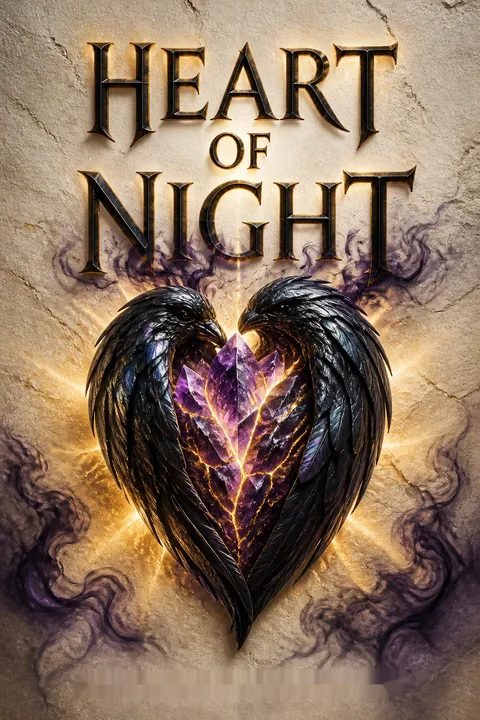
Heart of Night turns rescue into a contest over who has the right to define another person’s life. Erina7 treats marriage as a state instrument: by claiming Ayna1 publicly, he hopes to merge a rival dynasty into his own and secure heirs. Ephegos3 pursues a parallel kind of possession, using Ayna1 as leverage against Myron2 while presenting vengeance as justice. Their plans differ in scale, but both depend on making a person’s body serve a political purpose.
Ayna’s1 resistance grows through information and relationship rather than sudden mastery. She learns what her captors want, hides a knife, recognizes openings in Ephegos’s3 shield, and uses water to create them. Her developing Crow nature is not a clean transformation into power. It begins as an assault on her body, under the control of men who believe they can define what she is. Her response is to claim the change as something she can use, without letting it erase the human history that made her resilient.
Myron’s2 love is similarly double-edged. His instinct is to sacrifice himself for Ayna,1 but his return to the palace shows that devotion cannot guarantee safety. The bond between them makes separation more painful and their enemies more capable of manipulating them. It also helps restore what captivity suppresses, suggesting connection can strengthen without making either partner invulnerable.
The novel’s most complicated moral figure is Herinor.4 His bargain explains why he cannot simply choose loyalty, but the story does not treat explanation as innocence. He harms Ayna,1 regrets it, and searches for indirect ways to help. His constrained actions expose the distance between intending good and actually protecting someone.
The unresolved ending refuses the comfort of a completed escape. Myron2 and several allies are free, but Ayna1 is trapped again, publicly named as an heir,1 and threatened through Kaira.6 Survival has become political resistance, and the next choice will test whether Ayna1 can turn her contested inheritance into power of her own.
Review Summary
People Also Read
Characters
Ayna (Wolayna Milevishja)
Survivor turned queenAyna is a former prisoner and pirate whose instinct for survival is matched by a strong sense of responsibility toward the people she loves. She reads danger quickly, questions authority, and resists being reduced to the roles others assign her, whether criminal, tribute, widow, or bride. Her grief over Myron’s2 apparent death initially leaves her emotionally guarded, but her courage is practical rather than ornamental: she searches for information, hides a weapon, and acts when others are threatened. Her relationship with Myron2 gives her a rare experience of trust, while her history with Tavras forces her to confront the family past she tried to escape.
Myron
Cursed king in loveMyron is the Crow King, shaped by centuries of isolation, violence, and responsibility for a people cursed by their ancestors’ actions. He has learned to treat emotional restraint as a form of survival, yet Ayna1 unsettles that discipline by seeing the person beneath his frightening reputation. His devotion is intense, but it is also expressed through protection and sacrifice, not only desire. After the curse breaks, he must learn to wield restored powers without letting grief and fear govern every decision. His search for Ayna1 brings him into an uneasy alliance with former enemies and tests whether a king can protect others without claiming control over them.
Ephegos
Courtier with a grievanceEphegos is a polished Crow courtier and spymaster whose ease in conversation can conceal how closely he studies other people. He is intelligent, strategic, and accustomed to turning information into leverage. His personal history shapes his judgment of Myron2 and the Crow court, while his ambition draws him toward alliances that may serve him only temporarily. Ephegos presents cruelty as calculated justice, allowing him to preserve a self-image of reason even as he inflicts pain. He is most dangerous when he appears warm, because familiarity makes it harder for others to recognize when he has already chosen his own interests.
Herinor
Bound Crow warriorHerinor is an old Crow warrior with a scarred face, a formidable presence, and a history of violence he does not try to disguise. He understands the power of bargains and the cost of misjudging the person who holds one. His blunt manner makes him seem simpler than he is; he notices what others need and weighs each possible action against the danger it creates. Herinor’s loyalty is difficult to read because obligation and conscience pull him in opposite directions. He represents the possibility of change without easy absolution: regret can guide a different choice, but it cannot make past harm disappear.
Cliophera (Clio)
Princess and fierce allyClio is a princess of Askarea, a skilled fighter, and a close ally of Ayna1. She is direct, proud, and more comfortable confronting danger than explaining her vulnerabilities. Her protective instinct is especially strong toward those she considers family, and she often converts fear into action before anyone else can. Clio’s role as a warrior does not erase her tenderness; she offers Ayna1 practical care while carrying her own anxieties about the people she loves. Her experience in court and battle gives her a clear sense of strategy, though loyalty can make her impatient with plans that delay a rescue.
Kaira
Flame-born scoutKaira is a human-appearing warrior with a small measure of Flame heritage and a talent for observing what powerful people overlook. She is resourceful, bold, and able to use charm or secrecy as tools when direct force would fail. Years of being treated as insufficiently magical have made her keenly aware of status and exclusion, but she does not accept that others’ judgments define her worth. Kaira is drawn to Ayna’s1 story and to the possibility of a relationship built through choice. Her loyalty develops through action: she gathers information, finds routes, and takes risks when someone vulnerable needs help.
Erina
King guarding a dynastyErina is the young King of Tavras, raised within a court where lineage and political stability are treated as matters of survival. He can be courteous and even familiar, but his manners do not prevent him from using confinement, threats, and marriage to secure his aims. Erina sees Ayna1 through both personal history and dynastic calculation, and he is alert to the danger posed by a rival royal claim. His defining trait is not uncontrolled cruelty but the capacity to make coercion appear orderly and legitimate. He believes a stable succession justifies controlling the people whose bloodlines might challenge it.
Adrian Katrijanov
Tavrasian military generalKatrijanov is a senior Tavrasian general whose discipline and authority make him an effective instrument of the crown. He treats people as problems to be assessed and managed, and his calm manner can make threats feel procedural rather than personal. His history with Ayna1 gives their encounters a particular charge, while his involvement in the palace’s experiments connects military ambition to the suppression of magic. Katrijanov trusts force and planning more than sentiment, and he is willing to inflict pain when it serves a strategic purpose.
Royad
Myron’s loyal cousinRoyad is Myron’s2 cousin, a trusted companion, and a steady presence among the Crows. His humor softens tense moments, but it never makes him careless about danger. Royad has endured the same brutal history as Myron2 and understands the cost of their people’s past without allowing it to erase his loyalty. He tends to support others through practical reassurance and remains committed when the group is divided or outnumbered. His bond with Myron2 is familial as well as political, giving the Crow King2 someone who can challenge him without diminishing his authority.
Astorian
Askarean generalAstorian is a powerful Askarean general and Clio’s5 mate. He is a seasoned fighter, sharp in negotiation, and slow to forget the historic hostility between his people and the Crows. Beneath his military composure is a fierce attachment to Clio5, which makes her safety more important to him than old political boundaries. Astorian’s alliance with Myron2 is based on shared need rather than easy trust. He respects competence, speaks bluntly, and brings both tactical skill and a different perspective on what it means to protect a realm.
Silas
Veteran Crow fighterSilas is one of the older Crows, with memories that reach closer to the early history of the curse than those of Myron2 and Royad9. He is dry-witted, physically capable, and less inclined than the others to soften an uncomfortable truth. Silas understands how quickly a small group can be overwhelmed, so his instincts are practical rather than grand. His presence connects the younger Crows’ struggles to the longer collective history they have inherited.
Jeseida
Flame MatroneJeseida is the Matrone of the Flames and a descendant of the family that once held their ancestral seat. She is shaped by her people’s displacement and by the long desire to recover what was lost. Jeseida’s authority comes from lineage and from the hope that the Flames can become secure again. Her political choices place restoration above personal comfort, and she is willing to consider alliances that promise power. Her presence reveals that the conflict is not only a private feud but also a struggle over history, land, and who gets to rule.
Odja
King’s court officialOdja is a palace official who carries messages, manages access, and guides Ayna1 through Erina’s7 court. His role is small but useful: he demonstrates how obedience and etiquette keep the royal household functioning.
Vala
Goddess of water and lifeVala is the Neredynian goddess associated with life and water, whose ancient judgment shaped the Crows’ fate. Her influence is felt through the curse, Ayna’s1 water magic, and the marks that connect the central lovers. She is not a distant symbol of simple mercy; her power carries the weight of punishment and the possibility of change.
Shaelak
Maker of the CrowsShaelak is the Neredynian God of Darkness and the creator associated with the Crow people. His role in the story is bound to the Crows’ origins, their inherited nature, and the possibility that their future may be shaped by divine intervention.
Sariell
Ephegos’s half-sisterSariell was a half-Crow, half-Flame woman whose history links the two peoples. Her name carries emotional and political weight for Ephegos3, making her an important presence even when she is absent from the central action.
Recienne
King of AskareaRecienne is the ruler of Askarea and Clio’s5 brother. His authority shapes the boundaries Myron2 must consider, and his court becomes part of the political landscape surrounding the missing princess5 and general10.
Plot Devices
The Crow Curse
Inherited magical sentenceThe Crows were cursed by Vala14 after their ancestors committed violence and exploitation in Neredyn. The curse trapped them in monstrous forms, threatened their people’s continuation, and shaped the way other realms feared them. Its breaking in the previous conflict changes the balance of power: the Crows regain their full forms and abilities, but they also become targets for Flame and human schemes. The curse is not merely background history. It gives Ephegos3 a grievance, informs Herinor’s4 guilt, and makes Ayna’s1 love and choices consequential to an entire people.
The Crow Marks
A link across captivityMatching crow marks appear on Ayna’s1 and Myron’s2 shoulders after the battle. The marks ache, tingle, and respond to distance and injury, giving the separated pair a physical sign of connection when they cannot speak freely. Clio5 suspects the marks indicate a bond, while the story gradually links them to the gods and Ayna’s1 changing nature. They function as both emotional reassurance and a source of danger, since their connection makes each lover’s suffering more immediate to the other.
Ephegos’s Bargain
A limit on defianceHerinor’s4 fairy bargain requires him to serve Ephegos3 after he agreed to join the traitor’s cause. The bargain constrains what he can do directly, placing his conscience in conflict with his survival and his loyalty to Myron2. Herinor4 searches for ways to help Ayna1 and the others without triggering its terms, often assisting through indirect actions. The device makes loyalty more complicated than a simple choice between good and evil: a character can want to help and still inflict harm while trying to find a way out.
Magic-Nullifying Serum
Weapon against fairy powerErina7, Ephegos3, and the Flames develop drugs that suppress magical abilities and senses, as well as compounds that can weaken fairies through contact or injection. The experiments allow human authorities to capture and torture beings who would normally overpower them. Erina7 intends to improve the formula and use it against Askarea, turning a prison tool into a potential weapon of conquest. The serum also causes Ayna’s1 senses and hidden abilities to surface in an unpredictable way, so the same system meant to control her contributes to her transformation.
The Milevishja Papers
Proof of a disputed crownErina7 uses family records and a shipment document to reveal that Ayna’s1 father was the last publicly known male heir of the former royal Milevishja line. The paperwork also records his attempt to hire an assassin against the Jelnedyn family, giving the revelation moral complexity rather than turning Ayna’s1 claim into a simple restoration story. Erina’s7 family had obscured the old dynasty by spreading its surname among ordinary families, then sought to neutralize the remaining line through a marriage agreement. The documents transform Ayna’s1 identity into a political threat Erina7 wants to absorb.
Wings of Ink Series
About the Author

Download PDF
Download EPUB
.epub digital book format is ideal for reading ebooks on phones, tablets, and e-readers.








