

Key Takeaways
Treat success as a probability, not a verdict on talent
Chance bends life paths. The author’s father survived Buchenwald after stepping forward to spare other prisoners when a baker threatened to shoot suspects in a bread theft. Instead of killing him, the baker made him an assistant. That chance turn helped set the course that eventually brought the author’s parents together. Skill and effort matter, but outcomes also depend on forces no individual controls.
A record season can be an outlier. In 1961, Roger Maris hit 61 home runs, then never again reached 40 in a season. A model using his ordinary rate of home runs estimated that a season matching Babe Ruth’s record could happen by chance about once every 32 seasons. Across seven decades, the odds that some comparable player would do it exceeded 50 percent. Exceptional results do not prove exceptional causes.
What's striking is the distinction between a person’s underlying ability and the result visible to observers. Modern research on survivorship bias adds a useful caution: celebrated winners are a selected sample, while equally capable people whose opportunities never arrived remain unseen. The book’s point is not that effort is irrelevant, but that outcomes cannot cleanly measure effort or merit. This matters for hiring, education, and self-judgment. A fair assessment asks what someone could do across repeated opportunities, not only what happened once. The harder question is structural: who gets enough opportunities for skill to become visible?
Test the probability, not the story that feels most complete
Extra details shrink odds. In the Linda experiment, people heard about a bright, politically active woman and judged it more likely that she was a bank teller involved in feminism than simply a bank teller. That cannot be right: the combined event must be no more likely than either part alone. The vivid description made the detailed version feel representative, even as each added condition reduced its probability.
Memory also distorts frequency. People more readily recall dramatic examples than ordinary ones, then mistake ease of recall for prevalence. A conspicuously eccentric encounter with a homeless person may stick in memory; an unremarkable encounter may not. The same bias can make unusual dangers seem common and routine risks seem negligible.
These errors reveal a tension between narrative understanding and statistical reasoning. A coherent explanation helps people make sense of incomplete information, but coherence is not evidence of likelihood. Cognitive science suggests that vivid examples are especially influential because memory retrieves them quickly, not because they are representative. A practical safeguard is to ask what other possibilities fit the same facts and whether the proposed explanation adds conditions. Still, intuition is not useless: rapid pattern recognition can be valuable when decisions are urgent. The goal is to notice when a compelling story is being mistaken for a probability calculation.
Rebuild the full set of outcomes before choosing
List the possibilities first. Cardano’s law of the sample space says that, when outcomes are equally likely, an event’s probability is the fraction of all possible outcomes that produce it. This method prevents intuitive shortcuts from hiding relevant cases. For two coin tosses, the outcomes are heads-heads, heads-tails, tails-heads, and tails-tails. One head occurs in two of the four cases, so its probability is one-half, not one-third.
The host changes the game. In the Monty Hall problem, a contestant picks one of three doors. The host, who knows where the prize is, opens an unchosen door with a goat. Switching wins if the original choice was wrong, which happens two-thirds of the time. The host’s informed choice does not make the remaining doors equally likely.
The sample-space method is a form of explicit model-building: define the possible states, then track how information changes them. That habit is useful well beyond games, including medical decisions and project planning. The Monty Hall answer depends on the host following a particular rule: knowing the prize location and always opening a losing door. If the host behaves differently, the odds may change. That qualification is not a defect in the puzzle; it demonstrates a wider lesson. Probability problems often turn on the process that generated the evidence, not merely on what evidence appeared.
Count the routes to an outcome, then price the possible payoffs
More routes mean more probability. Three dice can total 9 in 25 ordered ways and 10 in 27, even though each total can be written as six unordered combinations. The combinations have different numbers of arrangements, so counting them as equally likely gives the wrong answer. Pascal’s triangle provides a compact way to count how many ways a certain number of successes can occur across repeated trials.
Probability meets payoff. Mathematical expectation is the average payoff implied by multiplying each possible outcome by its probability and adding the results. The book describes investors who bought nearly every possible ticket in a Virginia lottery when the prize pool made the expected value of a ticket greater than its one-dollar price. They still faced practical risks, including failing to buy every combination in time.
Counting paths is powerful because it exposes how a seemingly rare outcome can be common across many opportunities. Expected value then gives a disciplined way to compare gambles, investments, and risks. But an average payoff is not a guarantee for any one participant, and it does not capture everything people value. A lottery ticket may be a poor financial choice yet provide entertainment; a high-expected-value bet may be intolerable if failure would be catastrophic. Decision theory therefore pairs expected value with the size of the downside and the decision-maker’s capacity to absorb it.
A positive test is not the probability of being sick
Start with the base rate. Conditional probability asks how likely one event is given another. It is not interchangeable with the reverse conditional. In the author’s 1989 HIV screening example, about 1 in 10,000 men in the relevant group was infected, while the test produced a false positive in about 1 in 1,000 uninfected people. Among 10,000 tests, that gives roughly one true positive and ten false positives. A positive result therefore meant about a 1-in-11 chance of infection, not a 999-in-1,000 chance.
The courtroom version can ruin lives. In Sally Clark’s case, an expert treated the low probability of two infant deaths from sudden infant death syndrome as proof that murder was likely. That reverses the question and ignores alternative explanations and dependence between events. Clark’s conviction was later quashed.
Base-rate reasoning is indispensable whenever a test, clue, or symptom is used to infer a hidden cause. The examples also distinguish test accuracy from the usefulness of a test in a particular population. A screening tool can be reliable yet produce many false alarms when the condition is rare. Conversely, population estimates should not erase relevant individual risk factors. Good communication presents the denominator plainly, preferably with natural counts such as one true result and ten false alarms per 10,000. In law and medicine, statistical literacy is not decorative expertise; it is a safeguard against confident but invalid conclusions.
Treat a short streak as noisy evidence, not a talent report
Extreme results tend to soften. Regression toward the mean describes the tendency for an unusually high or low result to be followed by a result closer to a person’s typical level, partly because temporary luck does not usually repeat. Flight instructors thought praise harmed pilots because excellent landings were often followed by more ordinary ones. They thought shouting helped because especially poor landings were often followed by less poor ones. The apparent teaching effect could arise even if praise and criticism changed nothing.
Small samples mislead. Kahneman and Tversky called the expectation that a small sample will closely match the long-run pattern the law of small numbers. If a person succeeds 60 percent of the time, five years of results need not contain exactly three successes. Short records can make ordinary variation look like a dramatic rise or collapse.
The lesson is especially relevant to performance reviews, sports, and management, where recent outcomes are easy to see and underlying ability is harder to measure. Regression does not show that coaching, leadership, or practice never matters. It shows that a before-and-after comparison can confuse an intervention with the natural bounce after an extreme result. Stronger evaluation uses longer records, comparable groups, and evidence about the process that produced the outcome. When those are unavailable, humility is more rational than turning a brief streak into a sweeping judgment.
Report measurement uncertainty, not just the polished number
Numbers have error bars. A measurement is an estimate, not a perfect description. In one study of 120 student papers, eight faculty graders sometimes differed by two or more letter grades, and their scores varied by nearly a grade on average. Even carefully trained graders did not always agree. Yet a grade such as 93 can look far more precise than the judgment behind it.
Variation can be quantified. The normal distribution, often drawn as a bell-shaped curve, describes many situations in which observations cluster around an average. About 68 percent fall within one standard deviation of the mean, and about 95 percent within two. Polls use this idea to describe a margin of error. A reported change smaller than that margin may reflect sampling noise rather than a real shift.
The key distinction is between precision and validity. A score can be reported to a decimal place and still fail to measure the quality people care about. Repeated ratings, independent evaluators, and transparent uncertainty help reveal whether a difference is stable or merely an artifact of who happened to assess it. The normal distribution is an extraordinarily useful model, but it is not universal. Some outcomes, such as blockbuster film revenues, are highly skewed, with a few extreme successes. Before interpreting a bell-shaped summary, it matters whether the underlying data plausibly have that shape.
Expect clusters in randomness before inventing causes
Randomness makes patterns. Coin tosses naturally produce runs, clusters, and apparent streaks. In basketball studies, a player’s chance of making a shot after a successful shot was not higher than the player’s ordinary success rate. Yet viewers readily perceive a hot hand. The same temptation appears in investing: Bill Miller’s fund beat the S&P 500 in each calendar year for 15 years, but the chance that some manager would achieve a comparable streak across thousands of funds and many possible periods was estimated at roughly three in four.
Selection sharpens the illusion. People tend to notice the striking pattern, then construct a cause for it. Searching many locations or time periods makes an unusual cluster increasingly likely, as with cancer clusters identified after boundaries are drawn around cases.
The strongest defense against pattern-hunting is to specify the question before examining the data. Otherwise, analysts can unconsciously select the most dramatic interval, group, or success story and ignore the many comparisons that produced no headline. This is the logic behind multiple-testing corrections in modern science. At the same time, a surprising pattern should not automatically be dismissed as chance. It is a lead for investigation, not proof of causation. Replication, plausible mechanisms, and fresh data help distinguish a meaningful signal from a memorable coincidence.
Trust aggregate patterns without mistaking them for individual destinies
Large groups can be orderly. About 200 million U.S. drivers drove 2.86 trillion miles in one year and 2.88 trillion the next. With no mileage quotas, the average rose by only about 100 miles per driver. Individual journeys were unpredictable, but the total was remarkably stable. Such regularities let statisticians infer properties of populations from records of births, deaths, crime, and travel.
Deviations can expose manipulation. Poincaré suspected a baker was still giving customers underweight bread after his own loaves became larger. He weighed them for a year and found too few light loaves and too many heavy ones, suggesting the baker was reserving the largest loaf for him. The pattern across many measurements revealed what a single loaf could not.
Aggregation is one of statistics’ great achievements: individual unpredictability does not prevent useful forecasts about groups. Public health, insurance, and transportation planning all depend on this distinction. But a population average cannot tell whether a particular person will have an accident or how far that person will drive. Treating group-level patterns as individual predictions is an ecological fallacy. The baker example also shows that statistical anomalies are clues, not verdicts. A departure from an expected distribution can signal fraud, but it can also reflect a real difference in the process being measured.
Increase your chances without pretending to control the draw
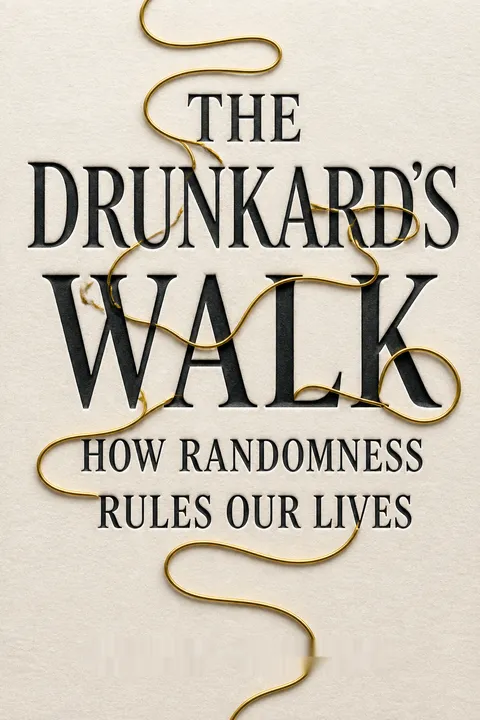
Life resembles a random walk. A drunkard’s walk is motion repeatedly nudged in unpredictable directions. The book uses it as a metaphor for careers and relationships, where small events can redirect a path. Bruce Willis’s trip to Los Angeles was not primarily a career move, yet it led to auditions and his role in Moonlighting. Bill Gates’s opportunity to supply IBM’s operating system depended partly on a chain of negotiations and decisions no one could confidently forecast.
Persistence changes the odds. Repeated attempts create more chances for luck to meet preparation. That is different from believing every setback is deserved or every plan can predict its outcome. The author’s family history, including his aunt Sabina’s death in a Nazi camp despite efforts to protect relatives, makes the point painfully: plan where possible, adapt when events turn, and recognize both fortunate breaks and avoided disasters.
This is a more useful stance than either fatalism or the fantasy of total control. In complex systems, precise prediction is often fragile, while the capacity to respond can be cultivated. The distinction resembles the difference between strategy and forecasting: strategy prepares for several plausible futures; forecasting bets on one. Yet chance does not distribute opportunity evenly. Persistence is easier for people with time, health, money, and social support. A humane reading of the book therefore pairs repeated effort with attention to the conditions that determine who gets repeated chances.
Analysis
The book’s central achievement is to make probability feel less like a specialist’s toolkit and more like a corrective lens for everyday judgment. Its stories move from dice and lottery puzzles to publishing, medicine, courts, sports, and family history. Across these settings, the same errors recur: treating a vivid explanation as more likely than a simpler one, mistaking a rare result for a stable ability, confusing a test’s false-positive rate with the chance that a positive result is true, and treating hindsight as evidence that the future was predictable.
The history of probability matters because it shows that these tools were not invented in one clean leap. Cardano’s gambling experience made it natural to list possible outcomes; Pascal and Fermat developed systematic counting; Bernoulli studied how large samples reveal underlying regularities; Bayes and Laplace addressed inference from evidence; and later statisticians formalized measurement error. This progression gives the book narrative momentum while reinforcing a practical point: sound judgment often begins by asking what the denominator is, how the data were generated, and how much uncertainty remains.
The argument is strongest when it separates skill from outcome without denying that skill matters. A capable person can improve the odds, but a single success or failure cannot measure ability cleanly. That distinction challenges both winner worship and reflexive blame. It also needs a careful boundary: randomness is not a universal excuse. Some systems are strongly shaped by incentives, discrimination, resources, and deliberate choices, and statistical noise does not erase responsibility. Nor should every apparent pattern be waved away; anomalies can expose fraud or reveal a causal mechanism. The book’s most durable advice is methodological rather than cynical: identify plausible alternatives, seek enough evidence, quantify uncertainty, and judge decisions by what was knowable when they were made. This approach cannot make life predictable. It can make explanations and choices less naive.
Review Summary
The Drunkard's Walk explores how randomness and probability impact our lives, often more than we realize. Reviewers found it accessible and engaging, praising Mlodinow's use of anecdotes and historical examples to explain complex statistical concepts. Many appreciated the book's insights into decision-making and success, though some felt it lacked depth or novelty. Overall, readers found it thought-provoking and valuable for understanding the role of chance in everyday life, despite occasional criticisms of its pacing or content density.
People Also Read

Glossary
law of the sample space
Counts favorable outcomesA method for finding probability by listing all possible outcomes of a random process and determining what fraction produce the event of interest. It applies directly when the outcomes are equally likely. If they are not, each outcome must be weighted by its probability rather than simply counted.
mathematical expectation
Probability-weighted average payoffThe expected payoff of a decision, calculated by multiplying each possible outcome by its probability and summing those products. It helps compare gambles and choices with uncertain results. It describes an average over repeated situations, not a promise about what will happen in any single instance.
law of large numbers
Samples approach true proportionsThe principle that, across many independent repetitions of a random process, observed proportions tend to get closer to the underlying probabilities. A fair coin may produce an uneven result in a short run, but the proportion of heads is expected to approach one-half as the number of tosses grows.
law of small numbers
Misreading small samplesKahneman and Tversky’s name for the mistaken belief that a small sample will closely reflect the population or long-run probability. A few observations can depart substantially from the underlying pattern simply by chance, so short streaks and tiny polls can give a misleading impression.
regression toward the mean
Extremes tend to moderateThe tendency for an unusually high or low observation to be followed by one closer to the typical level. When temporary random influences contribute to an extreme result, they are unlikely to repeat in exactly the same way. The return toward average can therefore occur even when no intervention caused it.
conditional probability
Probability given new informationThe probability of an event when another event or piece of evidence is known. It requires adjusting the set of relevant possibilities and their probabilities. The probability of A given B is generally different from the probability of B given A, a distinction often overlooked in medical diagnosis and legal argument.
normal distribution
Bell-shaped pattern of variationA family of bell-shaped probability distributions centered on a mean and described by a standard deviation. In a normal distribution, about 68 percent of observations fall within one standard deviation of the mean, about 95 percent within two, and about 99.7 percent within three.
central limit theorem
Sums tend toward a bell curveA mathematical result explaining why the sum of many independent random influences often follows an approximately normal distribution, even when the individual influences do not. It helps explain why measurement errors and many other aggregate outcomes cluster around an average.
hot-hand fallacy
Seeing skill in random streaksThe mistaken inference that a run of recent successes makes another success more likely, even when the events are largely independent and the streak is consistent with chance. Research discussed in the book found no general increase in a basketball player’s success rate immediately after a made shot.
normal accident theory
Accidents emerge in complex systemsCharles Perrow’s account of how accidents can arise from the interaction of many ordinary failures in complex systems. Individual faults may be familiar and manageable, yet their unforeseen combination can produce a major breakdown, as the Three Mile Island incident illustrates.
FAQ
What's The Drunkard's Walk about?
- Exploration of randomness: The book examines how randomness influences our lives, decisions, and perceptions, often in ways we don't realize.
- Historical context: Leonard Mlodinow provides a historical overview of probability theory, highlighting contributions from figures like Gerolamo Cardano and Blaise Pascal.
- Real-life applications: It illustrates how randomness affects everyday situations, from gambling to decision-making, helping readers recognize the role of chance in their lives.
Why should I read The Drunkard's Walk?
- Enhances critical thinking: The book sharpens your understanding of probability and randomness, encouraging you to question assumptions and recognize biases.
- Practical insights: Mlodinow offers practical insights applicable to investing, parenting, and health, leading to better decision-making.
- Engaging narrative: The book combines storytelling with scientific concepts, making complex ideas accessible and enjoyable.
What are the key takeaways of The Drunkard's Walk?
- Role of chance: Chance plays a significant role in our lives, often more than we realize, influencing outcomes beyond skill or effort.
- Misinterpretation of data: People often misinterpret statistical data, leading to flawed conclusions, as illustrated by concepts like the "law of small numbers."
- Understanding probability: Readers gain a better understanding of probability, learning to assess risks and make informed decisions.
What are the best quotes from The Drunkard's Walk and what do they mean?
- "Life is both hard to predict and hard to interpret." This quote emphasizes life's unpredictability due to randomness, suggesting our attempts to make sense of events can lead to misunderstandings.
- "Success or failure sometimes arises neither from great skill nor from great incompetence but from fortuitous circumstances." It highlights that many outcomes are determined by chance rather than individual merit.
- "The human mind is built to identify for each event a definite cause." This points to a cognitive bias where people seek clear explanations, often overlooking randomness.
How does Leonard Mlodinow explain randomness in The Drunkard's Walk?
- Randomness defined: Mlodinow defines randomness as the lack of a predictable pattern or order in events, influencing many processes in nature and human affairs.
- Drunkard's walk metaphor: The title refers to a mathematical concept describing random motion, illustrating life's unpredictability.
- Impact on decision-making: Understanding randomness can improve decision-making by recognizing when chance influences choices.
What is the "law of large numbers" as discussed in The Drunkard's Walk?
- Definition of the law: It states that as the number of trials increases, observed frequencies of outcomes converge to their expected probabilities.
- Jakob Bernoulli's contribution: Bernoulli formalized this concept, explaining why larger samples yield more reliable results.
- Practical implications: It has applications in finance, medicine, and social sciences, emphasizing the importance of sufficient trials for accurate estimates.
What is the "gambler's fallacy" mentioned in The Drunkard's Walk?
- Definition of the fallacy: The gambler's fallacy is the mistaken belief that past independent events influence future outcomes in random processes.
- Psychological implications: This fallacy arises from cognitive biases and the human tendency to seek patterns in randomness.
- Real-life examples: It manifests in contexts like sports betting and stock market investments, leading to poor decision-making.
How does Mlodinow address the concept of "false positives" in The Drunkard's Walk?
- Understanding false positives: A false positive occurs when a test incorrectly indicates the presence of a condition, relevant in medical testing and statistical analysis.
- Bayesian perspective: Bayesian analysis helps assess the likelihood of false positives by considering prior probabilities and condition prevalence.
- Implications for decision-making: Understanding false positives is crucial for informed decisions, especially in healthcare and legal contexts.
What is the "Monty Hall problem" and how is it explained in The Drunkard's Walk?
- Overview of the problem: It involves a game show scenario where a contestant chooses between three doors, with a prize behind one.
- Counterintuitive solution: Switching doors increases the contestant's chances of winning from 1/3 to 2/3, illustrating how probabilities shift.
- Importance of understanding: The problem shows how human intuition can be misleading in probability, encouraging critical thinking.
How does The Drunkard's Walk relate to decision-making in everyday life?
- Influence of randomness: Recognizing randomness's role can lead to better decision-making, avoiding reliance solely on intuition.
- Application of probability concepts: The book encourages applying concepts like the law of large numbers to everyday situations.
- Improving judgment: It aims to improve judgment by fostering a deeper understanding of randomness and probability.
What is the butterfly effect, and how is it explained in The Drunkard's Walk?
- Definition of the butterfly effect: It refers to small changes in initial conditions leading to vastly different outcomes.
- Lorenz's discovery: Edward Lorenz found that tiny data differences could lead to dramatically different weather predictions.
- Implications for life: The butterfly effect applies to many life aspects, highlighting chance's role in shaping experiences.
How can I apply the concepts from The Drunkard's Walk to my life?
- Embrace uncertainty: Accepting randomness as a natural part of life can lead to more informed decisions and reduced anxiety.
- Learn from failure: Viewing failures as growth opportunities encourages risk-taking and pursuing new opportunities.
- Cultivate awareness: Understanding chance and cognitive biases can improve decision-making and provide a nuanced life perspective.
About the Author
Other books by Leonard Mlodinow

Download PDF
Download EPUB
.epub digital book format is ideal for reading ebooks on phones, tablets, and e-readers.








