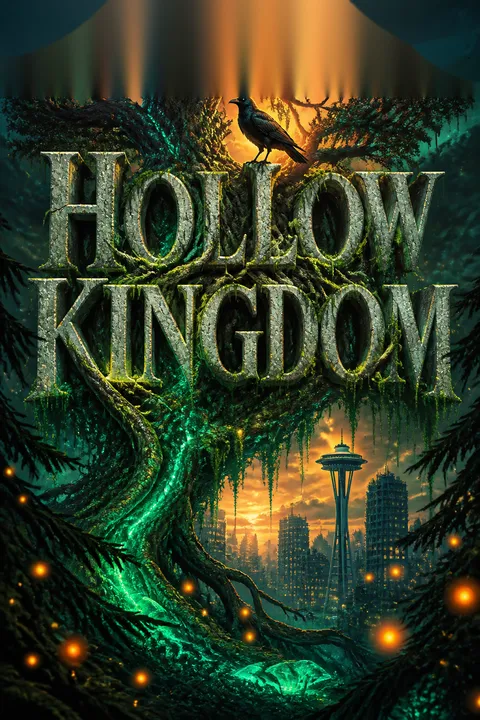


Plot Summary
The Eyeball in the Grass
S.T. is a domesticated crow who shares a Seattle home with Big Jim, the electrician who raised him. Their rough, companionable routine breaks when Big Jim's eyeball drops into the yard. S.T. rescues it from the dog, Dennis, and stores it, treating the incident as another household problem to manage.
But Big Jim has already begun forgetting appointments and words; soon he stops eating, retreats to the basement, and repeatedly scrapes a finger against the wall. S.T. tries food, medicine, and familiar comforts, but Big Jim barely responds. As the crow watches his human vanish into a strange, vacant version of himself, he introduces himself and admits how deeply his life is bound to Big Jim's.
The first horror arrives as a grotesque domestic mishap, filtered through S.T.'s practical jokes and complaints. His humor does not cancel the fear; it shows how he keeps fear manageable by translating it into chores, food, and the familiar irritations of shared life. Big Jim's decline also reverses their apparent roles. The human who taught S.T. how to live in a household now depends on the crow's improvised care, exposing the emotional labor beneath their comic symbiosis.
Walgreens Goes Quiet
When the neighborhood falls unnaturally silent, S.T. follows the absence of cars and deliveries to a wrecked church and an abandoned Walgreens. There he finds Hollows, humans with twisted bodies and bloodied mouths, fixated on a machine screen.
Their frenzy nearly catches him, and his flight home brings worse news: neighbor Nargatha is eating her miniature schnauzer, Triscuits. S.T. returns with a bag of medicines, but neither Big Jim nor Dennis can be restored by his efforts.
After discovering Big Jim's phone, he tries to use it to call for help. Its alert sound sends Big Jim charging after him, jaws broken and fingers clawing. S.T. escapes through a small window, retrieves Dennis, and leads the bloodhound away from the only home either has known.
S.T.'s first journey outward transforms a private medical crisis into a citywide catastrophe. The phone is introduced as a tool of rescue, yet its sound provokes the very danger he hopes to escape, foreshadowing its double role as technology and lure. Nargatha's attack on her own pet makes the collapse intimate rather than abstract: the old bonds between people and animals have become perilous. S.T. leaves only when staying would mean being consumed by the human he loves.
Onida Names the Extinction
S.T. and Dennis travel through the ruined city seeking Onida, a name carried through the animal network called Aura. At a library lawn, a grizzly bear attacks Dennis; a crow murder led by Kraai drives it away and directs the pair onward. In the flooded aquarium, S.T. meets Onida, a giant Pacific octopus who confirms the catastrophe reaches far beyond Seattle.
Humanity is dying, she explains, after taking too much from the natural world; no cure is known. But domesticated animals remain, many abandoned behind doors and dependent on help. Onida tells S.T. that he must reconcile with his own nature and choose what to do. He leaves shaken, no longer searching only for Big Jim's cure, but for the animals who cannot escape by themselves.
Onida shifts the story's scale from an unexplained illness to an ecological reckoning, while refusing S.T. the reassurance of a cure. Her account does not make human extinction feel deserved in any simple moral sense; it makes the consequences of imbalance unavoidable. The octopus also widens S.T.'s understanding of communication beyond the human world. His task becomes less about restoring the past than answering a concrete need in the present, even while he resists the identity others see in him.
A Redhead in the Zoo
Following the coast and the silent freeway, S.T. and Dennis pass wrecked vehicles, a dying gorilla at King Street Station, and a hippopotamus attacking in the ruined football stadium. A gull helps S.T. reconnect with Aura, where a mole, an opossum, and a junco report a tall, red-haired figure who opens doors and has headed toward the zoo.
S.T. takes the clue as proof that a healthy human may still be alive. Near the Woodland Park Zoo, however, he spots Cinnamon, a starving Pomeranian trapped in a sealed house, and promises himself he will return for her. He enters the zoo to find the supposed survivor, searching among emptied enclosures and escaped animals while his hope makes every danger seem worth approaching.
The journey makes S.T. a reader of damaged landscapes: wrecks and animal sightings become evidence he tries to arrange into a survivable story. The red-haired figure gives him hope of human rescue, while Cinnamon supplies a more immediate obligation. Those hopes pull in different directions. S.T. still measures a better future by the return of people, even as the abandoned dog at the zoo's edge demonstrates that the beings needing him are already present.
The Zoo's False Beacon
Inside the zoo, S.T. finds broken enclosures, roaming predators, and crows that harass him. In a rainforest exhibit, a frog's cryptic directions lead him toward a cave where he sees a red-haired human among several others. They smash their heads against the glass beside the bear habitat. S.T. understands that the supposed survivor is another Hollow, drawn to screens and reflective surfaces, not a rescuer.
The failed clue leaves him alone among predators and wreckage. As he flees through the darkness, he crashes into one of the few intact windows. The impact injures his wing so badly that he can no longer fly. He has lost his imagined human ally and the ability he relied on to escape danger.
The false beacon is not merely a mistaken report; it is hope shaped by S.T.'s need to believe that human ingenuity will return to repair the world. The glass collision makes that error physical. His injured wing removes his most reliable defense and forces dependence on Dennis and other animals. The episode also changes the meaning of captivity: the zoo's barriers have failed, but S.T. remains confined by the damage done to his own body.
Cinnamon Through the Window
Grounded and limping, S.T. returns with Dennis to the house where Cinnamon is trapped. In a nearby apartment, Dennis uncovers a working smartphone, giving S.T. a way to exploit the Hollows' fixation. He sets the illuminated phone on Dennis's back and draws two pursuing Hollows toward Cinnamon's home. When they crash through a window to reach the screen, Cinnamon slips out past them.
The dog is frightened and weak, but she joins S.T. and Dennis rather than returning to her empty house. Their escape gives S.T. a practical method for reaching animals behind glass, though the phone's limited battery makes each use urgent. For the first time since leaving home, S.T. has turned the world's strange new rules into a rescue.
S.T. succeeds by learning the pattern that once endangered him: the Hollows' response to a phone can be redirected. This is a small but decisive change in his relation to technology. He does not repair the device or recover the human world it represents; he repurposes its power to serve an animal in need. Cinnamon's rescue also turns the partnership into a small community, giving S.T. an obligation beyond Dennis and a reason to keep moving.
The Cost of Rescue
S.T. and his companions use a sheet of glass and a phone alert to draw Hollows away from a house, allowing two German shorthaired pointers to escape. In the next home, they discover a starving husky mother and her litter of puppies. Before they can find a way inside, a lone African painted dog convulses with rabies and charges Cinnamon.
Dennis grips S.T.'s injured wing to keep him from rushing into the attack. Cinnamon stands her ground, and the rabid dog kills her before collapsing itself. Dennis carries S.T. away, leaving the puppies behind. Under the cedars, S.T.'s confidence breaks: his effort has saved a few animals, but he could not protect the friend who had joined his mission.
Cinnamon's death is the point at which S.T.'s rescue work stops feeling like a sequence of clever victories. Dennis's restraint, painful to S.T. in the moment, is also an act of protection that prevents another loss. The rabies outbreak shows that freeing animals from human-made cages does not remove the dangers now spreading through the wild. S.T. has to face the limits of individual courage, and the grief that follows pushes him toward the community he has repeatedly rejected.
A Crow Finds His Murder
S.T. lashes out at Kraai when the crow leader insists that S.T. belongs with his own kind. After S.T. falls from the sky, Kraai's crows break his fall, and S.T. finally recognizes that their help is not a claim of ownership. He returns to the murder and accepts their protection. During a gathering of birds, S.T.'s old friend Ghubari arrives and recounts what happened to his owner, Rohan, and Rohan's wife, Neera.
Ghubari believes the human disaster began with a virus carried through connected devices and screens; a scientist's account suggests the infected are changing rapidly in an attempt to survive. There is no known cure. S.T. can no longer treat his crow nature as an insult or rely on a simple return to the old world.
S.T.'s fight with Kraai dramatizes identity as a defense mechanism: rejecting the crow lets him preserve his bond with Big Jim, but it also isolates him from the allies who can help him survive. The murder's rescue gives belonging a material form before S.T. can accept it emotionally. Ghubari's account then unsettles the extinction narrative. The Hollows may not simply disappear; they are changing, making the future more dangerous and less predictable.
The Orangutan's Open Door
S.T. shows a gathering of birds how to attract Hollows with an illuminated phone and break a window while they rush toward it. As the birds prepare to free a starving husky and her puppies, a family of orangutans arrives. The adult male uses a rock to break a window, reaches inside, and unlocks the front door, revealing a way past the animals' inability to turn handles.
The husky and a puppy emerge into the grass. The orangutan's skill makes him the real door-opener the animal network had been seeking, not the imagined healthy red-haired human. Elsewhere, golden lion tamarins help free Winnie the Poodle. Rescue can now spread through cooperation, combining bird knowledge, human tools, and an ape's hands.
The breakthrough is collective rather than miraculous. Birds can learn the screen lure, but the orangutan supplies a capacity their bodies lack: reaching through a broken window to work a lock. The rescue depends on distinct forms of intelligence cooperating without becoming interchangeable. The same principle applies to the tamarins freeing Winnie. What survives from human civilization is not its dominance, but practical knowledge that other species can adapt and share.
Dennis Outswims the Hollows
The rescue effort grows into regular flights that free domesticated animals from abandoned homes. The danger escalates when a new kind of Hollow, enlarged and birdlike, attacks the animals and kills six crows near the Bothell refuge. While the murder prepares to confront a predator, Dennis and S.T. follow a distress scent to Mill Creek and find another flock under attack.
Dennis runs into danger carrying an iPad, using its screen to draw the creatures after him. He races to a lake and swims into deep water. The mutants follow their fixation and drown because they cannot swim. Dennis returns alive, having saved the crows, and the birds celebrate him as a hero. S.T. sees that the lesson of their partnership works both ways.
Dennis's victory reverses the old arrangement between teacher and student. S.T. trained him to obey, play, and respond to human habits; now Dennis uses that knowledge with his own judgment. The screen remains dangerous, but the creatures' inability to resist it becomes a weakness he can exploit. The episode also sharpens the stakes: freeing pets is no longer enough when a newly altered human population can hunt the rescue network itself.
The UPS Road Ends
After Dennis's victory, the pair travel with the animal coalition. Then Dennis spots a UPS truck, the old enemy he has always chased, and charges into a crowd of Hollows around it. The other animals cannot reach him before the crowd overwhelms him. S.T. returns to find Dennis dead and helps arrange a funeral attended by crows, dogs, cats, orangutans, elephants, and the animals they rescued.
Ghubari then shares a memory of Rohan confronting a scientist, who explained that the infected may be undergoing rapid physical changes to survive a virus and a damaged environment. S.T. loses his closest companion just as he learns the Hollows may be evolving rather than simply fading away. Grief and danger now belong to the same future.
Dennis's death is not a punishment for foolishness so much as the cost of a life lived through instinct, attachment, and accumulated habits. The UPS truck condenses his old world into one irresistible target. The funeral answers that private bond with public recognition: many species gather because Dennis's loyalty made him part of their shared community. Ghubari's revelation refuses a comforting ending to the human crisis. Loss does not settle the ecological conflict; it changes what the survivors must prepare to face.
Silk, Stripes, and Wolves
With Kraai's murder and allied animals at his side, S.T. confronts two threats closing on the refuge. He uses a rope and a plush toy to draw three tigers toward the Weavers, giant spiderlike Hollows that have been killing animals and spreading silk through the trees.
The tigers attack the Weavers, giving Migisi time to escape their web. S.T. then returns to Bothell Landing, where a large wolf pack is fighting the orangutans and birds. Riding Migisi, he calls the domestic dogs to follow him into the clearing.
Their numbers drive the wolves away from the immediate territory. Far beyond Seattle, animal interludes echo the change: a polar bear finds her grown cub, and the ice bears endure. The victory is local, but the coalition has learned to act together.
S.T. no longer imagines that survival means eliminating every predator or restoring human control. He redirects existing instincts, using the tigers' hunting drive against the Weavers and the dogs' pack loyalty against the wolves. This is a tactical form of ecological thinking: success depends on relationships among species, not on a single hero's force. The polar bear's reunion broadens the ending's horizon, suggesting that renewal is possible without promising a painless or settled world.
The Story Reaches Dee
After the battles, S.T. joins a secret journey north with Kraai, Ghubari, Pressa, and other birds. They reach a remote Yup'ik village, where five snowy owls have been keeping a human baby warm and alive with what little food they can find. S.T. recognizes a crow-and-evergreen image on the wall from an earlier rescue site, then approaches the starving infant and chooses to become her guardian.
He names her Dee, after Dennis, and promises to teach her how to live in the altered world. The crow who once wanted to be human now carries human history forward through care and storytelling. His account becomes a lesson for the child: every species must adapt, and survival depends on recognizing the ties between lives.
The ending returns to the opening's question of family, but changes its terms. S.T. once defined himself through the human who raised him; now he chooses to care for a human child without expecting humanity to resume its former authority. Naming Dee after Dennis turns memory into an active inheritance rather than a monument. By telling the story, S.T. gives the child both knowledge and a relationship to loss, making narration itself one of the ways a community keeps living.
Analysis
Hollow Kingdom makes the apocalypse intimate before it makes it planetary. Its first evidence of collapse is not a government announcement but Big Jim's lost eye, a body S.T. knows well becoming unreadable. That scale matters: S.T. experiences environmental breakdown through interrupted routines, empty homes, abandoned pets, and the disappearance of the people who taught him how to live among them.
The novel's central conflict is also a crisis of attention. Humans become trapped by screens; S.T. begins trapped by his wish to be human. Both forms of fixation narrow the world until other lives become difficult to see. His development does not require rejecting his human attachments. Instead, he learns to hold them without denying his crow nature, and to turn human inventions toward care rather than compulsion.
The communication systems of Aura, Echo, and Web offer a countermodel to technological connectivity. They are embodied, local, and dependent on listening, yet they are not infallible. Animals misread reports, S.T. mistakes a Hollow for a savior, and prophecy must be interpreted through action. The novel's alternative to human mastery is therefore not perfect natural harmony. It is a network of partial knowers who survive by correcting one another.
Dennis gives this argument its emotional force. His loyalty is not a metaphor detached from the plot; it changes who can be rescued, what S.T. learns, and what the animal community mourns. The crowded funeral makes grief a cross-species practice, while S.T.'s care for Dee turns memory into responsibility. The ending offers no cure and no restoration of the old order. It imagines a future built through practical cooperation, shared stories, and attention to lives that have no power to demand notice.
Review Summary
Hollow Kingdom receives generally positive reviews, averaging 3.83/5 stars. Readers frequently praise its unique premise, humor, and beautiful prose narrated by S.T., a foul-mouthed domesticated crow navigating a zombie apocalypse. Many highlight its emotional depth, originality, and love of nature. Common criticisms include pacing issues in the second half, repetitive plot points, juvenile humor, and an underwhelming explanation for the apocalypse (cell phones). Despite mixed opinions on structure, most readers find S.T. and Dennis's relationship compelling, and many recommend it as a refreshingly creative take on post-apocalyptic fiction.
People Also Read
Characters
S.T. (Shit Turd)
Crow seeking belongingS.T. is a domesticated American crow raised by Big Jim, whose home and habits have shaped S.T.'s idea of what it means to be human. He is observant, opportunistic, funny, and fond of turning fear into a joke or a practical scheme. Beneath his swagger, he longs to be recognized as more than a crow and struggles to trust the natural world he has mostly ignored. His loyalty makes him brave, but his attachment to one person can narrow his attention. S.T.'s intelligence is partly learned from humans and partly rooted in crow perception, leaving him unusually able to translate between worlds.
Dennis
Loyal bloodhound partnerDennis is Big Jim's bloodhound and S.T.'s home companion. His powerful nose gathers information that his limited speech cannot, and his steady affection balances S.T.'s restless cleverness. Dennis is stubborn, food-motivated, easily distracted, and more emotionally perceptive than S.T. initially allows. He responds to training and routine, but his bond with S.T. is not merely obedience: he repeatedly makes choices that protect their small partnership. His plain, physical presence gives S.T. a source of comfort and an honest measure of what care looks like.
Big Jim
S.T.'s human guardianBig Jim is a working electrician who raised S.T. and shares his home with the crow and Dennis. He is loud, messy, comic, and steeped in ordinary human routines, yet his affection for his animal companions is genuine. Big Jim gives S.T. language, practical knowledge, and a model of loyalty, even as his emotional life is vulnerable to loneliness and rejection. Through S.T.'s memories, he becomes more than a joke-filled human specimen: a person whose capacity to love animals is inseparable from his need to be accepted himself.
Kraai
Leader of the college crowsKraai is a charismatic crow who leads the large murder near the University of Washington Bothell campus. He is strategic, socially perceptive, and committed to collective survival. Kraai recognizes S.T.'s unusual relationship with Dennis as useful knowledge, but his interest is not purely practical: he believes a murder must protect its members. His confidence can sound like certainty about the world, which provokes S.T.'s resistance. Kraai offers a different model of belonging from Big Jim's household, one grounded in mutual obligation, shared territory, and the preservation of a community.
Onida
Aquarium oracleOnida is a giant Pacific octopus living in the damaged Seattle Aquarium. She listens to the ocean's communication network and understands events far beyond S.T.'s neighborhood. Her knowledge is immense, but she does not offer easy rescue or pretend to control the future. Onida presses S.T. to face the limits of his understanding and make a choice about the animals still dependent on help. Her fluid body and multiple senses make her a striking counterpoint to S.T.'s human-centered assumptions.
Ghubari
Parrot and keeper of memoryGhubari is an African gray parrot who once belonged to Rohan and knew S.T. through their human owners. Brilliant, articulate, and gifted at mimicry, he carries memories that S.T. cannot access directly. Ghubari's loyalty to Rohan and Neera gives his knowledge an emotional weight that pure information would lack. He is patient with S.T.'s uncertainty and uses humor to keep grief from becoming the only thing in the air. His ability to repeat human voices also makes him a living bridge to the lost world.
Cinnamon
Trapped Pomeranian survivorCinnamon is a small Pomeranian trapped inside a house near the zoo, where she has survived by scavenging abandoned food. She is frightened and depleted when S.T. first finds her, but she has not lost her instinct to respond to others in need. Her experience makes her alert to confinement and quick to sense which homes may contain animals requiring rescue. Cinnamon's combination of fragility and resolve gives S.T.'s growing mission a companion who understands what it means to wait behind a closed door.
Migisi
Bald eagle allyMigisi is a powerful bald eagle allied with Kraai's crows. She is direct, capable, and more inclined to act than deliberate at length. Her strength and mastery of flight make her essential when S.T.'s injured wing prevents him from traveling through the air. Migisi's confidence is not a lack of judgment; she weighs danger differently from S.T. and is willing to commit when others remain caught in argument. She becomes one of the coalition's most valuable partners.
Pressa
Crow medic and allyPressa is a crow with a burn injury who brings herbs to help S.T.'s damaged wing. She is cautious, observant, and frank about the risks of acting without a plan. Her willingness to trust S.T. develops through shared work rather than grand declarations. Pressa also takes a serious interest in human language and culture, treating unfamiliar knowledge as something to learn rather than dismiss. She represents the care and practical expertise that make the coalition more than a fighting force.
The One Who Opens Doors
Orangutan problem-solverThe One Who Opens Doors is an adult male orangutan whose strength and dexterity let him manipulate the handles that defeat the birds and dogs. He travels with his family and is treated with respect by many animals. His quiet confidence makes him an effective presence in a world where survival depends on more than aggression. He offers a practical answer to a recurring obstacle, demonstrating how one species' abilities can make another species' rescue possible.
Genghis Cat
Territorial feline protectorGenghis Cat is an imperious tabby who narrates his own exploits as though the surrounding world exists for his amusement. He hoards socks and other objects, claims territory with absolute confidence, and regards human beings as amusingly inadequate servants. Beneath the vanity is a fierce capacity to protect those he has chosen, including an orangutan family. His comic self-importance becomes a distinctive form of courage: he does not need to think of himself as heroic before he acts.
Winnie the Poodle
Waiting house petWinnie is a pampered miniature poodle who describes herself in the third person and measures life through beauty, attention, and the return of her absent owner. Her comic vanity coexists with genuine loneliness and guilt about the choices she made before the crisis. Winnie reveals how deeply a house pet's sense of safety depends on human routines, even when she once resented them.
Nargatha
Neighbor and animal loverNargatha is an elderly Seattle neighbor known to S.T. for her eccentric style and kindness toward animals. She offers him treats and shares neighborhood rituals with Big Jim. Her presence helps S.T. recognize that the crisis has reached familiar faces and homes, not just anonymous streets.
The Mother Trees
Keepers beneath the forestThe Mother Trees are the ancient forest matriarchs connected through roots and fungal networks. They store knowledge, warn other living things, and help carry messages through Web, the underground communication system. Their perspective stretches beyond human measures of time and individual life. They embody a form of memory based on relationships among organisms rather than a single mind or archive.
Plot Devices
Aura, Echo, and Web
Nature's information networkThe animals and plants communicate through linked systems. Birds, insects, and trees carry information through Aura; ocean creatures share news through Echo; roots and fungi transmit knowledge through Web. These networks give S.T. directions, warnings, and reports from beyond Seattle, but they do not guarantee accuracy. Their imperfect messages move the plot while showing that the nonhuman world has ways of knowing that humans often overlook.
The Hollows
Humanity's transformed remainsHollows are humans whose bodies and behavior have been altered by a mysterious technological virus. They obsess over screens, glass, and sources of electronic light, making devices both dangerous attractors and tools S.T. can redirect. Their condition initially appears to be a simple collapse into mindless hunger. Later evidence suggests that some are changing physically in an attempt to survive, keeping the nature and outcome of the crisis uncertain.
Screens and glass
Lures that open barriersS.T. discovers that phones and tablets draw Hollows toward their glowing screens. By placing a device near a window, he can make the Hollows break the glass as they pursue it, allowing trapped pets to escape. The tactic turns a hallmark of human dependence into a rescue tool, though working devices are scarce and their batteries have limited life. Glass is therefore both a physical barrier and a strategic vulnerability.
The animal prophecies
A call to collective actionOnida's warnings, the trees' messages, and the animals' stories about the One Who Keeps and the One Who Hollows give the scattered survivors a shared language for change. These signs help S.T. find allies and frame the coming struggle, but they are often fragmentary or misread. The prophecies do not hand him a complete plan; they force him to interpret events and make choices alongside other species.
Download PDF
Download EPUB
.epub digital book format is ideal for reading ebooks on phones, tablets, and e-readers.








