

Key Takeaways
Treat emotion as part of intelligence, not decoration added after engineering
Feeling helps thinking. Norman argues that emotion and cognition are partners, not rivals. Affect is the brain's rapid evaluation of whether something seems safe, welcome, or threatening. Emotion is the conscious experience of that evaluation, often with an explanation attached. Both shape decisions and behavior, much of it before conscious thought begins.
Choices need a feeling. Neurologist Antonio Damasio studied people whose emotional systems were impaired. They could reason about options but struggled to make ordinary decisions, such as where to live or what to eat. A product, too, is never merely a set of functions: its appearance, feel, and behavior influence how people think and what they choose. Design that ignores emotion leaves out a basic part of human judgment.
What's striking is the reversal of a familiar engineering assumption: emotion is not noise that must be removed from decision-making, but a rapid value signal that helps narrow choices. This connects to embodied cognition, the view that thought is shaped by bodily sensation and action, not just abstract reasoning. The practical implication is not to make every interface cheerful. Fear, irritation, or urgency can be useful signals when danger is real. The challenge is to distinguish helpful emotional guidance from avoidable stress created by confusing or unreliable design.
Design for the first glance, the act of using, and the memory afterward
Three kinds of response. Norman's model distinguishes three levels of processing. The visceral level reacts quickly to appearance and sensation. The behavioral level concerns doing: whether a product works, feels right, and is understandable. The reflective level interprets meaning, identity, and memory. A single object can succeed at one level and fail at another.
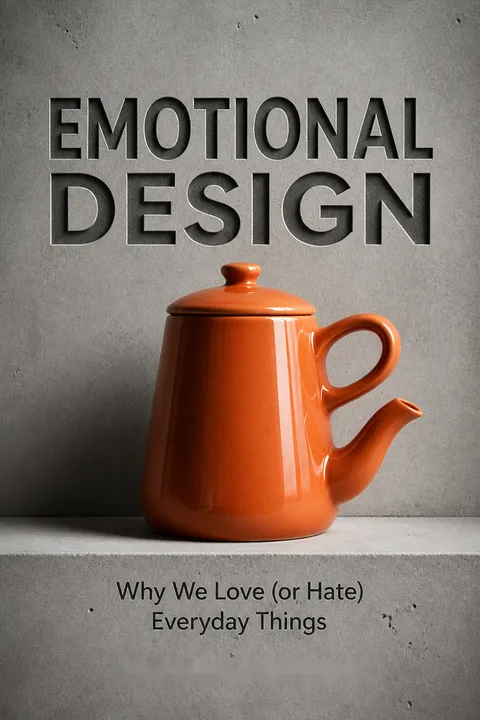
Three teapots show why. Norman keeps an unusable novelty pot because it tells a funny story, likes a charming pot for its looks, and admires a clever tilting pot that controls how long tea steeps. Yet for his rushed morning routine, he uses a simple brewing ball and hot-water pot. The best choice depends on the moment. Design is not a contest between beauty and function; it is a balance among immediate appeal, use, and meaning.
The model is memorable because it separates questions that product reviews often blur: Does it attract attention? Does it help someone act? Does it matter to its owner? These dimensions also explain why a single satisfaction score can conceal important differences. A decorative object may be loved despite poor utility, while a plain tool earns affection through years of dependable use. The three levels are best treated as a practical lens, not as isolated brain compartments. Real experience blends them, and the blend changes with context.
Let beauty support usability, but never mistake charm for actual ease
A pleasing start can help. Researchers Kurosu and Kashimura found that people judged attractive ATM layouts easier to use, even though the machines had the same functions. Noam Tractinsky repeated the study in Israel and found a similar, stronger effect. The result fits research by psychologist Alice Isen: a small positive experience, such as a gift or a funny film, can improve performance on problems that require flexible thinking.
Mood changes the search. Positive affect can make people more open to alternatives when their first attempt fails. Anxiety tends to narrow attention, which may help in an immediate threat but can make a confusing interface harder to navigate. This is not permission to decorate away flaws. In high-stakes settings, clear information, reliable feedback, and low ambiguity matter more than visual delight.
The finding matters because perceived usability is partly emotional: confidence can encourage exploration instead of repeated, fruitless attempts. Yet perceived ease and actual task success are different outcomes. A polished interface may invite trust it has not earned, while an austere tool may perform well once learned. The sound design question is therefore twofold: does the design help people feel capable, and does observation confirm that they can complete the task? Beauty can open the door. Testing must establish whether the room is navigable.
Watch people work before asking them what a better product should do
Needs hide in routines. Norman separates behavioral design into function, understandability, usability, and physical feel. Designers often miss the real task because they add features without seeing how people use a product in ordinary settings. Surveys and focus groups can capture what people say, but not necessarily the workarounds and small frustrations they barely notice.
Observe the coffee problem. Designers visiting night-shift cleaners saw workers struggle to drink coffee while steering large floor-cleaning machines. Cup holders were not on the client's requirements list, but adding them helped make the redesigned machine a success. A product's system image, the clues its form and feedback provide about how it works, also matters. Prototypes tested with real users expose misunderstandings early, before they become expensive habits.
This is a strong argument for ethnographic observation: behavior in context reveals needs that are invisible in a meeting room. It also resembles safety engineering, where investigators examine the whole work system rather than blaming the last person who made an error. Observation is not automatically neutral, however. A designer's presence can change behavior, and one site's workaround may not generalize to another. The best process combines field observation with iterative prototypes and diverse users, treating each finding as a hypothesis to test rather than a universal rule.
Build meaning through memories, identity, and earned accomplishment
Objects carry stories. Research by Mihaly Csikszentmihalyi and Eugene Rochberg-Halton asked people to identify special possessions in their homes. Often, the importance came not from the object's beauty but from the memory attached to it. A pair of chairs mattered to one woman because they were part of her early family life. Souvenirs work similarly: an ordinary miniature monument can recall a place, a trip, and the people who shared it.
Effort can deepen attachment. A ready-made cake mix initially struggled because it asked too little of the cook and gave little sense of achievement. Requiring the addition of an egg helped restore involvement. Heathkit customers likewise took pride in assembling electronics, even when the kits cost about as much as finished products. Reflective design concerns the meaning people give to owning, using, or displaying things.
The distinction between an object's market value and its personal value is essential for understanding attachment. A worn photograph or imperfect handmade object can be more meaningful than a flawless luxury item because it anchors a relationship or a remembered effort. This also connects to the psychology of autobiographical memory: familiar objects can act as cues that make the past accessible. But effort is not inherently rewarding. The cake mix example shows that participation can create pride when it feels meaningful, not that every product should add friction to manufacture a sense of accomplishment.
Make routine interactions pleasurable without letting novelty become the whole product
Delight can carry information. At an MIT laboratory, picking up different bottles triggered musical parts that joined into a tune. Another installation projected fish onto a ping-pong table, where the ball sent them scattering. These experiments made interaction playful rather than merely efficient. Norman also describes flow, a state of deep absorption that can occur when a task holds attention and its difficulty is close to a person's skill level.
Surprise needs substance. A small tea strainer looks like a little figure until it is placed on a cup, where its shape becomes functional and funny. That reveal makes its charm more durable than cuteness alone. Music can likewise enrich an interface, but intrusive beeps and loud background sound can become irritants. Pleasurable design should reward use, communicate clearly, and remain worth returning to after the first surprise fades.
Play is not the opposite of seriousness. It can make information easier to notice, invite experimentation, and turn a routine action into an experience people remember. The flow idea also offers a useful design test: too much difficulty frustrates, while too little leaves attention wandering. Novelty is a weaker foundation than ongoing discovery, however. A playful signal that interrupts concentration or excludes people with sensory sensitivities can undermine its purpose. Delight works best when it is relevant, optional where possible, and integrated with the task.
Fit a product's personality to its users, setting, and purpose
One design cannot please everyone. Visceral reactions may share some broad patterns, but experience, culture, age, and self-image shape what people value. A playful product may suit a home or game, yet look out of place in a business setting. Products also make statements: a watch can be chosen for accurate timekeeping, fashion, status, or the pleasure of explaining its unusual design.
The NFL headset had to signal authority. It needed to survive stadium noise, weather, and rough handling, while remaining comfortable and visibly carrying Motorola's name. Coaches rejected lighter designs because the heftier headset better fit their image of strong leaders. This is why iterative testing is valuable for practical use, while a distinctive visual or reflective identity may need a coherent creative vision instead of a committee sanding away every unusual choice.
Designing for a specific audience is more honest than pretending to deliver universal appeal. The headset example shows that a product can be equipment and a prop in a user's social identity at the same time. This resembles role-based design in architecture: the right environment depends on what people are trying to do and how they understand their place within it. Segmentation can also become stereotyping, however. A designer should test assumptions about gender, age, or profession with actual users, rather than treating a market profile as a fixed personality.
Earn trust through reliable behavior, useful feedback, and understandable limits
People read intention into things. Anthropomorphism is the tendency to assign human feelings or motives to animals and objects. A chair posed as if it had lost a ball can look embarrassed; a computer that refuses a command can seem stubborn. This response is natural, but trust depends on more than a friendly appearance. It grows when a device behaves predictably and explains what it is doing.
The fuel gauge is a small contract. If a warning light signals an empty tank and the car stops, the driver may blame their own delay. If the gauge gives no warning or varies unpredictably, trust falls. Complex electronics are especially frustrating when their operation is invisible. Norman also notes that repeated checks can make each person less vigilant. Aviation's Crew Resource Management addresses this by training one pilot to question the other, even across rank.
Trust in technology is calibrated through experience, much like trust in a person: expectations form, behavior confirms or violates them, and the user updates. Clear feedback helps people attribute a failure accurately instead of feeling helpless. The cockpit example adds a useful organizational lesson: respectful questioning can improve safety without implying hostility. A caveat is that humanlike cues can create more confidence than a system deserves. Trustworthy design should make limits visible and make it easy to recover from mistakes, not simply make a device seem personable.
Protect attention by giving people control over when communication arrives
Connection has two sides. Text messages and instant messaging often carry less factual information than social reassurance: a brief sign that someone is present and thinking of another person. That contact can sustain relationships across distance. But the sender's connection may be the recipient's interruption. Norman describes cell phone users as inhabiting a private conversational space while physically sharing a street, meeting, or meal with others.
Attention has limits. A phone conversation while driving occupies the reflective attention needed to anticipate hazards. Norman notes that hands-free equipment does not remove this mental distraction. Communication systems should therefore let recipients defer or screen contact, and should not assume every message deserves an immediate response. Asynchronous tools such as email and voice mail can preserve the relationship while allowing people to choose a suitable time to engage.
The distinction between being reachable and being available remains crucial in a world of persistent notifications. Communication can strengthen weak ties and offer comfort, but constant access can turn social presence into social pressure. This is also a design issue, not merely a discipline problem: defaults, alerts, and response expectations shape behavior. The driving example makes the cost concrete, because mental conversation competes with anticipating events even when both hands remain free. A humane system treats the receiver's attention as a resource belonging to that person.
Give autonomous machines internal affect, not merely theatrical emotional faces
Emotion must guide action. Norman argues that autonomous machines need affect-like mechanisms to prioritize tasks, detect danger, learn from outcomes, and avoid repeating failures. A robot that says it is afraid but takes no protective action, like the fictional HAL, only describes fear. The emotional signal should influence what the machine does and help people understand its state.
A face is not proof of understanding. The robot Kismet could respond to movement and vocal tone with interest or boredom, yet it did not understand the words it heard. Its expressiveness made interaction compelling, but observers supplied much of the meaning. Norman's discussion of Isaac Asimov's robotics laws points toward safety and responsibility, while recognizing that real machines must handle conflicts among human instructions, safety, and their own continued operation.
The useful distinction is between simulated emotion as decoration and affect as a control system. A machine can use internal signals to prioritize, pause, or seek help without possessing human subjective experience. Visible uncertainty can also help a person supervise it. Yet expressive faces risk encouraging attachment or obedience beyond a machine's actual competence, as Kismet's engaging responses illustrate. The design challenge is to make machine state legible without implying consciousness or moral standing that the system cannot support. Safety rules matter, but accountability also requires clear human oversight.
Turn purchased objects into personal belongings through use, arrangement, and repair
Personal meaning is made, not ordered. Choosing a color or accessory from a catalog is customization, but it does not necessarily make an object feel personal. People create that connection by arranging possessions around their routines, modifying products, and attaching memories to marks of use. A scratched tool or annotated book can become distinctively one's own because its wear records a history.
Everyday choices are design acts. Rearranging a room, adapting furniture, or changing a motorcycle transforms generic things into a setting that fits its inhabitants. Norman argues that professional designers can make objects attractive and effective, but owners contribute the personal meaning. This process also changes over time as needs and relationships change. Good products can support it by allowing adaptation and by aging gracefully, rather than treating every sign of use as damage to be hidden.
This closing idea shifts design from a finished artifact to an ongoing relationship between people and their surroundings. It anticipates participatory design, where users shape tools through practice, and it offers a counterpoint to the idea that personalization requires ever more settings and options. Sometimes the meaningful customization happens after purchase, through repair, placement, and shared use. Access to that process is unequal, however: time, skills, money, and physical ability all matter. Adaptable design should invite personal expression without requiring every owner to become a craftsperson.
Analysis
Emotional Design is a design and psychology book organized around a central claim: products are judged not only by what they do, but by how they shape feeling, action, identity, and memory. Norman moves from everyday objects, especially his three contrasting teapots, to a practical model of visceral response, behavioral use, and reflective meaning. He then tests that model against interfaces, games, music, shopping, communication technologies, and imagined robots. The narrative works because the theory keeps returning to ordinary encounters: a cup holder overlooked by engineers, a confusing computer, a cherished knife, a robot that appears interested.
The book's most durable contribution is its refusal to treat beauty and usability as enemies. A positive emotional state can support flexible thinking, while reliable feedback and clear task design remain necessary for effective use. Its second major contribution is to show that attachment often resides outside the object itself. A souvenir matters because of a remembered trip; a tool matters because repeated use has earned confidence; a handmade project matters because its owner feels capable.
The three-level model is most useful as a diagnostic vocabulary, not a literal map of three independent brain systems. The categories overlap, and the same product can feel attractive, frustrating, or meaningful depending on a user's culture, abilities, mood, and purpose. Norman recognizes this variation, but some examples lean on broad assumptions about audiences and gender that require contemporary user research rather than intuition. The model also leaves designers with ethical choices: positive emotion can help people learn and explore, but it can also be used to manipulate shoppers or encourage excessive attachment to devices.
That tension gives the book continuing relevance. Its argument is not simply to make objects lovable. It is to design experiences that earn affection through coherent appearance, effective action, honest communication, and meanings people can make their own. As technologies become more persuasive and socially expressive, the central question is not whether emotion belongs in design, but whether the emotions a product evokes serve the people using it.
Review Summary
Emotional Design received mixed reviews. Many praised its insights on how emotions affect design and user experience, especially in the first half. The book's framework of visceral, behavioral, and reflective design layers was appreciated. However, some found the later chapters on robots and AI less relevant or interesting. Readers valued the numerous examples and anecdotes but criticized repetitiveness and outdated content. Overall, it's considered a worthwhile read for designers, though not as impactful as Norman's earlier work, "The Design of Everyday Things."
People Also Read








Glossary
Affect
Rapid evaluationAffect is the brain's evaluative process for judging conditions as favorable or unfavorable, safe or dangerous. It can operate outside conscious awareness and influence attention, bodily readiness, and decisions. Norman distinguishes affect from emotion: emotion is the conscious experience of affect, often with an identified cause.
Three levels of processing
Three modes of responseNorman's model describes visceral, behavioral, and reflective processing. Visceral processing makes fast sensory judgments; behavioral processing governs actions and skilled use; reflective processing interprets experience, considers identity, and draws on memory. The levels interact, and Norman applies them to explain different dimensions of product experience.
Visceral design
Immediate sensory appealVisceral design concerns a product's immediate impact through appearance, sound, touch, and other sensory qualities. It draws on rapid, often biologically prepared reactions before deliberate interpretation. Shape, color, texture, and weight can all contribute. A strong visceral response may prompt interest before a person knows what a product does.
Behavioral design
Quality of useBehavioral design concerns what a product enables people to do and how well it supports those actions. Norman emphasizes function, understandability, usability, and physical feel. It requires observing actual tasks, providing useful feedback, and helping users form an accurate understanding of how the product works.
Reflective design
Meaning and identityReflective design concerns the meanings people assign to products through memory, culture, self-image, ownership, and social display. Its effects may develop over time and differ substantially among people. A product can be valued as a keepsake, a status signal, a source of pride, or a reminder of an experience.
System image
Clues a product communicatesThe system image is the information conveyed to users by a product's appearance, controls, feedback, and accompanying material. Users rely on it to form a mental model of how the product works. Since designers do not communicate directly with every user, a clear system image is essential to correct understanding and use.
Flow
Deep task absorptionFlow is a state of concentrated involvement in an activity, during which awareness of distractions and time can recede. Norman, drawing on Mihaly Csikszentmihalyi, describes it as more likely when a task fully engages attention and its difficulty closely matches the participant's abilities. Excessive difficulty frustrates; insufficient challenge bores.
Anthropomorphism
Human qualities assigned to thingsAnthropomorphism is the attribution of human motives, beliefs, or feelings to animals, objects, or machines. People may treat a responsive computer as stubborn or interpret a chair's posture as embarrassed. Norman explains this as an extension of humans' tendency to read social cues and infer the inner states of others.
Affective Computing
Machines that sense emotionAffective Computing is the research area described by Rosalind Picard that explores how machines might detect aspects of human emotional states and respond appropriately. Possible signals include facial movement, voice, and physiological measures. Norman stresses that such signals are ambiguous and that sensing emotion does not by itself determine the right response.
Asimov's Laws of Robotics
Fictional robot conduct rulesIsaac Asimov's fictional laws prioritize preventing harm to humanity and individuals, obeying human instructions when safety permits, and protecting a robot's own existence when higher priorities allow. Norman uses the laws to examine safety, obedience, and self-preservation in machines, while noting that real systems face complex conflicts and require broader oversight.
FAQ
What's Emotional Design: Why We Love (or Hate) Everyday Things about?
- Exploration of Emotions: The book explores how emotional responses to everyday objects influence perceptions and interactions. Norman argues that emotions are integral to design, affecting usability and satisfaction.
- Three Levels of Design: It introduces visceral, behavioral, and reflective design levels, each addressing different aspects of human interaction with products.
- Aesthetics and Functionality: Norman emphasizes that attractive designs enhance functionality and user experience, positing that "attractive things work better."
Why should I read Emotional Design by Donald A. Norman?
- Insight into User Experience: The book provides valuable insights for designers and marketers on how emotions influence consumer behavior and product interaction.
- Practical Applications: Norman offers advice on incorporating emotional design principles into products, leading to better user satisfaction and loyalty.
- Cultural Relevance: It discusses the cultural implications of design, making it relevant for global markets and helping create products that resonate across cultures.
What are the key takeaways of Emotional Design?
- Emotions Drive Decisions: Emotions significantly influence decision-making, often more than logic. Norman states, "Emotion makes you smart," highlighting the necessity of emotional engagement in design.
- Three Levels of Processing: The visceral, behavioral, and reflective levels of design are crucial for creating successful products, each requiring different strategies.
- Aesthetic Appeal Matters: Aesthetics play a critical role in usability and user satisfaction, with attractive designs leading to better performance and engagement.
What are the best quotes from Emotional Design and what do they mean?
- "Attractive things work better.": This encapsulates the thesis that aesthetics influence functionality, suggesting visually appealing products encourage positive engagement.
- "Emotions are inseparable from and a necessary part of cognition.": This highlights the interconnectedness of emotion and thought, shaping our understanding and interactions.
- "The objects in our lives are more than mere material possessions.": This reflects the idea that products carry personal significance and memories, underscoring emotional connections.
How does Donald A. Norman define the three levels of design in Emotional Design?
- Visceral Design: Focuses on immediate emotional responses to a product's appearance, creating an attractive first impression.
- Behavioral Design: Addresses how well a product performs its intended function and its ease of use, emphasizing usability.
- Reflective Design: Involves deeper meanings and personal associations with a product, shaping self-image and long-term attachment.
How does Emotional Design relate to product usability?
- Usability and Emotion: Emotional responses can enhance or hinder usability, with positive emotions leading to more effective use and enjoyment.
- Designing for Emotions: Designers should consider emotional factors to create intuitive and satisfying experiences.
- Feedback Mechanisms: Effective feedback enhances emotional engagement, making users feel in control and informed.
What role do aesthetics play in Emotional Design?
- Aesthetics Influence Perception: Visual appeal significantly affects how users perceive functionality, with attractive designs leading to favorable experiences.
- Emotional Connection: Aesthetics create emotional connections between users and products, often more critical to success than practical elements.
- Cultural Significance: Aesthetic preferences vary across cultures, impacting user experiences and requiring consideration in global design.
How can designers apply the concepts from Emotional Design?
- Focus on User Emotions: Prioritize understanding emotional responses through user testing and feedback.
- Integrate Aesthetics with Functionality: Blend beauty with usability to ensure products are both attractive and functional.
- Create Meaningful Experiences: Aim to foster emotional connections, enhancing user loyalty and satisfaction.
How does Emotional Design address the concept of anthropomorphism?
- Human-Like Qualities: Users often attribute human-like characteristics to objects, enhancing emotional connections.
- Impact on Interaction: Anthropomorphic traits foster companionship and trust, leading to positive experiences.
- Examples in Design: Successful products utilize anthropomorphism to evoke emotional responses and engagement.
What examples does Emotional Design provide to illustrate its concepts?
- Teapots as Design Examples: Norman uses teapots to illustrate visceral, behavioral, and reflective design aspects.
- The NFL Headset Case Study: Highlights the balance of functionality and self-image in reflective design.
- Video Games and Emotional Engagement: References games like The Sims to demonstrate emotional design in creating engaging experiences.
How does Emotional Design relate to the future of technology and robots?
- Emotional Robots: Future products, including robots, may need to understand and respond to human emotions for intuitive interactions.
- Designing for Interaction: Emotional design principles can guide the development of emotionally engaging robots.
- Ethical Considerations: Raises questions about the ethical implications of emotional attachments to robots.
What challenges does Norman identify in implementing emotional design?
- Complexity of Emotions: Human emotions are complex and difficult to predict, posing challenges for designers.
- Balancing Functionality and Emotion: Ensuring emotional design does not compromise usability or performance.
- Cultural Differences: Designing products that resonate universally requires understanding diverse cultural contexts.
About the Author
Other books by Donald A. Norman

Download PDF
Download EPUB
.epub digital book format is ideal for reading ebooks on phones, tablets, and e-readers.








