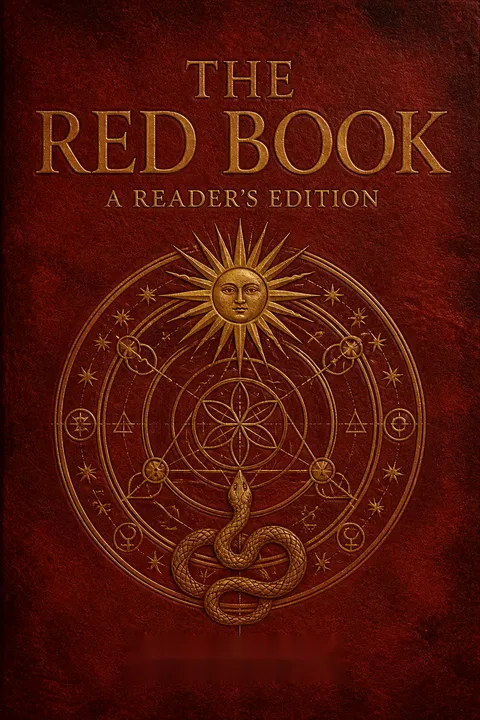


Key Takeaways
Treat the psyche as a living world, not a machine to explain
A crisis after success. In 1913, around forty, Jung had achieved much of what he had pursued, yet felt his desire drain away. Visions of floods and mass death frightened him; he wondered whether he was becoming mentally ill. He began an inward investigation that became Liber Novus, the Red Book. Its central claim is experiential: the inner life is not merely an object to classify but a force that can challenge and reshape the person studying it.
Two competing voices. Jung calls the era’s practical, rational outlook the “spirit of this time.” Against it stands the “spirit of the depths,” his name for the mythic, unconscious pressures that surface in images and affect. He does not simply dismiss reason; he argues that reason alone cannot explain a life. His images of a new God describe psychic transformation, not proof of a supernatural event.
What's striking is the book's refusal to treat introspection as neutral observation. The observer is changed by what is observed, a problem familiar in both psychotherapy and research on human subjects. That reflexivity gives Jung's record unusual force. It also complicates his claims: intense inner conviction can feel self-validating without establishing metaphysical truth. The most useful reading keeps both levels visible. The experience matters psychologically, while its religious language remains an interpretation rather than evidence that a deity has objectively appeared.
Give inner images a hearing, but never hand them the steering wheel
A deliberate encounter. Jung calls his method “active imagination ”: intentionally quieting critical thought enough for spontaneous images or voices to appear, then engaging them in dialogue rather than letting them pass unnoticed. He recorded these experiments in notebooks, entered the scenes imaginatively, and later shaped them into the Red Book’s dialogues, reflections, and paintings. Figures such as Elijah, Salome, and Philemon become distinct presences in this inner drama.
Make the experience visible. Jung came to regard Philemon, an inner teacher figure, as evidence that thoughts can feel autonomous rather than authored at will. He encouraged some patients to write or paint their own images, giving them a form they could revisit and consider. Yet he also kept his clinical work, family life, and public responsibilities. The practice was engagement with inner material, not surrender to it.
What's valuable here is the distance created by giving an experience a form. Writing a dialogue can make an impulse examinable instead of immediately actionable, much as reflective journaling or psychological parts work can. The risk is equally important: personifying a thought can make it seem like an unquestionable authority. The productive stance is neither dismissal nor obedience. Images can be treated as meaningful mental events while their claims are tested against ordinary evidence, relationships, and consequences.
Follow your own path without turning independence into isolation
A route, not a recipe. Jung repeatedly warns that another person’s example cannot substitute for one’s own life. At the beginning, he recognizes that he has served public success and professional identity while neglecting his inner life. His return to it is not a recommendation to copy his visions, religious language, or way of living; he says each person must discover a path suited to their own circumstances.
Wholeness is not self-worship. Jung distinguishes the “I,” the center of conscious awareness, from the “self,” the larger psychic totality that includes unconscious life. The movement toward this fuller relation is not permission to disregard other people. In his account, becoming more oneself should make genuine fellowship possible, while conformity can hide isolation beneath shared rules. The challenge is to be distinct without treating others as obstacles or disciples.
The distinction between self-authorship and imitation remains compelling in a culture saturated with templates for how a life should look. Still, individualism can disguise privilege: people do not choose their obligations, resources, or constraints from a blank slate. Jung's own warning against making a personal path into a universal lesson helps correct that danger. Autonomy becomes more credible when it includes responsibility to others, rather than using authenticity as a reason to withdraw from them.
Make room for opposites until a new response becomes possible
Conflict can produce form. Jung stages opposed tendencies through characters and images. Elijah represents foresight and ordering thought; Salome carries desire and feeling. When Jung identifies wholly with one side, the other appears strange or threatening. The serpent, moving between realms, becomes an image of their connection and conflict.
A third response. Jung calls the emergence of a new attitude from conscious and unconscious elements the “transcendent function.” It is not a compromise that splits the difference. In the book, a child-like divine image symbolizes something formed through tension between opposites, something neither side could produce alone. The reader’s practical task is to notice which side has been excluded, stay with the conflict long enough to learn from it, and avoid forcing a quick answer simply to end discomfort.
This is a strong alternative to binary thinking: a conflict may reveal an unconsidered possibility rather than demand a winner. The image of a third response also resembles creative problem-solving, where holding competing constraints can generate a new design. But not every opposition is symmetrical, and some conflicts involve real harm rather than complementary needs. “Both sides” should not become a reflex that erases power differences. The method is most useful when it deepens judgment, not when it suspends it indefinitely.
Retire the hero who mistakes relentless control for strength
A symbolic death. Jung dreams of killing Siegfried, the heroic figure from German legend. He interprets the act as the destruction of an ideal he had attached to himself: exceptional force, efficiency, and upward striving. The point is not literal violence. The heroic ideal has become too dominant, leaving neglected aspects of the personality without room to develop.
Capacity has limits. Jung links the dream to his visions of war, arguing that public conflict can echo conflicts within individuals. In the book, sacrifice means relinquishing a rigid claim to mastery, not seeking injury or celebrating actual deaths. He sees acknowledging incapacity and limitation as a condition for developing other capacities. The lesson is not to abandon ambition, but to question when an ideal has become a demand to outperform, dominate, or imitate a model at any cost.
The insight cuts against cultures that equate worth with conquest and constant productivity. It also clarifies why a valued strength can become a liability when it monopolizes identity. Yet the symbolic reading of Siegfried should not be mistaken for an explanation of political violence. Interpreting war as an inner drama can illuminate personal participation, but it can also turn victims into props in someone else's growth story. Psychological meaning must not replace historical accountability.
Welcome disowned impulses into awareness without obeying them
The dark is part of life. Jung argues that rejecting everything judged evil or inferior does not make it disappear; it can return in distorted or destructive form. His inner cosmology gives this conflict mythic names. The “Pleroma” is an undifferentiated fullness in which opposites are not yet distinct. “Abraxas” is a figure for the power of life that encompasses creation and destruction, rather than a purely benevolent God.
Recognition is not permission. Jung’s descent into images of blood, death, and the underworld dramatizes the effort to acknowledge what consciousness would rather disown. The task is to recognize an impulse as part of one’s psychological reality, then decide how to act. Acceptance does not make cruelty harmless or erase moral responsibility. It prevents denial from masquerading as goodness and makes deliberate choice more possible.
This distinction between acknowledging an impulse and acting it out is essential to any serious account of moral life. Denial can make self-understanding shallow, while recognition can support restraint and responsibility. Jung's language of a God containing opposites gives the problem religious intensity, but it can also blur the line between psychic integration and moral relativism. The useful test is behavioral: does acknowledging the dark material reduce harm and increase accountability, or merely provide a grand story for indulgence?
Treat visions as psychological material, not proof of prophecy
A frightening interpretation. Jung’s 1913 visions showed floods, blood, and destruction across Europe. He feared they indicated his own impending breakdown. When war began in 1914, he interpreted the imagery as connected to collective events and used that experience to continue his investigation. He believed private images could express forces shared across a society, not just an individual’s biography.
Meaning needs containment. Jung’s distinction between an image and a literal event matters: he tried to observe, record, and interpret his visions while maintaining work and family responsibilities. The book does not establish that the visions predicted the war in a testable sense. Their timing and resemblance gave Jung conviction, but resemblance after an event is not proof of foresight. For readers, the safer lesson is to explore what an image means without treating it as an instruction or a forecast.
The account takes unusual inner experience seriously without making its intensity a diagnosis. That is a useful corrective to the assumption that vivid imagery is automatically meaningless or pathological. It is also a place for epistemic restraint. A later event can make an earlier image appear precise, especially when symbols are flexible. Psychological significance and predictive accuracy are separate questions. Holding them apart preserves the insight of the experience without turning coincidence, memory, or interpretation into certainty.
Make inner discoveries answerable to ordinary life and other people
Development has a public cost. Jung uses “individuation” for the process of becoming more fully oneself by relating conscious life to the unconscious. He does not present it as polishing an already admirable personality. It can require revaluing earlier ambitions and developing neglected capacities, while still producing values that can matter to other people.
The work takes form. Jung spent years shaping his inner material into writing and images, then turned toward comparative study, clinical work, and his stone tower at Bollingen, which he treated as a physical continuation of his symbolic work. He also invited some patients to make images of their own. The journey is not complete merely because it feels profound. Its test is whether insight can be carried into a life with duties, relationships, and consequences.
The insistence on translation into life guards against a familiar trap: mistaking intensity for transformation. A private revelation can feel complete while leaving habits and relationships untouched. At the same time, Jung’s own disciplined work cannot prove that every person should undertake an equally elaborate inner practice. The better principle is modest: judge self-exploration partly by what it enables in ordinary conduct. If it makes a person less accountable or more grandiose, the process has not earned its claims.
Read collective crisis inwardly without mistaking metaphor for history
Private images, public turmoil. Jung proposed that a “collective psyche,” an impersonal layer of the mind shared across human life, could become active during social upheaval. He connected his prewar visions with the outbreak of the First World War and treated the conflict as both historical catastrophe and psychological image. This helped him ask how traits suppressed in individuals might reappear in collective behavior.
A lens is not a cause. Jung’s method invites readers to ask what a public crisis reveals about their own assumptions, fears, and participation. It does not show that one person’s fantasy caused an event, nor that violence is necessary for renewal. The book’s strongest use of the connection is interpretive: history can expose what a society has refused to recognize. Its weakest use would be turning real suffering into a symbolic plot with a predetermined spiritual purpose.
This bridge between personal and political life remains fertile because societies are made of people whose private habits can reinforce public norms. It encourages self-scrutiny where blame alone can be evasive. But archetypal language can flatten historical differences, treating distinct conflicts as repetitions of one timeless pattern. Political analysis still needs institutions, material conditions, and the testimony of those affected. A symbolic reading can enrich that account, but cannot substitute for it.
Analysis
The Red Book is best read as a record of method and transformation, not as a finished psychological system. Its narrative follows a clinician who distrusts the limits of his own explanatory habits, deliberately evokes inner imagery, and then struggles to interpret what appears without either dismissing it or surrendering judgment. That tension is the book’s intellectual engine. Jung’s later concepts, including individuation, the self, and the collective psyche, become more intelligible when seen as attempts to translate this personal experiment into a public language.
The book’s form matters. Reported scenes, reflective commentary, religious imagery, and paintings remain distinct but interact. The reader sees interpretation being made, revised, and sometimes left unresolved. This offers unusual access to the construction of a theory, while also limiting its evidentiary force: a richly meaningful image is not, by itself, proof of a universal psychic structure or a prediction of external events. Jung’s account of his wartime visions illustrates both the power and the danger of interpreting private experience through collective history.
Its ethical tensions deserve equal attention. The call to accept excluded aspects of the psyche is not a license to act on them; the warning against imitation is not a warrant for self-absorption. The text often tries to hold those distinctions, though its grand religious language can make ordinary psychological claims sound cosmically certain. Its treatment of masculine and feminine principles also reflects a strongly binary framework that modern readers should not take as a universal map of gender.
The enduring value lies in the disciplined middle ground the book attempts: engage inner experience as meaningful, keep a distinction between image and fact, and require insight to return to lived responsibility. Its central question is less whether Jung’s cosmology is literally true than whether this difficult encounter with inner life can produce clearer, less divided ways of being human.
Review Summary
Reviews of The Red Book are polarized but lean positive, averaging 4.39/5. Many praise it as a profound, life-altering descent into the unconscious, offering rare insight into the origins of Jungian thought. However, critics find it inaccessible, overly dense, and difficult without prior knowledge of Jung's framework. Readers consistently recommend familiarity with Jung's other works beforehand, and many suggest the illustrated facsimile edition enhances the experience. Common themes include its value as shadow work documentation, its non-linear structure, and its historical significance as the seed of Jung's later theories.
People Also Read



Glossary
spirit of the depths
unconscious pressure toward inner lifeJung’s name for the forces and contents of psychic life that are not governed by the conscious values of his era. In the Red Book, these forces appear through images, voices, and affect that challenge his established identity. The term marks a tension with the “spirit of this time,” associated with practical usefulness, conventional knowledge, and conscious aims.
Active imagination
deliberate dialogue with inner imagesJung’s method of allowing spontaneous fantasies or images to emerge while awake, then engaging with them rather than suppressing or passively watching them. A person may record the experience in writing, drawing, or painting. Jung used the practice to explore unconscious processes and to give them a form that could be reflected upon.
Philemon
inner teacher and wise figureA figure in Jung’s inner experiences who represents superior insight and, in Jung’s account, taught him to regard thoughts as having a degree of psychic autonomy. Philemon appears as a magician, teacher, and interpreter of the dead. Jung’s personification makes an inner process available for dialogue; it does not establish Philemon as an independently verified being.
self
the psyche as a wholeJung distinguishes the self from the “I,” which is the center of conscious awareness. The self refers to the wider totality of the psyche, including both conscious and unconscious life. It is not simply confidence or personal preference. Jung treats it as a guiding image of psychological wholeness, approached through a changing relationship between what is known and what is not.
transcendent function
new attitude from psychic tensionJung’s term for a process in which conscious and unconscious contents are held in relation long enough for a new psychological attitude or symbol to emerge. It is not a supernatural power or a simple compromise between opposing views. In the Red Book, it helps explain how sustained engagement with inner conflict may create a response that neither side could supply alone.
individuation
development toward psychic wholenessJung’s term for the process of becoming more fully oneself by differentiating from social roles and relating conscious life to unconscious aspects of the psyche. It is not a project of becoming flawless or exceptional. Jung argues that development requires personal work while also producing values that can be brought back into shared life.
collective psyche
shared, inherited psychic layerJung’s term for an impersonal layer of the psyche that he believed was not formed solely by an individual’s personal experiences. It contains recurring mythic forms and images that may appear across different lives and cultures. The Red Book uses this idea to connect Jung’s fantasies with wider historical and cultural patterns, though the claim remains theoretical.
Pleroma
undifferentiated psychic fullnessA Gnostic term meaning fullness, used in the Red Book for a state in which opposites are not yet distinct. Qualities such as good and evil or light and darkness cancel one another there. Creation, by contrast, depends on differentiation. Jung uses the idea to describe the relation between an undivided origin and the distinct forms of ordinary psychic life.
Abraxas
power encompassing opposing forcesA figure in Jung’s psychological cosmology who represents the effective force of life containing both creation and destruction, good and evil, and light and darkness. In the Sermons to the Dead, Abraxas is more encompassing than the purely benevolent God or the purely destructive devil. The figure symbolizes the frightening coexistence of opposites, rather than a simple moral ideal.
About the Author
Other books by C.G. Jung



Download PDF
Download EPUB
.epub digital book format is ideal for reading ebooks on phones, tablets, and e-readers.








