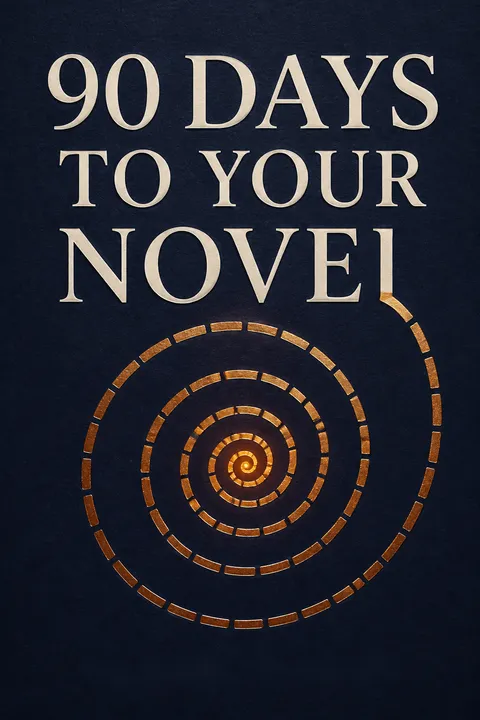


Key Takeaways
Treat the ninety-day deadline as a work system, not an inspiration test
Habit beats waiting. Domet’s central challenge is practical: set aside two to three hours a day, write regularly, and finish a first draft on a deadline. Inspiration may supply an idea, but a routine keeps the pages coming when enthusiasm fades. The book recommends protecting writing time with simple measures: use a timer, silence the phone, disconnect from the internet, and try writing at the same time each day.
Make the work repeatable. A writing contract and a group of fellow challengers can help turn a vague wish into a commitment. The goal is not to produce a perfect novel in three months. It is to replace talking about writing with sustained practice and a completed draft.
What's striking is the book's refusal to treat creativity as a rare mood that must be courted. Its advice resembles behavioral design: reduce interruptions, anchor work to a routine, and make progress visible. That approach is particularly useful for large projects, where the distance between an idea and a finished product can feel abstract. The strict daily schedule is less universally workable, however. Caregiving, disability, and unpredictable jobs can make a fixed two-hour block unrealistic. The durable principle is consistency, not a single ideal timetable.
Spend the first month designing scenes, so drafting has fewer dead ends
Plan before prose. The book devotes its opening phase to developing memories, characters, setting, conflicts, and a synopsis, then arranging the story as scenes. It recommends spending time on this groundwork because a clever premise alone may not sustain a novel. The writer should test whether the characters want something strongly enough, whether obstacles can complicate that desire, and whether the story has a plausible beginning, middle, and ending.
Choose a usable map. Options include a detailed written outline, brief scene signposts, movable note cards, a spreadsheet, or a wall-based flowchart. Each helps organize the same essential information: what happens, who is present, where it happens, and why the scene matters. The outline is a guide, not a contract that forbids change.
The plan serves as a cognitive aid, not merely a plot prescription. Externalizing decisions frees working memory for sentence-making, character nuance, and surprise. This is similar to project planning in fields where complex work is divided into inspectable units. Yet a detailed outline can create false confidence: a sequence that looks coherent in summary may feel lifeless in scenes. The book's flexible view of outlining is therefore important. A useful plan should make revision easier, not punish discoveries that emerge during drafting.
Make every scene change the plot, the character, or both
A scene earns its place. Domet treats a scene as a compact unit of fiction that combines character, action, setting, dialogue, conflict, and emotion. Each should have a beginning, a middle where something resists a character's aim, and an ending that changes the situation or gives the reader a meaningful pause. Before drafting, ask what the scene is for, what is at stake, and how it affects the larger story.
Parts imply wholes. In a scene from The Great Gatsby, Gatsby’s disappointment that Daisy did not enjoy his party reveals how much he has invested in winning her. The moment advances the relationship and exposes his longing without needing a full explanation of his personality. If two scenes do the same work, combine or cut one.
This scene-level test is a compact form of causal reasoning. It asks the writer to connect local events to global change, much as systems analysis traces how one component affects a larger process. It also discourages scenes that exist only because the writer enjoys them. Still, a scene’s contribution need not be a visible plot twist. A change in trust, knowledge, expectation, or emotional pressure can be consequential. The standard is not constant spectacle, but a discernible shift in what the reader understands or anticipates.
Give desire an obstacle, or your plot remains a wish list
Wanting creates motion. The book defines plot not as a list of events, but as events shaped by how a character responds. A protagonist must yearn for something, and other people, circumstances, or conflicting values must obstruct it. The response then causes further events. Gatsby’s desire for Daisy matters because she is married to Tom and because Gatsby’s own idealized vision of the past shapes his actions.
Separate tension from conflict. Domet calls a “nonflict” a desire or worry that does not lead to action or reaction. A character privately longing for a partner may create feeling, but a barrier that forces a decision creates story. If a plot seems stalled, identify what the character risks losing, then strengthen or clarify the obstacle.
The distinction between desire and blocked desire is a strong diagnostic because it turns a vague story problem into a question of pressure and choice. In narrative theory, readers often follow a character by tracking goals, obstacles, and consequences; this model makes that chain visible to the writer. It need not require melodrama. A modest but meaningful risk, such as losing trust or exposing a secret, can generate real conflict. The useful test is whether the situation compels a character to do something, not whether the stakes sound enormous.
Let a character's history shape choices, not sit in a biography file
Backstory should have consequences. Character exercises ask writers to explore family, fears, past experiences, appearance, habits, and desires. These details matter when they affect how someone acts now. Gatsby’s earlier poverty and his attempt to remake himself help explain why he pursues wealth and stages lavish parties to impress Daisy. History becomes useful when it alters a present decision, not when it merely fills a profile.
Reveal selectively. Flashback can show an earlier event, while a brief memory or a telling physical detail can suggest the past without stopping the current action. Minor characters also help reveal a protagonist: a brief interaction can show generosity, impatience, prejudice, or embarrassment. Give even secondary characters a clear function, and combine or remove those who duplicate one another.
This approach treats characterization as a causal model: experience informs belief, belief influences choice, and choice changes the story. It helps avoid the common split between a biography document and a protagonist who behaves as though that biography never happened. The emphasis on particular details also gives readers material from which to infer personality. A caution is that backstory should not become destiny. People can resist their histories, misread them, or change their habits. Such resistance can deepen character more than a predictable reaction.
Alternate interior thought with outward action to keep the middle moving
Vary the scene experience. The book distinguishes internal scenes, which foreground thought, mood, or emotion, from external scenes, which engage characters with the world and tend to advance action. A novel dominated by reflection may feel inert; one composed only of action can leave readers with little sense of who the characters are. Dialogue, action, contemplation, and dramatic scenes give the story different speeds and kinds of attention.
Make emotion observable. Rather than naming a feeling outright, the writer can show it through physical response, behavior, or the gap between what a character says and thinks. Setting can also echo a character’s state of mind. Use narrative summary to move quickly across uneventful time, and reserve full scenes for moments whose details and consequences matter.
The advice is fundamentally about regulating attention. Alternation gives readers a changing mix of information, pace, and emotional access, while summary prevents routine events from consuming the same narrative space as turning points. This resembles editing in film, where duration and focus guide audience response. The categories should remain flexible, as Domet acknowledges: a conversation can reveal inner life, and an action scene can carry emotional weight. Physical cues also require care. The same gesture can signal different feelings depending on context, so behavior should be particular rather than formulaic.
Choose a narrator whose blind spots make the story more revealing
Point of view shapes evidence. A narrator determines what readers can know, notice, and misunderstand. First-person narration offers closeness but limits access to other minds. Third-person limited stays close to one character while using “he” or “she.” Omniscient narration can move among characters’ thoughts, but frequent shifts can confuse or overexplain.
Voice is a point of view in motion. The narrator’s history, temperament, vocabulary, and motives affect how events are described. In Domet’s diner example, a waitress fears a customer is the person who mugged her, while the customer believes she is reacting to his disfigured face. A third diner sees only an overreaction to spilled coffee. The same event changes meaning through each observer’s limited knowledge.
Point of view operates like a camera with a memory and an agenda. It does not merely report events; it selects evidence and assigns significance. That makes a narrator’s limits narratively productive, because readers can compare what a character believes with what the scene permits them to infer. The diner example shows how misunderstanding can arise without anyone lying. The tradeoff is that restricted access can withhold information readers need for orientation. Deliberate uncertainty is compelling; accidental confusion is not.
Make the climax a choice that renders the old normal impossible
Build toward a point of no return. In the book’s three-act model, the opening introduces the central characters, desire, and conflict; the middle complicates that desire; the climax forces a defining choice or realization; and the final act shows consequences and resolves remaining threads. The climax should matter because the protagonist cannot simply return to life as it was. In The Great Gatsby, exposing Gatsby and Daisy’s relationship triggers consequences that reshape the lives around them.
Earn the ending. After the climax, give readers enough falling action to understand what follows. Resolve important secondary threads, show how the protagonist has changed, and connect the final scene to the opening when that strengthens the story. Theme should emerge through choices, images, and outcomes rather than an authorial lecture.
A climax has structural force when it changes the conditions under which the characters can act. In decision theory, choices reveal priorities most clearly when alternatives carry costs; the same is true in fiction. A turning point should expose what the protagonist values under pressure, then make the consequences legible. Not every novel needs a dramatic public revelation. A quiet decision can be irreversible if it alters a relationship or self-understanding. The test is meaningful consequence, not volume.
Reverse-outline the draft to expose missing links and scenes without purpose
Inspect what exists. After drafting, Domet asks writers to turn the manuscript back into an outline, recording each scene’s point of view, setting, characters, summary, intention, and relation to the plot. This “reverse outline” makes the actual book visible, rather than the book the writer intended to produce. It can expose missing transitions, repeated scenes, underdeveloped conflicts, inconsistent point of view, and a climax that lacks sufficient preparation.
Revise at two scales. Revision examines the novel as a whole: structure, pacing, and character development. Editing examines how its parts work: clarity, consistency, concision, and correctness. Read the manuscript straight through, mark where attention falters, read dialogue aloud, and cut material that does not strengthen the story. First drafts are material to shape, not finished products to defend.
The reverse outline is a form of reverse engineering. Instead of judging a scene by intention, it asks what the scene actually contributes and how the sequence behaves as a whole. That distinction is valuable because writers often remember the purpose they hoped a passage would serve, not the effect it creates on the page. The method can reveal structural gaps before line-level polishing disguises them. Its limit is that a scene’s value may be tonal or cumulative, so the outline should guide judgment rather than replace a full reading.
Use candid outside readers before querying agents or editors
Get useful criticism. Domet advises sharing the manuscript with readers who can respond honestly, rather than relying only on relatives or partners who may be reluctant to criticize. Ask specific questions: Did the protagonist hold attention? Where did the story drag? Were the character’s motives clear? Did the ending satisfy? Feedback from several readers can reveal recurring problems that one person’s preferences might miss.
Submit professionally. Research agents or editors whose interests fit the book, follow their submission guidelines, and send only the materials requested. A query should be concise, accurate, and free of gimmicks. Rejection is a normal part of the process, not a verdict that writing should stop. After sending the draft out, put it aside for a few weeks so distance can restore perspective.
Specific questions improve feedback because they ask readers to report observable effects rather than deliver a vague verdict. Multiple responses also help distinguish a recurring comprehension problem from one reader’s taste. This resembles user testing: the creator learns where an audience hesitates, but remains responsible for deciding what to change. The advice to seek distance is equally practical, since emotional attachment can make every cut feel like a loss. Outside readers can identify friction, but they cannot decide what the novel is ultimately meant to be.
Analysis
The book is a practical writing guide organized as both a craft manual and a ninety-day program. Its narrative arc mirrors the work it prescribes: a would-be novelist begins with an idea, develops a plan, drafts scene by scene, and learns that completion is not the same as readiness for readers. The intended audience is especially clear: people who want to write a novel but have not yet built a dependable practice or a workable process.
Its central strength is the way it converts abstract craft advice into repeated decisions. Rather than treating character, plot, setting, and dialogue as isolated ingredients, it asks writers to make them interact inside scenes. A scene must have a local purpose, but its consequences must also fit the larger narrative. This micro-to-macro view is the book’s most durable teaching device. The outlining chapter is similarly pragmatic because it offers several formats and presents the outline as adaptable, not sacred.
The strongest conceptual chain runs from desire to obstruction, response, and consequence. That chain gives plot a human source: events matter because a particular person reacts to them. The associated advice about point of view, backstory, scene variety, and physical emotion helps make those reactions legible without reducing a novel to a sequence of plot mechanics.
The schedule is intentionally demanding. Its two-to-three-hour daily expectation may motivate writers who need a firm boundary, but it should be treated as a challenge structure rather than a universal productivity law. The deeper lesson is that scope becomes manageable when work is divided into stages, protected by routine, and regularly assessed. Likewise, three-act structure and scene-purpose checklists are useful tools, not guarantees of artistic quality. Their value lies in helping writers notice choices and diagnose weak links, while leaving room for experimentation.
The book is most persuasive when it balances discipline with permission to change course. It asks writers to plan seriously, draft continuously, and revise without sentimentality, yet it also allows the outline to evolve. That combination avoids two familiar traps: waiting endlessly for inspiration and mistaking rigid control for craft. The result is a practical account of novel writing as both imaginative work and sustained decision-making.
Review Summary
90 Days to Your Novel receives mixed reviews, with an average rating of 3.77/5. Many find it helpful for beginners, offering concrete exercises and guidance. The book's focus on outlining and structure is praised, though some find the pace ambitious. Critics note it's less useful for experienced writers or those with existing ideas. The exercises are sometimes viewed as irrelevant or time-consuming. While some appreciate the step-by-step approach, others find it limiting or condescending. Overall, it's considered a good resource for new writers seeking direction.
People Also Read



Glossary
Structure-Plus Outline
Detailed scene blueprintA linear outline that describes individual scenes in detail. For each scene, the writer records such information as setting, characters, and purpose, then breaks down the events. It takes more planning than a brief outline, but can clarify the story’s logistics before drafting begins.
Signpost Outline
Flexible scene guideAn outline that marks the main features of each planned scene without specifying every beat. It typically identifies the setting, characters, and general plot movement, leaving room to discover details during drafting. It offers less advance structure than a detailed outline and may leave more connective work for the writer.
The Note-Card Technique
Rearrangeable scene cardsA method in which each card represents one scene and contains information such as setting, characters, plot events, and the scene’s goal. Cards can be moved to test different orders, making the structure visible and easy to manipulate. The method is useful for writers who think spatially or want a portable outline.
The Spreadsheet Approach
Sortable scene outlineA digital outline that places scenes in spreadsheet rows and story information in columns. Writers can record scene number, setting, characters, summary, and purpose, then reorganize or add categories as needed. Its flexibility supports assessment and revision, but it works best for someone comfortable with spreadsheet software.
Nonflict
Tension without story movementDomet’s term for a desire or tension that does not produce a meaningful action or reaction. A character may long for something, but if nothing blocks that desire or forces a choice, the story can remain static. Turning a nonflict into conflict requires adding stakes or an obstacle that prompts the character to act.
Internal Scenes
Character interior scenesScenes whose primary function is to reveal a character’s inner life, including thoughts, emotions, values, or interpretations. They may include external events, but the emphasis rests on how the character experiences them. They help readers understand motivation and emotional change, especially when balanced with scenes that advance outward action.
External Scenes
World-engaging scenesScenes whose primary function is to show characters interacting with the world around them and to advance action or plot. Dialogue, confrontation, and physical events often feature prominently. External scenes can also reveal character through behavior, but their main emphasis is what happens between people or in the surrounding world.
Reverse outline
Map of the actual draftAn outline created from an existing manuscript rather than before it. The writer summarizes each scene and notes its point of view, setting, characters, intention, and relationship to the larger plot. Comparing this map with the intended structure helps identify gaps, repetition, weak transitions, and scenes that do not contribute.
Download PDF
Download EPUB
.epub digital book format is ideal for reading ebooks on phones, tablets, and e-readers.








