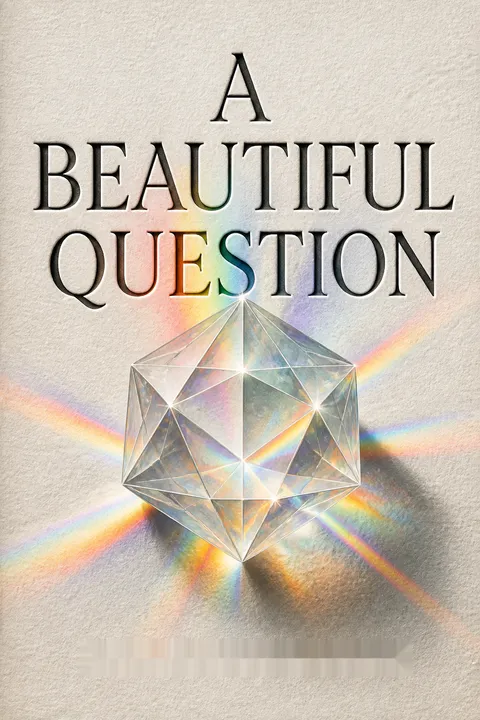


Key Takeaways
Nature's deepest laws embody beauty, but beauty must survive measurement.
A question with stakes. Frank Wilczek asks whether the world embodies beautiful ideas. His answer is yes: fundamental physics reveals patterns of mathematical symmetry and economy beneath the complexity of matter. But this is not a claim that every part of nature is beautiful, or that beautiful theories are automatically true. The book’s argument unfolds through the people who tried to unite elegant ideas with physical evidence, from Pythagoras to modern particle physics.
Beauty has a specific style. In nature’s basic laws, beauty means more than visual prettiness. It often means that a small set of principles can explain many phenomena, and that the principles have symmetry: their form stays consistent through certain changes. This is a guide to inquiry, not a substitute for observation.
The strength of this question is that it treats beauty as a working idea rather than a mood. Economy, symmetry, and explanatory reach can help researchers choose between possible theories before experiments settle the matter. Yet beauty is not a neutral measuring instrument: people disagree about what counts as elegant, and simple theories can be wrong. The useful discipline is to make aesthetic judgment explicit, then expose it to evidence. In that sense, the book’s most persuasive claim is not that beauty guarantees truth, but that it can help humans find better questions.
Use numbers to expose patterns, but let nature revise the arithmetic.
Number meets shape. Pythagoras’s theorem links the sides of a right triangle through a numerical relationship. In a 3-4-5 triangle, the squares of the shorter sides, 9 and 16, add to the square of the longest, 25. The Pythagorean school also found that string lengths in simple ratios, such as 1:2 or 2:3, produce musical intervals commonly heard as harmonious. Shape, number, physical objects, and aesthetic response suddenly seemed connected.
A useful limit. The diagonal of a square cannot be expressed as a ratio of whole numbers. This discovery challenged the idea that all lengths reduce to whole-number multiples. The lesson is not to abandon mathematics, but to let geometry and evidence demand new kinds of number and description.
These examples make mathematics feel less like a language imposed on nature and more like a set of relationships discovered within it. The string experiment is especially memorable because it ties measurable structure to perception. Still, a numerical pattern does not explain itself: why a ratio produces a pleasing interval is a further question, not a consequence of spotting the ratio. The episode of the incommensurable diagonal is a useful corrective to mathematical overconfidence. A productive theory can begin with a beautiful hunch, but it must be willing to expand its vocabulary when reality refuses to fit.
Treat symmetry as a search strategy, not proof of what matter is.
Plato’s bold guess. The five Platonic solids are the only finite solids whose faces are identical regular polygons arranged identically at every vertex. Plato proposed that these shapes were the atoms of the elements. The specific model was wrong, but its ambition was fertile: derive physical structure from mathematical symmetry instead of treating the world as an arbitrary collection of objects.
Nature reuses simple parts. Some viruses build shell-like outer structures from many copies of identical protein units, arranged in forms that resemble Platonic solids. Repeating a small set of instructions is an efficient way to build a complex structure. The example gives symmetry a plausible physical role: order can emerge from economical construction, without a separate instruction for every detail.
Plato’s mistake matters because it shows both the power and danger of aesthetic reasoning. Symmetry can narrow a search by identifying a small family of plausible structures; it cannot, by itself, tell which structure nature actually uses. Viral shells support the broader connection between repeated units and efficient construction, but they do not validate Plato’s elemental theory. The distinction between a fruitful research program and a confirmed explanation is essential. Beauty earns scientific value when it points toward precise claims that can be checked, not when it makes a proposal feel inevitable.
Break problems into precise parts, then rebuild explanations from evidence.
Newton’s two-way method. Analysis and Synthesis is Newton’s approach of identifying simple components and laws, then using them to reconstruct larger systems. He applied it to light by separating white sunlight into spectral colors, and to motion by studying quantities such as velocity, acceleration, and force. In each case, the aim was not just a plausible overview, but a precise account that could be tested against observation.
From falling stone to orbit. Newton’s mountain thought experiment imagines throwing a stone faster and faster until its fall curves around Earth. It suggests that an orbiting Moon and a falling object might share one cause: gravity. The picture is not proof, but it makes a daring connection thinkable. Newton’s equations then turn that connection into quantitative predictions about planets, tides, comets, and Earth’s shape.
Analysis and Synthesis is more than a slogan for breaking tasks into pieces. Its force comes from the return journey: an explanation must rebuild the complex phenomenon from the proposed parts, and the reconstruction must match measurements. Newton’s mountain is a model of how imagination can make a hidden unity visible before calculation tests it. The method also has a boundary. Some systems are too complex to reconstruct exactly, and the choice of what counts as a basic component can shape the answer. Precision helps expose those assumptions instead of hiding them.
Remember that human perception is a narrow slice of physical information.
Seeing is selective. Newton showed that sunlight contains many spectral colors, even though people experience it as white. Human color vision compresses a much richer signal into three receptor responses. Many physically different mixtures, including spectral yellow and a mixture of red and green light, can produce the same perceived color. Human eyes also miss other information carried by light, including polarization.
Other creatures sample differently. Dogs distinguish fewer color dimensions than humans, while some insects and birds detect ultraviolet light. Mantis shrimp have many kinds of color receptors. Wilczek argues that perception is an active, limited reconstruction, not a transparent copy of the world. The same idea applies to scientific instruments: tools extend the senses, but every instrument selects and processes information.
This account connects the philosophy of perception to practical science. If sensing is selective, then better instruments do more than magnify what is already visible: they reveal properties that the unaided observer cannot represent. The comparison across species also loosens the assumption that human experience is the natural standard for reality. Still, a richer signal is not automatically a richer understanding. New channels require interpretation, and interpretation depends on models that can be mistaken. Expanded perception gives inquiry more evidence, not an escape from the need to reason carefully.
Look for equations that unify phenomena and generate testable surprises.
Faraday imagined space filled. Rather than treat electric and magnetic forces as invisible actions across empty space, Michael Faraday pictured lines of force extending through space. James Clerk Maxwell translated that picture into mathematics. When he found that the existing equations were inconsistent, he added a term that restored consistency and made the equations more symmetrical.
Light emerges from the equations. Maxwell’s system implied that changing electric and magnetic fields could sustain one another as waves. Their calculated speed matched the measured speed of light, suggesting that light itself is electromagnetic activity. The prediction reached beyond visible light: radio waves and other forms of electromagnetic radiation belong to the same family. Hertz later produced and detected radio waves, confirming a consequence that had begun as mathematical possibility.
Maxwell’s achievement shows why mathematical consistency and symmetry can be more than decorative. They can constrain a theory so tightly that an unobserved phenomenon follows from it. The striking move is that the equations did not merely organize known facts about electricity and magnetism; they predicted a broader physical reality. Yet consistency alone cannot distinguish a true theory from a coherent fiction. Maxwell’s case is compelling because the mathematics generated a concrete result that experiment could examine. The standard is not elegance by itself, but elegance that risks being wrong.
See atoms as constrained wave patterns, not tiny planetary systems.
Quantum states have notes. The Schrödinger equation, which describes how an electron’s wave function changes, resembles equations used for vibrating instruments. A confined string can sustain only certain standing-wave patterns; an electron bound to a nucleus likewise occupies certain stable patterns, called stationary states. Their discrete energies help explain the characteristic colors atoms emit or absorb. Atomic spectra are, in this sense, readable signatures of allowed states.
Simple rules, varied materials. Electrons follow electrical attraction and repulsion, occupy wave patterns, and obey the Pauli exclusion principle, which limits how many can share a state. These rules help explain why carbon can form diamond, layered graphite, graphene sheets, nanotubes, and buckyballs. The forms differ, but arise from a small set of ingredients and constraints.
The musical analogy is more than a metaphor because similar mathematical structures appear in the physics of instruments and atoms. It makes the quantum shift intuitive: stable matter is not made of miniature planets following familiar paths, but of patterns selected by equations and constraints. The analogy also clarifies emergence. The same rules can generate radically different materials when their parts are arranged differently. But music should not be taken literally here. The equations share mathematical features, while atoms and instruments remain physically distinct systems.
Follow local symmetry to the hidden architecture of matter and force.
Symmetry becomes local. A symmetry is a change that leaves the underlying description unchanged. Local symmetry allows the change to vary from place to place, but this demands additional space-filling fields that compensate for the variations. In the Core Theory, this principle organizes the electromagnetic, weak, and strong forces, while general relativity applies a related idea to gravity.
The strong force makes mass. Quarks carry three kinds of strong charge, and gluons transmit the strong interaction. Unlike photons, gluons interact with one another, helping concentrate their influence into tubes that confine quarks inside protons and neutrons. At short distances, the strong force weakens, a behavior called asymptotic freedom. Calculations show that most proton mass comes not from the small masses of its quarks, but from the energy of quark motion and gluon fields.
Local symmetry is the book’s most powerful bridge between aesthetic principle and physical machinery. It turns a demand for consistency across many descriptions into specific fields and force-carrying particles. Quantum chromodynamics gives the bridge empirical weight: its equations account for confinement, particle jets, and measured hadron masses. The claim that symmetry dictates structure is strongest within the assumptions of this framework, not as a universal proof that every natural system must be symmetric. The book also keeps the theory in perspective: its impressive account of ordinary matter does not explain dark matter or dark energy.
Read conservation laws as fingerprints of symmetry in nature.
Noether connects form to fact. Emmy Noether proved that continuous symmetries of physical laws correspond to conserved quantities. If the laws do not change over time, energy is conserved. If they do not depend on location, momentum is conserved. If they do not depend on orientation, angular momentum is conserved. These links turn symmetry from an aesthetic preference into a source of measurable predictions.
Uniform laws are not unchanging events. Time translation symmetry means the same laws apply at different times; it does not mean the world repeats its history. The distinction matters because equations describe possible change, while initial conditions specify the state from which a particular history unfolds. Noether’s result explains why energy conservation is structurally important, while leaving the universe’s initial state as a separate question.
Noether’s theorem is an unusually clean example of abstract mathematics producing a physical principle with broad reach. It lets researchers infer what must remain constant from what transformations leave the laws unchanged, and it gives experiments a way to test those commitments. The distinction between laws and initial conditions is equally valuable: regularity in the rules does not explain why this particular cosmic history began as it did. The theorem’s power is not unlimited, since its formal assumptions matter. Its deeper contribution is showing that conservation is connected to the structure of explanation, not merely a bookkeeping convenience.
Let beauty guide the next theory, never certify it as true.
The Core is powerful, not final. The theory unifies much of modern physics through quantum theory and symmetry, yet retains loose ends: three families of matter, unexplained particle masses, dark matter, dark energy, and a striking disparity between gravity and the other forces. Wilczek explores supersymmetry as a possible extension. When its predicted quantum effects are included, the strengths of the strong, weak, and electromagnetic forces appear to converge more closely. But the predicted partner particles had not been directly observed when the book was written.
Trust needs a test. Beautiful ideas have sometimes failed as descriptions of nature, including Plato’s atomic model and Kepler’s early geometric Solar System. Their value was that they inspired further work, not that they were correct. The book’s final lesson is complementary: physical reality can be mathematically elegant and materially messy at once.
The book’s confidence in beauty is most credible when paired with its record of failure. Plato and Kepler show that elegance can launch inquiry without delivering the right answer; supersymmetry shows that an appealing extension remains provisional until evidence arrives. This is a productive division of labor: aesthetics proposes, mathematics sharpens, and measurement judges. The unresolved cosmic components also limit how triumphantly the Core can be called a complete picture. A theory can be extraordinarily successful within a domain while leaving its largest surroundings unexplained.
Analysis
The book’s distinctive achievement is to make the history of physics feel like one long experiment in aesthetic judgment. Pythagoras finds numerical relations in triangles and strings; Plato bets on symmetry; Brunelleschi turns perspective into a geometry of different views; Newton makes precision and dynamic laws decisive; Maxwell replaces empty space with fields; quantum theory makes stable matter resemble standing waves; local symmetry then links mathematical form to the forces that build the material world. The historical sequence is not merely decorative. Each episode shows how an attractive idea becomes more powerful when it can be made precise and tested.
The central claim is best understood as methodological, not theological. Wilczek does not establish that a creator designed nature for beauty. He shows that symmetry and economy have repeatedly helped physicists generate theories that later match observation. The book’s strongest examples are unusually concrete: Maxwell’s equations imply electromagnetic waves; quantum chromodynamics calculates hadron masses; Noether connects time uniformity to energy conservation. In such cases, mathematical form is not just pleasing. It constrains what the world can do.
There is also a risk in the argument. Once a theory succeeds, its beauty can seem inevitable in retrospect, while failed elegant theories become inspirational side stories. The aesthetic criteria themselves are partly human judgments, and nature contains structures that are awkward, contingent, or still unexplained. Wilczek acknowledges this through the Core Theory’s open problems and the unconfirmed status of supersymmetry. That honesty matters. The book does not make beauty a proof; it makes beauty a disciplined wager.
Its deeper philosophical contribution is a model of intellectual humility. Human perception is partial, equations are representations rather than reality itself, and distinct perspectives can be valid without combining into one simple picture. Yet this limitation does not collapse inquiry into relativism. Better instruments, stronger mathematics, and tests across different conditions allow some descriptions to earn more trust than others. The resulting position is neither naive faith in elegant laws nor cynicism about scientific models. It is confidence earned provisionally, through the repeated meeting of imagination and measurement.
Review Summary
A Beautiful Question explores whether the world embodies beautiful ideas through physics and mathematics. Wilczek traces symmetry's role from ancient philosophy to modern particle physics, examining how beauty guides scientific discovery. Readers praise the book's engaging style and fascinating insights, though some find it challenging. Many appreciate Wilczek's ability to connect art, philosophy, and science, highlighting the aesthetic aspects of physical laws. While some struggle with complex concepts, most find the journey through scientific history and modern theories rewarding and thought-provoking.
People Also Read






Glossary
Analysis and Synthesis
Break down, then rebuildNewton’s name for a method of understanding complex systems. Analysis identifies simpler components and the laws governing them. Synthesis uses those components and laws to reconstruct larger phenomena and test whether the explanation accounts for what is observed. The approach combines reduction with a requirement to recover the complexity of the whole.
Core Theory
Current fundamental physicsWilczek’s preferred name for the theories describing gravity, electromagnetism, and the strong and weak forces, together with quantum theory. The Core Theory explains ordinary matter and supports applications across chemistry, biology, engineering, and astrophysics. It is exceptionally well tested within its domain, but does not explain dark matter, dark energy, or every feature of particle physics.
local symmetry
Symmetry varying across space-timeA symmetry principle that permits transformations to differ at different places and times while preserving the physical content of a theory. Making symmetry local requires additional fields whose behavior compensates for those variations. In Wilczek’s account, local symmetry is the organizing principle behind the force theories of the Core and a route to deriving their force-carrying particles.
property space
Geometry of particle propertiesA mathematical space whose coordinates represent properties rather than ordinary position. A particle’s location in a property space can encode features such as electric or strong charge. Transformations within the space can make what appear to be different particles into related states of one underlying entity. Property spaces help express the symmetries used in modern force theories.
Noether's theorem
Symmetry yields conservationEmmy Noether’s mathematical result connects continuous symmetries of physical laws to conserved quantities. Uniformity of laws over time corresponds to conservation of energy; uniformity across space corresponds to conservation of momentum; and rotational symmetry corresponds to conservation of angular momentum. The theorem makes a precise link between the form of physical laws and measurable regularities.
asymptotic freedom
Strong force weakens nearbyA feature of the strong interaction in which quarks interact more weakly at very short distances and higher energies, while the interaction becomes stronger as they are separated. This behavior helps explain why quarks can act nearly independently inside protons yet remain confined within larger particles. It also makes high-energy calculations in quantum chromodynamics more tractable.
complementarity
Valid, incompatible perspectivesThe principle that different descriptions of a system can each be valid while remaining mutually exclusive in a particular observation. In quantum physics, measuring one property can prevent simultaneous access to another, such as position and momentum. Wilczek also uses complementarity more broadly to describe how distinct perspectives can enrich understanding without collapsing into a single view.
quantum theory
Rules for atomic-scale physicsThe framework used to describe matter and radiation at atomic and subatomic scales. It replaces definite classical trajectories with wave functions that yield probabilities for measurement outcomes, and it permits only certain stable states in many systems. Quantum theory explains atomic spectra, material properties, and the particle behavior underlying the Core’s force theories.
Download PDF
Download EPUB
.epub digital book format is ideal for reading ebooks on phones, tablets, and e-readers.








