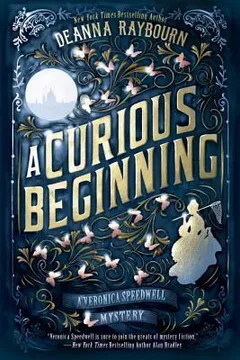


Plot Summary
A Grave Opens
At her guardian Nell Harbottle's funeral, Veronica Speedwell feels more freedom than grief. The village vicar's wife tries to arrange her marriage to a widowed farmer, so Veronica rejects the offer and announces that she is an orphan born outside marriage. Returning to the cottage she is preparing to leave, she finds it ransacked and catches a huge intruder inside.
He overpowers her and tries to drag her to a waiting carriage. A scarred Continental gentleman, Baron von Stauffenbach, intervenes with a revolver. He insists the attack was no ordinary burglary and urges Veronica to leave immediately. She agrees, carrying her carpetbag and butterfly net, though she believes she is simply taking a convenient ride to London.
The opening makes Veronica's independence practical rather than merely declared. She has already settled accounts, packed lightly, and planned to travel; the village's marriage scheme is a threat to that plan, but not its source. The attack turns her chosen departure into an urgent escape. Her composure after Nell's death is not evidence that she feels nothing. It reflects a lifetime of keeping herself mobile, especially when other people try to assign her a role. The baron's warning introduces the central tension between her self-knowledge and the possibility that her origins conceal dangers she cannot yet see.
The Mother's Shadow
On the road, the baron recognizes Veronica's eyes and tells her that they belonged to her mother, a woman he remembers with deep affection. Veronica presses him for her mother's name and history, but he says he must first obtain permission to disclose them. He confirms that he is not her father, a denial that unexpectedly hurts her, then promises to help her find the truth.
Veronica explains that she earns her living collecting butterflies and intends to travel abroad again. The baron latches onto the name of his friend Stoker, a natural historian in London, as the person who can protect her. He tells Veronica that Stoker can be trusted with her life, then brings her to the riverside warehouse where the reclusive man works.
Veronica's first response to the baron's revelation is scientific curiosity, but his denial of paternity exposes a more private need: she has not been indifferent to the absence of a father, only practiced at treating it as settled. The baron offers a fragment of belonging while withholding its explanation. That imbalance gives his promise emotional force and makes Veronica's trust partly strategic. She follows him because she senses his honesty, but also because he is the first living link to her unknown mother. Her journey begins to serve two purposes at once, escape into adventure and an inquiry into the self she thought she already understood.
A Friend Dies in London
Veronica finds Stoker at work on an enormous elephant mount in a warehouse crowded with animal specimens. He resents the baron's request to shelter her, but her sharp correction of a mislabeled frog earns his attention.
The baron leaves them together, still unable to explain the danger or Veronica's parentage. Stoker and Veronica begin an uneasy partnership: she helps with the elephant, recognizes his skill, and sees that his gruffness hides both ambition and generosity.
When a newspaper arrives, it reports that the baron has been found murdered in his study. Stoker reacts with grief and fury, then packs to flee. He believes Veronica may be connected to the killing and declares that he will not let her leave his sight until he understands what happened.
The warehouse establishes the pair's complementarity through action. Stoker's expertise is physical, painstaking, and technically inventive; Veronica's is classificatory and interpretive. Their first bond is not romance but mutual recognition of competence, complicated by his impulse to control her and her refusal to be managed. The baron's murder abruptly converts his promise of protection into an investigative burden. Stoker's suspicion is emotionally understandable, but his response also reveals how grief narrows his judgment. Veronica chooses to remain not because she accepts his authority, but because the baron's death may be the only path to the truth about her mother.
A Bride on the Run
At Paddington Station, Edmund de Clare approaches Veronica while Stoker buys tickets. He claims the baron meant to place her in his care, but his anxious glances and rehearsed concern convince her he is lying. Veronica escapes his reach by asking him to fetch ginger beer, then runs back to Stoker and boards the moving train.
They travel west to a traveling curiosity show, where Stoker can hide among old acquaintances. To make their arrival plausible, he gives Veronica a battered wedding ring and presents her as his wife. The show is run by the sharp-tongued Professor Pygopagus, who accepts them only if they earn their keep. Stoker must replace a missing performer, and Veronica agrees to help before she knows what the act requires.
The false marriage begins as cover, but it also crystallizes the story's recurring conflict between social appearance and chosen identity. Veronica survives de Clare's approach by reading small bodily signs rather than trusting his polished account. At the show, she enters a community where people perform exaggerated versions of themselves for money, a fitting refuge for two fugitives whose own roles are improvised. The ring makes their disguise materially credible while adding an intimate object whose history remains unexplained. Stoker's decision to bring Veronica into a dangerous performance shows his habit of acting first and reckoning with consequences later, while her consent reflects curiosity as much as trust.
Knives Beneath the Big Top
At the show, Veronica meets its performers, including the giant Colosso, the dancer Salome, and the conjoined brothers Otto and Professor Pygopagus. She learns that Stoker once belonged to this troupe and that his return unsettles old loyalties.
Salome supplies a revealing history: years earlier, Stoker helped a legless performer escape the professor's control by devising a mermaid's tail for her. When the knife-throwing act begins, Stoker pins blades around Veronica's body while she stands restrained against a target.
Later, fever and a bout of malaria make her collapse during another performance, and one knife cuts her arm. Stoker removes the blade, stitches the wound, and nurses her through two days unconscious. The accident forces both to depend on care they had resisted accepting.
The traveling show turns the novel's concern with agency into literal spectacle. Veronica consents to be placed in danger, but the audience's appetite for risk does not make that danger imaginary. The injury exposes the difference between bravado and vulnerability: her body can fail even when her will does not, and Stoker's practiced medical competence emerges beneath his hostility. Salome's account also reframes his past. His assistance to the trapped performer shows that he is willing to use skill against an exploitative system, even when doing so costs him belonging. Veronica and Stoker begin to trust one another through care, not through declarations.
The Name Behind the Patch
As Veronica recovers, she identifies Stoker as the disgraced explorer Revelstoke Templeton-Vane, a former scientific celebrity who now hides his name. He admits that his Amazon expedition destroyed his reputation, his marriage, and nearly his life.
The inquest report then names him as a suspect in the baron's murder, so the pair must leave the show before the police find them. Before they go, the professor advertises Stoker by his real name and forces him into a whip fight against Colosso.
Veronica spots that Colosso's rebenque has been secretly weighted. Stoker recognizes the cheating, takes the heavier weapon, and defeats Colosso with controlled brutality. They slip away through the night, knowing the show has made Stoker's identity public.
Stoker's hidden name is more than an alias. It marks the distance between the celebrated naturalist he once was and the damaged man who has survived by narrowing his life to work, drink, and isolation. The fight makes his competence visible, but not in the terms he would choose: the professor turns his past into commercial bait, and the audience treats violence as entertainment. Veronica's discovery of the weighted whip lets her see the rigged structure around Stoker, even when she cannot prevent him from entering the ring. His victory is both protection and self-exposure, leaving them with less shelter and a clearer sense of the danger pursuing them.
The Baron’s Study Yields a Packet
Back in London, Stoker and Veronica hide in the Belvedere, a vast collection hall belonging to Lord Rosemorran. His sister, Lady Cordelia, helps them remain concealed while the police search for Stoker. The pair decide to investigate the baron's home themselves.
Inside his disturbed study, Veronica finds a caraway seed, a clue that points toward the scented stranger from Paddington. Stoker discovers a hollowed book containing papers tied with violet ribbon. Before they can examine them, another intruder breaks into the house.
They escape, but the attacker grabs Veronica's recently stitched arm, reopening the wound. Stoker gets her back to safety and repairs it. The recovered packet now offers a way to learn why someone is searching the baron's rooms and pursuing Veronica.
The Belvedere's crowded museum-like interior offers a temporary shelter among objects removed from their original contexts, echoing the characters' own displacement. Cordelia provides practical aid without demanding obedience, a model of authority Veronica can accept. In the baron's study, the investigation shifts from speculation to material evidence: a seed, a concealed packet, and a second break-in. Veronica's sensory attention and Stoker's tracking instincts produce different kinds of knowledge, neither sufficient alone. The reopened wound is a concrete cost of their decision to investigate. It also makes clear that the danger is not merely about Stoker's reputation; someone is willing to pursue Veronica directly.
Lily's Face in the Papers
The packet contains clippings, letters, and photographs of Lily Ashbourne, a celebrated Irish actress who died in 1863. Veronica recognizes her own features in Lily's portrait and learns that Lily had a baby daughter.
A second photograph shows the Harbottle sisters holding that child, proving they knew Veronica's mother before raising Veronica under assumed names. Edmund de Clare appears in the papers as Lily's brother, linking the man from Paddington to her family.
The documents suggest Lily had been abandoned by the child's father shortly before her death, but they do not establish what happened to her or why the Harbottles fled. Veronica and Stoker begin to suspect her birth is connected to the baron's murder, though its political importance remains hidden.
The photographs make family history bodily and visual. Veronica does not learn her past through a confession but through the resemblance of faces and the recognition of a childhood keepsake. That evidence unsettles the category of foundling on which she has built her independence: she was not simply left without origins; people around her made deliberate choices to conceal them. Yet the papers do not resolve whether concealment was protective or coercive. The gap between evidence and interpretation becomes central to the investigation. Veronica's scientific habits keep her from treating a compelling resemblance as a complete explanation, even as the discovery makes the past newly intimate.
The River Takes Their Certainty
Before the pair can act on the family clues, masked men seize them beside the Thames. Edmund de Clare reveals himself as their leader and says he wants to free Veronica from Stoker. When he orders Silent John to throw Stoker overboard, Veronica resists and dives into the river rather than submit.
Stoker surfaces alive and pulls her clear, but de Clare's boat pursues them. Mornaday, the charming groom from the show, arrives by yacht and rescues them.
He reveals that he is a Scotland Yard inspector who has been investigating on his own and secretly shielding them from his superior. He warns that de Clare's allies remain dangerous and urges them to leave England. Veronica and Stoker return to the Belvedere instead, more suspicious of every supposed protector.
The river episode strips away the pair's remaining illusion that they can choose the pace of events. De Clare's claim of protection is revealed as force, and Veronica's escape depends on a willingness to risk drowning rather than accept his version of her future. Stoker's return from the water confirms the trust between them through action. Mornaday complicates the moral map: he has deceived them, but his deception has kept them alive. The scene asks the reader to distinguish benevolent motive from legitimate authority. Veronica's refusal to leave England is not simple recklessness; she recognizes that flight would hand control of the story to other people.
A Key Inside the Compass
Back at the Belvedere, Stoker repairs Veronica's compass and discovers a concealed key inside it. Its letters point them to a deposit at the Bank of London, Oxford Street branch. There, a bank manager verifies Veronica's identity with the velvet mouse Chester and releases a sealed packet left by the Harbottles.
The documents identify her father as the Prince of Wales and include a Catholic marriage certificate joining him to Lily Ashbourne. Stoker takes her to his estranged brother, Sir Rupert, a barrister, who explains the legal uncertainty: the marriage may be void under British law yet valid in the Catholic Church. That distinction could make Veronica a rival heir in Irish eyes and turn her existence into a threat to the monarchy.
The compass, once a sentimental gift promising direction, becomes a container for a history the guardians could not safely speak aloud. Its hidden key makes memory operational: an intimate object opens an institutional archive. The discovery of royal parentage does not simply elevate Veronica; it converts her into a political symbol over which others may fight. Sir Rupert's legal analysis sharpens the paradox. The same marriage can be invalid in one system and binding in another, so no single authority can settle the matter cleanly. Veronica's identity becomes dangerous not because she seeks power, but because competing communities can use her existence to challenge power.
The Tower's Raven Watches
At the Tower of London, Veronica and Stoker weigh who benefits from her discovery: Irish separatists, royal agents, or both. They infer that de Clare wants to use her as a Catholic figurehead, while the secretive Special Branch may want her silenced before she can become one. Mornaday's warnings now sound like evidence of a broader plot, not merely concern for their safety.
Stoker offers marriage as a way to protect her reputation if they flee, but Veronica refuses both marriage and exile. She insists they stay and force their enemies into the open. Back at Stoker's warehouse, she and Stoker prepare a theatrical confrontation, send invitations to their pursuers, and arrange the room to make every arrival visible.
The Tower's history of state violence gives the pair a setting in which political risk feels material rather than abstract. Veronica refuses the two solutions offered by male authority, marriage into safety or flight into obscurity. Her choice is not a claim to the throne; it is a demand to control what happens to her own evidence and body. Stoker's willingness to remain beside her marks a change from protective possession to chosen partnership. Their plan borrows the logic of theater from the traveling show, but reverses its terms: instead of being displayed for an audience, Veronica will direct the encounter and force the hidden actors to reveal themselves.
The Cauldron's False Papers
At the appointed hour, Edmund de Clare arrives with Silent John and other Irish associates; Mornaday and Sir Hugo Montgomerie, head of Special Branch, follow. Veronica names the central facts: de Clare's men killed the baron while trying to obtain the documents, and the Crown's agents fear the scandal.
De Clare admits the baron's death came from an overstrong blow, then offers to take Veronica to Ireland and use her claim. Sir Hugo insists that she must be detained.
Veronica refuses both sides and throws a decoy packet into a cauldron, making the originals appear destroyed. De Clare attacks Stoker and catches fire before plunging through a window into the Thames. The warehouse ignites. Stoker risks the flames to rescue Huxley, while the others escape or retreat.
The climax pits two forms of instrumentalization against Veronica: de Clare wants a dynastic emblem for a nationalist cause, while Special Branch treats her as a threat to be contained. Her refusal of both is the decisive act of self-definition. The decoy packet allows her to destroy the political usefulness of the documents without actually surrendering her private access to the truth, a distinction the authorities cannot verify. The fire literalizes the destructive consequences of secrecy and coercion, consuming Stoker's workshop and scientific collection. His return for Huxley gives the scene a counterweight to political calculation: loyalty persists in a form that asks for no power in return.
A Museum Instead of a Throne
The next day, Sir Hugo offers Veronica a pension from the Crown, but she refuses the payment because it would bind her to the people who wanted her quiet. Mornaday confirms that a woman, not a man, directs the hidden operation, leaving its architect unidentified.
At the Jubilee procession, Veronica sees the Prince of Wales and Queen Victoria but finds no recognition or reconciliation. She returns to Stoker with a proposal she has arranged with Lord Rosemorran: they will catalog the estate's vast collection and lead funded scientific expeditions.
Stoker accepts. On her birthday, he gives her the original documents he secretly preserved while she burned a decoy. Veronica keeps them for now, choosing when to reveal or destroy the truth, and walks back with Stoker toward a life of work and adventure.
The resolution distinguishes freedom from both wealth and recognition. Veronica rejects the pension because accepting it would convert her silence into a purchased obligation; she does not need the Crown's approval to decide who she is. Her brief sight of the royal family offers no emotional repair, and the novel refuses to pretend that biological kinship guarantees intimacy. The museum proposal gives her and Stoker a future built from shared expertise rather than romantic convention or aristocratic status. Most important, Stoker returns the original papers and leaves the decision with Veronica. The ending restores agency without resolving every danger: the hidden woman behind Special Branch remains unknown, and truth becomes a choice she can hold rather than a weapon others control.
Analysis
The novel makes investigation a contest over who has the right to interpret a life. Veronica begins with a settled account of herself: an orphan, a natural historian, and a woman who has chosen travel over dependence. Each new artifact complicates that account, but the story does not treat ancestry as destiny. Royal blood makes her politically useful to factions, yet she refuses to become either a dynastic claimant or a nationalist emblem. Her decisive action is not to discover a title but to deny others the authority to decide what her identity must mean.
Stoker's parallel arc concerns the difference between reputation and conduct. Public rumor has fixed him as a violent, disgraced man; his actions reveal a more difficult mixture of damage, skill, loyalty, and restraint. Veronica does not redeem him by affection. She insists that he be judged through observed behavior, then earns his trust by accepting risk alongside him. Their intimacy develops through shared labor, medical care, argument, and reciprocal respect. The romance remains strongest when neither character is reduced to a cure for the other's wounds.
The book also treats institutions as systems that convert private histories into public leverage. The church, the monarchy, the police, the press, and the traveling show each impose a different frame on the same person. The legal ambiguity around Veronica's parents' marriage gives this conflict literal form: truth exists, but its consequences depend on who is empowered to interpret it. The false packet and the preserved originals make the ethical distinction between concealing evidence and surrendering agency. Veronica may destroy the papers publicly, but Stoker returns her the choice privately.
Natural history supplies the novel's moral method. Classification begins with attention to difference, not with a claim to mastery. Veronica and Stoker are most effective when they combine their observations and revise their theories. The ending's proposed museum extends that method into a shared future: instead of ruling over people or hiding from them, they will preserve, study, and make knowledge accessible. Their freedom is provisional, but it is built from work they choose together.
Review Summary
A Curious Beginning receives mixed reviews, averaging 3.96/5. Many readers praise the witty banter and slow-burn chemistry between protagonists Veronica Speedwell and Stoker, calling it a highlight of the series. The Victorian setting and Veronica's unconventional, independent character are frequently celebrated. Critics, however, find the mystery thin and underdeveloped, with too much time spent at the circus and insufficient investigation. Some readers find Veronica's quirkiness overdone and her characterization unrealistic for the era, while others adore her progressive spirit.
People Also Read



Characters
Veronica Speedwell
Restless natural historianVeronica is an orphaned, self-educated lepidopterist who earns her living collecting butterflies and planning expeditions. Years of moving between villages and traveling abroad have made her observant, resourceful, and distrustful of conventional feminine helplessness. She reads faces and environments with a scientist's attention, but her confidence can harden into a refusal to admit fear or accept care. She values sexual and intellectual autonomy, speaks plainly, and treats curiosity as a form of self-preservation. Her developing partnership with Stoker challenges her preference for leaving people behind once an adventure ends. She remains fiercely independent while learning that trust need not mean surrendering control.
Revelstoke Stoker
Scarred explorerKnown as Stoker, he is a gifted natural historian, taxidermist, former naval surgeon, and experienced explorer. His formidable body and abrasive manners conceal a mind trained in observation, tracking, and precise practical work. A disgraced past has left him isolated, financially precarious, and wary of intimacy; he often disguises vulnerability with anger or self-neglect. Beneath that armor, he is loyal to the people and creatures he considers family, and he retains a strong sense of honor despite his damaged reputation. Veronica's directness unsettles him because she sees both his failures and his capacities. Their partnership asks him to accept help without confusing it with weakness.
Baron Maximilian von Stauffenbach
Keeper of old confidencesA dignified German aristocrat and longtime friend of Stoker, the baron approaches Veronica after the death of her guardian. He has known her mother and carries information about Veronica's origins, but loyalty and timing constrain what he is willing to reveal. His concern for Veronica is sincere, and he trusts Stoker to protect her even when he cannot explain the full danger. The baron stands at the intersection of private affection and public consequence, showing how a decision made decades earlier can continue to shape lives.
Lady Cordelia Beauclerk
Practical aristocratic allySister to Lord Rosemorran, Cordelia manages the household and takes an active interest in intellectual life, including mathematics. Calm, generous, and perceptive, she offers Veronica and Stoker shelter without trying to dictate their choices. Her graceful manner should not be mistaken for passivity; she knows how to make a decision and carry it through. Cordelia understands that Stoker's boredom and isolation are dangerous to him, and she quietly mobilizes the resources she has. Her friendship offers an alternative to the narrow domestic role society expects of women.
Edmund de Clare
Polished family pursuerA well-dressed, persuasive gentleman who approaches Veronica with claims of protective concern. His charm is practiced, but careful observers can detect tension beneath it. He is tied to the history of Lily Ashbourne and to a wider Irish political cause, making his interest in Veronica difficult to separate from his ambitions. De Clare represents the danger of being offered belonging by someone who may want to direct what that belonging means.
Inspector Mornaday
Disguised investigatorA personable young man who first appears among the traveling show's grooms, Mornaday is unusually attentive to Veronica and Stoker's movements. He is clever with disguises and adept at finding information through London and its river communities. His ambition and his own judgment pull in different directions, making him an uncertain ally. Mornaday prefers to work around official channels when he believes they are leading toward the wrong conclusion.
Sir Hugo Montgomerie
Head of Special BranchA controlled, formidable police official, Sir Hugo oversees investigations involving threats to the Crown. He is disciplined and politically shrewd, with a strong belief that public stability can justify secrecy. His professional restraint makes him difficult to read, but he is not a simple instrument of power. He sees himself as a man of honor even while operating inside institutions that treat people as risks to be managed.
Lily Ashbourne
Celebrated Irish actressA gifted stage performer whose beauty and voice made her famous, Lily appears through letters, photographs, and the memories of those who knew her. Her career required reinvention, and her private life was shaped by pressures that her public success could not overcome. The surviving evidence presents her as passionate and determined, but also vulnerable to the choices of people with greater social power. Her history gives Veronica a route toward understanding her origins.
Sir Rupert Templeton-Vane
Estranged barrister brotherStoker's elder brother is a successful barrister with a cool, exacting manner and a complicated history with his family. He takes legal questions seriously and can separate personal grievance from professional duty when circumstances demand it. His expertise helps clarify how royal law and religious law can reach different conclusions. Though he and Stoker remain emotionally distant, their meeting reveals that old conflict does not entirely erase familial obligation.
Lord Ambrose Rosemorran
Absent-minded collectorCordelia's brother, Ambrose is an earl devoted to collecting art, natural specimens, and historical objects. His absorption in scholarship leaves practical household matters largely to Cordelia, though he is gentler and more receptive than his distracted manner first suggests. His vast collection reflects genuine wonder, even when he has not fully considered how best to preserve or share it. He offers a possible home for scientific work.
Professor Pygopagus
Showman with a grudgeThe theatrical proprietor of a traveling curiosity show, the professor combines charm, business instinct, and a capacity for spite. He expects performers to earn their place and knows how to turn conflict into a paying attraction. His complicated history with Stoker shapes the terms of the pair's stay. He sees people both as individuals and as acts for the crowd, a balance that can become exploitative.
Salome, Sally Barnes
Dancer behind a personaSally performs as the exotic dancer Salome, adopting a theatrical identity that differs from her English background. She is observant, ambitious, and business-minded, with a history of intimacy with Stoker. Her curiosity about Veronica is mixed with jealousy and a desire to control the story of her past with him. Beneath the performance, Sally is more candid than she first appears.
Colosso
Towering strongmanA massive Italian performer in the traveling show, Colosso draws crowds with his strength and carries a personal resentment toward Stoker. His size makes him intimidating, but his anger is rooted in loyalty and loss rather than mere appetite for violence. He is a reminder that the showman's stage personas conceal real attachments and grievances.
Badger
Stoker's loyal errand boyA sharp-eyed London boy, Badger runs errands for Stoker and helps care for Huxley. He has a strong sense of pride and refuses to be treated as an object of charity, even while supporting a family in need. Stoker respects his independence and finds quiet ways to help him. Badger's courage and loyalty exceed what his age and circumstances might suggest.
Huxley
Stoker's bulldog companionStoker's squat, solemn bulldog is both a source of comic disruption and a measure of Stoker's tenderness. Huxley accepts affection readily, especially from Veronica, and offers a steady presence in an unsettled household.
Leopold
Lion-faced performerA dignified member of the traveling show whose hair-covered face gives him his stage identity. Leopold is kind, dependable, and attentive when others are hurt. His practical assistance contrasts with the spectacle built around his appearance.
Otto
Musical silent performerThe conjoined brother of Professor Pygopagus, Otto communicates through music rather than ordinary speech. His tunes express moods and relationships the professor often interprets for others. He is observant, self-contained, and quietly expressive.
Tilly
Generous show performerA celebrated large-bodied performer in the show, Tilly is warm and hospitable. She helps care for Veronica after her injury and offers food without making a spectacle of her kindness.
Baby Alice
Performer seeking freedomA legless performer once controlled by the show, Alice resists the infantilizing act built around her. Her wish to work on her own terms draws out Stoker's inventive and protective instincts.
Sidonie
Cordelia's watchful maidCordelia's French maid is a sharp observer with a romantic fascination for Stoker. She is devoted to her employer and attentive to the household's secrets, though her curiosity sometimes makes her an enthusiastic snoop.
Plot Devices
The hidden documents
Proof with explosive forceLetters, photographs, a birth record, and a marriage certificate turn Veronica's uncertain origins into verifiable evidence. One packet is hidden in the baron's study, while another is secured by the Harbottles in a bank box. Together they establish a connection between Veronica, Lily Ashbourne, and the Prince of Wales. The documents matter not only as clues but as political objects: different legal and religious authorities can interpret them differently, and competing factions want to control their meaning. Stoker later creates a decoy packet so Veronica can appear to destroy the evidence without surrendering the originals.
Veronica's compass
A keepsake becomes a keyA compass given to Veronica by her guardian Lucy serves as a daily reminder of travel and home. After the Thames escape, Stoker notices it rattles and opens its casing to reveal a concealed key. The key's markings identify a bank branch where the Harbottles stored documents. The object thus changes from a sentimental token into a practical link between Veronica's childhood and her hidden history.
The wedding ring
A disguise with historyStoker gives Veronica a damaged gold ring so they can pass as a married couple while hiding with the traveling show. Its inscription connects it to his concealed past and makes the false marriage more than a convenient prop. The ring helps expose how little either knows about the other, while their public performance of intimacy repeatedly rubs against their private distrust and growing attraction.
The traveling show
Cover in plain sightThe curiosity show gives Veronica and Stoker a mobile refuge where eccentric performers and staged identities make their own disguise less conspicuous. Its rules force Stoker back into knife throwing and expose old conflicts with the professor and Colosso. The show's public appetite for danger also mirrors the political factions' appetite for Veronica as a spectacle or symbol. It provides shelter, but only while the pair can earn their keep and endure the risks built into the performances.
Naturalist observation
Details become evidenceVeronica and Stoker approach the mystery through the skills they have developed in natural history. Veronica identifies species, notices facial movements, scents a seed, and reads small inconsistencies in people's behavior. Stoker tracks movement, understands wounds, and evaluates physical evidence. Their methods do not guarantee correct conclusions: the same clue can support competing hypotheses, and their personal biases sometimes distort what they see. The plot repeatedly rewards careful observation while insisting that evidence must be tested rather than mistaken for certainty.
Download PDF
Download EPUB
.epub digital book format is ideal for reading ebooks on phones, tablets, and e-readers.








