


Plot Summary
The Coast Gives Back
Princess Solenn of Braiz has returned from Verdania with scars, no tongue, and the knowledge that a poisoned Prince Rupert’s death was arranged to frame her and break the countries’ alliance. As she tries to resume her work as an ambassador, she rides with her attendants toward the Corre estate, where her birth mother, Adamantine Garland, has arrived.
Before they can meet privately, Solenn spots bodies washing onto the coast. She and musketeer Jean haul sailors from the surf, then summon help. With August Chef Gurvan, Solenn records names and injuries while Selland briefly stills the storm. The drowned men are Braizian, and cannon wounds prove that the war Solenn tried to prevent has already reached her homeland.
The book begins not with a battle but with its aftermath, forcing Solenn to serve as witness before she can act as diplomat. Recording the dead turns her trained attention into public labor: names resist the military habit of reducing losses to numbers. Her reunion with Ada is delayed by that duty, establishing a family pattern in which intimacy must make room for care of the wider community. The dead also expose the limits of diplomatic intention. Solenn did not cause Albion’s aggression, yet she feels responsible because prevention had been placed on her shoulders.
A God in the Cellar
At the Corre château, Solenn’s great-grandmother Madame Garland leads her into a cellar and, under Gyst’s influence, knocks her to the floor. The God of Unknowns tries to reassert his authority and threatens Braiz through the coming war. Solenn cannot hear him, but she recognizes the pattern of control that once trapped her inside her own body.
Ada rushes down and uses a bottle of old wine, awakened by Melissa, to draw her grandmother away. Gyst retaliates by spoiling food and bursting bottles in the cellar. Solenn and Ada get Madame Garland upstairs, aided by Mari, who fetches salt and guards the door. Later, a weary messenger named Yanik reports that Erwan and the other Braizian musketeers are prisoners in Verdania.
Gyst’s assault makes the cellar more than a setting: it is his domain of fermentation, secrecy, and unseen influence, where inherited respect for the Gods can be turned into a weapon. Solenn’s inability to hear him is both a wound and a boundary; the tongue she sacrificed has kept him from repeating his earlier possession. Ada’s intervention depends on practical knowledge, not force, while Mari’s quick decision shows that protection can come from someone with little status. Yanik’s news then converts a divine threat into an urgent human one: Erwan is in enemy hands.
The Queen's Hidden Permission
Yanik describes the hostility in Lutecia, the sudden rebellion against King Caristo, and the planned execution of the Braizian prisoners. Ada resolves to reach Verdania and find Erwan, while Solenn visits the prison in Nont to question Aotrou Corentin, one of the sailors convicted of starting the devastating port fire.
His confused account strengthens her suspicion that Albion framed him, but she cannot secure his release without evidence. At a tense meeting with her father, Prince Morvan, and grandmother, Queen Privela, Solenn asks to leave Braiz on a confidential diplomatic mission.
Morvan refuses. Privela quietly overrides him, gives Solenn supplies, and lets her depart with Aveyron. Before leaving, Solenn persuades her grandmother to stop using rose-fairy magic.
Solenn’s departure marks the point at which she stops waiting for permission from every person who loves her. Morvan’s refusal is protective rather than cruel, but it repeats the larger problem of her life: other people treat safety as a reason to limit her agency. Privela understands that a secret mission may be necessary even if she cannot endorse all its risks. Solenn also changes the terms of diplomacy by asking her grandmother to relinquish a small magical privilege. It is not yet a national reform, but it makes the demand personal and practicable.
Dragon Bones Over Braiz
On the road toward an ancient stone gateway, Solenn and Aveyron discover concealed muskets, ammunition, and a dismantled flying frame made from dragon bones and skin. Solenn breaks the wings and ruins the ammunition, recognizing that Albion has sent agents into Braiz by air.
They cross into Arcady, the parallel realm of magical beings, and bring the warning to Queen Abonde, an ancient dragon and leader of the Coterie. Abonde explains that dragon remains could empower thousands of soldiers, then rejects Solenn’s request for an immediate alliance because Braiz still uses epicurea.
Solenn proposes negotiating with the krakens, but her fear of mind-to-mind contact overwhelms her at Land’s End. Aveyron takes her place; his attempt reveals how little the krakens understand human nations and military plans.
The dragon remains turn a distant threat into material evidence: Albion is not merely preparing ships but converting living beings into military technology. Solenn’s attempt to destroy the cache is a small act of refusal against that logic. Her failure with the krakens is more intimate. After Gyst’s invasion of her body, a contact that enters the mind feels dangerous even when the other party is not hostile. Aveyron’s willingness to communicate for her preserves their friendship, but it cannot solve the diplomatic problem. Solenn must learn to approach difference without assuming that another being can simply be made to understand her.
Four Men at the Gallows
Ada rides into Lutecia with Brillat Silvacane, a Camarga who can become a horse, and learns that the Braizian prisoners will be executed within hours. With her old friend Emone, she reaches the palace square in time to witness four musketeers being led to the gallows.
All have already been poisoned with the same rare ingredient that killed Rupert; Erwan is not among them. Ada cannot stop their deaths, but she and Emone plan to recover their bodies so their families can bury them.
Later, Ada finds two girls practicing with light, broken poles beside a canal. Their strange weight and texture reveal dragon wing bones, proof that an Albionish flier has reached Lutecia. Ada teaches the girls basic sword defense, then sets out toward Versay to find Erwan.
The public execution forces Ada to confront the machinery she once served: evidence and testimony have become irrelevant once the Crown has selected its scapegoats. Her choice to witness rather than launch a futile attack is not passivity. It preserves her ability to help the dead return to their families and keeps her alive for the next attempt. The children’s dragon-bone swords carry the war into ordinary streets, where its instruments become toys before anyone understands their origin. Ada’s lesson gives the girls a limited defense, while her own route toward Versay turns grief into a deliberate, if dangerous, plan.
Hester Gets a Face
After the failed kraken parley, Solenn decides she can still change the relationship between humans and the Coterie by helping Hester, the God who once cursed the kin and now lies trapped as a statue. With Queen Abonde’s permission, Solenn carries a fragment of Hester’s body to Dryad Lyria. The dryad hears the stone’s desire to speak and rapidly carves it into a humanlike head.
Solenn brings the head to the Grand Pentad in Nont, where August Chef Gurvan agrees to tend it and stops using epicurea. Offerings and prayers feed the carving until Hester awakens and speaks, though her emotions overwhelm people nearby. As Albion’s ships enter Nont’s bay, the revived God must learn to restrain her power before she can help anyone.
Solenn’s choice to restore Hester is not simple forgiveness. She gives a former enemy a chance to speak, while placing that power in the hands of an artisan and a community rather than returning Hester to her immense, isolated statue. Lyria’s work treats stone as something with its own urgency, and the resulting face makes divinity look more vulnerable and less abstract. Gurvan’s decision to abandon epicurea gives the alliance a human foothold. Hester’s first words, however, show that good intentions do not automatically make power safe. A newly heard voice can still overwhelm its audience.
The Kraken Turns the Bay
When five Albionish ships threaten Nont, Queen Abonde carries Solenn over the city with a Braizian flag tied to her back. The signal helps a kraken distinguish Braizian vessels from the enemy ships. Abonde tears down an Albionish mast, and the kraken attacks the damaged warship, giving Braiz’s smaller navy time to fire.
Solenn returns to the château and publicly identifies herself as ambassador to the Coterie. Abonde explains that epicurea comes from intelligent beings, and demands that Braiz stop using it if it wants an alliance.
Prince Morvan accepts the terms for the navy. A seasweeper later brings documents taken from Lord Whitney’s office, proving Albion arranged the port fire and framed the Everett sailors. The evidence allows Braiz to free them and address their mistreatment.
This victory depends on communication made visible. A flag is crude by human standards, but it gives the kraken a distinction it can use, while the dragon’s flight makes a hidden community impossible to dismiss. The alliance does not erase the ethical cost of human magic; instead, Abonde makes cooperation conditional on ending exploitation. Morvan’s response matters because he accepts a loss of military advantage rather than pretending that the old system can continue unchanged. The documents also transform Solenn’s intuition about the port fire into evidence. Political truth becomes actionable only when someone carries proof into the room.
Ada Crosses the Bridge
On her way toward Versay, Ada and Brillat reach Viflay, where Claudette and a small group of travelers are trapped by the Blessed, rebels whose disorder is being exploited by Albion. Ada and Claudette help defend the bridge, driving back attacks and a small cannon, but a broken barrel hoop pierces Ada’s calf. Verdanian soldiers arrive and take her to camp for treatment, giving her an opening into the palace grounds.
Ada finds Erwan’s cell empty and assumes he escaped after killing guards. She then joins Brillat in helping Queen Roswita, trapped by Blessed attackers in a garden chalet. Erwan appears with the queen’s Chef, Sidonie Pedroza. Ada and Erwan reunite, but his fellow musketeers have died, and Ada’s infected wound worsens.
Ada’s injury both limits her and creates her route into Versay. She has to use the military’s expectation that wounded veterans will obey orders, then turn that expectation into access. At the chalet, her decision to defend Roswita complicates her hatred of the queen’s husband and the regime that separated her from Erwan. The rescue does not undo the cost of the execution; Erwan’s companions are gone, and Ada’s own body is deteriorating. Their reunion is therefore not a reward that restores the past. It is a fragile chance to act together while both carry damage they cannot yet repair.
The Avatar Shatters
Ada and Erwan reach Nont by crossing Arcady, then enter the château as Albionish fliers attack. One invader tries to seize Hester’s newly awakened stone head; the God destroys the attacker but shatters her own avatar in the effort. Elsewhere, Solenn rides Abonde against the dragon-winged forces. A lance strikes the queen, and Solenn falls into the sea.
Remembering how she survived a childhood near-drowning, she fights the current until Selland’s waves carry her to shore. She finds Abonde wounded and learns that the invaders have started fires with Graecian fire, a substance made with dragon oil that water cannot extinguish. With the city burning and Hester’s carved body gone, Solenn takes the injured queen back to Arcady to seek help.
The attack destroys two kinds of security at once: Nont’s remaining defenses and Solenn’s newly built means of communicating with Hester. Yet the God’s destruction of her own avatar prevents Albion from claiming it as a weapon. Solenn’s fall into the sea renews an earlier bodily memory, but this time she survives through learned movement and her own decision to keep swimming. Selland assists without replacing her effort. That distinction prepares Solenn for the next crisis: divine aid can encourage action, but it cannot be treated as a substitute for agency.
Oatcakes Against Graecian Fire
With Hester’s permission, Ada grinds a portion of the shattered statue into oatcakes, mixing the God’s powder with butter, honey, oats, and salt. Eating them gives Ada access to Hester’s fire and to the emotional presence of homes throughout Nont. She and the Camargas guide residents toward fires that can be contained, then use her power to halt burning dragon oil and push a collapsing building away from the Grand Pentad.
Ada also kills Albionish soldiers who are firing on the firefighters. The flood of prayers and divine energy nearly overwhelms her, and Hester briefly controls her body to ask Brillat and Aveyron for help. They guide Ada back toward the hearth, where she concentrates on the people she loves and regains herself.
Ada’s use of Hester’s remains is morally fraught, but unlike Valmont’s consumption of the God, it is consent-based and directed toward protecting the people whose prayers sustain Hester. The oatcakes turn an abstract power into a familiar practice of cooking, making Ada’s expertise both the instrument and the danger. Her temporary loss of bodily control echoes Solenn’s history with Gyst, yet Hester uses that moment to ask for assistance rather than claim permanent dominion. Ada’s fear that she could become dependent on the power is crucial: relief and capability can become seductive precisely because they work.
Selland Opens the Memory
In Arcady, Solenn asks Gyst for help reaching Lord Whitney, but he refuses and reminds her that she now controls her own life. Selland then surrounds her with scenes from her childhood, showing that she had assumed he would solve the kraken problem for her. The memories correct her without taking away her choice. Solenn returns to Land’s End with Erwan and meets a kraken herself.
This time she uses images and feeling instead of words, learning that krakens recognize danger through the magic of epicurea and do not distinguish people by human features. She understands that they can identify Whitney’s heavily enchanted flagship, but will need her and Erwan to reach it. A kraken offers a great shell as their underwater transport.
Selland’s intervention is intimate but not invasive. Unlike Gyst, he does not seize Solenn’s body or dictate an outcome; he uses memories to show her how expectation has narrowed her sense of possibility. The lesson concerns both diplomacy and consent: the krakens cannot be remade into human strategists, so Solenn must adapt her communication to their way of seeing. Her return to the tentacle is a physical confrontation with the fear left by Gyst. This time she does not ask Aveyron or a God to make contact for her. She accepts danger as part of her own chosen work.
The Flagship's Last Meal
Inside a giant shell, Solenn and Erwan are carried through the water into Lord Whitney’s flagship, the Blessing of the Five. Whitney accepts Erwan’s challenge to a duel, relying on dragon-derived strength and other epicurea still in his system.
As Erwan fights despite broken ribs, Solenn tears open the ship’s stores and throws the ingredients overboard, weakening the enemy and giving the kraken a clear target. The kraken’s tentacle is badly wounded, but it eventually seizes Whitney and crushes him.
Fire spreads through the sinking ship, leaving Solenn and Erwan with no ordinary escape. Solenn asks Hester to guide them through the flames. Trusting the God, she and Erwan walk into the fire and emerge inside Nont’s Grand Pentad, where Ada and the others are waiting.
The climax denies Whitney the kind of victory he has pursued throughout the story: power accumulated by converting other beings into resources. Solenn does not defeat him by matching his strength. She dismantles the material system that sustains it, while Erwan’s duel holds Whitney’s attention. The kraken’s violence is not an act of human-style vengeance but a response to a danger it recognizes through epicurea. Their escape through Hester’s fire completes the book’s transformation of home from a private refuge into a shared, divine passage. Trust is not certainty here; it is a risk taken together.
The Valley Holds
Back in Nont, Ada and Erwan face Ada’s infected leg, while Hester helps cauterize the wound at great risk and the family finally stands together. Melissa’s bells announce that Albion’s ships are retreating, and Braiz begins recovering from the fires. The musketeers killed in Verdania are returned to their families, while the freed Everett sailors receive care and a chance to answer the false accusations.
A week later, Prince Morvan and Solenn meet a Verdanian army at the border with Abonde visibly present. The soldiers refuse to advance against a dragon and a united Braizian force, then retreat without a shot. Ada wins a wager with Brillat and Erwan about the standoff, choosing a sugar cake for their eventual gathering in Malo.
The ending offers a pause, not a final settlement: Verdania’s army withdraws, but the political conflict and the cost of war remain. The returned dead and the treatment of the Everett sailors provide concrete forms of repair, though neither can reverse what happened. Solenn’s authority is now public, and her family can no longer protect her by pretending she is only a child in need of shelter. The promised cake matters because it imagines reunion through ordinary, shared labor after a story dominated by military food and divine power. Home is not untouched; it is a place the characters must keep choosing and rebuilding.
Analysis
The novel makes food the material form of political power. Cooking is simultaneously care, cultural memory, religious practice, and a technology of war. The revelation that epicurea comes from intelligent beings does not simply expose a hidden fact; it invalidates the moral comfort that has allowed human societies to call extraction a blessing. Solenn’s diplomacy therefore begins with an asymmetry she cannot solve through eloquence alone. Braiz needs magic to survive, while the Coterie needs humans to stop consuming its people. Their alliance becomes credible only when leaders accept vulnerability themselves, as Abonde does in battle and Gurvan does by abandoning the ingredients his profession taught him to revere.
Bodily autonomy links the political plot to the family story. Solenn’s severed tongue prevents Gyst from using the conduit through which he controlled her, but it also makes eating, speaking, and public life laborious. Ada’s encounter with Hester’s power repeats the danger in a different form: extraordinary competence can feel like relief even as it threatens to displace the self. Neither woman is healed by simply becoming stronger. They survive by setting limits, asking for assistance, and deciding what kinds of power they will not use.
The Gods are not distant symbols of moral certainty. They are persons with histories, appetites, grief, and blind spots. Hester’s loneliness does not absolve her of the curse she imposed, but Solenn’s willingness to hear her creates the possibility of change without erasing responsibility. Selland offers guidance through memory rather than command, while Gyst’s intelligence repeatedly curdles into entitlement. The novel’s most consequential diplomacy occurs at this intimate scale: one being learns how another experiences the world, then adjusts behavior accordingly.
The final movement does not promise a peaceful continent. Verdania retreats, Albion’s offensive is checked, and family members find one another, but the conflicts remain. The closing image of a cake planned for a future gathering is modest by design. After divine fire, naval combat, and public grief, the hope of eating together becomes a political vision: a home built through shared labor rather than possession.
Review Summary
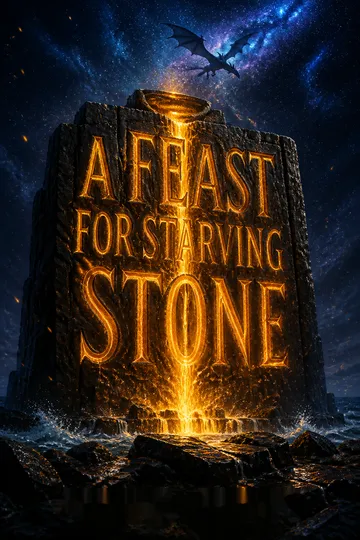
A Feast for Starving Stone continues the exciting duology, following Princess Solenn and her mother Ada as they face war and magical challenges. Readers praise the unique world-building, food-based magic system, and character development. Some found the pacing uneven or the ending rushed, but most enjoyed the complex plot, diverse characters, and themes of compromise and empathy. The book explores PTSD, diplomacy, and alliances with magical beings. While a few readers felt it didn't match the first book's quality, most found it a satisfying conclusion.
People Also Read





Characters
Solenn
Tongueless royal envoyThe sixteen-year-old princess of Braiz is also its emerging ambassador to the magical Coterie. Solenn is observant, diplomatically trained, and deeply attached to her country, especially its coastline and horses. Her recent ordeal has left her physically scarred and without a tongue, so she writes, gestures, and speaks with difficulty. She is not defined by eloquence alone: her strength lies in reading what others need and in persisting when their worlds do not fit neatly together. Protective parents often mistake care for a reason to restrict her, while Solenn struggles to carry responsibility without treating every failure as her fault. Her birth parents are Ada and Erwan, though she was raised as a princess.
Adamantine Garland, Ada
Rogue empathic ChefAda is a gifted Verdanian Chef whose empathy lets her perceive how others experience food. She deserted the royal system after its politics separated her from Erwan and their infant daughter, and she has spent years hiding her skills while helping other Chefs escape. Practical, sharp-tongued, and suspicious of authority, she tends to turn fear into work: cooking, planning, or taking responsibility for someone more vulnerable. Her talent makes her attentive to needs others overlook, but it can also leave her exposed to sensory overload and memories of battle. Ada loves Solenn fiercely, though their relationship must be handled carefully in public, and she still hopes to build a life with Erwan after years apart.
Erwan Corre
Solenn's steadfast fatherErwan is a Braizian musketeer, a respected officer, and Solenn’s father. His first loyalty is to the people under his command, a principle that shapes both his courage and his willingness to endure hardship. He is steady where Ada is quick to challenge, but his restraint is not passivity; he has spent years navigating divided loyalties and political decisions made by others. Erwan is also an artist and a devoted parent, with a gentleness that survives his military discipline. His long separation from Ada has not diminished his love for her. With Solenn, he combines affection and guidance, though he must learn that protecting her also means respecting her choices.
Aveyron Silvacane
Shapeshifting Camarga allyAveyron is a young Camarga, one of the magical kin who can live as a horse or a humanlike person. He is Solenn’s companion, interpreter, and trusted friend, often helping her bridge conversations that exceed her limited voice. His careful manners conceal a clear-eyed understanding of how humans exploit his kind. Aveyron can be brave without being reckless, and he often recognizes when Solenn needs support rather than persuasion. His loyalty is reciprocal: he does not treat her as a princess to obey but as a partner whose judgment matters. Through him, Solenn encounters the kin not as ingredients or legends but as people with families, fears, and political interests.
Queen Abonde
Lasting dragon diplomatAbonde is an ancient dragon and the leader of the Coterie, the community of magical beings who have survived human predation. She is proud, politically cautious, and burdened by the losses suffered by her kind. Her authority comes less from commanding obedience than from taking risks herself before asking others to do the same. Abonde initially distrusts human promises because the history of epicurea gives her ample reason. She also knows that hiding has not kept the kin safe. Her careful negotiations with Solenn reveal a ruler trying to balance grief, survival, and the possibility of cooperation without pretending that an alliance can erase the past.
Hester
Wounded hearth deityHester governs hearth, home, and fire, embodying both the warmth that sustains a household and the force that can destroy it. Her old decision to protect humans by cursing the kin has made her a source of deep historical harm. At the same time, isolation has left her profoundly lonely and despairing. Hester is expressive, proud, and quick to anger, but she can also recognize a kindness she did not expect. Her need to speak and to belong gives her a startlingly personal dimension for a deity. She is most dangerous when she assumes that power excuses her from considering how other beings experience it.
Gyst
God of hidden thingsGyst rules fermentation, infection, secrets, and the unseen. He is clever, curious about human sensation, and convinced that he understands people better than they understand themselves. That confidence becomes coercive when he treats Solenn’s body and choices as territory he can manage. His history with her reveals a deity capable of affection and mercy, but whose self-importance repeatedly overwhelms those qualities. Gyst is also connected to the family’s unusual Chef abilities, a fact that complicates Solenn’s understanding of her own power. His presence makes cellars, wounds, and silence feel politically charged, because what cannot be seen may still be acting upon the living.
Brillat Silvacane
Camarga elder and envoyBrillat is Aveyron’s father, an experienced representative of the Coterie, and a Camarga who can take human form. He is formal, proud, and deeply protective of his people. His knowledge helps Ada and Solenn understand the kin’s laws, their vulnerability, and the consequences of human use of epicurea. Brillat does not offer trust cheaply, especially to Chefs, whose profession has harmed his relatives. Yet he is capable of recognizing honorable conduct and repaying kindness. His relationship with Erwan grows from shared respect, while his care for Aveyron shows the tenderness beneath his measured public manner.
Prince Morvan
Solenn's cautious fatherMorvan is Solenn’s adoptive father and a senior political figure in Braiz. He loves his daughter and worries that the danger around her has become impossible to manage, which sometimes makes him favor protection over trust. His diplomacy is practical and informed by the military imbalance facing his country. Morvan is able to listen to people beyond his rank, but fear can make him resistant when Solenn asks to take risks he cannot supervise. He represents a parent trying to reconcile political duty with a child’s growing independence.
Queen Privela
Solenn's shrewd grandmotherPrivela is Solenn’s grandmother and a queen accustomed to making difficult decisions without ceremony. She understands the danger of Solenn’s mission, yet recognizes that keeping her at home may be the greater risk to Braiz. Her support is discreet and concrete: she provides travel supplies and creates a way for Solenn to leave without exposing her attendants to punishment. Privela’s affection is warm, but it does not blind her to political realities. She trusts Solenn’s judgment more readily than Morvan does.
August Chef Gurvan
Braiz's trusted ChefGurvan is Braiz’s senior Chef, a spiritual guide, and a practical caretaker of the Grand Pentad. He records the dead with Solenn, offers thoughtful insight into the Gods, and takes seriously the responsibility of feeding both people and their sense of belonging. His training has taught him to regard epicurea as sacred, which makes his willingness to reconsider its use significant. Gurvan’s religious devotion is not rigid; he remains curious about Hester’s needs and attentive to new evidence.
Madame Garland
Solenn's spirited elderSolenn’s great-grandmother is lively, curious, and sometimes confused by recent events. Her memory shifts, but her character remains unmistakable: she is irreverent toward authority and instinctively generous. Her affection for the Gods is sincere, yet it does not prevent her from challenging Gyst when he behaves cruelly. Ada’s care for her is shaped by love and worry, especially because the elder woman’s independence matters as much as her safety.
Mari
Quietly capable helperMari is a young girl who assists at the Corre household and cares for Madame Garland. She is patient, observant, and more capable than adults initially assume. When Gyst appears in the cellar, Mari recognizes that something is wrong and fetches salt to help protect the others. Her careful lacework is a source of comfort, but it does not keep her from acting when someone needs help.
Lieutenant Talia
Solenn's watchful protectorTalia is an experienced musketeer who has served Solenn since childhood. She is disciplined, blunt when needed, and attuned to the emotional cost of military duty. Talia can protect Solenn without mistaking her for helpless, though she remains alert to the dangers created by Solenn’s public role. Her grief for people she has lost sits beside a steady commitment to those still in her care.
Jean
Solenn's trusted attendantJean is a musketeer and one of Solenn’s closest attendants. He helps interpret her gestures, manages practical needs, and offers dependable support without drawing attention away from her decisions. His regard for Solenn deepens as he sees the scale of her responsibilities. Jean is respectful of rank, but his loyalty is personal as well as professional.
Yanik
Worn messenger from VerdaniaYanik is a musketeer and former aide to Erwan who risks a difficult journey back to Braiz with news of the prisoners. He is exhausted, grieving, and troubled by being the one who escaped when others remained behind. His loyalty makes him a reliable messenger, but it also leaves him carrying guilt that he cannot solve by simply returning to duty.
Emone
Ada's battle-tested friendEmone is Ada’s old military friend and a charismatic tavern keeper. Her emotional intelligence helps Ada slow down when fear threatens to push her into a reckless rescue. Emone is practical without becoming cold, and she understands that witnessing a death can be an act of care when intervention is impossible. She also maintains a community of people who need shelter and support.
Claudette
Merchant with a rapierClaudette is Emone’s partner, a fabric merchant, and an accomplished swordswoman. She combines sharp judgment with a dry sense of humor and is willing to fight when a community is threatened. Claudette knows how to protect people without pretending that courage makes them invulnerable. Her friendship with Ada is built on mutual trust and a shared history of surviving conflict.
Queen Roswita
Stranded Verdanian queenRoswita is Queen of Verdania and the politically isolated wife of King Caristo. She has her own experience with a rapier and does not mistake royal status for control over her husband’s decisions. Her wary dealings with Ada reveal a person who can recognize courage even in someone who dislikes her. Roswita has limited influence at court, but she remains perceptive about the abuses carried out in its name.
Sidonie Pedroza
Palace Chef with principlesSidonie is a Verdanian palace Chef who helps defend Roswita during the attack at Versay. She is skilled, composed, and loyal to the people in her care rather than blindly obedient to the Crown. Her past connection to Ada’s family makes her response to Ada’s identity especially consequential. Sidonie listens to warnings about epicurea even when she does not yet understand the full explanation.
Lord Whitney
Albion's calculating commanderWhitney is an Albionish military leader who prefers layered plans to direct confrontation. He understands how to exploit the rivalries between Braiz and Verdania, using false blame, covert agents, and advanced epicurea to destabilize both countries. His public manner is controlled and self-assured, and he treats magical beings as stores of military potential. Whitney’s strategic patience makes him dangerous, but his confidence also depends on believing that every advantage can be measured, owned, and deployed.
Mallory Valmont
Cannibalized war heroValmont is a former Verdanian war hero whose reputation conceals a history of murder and cannibalism. He used rupic, the remains of people cursed into stone, to gain strength and prolong his life. His past crime connects the exploitation of magical beings to human ambition at its most grotesque. He serves as a warning about what happens when power is treated as entitlement.
King Caristo
Verdania's brittle monarchCaristo rules Verdania and is the father of Prince Rupert. His decisions are shaped by pride, grief, and a desire to preserve royal authority during unrest. He treats political accusation as a tool of control, helping turn Solenn and the Braizian delegation into convenient targets. His response to crisis is often punitive rather than curious.
Prince Rupert
A planned political bridgeRupert is the Verdanian prince whose intended marriage to Solenn was meant to repair the breach between their countries. His role in this story is largely political and remembered through the tragedy that destroyed the proposed alliance. He represents the possibility of cooperation that rival powers worked to sabotage.
Plot Devices
Epicurea and food magic
Power with a hidden costIn this world, Chefs call upon the Gods to awaken magic in food and ingredients known as epicurea. The system initially appears to be a sacred human privilege, but Solenn and Ada learn that the ingredients originate in intelligent magical beings who can be killed, processed, and consumed. This revelation changes the meaning of cooking, warfare, healing, and diplomacy. The Coterie’s demand that Braiz relinquish epicurea forces the humans to choose between immediate power and a different relationship with the beings they have treated as resources.
Arcady and the veil
A border between worldsArcady is a parallel realm inhabited by the magical kin. Certain stone gateways and other threshold places allow travel between it and the human world. The veil makes diplomacy possible but dangerous: travelers can become disoriented, and ordinary assumptions about language, bodies, and geography often fail. It also gives the plot a way to connect distant conflicts, letting characters reach allies or return home by routes no human army can control. Its existence turns the Coterie from a rumor into a political community with its own territory and laws.
Solenn's severed tongue
A wound that protectsSolenn’s loss of her tongue is both a physical disability and the consequence of a desperate attempt to escape Gyst’s control. It impairs her speech and eating, isolates her in diplomatic settings, and forces her to rely on writing, gesture, and trusted interpreters. At the same time, it removes the direct conduit through which Gyst once exerted power over her. The injury therefore refuses a simple division between damage and protection: Solenn must live with its daily costs while learning that it has not erased her intelligence, authority, or inner connection to the divine.
Hester's carved avatar
A voice made from stoneSolenn carries a fragment of Hester’s immense statue to Dryad Lyria, who carves it into a humanlike head. Placed in the Grand Pentad hearth, it absorbs prayers and offerings until Hester can see and speak with greater intimacy. The avatar gives the isolated God a new way to interact with people, but its power is difficult to contain and its stone remains dangerous if treated as an ingredient. Its destruction during Albion’s attack does not end its influence; the remaining divine material becomes a means for Ada to help defend Nont.
Krakens' shared perception
An alien language of imagesKrakens communicate through touch and shared images rather than spoken language. Their perception does not prioritize human faces, clothing, or political flags, so an ordinary request to attack a specific commander means little to them. Solenn gradually learns that they identify ships and threats through the presence of epicurea, a form of magical sensation. This difference makes the alliance difficult but possible: rather than forcing krakens to adopt human categories, Solenn translates her goal into patterns they can recognize and accepts their own understanding of pain, kinship, and sacrifice.
Chefs of the Five Gods Series
About the Author
Other books by Beth Cato
Download PDF
Download EPUB
.epub digital book format is ideal for reading ebooks on phones, tablets, and e-readers.








