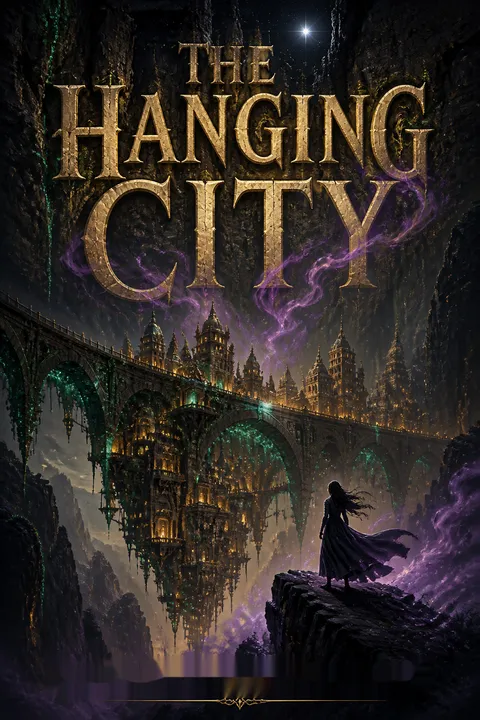


Plot Summary
Prologue
At thirteen, Lark hears a bard tell how Paca crossed the bridge to Eterellis by letting two trolls quarrel, then returned safely with a sacred oath he had overheard. The tale also reveals that trolls built Cagmar in the canyon after humans drove them from the sun.
Lark presses the bard to share the oath, repeating its strange promise until she knows it by heart. Six years later, with her supplies gone and her father still hunting her, she will stake her life on that old story.
The story of Paca turns survival into a matter of attention rather than strength: he listens closely enough to carry away words that protect him later. Lark’s decision to memorize the oath is similarly practical, but it is also an act of faith in a story told by someone she barely knows. The bard’s account challenges the inherited human picture of trolls as simple monsters by giving their city a history of displacement. Its central irony is already present: the bridge connects two peoples while preserving the wound that separates them.
The Oath Opens Cagmar
After years of fleeing her father and the humans who fear her, Lark reaches the Empyrean Bridge nearly dead from thirst. When armed trollis surround her, she repeats Paca’s oath. The guards stop, acknowledging its force, and carry her blindfolded into Cagmar. The council initially orders her expelled, since she can offer no useful trade skill.
Lark then reveals that she can make others feel terror without touching them. Qequan, the council’s leader, tests her himself and nearly attacks under its influence. Instead of sending her away, he assigns her to monster-slayer Unach. Lark has found shelter, but only by exposing the ability that has repeatedly driven her from human homes.
Lark’s entrance is a bargain made under duress: she risks disclosing the very trait that has made ordinary refuge impossible. The oath works because the trollis treat inherited words as binding law, while her fear-gift works through a force she can scarcely separate from her own body. Qequan’s decision grants her conditional belonging, not acceptance. The scene establishes the novel’s sharpest social question: what kind of community will recognize a person’s usefulness without reducing her to it?
Unach's Reluctant Lodger
Unach takes Lark to the apartment she shares with her brother, Azmar, an engineer, and makes clear that the arrangement is temporary. The city is a maze of lifts, tunnels, gardens clinging to the canyon wall, and rigid caste rules. On her first errand, Lark gets lost until Azmar draws her a map and explains that humans have no caste and cannot be trusted with currency.
In the market she meets Perg, a half-human trollis mocked for his parentage, then finds a cramped enclave where Ritha, Wiln, and other humans live under close supervision. Unach sets Lark to dock work, where she must learn ropes, harnesses, and the monsters below.
Cagmar’s architecture gives social hierarchy a physical form: Lark must navigate levels and barriers before she can understand who is allowed to move freely. Unach’s bluntness initially makes shelter feel like another trial, while Azmar’s map offers a small, concrete alternative: knowledge shared without humiliation. Perg’s presence complicates the city’s human-trollis divide. Lark recognizes in him the same problem she carries, being judged as an exception before anyone asks who he is.
The Enclave Turns Violent
Lark begins finding a place in Cagmar through work, the human enclave, and time spent learning engineering calculations with Azmar. But Colson, a human miner, blames her unusual slayer assignment for the enclave’s harsher treatment. At a supposed gathering, he and several men beat her until she releases her fear and drives them off.
Perg finds her and carries her back to Unach’s apartment; Ritha treats her injuries. Unach secures Lark a narrow servants’ room, while Azmar speaks up for Colson, persuading the council to defer the punishment that could have thrown him into the canyon. Lark’s plea for mercy keeps the human community from losing one of its own to Cagmar’s law.
The assault repeats Lark’s old pattern: a community offers the possibility of kinship, then fear and resentment turn her into a target. Her refusal to retaliate until she is in danger is not passivity; it reflects how costly exposure has been throughout her life. Azmar’s intervention and Lark’s plea separate accountability from vengeance. Their choices do not erase the violence, but they interrupt the city’s habit of treating punishment as proof of strength.
A Lecker Tests Her
As Lark studies the monsters and works the south dock, a huge lecker attacks Cagmar, shaking the city’s outer structure. Azmar guides her toward safety, but she insists on joining Unach and the slayers. While they climb the wall to fight the beast, Lark spots a second lecker approaching unseen.
She forces her fear into it; the creature veers mid-leap and tumbles into the canyon, giving the slayers time to drive off the first. Lark claims the shot was luck, but Unach demands a demonstration back at the apartment. Azmar stops her, reminding Unach that Lark saved the team. The attack leaves damage in Deccor housing and raises the question of whether Perg survived the breach.
The rescue makes Lark’s ability valuable in exactly the way she fears: Cagmar sees a weapon before it sees a person. Yet this time her power protects others rather than serving her father’s schemes. Unach’s demand for proof shows how deeply the city equates strength with legitimacy; Azmar’s intervention offers a competing standard based on judgment and gratitude. Lark’s usefulness earns her a place, but it also makes secrecy harder to maintain.
Perg Wins, Grodd Cheats
At the caste tournament on the Empyrean Bridge, Perg challenges a much larger trollis and earns a promotion after a hard fight. Grodd, leader of the human task force, then manipulates the rules: he gives his own rank to a low-caste trollis so he can challenge Perg while Perg is exhausted.
Grodd cuts him down and keeps attacking after Perg can no longer defend himself. Lark rushes onto the bridge, takes Perg’s axe, and floods Grodd with terror until he drops his weapon. The medics finally reach Perg. Qequan keeps Perg at his former rank, demotes Grodd, and warns Lark that using her gift against trollis again could cost her life.
The tournament presents caste as a system that claims to reward merit but can be bent by those who control its rules. Grodd turns Perg’s hard-won advancement into an opportunity for public humiliation, and the crowd’s inaction exposes the cost of treating strength as the only moral authority. Lark breaks her silence because the alternative is to watch a friend die. Her intervention saves Perg, but makes her power public and places her safety in Qequan’s hands.
Grodd Takes Her to the Edge
After the council hearing, Lark tries to avoid Grodd, but he follows her into Cagmar’s waterworks. He accuses her of using magic to humiliate him, then lifts her by the throat and dangles her over the canyon, demanding an explanation. Azmar arrives and uses Grodd’s demotion to make him release her, threatening to report the assault.
Once Grodd leaves, Lark clings to Azmar and weeps. Later, on an engineering survey above the bridge, Azmar explains why he distrusts inherited hatred: as a young soldier, he was wounded in a raid and nursed by a human widow, Aleah. His own returning band killed her. He has carried that loss, and the scars, ever since.
Grodd’s attack makes Cagmar’s protections feel provisional: Lark is physically vulnerable and legally beneath every trollis. Azmar’s rescue matters because he acts where the law offers no reliable shield. His memory of Aleah also gives his kindness a history, not an instinctive exception. He knows that a person can be saved by someone their community teaches them to hate, and he refuses to let that lesson vanish into the official story of war.
A Human Trail North
During the bridge survey, Lark spots armed humans hiding nearby. She joins Azmar and Homper in pursuit, but when the group fights back, she uses fear to stop one attacker and helps capture a boy named Tayler. He explains that his band came to study Cagmar’s food sources, not to raid, and mentions Baten, a half-trollis accepted in his township.
Lark lets Tayler and his cousin go, hoping to learn where they live and whether Baten has found a family. In the enclave, Ritha recognizes Lark as the daughter of Artlina, a servant who died while fleeing Lark’s father. Ritha believes Lark inherited her fear-gift from her mother’s terror at childbirth.
The encounter with Tayler widens Lark’s sense of possibility: Perg’s rejection is not the only future available to someone of mixed parentage. Letting the humans go risks her standing with Cagmar, but she chooses curiosity and compassion over automatic loyalty to power. Ritha’s account gives Lark’s ability a maternal origin, transforming it from a private defect into an inheritance shaped by another woman’s violence and survival.
The Name Beneath Lark
Ritha’s revelation confirms that Lark’s father, Ottius Thellele, may have caused her mother’s death. She also warns that Grodd has allies and has begun targeting humans. Soon Grodd follows Ritha to Lark’s servants’ quarters, so Unach applies to make Lark her official servant, giving her a measure of protection.
Azmar installs a lock on Lark’s door and stays beside it overnight. In the darkness, Lark tells him how her father used her fear to intimidate people and why she fled. She still withholds the full truth of her ability, but her account makes clear that returning to Ottius would mean returning to coercion, not home.
Ritha’s knowledge reconnects Lark to a past she had survived by refusing to name. The revelation does not give her a simple origin story; it deepens her grief by making her mother both newly present and irretrievably lost. Meanwhile, Unach’s legal protection and Azmar’s lock are practical forms of care in a city where human safety is not guaranteed. Lark’s confession begins to replace secrecy with chosen trust.
Fear Becomes a Confession
Lark meets Tayler again outside the city and learns that Baten’s human community accepts him, though it assumes his mother was assaulted during a raid. Back in Cagmar, she finally tells Azmar that she can project fear into people and monsters. He calls it a gift and promises not to expose her.
Lark kisses him, but Azmar pulls away, convinced that a human-trollis relationship will bring harm. Soon he returns to her, kisses her willingly, and gives her his bloodstone, the trollis token of a chosen mate. Lark accepts it. Their private happiness is immediately shadowed when Unach reports that human attackers have murdered seven trollis adolescents during military drills.
Lark’s confession asks Azmar to know her without converting knowledge into suspicion. His acceptance gives her a kind of intimacy she has never experienced, while his first withdrawal shows how social rules can inhabit even a sympathetic person. The bloodstone makes their bond tangible, but the murders arrive as a brutal counterweight: private love cannot insulate them from a conflict organized around inherited categories.
The Canyon Takes Her Measure
With attacks escalating, Azmar moves into his own quarters and offers Lark a safer place to sleep. He gives her his bloodstone, and they begin a relationship in secret. Soon a giant spreener breaches the south dock. Lark is struck from the platform before she has fastened her harness and clings to the cliff by a few fingers.
She drives the spider toward the slayers, who kill it, and Unach risks a fall herself to pull Lark back onto the dock. Lark finds a blood-colored shard in the broken stone and keeps it for Azmar. Meanwhile, increased patrols prevent her from meeting Tayler again, and Grodd sees her climbing outside Cagmar.
The spreener attack turns dependence into reciprocal action: Lark’s gift draws the beast, but Unach’s physical courage saves her. The shard she keeps for Azmar echoes his bloodstone without duplicating it; their bond is made from what each can actually offer. The increased patrols also close off Lark’s imagined escape route, while Grodd’s sighting converts her private search for answers into a public accusation.
The Council Sends Her Back
Grodd drags Lark before the council, claiming she tried to flee Cagmar. When the guards find Perg’s forbidden dagger strapped to her thigh, Qequan treats the evidence as proof of disloyalty and locks her in the dungeon. Perg attempts to free her, even offering to flee with her, but Lark refuses to risk his life without knowing the council’s sentence.
When she is brought before Qequan, Azmar has already admitted their relationship and offered himself to the council’s judgment. Lark identifies Ottius as the likely leader of the human army and volunteers to gather his plans. Qequan agrees only if she returns with useful intelligence within two days.
The dagger, given to Lark as protection, becomes evidence against her because Cagmar’s laws do not recognize the danger that made her carry it. Her imprisonment shows how quickly conditional belonging can become suspicion. Azmar’s admission and Lark’s bargain are parallel sacrifices: each risks standing to protect the other. Qequan’s deadline turns loyalty into a test administered by the same authority that has already denied Lark a fair hearing.
Ottius's Camp of Fear
At her father’s camp, Lark hides her allegiance to Cagmar and lets Ottius believe she has returned willingly. He tests her by ordering her to frighten information from a captured trollis. Later, she loosens her guard’s bindings through flirtation, slips into Ottius’s tent, and reads his maps and notes.
She learns that he has staged the killings to draw Cagmar’s scouts out and plans to force an open battle. When she escapes, she uses her fear-gift to divert an aerolass and reaches the rendezvous point. The trollis scout accepts her intelligence but refuses to escort her home until it is verified. With no shelter and no supplies, Lark has to return to her father.
Lark’s return to Ottius is not reconciliation; it is an act of tactical camouflage. She uses skills learned under his control, from reading maps to anticipating suspicion, against the campaign he built around domination. The captured trollis forces her to confront the cost of that strategy: she must reproduce the coercion she wants to escape. The scout’s refusal exposes Cagmar’s limits as a refuge, leaving Lark to survive between two societies that distrust her.
Azmar Runs Through Battle
Ottius beats Lark for leaving, then brings her to the battlefield with his army. As the human and trollis forces collide, she escapes his grasp. Ottius pursues her and threatens her with a knife, but Azmar reaches her from the front line and lifts her father away. A human soldier slashes Azmar across the back before Lark can stop him.
Seeing Azmar bleed badly, Lark uses her gift not to frighten the attackers but to force Azmar into flight, giving him enough strength to run toward Cagmar and medical help. She follows him across the battle line. The fear saves his life, but she knows it may leave him unable to recognize her without terror.
The battle brings Lark’s two inheritances into direct conflict: the power Ottius exploited and the love she has built with Azmar. Her choice to direct fear toward Azmar is an act of care that resembles violence from the outside. It succeeds physically while threatening their emotional bond. For once, survival requires Lark to become frightening to the person she most wants to keep safe.
Monsters Answer the Siege
Back in Cagmar, Lark learns that Azmar is alive but cannot visit him freely, while Unach blames her for the danger he faced. When the human army returns, Lark descends alone into the canyon waterworks, turns her lamp into a beacon, and sings to draw the creatures near. She floods the monsters with fear until they stampede toward the surface and scatter the human forces without a citywide battle.
The effort nearly stops her heart. Unach finds her at the river and carries her back. Afterward, the council confirms her intelligence and allows her to stay. Azmar wakes in the infirmary, sees Lark, and recoils in terror, leaving her convinced she has destroyed their love.
Lark’s plan turns Cagmar’s most feared landscape into a defense, but the price is bodily rather than abstract: she pushes her heart to collapse. The monsters become an army only because she can reach them through the same terror that isolates her from people. Her rescue by Unach marks a change in their bond, though it cannot erase Unach’s anger. Azmar’s frightened response makes the cost of Lark’s intervention immediate and intimate.
A Road Beyond Cagmar
Certain Azmar now fears her, Lark prepares to leave Cagmar and seeks farewells. Perg tells her he has been promoted after killing a human general with pale hair. Lark realizes the dead man was Ottius, but hides the truth from Perg. Grodd confronts her in the market, and Perg steps in to protect her, proving their friendship has survived the war.
Then Azmar finds Lark and explains that his terror in the infirmary came from his own trained response: fear makes him fight, not flee. He knew she had saved him. He places his bloodstone back around her neck, and they choose to leave Cagmar together. Following the canyon north, they find a trail toward Tayler’s township. Rain begins to fall.
The ending resolves the novel’s competing definitions of home. Lark can leave without being driven out, and Azmar can choose a future beyond the caste and customs that shaped him. Perg’s promotion confirms his hard-won place, while his defense of Lark shows that status need not cancel affection. The rain does not erase the drought’s history, but it changes the horizon: the couple’s journey ends not in a guaranteed sanctuary, but in weather that makes new life imaginable.
Analysis
The Hanging City makes belonging a material question. Cagmar has finite rooms, food, water, and safe pathways, so its caste system is not merely an ideology; it decides who receives resources and who must yield space. Lark enters this system with no recognized rank, but her ability makes her useful enough to be admitted. The contradiction is painful: she gains a place by revealing the same difference that has repeatedly cost her a home.
The novel’s strongest relationships challenge the idea that identity can be read from ancestry or appearance. Perg is treated as lesser because he is part human; Lark is feared by humans for her gift and mistrusted by trollis for being human. Azmar’s memory of Aleah, the widow who saved him, gives that challenge a personal history. He knows that inherited hatred can be contradicted by a single act of care, even if his society does not readily reward such contradiction.
Fear is the book’s most unusual instrument. Lark can impose it on others, but she cannot use it without feeling its physical consequences herself. Her father turns that shared sensation into coercion, while Lark increasingly uses it to interrupt violence. The distinction is ethical rather than mechanical: the power remains dangerous, but her choices determine whom it serves. Her greatest act of protection, making Azmar flee when he is wounded, also threatens the intimacy she has built with him. Care is not presented as harmless. Sometimes it requires an action that looks like betrayal until its purpose can be understood.
The ending offers no easy escape from history. Lark and Azmar leave Cagmar with grief, injury, and unresolved social opposition still behind them. Yet the rain alters the story’s drought-struck horizon. Their future is not guaranteed, but it is chosen together, outside the rigid structures that tried to decide what each of them could become.
Review Summary
The Hanging City receives mixed reviews with an average 3.94 rating. Readers praise the unique premise of a human woman with fear powers seeking refuge in a troll city suspended beneath a bridge. Many commend the world-building and forbidden romance elements. However, criticisms focus on slow pacing, flat characters, repetitive content, and a rushed ending. The romance divides readers—some find it compelling while others consider it forced and underdeveloped. Several reviewers note the book's shift in tone, possibly due to the author's writing break during COVID. Fantasy romance fans generally enjoyed it more than traditional fantasy readers.
People Also Read

Characters
Lark
The fear-bearing wandererLark is a tall human woman who has spent much of her life moving from settlement to settlement, searching for safety and a family that will not fear her. Observant, literate, and skilled at reading people, she also carries a strange ability to make others experience terror. Her past has taught her to conceal both her power and her needs, yet she continues to offer mercy even to people who hurt her. She is drawn to the stars because their order helps her understand a life that has rarely felt orderly. Lark’s central struggle is not whether she can wield fear, but whether she can use it without becoming like the people who taught her to survive through intimidation.
Azmar
The engineer with scarsAzmar is Unach’s younger brother, a Centra engineer whose work helps keep Cagmar from collapsing into the canyon. Quiet and exacting, he prefers calculations to the warrior status his family expected him to pursue. His restraint is not indifference: he notices when Lark is lost, injured, or frightened, and offers help without demanding that she earn his kindness first. A formative experience in a human township has complicated the hatred his society teaches toward humans. Azmar is drawn to structure, but he understands that structures can fail people as readily as they support them. His guarded manner conceals a capacity for loyalty and tenderness that he rarely displays in public.
Unach
The blunt monster slayerUnach is Azmar’s sister and a Montra slayer who patrols Cagmar’s dangerous outer walls. Muscular, disciplined, and impatient with weakness, she initially treats Lark as an unwanted assignment. Her directness can feel cruel, but she is practical rather than casually malicious, and her actions often reveal concern before her words do. Unach takes pride in her work and in the people she considers hers, though she resists emotional displays and dislikes being asked to explain herself. She represents Cagmar’s warrior culture at its most capable, while also revealing that loyalty and family can matter more to her than the hierarchy she serves.
Perg
The half-trollis outcastPerg is a half-human trollis who works as a stone layer and trains to rise within Cagmar’s caste system. His mixed heritage leaves him excluded by both peoples, and the absence of a bloodstone denies him one of the accepted routes to status. Beneath his guarded humor is a persistent hunger to be seen as capable rather than tolerated. Lark recognizes his loneliness without treating him as a symbol, and their friendship grows from mutual recognition into something like family. Perg’s ambition is real, but so is his capacity for care: he notices when Lark is in danger and is willing to take risks for her even when doing so could cost him the progress he has fought to earn.
Ritha
The enclave's healerRitha is a human herbalist and midwife who lives in Cagmar’s crowded enclave. Calm, perceptive, and careful about the limits of her influence, she treats Lark’s injuries and offers the kind of practical compassion that does not demand gratitude. Ritha understands how vulnerable humans are under trollis rule, but she has also learned that survival sometimes requires keeping clear of political disputes. Her knowledge of Lark’s family history gives her a quiet authority, and her own experience makes her alert to the way fear can shape a person long before anyone names it.
Qequan
Cagmar's calculating leaderQequan is the largest and most influential member of Cagmar’s ruling council. He tests Lark’s ability himself, then allows her to stay because her power may help defend the city. Amused and politically astute, he can be generous when a person proves useful, but his mercy always has limits set by Cagmar’s laws and interests. Qequan sees himself as guardian of the city’s survival, a responsibility that can make individual compassion seem expendable. His relationship with Lark is therefore shaped by wary respect: he recognizes her value while remaining willing to threaten her when he believes the city is at risk.
Grodd
The fallen task-force chiefGrodd is a powerful trollis who leads the task force overseeing the human enclave. He believes strength entitles him to command and treats humans, especially those who resist him, as beneath consideration. His pride makes him skilled at exploiting Cagmar’s rules when they favor him, but poorly equipped to accept humiliation or lost status. Grodd’s hostility toward Perg and Lark is rooted in more than personal dislike: both challenge his conviction that bodies and ancestry determine worth. He remains dangerous even when his rank changes, because his social influence and appetite for retaliation do not disappear with a title.
Ottius Thellele
Lark's controlling fatherOttius is a powerful human leader who raised Lark in a household governed by fear, calculation, and control. He values intelligence when it can be turned into leverage and treats affection as a tool rather than a bond. His ambition grows from a belief that order belongs to whoever can impose it, making him adept at gathering followers in a desperate, fragmented world. For Lark, he represents the danger of using fear as a substitute for trust. His influence remains present in her instincts even after she escapes, shaping how she reads rooms, anticipates punishment, and hides what she wants.
Tayler
The wary human scoutTayler is a young human who scouts near Cagmar with a group seeking information about food and water. Suspicious of trollis power and protective of his community, he is slow to trust Lark, especially when she appears beside Azmar. Still, he recognizes a debt when she lets him escape and eventually shares limited information about his township. His guardedness is not simple hostility; he has learned that revealing a home or a vulnerable person can invite danger. Through Tayler, Lark glimpses a human community that may make room for people rejected elsewhere.
Colson
The resentful enclave minerColson is a young human miner in Cagmar’s enclave. He carries the bitterness of long hours, restricted freedom, and the task force’s abuse, and initially directs that anger at Lark because the council has granted her an unusual role. His violence grows from a real grievance, but he chooses to punish someone with less power rather than challenge the system itself. Colson is capable of shame and gratitude once he recognizes the consequences of his actions. His relationship with Lark shows how oppression can reproduce itself among the oppressed without making that harm harmless.
Wiln
The enclave clockmakerWiln is an elderly human clockmaker and tinker who works from a tiny stall in the enclave. Cheerful and generous with his knowledge, he lends Lark an old almanac that deepens her study of the stars. His modest craft gives him a role in Cagmar’s daily life and offers Lark an intergenerational kindness she has rarely known.
Etewen
The quiet enclave youthEtewen is a young human in the enclave who knows how harshly the task force treats his people. Initially hesitant around Lark, he later acknowledges the harm done to her. His quietness suggests a person accustomed to avoiding attention in a place where speaking up can carry consequences.
Danner
The violated trustDanner is the older son in the human family that once sheltered Lark. His abuse shatters the childhood bond she believed she had with that household and forces her to flee again. The betrayal explains why Lark is wary of promises that sound like protection.
Andru
The abandoned fiancéAndru is a kind young man Lark once expected to marry. Their brief courtship gives her a glimpse of ordinary domestic happiness, but he turns away when her ability becomes visible during an attack. His rejection reinforces Lark’s fear that love can vanish as soon as someone sees her clearly.
Artlina
Lark's lost motherArtlina was a servant in Ottius’s household who sought help escaping his control. Ritha remembers her as a woman trying to protect her child in a dangerous situation. Though absent from Lark’s life, Artlina’s story gives Lark a connection to a mother she never knew and a possible origin for her unusual gift.
Plot Devices
The trollis oath
A promise that opens doorsThe oath Lark learns from the bard is an old cultural pledge that Cagmar’s trollis still treat as binding. She repeats it when guards stop her on the Empyrean Bridge, and its force persuades the council to hear her before they send her away. The oath gives the opening its mechanism and introduces the possibility that human stories preserve truths about trollis history. It is not a magical password that grants unconditional refuge: the council honors the words while still requiring Lark to prove her usefulness.
Lark's fear-gift
Terror turned into forceLark can project fear into people and animals, and apparently into canyon monsters as well. The ability affects her too, making her body experience the terror she creates, so every use risks overwhelming her. Her father exploited it to intimidate people; in Cagmar she uses it to save slayers, defend Perg, escape attackers, and eventually protect the city. The gift connects her greatest vulnerability to her greatest practical strength, while forcing her to distinguish self-defense from coercion.
Caste and bloodstones
Rank made visibleCagmar’s caste system organizes work, status, and everyday deference, with combat victories and bloodstone exchanges among the ways trollis can alter their position. Turquoise beads mark tournament wins, while a bloodstone carries a more intimate meaning as a token offered to a chosen mate. These customs shape Perg’s struggle for recognition and Azmar’s choice to pursue an unconventional relationship. They turn social rules into visible objects and rituals, making it clear who is permitted to move upward, who is excluded, and what it costs to challenge convention.
The star charts
A map for uncertain futuresLark studies an almanac and reads the night sky for direction, drawing on the Cosmodian’s childhood prediction that her road would be difficult but purposeful. The stars help her navigate the desert and interpret her identity, while Wiln’s old charts reveal that the queen and oak constellations will converge in the year of the conflict. Lark does not possess certain knowledge of what the sky means, so the charts function as both practical navigation and a language through which she makes sense of hope, danger, and change.
The canyon creatures
The city's living defensesCagmar hangs above a canyon inhabited by dangerous creatures that the trollis monitor, hunt, and harvest for materials. Early attacks establish how close the city lives to the threat, while slayer equipment and Lark’s lessons prepare her to move along its exposed walls. The creatures eventually become more than environmental danger: Lark recognizes that her power can redirect their fear. This device is central to the final defense of Cagmar, when the landscape the city has endured becomes a force that can alter the human assault.
About the Author





Download PDF
Download EPUB
.epub digital book format is ideal for reading ebooks on phones, tablets, and e-readers.








