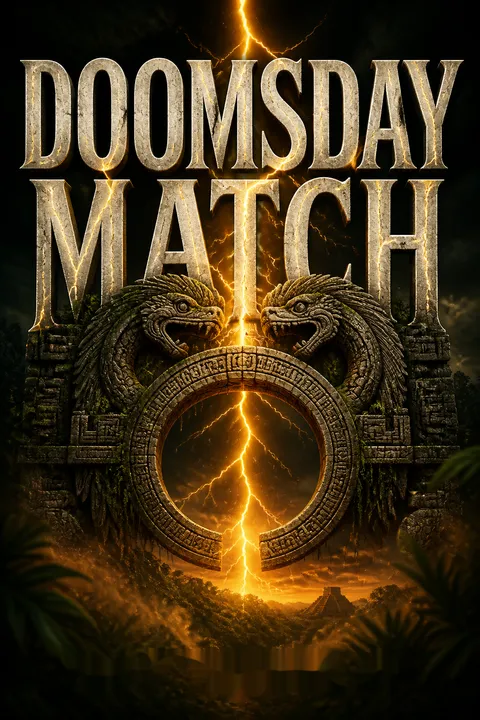


Plot Summary
A Survey Meets a Storm
Archaeologist Dr. Estrada persuades his pilot to cross into Mexico's Calakmul Biosphere Reserve, hoping LiDAR will reveal a pyramid hidden beneath the jungle. The scan uncovers a stone courtyard and a lone man dressed like an ancient Maya. Then black clouds gather above the ruins, lightning flashes, and hail strikes the aircraft in the tropical heat.
A force wrestles the controls until the plane lifts away from the trees and escapes south. Estrada abandons his search, unaware that the storm was no ordinary weather. His discovery has crossed into territory protected by something powerful, and someone in the jungle has noticed the intruders.
The opening makes technology both an instrument of discovery and a breach of control. LiDAR can see through the canopy, but its detached accuracy cannot interpret the human figure or the storm that answers it. Estrada's ambition is recognizably scholarly: he wants evidence that could change Maya archaeology. Yet the flight also frames knowledge as trespass when research ignores the people and powers that govern a place. The plane's escape is not a victory so much as a warning. The jungle has been rendered visible, but it remains beyond Estrada's authority.
A Resort Built Like a Trap
Author Roth arrives on Cozumel with his wife, Sarina, their daughter Suki, and twin sons Lucas and Bryant, nicknamed Brillante. Their wealthy neighbors, Eric and Kendall Beasley, have invited them to spend Christmas at a secluded resort owned by Jacob Calakmul.
Armed guards, silent staff, and the frightened reaction of the Beasleys' young daughter, Jane Louise, unsettle Roth and Suki, though Sarina tries to treat the visit as a holiday. The warning sharpens when Colter, one of the Beasley boys, smashes a heavy rubber ball into Lucas's face, injuring his nose. Roth and Sarina ask to drive Lucas to a hospital, using the request to test whether the hosts will let them leave.
The resort's luxury works as camouflage: private transport, attentive staff, and beautiful isolation initially resemble hospitality, while the armed gate makes dependence visible. Roth's suspicion is not simply authorial paranoia; Suki and Jane Louise register danger before the adults can explain it away. Sarina's calm offers a counterweight, but Lucas's injury turns unease into a parental decision with consequences. The episode also introduces the rubber ball as an object that can pass for play while carrying a more sinister purpose. In this setting, the ordinary gestures of vacation conceal an unequal distribution of knowledge and power.
The Girl in the Van
Jacob permits the Roths to borrow a van, but as they leave, they discover Jane Louise hiding in the back. She has overheard her father discussing a death game with Jacob and promising that the Roths' wealth would pass to the Beasleys after their deaths. She also knows the killings are meant to look accidental.
Roth now understands the strange ball, the armed guards, and the Beasleys' invitation as parts of one plan. Rather than return to the resort or risk the police, the family abandons the van and heads into the jungle on foot, taking Jane Louise with them. Sarina remembers to bring her insulin pump, but the family leaves its luggage and their last chance at an ordinary exit behind.
Jane Louise's warning transforms the family's uncertainty into a moral and practical crisis. Her evidence is partial, but the convergence of the ball, the resort's security, and the Beasleys' conversation makes waiting more dangerous than flight. Roth's response is revealing: he must weigh his children's safety against the risk of appearing to abduct the child who has helped them. By taking her along, he accepts responsibility without knowing whether authorities will believe him. The abandoned luggage marks the point of no return. They have not yet escaped the conspiracy, but they have stopped cooperating with its timetable.
The Cenote's Dark Water
As the family pushes through thick vegetation, Brillante vanishes toward the sound of water. Sarina and her son tumble into a deep cenote, leaving Roth, Suki, Lucas, and Jane Louise stranded above them. Roth and the children drag a fallen palm trunk to the edge and lower it as a rough ladder, pulling Brillante out before armed searchers arrive.
They hide in a ravine while a guard relieves himself almost directly above them, then Roth returns to the cenote and helps the exhausted Sarina climb up. Her insulin pump has stopped working after the fall, and the stress is worsening her diabetes. She warns Roth that without insulin she could slip into a coma, giving their escape a deadline more urgent than the pursuers.
The cenote turns the jungle from a route into a vertical trap. The rescue depends on improvisation and shared labor, not on Roth's control: his family must move the heavy palm trunk together, while Sarina and Brillante endure the water below. Their narrow escape from the searchers offers only temporary relief. The more consequential danger is Sarina's failing pump, a mundane device whose absence cannot be solved by courage. Her illness makes the adventure's bodily costs unavoidable and changes Roth's objective from simply evading capture to finding medical help before time runs out.
The Fence Has Eyes
At dawn, a boa constrictor coils around Lucas, and Roth beats it off with the first-aid kit. He then devises a way to keep the family walking straight through the trackless jungle, using a sequence of marked points rather than trusting his poor sense of direction. They find wild bananas, but Sarina grows weaker as they continue.
At the compound's ten-foot fence, the twins squeeze between the bars while Roth cannot fit through. Before they can search for another exit, an engine approaches along a concealed road. Motion cameras have detected them. Roth pulls everyone back into the trees as guards and soldiers converge on the boundary, confirming that the reserve is watched from more than the resort gate.
Survival here is a sequence of practical calculations: stop the snake, conserve strength, establish direction, and assess the fence. Roth's methodical line of marks briefly converts anxiety into a plan, but the surveillance system reveals the limits of individual cleverness. His size, normally a source of security, becomes an obstacle when the children can pass through the bars and he cannot. Sarina's declining health adds another pressure to the group's choices. The scene refuses the fantasy that reaching a boundary means reaching freedom; the fence is not merely an obstruction but a sensor within a managed landscape.
A Pyramid's Hidden Door
With soldiers closing in, the Roths flee toward a vast Maya pyramid rising from the trees. Suki's phone catches a faint signal at its summit, allowing Roth to contact his old friend Will Moretti, a law-enforcement officer. Moretti tells him that Bryant Westfall, Roth's closest friend and accountant, died in a car crash that morning.
The news makes the conspiracy feel planned: Westfall controlled the Roth family trust, and the Beasleys' estate attorney had introduced the two families. Moretti warns Roth not to trust local authorities and gives him the number of his uncle, an immigration lawyer who may help. When a helicopter bears down on the pyramid, Roth and his children discover a shaft inside and descend into the stone structure.
The pyramid offers shelter, but the call from Moretti changes the scale of the threat. Westfall's death links the pursuit to the legal machinery that would control Roth's estate, suggesting that financial preparation preceded the family's arrival. At the same time, the telephone call restores a fragile connection to the world beyond Cozumel. Roth's grief cannot be processed; he must convert it into information and keep moving. The hidden shaft literalizes a shift in perspective: escape from the visible surface requires entering older structures whose history and design may hold the means to survive.
The River Beneath Cozumel
Inside the pyramid, the family finds treasure chests, inflatable boats, and a cenote concealed beneath the temple. Roth punctures two boats with an obsidian spear, preventing the soldiers from following easily, then rows his family into an underground river. Suki reveals that one chest seemed to glow and that she took a jade bracelet from it; Sarina says she saw the same strange light.
The river carries them to San Gervasio, where Roth climbs through an ancient outlet near the Nohoch Nah temple and confirms they have reached a public archaeological site. The bracelet, dismissed by Roth as a mysterious trinket, remains with Suki as the family leaves the underground passage and seeks a route to town.
The escape depends on the same history that the pursuers exploit. Maya engineering gives the family a concealed route, while the treasure exposes the gap between Roth's skepticism and Sarina and Suki's inherited sensitivity to the place. The bracelet is a small, portable mystery carried out of the tomb, not yet a solution. By making it seem like an incidental theft, the narrative lets the object gather meaning before its function becomes clear. The family is no longer merely fleeing through nature; it has entered an ancient infrastructure that the modern resort's owners have repurposed.
Huellas de Pan Opens Its Gate
At San Gervasio, Roth and Sarina meet Teresa and Antonio, who run a Christian orphanage in San Miguel. They agree to hide the family in their shuttle bus and drive them to Huellas de Pan. At a police checkpoint, one of the orphanage children distracts an officer rather than expose the Americans. Jorge, the orphanage's generous founder, welcomes them, feeds them, and arranges for a doctor.
Sarina's condition worsens while the family waits; she is trembling, confused, and unable to stay awake. The doctor brings insulin and water but explains that the delay and dehydration have made her diabetes life-threatening. Before they can get her safely to a hospital, armed men surround the compound and kill the doctor.
The orphanage offers a sharp contrast to the resort: its residents possess little, yet they share food, transportation, and risk without demanding payment. The checkpoint child's quiet deception turns kindness into an active form of resistance. But refuge cannot undo Sarina's medical emergency, and Jorge's hospitality buys time rather than safety. The doctor's death reveals how completely Jacob's authority reaches beyond his own property. The episode tests Roth's belief that trustworthy people can be found through conduct rather than status, while making clear that goodness alone cannot stop organized violence.
The Jaguar's Invitation
When Jacob's men threaten Jorge, Roth comes out of hiding so the orphanage residents will not be killed for protecting his family. The captors take Roth, his children, and the unconscious Sarina to a private aircraft.
During the flight, Jacob explains that the Beasleys entered the death game for status among wealthy allies preparing for a coming upheaval. He also claims the Order of the Jaguar intends to avenge the Spanish conquest by destabilizing and conquering the West, using a prophecy associated with the Maya Long Count calendar.
Jacob admits he arranged Westfall's fatal crash to gain leverage over Roth's estate. At the Calakmul ruins, he heals Lucas's injured nose with a glyph but leaves Sarina near death, saying ancient magic alone is keeping her alive.
Jacob's exposition reframes a seemingly private financial crime as an ideological project, but his account of historical injustice does not make his planned violence morally coherent. He converts collective trauma into inherited permission to harm people who had no part in the original conquest. Roth's decision to surrender is also significant: he chooses to expose himself rather than let the orphanage pay for helping him. The healing of Lucas proves that Jacob's claims cannot be dismissed as mere performance, while his refusal to heal Sarina makes magic another instrument of control.
Eight Feathers to Survive
At the Jaguar Temple, Jacob's assistant Angélica explains the rules: each family must keep a heavy rubber ball moving with hips, knees, elbows, or chest, and eight points decide the match. A team can score by stopping the ball on the opponent's side or by sending it through a high stone ring.
The Roths are bathed, dressed in protective gear, and brought into an arena lined with spectators and carvings of sacrifice. Eric Beasley and his family have trained for the game, while Roth's family has only hours to learn it. The Beasleys exploit their fitness and coordination, repeatedly forcing the Roths to chase the ball. By sunset, the score is six to one, and Sarina remains unconscious in a healing shrine.
The game formalizes the power imbalance already established at the resort: one family arrives prepared, the other learns under threat of death. Its apparent simplicity conceals a physical and strategic system that punishes exhaustion. The high rings are especially important because they seem nearly impossible to reach, directing the players toward the more obvious scoring method of forcing a mistake. The ceremonial clothing and spectators transform survival into public entertainment. Roth must now protect his children while reading an unfamiliar sport whose rules are also a language of control.
A Blade Above Lucas
After the first match, Jacob changes the schedule: the families must resume at midnight and play until sunrise, or both will lose. Roth's family considers escaping, but a warrior catches Lucas on the roof and holds an obsidian blade to his throat. A snake suddenly appears on the warrior's arm, giving Roth time to catch Lucas when he falls.
Angélica later admits she wants the Roths to win, though she cannot openly help them. She hints that they do not yet understand how the game should be played. As they wait for midnight, Roth studies the court's impossible-looking rings and reasons that the Maya may have played in a different plane of space. Suki, wearing the jade bracelet, tries and fails to move a small object with it.
The threatened execution makes escape feel less like a daring option than a gamble with a child's life. The snake's sudden intervention is an unmistakable break in the family's ordinary understanding, yet it does not grant them safety or certainty. Angélica's hint offers a different kind of help: an interpretive opening rather than a weapon. Roth's habit of solving problems through patterns now becomes useful, but Suki's repeated failures expose the emotional cost of being named as the family's possible answer. Insight and confidence must arrive together.
Suki Bends the Orbit
When the match resumes, the Roths remain behind, seven points to one, and the Beasleys drive the ball hard at them. Roth notices Venus and connects the high rings to the Maya's attention to planetary motion. He realizes the game was not designed to be played on the ground. Suki, who has sensed the bracelet's magic since the jungle, finally concentrates and suspends the ball in golden threads.
She guides it into a circular orbit through the rings, scoring repeatedly until the Roths lead eight to six. Eric crosses the center line and charges at her, but a warrior's dart drops him before he can strike. The horns announce the Roths' victory. Their survival no longer depends on learning the Beasleys' version of the game.
Roth's breakthrough is not simply a clever theory; it revises the assumptions that have structured the contest. The rings seemed absurd because he imagined a ground-bound sport. Once he recognizes an orbital model, Suki's inherited sensitivity and the bracelet become a practical answer. Her success is collaborative: Roth interprets, but she must act, and her confidence cannot be supplied by his reasoning alone. Eric's attack exposes the violence beneath his competitive pose. The final score is won through attention and cooperation, not superior conditioning or obedience to the game as the Beasleys understand it.
Victory Still Has Teeth
After the match, Jacob transforms into a jaguar and kills Eric. Angélica tells Roth that the remaining Beasleys will be sacrificed, including Jane Louise, who runs to him begging to go home. Roth cannot persuade Jacob to release her. He can only leave her behind and visit Sarina, whose breathing is being sustained by magic in Ix Chel's shrine.
Jacob permits the Roth children to return to Cancún, supplies a false account of Sarina's treatment abroad, and warns Roth to keep silent. Back in Bozeman, Jacob's agents install surveillance on the family's devices and computers. Roth has survived the game, but his wife remains captive, Jane Louise is trapped, and the organization that hunted them now watches their home.
Winning resolves the immediate contest while refusing the comfort of a clean ending. Roth's inability to save Jane Louise is not a failure of affection; it is the consequence of having no leverage over a system that controls transport, medicine, and information. Sarina's survival is similarly conditional, held within Jacob's shrine rather than restored to her family. The return to Bozeman does not restore ordinary life because surveillance extends the jungle's reach into the home. The victory therefore changes Roth's role from fugitive to witness and potential opponent, while leaving the cost of escape painfully visible.
Epilogue
At home, Roth opens his bank account and finds more than fifty-two million dollars transferred into it, the Beasleys' estate presented as the prize for winning. The money feels less like a windfall than a burden attached to the deaths he has just witnessed.
He thinks of Westfall's family and the orphanage in Cozumel, then searches for Huellas de Pan. Jacob has ordered the Roths to stay quiet and prepare for the coming conflict. Roth has promised nothing that would keep him from speaking. The family's return is real, but the safety of home is already compromised.
The money makes the death game's promised reward concrete, but Roth experiences it as an ethical liability rather than triumph. Wealth arrives through a mechanism designed to turn murder into inheritance, echoing the way Jacob's organization treats history as a debt payable in other people's bodies. Roth's first impulse is redistributive: he thinks of Westfall's dependents and the orphanage, whose generosity sustained his family when powerful institutions failed them. His online search is modest resistance, not yet a public declaration, but it marks a shift from survival toward responsibility. The watched home and the unexpected fortune make silence difficult to mistake for safety.
Analysis
Doomsday Match makes its thriller machinery depend on a conflict over who gets to interpret history. Roth begins as a historian and storyteller who expects evidence to make the past legible. Jacob also claims historical knowledge, but turns it into a justification for inherited vengeance. The distinction is not that one remembers and the other forgets; it is that Roth's curiosity can revise his assumptions, while Jacob treats an account of past injury as permission to injure others. The novel therefore refuses to equate understanding injustice with moral authority.
The family's survival is repeatedly built from forms of attention that conventional power dismisses. Suki notices the resort's atmosphere, the glowing treasure, and finally the game’s hidden geometry. Roth's habitual pattern-making gives her a framework, but she must act on the insight herself. Sarina contributes medical expertise and cultural memory; the twins offer speed and mutual support. Their strengths are uneven, and that unevenness matters. They survive not by becoming a more efficient version of the Beasleys, but by coordinating different kinds of knowledge.
The novel also contrasts institutional abundance with human generosity. The resort has armed guards, vehicles, private aircraft, and surveillance, while Huellas de Pan stretches food and transport among children with few resources. Yet the orphanage offers the more meaningful form of security because its people accept risk for strangers. That contrast gives the book's attacks on elite status a concrete shape rather than leaving them as rhetoric.
Victory does not erase the cost. Sarina remains in Jacob's custody, Jane Louise is left behind, and the Roths return home under surveillance with a fortune generated by another family's destruction. The ending turns survival into obligation: Roth must decide whether protecting his children means obeying Jacob or resisting him. His story-making, once a way to comfort his family, becomes a means of recognizing and answering a danger that refuses to stay fictional.
Review Summary
People Also Read
Characters
Roth
Anxious storyteller fatherRoth is a bestselling fantasy author and former history professor whose imagination tends to turn uncertainty into elaborate danger. He uses humor and storytelling to comfort his children, even when he is frightened himself. His impulse to analyze, connect clues, and make plans can become anxious overthinking, but it also helps him adapt when familiar explanations fail. His devotion to Sarina and their children makes him protective without making him invulnerable; he has to learn that keeping a family safe sometimes means accepting help and acting before certainty arrives. His curiosity about history becomes more than an intellectual habit when Maya ruins, legends, and a deadly game enter his family's life.
Sarina
Roth's steadying partnerSarina is Roth's wife, a nurse, and the calm center of a family whose members often react to danger in different ways. Her nursing training makes her attentive to physical details, while her sensitivity to other people's emotions helps her read a room without dismissing what others feel. She is practical rather than passive: she supports Roth's decisions but questions their risks, and her Mexican heritage gives her a personal connection to the Yucatán's stories and customs. Sarina's type 1 diabetes requires careful management, making medical preparation part of family life and reminding those around her that competence does not erase vulnerability.
Suki
A watchful older sisterSuki is Roth and Sarina's teenage daughter, an introvert with a sharp eye for atmosphere and an even sharper sense of humor. She is interested in anime and theater technology, and she often expresses discomfort through dry observations rather than open displays of fear. Suki is close to her brothers, though she guards her privacy and resists being treated as a child. Her mother's family history matters to her, even when she does not yet understand why. Beneath her sarcasm is a serious capacity for attention: she notices details others overlook and wants to be useful without becoming the center of attention.
Lucas
The anxious twinLucas is one of Roth and Sarina's twin sons. He worries openly, especially when flying or faced with an unfamiliar danger, and looks to his father and siblings for reassurance. His direct questions often give the family a way to name risks they might otherwise avoid discussing. Lucas is also playful and energetic, with a love of soccer and fast food that keeps ordinary childhood wants present amid the crisis. He and his brother are close, but they have distinct temperaments that make their teamwork more than simple sameness.
Bryant, called Brillante
The distracted twinBrillante is Lucas's twin brother and is often absorbed in games or whatever has caught his attention. His nickname reflects the family's playful affection, while his athletic ability and quick responses emerge when his loved ones need him. He can be impulsive and easily distracted, but he is not indifferent: his loyalty to Lucas and his parents becomes clear in moments of danger. His character balances the family's fear with a boy's appetite for jokes, soccer, and the next interesting thing in front of him.
Jacob Calakmul
The polished predatorJacob is the wealthy owner of the Cozumel resort and a man accustomed to having people, institutions, and landscapes answer to him. He cultivates a gracious public manner, but beneath it lies a disciplined and coercive intelligence. Jacob sees history as an account that can be settled through inherited obligation, and he treats people as pieces in a larger design. His conviction gives him charisma among followers and makes his reasoning dangerous: he can describe injustice accurately while using it to excuse fresh violence. He prizes loyalty, control, and prophecy, yet his certainty is repeatedly tested by people he underestimates.
Angélica Torres
The learned interpreterAngélica is Jacob's highly educated assistant, fluent in English, Spanish, and Maya traditions. Her Stanford training in engineering and Latin American studies makes her both an administrator and an interpreter between worlds. She is ambitious, composed, and practiced at reading the people around her, but her professional loyalty exists beside a personal judgment about class and prejudice. Angélica understands how power is performed through ceremony as well as logistics. Her attraction to Jacob complicates her position, while her intelligence leaves her alert to the costs of serving a man who demands obedience.
Eric Beasley
The status-hungry rivalEric is a wealthy hedge-fund executive and Roth's Bozeman neighbor. He is physically imposing, competitive, and conscious of the social circles that have excluded him. Money has not satisfied his appetite for distinction, and he values displays of power as proof that he belongs among the elite. Eric can present himself as a generous host, but his ambition narrows his regard for other people. His relationship with Jacob offers him a route toward the prestige he wants, at a price he is willing to minimize.
Kendall Beasley
The polished social climberKendall is Eric's wife and the mother of Colter, James, and Jane Louise. She is attentive to appearance, status, and the achievements of her children, especially her sons. Her social ease can conceal a colder habit of sorting people by usefulness and rank. Kendall's relationship with her daughter is notably different from her attention to the boys, leaving Jane Louise with less emotional safety at home. She is accustomed to managing people and appearances, but that control becomes less secure when events stop following her expectations.
Jane Louise Beasley
The quiet youngest childJane Louise is Eric and Kendall Beasley's young daughter, much quieter than her older brothers. She is sensitive to the adults around her and often retreats when a room feels unsafe. Her attachment to her grandmother offers a source of affection beyond her immediate household. Though easily overlooked by the adults, Jane Louise pays close attention to what they say and do. She is a child caught between a family's expectations and her own developing moral judgment, with a strong need for security, kindness, and a voice of her own.
Will Moretti
The distant lawman friendMoretti is Roth's longtime friend from high school and works in law enforcement in Utah. He shares a deep history with Roth and Bryant Westfall, including the private jokes and loyalty of a friendship formed before Roth became famous. Moretti cannot directly reach Cozumel, but his practical knowledge helps Roth understand the danger of relying on local authorities. He acts quickly from a distance, connecting Roth to his uncle, an attorney with experience helping people in Mexico.
Bryant Westfall
The trusted accountantWestfall is Roth's close friend and accountant, one of the three friends who stayed connected from high school onward. Roth trusts him with consequential financial responsibilities because Westfall combines professional judgment with personal loyalty. His family life and long friendship with Roth give the relationship weight beyond business. The possibility of losing his counsel is a source of unease for Roth, who has built important parts of his family's future around trust in people he knows well.
Jorge Jiménez
The generous orphanage founderJorge runs Huellas de Pan, a small orphanage in San Miguel that survives through donations and the resourcefulness of its caregivers. He is warm, playful with the children, and guided by a practical faith expressed through feeding and sheltering people. His limited English does not keep him from communicating compassion. Jorge's generosity is not abstract: he shares scarce food and places his community at risk to help strangers in need.
Teresa
The protective caregiverTeresa helps care for children at Huellas de Pan alongside her husband, Antonio. Pregnant and responsible for a large group of young people, she remains attentive to their safety while recognizing when strangers need help. Her faith informs her willingness to shelter people in danger, but her choice is also practical and courageous. Teresa represents the daily labor that makes the orphanage a refuge.
Antonio
The cautious driverAntonio is Teresa's husband and one of the adults caring for children at Huellas de Pan. He drives the orphanage shuttle and is understandably wary of helping strangers pursued by a powerful family. His caution reflects responsibility for the children in his care, not indifference. Once he understands the Roths' situation, he chooses to help.
Dr. Estrada
The boundary-crossing archaeologistDr. Estrada is a Guatemalan archaeologist using LiDAR to locate Maya structures hidden beneath jungle cover. Ambitious and convinced that a major discovery lies in the Calakmul reserve, he pushes his pilot beyond the permitted survey area. His professional curiosity is genuine, but confidence in his research makes him underestimate the danger of crossing a boundary he cannot see.
Uacmitun
The temple's chief warriorUacmitun leads the warriors who protect the Calakmul ruins and the surrounding jungle. He is disciplined, proud of his position, and loyal to the order that gives him authority. His belief in honor and obedience makes him dangerous to anyone who threatens the system he serves.
The pilot
Estrada's wary airmanThe pilot flies Estrada's LiDAR survey plane through the Guatemalan jungle. He understands the risks of entering Mexican airspace and objects when Estrada pushes farther north. His practical caution provides a clear counterpoint to the archaeologist's ambition.
Plot Devices
LiDAR survey
Reveals the hidden cityThe aircraft's LiDAR system sends laser pulses through breaks in the jungle canopy and uses their reflections to map the ground below. It gives Estrada a way to locate ruins that satellites and ordinary sight cannot reveal. The survey uncovers a temple in territory the Calakmul family has kept inaccessible, triggering the novel's first warning that ancient knowledge and modern ownership overlap. The technology is not itself magical; its significance lies in exposing a place whose defenders have their own means of concealment.
The death game
Turns wealth into a wagerTwo wealthy families are forced into an ancient Mesoamerican ball game in which eight points decide which family survives. Players must keep a heavy rubber ball moving without using hands or feet, while the high stone rings offer a second, extraordinarily difficult way to score. The game first appears to be a ritualized contest, but it also serves Jacob's ambition to recruit and reward people seeking elite status. Its true spatial logic becomes essential to the outcome. This device contains major plot revelations.
The jade bracelet
Connects Suki to magicSuki takes a jade bracelet from a treasure chest beneath the pyramid after she and Sarina notice the chest's unusual glow. At first, Roth treats the object as a stolen relic with no practical use. Its design echoes the bracelets worn by Jacob's followers, which interact with the golden barriers around the arena. Suki's connection to the object grows as the family recognizes that perception and concentration matter as much as physical strength. The bracelet's role in the climax is a major spoiler.
Sarina's insulin pump
Sets a medical deadlineSarina's pump delivers the insulin her body needs to regulate blood sugar. She remembers to bring it when the family flees, but it fails after she falls into the cenote and is exposed to water. The malfunction turns an already dangerous escape into a race against diabetic ketoacidosis. The device grounds the fantasy-thriller action in a specific medical vulnerability: Sarina's condition cannot be overcome by determination, and every delay narrows the family's options. Its consequences shape their route from the jungle to the orphanage and then to Jacob's shrine.
The Jaguar prophecy
Gives revenge a futureJacob's followers believe an ancient prophecy tied to the Maya calendar foretells a return to power and a coming transformation of the world. Jacob interprets it as a mandate to avenge the conquest of the Americas and to destabilize Western society before conquering it. The prophecy links the hidden ruins, the death games, and the secret network of wealthy participants. It also lets Jacob frame personal ambition as historical destiny. Its meaning remains partly concealed within the lost Dresden Codex, leaving the conspiracy larger than the contest described in this book.
About the Author

Download PDF
Download EPUB
.epub digital book format is ideal for reading ebooks on phones, tablets, and e-readers.








