

Key Takeaways
Stop asking life for a meaning; make meaning by fully participating.
Meaning is lived. Campbell begins from an unsentimental premise: the world is beautiful and painful, disordered, and not something one person can set right. Rather than wait for a cosmic explanation, a person can create meaning through the way they meet experience. Joy, in this view, does not require pretending that suffering is good or that injustice is harmless. It means staying present to life instead of withdrawing from everything difficult.
Say yes without surrendering judgment. Campbell’s ideal is to take part in life’s pleasures and sorrows while tending to one’s own life and responsibilities. That stance is less a theory than a practice: notice what is happening, respond as fully as possible, and resist the fantasy that life must first become orderly before it can be worth living.
What's compelling here is the distinction between accepting reality and approving of it. Psychological research on acceptance-based therapies similarly treats willingness to experience difficult feelings as different from resignation: acceptance can make purposeful action possible. Campbell’s emphasis on personal participation offers a counterweight to the search for a single, universal answer to life’s meaning. Its limit is that focusing on one’s attitude can underplay conditions that demand collective change. His view is most useful when inner composure supports action, not when it becomes a reason to tolerate preventable harm.
Choose the path that awakens you, not the one already paved.
Bliss means deep fit. Campbell uses bliss to mean the life-giving direction that feels profoundly one’s own, not a promise of comfort or constant pleasure. His example is his own uncertain start: after Europe, he rejected the expected academic route, spent years reading in a small house during the Depression, and followed interests that led him toward mythology and literature. He later described that wandering period as essential to discovering his work.
Follow clues, not a script. Campbell recommends noticing which activities make life feel more vivid, then giving them room to develop. A ready-made career plan may offer security, but it can also substitute other people’s ambitions for one’s own. The path is not guaranteed to pay off, and it may not be visible in advance.
The idea resonates with research on intrinsic motivation, which finds that people often sustain effort more readily when an activity feels meaningful and self-directed. Campbell’s life story makes the principle concrete: unplanned reading and encounters became part of a vocation he could not have mapped beforehand. But his freedom to live with little income and few obligations is not a universal starting point. The useful lesson is not to imitate his leap into uncertainty; it is to create whatever modest room is possible for exploration, while acknowledging the practical risks.
Read myths as maps of inner experience, not newspaper reports.
Myth speaks in symbols. Campbell defines mythology as a cultural arrangement of images that helps people understand the universe, social life, and the transitions of a human life. He reads stories such as Eden not as literal history, but as symbolic accounts of entering time, discovering opposites, and losing an earlier unity. On this reading, a myth is not simply false because its events cannot be verified. Its value lies in what it helps people recognize in experience.
A living map must fit its time. Myths can connect a person to nature, support shared values, and give form to changes such as birth, adulthood, and death. Yet inherited symbols can become lifeless when people are asked to accept them as facts they cannot believe, or when they prescribe a social world that no longer exists.
Campbell’s approach offers a practical way to keep religious and cultural stories meaningful without requiring literal belief. It resembles literary interpretation: a story can illuminate patterns of fear, loss, or renewal without serving as a historical record. The move also has a risk. Treating different traditions as expressions of one shared psychological truth can smooth over differences in history, theology, and power. A reader can use Campbell’s symbolic lens while still asking whose experience a myth represents, whom it excludes, and what its particular community understands it to mean.
Treat the feared threshold as a possible doorway, not a verdict.
A quest begins with dislocation. Campbell’s hero’s journey is a story pattern for leaving familiar life, confronting what is unknown, and returning with a changed understanding or gift. He insists that a person’s route cannot simply be copied from someone else. A dark stretch may be a sign that something needs attention, not proof that the person has failed.
Parzival’s mistake was withholding care. In the Grail story, the young knight reaches a castle where the king is gravely wounded. Parzival wants to ask what is wrong, but holds back because he has been told that a knight should not ask questions. His obedience costs him the chance to help. The story makes compassion, rather than perfect rule-following, the test of his progress. Campbell uses it to suggest that the difficulty one fears may contain the very question one needs to face.
The story is memorable because its turning point is small: a question not asked. That makes the lesson more demanding than generic advice to be brave. Yet the heroic framing can make suffering sound automatically instructive. Trauma, poverty, and illness do not reliably produce wisdom, and people do not owe anyone a redemptive narrative about pain. The story is strongest as an invitation to examine avoidable forms of conformity and notice where a humane response is being suppressed, not as a claim that every crisis is secretly a gift.
Build a private sacred space where attention can reset.
Make a place for inward life. Campbell calls sacred space an environment set apart from ordinary demands, where objects and activities help a person return to what matters. His own writing room echoed the childhood space he had lost when his family home burned: familiar books and carefully placed tools helped him enter the work again. The point is not that a room is inherently holy, but that a deliberate setting can focus attention and make a valued activity easier to begin.
Ritual gives an act its meaning. Campbell uses saying grace before a meal as an example. It can remind diners that food was once living and that eating joins them to a larger cycle of life. Ritual, in this sense, is not empty repetition. It is a pause that helps people notice what they are doing and what it asks of them.
This connects to environmental psychology: places acquire meaning through repeated actions, and stable cues can help people shift into a particular kind of attention. Campbell’s writing room is a personal example of how an environment can support rather than merely decorate a practice. The same idea applies to a desk, a walk, or a shared meal. Sacredness should not depend on elaborate objects or perfect quiet, however. If a ritual becomes another performance standard, it can add pressure instead of creating the protected space it is meant to provide.
Practice a craft until discipline becomes a freer form of play.
Technique makes freedom possible. Campbell rejects the idea that creativity means simply doing whatever feels spontaneous. A dancer must first learn difficult techniques; a writer must learn language and form. With practice, the rules can become so familiar that attention moves from managing each small step to expressing something larger. He describes the shift as learning the craft, then allowing it to work without constant conscious supervision.
Art can change how the world appears. Campbell calls esthetic arrest the pause in which a work is encountered for its shape and presence, rather than judged mainly by what it can do or what it makes the viewer want. He compares this to a carefully arranged tea gathering, where ordinary objects and gestures become a unified experience. Art, at its most powerful, lets familiar things appear newly vivid.
The craft argument has a close parallel in expertise research: repeated practice can make complex actions feel more fluid, freeing attention for judgment and expression. Campbell’s aesthetic claim adds another dimension by asking the audience to suspend immediate use and evaluation. That can deepen attention, though it is not the only valid purpose of art. Political, therapeutic, and practical works may matter precisely because they move or persuade people. His distinction is most helpful as a reminder that art need not justify itself by delivering a lesson or satisfying a desire.
Use stillness to loosen fear and desire, then re-enter the world.
Still the mental surface. Campbell explains yoga through an image of a pond: wind disturbs the water, scattering its reflections; when the surface settles, the scene becomes clearer. Meditation and controlled breathing are practices for quieting the mind’s constant movement, not simply for collecting unusual experiences. Campbell links this stillness to a change in how people meet fear, desire, and the pressure to act for approval.
Engagement and peace can coexist. In his account, samsara is life in motion, with change and sorrow; nirvana is freedom from being ruled by craving and fear. They need not be separate places. A person can participate in ordinary life while holding a steadier perspective on success, failure, and loss. Campbell’s point is not to discard everyday needs, but to stop letting them dictate the whole meaning of existence.
The pond image captures something accessible: attention can be trained to notice thoughts without instantly following them. That idea appears in contemporary mindfulness practices, which use observation rather than suppression as a route to greater choice. Campbell’s religious language takes the claim further, toward an enduring consciousness beyond individual experience. That metaphysical conclusion is not established by the meditation analogy itself. The practice can still be valuable without settling what consciousness ultimately is, especially when stillness helps people return to relationships and responsibilities with less reactivity.
Make compassion the test of spiritual insight.
Insight must return to others. Campbell treats compassion as a recognition of another person’s suffering that moves someone toward help, rather than a rule followed for approval. His model is the Bodhisattva, an enlightened figure who remains engaged with the suffering world instead of seeking release only for himself. In the Grail story, Parzival’s failure to ask about the wounded king shows the same principle in miniature: spiritual progress is empty if it blocks a humane response.
Widen the circle. Campbell argues that devotion to one group can intensify hostility toward everyone outside it. He calls for a human community broad enough to include the planet and its life. The inner journey is therefore incomplete if it ends in private bliss. Its return should make the world more visible, and other beings harder to treat as objects.
This is a strong ethical check on spiritual self-absorption. Compassion-focused psychology likewise treats attention to suffering and the capacity to respond as skills that can be cultivated, not merely as sentiments. Campbell’s wider circle also anticipates ecological ethics: human flourishing depends on systems that include other species and shared habitats. Still, the claim that compassion reveals an underlying unity is a spiritual interpretation, not an empirical finding. Ethical solidarity does not require everyone to share that metaphysics; it can also rest on mutual dependence and a commitment to reduce suffering.
Build love on responsibility, not projection or rapture alone.
See the person, not the fantasy. Campbell distinguishes an overwhelming feeling of attraction from a durable relationship. Early love can load another person with imagined qualities and make one partnership seem like the whole future. He describes marriage instead as a commitment to the other person and to the relationship, with ordinary work and changing circumstances included. His own long marriage, he says, involved mutual learning rather than simply preserving the first rush of romance.
Rapture needs a daily home. Campbell outlines five devotional forms of love, ranging from service and friendship to parental care, partnership, and total absorption. The most consuming form can be spiritually powerful but difficult to reconcile with a shared household. He argues that everyday pleasures and responsibilities give intense feeling somewhere to live. He also says that a relationship that threatens a person’s life or love of life may need to end.
The distinction between idealizing a partner and responding to an actual person remains useful. Research on close relationships often emphasizes responsiveness, trust, and shared daily practices, qualities that fit Campbell’s insistence on responsibility. His language about marriage as a permanent sacrament reflects a particular religious and historical outlook, not a universal prescription. Commitment can sustain intimacy, but it should not become a reason to remain in an unsafe relationship. Campbell’s own qualification matters: the demands of a relationship must be weighed against the real conditions of the people in it.
Let aging change the assignment from achievement to inward harvest.
A life changes its emphasis. Drawing on Jung, Campbell describes early adulthood as a period of relationships, work, and participation in society, while the later years can turn toward memory, inward reflection, and acceptance of death. This is not presented as simple decline. He portrays older age as a time when earlier experiences can be seen in a wider pattern, and when a person can share hard-won perspective with younger generations.
Release can be gradual. Campbell discusses renunciation as shedding responsibilities that no longer fit, preferably in an orderly way rather than through an impulsive break. In his own case, stepping away from much of his lecturing to write in Hawaii meant both giving things up and making room for focused work. The practical challenge is not to abandon life, but to stop adding obligations automatically and allow a new form of attention to emerge.
Campbell’s account counters a culture that often treats later life as a problem of lost productivity. Life-course research also recognizes that people’s goals and social roles change with age, although there is no single timetable that fits everyone. His invitation to review commitments can help at any age, especially during retirement, illness, or family transitions. The age-based division between outward and inward life should remain a flexible metaphor, not a rule. Some people turn inward early, while others find new forms of public work or creation in old age.
Analysis
This book is a collage of workshop reflections, not a tightly argued treatise. Its coherence comes from Campbell’s recurring move: translate large claims about religion, art, and destiny into questions about how a person lives today. The reader is asked to notice where energy gathers, what inherited symbols mean in lived experience, and whether insight produces compassion. Myth is not offered as a rival science, but as a language for experiences that factual description alone may not organize.
The book’s most persuasive synthesis links vocation, craft, ritual, and attention. Following one’s path is not merely choosing a pleasing job. It means sustaining the work that feels inwardly necessary, learning its discipline, protecting time for it, and returning its fruits to human life. This is why Campbell’s stories about giving up a degree, building a writing space, and Parzival’s missed question belong together. Each asks whether external expectations have displaced a more attentive response.
The method also has limits. Campbell frequently treats very different religions as versions of one psychological truth. That comparative reach is illuminating, but it can flatten traditions whose histories and doctrines resist easy equivalence. His broad claims about women and men are especially shaped by inherited gender roles, even when his own examples complicate them. The advice to follow an inner call can also understate unequal access to money, time, and safety. A vocation is not made real by desire alone.
The most durable way to use the book is therefore neither to accept every universal claim nor to dismiss its spiritual language. Treat its myths as invitations to interpretation, its practices as experiments in attention, and its ideals as questions for action. Does a chosen path deepen attention? Does a ritual make an ordinary act more conscious? Does an insight expand responsibility beyond the self? Those tests preserve Campbell’s imaginative force while leaving room for historical context, evidence, and personal difference.
Review Summary
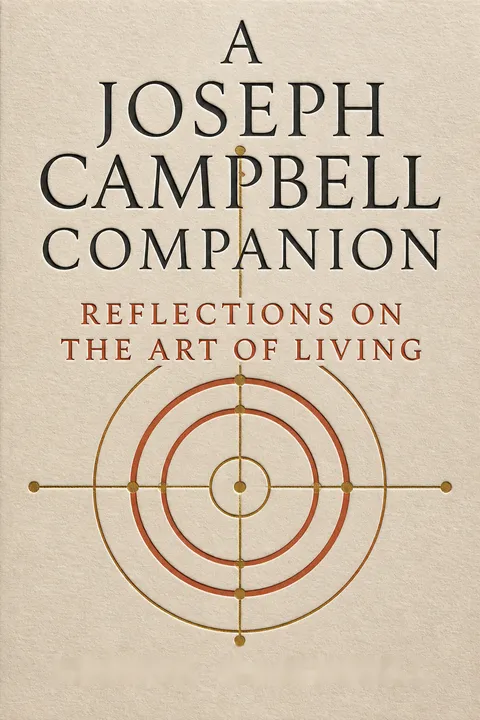
A Joseph Campbell Companion receives overwhelmingly positive reviews, with readers praising Campbell's wisdom and insights on mythology, spirituality, and personal growth. Many find the book life-changing and return to it repeatedly for guidance. Reviewers appreciate Campbell's ability to connect ancient myths to modern life, offering a fresh perspective on familiar concepts. Some critics note the book's disjointed structure and occasional dated views, but most readers find it deeply inspiring and enlightening, particularly during times of transition or self-discovery.
People Also Read








Glossary
bliss
inner vocational directionCampbell uses bliss for the felt direction of a life that expresses a person’s distinctive energies and interests. It is not simply pleasure, comfort, or a guarantee of success. Following bliss means attending to what makes life feel genuinely alive, then accepting the uncertainty involved in making room for it.
hero's journey
departure, transformation, returnA recurring story pattern in which a person leaves familiar social life, enters an unknown or difficult realm, undergoes change, and returns with something of value. Campbell treats it as a metaphor for individual development, not a required checklist. Each person’s route and the gift brought back depend on the life being lived.
mythology
cultural images of experienceCampbell uses mythology for a culture’s organized images and stories that relate people to the universe, social values, and the stages of life. Myths are not merely explanations of physical events. Read metaphorically, they can give shape to psychological and spiritual experiences and help people recognize possibilities within themselves.
māyā
world-making appearanceIn Campbell’s discussion of Indian thought, māyā names both the power that produces the world of appearances and the appearances themselves. It can conceal an underlying unity, project the forms people experience, and, through art or spiritual practice, reveal the mystery those forms express. The world is not simply unreal; it can be seen in different ways.
esthetic arrest
attention held by formCampbell uses this term for an aesthetic experience in which attention is held by a work’s wholeness, harmony, and radiance. For a time, the viewer is less occupied with using, possessing, fearing, or judging the object. Drawing on James Joyce, Campbell contrasts this contemplative response with art primarily designed to provoke desire or instruct an audience.
sacred space
protected place for attentionA place set apart from ordinary demands so a person can return to inward life, meaningful work, or meditation. It may be a temple, a room, or another personally significant environment. Its importance comes from how it focuses attention and makes ordinary objects or actions carry symbolic meaning, not from any inherent property of the location.
Bodhisattva
compassionate enlightened beingIn Mahayana Buddhism, a Bodhisattva is an enlightened being who remains engaged with the world rather than seeking release solely for himself or herself. Campbell uses the figure to express a spiritual ideal: insight deepens into compassion and service to all beings. The Bodhisattva represents return to the world, not escape from its suffering.
Cakra
subtle center of awarenessIn the yoga system Campbell describes, a cakra is a subtle center associated with a region of the body and a mode of psychological or spiritual experience. He discusses seven centers, from basic survival and desire to spiritual awareness. The system functions in the book as a symbolic map of changing consciousness, not as an anatomical description.
Five degrees of love
scale of devotional relationshipsA scheme Campbell presents from Hindu devotional thought, describing love through relationships such as servant and master, friends, parent and child, spouses, and total devotional absorption. The forms suggest increasing intimacy and intensity. Campbell uses the scheme to distinguish everyday loving responsibilities from rapture that can overwhelm ordinary relationships.
FAQ
What's A Joseph Campbell Companion: Reflections on the Art of Living about?
- Exploration of Myth and Life: The book is a collection of Joseph Campbell's insights from his workshops, focusing on the intersection of mythology, psychology, and the human experience.
- Personal Growth and Awareness: It emphasizes self-discovery and personal transformation, encouraging readers to find their own paths and meanings in life.
- Integration of Spirituality and Daily Life: Campbell discusses how to live joyfully and meaningfully, integrating spiritual insights into everyday experiences.
Why should I read A Joseph Campbell Companion?
- Inspiration for Personal Journey: The book offers profound reflections that can inspire readers to embark on their own journeys of self-discovery and fulfillment.
- Understanding of Universal Themes: Campbell's exploration of myths provides a framework for understanding universal human experiences, making it relevant to anyone seeking deeper meaning in life.
- Timeless Wisdom: The insights presented are timeless and resonate across cultures, making them applicable to contemporary life challenges.
What are the key takeaways of A Joseph Campbell Companion?
- Follow Your Bliss: Campbell encourages individuals to pursue what brings them joy and fulfillment.
- Embrace Life's Challenges: He suggests that adversity can lead to growth, as deeper powers within ourselves are found during challenging times.
- Unity of Experience: Campbell highlights the interconnectedness of all human experiences, suggesting that apparent separateness is secondary.
What are the best quotes from A Joseph Campbell Companion and what do they mean?
- "The privilege of a lifetime is being who you are.": This underscores the importance of authenticity and embracing one's true self as the ultimate fulfillment in life.
- "Life is without meaning. You bring the meaning to it.": Campbell suggests that meaning is created by individuals through their experiences and choices.
- "The warrior’s approach is to say 'yes' to life.": This reflects the idea of embracing all aspects of life, both joy and sorrow, as essential parts of the human experience.
How does Joseph Campbell define the "hero's journey" in A Joseph Campbell Companion?
- Universal Pattern: The hero's journey is a universal narrative structure involving departure, initiation, and return, symbolizing personal transformation.
- Call to Adventure: It begins with a "call to adventure," where the hero leaves their ordinary world to embark on a quest for self-discovery.
- Integration of Experience: The journey culminates in the hero's return, bringing back wisdom or a boon to share with their community.
What is the significance of mythology in A Joseph Campbell Companion?
- Framework for Understanding Life: Campbell argues that mythology serves as a lens to understand our lives and universal themes that connect us all.
- Cultural Reflection: Myths reflect the values, beliefs, and struggles of cultures, providing insight into human nature and societal dynamics.
- Personal Transformation: Engaging with myths can facilitate personal growth, mirroring the hero's journey individuals undergo in their own lives.
How does A Joseph Campbell Companion address the concept of self and identity?
- Self-Discovery: Campbell emphasizes understanding oneself as a unique individual, shaped by personal experiences and choices.
- Transcendence of Ego: He discusses the need to transcend the ego to connect with a deeper sense of self that is part of the collective human experience.
- Integration of Inner and Outer Worlds: True identity is found in balancing one's inner spiritual life and outer social existence.
What role does spirituality play in A Joseph Campbell Companion?
- Connection to the Divine: Campbell explores spirituality as a means of connecting with a higher power or universal consciousness.
- Personal Practice: He encourages readers to cultivate spiritual practices that resonate with their personal beliefs and experiences.
- Integration with Daily Life: Spirituality is presented as integral to everyday life, influencing how individuals navigate challenges and find meaning.
How does Joseph Campbell suggest we deal with life's challenges in A Joseph Campbell Companion?
- Embrace Adversity: Challenges should be embraced as opportunities for growth, with the idea that "we can choose to live in joy."
- Transform Obstacles: Campbell encourages transforming obstacles into gateways for personal development, viewing them as essential parts of the journey.
- Seek Inner Strength: Finding deeper powers within oneself during difficult times is emphasized, suggesting resilience through self-awareness and acceptance.
What is the relationship between love and suffering in A Joseph Campbell Companion?
- Interconnectedness of Emotions: Love and suffering are deeply interconnected, with love often leading to vulnerability and potential pain.
- Growth Through Suffering: Experiencing suffering can deepen one's capacity for love and compassion, enriching personal relationships and spiritual understanding.
- Joyful Participation: Embracing both love and suffering is essential for a meaningful life, as advocated by the book.
How does Joseph Campbell define sacred space in A Joseph Campbell Companion?
- Personal Retreat: Sacred space is any space set apart from the usual context of life, where individuals can engage in introspection and creativity.
- Exclusion of Distractions: It should be free from external pressures, allowing for a deeper connection with oneself and one's spiritual journey.
- Dynamic Environment: This space should be filled with meaningful objects and activities that resonate with the individual's inner life.
What is the overall message of A Joseph Campbell Companion?
- Interconnectedness of Life: The book conveys that all beings are interconnected, leading to a more compassionate and fulfilling life.
- Personal Growth through Myth: Campbell encourages engaging with myths as tools for personal growth and self-discovery.
- Sacredness of Existence: The message is one of reverence for life and the divine presence within it, urging individuals to recognize and celebrate the sacredness of their experiences.
About the Author




Download PDF
Download EPUB
.epub digital book format is ideal for reading ebooks on phones, tablets, and e-readers.








