

Key Takeaways
Treat an insult as a social signal, not just a cruel sentence
Intent is not required. An insult can be a remark, gesture, refusal, or omission that causes offense. Someone may insult a host by failing to thank her, or a friend by ignoring a greeting, without meaning to hurt anyone. The meaning also depends on culture and circumstance: behavior considered ordinary in one setting may be insulting in another. A missed invitation, for example, matters more when it breaks an established pattern of inclusion.
Read the situation first. Because offense depends on the recipient, the relationship, and the setting, good intentions do not guarantee that a remark will land well. But feeling insulted does not, by itself, prove deliberate malice. Before retaliating, it helps to distinguish what happened from what the other person may have meant.
This broad definition captures something important about social life: people respond to perceived meaning, not merely to a speaker’s private intention. It resembles the distinction in pragmatics between the words spoken and the social act they perform. The same silence can signal distraction, contempt, or intimacy, depending on context. That makes interpretation unavoidable, but not infallible. Treating every hurt feeling as proof of hostile intent can fuel needless conflict; treating intent as the only thing that matters can excuse real harm. The useful middle ground is to take the impact seriously while remaining curious about its cause.
Notice the status contest hiding inside omissions, comparisons, and compliments
Small gestures carry rankings. Subtle insults often arrive without a plainly hostile sentence. Forgetting to thank someone can imply that a gift did not matter. Praising a colleague’s old work while ignoring her recent work may suggest that her best days are behind her. Even a compliment can sting if it praises the wrong thing, or if it compares one person favorably by making another feel lesser.
Reports can wound twice. A secondhand insult occurs when someone passes along another person’s disparaging remark. The messenger may be trying to warn the target, or may be enjoying the chance to deliver pain while avoiding responsibility for the original insult. The book’s advice is not to become suspicious of every compliment, but to notice how comparisons and omissions can quietly communicate rank.
Indirect communication is efficient partly because it preserves deniability: a slight can be delivered while allowing the speaker to insist that nothing was meant. That ambiguity can make social life feel like a puzzle with no final answer. A useful response is to test the interpretation with a low-accusation question, especially in relationships worth protecting. At the same time, repeated patterns matter more than a single lapse. One forgotten thank-you may be forgetfulness; a recurring pattern of exclusion may reveal how the relationship is being managed.
Keep teasing playful by checking whether closeness is mutual
A jab can signal welcome. Playful teasing uses insults without intending serious harm. Friends may joke about one another’s habits, and a new group may tease a newcomer as a sign that it considers him one of its own. Teasing can also raise an awkward issue gently, such as a partner’s recurring messiness, where a joke may feel less hostile than a scolding.
The same tool can bully. Malicious teasing aims to shame, control, or push someone out. The difference is not simply the words used. It depends on the relationship, the target’s response, and the balance of power. A group that treats teasing as a membership test may create solidarity, but it can also pressure people to hide genuine hurt. Calling it a joke does not erase its effect.
Teasing works like a small social experiment: the participants learn whether a bond can tolerate criticism without collapsing. That can create warmth, especially where direct declarations of affection feel awkward. But the experiment is only fair when people can decline the game without losing belonging. Power changes the meaning of a joke: a boss teasing an employee or a group targeting an isolated member can make refusal costly. A good test of friendly teasing is not whether the teaser meant well, but whether the target can object and still be treated with respect.
Insults sting when they threaten belonging, rank, or identity
Rejection is the deeper wound. An insult from a stranger may anger someone, while the same remark from a partner can hurt deeply. The difference is that the partner’s words may suggest that a valued relationship has lost importance. Public insults add another threat: witnesses may appear to confirm the target’s reduced standing. The author cites a university survey in which 60 percent of students reported hurt feelings more often than once a month, and 20 percent at least weekly.
Identity raises the stakes. Insults can also challenge a person’s self-image, the traits and roles he considers central to who he is. A harsh critique of a poem may hurt especially badly when being a poet is central to the writer’s identity. The pain can then reflect not only rejection, but doubt about the self the person has built.
The account links social pain to attachment and identity, rather than treating sensitivity as mere vanity. That connection helps explain why a minor slight from a loved one can outweigh a harsher remark from someone irrelevant. It also suggests that repair often requires more than disproving the insult: reassurance about the relationship may matter most. Still, an insult is not always a reliable measure of rejection. People forget, speak carelessly, or disagree without withdrawing affection. The signal deserves attention, but its meaning should be checked against the wider pattern.
Recognize the inherited status game behind the urge to insult
Social monitoring stays active. Evolutionary psychologists argue that humans developed strong incentives to belong to groups and gain standing within them. The book connects this inheritance to the sociometer, a mental monitor of social acceptance that reacts to signs of inclusion or rejection. A pause, a snub, or a public slight can set off its alarm, prompting anger or efforts to restore status.
Envy can start the attack. People promote themselves by boasting, displaying success, or putting others down. A colleague’s award or a friend’s expensive purchase may feel like a threat to relative standing, even when no one has actually lost anything. The author argues that envy often lies behind first-strike insults. Evolution helps explain these impulses, but it does not make them wise or inevitable.
The sociometer offers a memorable way to understand why social cues can trigger reactions before deliberate thought catches up. It also connects insult behavior to group dynamics: status is not only an individual concern, but a shared system people continually negotiate. Evolutionary explanations are most useful when treated as accounts of pressures, not as proof that any particular behavior is biologically fixed. The same competitive impulse can be reshaped by institutions, norms, and personal reflection. Explaining why a person feels threatened does not excuse the damage caused by acting on that feeling.
Build self-respect through real challenges, not indiscriminate praise
Confidence needs honest evidence. The author distinguishes strong self-esteem from a secure self-image. Praise may make someone feel good, but without meaningful feedback, it may not help that person understand what she can do well or where she needs work. Irvine argues that children gain sturdier confidence by taking on achievable challenges, succeeding through effort, and accepting responsibility for mistakes.
Inflation is not mastery. The book reports that the share of high school students receiving As rose from 17.6 percent in 1968 to 47.5 percent in 2004, during a period of growing efforts to protect students’ self-esteem. Irvine argues that inflated praise and softened criticism can obscure real ability rather than build resilience. The figures illustrate his concern, though they do not alone prove that praise caused weaker performance or greater sensitivity.
The distinction between self-worth and competence is valuable: confidence grounded in experience is less dependent on strangers’ approval than confidence built from constant reassurance. This fits a broader learning principle: feedback is most useful when it identifies what can be improved and gives a person a way to improve it. Yet criticism is not automatically constructive, and praise is not automatically empty. Specific, credible encouragement can support persistence, while chronic harshness can make challenge feel unsafe. The key is not to ration kindness, but to make praise and correction informative enough to help a person grow.
Let silence or self-mockery starve an insult of its payoff
Do not feed the exchange. Insult pacifism means refusing to answer verbal attacks with counterattacks. The response may be silence, carrying on normally, or using self-deprecating humor rather than targeting the insulter. Irvine describes being verbally abused by a truck driver after capsizing a rowing shell. He felt anger rise, but chose not to react, reasoning that a reaction would reward the driver’s effort to provoke him.
A nonresponse can change the stakes. Insulters often expect a rebuttal or comeback; without one, they may be left frustrated and unsure how to continue. Self-mockery can make the same point while easing tension. This approach is not a requirement to tolerate danger or persistent mistreatment. A person can refuse revenge while still setting limits, seeking support, or using formal channels to address abuse.
The tactic resembles emotion regulation through interruption: attention shifts from defending status to choosing a response, which can keep anger from escalating. It also deprives an aggressor of the predictable reward of visible distress. But silence is not universally safe or fair. In a workplace, family, or school, repeated abuse can require documentation and intervention, not simply inner calm. The deeper lesson is to separate retaliation from protection. A person can decline the insult contest while clearly naming unacceptable conduct and taking practical steps to stop it.
Trade status chasing for character and insults lose their leverage
Change what counts as a loss. The Stoics argue that insults hurt partly because people prize reputation, wealth, and social rank. Their alternative is to value character traits such as courage, fairness, and self-discipline, along with tranquility. A person who no longer treats every exchange as a contest for rank has less reason to interpret an insult as a defeat.
The goal is freedom, not numbness. In the book’s analogy, someone who is not playing tag has little reason to worry when another person tags him. Likewise, a person who steps back from the status contest can see an insult as the other person’s move in a game he no longer accepts. Irvine’s own account makes the aim modest: the desire for status persists, but reflection can reduce its control.
This Stoic move changes the standard of success. Instead of asking whether others admire someone, it asks whether that person acts well. That shift can protect attention and make social comparison less consuming. It should not be confused with indifference to injustice: dignity, safety, and fair treatment matter even when prestige does not. Nor can anyone fully opt out of social evaluation, since relationships and institutions shape real opportunities. The useful ambition is not to stop caring about people, but to stop letting every judgment become a verdict on personal worth.
Use criticism as evidence, without letting enemies define you
Inspect the claim, not just the motive. Stoic advice in the book is to look for any truth contained in an insult, even when it comes from an unfriendly source. A critic may notice a weakness that a loyal friend avoids mentioning. If the criticism reveals a real flaw, it can become material for self-improvement; if it contains no useful truth, it may reveal more about the insulter than the target.
Neither accept nor dismiss automatically. The target of an insult should not confuse cruelty with insight, or assume that malice makes every observation false. The same discipline applies to praise: approval from people whose values are mistaken may be no more reliable than their disapproval. The practical question is whether the feedback is accurate and relevant, not whether it feels pleasant.
This is a form of epistemic humility: an unpleasant source can still provide accurate information, while a friendly source can be biased by affection. The idea is strongest when criticism is treated as a hypothesis to test rather than a command to obey. That protects people from both defensiveness and needless self-condemnation. It also matters that some insults target characteristics a person cannot or should not need to change. Self-improvement is not the same as accommodating every critic; judgment requires asking what standard the criticism assumes and whether that standard deserves authority.
Set rules against abuse, but do not mistake rules for immunity
Shared norms reduce guesswork. Politeness codes give people common expectations about greetings, gifts, and public behavior, making many disputes easier to interpret. Such rules differ across cultures and change over time. The book also examines political correctness codes, which aim to reduce language that demeans disadvantaged groups. It notes a recurring problem: new labels can themselves become disliked, prompting another round of replacement terms.
Protection has tradeoffs. Irvine contrasts US limits on regulating insulting speech with Canada’s criminal prohibition on publicly promoting hatred against identifiable groups. He argues that speech restrictions can inhibit discussion and be used strategically, while acknowledging that societies try to reduce harmful speech. Rules can restrain abuse, but they cannot guarantee that nobody feels insulted or replace the personal skill of responding wisely.
The section identifies a real tension between preventing group-directed harm and protecting open inquiry. Rules can establish boundaries and signal that certain forms of degradation are unacceptable; they can also become vague enough to chill legitimate disagreement. The right balance depends on the setting and the harm at issue, not on a simple choice between unrestricted speech and total protection from offense. Institutions need clear standards and fair procedures, while individuals still benefit from resilience. Neither policy nor private philosophy can do the other’s job alone.
Analysis
The book’s strongest move is to treat insults as social events rather than isolated words. A slight can threaten several things at once: a valued relationship, a person’s rank within a group, or a self-image built around a particular identity. This explains why identical remarks can be harmless banter in one relationship and devastating rejection in another. It also makes the book’s catalogue of omissions, teasing, backhanded praise, and public humiliation more than a collection of curiosities. Each case shows how people infer their place in other people’s minds.
The Stoic response is persuasive as a practice of attention. Refusing to retaliate interrupts a familiar loop in which each insult recruits another, and shifting value from reputation to conduct reduces the emotional stakes. The approach is particularly useful for petty provocation, where a comeback often prolongs the exchange without repairing anything. Yet the book’s emphasis on internal transformation needs a boundary: composure must not be treated as a duty to endure bullying, discrimination, or coercive treatment. Refusing to play a status game is different from refusing to defend oneself or others.
The evolutionary account gives a plausible reason that social rejection feels urgent, but its explanatory reach should remain modest. A general story about ancestral group life cannot identify the motive behind every slight; habit, fear, cultural norms, and deliberate cruelty may all contribute. Likewise, the book’s critique of self-esteem campaigns is sharper than its evidence can fully support. Inflated praise and grade inflation are suggestive examples, not a complete causal test. Its more durable insight is that confidence becomes sturdier when it is connected to real capacities and honest feedback.
Taken together, the book offers a practical sequence: identify what kind of social signal occurred, assess whether it is accurate or patterned, protect people from genuine harm, and avoid making status the measure of a good life. The goal is not to become unfeeling. It is to keep an insult from choosing the next action.
Review Summary
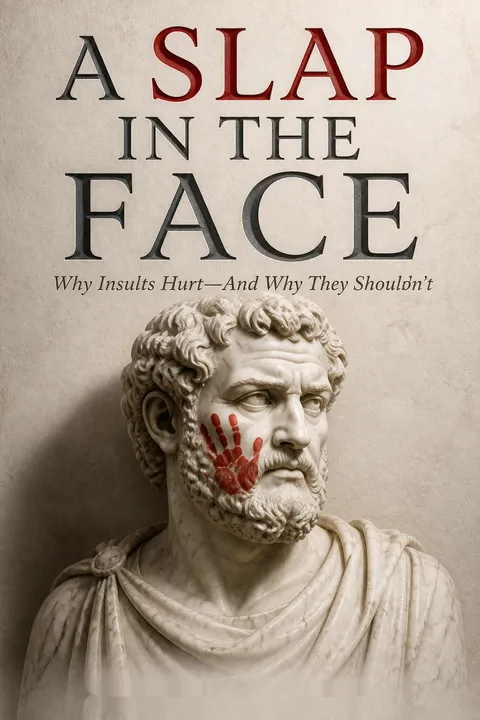
A Slap in the Face examines insults through a Stoic philosophical lens, exploring their types, psychological impact, and responses. Most reviewers appreciate Irvine's practical approach to becoming an "insult pacifist" by rejecting the social hierarchy game and choosing better values. The book argues insults hurt because we overvalue social status, but choosing proper internal values can make us immune to them. Some found it too academic or disagreed with self-deprecation advice. The third section on Stoic responses received particular praise, though earlier categorization chapters felt repetitive to many readers.
People Also Read






Glossary
sociometer
Monitors social acceptanceA proposed psychological system that continually tracks cues of approval, rejection, and exclusion. When it detects a threat to social acceptance, it produces unpleasant feelings that can motivate a person to restore connection or standing. In Irvine’s account, this system helps explain why even subtle social signals can trigger anger or hurt.
insult pacifism
Refusing verbal retaliationA personal strategy of not answering insults with counterinsults. The response may be silence, behaving as though the insult has no power, or using self-deprecating humor instead of attacking the insulter. Irvine draws on Stoic practice to argue that nonretaliation can frustrate provocation and reduce the target’s own distress.
social hierarchy game
Competition for social rankIrvine’s name for the everyday contest in which people seek higher standing and interpret others’ successes or slights as changes in relative position. Insults, boasting, envy, and subtle comparisons can all function as moves in this contest. Stoic practice aims to reduce its influence by placing greater value on character than reputation.
backrubbing
Praising someone indirectlyIrvine’s term for praising a person to someone else, rather than praising that person directly. The praise may reach its intended recipient through conversation, but it avoids some awkwardness or status tension that can arise face to face. It can also influence the listener, who may imitate the praised behavior.
self-aggrandizement scale
Rates self-promotionA zero-to-ten scale Irvine devised to describe how much a person promotes their own accomplishments in conversation. At the low end, a person rarely mentions achievements; at the high end, ordinary topics quickly become opportunities for self-praise. Irvine uses the scale to examine his own tendency to seek admiration.
un-sults
Insults that delightIrvine’s label for insults that do not produce the usual pain and may instead entertain or strengthen a relationship. Playful teasing, friendly insult exchanges, and some public roasts can function this way when participants understand the context and accept the terms. The label does not make malicious teasing harmless.
About the Author


Download PDF
Download EPUB
.epub digital book format is ideal for reading ebooks on phones, tablets, and e-readers.








