

Key Takeaways
Treat Buddhism as a practice for this world, not a passport to another.
This-worldly purpose. Stephen Batchelor argues for a secular Buddhism: a way to meet birth, illness, aging, death, and shared social problems without requiring belief in an afterlife. “Secular” here means oriented toward this life, not stripped of depth or moral seriousness. People can still have ultimate concerns, such as how to live with mortality, without accepting a religious institution or its cosmology.
More than a wellness tool. Batchelor warns that mindfulness detached from ethical commitments can become a technique for functioning more comfortably inside consumer culture. His proposal is to recover the early dharma as an ethical, contemplative, and philosophical practice, while recognizing that its historical forms, including his own, are shaped by their time and culture.
What's compelling is the refusal to equate secularism with shallow materialism. A practice can reject supernatural guarantees while taking grief, responsibility, and mortality seriously. That distinction matters wherever contemplative methods enter workplaces or health care: symptom relief may be valuable, but it does not by itself answer what a person or institution should care about. The tension is real, though. A secular framework can also become a new orthodoxy, especially if it treats modern skepticism as culture-free. The proposal is strongest as an ongoing conversation between inherited practice and contemporary judgment, not a final purification of Buddhism.
Turn the Four Noble Truths into four tasks you can actually perform.
A practical sequence. Batchelor reads an early teaching as a fourfold task rather than a set of propositions to believe. First, comprehend dukkha, the whole condition of life, including pleasure and loss. Second, let go of reactivity, the pull to grasp, reject, or obsess. Third, behold the moments when that reactivity ceases. Fourth, cultivate the eightfold path through complete understanding, speech, action, livelihood, effort, mindfulness, and concentration.
Practice, not doctrine. The tasks overlap: understanding a difficult situation can loosen impulsive reactions, while a calmer response can clarify what is happening. Batchelor argues that adding the phrase “noble truth” made the instructions sound like claims to understand, abandon, or develop, when the actual work is to understand suffering, release reactivity, and cultivate a path.
The framework shifts the test of a teaching from assent to participation. It resembles a practical discipline in which insight is judged partly by what it enables someone to do, rather than by whether a theory appears complete. This also guards against treating suffering as an abstract topic instead of attending to a particular person's pain. Batchelor's philological case is provocative, not settled fact: the texts were transmitted and edited over centuries, and their wording supports multiple readings. Readers can still use the tasks as a coherent practice without accepting every claim about how the canonical formula developed.
Nirvana is freedom from reaction, not an escape from being alive.
A usable freedom. Batchelor interprets nirvana as the ending, for a time, of greed, hatred, and confusion, not as a separate realm beyond ordinary life. Pain, illness, and anxiety remain possible in an embodied person. What changes is the freedom to avoid being governed by each impulse. A reaction may arise, but it need not dictate the next word or action.
Conditions still matter. The Buddha's teaching of conditionality means that events arise through interacting causes and can change when conditions change. Batchelor pictures the path as moving against habitual reactivity while learning to flow along a different current. This is not a claim that willpower can erase biological drives. It is a training in noticing them, declining to feed them, and responding with greater care.
This account makes liberation psychologically intelligible without promising an emotion-free life. It also aligns with a useful distinction in emotion regulation: feelings can be involuntary while actions remain open to reflection and restraint. That opening is ethically significant, not merely calming. Still, the emphasis on individual nonreactivity has limits. A person cannot meditate away illness, poverty, or political violence. The account becomes more persuasive when freedom from impulsive response supports action on difficult conditions, rather than becoming a private substitute for changing them.
Use doubt to loosen certainty, then test teachings by their effects.
Questions before conclusions. Batchelor favors the skeptical and pragmatic voices in the early discourses. In the poisoned-arrow parable, a wounded man refuses treatment until he learns every detail about the shooter and weapon. The point is that some questions can distract from the urgent work of healing. Teachings should be tested by whether they reduce harmful reactivity and support a more compassionate life, not accepted solely because a scripture, lineage, or teacher endorses them.
No miracles required. Sunakkhatta, a former follower, rejected Gotama partly because the teacher did not provide supernatural displays or grand answers about the universe's beginnings. Batchelor treats this as a warning against confusing spectacle with practice. Skepticism here does not mean that every claim is false. It means refusing to let metaphysical certainty replace attention to consequences.
The poisoned-arrow image is a powerful model of prioritization: not every unresolved question deserves equal attention at every moment. Pragmatic testing also makes a tradition answerable to lived consequences. Yet usefulness alone cannot establish truth. A comforting belief may feel helpful while misleading its adherents, and a difficult fact may be ethically necessary despite offering no immediate relief. The most robust version of Batchelor's approach combines practical scrutiny with intellectual honesty: ask what a belief enables, what it obscures, and what evidence could change the judgment.
Meet experience as a process, not as a possession of a fixed self.
Five changing bundles. Batchelor presents experience through five interacting aspects: physical form, feeling, perception, inclination, and consciousness. They are not five separate substances but a way to notice how a situation is sensed, felt, interpreted, and answered. Consciousness, on this account, depends on conditions rather than existing as a permanent witness outside the body and world.
Self without a hidden ruler. The teaching of not-self challenges the idea that a stable inner controller can command the body never to become sick or the mind never to feel fear. It does not require denying that people make choices or carry responsibility. The self is an evolving person, shaped by experience and action, rather than an unchanging essence. Practice asks what can be understood and changed, not what the self ultimately is.
This process view avoids two familiar extremes: imagining a sovereign self untouched by circumstances, and treating a person as a passive machine with no practical agency. Contemporary approaches to cognition likewise study perception and action as intertwined with bodily and environmental conditions. That connection supports the book's emphasis on embodied attention, though it does not prove the Buddhist account. The framework also needs care in ethical use: describing behavior as conditioned can deepen compassion, but it must not become an excuse to erase accountability or the reality of individual experience.
Let meditation disclose the ordinary world's strangeness, not promise supernatural escape.
Attention begins in the body. Batchelor presents meditation as dwelling in the breath and sensory life, not as a guaranteed route to visions, special powers, or a purified realm. The breath offers a direct way to notice bodily experience without needing to control it. Attention can then extend to posture, feelings, daily actions, and other people's physical presence.
The everyday sublime. This term names ordinary life experienced with enough openness to reveal its beauty, instability, and mystery. Meditation develops a sensibility, much like learning to appreciate art: technique can help focus attention, but technique alone cannot guarantee compassion or insight. Walking, eating, or caring for someone can belong to practice as fully as sitting meditation, provided awareness remains connected to ethical aims.
The comparison to art helps explain why contemplative training cannot be reduced to a measurable performance. Repeated exercises can build attention, while the meaning of that attention depends on the person and context in which it is used. This distinction is especially useful as mindfulness becomes a standardized intervention. At the same time, technical methods need not be dismissed: reliable instructions can make practice accessible and help people notice change. The important question is whether a technique opens attention to the world and other people, or simply makes the practitioner more efficient at pursuing existing goals.
Make care visible in relationships, public choices, and responses to suffering.
Care as a way of life. Batchelor translates appamāda as care: attentive concern for one's own condition and the well-being of others. It is sustained by friendship and example, not just by reading moral rules. King Pasenadi learns that external power cannot protect someone from the consequences of unethical conduct. His wife Mallikā helps him understand sorrow by asking him to imagine losing the people and places he loves.
Ordinary people can practice. Mahānāma, a ruler troubled by fear and sensual desire, is still portrayed as committed to the path. Jīvaka, a physician, embodies care through his work with the sick. The book uses such imperfect, socially engaged figures to argue that ethical practice is not reserved for secluded specialists. It also urges equal participation across gender and social roles.
Care becomes more concrete here than a general wish for kindness. It means attending to particular bodies, relationships, and consequences, and allowing another person's vulnerability to alter one's priorities. That resembles the logic of care ethics, which treats dependence and relationship as central moral facts rather than exceptions to individual autonomy. The examples also challenge the assumption that spiritual authority belongs only to renunciants. Still, intimate compassion cannot carry the whole burden of justice: caring relationships are necessary, but institutional arrangements can systematically produce harm and require collective correction.
Build a community where authority belongs to the practice, not rank.
A fourfold community. Batchelor argues that the early community included male and female mendicants and adherents. Membership depended on making the path one's own, not on ordination or gender. The ideal is a network of self-reliant people who learn from one another while remaining responsible for their own judgment.
A succession struggle. Near Gotama's death, he refuses to appoint a personal successor and points followers toward the dharma. Afterward, the strict elder Mahākassapa and the more inclusive Ānanda represent competing visions of authority. Ānanda, who served the teacher and preserved his teachings, is treated harshly by some elders. Batchelor reads this conflict as an early contest between hierarchy and a community of equals, while acknowledging that the historical record is fragmentary.
The proposal makes community more than a support group: it is a structure for distributing responsibility and limiting charismatic power. Shared authority can protect members from the assumption that spiritual attainment makes a leader immune to scrutiny. But consensus is not automatically fair. Informal groups can reproduce status and exclusion while claiming equality, and expertise still matters when teaching or caring for others. A workable community therefore needs both plural participation and transparent ways to question decisions, recognize skill, and protect people with less power.
Aim awakening toward a flourishing society, not private spiritual achievement.
The path rebuilds a city. In one parable, a traveler finds an overgrown route to a ruined city and asks a ruler to help restore it. Batchelor reads the city as an image of shared life made more humane through the path: secure, prosperous, and open to community. The aim is not merely a private state of calm but a society shaped by ethical conduct and mutual responsibility.
Responsibility survives death. Batchelor questions whether rebirth and cosmic karma must be accepted as literal facts. He separates survival after death from the idea that actions have consequences. History, psychology, and ecology show how choices shape lives beyond an individual lifespan. A secular practice can therefore replace concern about one's next birth with responsibility for the people and other living beings who inherit today's world.
The city parable gives the book an important political horizon: inner restraint matters partly because it changes how people build institutions and share a world. Modern ecological thinking sharpens that point by tracing consequences across generations and species. Yet a flourishing society cannot be inferred from individual virtue alone. Power, resources, and public rules shape what choices are available, so civic practice must address structures as well as motives. The book's lasting challenge is to keep meditation connected to shared conditions, rather than letting either private serenity or abstract activism stand in for the work.
Analysis
After Buddhism is both a reconstruction of early Buddhist practice and an argument about how traditions change. Batchelor reads scattered Pali discourses against later doctrinal systems, looking for a dharma centered on conditionality, embodied attention, ethical freedom, and community. His organizing shift, from truths to tasks, is the book's sharpest contribution: it recasts awakening as a lived capacity to understand suffering, loosen reactive habits, recognize their temporary cessation, and cultivate an integrated life.
The biographical narratives keep this proposal from becoming merely theoretical. Mahānāma remains a political leader with fears and desires; Pasenadi is a compromised ruler; Jīvaka serves patients; Ānanda's emotional loyalty becomes entangled in institutional conflict. These figures make practice visible among people who are neither idealized saints nor detached observers. The result is a human portrait of the dharma as an activity conducted amid vulnerability, power, and imperfect choices.
The book's method is also its main vulnerability. The early canon is a layered, internally diverse record, and Batchelor's preference for skeptical and pragmatic passages reflects a modern secular sensibility as well as textual analysis. His arguments about interpolations, doctrinal evolution, and the Buddha's historical intentions are often plausible hypotheses, but not settled demonstrations. Nor does showing that rebirth or ultimate truth is unnecessary for a practical reading prove that such beliefs are false. The strongest case for the project is therefore not that it has recovered an uncontested original Buddhism, but that its interpretation yields a coherent and ethically serious practice.
That practice also resists two easy reductions. It is not simply a private therapeutic technology, because care, friendship, equality, and civic life are central. It is not a rejection of religious depth, because mortality, awe, and uncertainty remain ultimate concerns. The book asks whether a tradition can honor its past without treating inherited cosmology or hierarchy as untouchable. Its answer is a provisional yes: keep the practice answerable to experience, consequences, and the needs of a shared world.
Review Summary
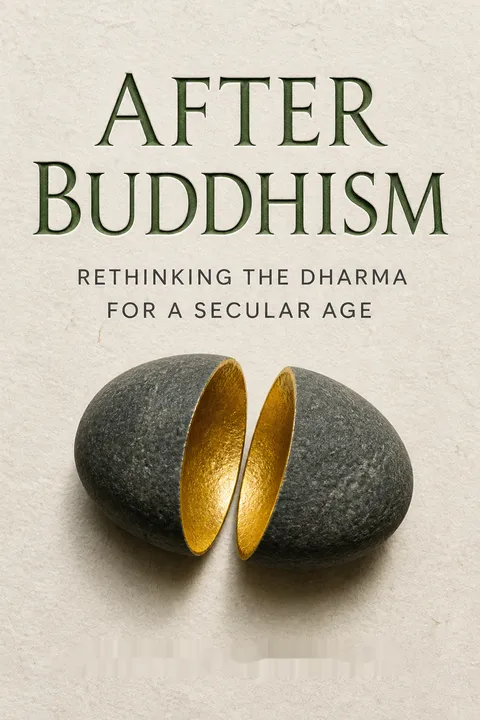
After Buddhism by Stephen Batchelor presents a secular interpretation of Buddhist teachings, focusing on pragmatic ethics rather than metaphysical beliefs. Readers appreciate Batchelor's efforts to strip away religious dogma and return to the Buddha's original intent. Many find his reinterpretation of core Buddhist concepts refreshing and relevant to modern life. However, some critics argue that Batchelor cherry-picks ideas to fit his secular vision. Overall, reviewers praise the book's thought-provoking nature and its potential to make Buddhism more accessible to contemporary Western audiences.
People Also Read







Glossary
Fourfold task
Four practices for livingBatchelor's practical reading of an early Buddhist teaching often presented as the Four Noble Truths. The tasks are to comprehend dukkha, let go of reactivity, behold the ceasing of reactivity, and cultivate the eightfold path. They are interconnected practices, not merely propositions to accept, and they orient the dharma toward ethical life in the present world.
Four P's
Four foundations of practiceBatchelor's name for four elements he considers distinctive in Gotama's teaching: the principle of conditionality, the practice of a fourfold task, the perspective of mindful awareness, and the power of self-reliance. Together they form his proposed foundation for a secular interpretation of the dharma, distinct from beliefs he sees as shared with other ancient Indian traditions.
conditionality
Events depend on conditionsThe principle that situations and experiences arise through conditions and change when those conditions change. Batchelor treats conditionality less as a complete theory of the universe than as a practical way to understand how past circumstances and choices shape the present, and how present actions can open different possibilities.
reactivity (tahā)
Habitual grasping and resistanceBatchelor uses reactivity for the repetitive patterns of attraction, aversion, fixation, and self-protective response that arise when a living person encounters the world. It is broader than the common translation of tahā as craving. Reactivity is natural, but when it governs action it can intensify distress and obstruct more considered responses.
five bundles
Five aspects of experienceA framework describing experience through physical form, feeling, perception, inclination, and consciousness. Batchelor interprets these not as independent substances but as interwoven aspects of embodied life. Comprehending them helps reveal how experience is conditioned and changing, without requiring a permanent inner controller separate from the body and world.
embodied attention
Attending from lived experienceBatchelor's rendering of yoniso manasikāra, a mode of attention grounded in bodily experience and directed toward the conditions that shape it. Rather than accepting habitual perceptions automatically, practitioners examine feelings, interpretations, and intentions with care. This attention supports comprehension of experience and helps loosen reactive patterns.
everyday sublime
The ordinary, newly vividBatchelor's term for ordinary life experienced with heightened openness to its beauty, fragility, and mystery. The everyday sublime is not a hidden supernatural realm or a special meditative state. It emerges when attention is less governed by assumptions of permanence, control, and ownership, allowing familiar experience to feel surprising again.
stream entry
Commitment to the pathA canonical image Batchelor interprets as making the eightfold path one's own. A stream entrant has undergone a shift in core orientation toward the Buddha, dharma, and community, but is not thereby portrayed as flawless or free from every recurring impulse. The term includes committed adherents as well as mendicants.
place and ground
Identity versus changing conditionsBatchelor's contrast between a person's reassuring social or psychological identities, called place, and the contingent conditions of lived existence, called ground. Clinging to place can obscure how unstable life is. Attending to ground means recognizing that identities and situations depend on changing conditions, while remaining engaged in the world.
care (appamāda)
Vigilant, compassionate concernBatchelor's preferred translation of appamāda, a central virtue that combines alertness with concern for the well-being of oneself and others. Care is not merely a momentary feeling or diligence at a task. It is a way of living that resists heedlessness and supports ethical choices, friendship, and the cultivation of the path.
FAQ
What's After Buddhism: Rethinking the Dharma for a Secular Age about?
- Secular Buddhism Exploration: The book explores how Buddhism can be practiced in a secular context, moving away from traditional religious frameworks.
- Focus on Human Experience: It emphasizes the importance of personal experience and ethical living over dogmatic beliefs.
- Fourfold Task Framework: Stephen Batchelor introduces a practical framework consisting of four tasks to guide meaningful living.
Why should I read After Buddhism?
- Relevance to Modern Life: The book offers insights applicable to contemporary issues, integrating Buddhist principles into daily life.
- Challenging Orthodoxy: Batchelor encourages questioning established beliefs, promoting a personal and experiential approach.
- Critical Thinking Encouragement: It fosters inquiry and doubt, aligning with personal responsibility and ethical living.
What are the key takeaways of After Buddhism?
- Embrace Impermanence: Understanding life's transient nature can lead to a more fulfilling existence.
- Mindful Awareness: Cultivating mindfulness helps navigate life's complexities and challenges.
- Community and Care: Ethical living is rooted in relationships, emphasizing the significance of community.
What is the significance of the twofold ground in After Buddhism?
- Conditioned Arising and Nirvana: These concepts form the basis for a practical approach to the dharma.
- Framework for Practice: It allows practitioners to engage with experiences, fostering growth and understanding.
- Relevance to Secular Life: Batchelor makes these concepts accessible to those in a secular age.
How does Stephen Batchelor define the fourfold task in After Buddhism?
- Comprehending Suffering: Understanding suffering as an integral part of life.
- Letting Go of Reactivity: Releasing attachment to cravings and reactivity.
- Beholding the Ceasing: Recognizing moments when reactivity ceases for deeper understanding.
- Cultivating the Path: Engaging with the eightfold path for ethical living and personal development.
How does After Buddhism address the concept of not-self (anattā)?
- Reinterpretation of Not-Self: Understanding identity as fluid and contingent, reducing suffering.
- Focus on Experience: Recognizing interconnectedness encourages a compassionate approach to life.
- Practical Implications: Leads to reduced ego-driven behavior and increased ethical living.
What role does doubt play in After Buddhism?
- Doubt as Inquiry Tool: Encourages critical thinking and personal exploration.
- Existential Doubt: Leads to deeper insights into suffering and existence.
- Connection to Sŏn Buddhism: Parallels with Zen Buddhism, where doubt is a pathway to awakening.
How does After Buddhism redefine the relationship between Buddhism and modernity?
- Secular Approach: Advocates for a secular interpretation relevant to contemporary life.
- Focus on Human Experience: Emphasizes personal experience and ethical living over dogma.
- Cultural Adaptation: Suggests Buddhism can adapt to modern challenges, fostering a culture of awakening.
How does Batchelor's view of the Buddha differ from traditional interpretations?
- Humanizing the Buddha: Emphasizes the Buddha's struggles and insights over divine attributes.
- Focus on Practicality: Shifts focus from metaphysical claims to practical applications of the dharma.
- Critique of Orthodoxy: Challenges traditional interpretations, inviting reconsideration of the teachings.
What are the best quotes from After Buddhism and what do they mean?
- “Whatever is subject to arising is subject to ceasing.”: Highlights the core teaching of impermanence.
- “The dharma is the whole elephant.”: Illustrates the complexity and multifaceted nature of the dharma.
- “Care is the path to the deathless; carelessness the path to death.”: Emphasizes mindfulness and ethical living.
How does After Buddhism address the role of community in practicing the dharma?
- Importance of Relationships: The practice of the dharma is deeply rooted in interactions with others.
- Care and Compassion: Care for oneself and others is fundamental to ethical living and community building.
- Collective Flourishing: Cultivating community enhances understanding and commitment to the dharma.
How does Stephen Batchelor define mindfulness in After Buddhism?
- Mindfulness as Embodied Attention: Connects individuals to their immediate experience.
- Integration into Daily Life: Extends mindfulness to all aspects of life, encouraging continuous practice.
- Cultivation of Compassion: Develops empathy and compassion, aligning with the ethical dimensions of the fourfold task.
About the Author


Download PDF
Download EPUB
.epub digital book format is ideal for reading ebooks on phones, tablets, and e-readers.








