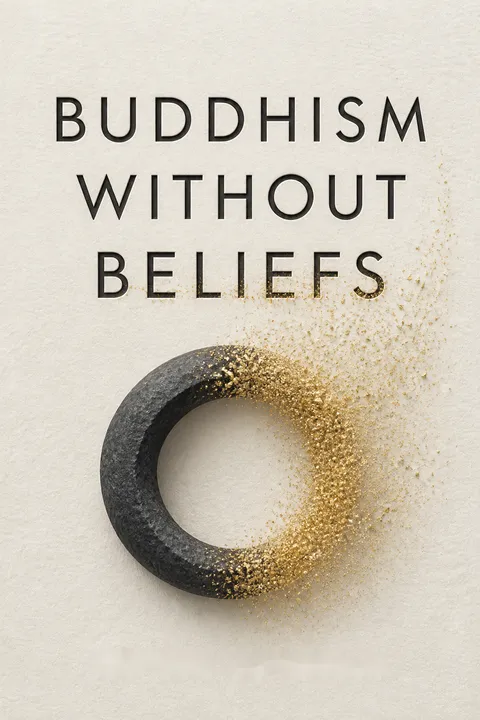


Key Takeaways
Treat the Buddha’s truths as four tasks, not four doctrines to believe
A practical diagnosis. Batchelor reads the Buddha’s first teaching as a method for responding to distress, not a creed about the universe. Its four truths name anguish, what feeds it, the possibility of its ending, and a path of practice. Each calls for a distinct action: understand anguish, release its causes, experience its easing, and cultivate a way of living that supports freedom. Like a medical diagnosis, the teaching matters because it directs a response, not because someone assents to a proposition.
Practice over certainty. This framing shifts Buddhism from a package of claims to a course of action. A worry, for example, is not simply proof that life is suffering. It is an invitation to examine what is happening and what response might loosen the grip of craving. The four tasks work together, rather than serving as a ladder of spiritual ranks.
The shift from belief to practice resembles an important distinction in medicine: knowing a diagnosis is not the same as following treatment. It also makes the teaching testable in ordinary life, since its value can be judged by what happens to attention, conduct, and distress. Still, practice and belief are not always clean opposites. Communities transmit practices through stories and shared assumptions, and those assumptions can shape what practitioners notice. The book’s distinction is most useful as a corrective to passive assent, not as proof that Buddhist traditions contain no meaningful doctrines.
Meet anguish closely; avoidance turns change into a private crisis
Look directly at distress. The book uses anguish for the unease that arises when people demand lasting security from changing conditions. Illness, aging, grief, and death are not unusual interruptions in an otherwise controllable life. They expose how little can be guaranteed. Siddhartha’s traditional story makes this concrete: protected within palace life, he encounters sickness, old age, death, and a wandering seeker, and can no longer treat vulnerability as someone else’s problem.
Understand before reacting. When worry appears, the habitual responses are often denial, distraction, or an attempt to force the feeling away. Batchelor argues that careful attention reveals it as changing and dependent on conditions, rather than as a fixed object that defines the self. This does not erase pain. It can, however, make room for a response before fear or rumination takes over.
This approach has a useful connection to acceptance-based therapies, which distinguish making room for painful experience from endorsing it or surrendering to it. It also counters the common mistake of treating every difficult feeling as a malfunction to eliminate. The argument is strongest when anguish means the additional distress created by clinging, not every form of suffering. Physical pain, trauma, and injustice may call for protection or treatment as well as attention. Understanding experience should widen practical choices, not become a reason to tolerate preventable harm.
Keep metaphysical uncertainty open, but let it sharpen present action
Agnosticism as discipline. Batchelor presents agnosticism not as indifference but as refusing to claim certainty where evidence does not settle the question. The Buddha’s parable of a poisoned arrow illustrates the priority: a wounded person who insists on learning every detail about the attacker before accepting treatment may die while waiting. Questions about the universe’s limits or what happens after death, the book argues, should not obstruct work on anguish here and now.
Rebirth remains uncertain. The Buddha accepted rebirth according to the book’s account, but Batchelor argues that modern practitioners need not treat it as established fact. He distinguishes literal survival after death from the consequences of actions that continue through other people. He also presents karma primarily as intention shaping habits and experience, rather than as a complete cosmic explanation.
The strongest feature of this position is its separation of existential practice from claims that belong to other kinds of inquiry. Uncertainty becomes active: it redirects effort toward what can be examined in experience and toward consequences that are visible in this life. The distinction also resists using promised reward or punishment as the sole basis for ethics. A tension remains: suspending belief in rebirth may be liberating for some practitioners, while others understand it as integral to Buddhist teaching. The book offers a compelling contemporary interpretation, not a neutral account accepted by every Buddhist tradition.
Use mortality to make ordinary life vivid and choices honest
Let death ask a question. The book proposes a meditation that begins with steady attention to breathing, then considers that death is certain while its timing is unknown. Rather than treating this as a gloomy slogan, the practitioner reflects on what it means personally: life depends on a fragile body, and no schedule guarantees a long future. Batchelor compares this to drifting toward a waterfall while absorbed in the scenery behind the boat.
Return to what matters. The exercise asks whether daily life reflects deeply held priorities or keeps postponing them until circumstances become ideal. Its purpose is not to produce a dramatic revelation. Repeated reflection may turn an abstract fact into a felt awareness that makes sensory life, relationships, and choices newly valuable. The practice ends by returning attention to the breath and the immediate surroundings.
Mortality reflection can function as a values exercise: it interrupts routine long enough to distinguish chosen priorities from inherited momentum. That is a more grounded use of death awareness than treating it as a demand for heroic urgency. There is also a real limit. For people coping with bereavement, trauma, or acute anxiety, sustained attention to death can intensify distress rather than clarify purpose. The book’s careful, embodied approach matters here. Mortality is most useful as a prompt for honest attention, not as a weapon for shaming ordinary hesitation.
Train attention to catch impulses before they become your identity
Notice the missing minutes. Batchelor describes walking to a shop for milk while mentally rehearsing an argument. The errand happens, but attention misses the weather, a friend calling from across the street, and much of the world around it. This ordinary lapse shows how habit can steer a person while the mind is elsewhere.
Return without punishment. Mindfulness means remembering to attend to experience as it unfolds. Formal practice begins with breathing and bodily sensations, then includes feelings, thoughts, and sounds. When anger appears, the aim is neither to indulge it nor pretend it is absent. Notice its physical signs and mental story, then keep returning to present experience. Restlessness and dullness are not proof of failure; they are conditions to observe and work with. The training builds steadier attention, not perfect control.
The account anticipates the modern idea of metacognition: noticing a thought as an event in the mind rather than automatically treating it as a command or fact. That small distance can change behavior without requiring a person to suppress emotion. The milk errand also illustrates how attention is a resource with social consequences; distraction can narrow awareness of other people and surroundings. Yet the aspiration to detect an impulse at its very beginning may set an unrealistic standard. The more practical measure is whether attention returns, and whether that return makes the next response less automatic.
See the self as a conditioned process, not a sealed possession
Trace the chain. The book presents dependent origination as a sequence in which confusion shapes activity and awareness, sensory experience gives rise to feeling, and feeling can feed craving, clinging, and repeated patterns of becoming. The point is not that one event mechanically determines the next. It is that experience develops through conditions, and those conditions can sometimes be noticed before they harden into a familiar reaction.
Find room to respond. A sound or remark may trigger a mood, which then colors perception and suggests an action. Batchelor’s snake-in-the-shed example shows how prior expectations can turn a coiled garden hose into a threat until closer attention corrects the perception. The self, too, is described as a changing arrangement of bodily, mental, and cultural processes. That view does not deny a person’s distinct life; it questions the idea of an independent, unchanging core.
This process view resonates with systems thinking, where outcomes emerge from interactions rather than from a single isolated cause. It can make self-understanding less punitive: a reaction has a history and conditions, which means it may be altered by changing those conditions. That does not make responsibility disappear. In fact, tracing how actions shape later habits can deepen it. The hose mistaken for a snake also points to the value of checking perception before acting. Still, a fluid account of the self needs practical continuity, such as memory and accountability, to explain how commitments endure across change.
Use emptiness to loosen fixed boundaries, not to deny the world
No thing stands alone. Emptiness is the absence of an independent, permanent essence, not a hidden cosmic substance or a claim that nothing exists. A pen remains recognizable through its parts, materials, and use, but dismantling it makes it difficult to identify a single component as the pen itself. A flower likewise develops through conditions, with no exact natural line separating its earlier form from its later one.
Apply the insight to yourself. People, too, depend on bodies, relationships, histories, and language. Batchelor’s concern is less to prove a theory about the self than to loosen the clinging that makes identity feel like a fragile object under constant threat. Emptiness does not remove ordinary distinctions. It invites a more flexible response to a world whose boundaries and meanings depend partly on how things relate.
The relational account has clear affinities with ecology and contemporary theories of complex systems: an entity can be real and consequential without existing independently of its surroundings. This avoids the easy but mistaken slide from no fixed essence to nothing matters. The pen and flower examples make an abstract idea inspectable in ordinary experience. A useful caution is that conventional categories remain indispensable. A growing flower and a sprout may lack a sharp metaphysical boundary, but practical distinctions still help people describe, study, and care for living things. Flexibility need not mean vagueness.
Extend compassion beyond your circle without appointing yourself its savior
Question the private portrait. Batchelor asks readers to imagine a friend, an enemy, and a stranger across the span of each person’s life. Each was born, formed hopes, and faces aging and death. The exercise loosens the tendency to reduce people to how they make us feel. A friend is not only a source of comfort, an enemy only a source of irritation, and a stranger more than a passing image.
Broaden concern carefully. Compassion often comes naturally for family or friends but falters across the boundary between us and them. The book describes an antagonist revealing a frightening illness, and resentment giving way to recognition of his fear. Compassion is not agreement or unlimited self-sacrifice. It requires attention, courage, and discernment, and it can be undermined when helping others becomes a performance of moral superiority.
Perspective-taking can soften snap judgments by restoring the complexity hidden behind a social label. The practice is especially valuable because it does not require pretending to like someone; it asks that their inner life be taken seriously. At the same time, empathy is selective and can privilege vivid individual stories over less visible groups. That is why the book’s emphasis on disciplined reflection matters, along with its warning against savior fantasies. Compassion is not simply a warm feeling. It needs judgment about what help is useful, what boundaries are necessary, and whose voice is missing.
Make ethics a courageous response, not obedience to certainty
Integrity includes risk. The book grounds ethical life in empathy, but argues that good intentions alone do not guarantee good results. A person must also understand the situation and have the courage to act, knowing that consequences cannot be fully predicted. Integrity therefore differs from moral certainty. Instead of reaching for a rule that settles every case, ask what response is compassionate in this particular situation.
Learn from concrete choices. Ethical awareness includes noticing when fear, self-interest, or concern for one’s image is disguising itself as kindness. It also includes reviewing mistakes rather than defending them as inevitable. A pause can be useful, but hesitation may become a way to avoid responsibility. The book treats words and actions as consequential interventions: they shape the present relationship and the conditions people will face next.
This view is close to practical ethics, where judgment depends on context and must remain answerable to consequences. Its refusal to promise certainty is a strength in novel situations, especially when rules conflict. But uncertainty can also become a convenient excuse for inaction. The book counters that danger by pairing humility with courage and attention to others. A useful extension is accountability: compassionate intent should be tested against the effects of an action and the testimony of those affected. Fallibility is not a free pass; it is a reason to stay responsive.
Choose friends and teachers who strengthen autonomy rather than dependence
Practice needs company. Batchelor treats friendship as part of the path, not an optional social accessory. Friends and mentors can help clarify confusion, offer reassurance, and challenge habits that private reflection may leave untouched. He contrasts a community organized as a fellowship, where shared discipline guides members, with the guru-disciple model, where a teacher’s authority can become central.
Keep authority answerable. A useful teacher need not be flawless or all-knowing. The relationship should invite questioning and help the student become more capable of independent judgment, rather than making the teacher indispensable. The book imagines contemporary communities built on mutual respect, shared responsibility, and genuine equality between women and men. Friendship carries practice across generations, while also creating a responsibility to adapt inherited forms rather than merely copy them.
The emphasis on autonomy addresses a persistent problem in any teacher-student relationship: expertise can support learning, but unequal authority can also suppress criticism. Psychological safety and clear accountability make challenge more possible without requiring the fiction that teacher and student have identical roles. The book’s ideal of friendship is therefore not simply informality; it is a way to distribute trust and responsibility. Its critique of hierarchy is persuasive, though institutions can preserve knowledge and provide safeguards too. The central question is not whether structure exists, but whether it serves learning or protects power.
Translate awakening into institutions that answer today’s anguish
Freedom needs expression. For Batchelor, awakening does not deliver a finished set of answers. It creates room to respond imaginatively to the needs of a particular time and place. He compares this to artistic work: technical training matters, but skill alone cannot guarantee a meaningful creation. Practice also needs commitment and imagination, so insight becomes speech, action, work, and shared forms of life.
Join personal and social change. The book names two linked responsibilities: individuation, or recovering personal authority from unquestioned orthodoxy, and social engagement, or addressing suffering embedded in political, economic, and environmental conditions. A living culture of awakening must keep both in view. It can learn from inherited Buddhist traditions while adapting them to a pluralist, democratic world, rather than becoming either a preserved relic or an uncritical copy of secular trends.
The strongest cultural claim here is that inner freedom is incomplete if it never affects shared conditions. This connects contemplative practice with civic life: habits of attention and restraint matter, but so do institutions that distribute power and resources. The artistic analogy also explains why faithful transmission sometimes requires change rather than imitation. Yet innovation alone does not establish wisdom, and inherited forms may contain hard-won knowledge. A healthy culture needs both creative freedom and standards for evaluating whether new practices actually reduce harm, deepen understanding, and widen participation.
Analysis
Buddhism without Beliefs is both an interpretation of early Buddhist teaching and an argument about how a tradition might live in a secular, pluralist society. Its structure moves from ground, to path, to fruition: first, confront anguish and uncertainty; then train attention and examine how experience takes shape; finally, understand freedom as creative participation in a shared world. That arc makes the book more than a defense of meditation without religion. It argues that practice should transform how people perceive, choose, relate, and build community.
The book’s most consequential move is to recast the four truths as tasks rather than propositions. This makes the teaching experiential without reducing it to private self-improvement. Ethical conduct, friendship, and social life remain part of the practice. Its account of emptiness likewise avoids a common misreading: the world is not dismissed as unreal, but seen as dependent, changing, and resistant to simple boundaries. The result is a form of freedom grounded not in independence from conditions, but in responding more intelligently within them.
The interpretation also has limits. Batchelor’s distinction between an existential method and institutional religion is illuminating, but the line can be too neat. Ritual, doctrine, and community may sustain ethical practice rather than merely obscure it. His selective emphasis on the Buddha’s agnostic posture offers a coherent modern reading, not a settled historical verdict or a description every Buddhist tradition would accept. The book’s challenge to rebirth is similarly best understood as an invitation to examine inherited claims, not as a definitive resolution of them.
Its contemporary value lies in holding two commitments together: intellectual humility and practical responsibility. Not knowing what happens after death does not excuse indifference to suffering now. Questioning authority does not eliminate the need for teachers, institutions, or accountability. And seeing the self as conditioned does not erase the obligations that arise through relationships. The book’s version of awakening is deliberately ordinary: a continuing capacity to notice, release, and respond, without mistaking any insight for permanent perfection.
Review Summary
Buddhism Without Beliefs receives mixed reviews, with many praising its accessible approach to Buddhist concepts without religious trappings. Readers appreciate Batchelor's focus on practical application and agnostic perspective. Some find the writing style dry or confusing, while others consider it thought-provoking. The book's emphasis on questioning and personal investigation resonates with many readers. Critics argue that Batchelor oversimplifies or misrepresents some Buddhist ideas. Overall, it's seen as a valuable introduction to secular Buddhism, though potentially challenging for beginners.
People Also Read







Glossary
dharma practice
Buddhist practice in lifeA way of living inspired by the Buddha’s teaching, or dharma. In this book, it is not primarily the acceptance of a religious belief system. It involves understanding anguish, releasing the craving that intensifies it, developing awareness, and cultivating ethical, compassionate responses throughout ordinary life.
four ennobling truths
Four tasks for awakeningThe Buddha’s teaching about anguish, its origins, its cessation, and the path toward its cessation. Batchelor emphasizes that each truth calls for an action: anguish is to be understood, its origins released, cessation realized, and the path cultivated. They function as a connected practice, not merely as four claims to believe.
agnosticism
Disciplined openness to uncertaintyA method of refusing to claim certainty about matters that cannot be demonstrated, while continuing to investigate and act on what can be understood. Batchelor distinguishes this active stance from indifference or indecision. Applied to Buddhism, it means approaching teachings as practices to examine rather than accepting every metaphysical claim as established fact.
karma
Intention shaping experienceIn Buddhist traditions, karma concerns actions and their consequences. Batchelor foregrounds the Buddha’s account of karma as intention: mental movements expressed through thought, speech, and action shape habits and influence the quality of experience. This psychological emphasis does not make karma a complete explanation for everything that happens to a person.
dependent origination
Experience arising through conditionsA Buddhist teaching that describes how processes condition one another, including the development of confusion, sensory experience, feeling, craving, clinging, and further becoming. Batchelor presents it as a way to see how familiar patterns form, rather than as a simple chain of isolated causes. Recognizing conditions can create room for a different response.
emptiness
Lack of independent essenceThe absence of an intrinsic, permanent identity in things and persons. Emptiness does not mean that nothing exists, nor does it name a cosmic substance beneath the world. A person, object, or event exists through changing parts, causes, relationships, and ways of being understood, rather than independently of them.
culture of awakening
Shared life supporting practiceA culture shaped by practices and values that support awakening, including ethical conduct, awareness, understanding, friendship, and creative response to suffering. Batchelor argues that such a culture must engage its particular historical and social setting. It should preserve what sustains practice while remaining open to change, individual autonomy, and social responsibility.
FAQ
What's "Buddhism without Beliefs" about?
- Contemporary Guide: "Buddhism without Beliefs" by Stephen Batchelor is a modern interpretation of Buddhism that focuses on practical application rather than religious dogma.
- Existential Approach: The book presents Buddhism as an existential, therapeutic practice rather than a belief system, emphasizing personal experience and action.
- Agnostic Perspective: Batchelor argues for an agnostic approach to Buddhism, suggesting that it is more about understanding and addressing human suffering than adhering to metaphysical beliefs.
- Practical Application: The book provides guidance on how to integrate Buddhist principles into everyday life to cultivate morality, compassion, and inner peace.
Why should I read "Buddhism without Beliefs"?
- Practical Insights: The book offers practical insights into how Buddhist teachings can be applied to modern life without requiring belief in religious doctrines.
- Accessible Language: Batchelor writes in ordinary English, making complex Buddhist concepts accessible to a wide audience.
- Focus on Action: It emphasizes Buddhism as a course of action that naturally instills morality and compassion, rather than a set of beliefs.
- Personal Growth: Readers interested in personal growth and self-awareness will find valuable tools for understanding and addressing their own suffering.
What are the key takeaways of "Buddhism without Beliefs"?
- Buddhism as Practice: Buddhism is presented as a practice focused on understanding and alleviating suffering, rather than a belief system.
- Four Ennobling Truths: The book reinterprets the Four Noble Truths as actions to be taken rather than propositions to be believed.
- Agnostic Approach: Batchelor advocates for an agnostic approach, encouraging readers to explore Buddhist teachings without the need for metaphysical beliefs.
- Integration into Daily Life: The book provides practical advice on integrating Buddhist principles into daily life to cultivate a more compassionate and peaceful existence.
How does Stephen Batchelor define "Dharma" in "Buddhism without Beliefs"?
- Broad Definition: Batchelor defines "dharma" as the teachings of the Buddha and the aspects of reality and experience they address.
- Dharma Practice: It refers to the way of life undertaken by someone inspired by these teachings, focusing on personal experience and action.
- Avoids Jargon: The book avoids foreign words and technical terms, except for "dharma," to make the teachings more accessible.
- Practical Application: Dharma is presented as a practical guide for living a life of integrity, compassion, and awareness.
What is the "Agnostic Buddhism" approach in "Buddhism without Beliefs"?
- Existential and Therapeutic: Agnostic Buddhism is described as an existential, therapeutic approach that focuses on addressing human suffering.
- No Metaphysical Claims: It avoids metaphysical claims about the universe, God, or the afterlife, focusing instead on practical teachings.
- Emphasis on Experience: The approach encourages personal exploration and experience rather than adherence to dogma.
- Freedom and Responsibility: It highlights the freedom and responsibility to create a more awakened and compassionate society.
How does "Buddhism without Beliefs" reinterpret the Four Noble Truths?
- Action-Oriented: The Four Noble Truths are presented as actions to be taken: understanding suffering, letting go of craving, realizing cessation, and cultivating the path.
- Not Propositions: Batchelor argues against viewing them as propositions to be believed, such as "Life is suffering."
- Practical Application: Each truth is seen as a practical challenge to act upon, rather than a belief to hold.
- Focus on Awakening: The reinterpretation emphasizes awakening as a process of personal transformation and action.
What role does "Emptiness" play in "Buddhism without Beliefs"?
- Concept of Emptiness: Emptiness is described as the absence of intrinsic identity in things, highlighting their contingent and interdependent nature.
- Freedom from Self-Centeredness: Understanding emptiness helps free individuals from self-centered craving and the illusion of a fixed self.
- Dynamic Process: Emptiness is seen as a dynamic process, not a static state or metaphysical void.
- Path to Awakening: It is presented as the track on which the centered person moves, leading to greater freedom and compassion.
How does "Buddhism without Beliefs" address the concept of Rebirth?
- Agnostic Stance: Batchelor takes an agnostic stance on rebirth, suggesting that it is not necessary to believe in it to practice Buddhism.
- Focus on Present Actions: The emphasis is on the ethical implications of actions in this life, rather than their consequences in future lives.
- Cultural Context: The book acknowledges that the Buddha accepted rebirth as part of the cultural context of his time.
- Legacy of Actions: Regardless of belief in rebirth, the legacy of one's actions continues through their impact on others.
What is the significance of "Friendship" in "Buddhism without Beliefs"?
- Supportive Relationships: Friendship is seen as essential for sustaining and challenging one's practice of the dharma.
- Participatory Reality: The book emphasizes that we are participatory beings who inhabit a participatory reality, seeking relationships that enhance our sense of being alive.
- Guidance and Reassurance: True friends are those who refine our understanding of life and guide us when we're lost.
- Community of Awakening: Friendship is vital for creating a culture of awakening, linking past and future generations.
How does "Buddhism without Beliefs" define "Awakening"?
- Process of Transformation: Awakening is described as a process of personal transformation, not a mystical experience or revelation of absolute truth.
- Freedom from Craving: It involves freeing oneself from the compulsions of craving and the illusion of a fixed self.
- Practical Path: Awakening is seen as a practical path that encompasses all aspects of human life, leading to greater freedom and compassion.
- Accessible to All: The book argues that awakening is accessible to anyone who engages with the teachings and practices of Buddhism.
What are the best quotes from "Buddhism without Beliefs" and what do they mean?
- "The Buddha was not a mystic." This quote emphasizes that the Buddha's awakening was not a mystical insight but a practical understanding of human suffering and its resolution.
- "Awakening is no longer seen as something to attain in the distant future." It highlights the idea that awakening is a process unfolding in the present, not a distant goal.
- "Emptiness is the track on which the centered person moves." This quote illustrates the concept of emptiness as a dynamic path leading to greater freedom and compassion.
- "The dharma is not something to believe in but something to do." It underscores the book's focus on Buddhism as a practical course of action rather than a belief system.
How does "Buddhism without Beliefs" integrate Buddhist principles into daily life?
- Mindful Awareness: The book emphasizes the practice of mindful awareness in everyday activities, such as walking, sitting, and interacting with others.
- Ethical Integrity: It highlights the importance of ethical integrity in all actions, ensuring that one's behavior supports rather than undermines their resolve.
- Compassionate Living: The book encourages cultivating compassion for oneself and others, recognizing the interconnectedness of all beings.
- Reflective Meditation: It provides guidance on reflective meditation practices that deepen understanding and transform habitual perceptions.
About the Author

Download PDF
Download EPUB
.epub digital book format is ideal for reading ebooks on phones, tablets, and e-readers.








