

Key Takeaways
Keep the practice; question the cosmology that travels with it
Start with what works. A patient named Jane took an eight-week mindfulness course to manage pain from severe burns. Her pain did not disappear, but it became less overwhelming, allowing her to live more fully. For Batchelor, that practical change can matter whether or not someone accepts Buddhist religious beliefs. He uses secular in three related senses: nonreligious, focused on life in this world and age, and shaped by authority moving from religious institutions to public ones.
More than symptom relief. Mindfulness may open questions about how to meet the whole human condition, including illness, aging, and death. Batchelor calls this a possible secular Buddhism: a way of practicing the dharma, or Buddhist teaching, without requiring ancient Indian beliefs about rebirth and supernatural realms. It is a proposal for adaptation, not a claim that all Buddhist traditions already agree.
The example captures a useful distinction between a practice's effects and the worldview historically attached to it. Modern medicine routinely adopts techniques across cultures, but effectiveness in pain management does not by itself validate every philosophical interpretation surrounding a technique. The harder question is what gets lost when mindfulness is isolated from ethics, community, and reflection on suffering. Secular adaptation can widen access, but it can also turn a demanding discipline into a consumer service for stress reduction. The strongest case for this approach preserves both practical testing and the broader ethical questions that Jane's experience awakens.
Treat the Four as tasks for living, not claims to believe
A change of grammar. Batchelor rereads the Buddha's Four Noble Truths as four tasks: fully know suffering, release the reactive craving that arises, experience its ceasing, and cultivate a path of wise conduct. He calls the sequence ELSA: Embrace, Let go, Stop, Act. The point is not to certify four propositions about the universe, but to practice a response to whatever life presents. Suffering includes ordinary pain and loss, as well as birth, aging, sickness, and death.
A disputed interpretation. Batchelor argues that the word translated as arising may refer to craving arising in response to suffering, rather than suffering originating in craving. He also draws on a philological argument that the word noble may have entered the first discourse later. These readings are contested, but his practical proposal is clear: attend to distress, notice the impulse to grasp or reject, and create room for a less reactive response.
This reframing resembles the difference between treating a theory as a description and using it as a procedure. In medicine, a diagnostic model earns its value partly by guiding effective action, not only by offering a satisfying explanation. The task-based approach likewise lowers the barrier to practice for people who cannot affirm rebirth or other metaphysical claims. Its risk is interpretive: turning a traditional doctrine into a modern therapeutic sequence may privilege present-day needs over historical meaning. Batchelor makes that choice openly, which allows readers to assess the argument rather than mistake it for an uncontested translation.
Stay uncertain about rebirth without postponing ethical responsibility
An honest unknown. Batchelor recounts meeting Osel, a Spanish child recognized by Tibetan Buddhists as the rebirth of Lama Thubten Yeshe. Adults tested the child with the deceased lama's belongings, and he selected a particular rosary. The episode could support the traditional account, but the child had also grown up among people who expected him to be the lama's successor. The evidence does not settle the question.
Practice without a verdict. Batchelor accepts that the historical Buddha taught rebirth, while arguing that contemporary practitioners need not claim certainty about life after death. Buddhist non-self, the denial of a permanent, independent soul, also makes it difficult to explain what precisely continues between lives. For him, ethical action can be worthwhile because it shapes this world and other people's lives, without a promise of personal reward in another one.
Agnosticism here is not a compromise that splits the difference between belief and disbelief. It is a rule for matching confidence to evidence, while refusing to let uncertainty become an excuse for passivity. That stance has affinities with scientific fallibilism: conclusions remain revisable, but decisions still have to be made. The Osel story also highlights how evidence is shaped by social expectation, not just observation. Yet caution cuts both ways. A secular account should not dismiss religious testimony solely because it is difficult to verify, just as a traditional account should not treat striking anecdotes as proof.
Read Gotama as a human conversation partner, not a finished icon
History and myth can coexist. Batchelor describes finding a human teacher in early Buddhist discourses, a figure among rulers, farmers, rival teachers, relatives, and disciples. He distinguishes this historical Gotama from the familiar mythic story of a prince who leaves palace life and awakens. The myth can express universal fears about illness, aging, and death, while historical inquiry asks what a teacher actually did in his time. Confusing the two weakens both.
Texts are encounters. The Buddha's teachings were passed on orally for centuries before being written down. Batchelor notes that Pali texts preserved in Sri Lanka and Chinese translations of related northern Indian texts show substantial agreement. That does not make every sentence certain, but it supports a meaningful conversation with early sources. Translation is also interpretation: a rendering can be imperfect yet still prompt insight, provided its limits remain visible.
The distinction between myth and history is productive because it avoids two common errors: treating sacred narrative as documentary fact, or discarding it once its factual details are questioned. Historians of religion often find that communities use stories to make values memorable, not simply to report events. Batchelor's conversational model gives readers permission to engage texts personally while acknowledging that such engagement can shape what the texts seem to say. That openness needs guardrails: historical context, comparison across sources, and willingness to revise a cherished reading when the evidence resists it.
Let Buddhism unsettle your assumptions, including its unsettling extremes
A life that resists romance. The book follows Ñāṇavīra Thera, an English officer who became a monk after reading a Buddhist book by Julius Evola, an Italian writer associated with fascism. Ñāṇavīra later challenged Buddhist orthodoxy and claimed to have entered the stream, a traditional stage of awakening. Severe illness and psychological strain preceded his suicide in 1965, which he considered religiously permissible. Batchelor presents the case as troubling, not as an endorsement of suicide or a model to imitate.
No easy certification. Ñāṇavīra's life unsettles the popular picture of Buddhism as invariably gentle, democratic, and life-affirming. His story also shows how Buddhist ideas can be read through stark, even dangerous, political and personal commitments. Batchelor does not claim to verify Ñāṇavīra's attainment. Instead, the case asks readers to examine the assumptions they bring to Buddhist history and to resist treating any claimed enlightenment as proof of moral wisdom.
This portrait is valuable because it refuses to make a tradition harmless by selecting only agreeable examples. Religious and political ideas can be recruited for very different projects, so scrutiny must include both cherished ideals and their institutional consequences. At the same time, a life ending in suicide cannot establish whether a spiritual claim was true or false. Biography is not a clinical diagnosis, and suffering should not be romanticized as evidence of insight. The section's most durable lesson is epistemic: respect a person's seriousness without surrendering judgment about the claims or actions attached to it.
Make uncertainty a discipline that leads to decisions
Not knowing is active. Batchelor draws on the Buddha's refusal to settle certain questions about the universe and the afterlife. In the poisoned-arrow parable, a wounded man refuses treatment until he learns details about the arrow and its shooter. The Buddha's point is that some questions can distract from the urgent work of addressing suffering. Deep agnosticism means taking uncertainty seriously, rather than shrugging that the answer does not matter.
Inquiry still has to move. Batchelor also recognizes the limit of agnosticism: people cannot remain undecided about every practical choice. A person must act despite incomplete knowledge, guided by attention to consequences and the welfare of others. His approach does not demand certainty about metaphysics, but it does demand commitment to a practice and willingness to question inherited beliefs. The goal is not permanent indecision. It is less dogmatic action in the face of what cannot be known.
This distinction echoes a central problem in decision theory: uncertainty does not remove the need to choose, and pretending to certainty can make choices worse. A disciplined agnostic can separate what is unknown from what is actionable, then update beliefs as evidence changes. That is different from skepticism used as a shield against commitment. Still, the poisoned-arrow image can be misapplied if it dismisses questions that shape people's moral lives or grief. The challenge is to distinguish genuinely unanswerable speculation from inquiry that affects how communities treat the living.
Build communities for modern practitioners, not medieval social divisions
Community is made, not inherited. Sangha means the Buddhist community. Historically, it often centered on monks and nuns, while laypeople with limited education and time supported monasteries and pursued different practices. Modern education, communication, and working lives have changed those conditions. Batchelor argues that serious study and practice are no longer restricted to monastics, so the community's center may need to change too.
Preserve depth, broaden belonging. Monastic life can still offer discipline and a visible alternative to consumer habits. The problem is treating monastics as the only people who count as the sangha. Batchelor points to the vulnerability of communities whose continuity depends on monasteries: political attacks can destroy institutions and leave lay networks without a center. He calls for new communal forms that retain rigor while resisting authoritarianism, sectarianism, and sexism.
The proposal speaks to a broader organizational question: institutions survive when their structures fit the lives of the people they serve, but adaptation can erode the very practices that gave them meaning. A community based only on individual choice may lack continuity, mentorship, and shared accountability. A community based only on hierarchy may suppress criticism and exclude capable practitioners. The most promising model is therefore not simply less monastic or more modern. It is one that distributes responsibility while preserving forms of training, care, and transmission across generations.
Let study interrogate meditation, and meditation test interpretation
Thinking is part of practice. Batchelor pushes back against the idea that Buddhist study is merely an optional intellectual extra. He describes three kinds of understanding: what comes from hearing a teaching, what comes from thinking it through, and what comes from cultivating it in experience. A person may hear that life is impermanent, consider what that means for their own life, and then notice change directly through mindful attention.
Keep the conversation open. Texts offer context for interpreting meditation, while meditation tests whether an interpretation speaks to lived experience. Batchelor recommends comparing translations and reading early discourses alongside historical scholarship, rather than relying only on later commentaries or one teacher's account. Study can become an escape from practice, just as meditation can produce self-deception. Neither deserves automatic authority; each can correct the other's blind spots.
This integrated approach counters a familiar split between theory and experience. In fields such as psychotherapy and science, observation gains meaning through concepts, while concepts remain answerable to observation. Buddhist study and meditation can work similarly, each exposing the other's distortions. The emphasis on translation is especially important because a single English word can import associations absent from the source language. Yet access to texts is not the same as expertise. Readers benefit from humility about linguistic and historical limits, not from treating independent interpretation as automatically superior to scholarship.
Make imagination part of awakening, not an escape from it
Attention can create. Batchelor links meditation with writing, photography, and collage. A photographer waits attentively for a fleeting arrangement of light; a meditator attends to experience without immediately reacting. In both, skill matters, but skill alone does not guarantee discovery. The practitioner must risk a fresh response rather than repeat a familiar formula. Batchelor sees the Buddha's teaching to his first disciples as such an imaginative act: an experience became meaningful through being expressed to others.
Rubbish becomes material. In his collages, Batchelor collects discarded paper, plastic, and cloth, then cuts and rearranges them into new compositions. The objects' identities change with their surroundings, illustrating his idea that things have no fixed, independent essence. Artistic practice becomes a way to notice neglected details and reshape ordinary material without pretending to escape the world.
The connection between contemplative attention and artistic invention gives practice a public dimension: insight is not merely an inward state but something expressed in forms that others can encounter. This resembles the way creative work turns observation into a shared object, open to interpretation beyond its maker's intentions. The collage example also makes relational identity visible rather than merely theoretical. Still, art does not automatically produce ethical insight. Its value here depends on the discipline of attention and the care taken with the material, not on novelty or beauty alone.
Face life's suffering without mistaking it for the whole story
Suffering and delight coexist. Batchelor resists reducing Buddhist practice to a doctrine that life is nothing but misery. The Buddha's discourses describe both life's instability and its pleasures. Mindfully facing illness, loss, and aging need not make life bleaker; it can sharpen awareness of ordinary beauty, from breath and wind in trees to a shifting patch of light. For Batchelor, the result is not escape from the world but a more generous way of inhabiting it.
The everyday sublime. He uses this term for moments when close attention to ordinary experience opens into awe that exceeds easy explanation. It need not require a grand landscape or religious belief. A worn scrap of material or a changing view through a camera can disclose the world's contingency and vividness. The practical test of the dharma is whether this clearer seeing supports wiser, more compassionate ways of living.
The insistence on both tragedy and delight protects the practice from two distortions: forced optimism and despair disguised as spiritual seriousness. Attention can reveal pain more sharply, but it can also widen perception beyond the self's immediate demands. This has a kinship with aesthetic theories in which beauty is not simply pleasant stimulation but a shift in how the world appears. The term sublime can, however, make ordinary experience sound elevated or rare. Its strongest use is precisely the opposite: showing that wonder need not depend on extraordinary circumstances.
Analysis
This book is best read as a sustained experiment in translation, not as a neutral survey of Buddhism. Its essays and conversations trace Stephen Batchelor's movement from Tibetan monastic training toward a secular, historically conscious practice. The central proposal is methodological as much as doctrinal: treat Buddhist teachings as practices to test, not propositions that demand assent. The Four Noble Truths become a sequence of tasks, and awakening becomes an ethical reorientation within ordinary life rather than privileged knowledge of a hidden metaphysical reality.
The argument's strength is its candor about interpretation. Batchelor acknowledges that his readings depend on contested translations, incomplete historical evidence, and present-day concerns. His insistence that every Buddhist tradition selects and reshapes its sources undermines claims to a single untouched orthodoxy. The method also has an important public consequence: it makes Buddhist practice intelligible to people who cannot accept rebirth while retaining ethical seriousness and a communal horizon.
The same method creates its main tension. Bracketing doctrines that fit ancient Indian cosmology may reveal a compelling modern framework, but it can also make contemporary plausibility the filter that determines what counts as essential. Historical criticism does not by itself prove that a secular reading is closer to Gotama's intention. Batchelor's strongest defense is that no tradition avoids interpretation, and that choices should be made openly, critically, and revisably. The reader can therefore treat secular Buddhism as a proposal with practical and textual arguments, not as a final verdict on the tradition.
The book's range also matters. Its account of Ñāṇavīra resists idealized portraits of Buddhist life; its essays on sangha ask how practice can be sustained socially; its reflections on art argue that attention must find expression. Together, these strands make the book less a rejection of religion than a call to make inherited practices answerable to this life, this society, and the uncertainty that remains.
Review Summary
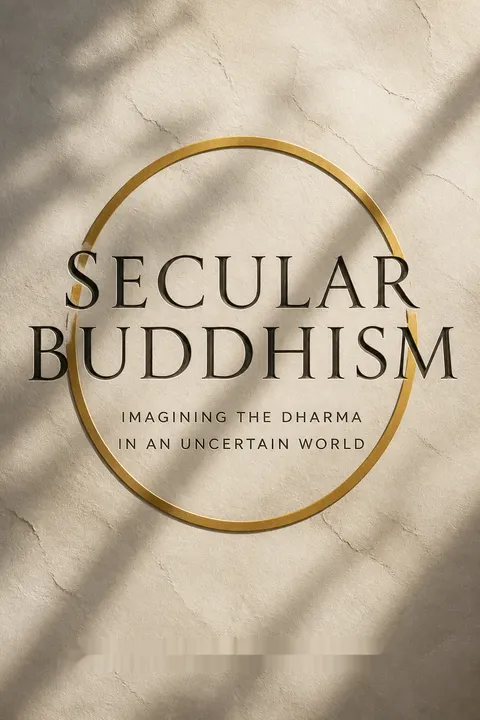
Secular Buddhism receives mixed reviews, averaging 3.90 out of 5 stars. Many readers appreciate Batchelor's approach to modernizing Buddhism, praising his efforts to make it more accessible and relevant to Western audiences. Some find his ideas thought-provoking and helpful in their spiritual journey. However, critics argue that Batchelor's interpretation may oversimplify or misinterpret traditional Buddhist teachings. The book's structure as a collection of essays and interviews is noted, with some readers finding it uneven but still valuable for those familiar with Batchelor's work.
People Also Read






Glossary
Buddhism 2.0
Secular reworking of BuddhismBatchelor's name for a proposed Buddhist framework that does not require the ancient Indian cosmology of rebirth and liberation from repeated lives. It retains Buddhist practices, ethics, and canonical sources, but treats the tradition as a way to respond to suffering and support human flourishing in this world.
four noble tasks
Four practices for respondingBatchelor's practice-centered reading of the Four Noble Truths. The tasks are to fully understand suffering, let go of the craving or reactivity that arises, experience its ceasing, and cultivate the path. He argues that these are instructions for action rather than metaphysical claims that practitioners must believe.
ELSA
A four-part practice sequenceAn acronym Batchelor uses to summarize his interpretation of Buddhist practice: Embrace, Let go, Stop, Act. Practitioners acknowledge the difficulty of a situation, release the reactive grasping that accompanies it, experience a pause in that reactivity, and act from a less self-centered perspective.
saeculum
This age, this worldA Latin term meaning an age, generation, or century. Batchelor uses it to explain the worldly sense of secular: attention to personal, social, and environmental life as experienced here, rather than orientation toward a supernatural realm or a future life.
deep agnosticism
Active contemplative unknowingBatchelor's description of a demanding openness to questions that cannot be settled with certainty, especially questions about death and ultimate reality. It is not indifference or refusal to choose. It sustains inquiry while directing ethical attention toward the conditions and decisions of present life.
four P's
Four distinctive Buddhist principlesBatchelor's summary of teachings he sees as distinctively important in the Buddha's early teaching: the principle of conditionality, the practice of the four tasks, the perspective of mindful awareness, and the power of self-reliance. He presents these as a practical foundation for secular Buddhism.
stream entry
Initial breakthrough in Buddhist practiceA traditional Buddhist attainment in which a practitioner is said to gain direct insight into the path and become a stream-enterer. Early texts associate it with the disappearance of certain entrenched views and doubts. Batchelor argues that it should not be elevated into an unreachable status reserved for exceptional monastics.
everyday sublime
Awe in ordinary experienceBatchelor's term for moments when attentive engagement with ordinary life opens into wonder that exceeds easy description. The experience does not depend on supernatural belief or spectacular scenery. It may arise through meditation, photography, or close attention to modest details of the material world.
About the Author

Download PDF
Download EPUB
.epub digital book format is ideal for reading ebooks on phones, tablets, and e-readers.








