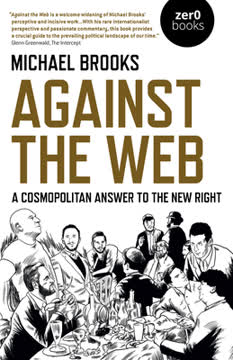
Key Takeaways
1. The Intellectual Dark Web: A Rebranded Right-Wing Defense of Hierarchy
Crucially, in all of these areas the IDW promotes narratives that either naturalize or mythologize historically contingent power relations—between workers and bosses, between men and women, they are old school reactionaries.
Deceptive self-branding. The Intellectual Dark Web (IDW) presents itself as a group of "renegade intellectuals" challenging "political correctness" and the "liberal consensus." However, this self-branding masks a deeply conservative agenda, often repackaging old right-wing arguments as fresh, contrarian insights. Their appeal lies in appearing to be free-thinkers, while consistently defending existing power structures.
Core conservative tenets. Despite claims of intellectual independence, the IDW consistently defends the capitalist economic order, American imperial hegemony, and a poorly understood concept of "the West." They frequently invoke "biology" to justify disparities between men and women, and some, like Sam Harris, extend this to race, echoing figures like Charles Murray. This approach serves to legitimize social inequalities by presenting them as natural or inevitable.
Naturalizing injustice. A defining characteristic of the IDW is its tendency to "naturalize or mythologize" social problems rather than historicize them. By ignoring the historical and social origins of power relations, they avoid critical analysis of how these structures were created and maintained. This intellectual sleight of hand allows them to defend traditional hierarchies—between workers and bosses, men and women—as if they were immutable facts of nature or timeless archetypes, rather than human-made systems open to change.
2. Sam Harris's "Thought Experiments" Provide Cover for Imperial Violence
The horrible irony here is that seeing could make it so: this very perception could plunge us into a state of hot war with any Muslim state that had the capacity to pose a nuclear threat of its own.
Justifying atrocities. Sam Harris, a prominent IDW member, employs "thought experiments" that, despite his claims of seeking "conceptual clarity," often serve to normalize horrific acts like genocide and torture. His infamous passage in The End of Faith muses on the "need" for a nuclear first strike against an "Islamist regime," while simultaneously demanding moral absolution for even contemplating such an "unthinkable crime." This rhetorical maneuver allows him to advocate for extreme violence under the guise of rational, albeit unpleasant, necessity.
Historical illiteracy. Harris's "thought experiments" consistently disregard real-world historical and political contexts. His hypothetical scenarios, such as a "suicidal" Islamist regime with nuclear weapons, ignore the complexities of international relations, the actual behavior of nation-states, and the history of US foreign policy. For instance, his conflation of independent terrorist networks with nation-states like Iran, or his naive portrayal of the My Lai massacre as an anomaly rather than a symptom of systemic issues, reveals a profound lack of historical understanding that underpins his moral pronouncements.
Imperial apologetics. Harris's worldview is deeply rooted in an uncritical faith in the American Empire, where US intentions are always presumed noble, and any civilian casualties are unfortunate accidents rather than strategic outcomes. His refusal to acknowledge that US actions could be less than virtuous, or that "idealistic" intentions might mask imperial ambitions, aligns him with a long tradition of justifying colonial domination. This is evident in his defense of Israel's actions against Palestinians, where he, much like John Stuart Mill on India, attributes brutality to the "moral immaturity" of the colonized rather than the dynamics of occupation.
3. Jordan Peterson's Ahistorical "Neo-Marxist" Conspiracy and Micro-Solutions
I’ve studied authoritarianism for a very long time—for 40 years—and they’re started by people’s attempts to control the ideological and linguistic territory...
Conflating ideologies. Jordan Peterson, a self-help guru turned cultural commentator, has built his fame on a wildly imprecise and historically illiterate conflation of "postmodernism" and "neo-Marxism." He claims these ideologies are a unified, totalitarian threat to "Western Civilization," despite their fundamental theoretical differences and historical antagonisms. His narrative of "French intellectuals" like Foucault and Derrida transforming Marxism into "identity politics" in the late 1960s is factually incorrect, ignoring the actual timelines and political positions of these figures and the broader history of the left.
"Lobster hierarchies" and naturalized injustice. Peterson frequently resorts to biological analogies, such as "lobster hierarchies," to naturalize social inequalities. He argues that because lobsters have dominance hierarchies, human hierarchies are also biologically ingrained and therefore immutable. This vacuous assertion can be used to defend any existing power structure, from feudalism to slavery, and ignores the crucial question of whether a particular hierarchy is justified or changeable. It's a classic example of mythologizing social problems to avoid addressing their human-made origins.
Micro-solutions for macro-problems. Peterson's appeal to alienated young men often involves offering micro-level self-help advice, such as "clean your room" or "stand up straight," as solutions to profound societal issues. While some of his "rules for life" offer basic common sense, his insistence on individual discipline as the primary answer to systemic problems like alienation, economic precarity, and cultural fragmentation is deeply flawed. He uncritically celebrates "free markets" while lamenting the very social atomization and despair that capitalism predictably generates, leaving him with no coherent macro-level response to the crises he identifies.
4. Ben Shapiro's Intellectual Facade Hides Enduring Bigotry and Historical Illiteracy
The philosophy of the founders, made material in the creation of the United States and in the continuing quest to fulfill their ideals, has been the greatest blessing for mankind in human history.
Rebranding as a "Deep Thinker." Ben Shapiro, known for his aggressive right-wing punditry, attempts to rebrand himself as a serious intellectual discussing "big ideas" like Religion, History, and Greek Philosophy in his book The Right Side of History. He aims to elevate his image beyond a mere purveyor of conservative talking points, seeking to align himself with the IDW's perceived intellectual gravitas. However, this rebranding effort is superficial, as his core ideological commitments and intellectual shallowness remain evident.
Mythologized "Western Civilization." Shapiro's narrative of "Western civilization" is a historically inaccurate and ideologically driven construction. He attributes its greatness to a magical combination of "Judeo-Christian" religiosity and "Greek reason," conveniently ignoring the complex, often violent, history of these traditions and their interactions. His concept of "Judeo-Christianity" is a mid-20th-century invention, and he selectively omits the persecution of Jews by Christians, or the crucial role of Muslim scholars in preserving Greek thought, to maintain a narrative that excludes those he deems "outside" his preferred civilization.
Enduring bigotry and intellectual dishonesty. Despite his attempts at a more refined image, Shapiro's past and present views reveal a consistent pattern of bigotry, particularly against Palestinians and Muslims. His past advocacy for the "ethnic cleansing" of Palestinians, his propagation of smears like "Friends of Hamas," and his defense of "Enemy 'Civilian Casualties' OK By Me" demonstrate a profound lack of empathy and intellectual integrity. His disastrous BBC interview, where he stormed out after being challenged on his extreme views and hypocrisy, exposed his intellectual fragility and his reliance on bluster and self-victimization when confronted with genuine scrutiny.
5. The Left's "Vampire Castle" Undermines Solidarity and Plays into Enemy Hands
The Vampires’ Castle "doesn’t know how to make converts. But that, after all, is not the point."
Counterproductive "call-out culture." The left, particularly online, often falls prey to a "Vampire Castle" mentality, characterized by "call-out culture" and "witch-hunting moralism." This phenomenon, brilliantly described by Mark Fisher, involves the relentless policing of language, ideas, and past mistakes, leading to public shaming and excommunication. While addressing genuine bigotry is important, this approach often prioritizes performative moral purity over effective political organizing and alienates potential allies.
Alienating potential converts. The "Vampire Castle" thrives on a "priest's desire to excommunicate and condemn" and a "hipster's desire to be one of the in-crowd," rather than a genuine desire to build a mass movement. This internal focus on moralistic self-policing makes the left insular and ineffective at making converts, as it prioritizes ideological conformity over broad appeal. It creates an environment where people are more afraid of making a mistake than of challenging real power, leading to political marginality.
Fueling the right-wing narrative. The excesses of "ultra-woke scolds" and "call-out culture" are a constant gift to the right, providing endless "oh my God, look at these leftists being crazy" content for outlets like Quillette. These examples are amplified to portray the entire left as irrational, censorious, and obsessed with trivialities, distracting from substantive critiques of capitalism and systemic injustice. By failing to distinguish between legitimate concerns and counterproductive moralism, the left inadvertently bolsters its political enemies and undermines its own credibility.
6. Beyond Social Democracy: Democratizing the Economy for True Freedom
The central contradiction in Peterson’s message is that he both uncritically celebrates capitalist “free markets” and sounds the alarm at the destructive toll those markets inevitably take on relationships and communities.
Freedom from economics. The ultimate goal of a truly liberatory left-wing politics is to create a world where human lives are not dominated by economic concerns, allowing individuals the "freedom from economics" to pursue their own visions of the good life. This means having the time and energy for meaningful relationships, creative pursuits, spiritual exploration, and personal development, rather than being exhausted by workplace tyranny and financial stress. This vision directly addresses the alienation and despair that figures like Peterson exploit, but with systemic solutions rather than individualistic self-help.
Limitations of social democracy. While social democratic reforms like Medicare for All, tuition-free college, and reduced workweeks are immensely valuable steps towards expanding human freedom and alleviating immediate suffering, they are ultimately insufficient. As long as the capitalist class retains its economic power, it will constantly seek to roll back these gains, as evidenced by the history of the 20th century. True and lasting freedom requires moving beyond social democracy to more radical, socialist proposals that fundamentally democratize the economy.
Democratizing ownership and production. A truly socialist future necessitates a transformation of economic ownership and control. This involves a combination of nationalizing key industries and promoting worker-run enterprises over traditional hierarchical businesses, as exemplified by models like the Mondragon Corporation in Spain or Cooperation Jackson in Mississippi. In a world of increasing automation, the question of ownership is paramount: if machines are privately owned, they enrich a few; if collectively owned, they can free everyone to work fewer hours and fulfill their highest human potential, as Marx envisioned.
7. Cosmopolitan Socialism: Building Global Solidarity on Universal Humanism
To MN Roy, the Communist International’s Second Congress was a revelation. “For the first time,” he remarked, “brown and yellow men met with white men who were not overbearing imperialists but friends and comrades.”
Transnational solidarity. A viable left movement requires an "Internationalist-socialist synthesis" built on global and materialist politics, fostering "transracial and transnational solidarities." This means making common cause across racial, ethnic, and national lines, recognizing that the interests of workers in the Global North are inextricably linked to those in the Global South. The strategic imperative is clear: capital flight and the perfection of oppressive techniques in one region impact workers everywhere, necessitating a united front against exploitation and authoritarianism.
Universal values from diverse roots. This cosmopolitan vision is rooted in the belief that values like freedom, equality, and solidarity are genuinely universal human aspirations, not exclusive "Western" concepts. As Amartya Sen demonstrates, these values can be found and rooted in a multiplicity of cultural traditions—Buddhist, Confucian, Indian, Islamic, and African—challenging Eurocentric narratives. This approach rejects the narrow chauvinism of "West is the Best" while also countering despotic claims of "Asian values" that suppress individual liberties.
Humanistic impulse. The core of this project is a humanistic impulse that transcends narrow group interests. While acknowledging the distinct economic interests of different human groups, it also embraces Engels' vision of a "really human morality" that emerges when society moves beyond class divisions. Figures like CLR James, who championed the Haitian Revolution while also embracing the "dead white men" of the European canon, exemplify this approach: a commitment to universal human emancipation that draws inspiration from all cultures, without policing influences or creating artificial boundaries.
8. Embracing Cultural Exchange Over Essentialism for a Liberatory Future
Simply put, there is no magical or particular essence that gives people born into a culture the right to deny those who are not from that culture access to art, ideas, music, and the like.
Rejecting essentialism. The international socialist project must actively reject "essentialism," the belief that culture is a fixed, almost metaphysical entity that stands apart from politics and economics, and that only those "born into" a culture have a right to it. This essentialist view, often seen in extreme interpretations of "cultural appropriation," stifles creativity, cultural exchange, and innovation, and ultimately fragments potential alliances. While legitimate concerns about exploitation or disrespect exist, the broader application of "cultural appropriation" can become counterproductive.
Encouraging syncretism and curiosity. Instead of policing each other's influences and enjoyments, a liberatory future encourages open cultural exchange and syncretism. This means emulating figures like Cornel West, who explores connections between diverse cultural forms without drawing artificial lines. The goal is to build a truly global intellectual and political culture that is enriched by the diversity of human experience, rather than constrained by rigid notions of cultural ownership or purity.
Moral growth and strategic empathy. The left must foster an environment that encourages moral growth and strategic empathy, rather than shaming and "canceling" individuals for past mistakes. While accountability is important, a default reaction of encouraging people to move on from bad views is more effective than perpetual condemnation. This approach, which avoids the pitfalls of the "Vampire Castle," allows for broader coalition-building and prevents the left from devouring itself, ultimately strengthening its ability to challenge real power and build a better world.
Last updated:
Review Summary
Against the Web by Michael Brooks critiques the "Intellectual Dark Web" (IDW), particularly Sam Harris, Jordan Peterson, and Ben Shapiro. Reviewers praise Brooks' ability to expose their ahistorical arguments and naturalization of power structures. The book argues for international solidarity and compassionate leftist politics rather than cancel culture. While most appreciate his takedown of IDW figures, some criticize the lack of scholarly rigor, missing citations, and blog-like tone. Many note the book's brevity at roughly 96 pages. The final chapter, offering Brooks' cosmopolitan socialist vision, receives particular acclaim. Multiple reviews mourn Brooks' untimely death in 2020.
Similar Books