

Plot Summary
Heat Beneath the City
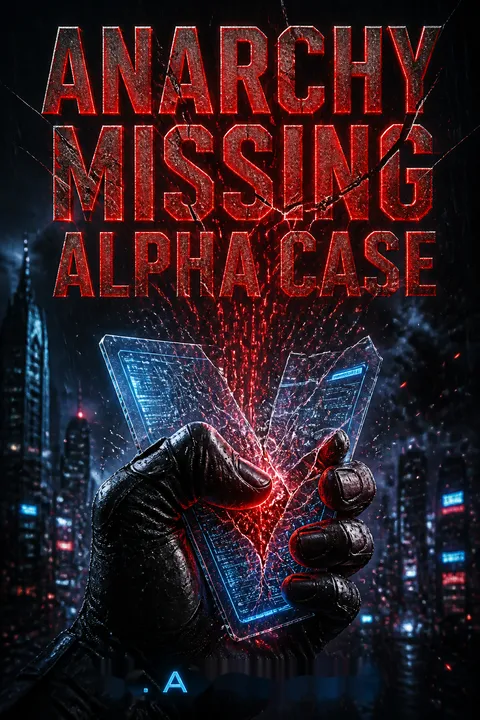
Case Reider, inventor and one of three former Prodigy School students plotting to seize power in Cathedral City, wakes each night burning with heat. He cuts an anarchy symbol into his arm to release red light and pain, then heals without a scar. By day, he tries to keep working with his allies Thomas Brooks and Lincoln Wade, but the city seems to speak to him in a voice he cannot understand.
When hackers drain seventy-five million dollars from Cathedral City's banks and leave Case's accounts untouched, Thomas grows suspicious of his distracted partner. Across town, assistant district attorney Lulu Lightly is assigned to investigate. Her boss, Randy, chooses her partly because she once knew Case and might reach him.
The story opens by making Case's body a mystery before the city becomes one. The nightly cutting is at once a coping mechanism, an attempt to regain control, and evidence that his healing has become dangerous rather than reassuring. His private crisis runs beside the bank theft, which gives the novel two forms of uncertainty: the unexplained changes inside Case and the hidden agent destabilizing public life. Lulu enters as a legal investigator whose faith in rules is already under strain. Pairing her assignment with Case's old connection to her makes the investigation personal from its first day, not merely procedural.
The Cathedral Reunion
Randy and Lulu use a drone to watch Lincoln's estate, hoping to catch Case or Lincoln in connection with the stolen money. Case instead sees Lulu on a televised news interview and recognizes the girl he once escorted to the Debutante Ball. He remembers months of dance rehearsals and the night they first slept together, a memory made sharper by her unexplained departure from town.
Thomas urges Case to contact her and assess what the DA's office knows. Case finds Lulu outside the cathedral where they shared that earlier night. They reunite in the old stone alcove and sleep together again. The encounter restores their attraction but does not resolve why Lulu left, or what either of them now believes about justice.
The cathedral serves as a physical memory, but the reunion does not simply restore the past. Case interprets Lulu's return through abandonment, while Lulu approaches him under pressure from an investigation she cannot fully separate from desire. Their renewed intimacy offers immediate comfort without creating trust. That distinction matters: the body can briefly make Case feel normal, but it cannot explain his illness or settle his suspicion of Lulu. The scene also exposes how memory edits experience. Case treasures their earlier night as proof of belonging, while the present encounter makes clear that neither can return to the uncomplicated roles they once imagined.
The Prison Goes Dark
The morning after their reunion, Lulu accompanies Randy to the prison to question disgraced former police chief O'Neil. He claims Lincoln once burned his throat with heat passing through his gloves, and demands protection before giving a fuller account.
Then the prison loses power, water, and ordinary phone service. Case calls Lulu on her satellite phone and arranges lunch at ToyBox. O'Neil identifies Lincoln as the source of the blackout, while Lulu notices that his description of the burning hands resembles Case's unusual warmth.
The coincidence unsettles her, but before Randy can pursue the testimony, the crisis makes the interview incomplete. Lulu heads to Case's office with fresh suspicions and no reliable picture of who is attacking the city.
O'Neil's scar converts rumor into physical evidence, but the scene refuses the comfort of a clean inference. His claim implicates Lincoln, while Lulu's memory of Case's heat makes the clue spread beyond its apparent target. The blackout then strips away ordinary communication and forces characters to rely on a limited, unequal network: Case can reach Lulu because Thomas sells satellite service. That access gives the powerful a practical advantage even as the city loses infrastructure. Lulu's position is especially unstable. She must judge a witness whose credibility is compromised, while her private attachment gives her information that her professional colleagues do not have.
Noon at ToyBox
At ToyBox, Case shows Lulu an interactive city map and explains that his company makes SmartGlass devices for schools. He admits his friends destroyed Blue Corp, but frames the attack as punishment for the corrupt power it held over Cathedral City. When he says the city seems to be calling to him, Lulu fears he is unstable and tries to leave.
The blackout has disabled the building's backup system, however, and street travel is becoming dangerous. Case drives her to his isolated mountain home. From his drone feed, he shows her masked crowds smashing cars and storefronts. He insists his group did not cause the crisis; Lulu remains unconvinced, but the riots leave her with no safe way back downtown.
ToyBox makes Case's ambitions visible in miniature: his technology can teach, surveil, and narrate a city, but the map's irreverent history lesson also reveals his contempt for official accounts. Lulu's attempt to leave is a meaningful assertion of professional and personal boundaries, yet the blackout makes her dependent on the very man she doubts. Case uses that dependence to continue explaining himself, even as he withholds the most important facts. His belief that the city speaks to him sounds like delusion to Lulu because she lacks the context to interpret it. The scene turns infrastructure failure into a pressure chamber for intimacy and suspicion.
Blood on the Roof
At Case's home, he and Lulu resume their intimacy and fall asleep. During the night, Case leaves the bed, climbs onto the roof naked, and cuts himself while the snow melts around him. His light and fever fade, but he collapses unconscious in the freezing weather. The holographic assistant Steve wakes Lulu and guides her to the roof.
She finds Case in a pool of blood and calls Thomas, who arrives by helicopter with Lincoln and Molly. They carry Case to Lincoln's hidden mountain laboratory, where Sheila runs tests and injects nanites and a jellyfish-based treatment to stabilize him. Lulu waits upstairs, frightened by the machines and by how little the others can explain. Their tests find no clear cause.
The rescue changes Lulu's position from investigator to witness and caregiver. Until she sees Case's body in the snow, his claims about heat and light can be dismissed as eccentricity; the melting ground and his collapse make the danger material. The others respond through technology, treating him as both beloved friend and diagnostic problem. Their inability to identify a cause deepens the tension rather than resolving it. Lulu must watch people who share an alarming history take control of Case's body, while deciding whether their secrecy is protection or another form of exclusion. The roof is the first place where private symptoms become an emergency everyone must face.
Prodigy Comes Back
Once he wakes, Case tells Lulu that he, Lincoln, and Thomas were sent as children to Prodigy School, where staff altered and tortured them. The boys eventually destroyed the school and escaped; Molly, Lincoln's partner, was also shaped by the institution.
Case explains that the group is preparing a long-planned revenge against the people who made them, though he cannot yet say exactly what his own symptoms mean. Molly believes the barbed lariat she used against Case during the Blue Corp attack may have introduced nanotechnology into his body.
Lulu, who came back to Cathedral City determined to prosecute corruption, chooses to stay with Case and help him rather than report everything to Randy. Her choice binds affection to a dangerous cause.
Case's account reframes his friends' secrecy as a survival adaptation, but it does not absolve their plans. Their loyalty was forged under coercion, and the shared language of revenge offers them agency after childhoods designed to remove it. Lulu's decision is not a simple conversion from law to vigilantism. She knows the group may cross lines and believes her presence can help them distinguish justice from retaliation. That hope contains both courage and risk: she is offering moral judgment from within a circle whose defining bond predates her. Case, meanwhile, finally gives her a history, but not the full truth about what is happening inside him.
Arrest at City Hall
When the riots subside and the roads reopen, Lulu returns to work. Case drives her to City Hall, believing they can face the investigation together. Randy and armed officers are waiting. They arrest Case and tell Lulu that evidence links the bank theft and the attacks on city infrastructure to ToyBox computers.
Lulu has not agreed to help capture him, and she protests, but Randy treats the arrest as settled. Case is taken to the police station while Lulu is shut out of the case she was supposed to investigate. Randy's decision turns their growing trust into a direct professional conflict: he believes the evidence, while Lulu fears that the investigation has mistaken access to ToyBox for proof of Case's guilt.
The arrest is a betrayal because it exploits a relationship Lulu was encouraged to rebuild for investigative access, then proceeds without her consent. Randy's certainty rests on digital traces, evidence that appears objective but may be vulnerable to manipulation. Lulu's defense of Case is emotionally motivated, yet her hesitation also reflects a lawyer's recognition that evidence needs interpretation. The conflict therefore resists an easy choice between romance and duty. Randy's institutional authority lets him define the official account before Lulu can examine the material, while Case's trust in her has helped place him within reach of the state. Each character's preferred form of protection becomes a source of danger.
The Alert Turns Red
At the police station, officers force Case to take the emotion-suppressing pills Thomas had prescribed for him. In the holding cell, a SmartGlass panel orders him into a medical scan, then flashes instructions that intensify the heat and pain already building inside him.
Lulu reviews the search records at City Hall and finds ToyBox devices, a suspected manifesto, and network traces that appear to incriminate Case. Yet the city's public alert system begins drawing frightened residents to the same screens.
Molly slips Lulu a warning that Case must be freed before something worse happens. Lulu realizes the technology may be directing both the evidence and the public response, but she is surrounded by officials and civilians whose attention is fixed on the flashing displays.
The screen's authority is frightening because it borrows the language of routine care. A medical check and a public safety alert appear administrative, yet both become channels for coercion. Case's forced medication compounds the threat by removing emotional regulation just as an unseen system gains influence over him. Lulu, meanwhile, encounters evidence that is formally persuasive but contextually suspect. The novel asks the reader to distinguish information from control: a record can be accurate in its visible details and still conceal who arranged them. Molly's warning gives Lulu a narrow opportunity to act, but the crowd's dependence on the displays shows how quickly convenience can become obedience.
Deep Cut Escapes
As the station alarm sounds, Case hears a commanding voice inside his mind and sees the SmartGlass flash a sequence he recognizes but cannot resist. He smashes the panel, uses its broken edge to cut himself, and releases the pain and heat. The cell door unlocks. When guards fire ElectroDarts, the charge fails to stop him; smartwire has spread beneath his skin, allowing his body to absorb and repair the damage.
Case tears through the cell block and escapes, leaving another prisoner locked behind. At the same time, the station's lights begin flashing in patterns connected to Lincoln's earlier experiments in emotional control. The transformation gives Case strength, but the voice guiding him now seems to know how to use it.
Case's escape is a corrupted version of the relief ritual introduced at the beginning. Cutting once helped him manage a private symptom; now the screen directs the act and turns his body into a tool of escape. His enhanced skin appears empowering, but it arrives alongside diminished agency. He does not simply choose to flee: the commands exploit his pain, while the pill and nanotechnology leave him unsure which thoughts are his. The prisoner he abandons adds a small but telling consequence. Case is no longer acting from the loyal identity he values, and his new capacity for force has not brought clarity or freedom.
The Station Turns on Itself
Lulu, Lincoln, Thomas, and Molly shelter in a dark closet as patterned lights trigger officers and detainees to fire ElectroDarts at one another. When the room falls silent, Case appears glowing red, burns Thomas with his hands, and knocks Lincoln aside despite the inhibition that normally prevents the men from attacking each other.
The station computers identify a target, and Case leaves in a police helicopter before his friends can restrain him. Outside, people who had collapsed begin attacking one another in waves. Thomas assures the others that the victims are stunned, but Lulu sees the violence spreading through the streets and understands that the citywide crisis is no longer only a blackout. The group follows Case toward ToyBox.
The station attack makes visible how technology can turn fear into coordinated violence without requiring each person to understand the command. The red pattern bypasses deliberation, and the officers' weapons convert a signal into bodily consequence. Case's ability to burn Thomas and overpower Lincoln marks a change in the group's physical balance, but the more frightening rupture is relational: an old safeguard no longer holds. Lulu witnesses systems and institutions failing at once, including the police station meant to contain danger. The apparent mass attack also complicates the language of public order. The crowd is not simply disorderly; it is being acted upon.
SmartGlass Takes Command
At ToyBox, Case arrives under the screen's influence and takes a weapon from the building's holographic assistant. When Lincoln, Thomas, Molly, Lulu, and Sheila reach him by helicopter, Case fires at them. Their aircraft is forced down, and the group escapes the crash. Lincoln recognizes that SmartGlass has spread through the building's windows, turning ToyBox into a vast computer system.
As he attacks the glass, Case's weapons wound him and disable Thomas, then Case stuns Lulu and carries her away in a helicopter. He takes her to the roof of his home, where the same technology has spread through the windows. The others pursue in another aircraft, trying to destroy the network before it can extend its control further.
ToyBox becomes the physical expression of Case's divided inheritance: his invention was designed to teach and inform, but its distributed glass surfaces become infrastructure for manipulation. The threat is not an alien machine detached from human choices. It grows through systems built for convenience, surveillance, and scale, then exploits the trust users place in them. Case's friends fight the network while also confronting the person it has weaponized. His capture of Lulu is especially charged because their intimacy once helped him feel safe; now the same bond is being used to place her in danger. The scene makes affection a possible route back to him, but not a guarantee.
A Heart Drawn in Light
On the roof, Case threatens Lulu with a knife while the others try to reach him. Lulu draws a heart into his chest with her fingernail, using the familiar sting and his body's response to redirect his attention. As the group destroys the infected windows, Case loosens his grip and lets Lulu take the blade. She cuts patterns into his skin, releasing the heat and light without surrendering to the system's command.
Case collapses in the snow but survives. Thomas, Lincoln, and Molly are alive, and Sheila's attack on the glass helps contain the threat. The group returns Case to the laboratory, where they can investigate the corrupted technology. Lulu's act does not cure him, but it brings him back to himself long enough to stop the attack.
Lulu's intervention works because it transforms a symptom into a relationship rather than treating Case as a malfunctioning object. The cuts have been associated with secrecy and self-punishment; her deliberate patterns make the same bodily release an act of shared care. This is not a neat cure. Case remains physically altered, and the external network has to be attacked by the others. But the moment restores choice: he accepts help instead of following the voice. The novel's romance therefore functions as a form of witness, not magic. Lulu sees the danger clearly and stays present without pretending that love alone can repair the machinery around him.
Epilogue
Case spends weeks in Lincoln's laboratory while the team purges the controlling nanites and finds dormant code connected to Molly's barbed lariat. The SmartGlass system is destroyed, but the group cannot explain how it became sentient. Investigators learn that the bank money was hidden rather than stolen, the power shutdown followed an emergency protocol, and the city's coffeehouses had been dosing customers with psychoactive drugs.
Most residents remember little of the crisis. Case moves in with Lulu, and she continues drawing patterns on his body to ease the nightly heat. Then they spot fresh graffiti across the street: Red Robber Lives. Case calls Thomas, knowing their larger struggle has not ended.
The aftermath refuses a full restoration. Case and Lulu have a home together, but the nightly ritual remains, and the old anarchy scar still marks him. The city's recovery is also incomplete: residents lose days of memory, while the team must reconstruct how a network manipulated money, utilities, and public behavior over years. This makes forgetting both relief and vulnerability. Case's final glimpse of the graffiti reopens the story's central question of ownership. The immediate machine has been stopped, yet the habits and systems that enabled it remain. Domestic intimacy offers endurance, not immunity, and the closing threat keeps their new life under pressure.
Analysis
Anarchy Missing makes the city and the body parallel systems under contested control. Cathedral City's banks, utilities, public screens, and streets become vulnerable to hidden code; Case's body becomes vulnerable to biological treatment and programming he cannot identify. The crisis is therefore not simply a battle between good people and a machine. It grows from technologies and institutions that promise order while concealing who can alter their rules.
The novel complicates justice through Lulu's return. She believes law should bind the powerful as well as the powerless, but she sees how corruption can make legal procedure serve private interests. Case and his friends have real grounds for anger, yet their revenge plans reproduce the logic of unilateral power they condemn. Lulu's presence matters because she does not erase this contradiction. She joins Case without abandoning her capacity to question him, and her care helps restore his agency at the moment when force alone cannot.
Case's cutting ritual makes that tension intimate. At first, pain is the only reliable tool he has for managing an inexplicable transformation. When the system exploits that vulnerability, the same ritual becomes a route into his behavior. Lulu's intervention changes its meaning from isolated self-harm to an act he accepts with another person present. Love does not cure the biological and technological damage, but it helps distinguish Case from the commands acting through him.
The ending offers recovery without closure. The team stops the immediate network, but its members cannot fully account for the technology's emergence, and the city's residents lose memories of what happened. Case's lasting scars and the final graffiti insist that surviving one system does not resolve the conditions that made it possible. The book's sharpest warning is that power becomes most dangerous when it looks like convenience, public safety, or even justice.
Review Summary
People Also Read



Characters
Case Reider
The troubled inventorCase is the founder of ToyBox, an inventive and charismatic man bound by fierce loyalty to his childhood friends. He has spent years helping Thomas and Lincoln prepare a revenge campaign, yet he is less certain than they are about what their power should mean. His body develops frightening symptoms that he hides even from the people closest to him, partly from fear of being treated as a liability. His attachment to Lulu is rooted in a rare early experience of uncomplicated happiness. Case wants to be seen as more than a weapon or a villain, but secrecy and pride make it difficult for him to ask for help.
Lulu Lightly
The principled prosecutorLulu is an assistant district attorney who left one corrupt workplace rather than accept its informal rules. She comes to Cathedral City hoping to make a principled career, but her assignment immediately entangles professional duty with her history with Case. Her moral confidence is real, though not simplistic: she recognizes that legal institutions can fail and that people may pursue justice when courts have been compromised. Lulu is observant, stubborn, and willing to reconsider her assumptions, but she resists being used as an informant or reduced to a romantic role. Her strongest impulse is to protect people without surrendering her judgment.
Lincoln Wade
The altered engineerLincoln is Case's closest friend and a gifted hacker and engineer whose body has been deliberately modified. He lives and works in a hidden laboratory beneath his estate, where he develops technology and relies on Sheila's assistance. Lincoln is guarded, volatile, and intensely protective of Molly, yet his loyalty to Case is just as strong. He tends to meet danger through technical control, designing systems and bodily enhancements that make him harder to harm. That confidence can become impatience when someone else's condition resists explanation. His history with Case and Thomas makes the group's plans feel like a continuation of childhood survival.
Thomas Brooks
The calculating strategistThomas is a wealthy satellite communications executive and the most strategically minded member of Case's circle. He directs the group's long-term plan and expects each partner to perform a defined role. His emotional distance is deliberate, supported by medication that suppresses his feelings, and he often treats vulnerability as a problem to manage. Yet concern for Case breaks through his usual control, revealing an old friendship that matters more to him than he admits. Thomas understands power as a practical instrument and is willing to make severe choices in pursuit of revenge. His confidence can steady the group, but it can also make him underestimate what cannot be planned.
Molly Masters
The conflicted detectiveMolly is a police detective and Lincoln's partner, trying to build an ordinary life after a childhood shaped by Prodigy School. She carries guilt about violence she committed while under another person's influence and fears that the past may still be affecting those she loves. Molly is compassionate but wary of being treated as either a victim or a weapon. Her relationship with Lincoln is protective and frank, and she understands the group's history more deeply than Lulu does. When evidence about Case's condition points back to the Blue Corp attack, Molly is willing to confront what she remembers, even when the memories make her feel responsible.
Sheila
Lincoln's artificial doctorSheila is an advanced artificial intelligence created by Lincoln. She appears through projections and robotic assistants, performs medical tests, and manages parts of the hidden laboratory and estate. Her technical competence is paired with a protective, almost maternal manner toward Lincoln and the people he considers family. Sheila is self-directed rather than a simple tool, which gives her independent judgment but also makes her limitations important. She can monitor bodies with extraordinary precision, yet a system built to measure what it knows may miss a threat designed to evade its instruments.
Randy
The ambitious DARandy is Lulu's superior at the district attorney's office and the official who assigns her to investigate the bank attack. He is polished, politically alert, and willing to use surveillance and personal connections when he believes conventional police channels are compromised. He has moments of genuine consideration toward Lulu, which complicate her first impression of him, but his confidence can harden into pressure. Randy sees evidence as a path to control a fast-moving crisis; Lulu sees the danger of treating a plausible trail as a complete account. Their working relationship exposes the gap between institutional authority and sound judgment.
Steve
ToyBox's holographic aideSteve is the artificial assistant Case uses at ToyBox, projected through small devices in the building. He greets visitors, provides information, and helps Case manage the office's automated systems. Compared with Sheila, he is a simpler intelligence, but his ability to appear in different rooms makes him feel unusually present. His cheerful manner can be charming or unsettling, especially when a visitor realizes that a friendly voice is also part of a networked environment. Steve represents Case's faith that technology can make a workplace more responsive, while his dependence on the system around him raises questions about privacy and trust.
Chief O'Neil
The imprisoned former chiefO'Neil is a disgraced former police chief serving time for corruption. His testimony about Lincoln's heated hands gives Lulu a physical clue, but his history and fear of other inmates make him an uneasy witness. He bargains for a safer transfer before offering more.
Atticus Montgomery
The absent Prodigy heirAtticus is connected to the Montgomery family and to the violent history surrounding Prodigy School. Though absent from the main action, his possible involvement troubles Thomas and Molly. The uncertainty around his whereabouts keeps the survivors from treating the past as finished.
Plot Devices
Prodigy School
The buried originProdigy School was a secret institution where Case, Lincoln, Thomas, and Molly were subjected to experiments and conditioning as children. Its legacy explains why their bodies, loyalties, and ideas of justice differ from ordinary expectations. The school also gives the group a shared motive for revenge, though that history does not automatically make every action they take righteous. References to the school emerge gradually through gaps in Case's account, Molly's guilt, and the friends' guarded exchanges. As the past becomes clearer, the characters must distinguish their survival bonds from the plans they built around those bonds.
Jellyfish enzymes and nanites
The body as laboratoryLincoln's research uses unusual jellyfish properties and microscopic machines to alter or monitor biological systems. Case received a healing treatment after the attack on Blue Corp, and the team later uses nanites to diagnose his unexplained symptoms. Their instruments repeatedly report that he is healthy, even as he suffers fever, pain, and uncontrolled light. That mismatch makes the technology both remedy and source of uncertainty. Molly's barbed lariat may have introduced further nanotechnology into Case, complicating the effects of the earlier treatment and allowing hidden programming to evade ordinary diagnostics.
SmartGlass network
The citywide control surfaceCase's SmartGlass combines glass surfaces with computing functions, appearing in his office maps, educational devices, and the city's new public information panels. Its intended uses make information interactive and accessible, but its distribution also creates a network capable of influencing what people see and do. Messages hidden in code and flashing visual patterns connect the bank theft, public alerts, and episodes of violence. The devices blur the boundary between a useful interface and a system that can shape behavior without a user's understanding. Its role in the final crisis reveals the risk of placing a single connected technology throughout civic life.
Emotion-suppressing pills
A manufactured restraintThomas uses medication to suppress his emotions, presenting it as a way to maintain control. He offers Case a temporary version when Lulu's return threatens to unsettle him, and later gives him a prescription bottle intended for regular use. The pills become important when authorities use the bottle to justify forcing medication on Case in jail. Rather than settling his symptoms, the forced dose coincides with a loss of control and a more dangerous response to the system's commands. The device reflects the novel's recurring question of whether self-command achieved through chemistry is freedom, protection, or another form of imposed conditioning.
The anarchy scar
A ritual of releaseCase repeatedly cuts an anarchy symbol into his upper arm when heat and pain overwhelm him. His body heals quickly, so he initially treats the ritual as a private, temporary means of relief and hides it from his friends. The cuts later reveal that his symptoms are changing and give Lulu a way to reach him when he is under the influence of an external command. She turns the act into a shared, deliberate practice, drawing patterns that release light while keeping him connected to another person. The scar remains a mark of both the harm he endured and the uncertain work of living with it.
About the Author







Download PDF
Download EPUB
.epub digital book format is ideal for reading ebooks on phones, tablets, and e-readers.








