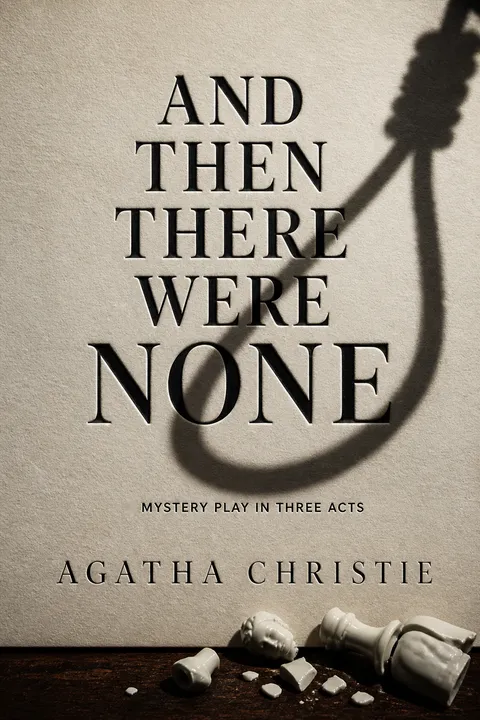


Plot Summary
Ten Invitations, Ten Secrets
On separate journeys to Devon, ten people answer invitations that promise a holiday, work, or money. Vera Claythorne, a schoolmistress seeking temporary employment, tries to suppress memories of a child lost at sea.
Retired judge Lawrence Wargrave expects a reunion with an old acquaintance; doctor Edward Armstrong accepts a well-paid consultation; and adventurer Philip Lombard takes a mysterious assignment from an intermediary. Emily Brent anticipates a free stay, while Anthony Marston races toward the island in his powerful car.
General Macarthur hopes to see old army friends. William Blore, meanwhile, travels under the false name Davis, hired to watch the other guests. Each believes the invitation has a personal explanation, but none has met the supposed hosts.
The opening makes invitation itself a form of misdirection. Each guest supplies a plausible story for why they are traveling, and those stories keep them from asking the more important question of who is arranging the gathering. The brief glimpses of private history also establish that the group is not socially random: the guests carry different forms of compromised judgment, from professional error to private resentment. Vera’s effort to manage her memory, and Blore’s deliberate disguise, make concealment part of the party before the island is even reached. Suspense begins not with a visible threat, but with the gap between what each person thinks they know and what the reader can see they have failed to investigate.
A House Without Hosts
At Oakbridge, Vera and Lombard meet the General, while Blore joins them pretending to be a South African visitor. The boatman ferries the party to Soldier Island, where the modern house stands above a difficult landing. Butler Thomas Rogers greets them, but explains that the owner, Mr. Owen, is delayed.
His wife, Ethel, has prepared the rooms despite never meeting their employers. Each bedroom contains a framed version of a children’s rhyme about ten little soldiers disappearing one by one; ten china soldiers decorate the dining table.
The guests notice the strange arrangement, then settle into dinner and try to make polite company of one another. Their unease grows when they realize that neither the host nor his wife has appeared, and no one can explain who actually invited them.
The island’s physical design turns ordinary hospitality into a controlled environment. The guests can see the mainland, but the narrow landing and exposed sea make departure dependent on someone else. Meanwhile, the missing hosts leave every reassuring detail without an accountable source: the prepared rooms, the food, the staff’s instructions. The rhyme and figurines convert the house into a kind of timetable, though at first the guests treat them as decoration. Their polite efforts to socialize are psychologically revealing: manners allow them to postpone the admission that they are strangers assembled by an absent authority. The setting does not merely isolate them; it makes their reliance on unexplained arrangements visible.
The Gramophone's Indictment
After dinner, a hidden gramophone record accuses all ten guests of causing someone’s death. The charges range from Wargrave’s death sentence for Edward Seton and Blore’s evidence against James Landor to Vera’s role in young Cyril Hamilton’s drowning.
Lombard admits abandoning men during an expedition, and Marston treats the children he killed with his car as an unfortunate accident. The Rogerses deny responsibility for their former employer’s death. Armstrong cannot remember the patient named in his charge, while Brent refuses to explain hers.
The guests discover that Rogers played the record under instructions from Owen, and that every invitation used a false or borrowed connection. Wargrave notices that the initials U.N. Owen can be read as an admission that their host is unknown.
The accusation record changes the party from a collection of uneasy strangers into a group forced to interpret one another’s pasts. Its power lies in combining verifiable details with disputed moral judgments: each person can reject the charge as legally false while still revealing a private defense, an evasion, or a disturbing lack of concern. Wargrave’s legal framing offers temporary order, but it cannot establish who is telling the truth or what standard of guilt the accuser applies. The unknown host has gathered intimate knowledge without granting the guests a way to question its source. Their first collective act of investigation therefore begins under conditions designed to make self-knowledge and suspicion inseparable.
The First Soldier Falls
While the guests argue over the accusations, Marston pours himself another whisky and soda. He suddenly chokes, collapses, and dies before Armstrong can revive him. The doctor detects signs of cyanide poisoning, although neither bottle appears contaminated and the group saw Marston serve himself.
With no other explanation, they initially consider suicide, despite his apparent energy and pleasure in life. They carry his body upstairs, then return to find one china soldier missing from the table.
The rhyme’s first disappearance now resembles a prediction rather than a joke. No guest can explain why Marston would have poisoned himself, and the fact that the lethal dose reached his glass without anyone noticing turns every shared room into a possible crime scene.
Marston’s death punctures the group’s last assumption that the recording was only a cruel prank. Yet the apparent lack of motive makes the event difficult to name as murder, leaving the guests briefly trapped between evidence and common sense. Marston’s own casual attitude toward the deaths attributed to him sharpens the moral discomfort: he can recognize harm as inconvenience without experiencing it as responsibility. The missing figurine supplies a visible pattern, but not an explanation. It gives the survivors a way to count danger while offering no reliable way to prevent it. From this point, the house’s playful ornament becomes a form of surveillance, marking losses after they have already happened.
The Boat Never Comes
The guests go to bed behind locked doors, while Rogers clears the dining room and notices that another china soldier is gone. In the morning he cannot wake Ethel; Armstrong finds her dead in bed, with no obvious cause.
Brent interprets the death as punishment for the Rogerses’ alleged crime, while Blore suspects that Rogers silenced his wife before she could confess. The expected supply boat fails to arrive, and worsening weather makes escape unlikely. The figures on the table have fallen from ten to eight.
The group’s theories multiply, but none can establish whether Ethel died by illness, suicide, or another person’s hand. Then General Macarthur wanders toward the water, speaking with the strange calm of someone who has stopped expecting rescue.
Ethel’s death leaves the guests with competing explanations that also reveal their habits of judgment. Brent turns uncertainty into divine certainty; Blore treats the frightened wife as a witness who might endanger her husband; Vera recognizes a terror that seems older than the accusation itself. None can prove what happened, and the absent boat removes the ordinary institutions that might settle the dispute. The island’s isolation is therefore not just a logistical obstacle: it deprives the group of a shared authority for deciding what counts as evidence. Macarthur’s quiet acceptance introduces another response to the crisis, one that unsettles Vera because it makes death seem less frightening than returning to a burdened life.
Macarthur Waits for Judgment
Vera speaks with Macarthur by the water and hears him admit that he deliberately sent his wife’s lover, Arthur Richmond, into a dangerous wartime mission. The General had discovered their affair and concealed his revenge beneath military necessity; afterward, he withdrew from old friends and lived with the knowledge.
While the others search for a way to contact the mainland, someone strikes Macarthur from behind with a heavy object. Armstrong confirms that the blow killed him. His death makes the group accept that a murderer is among them, and Wargrave argues that the culprit must be one of the guests. The storm breaks over the island as the count drops to seven, and every survivor becomes both witness and suspect.
Macarthur’s confession gives the accusation an intimate shape: his act came from love and humiliation, then survived long after the immediate passion had faded. His willingness to face the end contrasts with the younger guests’ frantic search for explanations, but his acceptance cannot absolve what he did. The concealed blow that follows makes the group’s moral reckoning brutally literal. Wargrave responds by turning fear into procedure, using the language of inquiry to impose order on a situation where no one can be safely excluded. That method is useful but limited. The guests can compare opportunities, yet their shared guilt makes the courtroom model unstable: each person is simultaneously investigator, defendant, and possible executioner.
The Butler's Last Errand
Armstrong, Lombard, and Blore search the bare island and the house, but find no hidden intruder. They suspect that one of their own is responsible, though the search offers no proof. Rogers continues serving the household, then rises early to prepare the kitchen fire. Later the guests find him dead in the washhouse, his head split by a chopping axe.
The tools have been wiped, and the dining table holds only six china soldiers. Blore admits that the man he helped convict, Landor, was innocent, though he tries to separate that perjury from the prisoner’s death in jail. The confession deepens the group’s distrust, while Rogers’s murder proves that even the most useful and apparently ordinary member of the household is not protected.
The fruitless search hardens suspicion without narrowing it. Because the island offers so little cover, the killer’s apparent absence makes the guests consider each other rather than a stranger, but the evidence still cannot distinguish opportunity from guilt. Rogers’s death is especially destabilizing because he had seemed to belong to the machinery of the house, not to the contest among its guests. Blore’s admission about Landor exposes how professional authority can be corrupted for advancement and then defended as mere procedure. The wiped weapon and shrinking figurines turn that abstract ethical failure into a material pattern. Each death brings the group closer to a verdict while making a trustworthy verdict less possible.
The Bee at the Window
Vera has already learned that Brent dismissed her young servant Beatrice Taylor after discovering she was pregnant; Beatrice later drowned herself, and Brent feels no remorse. During breakfast, Brent refuses Armstrong’s offer of medicine, then remains alone in the dining room. The others find her dead, a small puncture on her neck and a bee near the window.
Armstrong identifies the mark as an injection, not a sting. His hypodermic syringe is missing from his case, and the guests search one another and their rooms for weapons and drugs. They lock the discovered medicines away, but Lombard’s revolver has also vanished. Six figures have become five, and the group has secured dangerous objects without securing the knowledge of who took them.
Brent’s past reveals how moral certainty can protect a person from recognizing the consequences of her own conduct. She interprets Beatrice’s death as proof of the servant’s failure, leaving no room for the possibility that her punishment and expulsion helped create the crisis. The bee motif makes the murder feel like a staged message, but its theatrical neatness does not make the killer easier to identify. Instead, the syringe implicates the medical authority the group has relied on, while the missing revolver complicates the same logic. Confiscating objects is a practical response to danger, yet the plan depends on honest cooperation among people who have learned to lie. Security becomes another performance with gaps the killer can exploit.
A Judge Dies Twice
After a storm-bound day of watching one another, the survivors discover that a bathroom curtain and Brent’s grey wool have disappeared. That evening Vera enters her dark room and mistakes hanging seaweed for a cold hand at her throat.
The others rush upstairs to help, leaving the drawing room briefly unattended. They return to find Wargrave seated in a judge’s robe and wig, apparently shot through the forehead. The red curtain and wool explain the costume, and the group assumes the missing revolver killed him.
Lombard, who had suspected Wargrave, recognizes how badly he has misread the judge. Four guests now believe they remain, and the apparent proof of Wargrave’s death seems to clear him just as it removes the person who had been directing their inquiry.
The staged tableau weaponizes the guests’ need for a clear sequence. The costume makes Wargrave’s supposed death legible through the same legal imagery he used to organize the others, while the missing props invite them to solve the scene as a closed puzzle. Vera’s fear supplies the distraction that lets the performance work. Lombard’s reversal matters because he had trusted his own psychological reading of the judge and now has to abandon it. The group’s reasoning remains active, but the evidence is being arranged by someone who understands how observers build a story from visible clues. The apparent death therefore does more than remove a leader: it teaches the survivors to mistake a persuasive account for a proven event.
The Doctor Disappears
Wargrave’s apparent murder leaves Armstrong, Blore, Lombard, and Vera to guard themselves. Later that night, Vera screams when the seaweed in her room brushes her neck; the men rush to her, and she refuses brandy until Lombard brings an unopened bottle.
When they return downstairs, Wargrave is still seated in his staged pose, but Armstrong has disappeared. Blore and Lombard search the house and shore without finding him. By morning, the table holds only three china soldiers.
Vera recalls that the rhyme’s next verse points toward a misleading clue, and argues that Armstrong may have vanished deliberately rather than died. The theory gives them a possible explanation, not safety: no one knows where the doctor is, or whether he is hunting them.
The seaweed incident shows how the island has trained the survivors to experience ordinary objects as threats. Vera’s refusal to drink from an open bottle is one of the few moments when fear sharpens rather than overwhelms her judgment. The missing doctor then creates a more difficult uncertainty: absence can indicate escape, concealment, or death. Vera’s reading of the rhyme is perceptive, but it also shows how thoroughly the killer’s chosen pattern has shaped their thinking. They no longer ask only what happened; they ask what the next verse predicts. The group’s reasoning is both resourceful and compromised, because the murderer has made a children’s counting game the frame through which every new fact must pass.
The Bear Clock Strikes
With the weather clearing, Vera and Lombard stay outside while Blore returns to the house alone for food. A heavy marble clock shaped like a bear falls from Vera’s bedroom window and crushes his head. Lombard and Vera then search the island and find Armstrong’s drowned body wedged among the rocks. They drag it beyond the waterline, leaving only the two of them alive.
The discovery confirms that Vera’s theory about Armstrong’s disappearance was wrong: he did not hide on the island to continue the killings. Yet it cannot identify the murderer, and Lombard still has the revolver. Vera, who has spent the day trusting him because she has no better option, now faces the final danger at close range.
Blore’s death turns an ordinary object from Vera’s room into an instrument of remote violence, making the house itself seem to act against its occupants. The clock’s fall also shows how little control the survivors have over the spaces they thought they had searched. Armstrong’s body resolves one uncertainty but opens the central one again: if the suspected doctor is dead, who has arranged the other deaths? The remaining pair cannot rely on shared fear to bind them, because only one person needs to act first. Vera’s temporary trust in Lombard has always been pragmatic rather than intimate. The scene strips that bargain down to its essentials: possession of the gun, access to it, and the will to survive.
The Last Two
Lombard treats Armstrong’s death as proof that Vera is now his only obstacle. When he bends to move the body, she slips the revolver from his pocket. Lombard lunges for it, and Vera shoots him through the heart. The shock gives way to relief; she believes the danger has ended because she is alone on the island.
Back in the house, she sees the remaining china soldiers and climbs to her bedroom, exhausted and convinced Hugo Hamilton is waiting there. Wargrave has arranged a rope and chair in the room, and Vera’s buried guilt over Cyril’s drowning makes the scene feel like a command from her past. She places the noose around her neck and kicks away the chair.
Vera’s victory over Lombard is real but temporary. She acts decisively, reads his intentions correctly, and secures the weapon; then, once immediate danger has passed, her mind returns to the memory she has spent the novel trying to contain. Wargrave’s final trap does not need physical force. It relies on arranging a familiar setting around an unresolved guilt, so Vera experiences a prepared object as if it were an unavoidable judgment. The contrast with Macarthur is sharp: he accepts death as release, while Vera reaches it through exhaustion and a distorted sense of being summoned. Her survival instinct carries her through the external contest, but cannot free her from the story she tells herself about Cyril.
Epilogue
Scotland Yard investigators examine the bodies and records but cannot explain how the killer left the island. A manuscript recovered from a bottle at sea supplies the answer: Lawrence Wargrave planned the murders, invited himself among his targets, staged his own shooting with Armstrong’s help, and later pushed the doctor into the sea.
He arranged the deaths to match the rhyme, then watched Vera kill Lombard and hang herself. Wargrave reset the chair in her room and left the revolver bearing her fingerprints before engineering his own death. His confession explains the island’s clues, but the police never solve the case from their investigation alone.
The closing confession resolves the mechanics while preserving the story’s unease about justice. Wargrave does not merely evade the law; he appoints himself judge, investigator, and executioner, converting private certainty into a theatrical system that punishes people with sharply different degrees of responsibility. His plan depends on the same weakness he condemns in others: the desire to treat a compelling story as proof. The bottle confession also exposes a contradiction in his supposed mastery. He wants his crime to remain unsolved, yet he longs for recognition and leaves the explanation to chance. The final document gives readers an answer, but the authorities within the story remain unable to turn that answer into evidence.
Analysis
And Then There Were None builds its suspense from a conflict between moral judgment and legal proof. The guests arrive carrying actions that range from deliberate cruelty to negligence, accident, and decisions that the law either failed to reach or treated as lawful. The gramophone collapses those distinctions into a single accusation, but the group cannot agree on what responsibility means. Wargrave’s courtroom habits promise a method for sorting the claims, yet the island steadily removes the safeguards that make judgment credible: independent witnesses, physical evidence, and an authority outside the suspects.
The rhyme and china soldiers give the murders a countable structure. That structure comforts the survivors by making events seem predictable, then traps them in a pattern the killer controls. They interpret each disappearance as a clue, while the staged scenes show how easily visible evidence can be arranged to support a false conclusion. The island becomes a closed information system: everyone watches everyone else, but no observation can be verified beyond the group.
The novel also distinguishes guilt from remorse. Several guests defend themselves by appealing to legality, duty, or accident, while others expose an inability to feel the human weight of what they did. Vera’s emotional collapse complicates any simple ranking of the guilty. Wargrave’s final confession reveals the deepest danger in the story: a person who believes he can measure guilt perfectly may use that belief to excuse unlimited violence. His scheme achieves the appearance of justice only by eliminating trial, proportion, and appeal. The surviving mystery is not whether the guests were flawless, but who has the right to turn moral certainty into a sentence.
Review Summary
And Then There Were None receives overwhelmingly positive reviews, with readers praising its gripping plot, clever twists, and masterful suspense. Many consider it Christie's best work and a pinnacle of mystery fiction. The intricate story of ten strangers trapped on an island, accused of past crimes and dying one by one, captivates readers. While some prefer the novel to the play adaptation, most agree it's a thrilling, unputdownable read that keeps them guessing until the very end.
People Also Read









Characters
Vera Claythorne
The capable governessVera is a trained schoolmistress whose composure, practical intelligence, and athletic confidence make her seem especially suited to a crisis. She is accustomed to being praised for keeping her head, and she uses competence to hold difficult feelings at a distance. Memories of her time caring for a child trouble that controlled self-image, though she works hard to keep the past out of view. With the other guests, she observes carefully and responds quickly, but her confidence can falter when fear turns familiar surroundings into reminders. Vera’s tension between self-command and private distress makes her both an effective survivor and a psychologically exposed character.
Lawrence Wargrave
The retired hanging judgeWargrave is an elderly, retired judge known for his sharp intelligence and severe manner. He instinctively organizes confusion into questions of evidence, responsibility, and procedure, and other people often defer to the authority of his profession. His years in court have made him an acute observer of how testimony and emotion shape a verdict. He is also impatient with what he considers weak reasoning and tends to conceal his reactions behind a composed exterior. Among the guests, Wargrave’s legal habits offer a framework for understanding the crisis, even as his confidence in judgment can make him difficult to read.
Philip Lombard
The armed adventurerLombard is a resourceful, self-assured traveler who has survived by acting quickly in dangerous situations. He reads people with an alert, predatory attention and prefers practical solutions to formal rules. His confidence is reinforced by a willingness to take risks, while his blunt view of human nature makes him seem both useful and unsettling to the others. He values self-preservation and does not disguise that instinct as conventional virtue. As the crisis develops, his readiness to take charge can help the group, but it also makes others question what he has chosen not to reveal.
Dr. Edward Armstrong
The polished physicianArmstrong is a successful London doctor whose professional standing rests on skill, confidence, and an ability to inspire trust. He is proud of having rebuilt his career after a period of personal instability, and he treats work as both achievement and proof that he has regained control. Under pressure, he leans on medical expertise and looks for a rational explanation, though anxiety can make him eager to accept someone else’s certainty. His role among the guests is complicated by the fact that his training gives him access to knowledge and medicines the others lack.
Emily Brent
The rigid moralistBrent is a sixty-five-year-old spinster shaped by strict ideas of propriety, discipline, and social respectability. She takes pride in resisting comfort and in living by principles she regards as unquestionable. Her faith gives her a language for judging other people, but she is far less willing to examine how her actions affect them. Financial constraint sits beneath her stern independence, though she seldom admits vulnerability. In the company of the other guests, Brent’s refusal to soften her opinions makes her both a formidable presence and a revealing study in the difference between moral certainty and moral self-examination.
William Blore
The compromised investigatorBlore is a former police inspector who now works as a private investigator. He approaches trouble methodically, watching behavior and weighing practical opportunity, but he is also secretive and eager to maintain control over how others see him. His experience gives him confidence in procedure, while his habits of concealment make that confidence difficult for anyone else to trust. Blore tends to favor explanations that can be tested through physical evidence, yet his blunt manner and limited imagination can make him dismiss possibilities too quickly. He represents the uneasy overlap between law enforcement and personal ambition.
General Macarthur
The haunted generalMacarthur is a retired military officer with a distinguished service record and a strong attachment to the codes of his generation. He speaks with the authority of command but has grown increasingly withdrawn from old friends and public life. Beneath his formal manners lies a private history that has left him lonely and distrustful of the past he once tried to put aside. He is sensitive to perceived slights and wary of the younger men around him. His presence brings the island’s questions of duty and responsibility into the world of wartime decisions.
Anthony Marston
The heedless motoristMarston is a wealthy young man who prizes speed, sensation, and immediate enjoyment. His handsome appearance and powerful car attract attention, while his casual manner suggests that ordinary rules rarely slow him down. He experiences life chiefly through action and physical pleasure, showing little patience for reflection or for other people’s objections. The other guests find it difficult to know whether his apparent confidence comes from courage, carelessness, or an inability to imagine consequences. Marston’s presence makes questions of responsibility concrete, especially when charm and privilege seem to insulate someone from the weight of his choices.
Thomas Rogers
The anxious butlerRogers is the formal butler on Soldier Island, responsible for the practical work that keeps the house running. He is efficient, deferential, and proud of doing his duty, but his restraint becomes harder to maintain as the guests’ situation deteriorates. He relies heavily on routine and on his role as Ethel’s husband, treating service as a structure that can keep disorder at bay. His knowledge of the household makes him useful, though the guests’ questions place him under suspicion. Rogers embodies the vulnerable position of someone expected to obey instructions without knowing who truly stands behind them.
Ethel Rogers
The frightened housekeeperEthel is Rogers’s wife and the cook responsible for feeding the island’s visitors. She is quiet, capable, and visibly nervous, seeming more frightened than her husband by the strange arrangements surrounding the house. Her manner suggests a person who has learned to endure anxiety without explaining it, while her dependence on Rogers gives their relationship a protective but uneasy quality. The guests know little about her before the gathering, and her silence leaves room for others to project their own theories onto her. Through Ethel, the novel shows how fear can communicate more clearly than a direct confession.
U. N. Owen
The absent island ownerOwen is the name attached to Soldier Island’s ownership and to the instructions that bring the guests together. Neither the visitors nor the household staff has met him, and each invitation creates a different impression of the unseen employer. His absence turns ordinary arrangements into questions: who selected the guests, who paid for the house, and who is giving Rogers his orders? At first, Owen exists less as a known person than as the authority everyone assumes must be real.
Isaac Morris
The discreet intermediaryMorris is a London businessman who handles a mysterious assignment for Lombard and serves as a link to the island’s arrangements. He is cautious with information and skilled at making transactions difficult to trace. Lombard recognizes that Morris knows more than he is willing to explain, but accepts the offer because he needs the money. Though he appears only briefly, Morris’s role demonstrates how a distant organizer can use paid intermediaries to make a scheme look like ordinary business.
Hugo Hamilton
Vera's former loveHugo is a member of the Hamilton family and the man Vera once hoped to marry. His hopes are bound up with family inheritance, but he is also genuinely attached to young Cyril, whose future complicates those hopes. He remains important in Vera’s recollections because his affection and disappointment shape how she remembers her time as the child’s governess. Hugo is absent from Soldier Island, yet his unresolved place in Vera’s past gives her memories a continuing emotional force.
Cyril Hamilton
The restless childCyril is a young boy in Vera’s care, energetic and eager to test the limits adults set for him. His persistent wish to swim farther than he is permitted makes him a vivid presence in Vera’s memories of the seaside. He depends on adults to judge risks he cannot fully understand, while his impatience can make him seem difficult to manage. Cyril’s place in the story connects childhood vulnerability with the choices made by those responsible for protecting him.
Beatrice Taylor
Brent's former servantBeatrice was a young woman employed in Emily Brent’s household. Her experience there reveals the harsh limits of Brent’s moral code and remains part of the past the older woman refuses to reconsider.
Arthur Richmond
Macarthur's young officerRichmond served under General Macarthur during the war and became close to the General’s family. His relationship with Macarthur’s wife turned him into a figure of private conflict within the General’s memories.
Edward Seton
The convicted defendantSeton was tried before Wargrave for the murder of an elderly woman. His courtroom manner impressed observers, and the verdict remains a measure of Wargrave’s confidence in his own reading of evidence.
Fred Narracott
The island boatmanNarracott is a local boatman who ferries the guests between the mainland and Soldier Island. Practical and observant, he notices that the visitors do not resemble the wealthy parties once associated with the island.
Sir Thomas Legge
The baffled investigatorLegge is an Assistant Commissioner at Scotland Yard who oversees the official effort to explain the deaths. He insists on a practical answer, but the evidence leaves him confronting a case that resists a conventional solution.
Inspector Maine
The methodical inspectorMaine works with Legge to assemble the evidence from the island, the guests’ backgrounds, and the local witnesses. His careful reconstruction advances several theories, but he recognizes where the surviving facts fail to prove them.
Plot Devices
The nursery rhyme and figurines
Counts each new lossA framed children’s rhyme appears in every bedroom, while ten china soldiers stand at the dining table. As guests die or seem to die, figurines disappear in corresponding numbers, giving the survivors a visible record of the pattern. The verses also foreshadow methods and misdirect the guests, who try to use the rhyme as a map to the next crime. Its childlike form makes the killings feel both methodical and grotesquely playful.
Soldier Island
Makes escape depend on weatherThe island lies beyond a difficult landing and can be cut off when the sea turns rough. The regular supply boat is the guests’ only reliable link to the mainland, so its failure transforms their stay into captivity. The house’s modern comfort initially softens the danger, but its isolation leaves the guests with no outside authority to investigate the accusations or protect them.
The gramophone accusation
Turns secrets into evidenceA hidden record names each guest and describes a death for which that person is held responsible. Its accusations force the characters to reveal, deny, or reinterpret their past actions before they know who is listening. Because the record combines accurate private details with disputed judgments, it creates suspicion without offering a reliable way to distinguish truth from manipulation.
False invitations
Lures each guest separatelyEach guest receives an invitation tailored to a personal connection or practical need. Some believe they are visiting an acquaintance, others expect employment or a professional consultation, and Lombard accepts paid work with little information. The different pretexts prevent the group from comparing notes until they are already on the island. Later, the initials attached to the supposed owner’s name make the host’s anonymity part of the puzzle.
The staged judge's death
Makes false proof look finalThe judge’s robe and wig, a false wound, missing household materials, and Vera’s terror combine to create a convincing scene of death. The guests accept the tableau as proof and redirect their suspicions. The episode demonstrates how props and timing can manipulate witnesses, and it prepares the revelation that the crime pattern depends on observation as much as on physical violence.
About the Author
Other books by Agatha Christie







Download PDF
Download EPUB
.epub digital book format is ideal for reading ebooks on phones, tablets, and e-readers.








