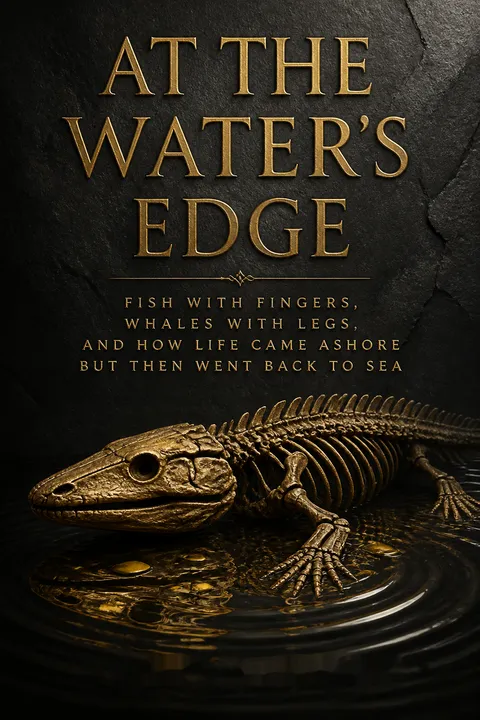


Key Takeaways
Treat macroevolution as a testable history, not a miraculous leap.
Two impossible journeys. This book follows vertebrates out of water and mammals back into it. The transitions once seemed to demand sudden, almost magical transformations: how could fish acquire limbs, or land mammals become whales? Macroevolution means large-scale evolutionary change, including the origin of new body plans. It is harder to study than microevolution, which tracks changes within populations, because it unfolds across immense spans of time and leaves an incomplete fossil record.
Evidence closes the gap. Fossils, anatomy, embryos, genes, and studies of living animals now illuminate both journeys. The evidence does not show a fish waking up with legs. It reveals many altered forms and intermediate ways of living, each offering clues to how a lineage changed.
The book’s central achievement is methodological as much as biological: it shows how historical sciences can make claims testable without replaying the past in a laboratory. A fossil supplies one kind of evidence, embryonic development another, and living animals a third. When these sources converge, a reconstruction gains strength. When they conflict, uncertainty becomes informative rather than embarrassing. This is a useful model for readers judging any account of deep history: ask what observations could weaken the proposed explanation, not merely whether the story sounds plausible.
Read bodies as inherited history, not as clean engineering.
Anatomy carries ancestry. Human bodies are not freshly optimized designs. Their structures preserve traces of earlier forms. A human embryo briefly develops arches and blood-vessel loops resembling those in fish gills. In humans, these structures are reorganized into parts of the head and neck, while one early vessel loop helps produce the hooked path of the aorta. The result works, but it is not the layout an engineer starting from scratch might choose.
Similarity has two causes. Homology is a shared structure inherited from a common ancestor, even when its modern jobs differ. Analogy is a similarity in function that evolved independently. A dolphin’s flipper and a human arm are homologous, built from the same basic arrangement of limb bones. A flying lizard’s skin sail and a flying squirrel’s skin flap are analogous, not the same inherited structure.
This distinction is a powerful antidote to reasoning from appearances. Similar function does not establish close kinship, and different function does not erase shared ancestry. In other fields, historical path dependence explains why institutions and technologies retain awkward features long after their original context has changed. Biology adds a physical record: development modifies inherited materials rather than drawing on a blank page. The caution is that resemblance is not self-interpreting. Homology claims need several features and lines of evidence, since convergence can make unrelated organisms look deceptively alike.
Look for old structures gaining new jobs before new structures appear.
Evolution repurposes. An exaptation is a feature that evolved in one context and later became useful for a different one. It is not a structure built in anticipation of the future. Bone, for example, may have begun as a way to store minerals before becoming armor and an internal scaffold for muscles. Lobe-finned fish already had lungs and sturdy bones within their fins before their descendants became land animals.
Preparation without foresight. The book also traces urea, a less toxic waste product that helps conserve water. Some fish lineages already used it in salty environments, leaving descendants better equipped for the water-loss problems of life on land. Limblike fins may likewise have helped animals maneuver through shallow, cluttered water before limbs supported movement on shore. A useful trait can precede the use that makes it famous.
Exaptation makes evolutionary history less like a design brief and more like adaptive reuse: a material acquires new value when circumstances change. The idea connects naturally to innovation studies, where breakthroughs often recombine tools developed for other purposes. It also complicates the familiar claim that a feature exists because it serves its current function. Current usefulness alone cannot reveal origin. At the same time, retrospective stories of repurposing can become too easy to invent. Strong cases need evidence for both the earlier role and the later change in use.
Study embryos to see both evolutionary possibilities and limits.
Hands grow by branching. Neil Shubin and Pere Alberch compared the development of limbs across tetrapods and described a recurring pattern: a central axis forms, then branches into smaller skeletal elements. Near the wrist, the axis bends, and digits grow from its far end. This developmental pattern helps explain why limb bones vary in size and number without producing every imaginable design.
Eight fingers changed the question. Acanthostega, an early tetrapod fossil from Greenland, had eight digits on a forelimb. Other early forms had six or seven. These discoveries undermined the assumption that the first tetrapods already had five fingers. The Hox genes that help pattern limbs are part of the developmental machinery involved, although the precise mechanisms were still under investigation in the book. Evolution can alter the program, but it works through rules that shape which variations can arise.
Development brings a missing level of explanation between genes and adult anatomy. A mutation does not simply add a finished part; it alters a process in a growing organism. That process both enables novelty and channels it. This helps explain why evolution can generate diverse hands while repeatedly preserving a shared structural logic. The wider lesson resembles constraint-based models in engineering: a system’s rules define its design space. Yet developmental constraints are not absolute walls. They describe probabilities and pathways, not a list of forms evolution can never produce.
Trace changes across connected anatomy, not one organ at a time.
The ear changed with the head. In lobe-finned fish, the hyomandibular bone helped support the jaw and move gill structures. In early tetrapods, it shrank into the stapes, a bone in the middle ear. This transition happened alongside changes to the skull, jaw, gills, and shoulders. As the skull fused and the jaw took on a new arrangement, the old bone lost its earlier jobs. Changes around the head also helped make room for a neck and stronger shoulders.
One shift affects others. Correlated progression is the coordinated change of linked structures during evolution. The term does not imply a plan. If one alteration makes another more useful, the changes can reinforce each other. A new way of biting, for instance, can favor changes in the head and muscles that support it.
Correlated progression captures a central systems insight: organisms are networks of interacting parts, not collections of independent components. A change in one region can alter the demands placed on another, producing feedback rather than a simple chain of isolated improvements. This perspective resembles systems biology, where researchers study interactions and emergent effects rather than treating each component as self-contained. The challenge is causal attribution. Because many changes occur together in the fossil record, it can be difficult to determine which initiated a transition and which followed as consequences.
Search ecological borders for evolutionary experiments, not destiny.
Water’s edge was not a death march. Older accounts placed the first tetrapods in drought-stricken ponds, where fish supposedly crawled to survive. Later discoveries showed that many relevant Devonian landscapes were lush, wet, and crossed by rivers. Keith Thomson argued that lobe-fins may have diversified in coastal lagoons, where shallow water, decaying plants, and low oxygen created new challenges and opportunities.
Acanthostega stayed aquatic. It had digits, but its weak shoulders, gills, and fishlike tail suggest it was poorly suited to walking on land. Its limbs may first have helped it move through shallow water and around submerged obstacles. The book also examines the amniotic egg and land reproduction, but suggests that plant-eating may have contributed more directly to later amniote diversification. That evidence is suggestive, not proof that a single innovation explains success.
The ecological setting changes the evolutionary question. Instead of asking what force pushed a fish onto land, it becomes possible to ask what advantages a limb offered in a shallow, obstructed habitat. This is a more precise account of selection because it connects anatomy to specific environmental conditions. The discussion of plant-eating also shows why evolutionary success is difficult to assign to one trait: reproductive biology, diet, body size, and microbial partnerships can interact. A correlation between an innovation and diversity is a promising lead, but not a causal verdict.
Use branching trees to separate ancestry from superficial resemblance.
Classify by shared history. Cladistics organizes organisms into evolutionary branches by comparing traits they share. A cladogram is a diagram of those relationships, not a ladder ranking living species from primitive to advanced. The method favors the simplest tree consistent with the evidence, while recognizing that unrelated lineages can independently evolve similar features.
The pace remains a live question. Punctuated equilibrium proposes that species may persist with relatively little visible change, while new species can arise comparatively quickly in isolated populations. The idea challenged a picture of evolution as uniformly gradual, but does not mean that major body plans appeared in a single leap. The book’s broader lesson is that fossils can reveal branching patterns and rates, while gaps and incomplete specimens leave room for competing reconstructions.
Cladistics makes assumptions visible: researchers must state which traits count and how they group organisms. That transparency makes disagreement productive, because alternative trees can be compared against evidence. The approach also guards against a common narrative error, treating the surviving branch as the destination of every extinct one. Still, the simplest tree is not automatically the true tree. Convergent traits, missing fossils, and choices about which features to code can change results. A cladogram is best understood as a revisable model, not a photograph of ancestry.
Whales did not become fish; land mammals rebuilt themselves for water.
Fossils reveal intermediate lives. Pakicetus, an early whale known first from its skull, retained features of land mammals and lived near rivers. Ambulocetus had limbs and could move on land, but its body and spine suggest powerful swimming. Rodhocetus relied more on its flexible back and tail, while later whales such as Basilosaurus were fully aquatic but still carried small hind limbs. Across these forms, the transition involved many changes rather than one sudden plunge.
The route was not settled. The book describes mesonychids as likely close relatives of whales, but also presents genetic evidence linking whales with even-toed mammals, especially hippos. Those lines of evidence did not fully agree. The fossils, including whale legs with toes, establish a land ancestry far more clearly than they settle every branch of the family tree.
The whale story is especially persuasive because it joins a vivid sequence of fossils to functional studies of living swimmers. Frank Fish’s comparisons of mammals in water suggest possible stages from paddling to more efficient tail-driven motion, while the fossils provide bodies that fit parts of that sequence. The unsettled relationship between whales and other mammals is equally instructive. Evolutionary history can be secure at one scale, such as land ancestry, while a finer question, such as the closest living relative, remains contested.
Loss rarely means simple deletion: old development can leave traces or new uses.
Whale legs had another possible role. Basilosaurus retained small hind limbs with strong muscle attachments and joints. Paleontologist Philip Gingerich argued that they may have helped with mating, even though they no longer propelled the whale. In living whales, hind-limb buds begin to form in embryos and then regress, showing that the developmental process has been modified rather than erased entirely.
Reduction can reorganize a body. An atavism is the reappearance of an ancestral feature, such as an extra digit or a rare limb in an animal whose lineage usually lacks one. But not every odd feature is a genuine throwback. Legless lizards, for example, did not simply lose legs and recover an old fishlike motion. Their bodies lengthened and their locomotion changed in stages, with limb loss part of a wider reorganization.
This account challenges the assumption that a reduced structure is useless or that loss is evolution in reverse. A feature can disappear from one function while remaining useful in another, as the proposed reproductive role of whale hind limbs suggests. Developmental remnants also show how evolutionary change can suppress a process without removing every mechanism behind it. The careful qualification matters: unusual anatomy is not automatically an atavism. Demonstrating that a feature reflects ancestral development requires more than noticing that it resembles an old form.
Judge intelligence within an animal’s sensory and social world.
Dolphins perceive differently. Toothed whales use echolocation, emitting clicks and interpreting returning echoes. Experiments described in the book show dolphins distinguishing shapes and materials through sound, and identifying objects they previously explored by sight. In language experiments, trained dolphins followed commands that specified objects, actions, and their relationships, suggesting they could process ordered instructions.
A test is not a mind. Dolphins performed impressively in mirror experiments, but the results could not settle whether they recognized themselves. The book reports an encephalization quotient, or EQ, comparing brain size with the expected size for an animal of similar body weight. Bottlenose dolphins scored about 4.14, while humans scored about 7.06. Such measures can invite comparison, but they do not capture every form of cognition or explain what another species experiences.
The dolphin chapters make a strong case for studying intelligence as an interaction between brain, senses, and social life. A creature that builds a detailed acoustic picture of its surroundings may organize information differently from a visually oriented human. This connects to the idea of an animal’s perceptual world: what counts as a salient object depends partly on the senses available. The caution is that trained performances are interpreted through human-designed tasks. Impressive results show genuine cognitive capacities, but they cannot by themselves translate a dolphin’s experience into human categories.
Analysis
At the Water’s Edge is a science narrative about how evolutionary explanations become credible. Its two main transitions, vertebrates moving onto land and mammals returning to the sea, are not presented as isolated miracles. They are reconstructed from fossils, comparative anatomy, embryology, genetics, ecology, and observations of living animals. The parallel between the transitions is especially useful: both begin with organisms exploring marginal habitats, using inherited structures in new ways, and diversifying before their descendants become fully adapted to a new environment.
The book’s most durable intellectual contribution is its refusal to treat evolution as either a perfect designer or a blind sequence of tiny changes. Developmental rules constrain variation, while exaptation and correlated progression show how existing structures can acquire new functions through interaction. That framework makes innovation intelligible without requiring foresight. It also leaves room for contingency: extinction can open ecological space, and lineages do not know what they are becoming.
The narrative makes scientific work memorable by following researchers through field searches, museum drawers, and disputes over specimens. This vividness has a tradeoff. A discovery can appear to depend on a lone scientist’s insight when its interpretation relies on many collaborators, prior collections, and later testing. The book partly corrects for this by showing arguments being revised, including the changing picture of Devonian habitats and disagreement between fossil and molecular evidence about whale relationships.
Because the book reflects research available in 1998, its particular phylogenetic proposals should be read as a snapshot, not as a final modern consensus. Its broader lesson holds: major evolutionary claims are strongest when independent evidence converges, and uncertainty about one branch does not invalidate the larger history. The reader finishes with a more demanding idea of explanation: not just a plausible story of transformation, but a story that exposes its evidence, alternatives, and limits.
Review Summary
At the Water's Edge is highly praised for its clear explanations of macroevolution, focusing on tetrapods and whales. Readers appreciate Zimmer's engaging writing style, blending science with historical context. The book explores concepts like exaptation and correlated progression, offering insights into evolutionary biology. While some find certain sections dense or technical, many consider it a fascinating and well-written account. Reviewers commend Zimmer's ability to make complex topics accessible and entertaining, though a few note it may be challenging for complete beginners.
People Also Read





Glossary
Macroevolution
large-scale evolutionary changeEvolutionary change at the scale of major lineages, new body plans, and broad patterns in life’s history. In the book, the transitions from lobe-finned fish to tetrapods and from land mammals to whales serve as major examples. Macroevolution includes changes in anatomy and ecological role across long periods, not merely shifts in trait frequencies within a population.
Exaptation
a feature gaining a new roleA structure or trait that evolved under one set of conditions and was later put to a different use. The term avoids implying that evolution planned ahead. In the book, limbs that may have helped early tetrapods move through shallow water became useful for movement on land, while existing physiological traits helped descendants cope with new environments.
Correlated progression
linked body changesThe coordinated evolution of structures that depend on or influence one another. A change in one part can make changes in other parts more useful or possible. The transformation of the fish hyomandibular bone into a tetrapod ear bone occurred alongside changes in the jaw, skull, gills, neck, and shoulders.
Morphogenetic field
local pattern-forming interactionsA region of a developing embryo in which chemical signals or mechanical interactions among cells produce an organized pattern. The concept helps explain how structures can form through interactions within tissue, rather than through a simple one-gene instruction for every anatomical detail. The book discusses this idea in relation to limb development.
Cladistics
classification by shared ancestryA method of reconstructing evolutionary relationships by comparing traits among organisms and grouping those that share derived features. Cladistics represents proposed relationships as branching diagrams called cladograms. It makes assumptions about traits explicit and favors the simplest tree consistent with the evidence, while allowing that similar features may have evolved independently.
Hox genes
genes that pattern body regionsA family of genes involved in organizing the body plan during development. In vertebrates, Hox genes help establish regions along the head-to-tail axis and contribute to limb development. The book connects changes in their expression to the evolution of digits and other anatomical innovations, while noting that genes operate within wider developmental processes.
Atavism
reappearance of an ancestral traitThe unusual reappearance in an individual of a feature associated with an ancestor, such as an extra digit or a rudimentary limb. Atavisms can occur when developmental processes that were reduced or suppressed remain partly available. Not every unusual structure qualifies: a resemblance alone does not prove that an ancestral developmental program has reactivated.
Encephalization quotient (EQ)
brain size relative to expectationA comparison between an animal’s actual brain size and the brain size expected for an animal of similar body weight. The book uses EQ as a rough way to compare brain expansion among species. It is not a direct measure of intelligence, since brain organization, sensory demands, social behavior, and developmental timing also matter.
Punctuated equilibrium
stasis interrupted by speciationA hypothesis that species often show extended periods with little visible evolutionary change, interrupted by comparatively rapid formation of new species, often in isolated populations. It challenges the idea that evolutionary change always proceeds at a steady pace. The book stresses that this proposal concerns patterns and rates, not the sudden appearance of complex body plans.
FAQ
What's At the Water's Edge about?
- Exploration of Evolutionary Transitions: The book examines the significant evolutionary shifts from aquatic to terrestrial life and back, focusing on species like fish, tetrapods, and whales.
- Scientific Storytelling: Carl Zimmer combines engaging narratives with scientific detail, highlighting the history and discoveries in evolutionary biology.
- Interconnectedness of Life: It emphasizes the connections between species and how environmental adaptations have shaped evolution on Earth.
Why should I read At the Water's Edge?
- Engaging Writing Style: Zimmer's lucid writing makes complex scientific concepts accessible and enjoyable for a wide audience.
- Current Scientific Insights: The book offers up-to-date information on macroevolution, bridging historical context with modern understanding.
- Inspiration for Further Learning: It serves as a compelling introduction to evolution, encouraging readers to explore more about life's history and science.
What are the key takeaways of At the Water's Edge?
- Understanding Macroevolution: The book clarifies macroevolution as large-scale changes leading to new species and body plans.
- Importance of Fossil Evidence: Fossils like Acanthostega and Ichthyostega fill gaps in understanding evolutionary transitions.
- Role of Genetics and Development: Modern genetics and embryology, particularly Hox genes, have reshaped our understanding of evolution.
How does At the Water's Edge explain the transition from fish to tetrapods?
- Fossil Evidence: Key fossils show anatomical changes, such as limb development and gill loss, during this transition.
- Genetic Mechanisms: Hox genes play a significant role in limb development, explaining how fins evolved into arms and legs.
- Environmental Factors: Coastal lagoons provided new opportunities for adaptation, driving the evolution of tetrapods.
What role do Hox genes play in evolution, according to At the Water's Edge?
- Blueprint for Development: Hox genes determine body plans during embryonic development, influencing limb formation.
- Evolutionary Innovations: Changes in Hox gene expression can lead to significant innovations, like the development of fingers.
- Common Ancestry: Similar Hox genes across species indicate shared evolutionary history, tracing tetrapods back to fish ancestors.
How does At the Water's Edge explain the return of mammals to the sea?
- Evolutionary Reversal: Some mammals, like whales, evolved from land-dwelling ancestors back to aquatic life, showing evolutionary flexibility.
- Anatomical Adaptations: Changes like streamlined bodies and specialized limbs for swimming demonstrate evolution's ability to reshape organisms.
- Intelligence and Social Behavior: The return to the sea influenced cetaceans' cognitive abilities, linking environment and behavior.
What is the significance of Acanthostega in the study of evolution?
- Transitional Fossil: Acanthostega provides insight into the evolution of tetrapods from lobe-finned fishes, showing both fish-like and tetrapod-like features.
- Eight Digits: Its eight fingers challenge assumptions about digit numbers in early tetrapods, suggesting variability in early evolution.
- Understanding Adaptations: Studying Acanthostega helps researchers understand early tetrapod adaptations, particularly in locomotion and respiration.
What is the significance of Pakicetus in At the Water's Edge?
- Oldest Known Whale: Pakicetus is the oldest known whale, providing crucial insights into the transition from land mammals to aquatic life.
- Fossil Evidence: Its teeth and skull structure reveal adaptations for a semi-aquatic lifestyle, linking terrestrial mammals to aquatic descendants.
- Evolutionary Implications: Pakicetus challenges previous notions about whale evolution timelines, suggesting an earlier transition to aquatic life.
How does At the Water's Edge address the concept of exaptation?
- Definition of Exaptation: Traits evolve for one purpose but later find new uses, like limbs evolving for walking and later adapting for swimming.
- Examples in Evolution: Features like whale flippers evolved from structures originally designed for different functions, showing evolutionary flexibility.
- Significance in Evolutionary Theory: Exaptation challenges the idea that every trait has a single purpose, emphasizing evolutionary complexity.
How does At the Water's Edge address the concept of vestigial structures?
- Definition of Vestigial Structures: Remnants of organs or features that once had a function but have lost their original purpose.
- Examples in Whales: Vestigial legs in whales indicate their evolutionary past, crucial for understanding the land-to-sea transition.
- Implications for Evolution: Vestigial structures support evolution by showing how species retain ancestral features while adapting to new environments.
What are the main evolutionary pressures discussed in At the Water's Edge?
- Environmental Changes: Climate and habitat changes create challenges and opportunities, driving significant evolutionary adaptations.
- Predation and Competition: These factors influence evolution, with organisms better able to escape predators or exploit resources thriving.
- Social Structures: Social dynamics can drive complex behaviors and intelligence, as seen in dolphins and other cetaceans.
How does At the Water's Edge connect the evolution of whales to broader themes in macroevolution?
- Patterns of Change: Whale evolution is part of a larger pattern of change, connected to other species' transitions like tetrapods.
- Interconnectedness of Species: Whale evolution is part of a complex web of life, emphasizing species' interconnected evolutionary paths.
- Implications for Understanding Evolution: Examining whale evolution provides insights into macroevolution mechanisms, informing biodiversity and conservation discussions.
About the Author

Download PDF
Download EPUB
.epub digital book format is ideal for reading ebooks on phones, tablets, and e-readers.








