

Key Takeaways
Read the Revolution as a contingent human struggle, not history's preset destination.
Memory outlasts monuments. Schama opens with Napoleon's plaster elephant, meant to distract visitors from the Bastille. It crumbled in the mud while the prison's revolutionary meaning endured. The image introduces the book's central argument: the Revolution was not an automatic result of an obsolete society, but an unpredictable sequence of choices, conflicts, and unintended consequences.
People made the turns. France was changing rapidly before 1789, and its institutions were already being challenged. But the collapse of royal authority depended on specific decisions, from the failed handling of debt to the calling of the Estates-General. Local pressures also mattered; Paris did not simply impose one uniform revolution on the country.
What's striking is that the book treats contingency as a serious explanation, not a denial that structures matter. Financial pressure, changing markets, and social inequality shaped the choices people could make, but they did not dictate a single outcome. The narrative form makes that distinction vivid: each failed compromise narrows the next set of options. The approach also carries a risk. Focusing on dramatic people and events can make long-term forces seem less powerful than they were, so the strongest reading holds agency and structure together.
Do not mistake late Bourbon France for a fossil awaiting revolution.
A country in motion. The France of Louis XVI was not economically inert. Roads and coaches made travel faster, canals expanded trade, and new industries grew. Schama estimates annual economic growth at about 1.9 percent; by the end of the reign, around 30 percent of agricultural goods were sold away from where they were produced. The state promoted science, engineering, public health, and technical education.
Progress had a price. The harbor at Cherbourg symbolized royal ambition, but its elaborate timber cones failed and consumed 28 million livres before the project was abandoned. Meanwhile, commercial change threatened customary access to common land and work. The Revolution drew power not only from anger at old privilege, but also from hostility to modernization that disrupted familiar livelihoods.
The chapter's useful distinction is between modernization and improvement. A growing economy can generate new wealth while making particular households less secure, especially when customary protections disappear faster than alternatives emerge. The aggregate figures show dynamism, but they cannot tell whether a displaced weaver or indebted smallholder felt it as progress. Schama's account is strongest when it follows both scales: expanding national markets and the people who experienced their costs. The failed Cherbourg project also shows that innovation could be expensive, politically conspicuous, and badly judged.
Treat American liberty as a cause of French citizenship, not its result.
Citizenship had a prehistory. French patriotism did not begin in 1789. After the Seven Years' War, young nobles and officials sought new national heroes and a more active public role. The American Revolution gave them a language of liberty and an opportunity to act. Lafayette's devotion to George Washington, and Franklin's carefully cultivated image as a plain, virtuous American, helped make citizenship feel personal and admirable.
Culture taught politics. Rousseau's writing, Greuze's family scenes, Roman history paintings, and patriotic theater promoted tenderness, civic duty, and sacrifice. Schama calls some reform-minded aristocrats a citizen-nobility: nobles who embraced civic identity and equality rather than treating inherited rank as their defining political role. The Revolution drew on this culture before it created new institutions.
The distinctive claim is that a political identity can be rehearsed before it is formally recognized. A public does not need a constitution before it starts imagining what a citizen should look and sound like. The American heroes, sentimental family ideals, and Roman exemplars supplied recognizable roles for people to inhabit. Yet the language of universal citizenship was more inclusive than the actual rights being offered. Women and many workers remained outside formal political participation, a gap that makes the culture both powerful and incomplete.
A war debt became fatal when royal credit lost political trust.
Debt was not destiny. France spent about 1.3 billion livres supporting the American Revolution, and 91 percent of the required funds came from loans. But the debt alone did not make revolution inevitable. Schama notes that Britain carried a heavy debt burden too. The sharper problem was political: the monarchy struggled to raise taxes broadly, and repeated changes in policy weakened confidence that it could manage its finances.
Credit required consent. Necker tried to build trust by publishing the royal accounts and cutting expenses, but his successors reversed many of his economies. By August 1788, the Treasury reportedly held only 400,000 livres, enough to keep the government operating for an afternoon. Once lenders doubted the crown's authority and repayment, the financial crisis became a crisis of sovereignty.
The episode makes a useful distinction between a state's debt and its capacity to make credible commitments. A large obligation can remain manageable when institutions command trust; a smaller one can become dangerous when policy looks arbitrary and revenue cannot be secured. Schama's emphasis on political confidence helps explain why financial rescue required representation. It also cautions against a purely moral account of royal failure. Debt, war, taxes, and institutional credibility interacted, and no single accounting figure explains the collapse.
Tie constitutional promises to bread, or hardship will judge them.
Hunger made politics immediate. A disastrous harvest followed by severe winter weather pushed the four-pound loaf from about eight sous in summer 1787 to fifteen sous in February 1789. A laborer might earn only twenty to thirty sous a day. For families already spending much of their income on bread, political reform could not be separated from survival.
Grievances were concrete. The cahiers de doléances were local statements of complaints and hopes, produced during the elections to the Estates-General. About 25,000 were drawn up across France. Many called for representation and legal equality; many others demanded protection from tax collectors, game laws, enclosures, and grain speculation. The new political order inherited expectations it could not easily satisfy.
This is where the book's political and social narratives meet. The people who entered politics did not all want the same thing: educated reformers often favored freer markets, while many village communities wanted customary protections restored. Their shared hope that a national assembly would deliver both justice and food concealed a real conflict over what justice meant. The chapter suggests that material hardship does not merely add pressure to political change. It helps define the promises people expect the new order to keep.
Public symbols can make a nation feel real before laws do.
A public came into view. In 1783, a balloon rose over Versailles before a crowd that accounts estimated at roughly 100,000, though Schama cautions that the figure is unreliable. The spectacle displaced the King as the main object of attention and gave strangers a shared experience outside court ceremony. Theater, salons, newspapers, songs, and political oratory widened that new public sphere.
Memory became political. The Bastille held only seven prisoners when it fell, yet its capture came to symbolize the destruction of arbitrary power. Pierre-François Palloy turned its stones into souvenirs and organized tours, ceremonies, and models. The Revolution's symbols did not simply decorate a political program. They helped people imagine themselves as participants in a common national event.
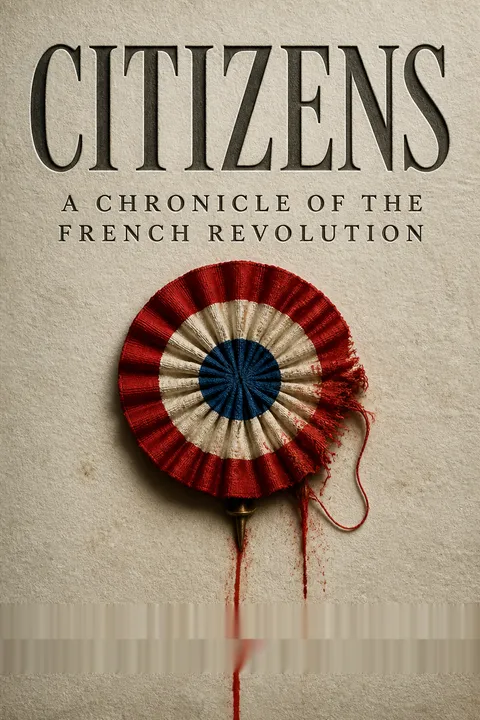
The section shows political communication working through bodies and objects as well as arguments. A cockade, a song, or a shared spectacle can make an abstract community feel present, especially to people who will never meet most of its members. That power can also outrun accuracy: the Bastille's symbolic importance grew far beyond the practical event of freeing seven prisoners. The gap is not necessarily a flaw. Political memory often works by concentrating diffuse fears and hopes into an image that can be carried and repeated.
Once elites enlist crowds, popular force writes its own terms.
Mobilization changed the agenda. In June 1789, deputies of the Third Estate declared themselves a National Assembly and swore not to disperse until they had created a constitution. Yet the political crisis was not confined to the hall. On October 5, market women marched to Versailles, driven by bread shortages and anger at the royal court. Their arrival forced the King and royal family to move to Paris.
The crowd was not a tool. The Bastille's fall began with demands for weapons and gunpowder, but fear, miscommunication, and combat turned the encounter into a battle. The governor, de Launay, was killed by the crowd. Schama traces how elites could invite popular action against their opponents, then discover that the people had their own priorities and would not simply return to passivity.
The account avoids treating crowds as either a single democratic voice or an irrational mob. Participants had varied aims, and events could shift rapidly as rumor, hunger, and armed confrontation interacted. That complexity matters because leaders often claimed to speak for a unified people whose wishes they could not actually control. The October march and the Bastille show different forms of popular agency: one aimed at bread and the King's presence, the other at arms and a hated symbol of state power.
Limit emergency power before a revolutionary state claims every citizen in its name.
Equality invited centralization. The Assembly abolished inherited distinctions, reorganized France into departments, and made the nation the source of sovereignty. It also took Church property into national hands and made clergy swear loyalty to the new order. These changes challenged real privileges, but they also brought local institutions under a more uniform state.
Rights met constraints. The language of universal citizenship did not translate into equal political participation. Voting rules excluded women, domestic servants, and many wage earners. Meanwhile, committees gained powers to investigate, censor, and detain people deemed threats to the Republic. The Revolution's central tension was already visible: the state claimed to protect citizens' liberty while narrowing who could act politically and what counted as acceptable dissent.
The dilemma is not unique to revolutions: a government may need capacity to enforce common rules, yet the same capacity can suppress the people it claims to represent. Schama makes that contradiction visible inside the Revolution's founding acts, not only in its later emergency politics. The distinction between equality before law and equal power is especially important here. A system can erase legal rank while preserving sharp limits on voice, property, and participation.
A republic that sanctifies violence teaches every faction to claim necessity.
Punishment became political. In September 1792, crowds killed at least 1,400 prisoners in Paris, many without trial. The massacres were not simply a sudden lapse into chaos: fear of invasion, rumors of conspiracy, and calls to punish traitors made the killings seem to some like a defense of the Republic.
The state adopted the logic. The guillotine was first presented as a uniform, relatively humane penalty, but it became part of a wider politics of exemplary death. In the Vendée and Lyon, military repression and mass executions followed rebellion. Schama's stark claim is that violence was not merely an unfortunate instrument used by the Revolution; it helped define what the Revolution was. Once necessity authorizes killing, every faction can claim it.
The strongest part of this argument is its refusal to let revolutionary ideals erase the means used to defend them. It also leaves a hard question: if violence is treated as constitutive, how can differences between a street massacre, battlefield killing, and state execution remain visible? Those distinctions matter morally and historically. Still, the book shows why each could be defended in the same political language of emergency, virtue, and national survival, making the boundary between justice and vengeance dangerously unstable.
Analysis
The book's central achievement is to make political culture and material pressure explain each other. It rejects a clean sequence in which an archaic regime collapses, a bourgeoisie takes power, and modernity follows. France was already modernizing, already debating citizenship, and already generating patriotic identities before 1789. The crisis emerged when financial decisions, failed compromises, local grievances, and new expectations converged. The Revolution was therefore neither predetermined nor simply an accident. It was a sequence of contingent choices made inside a society whose members had learned to imagine a different political community.
That argument gives the narrative its force. Lafayette, Necker, Mirabeau, the market women, and the deputies are not ornamental characters placed over social structures. They are actors who interpret events, deploy symbols, and alter what others believe possible. The Bastille matters less as a military prize than as a memory people can use. The Tennis Court Oath matters because it makes a new sovereign body imaginable. The September massacres matter because political rhetoric and popular fear turn violence into a claim of legitimacy.
The book's most productive tension is between citizenship and state power. The Revolution promises a nation of equals, but its institutions require centralized authority, taxation, policing, and military force. The more the state tries to protect the Republic, the more it narrows the space for citizens to disagree with its definition of the public good. This is not merely hypocrisy. It is a structural conflict between popular sovereignty, plural political life, and the practical demands of governing a large country at war.
Schama's emphasis on elite agency is persuasive, especially in explaining how liberal nobles and clergy helped dismantle their own orders. But it can make the poor appear mainly as pressure on political actors rather than producers of political ideas in their own right. The book's best corrective is its attention to local cahiers, urban crowds, village customs, and the changing language of popular protest. Taken together, these materials show a Revolution built not by one class or one ideology, but by competing claims to represent the nation, each made urgent by the fear that the other would destroy it.
Review Summary
Citizens receives mixed reviews, averaging 4.03/5. Praised for its rich narrative, vivid character portraits, and revisionist argument that violence was central—not incidental—to the French Revolution, many readers appreciate Schama's immersive storytelling and debunking of myths. However, critics note the book's excessive length, scattered chronology, and assumption of prior knowledge makes it challenging for beginners. Some find his conservative bias problematic, arguing he over-emphasizes brutality while undervaluing the Revolution's lasting contributions to liberty, democracy, and the concept of citizenship.
People Also Read


Glossary
citizen-nobility
Nobles embracing civic identitySchama's term for nobles who helped define themselves through public service and citizenship rather than inherited privilege alone. Many had served in the American Revolution or supported reform under Louis XVI. In 1789, some used their standing within the elite to support equality before the law and the political unity of the nation.
sensibilité
Virtue expressed through feelingAn eighteenth-century ideal of emotional responsiveness that treated tenderness, sympathy, sincerity, and visible feeling as signs of moral character. In Schama's account, it shaped literature, painting, family ideals, and public conduct. The capacity to feel deeply became linked to patriotism, and private relations were often treated as a training ground for citizenship.
General Will
The people's collective sovereigntyA political idea associated with Rousseau in which legitimate sovereignty belongs to the people collectively, rather than to a monarch or separate privileged bodies. Revolutionaries used it to justify a unified national authority and the claim that citizens could govern themselves. Schama emphasizes the danger in assuming that this collective will could never oppress individuals.
cahiers de doléances
Local grievance statementsWritten lists of complaints and proposals prepared in 1789 by communities participating in the elections to the Estates-General. Roughly 25,000 were produced across France. They recorded demands for political representation and legal equality, alongside practical concerns such as taxes, bread prices, game laws, common land, and local justice.
Great Fear
Rural panic and mobilizationThe wave of panic that swept parts of France in the summer of 1789, as rumors spread that brigands or foreign troops were attacking villages. Communities rang church bells, armed local militias, and sometimes attacked châteaux or symbols of seigneurial authority. Schama treats it as spontaneous, but fueled by real insecurity and the collapse of central authority.
Civil Constitution of the Clergy
State reorganization of the ChurchA revolutionary measure that reorganized the French Church around the new administrative map and required clergy to swear loyalty to the nation and its laws. It aimed to make the Church a public institution under state authority. The oath divided clergy and communities, intensifying the conflict between revolutionary sovereignty and religious allegiance.
About the Author
Other books by Simon Schama
Download PDF
Download EPUB
.epub digital book format is ideal for reading ebooks on phones, tablets, and e-readers.








