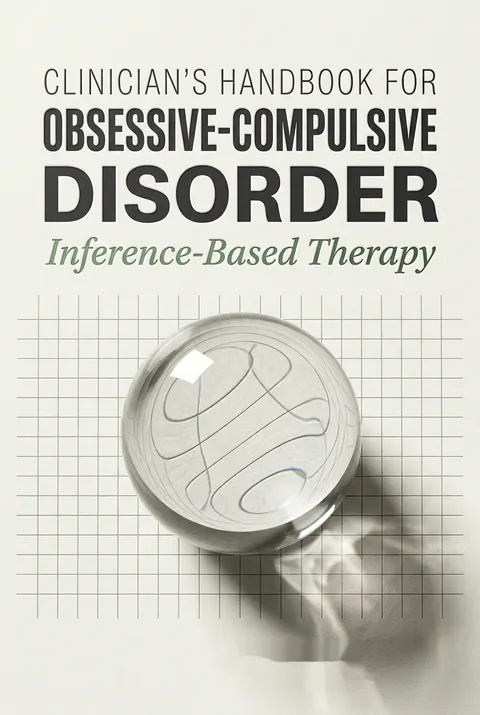


Key Takeaways
Treat OCD as a reasoning problem: locate the doubt that starts the spiral.
Start with the inference. In the Inference-Based Approach, an obsession begins not with a thought that simply barges in, but with a conclusion about what might be true. The authors call the characteristic reasoning pattern inferential confusion: a person distrusts their senses or judgment while giving remote possibilities unusual weight. A doubt such as perhaps I left the stove on can lead to feared consequences, anxiety, and checking. The treatment aims first at that initial inference, rather than beginning with the feelings or predictions that follow it.
A different lens. The book presents this as a reasoning disorder model, not a claim that every unwanted thought has the same origin. It also recognizes that images, appraisals, and anxiety can matter clinically. The key move is to ask what reasoning makes this particular doubt feel credible.
The model’s strength is its attention to the moment a thought becomes actionable. Many people experience strange or unwanted thoughts; the clinically important question is often how a person interprets and responds to one. That focus connects with metacognition, the study of how people think about their thinking. Still, describing obsessions as inferences rather than intrusions is a theoretical distinction, not a settled rule for every case. The two descriptions can illuminate different parts of the same experience, and a clinician should stay curious about the individual pattern rather than force every symptom into one explanation.
Work backward from the ritual to name its first obsessional maybe.
Trace the chain. The handbook offers a practical route to the primary obsessional doubt, the first feared possibility that drives the compulsive response. Ask what ritual the person performs, what would need to be true for that ritual to feel unnecessary, and what they currently doubt. For example, repeated handwashing may be driven by the possibility that the hands are contaminated, while fear of infecting family members is a consequence further down the chain.
Make the problem smaller. Mary, a client whose contamination fears attached to red objects, feared that red paint or foam might be blood. Her worries then spread to clothing, furniture, and her car. The authors argue that identifying the initiating doubt helps separate it from the escalating consequences and makes treatment more focused.
Working backward is a useful form of functional analysis: it asks what a behavior is meant to prevent, rather than treating the visible ritual as the whole problem. It can also reveal covert compulsions, such as mentally reviewing an event or seeking reassurance. The method depends on collaborative inquiry, because a therapist’s guess about the underlying doubt may miss the client’s actual reasoning. The same ritual can serve different perceived threats for different people, so the sequence should be discovered, checked, and revised with the client, not imposed as a tidy formula.
Separate a plausible possibility from evidence in the present situation.
Check the context. The book distinguishes an ordinary doubt, which has some relevant information in the current situation, from an obsessional doubt supported mainly by imagined possibilities. A person who notices a door lock behaving unusually has a reason to check it. Someone who sees the door lock normally, then imagines that it might have failed because locks sometimes break, is relying on a different kind of justification. IBT asks whether the doubt has direct support in the here and now, not whether the feared event is imaginable in the abstract.
Do not confuse evidence with certainty. The authors describe obsessional doubt as irrelevant when remote possibilities are disconnected from the actual situation. Their strong language that such doubt is imaginary is part of the treatment model, not a demand to prove absolute safety.
This distinction usefully separates a real-world signal from a possibility generated by an escalating story. It resembles decision theory, where a possible outcome is not automatically a reason to act unless its likelihood, cost, and context matter. A necessary caution follows: lack of immediate evidence does not logically prove that an event is impossible or false. Nor does sensory checking settle every genuine risk. The clinical task is to distinguish ordinary precaution from compulsive certainty-seeking, while preserving reasonable responses to actual hazards. That calibration requires judgment, not a blanket instruction to trust perception in every circumstance.
Expose the story stitching remote facts into a personal threat.
Notice the narrative. In IBT, a doubt gains force through an obsessional story: a chain of reasoning, associations, and details that makes an imagined threat feel connected to the present. The story may use true statements, such as germs exist, or reports about what happened to someone else. The problem, as the authors frame it, is how these facts are applied to the person’s current situation without relevant evidence.
See how stories persuade. The handbook illustrates this with a clean pen. A therapist invents a vivid account of the pen being exposed to dirt and bodily grime. Although the pen itself has not changed, the story changes how willing someone feels to touch it. Clients also build an alternative story from their own observations and experience. Its purpose is to loosen the OCD story’s monopoly, not to replace it with rote reassurance.
The narrative emphasis explains why a collection of individually plausible statements can feel more compelling when arranged as a sequence. This connects with research on narrative transportation, the way a vivid story can draw attention and shape judgment. It also makes the exercise memorable: the same object can acquire a different meaning through context. Yet an alternative narrative can become another reassurance ritual if repeated until it feels perfectly convincing. The useful outcome is not winning a debate with OCD, but recognizing that a persuasive account is not itself proof that its conclusion applies now.
Catch the moment imagination takes over before rituals reinforce the fear.
Find the crossover. The OCD Bubble is the handbook’s metaphor for becoming absorbed in an imagined scenario and losing contact with immediate sensory information or one’s current intentions. A client might see no powder on their clothes, then imagine that sweeping made invisible poison cling to them and endanger a child. The moment the story outruns what is actually sensed marks a useful point to notice.
Rituals can deepen the loop. Checking, washing, avoidance, and testing may briefly reduce distress, yet the book argues that they also treat the imagined threat as if it were established. Testing means deliberately creating or seeking a feared situation to see what happens. The manual gives examples such as repeatedly inspecting a lock until it loosens, or seeking out a feared stimulus to test one’s reaction.
The bubble metaphor gives an abstract reasoning process a recognizable shape. It also links attention, action, and emotion: once absorbed, a person may notice less of the surrounding world and act according to the imagined scenario. Learning to spot that transition can create a pause without demanding that distress vanish first. However, not every repeated action is irrational, and some checking or cleaning is appropriate in context. The distinction turns on function and proportionality. A clinician must help identify when a behavior is an ordinary safety practice and when it is primarily maintaining an obsessional cycle.
Use ordinary senses, not extra checking, to return to the present.
Practice reality sensing. Reality sensing means using perception and common sense in the ordinary, unforced way a person uses them outside an OCD situation. If someone locks a door, they register the usual sensory information and continue with their day, rather than staring at the lock or repeating the action to manufacture certainty. The point is not to gather more and more evidence, but to notice when the mind has dismissed information it would normally accept.
Expect the urge to do more. The book notes that stopping extra rituals can leave a sense of incompleteness or a void. That feeling is not, by itself, evidence that the task is unfinished. The exercises ask clients to identify the first thought that takes them beyond the senses, pause, and choose whether to follow the story or return attention to what is happening now.
This approach resembles attentional retraining: perception is allowed to guide action without turning observation into a prolonged test. Its emphasis on ordinary functioning is important because excessive monitoring can make ambiguous details feel newly significant. The paradox is that a person may try so hard to sense correctly that sensing becomes another ritual. The handbook recognizes this risk and distinguishes natural looking from staring. The exercise is best understood as restoring proportionate attention, not as a universal rule that sensory impressions are infallible or that medical and practical precautions should be ignored.
Challenge the feared self by documenting the person your actions reveal.
Find the recurring theme. The vulnerable self-theme is the feared identity that links a person’s separate doubts. Someone checking doors, appliances, and work may fear becoming careless or irresponsible. Someone who fears harming their children may worry that they could be a bad parent, despite acting with care. The therapist and client identify this theme by looking for the common thread among the doubts, rather than assuming that one personality trait explains everything.
Build from observable life. The handbook asks clients to examine ordinary actions, relationships, values, and accomplishments to describe the person they are, not the person OCD says they might become. A parent’s care, a person’s conduct with friends, or a history of handling responsibilities can challenge an imagined identity. This is not a claim that people must be perfect to be safe. It is a way to ground self-understanding in lived evidence.
Linking symptoms to a feared identity can explain why certain themes matter intensely to one person and barely register for another. It also invites a broader view of the self than a diagnosis or a frightening possibility. The practice of recording concrete actions resembles approaches to identity that emphasize behavior and social roles over abstract labels. There is a risk, though, of treating the authentic self as simply the opposite of the feared self. People are complex, and reassurance based on being a good person can become another certainty test. The more durable aim is a flexible self-concept that can tolerate imperfection without turning it into evidence of danger.
Treat progress as staged learning, and slips as clues to the missing step.
Follow a paced program. The manual organizes IBT into three broad phases: education and foundation, intervention, and consolidation. It describes a usual course of about 12 to 20 sessions, with flexibility to spend more time where needed. Clients move from learning the model, to applying it personally, to using it in everyday life. Worksheets, exercises, quizzes, clinical scales, and diaries help therapist and client track doubts, rituals, distress, and perceived ability to resist.
Use setbacks diagnostically. The authors reject the idea that a client who is stuck is necessarily resisting treatment. A slip can show that a step was not understood, a new obsession needs attention, or a stressful situation revived an old pattern. Case reports in the handbook describe substantial gains for several clients, alongside a client whose strong commitment to a personal washing method limited improvement.
The staged design is one of the manual’s practical strengths. It makes progress observable and gives therapist and client a shared vocabulary for deciding whether to pause, repeat, or adapt an exercise. The case material also shows why response cannot be assumed: outcomes differ, and one client’s preferred ritual remained resistant to change. The book reports research support for the approach, but the cases presented here cannot by themselves establish comparative effectiveness. IBT is a clinician’s treatment model, not a substitute for assessment or individualized care, and progress measures should inform clinical judgment rather than serve as proof that a theory is correct.
Analysis
This handbook’s distinctive contribution is a change in where treatment looks first. Instead of treating anxiety, catastrophic appraisal, or the visible ritual as the starting point, it asks how a person arrived at the first doubt. That shift can make an elaborate symptom pattern more legible: one feared possibility may organize a chain of mental review, avoidance, emotional distress, and repeated action. The framework is especially useful when a client feels trapped by a story that borrows facts from other contexts and makes them seem personally urgent.
Its most productive concepts are also its most debatable. The distinction between an imagined possibility and a relevant present cue is clinically useful, but the further claim that an obsessional doubt is always false does not follow from the absence of direct evidence alone. In ordinary life, people often act on indirect information, probability, and precaution. The treatment therefore depends on careful contextual judgment, not on treating the senses as perfect instruments. Reality sensing should mean returning to proportionate perception and common sense, not dismissing legitimate safety information.
The book’s narrative approach offers another strength. It treats reasoning as something people do through connected accounts, not only through isolated beliefs. That helps explain why simply disputing a fact may fail: the fact may be true, while its connection to the current danger is unsupported. Constructing a competing account can expose that gap, although repeated use could become reassurance if the client feels required to make the alternative story certain.
The manual also respects therapy as a learning process. Its mapped stages, self-monitoring, and attention to small gains help locate obstacles instead of blaming the client. The evidence described includes research claims and detailed clinical examples, but the case illustrations include varied outcomes and do not settle how IBT compares with other established approaches. The strongest reading is neither that OCD is merely faulty logic nor that the model explains every case. It is a focused clinical lens for examining how possibility becomes conviction, to be applied collaboratively and tested against the person’s real circumstances.
People Also Read









Glossary
Inference-Based Therapy (IBT)
OCD reasoning treatmentA structured cognitive treatment for OCD that targets the reasoning behind the initial obsessional doubt. It helps clients identify how they arrive at the doubt, distinguish imagined possibilities from information relevant to the present situation, and act using ordinary perception and common sense. The handbook presents it as a collaborative program delivered across education, intervention, and consolidation.
Inference-Based Approach (IBA)
Reasoning model of OCDThe theoretical model underlying Inference-Based Therapy. It proposes that obsessional doubt arises through a reasoning process that gives remote possibilities undue influence while discounting the senses or one’s own judgment. In this account, compulsions and other responses follow from the doubt and can maintain its credibility. IBA focuses on how a person reaches a conclusion, not only on the conclusion’s content.
Inferential confusion
Possibility mistaken for probabilityA reasoning pattern in which a person relies heavily on imagined possibilities, distrusts sensory or self-based information, and treats a subjective scenario as though it were a realistic probability in the current situation. The authors describe these features as working together. In their model, inferential confusion helps explain why doubts feel compelling and why repeated neutralizing actions do not settle them.
Primary obsessional doubt
The first feared possibilityThe initial inference that something may be wrong, unsafe, or contrary to the person’s intentions. It precedes the feared consequences, emotional reaction, and compulsion in the proposed obsessional sequence. A clinician can identify it by working backward from the ritual and asking what state of affairs the person would need to be sure of for the ritual to feel unnecessary.
Obsessional sequence
Trigger-to-compulsion chainThe sequence through which OCD symptoms unfold: a situation or internal prompt is followed by an obsessional doubt, anticipated consequences, distress, and a compulsive or neutralizing response. Mapping the sequence helps distinguish the initiating doubt from later fears and actions. The handbook uses this map to help clients identify where their reasoning shifts away from the present situation.
Narrative unit
Story supporting a doubtThe connected account of reasons, associations, memories, and imagined possibilities that gives an obsessional doubt credibility. Rather than existing only as separate thoughts, these elements form a story that seems to carry the person toward a conclusion. IBT examines how this story is assembled and whether its details are relevant to the present situation.
OCD Bubble
Absorption in imagined threatA metaphor for becoming absorbed in an obsessional scenario and losing contact with immediate sensory information, common sense, or one’s actual intentions. The person may feel pulled to solve the imagined problem through checking, washing, avoidance, or testing. The treatment uses the metaphor to help clients notice the point where they shift from current evidence into an imagined account.
Reality sensing
Ordinary, unforced perceptionThe practice of relying on sensory information and common sense in the ordinary manner used in situations not dominated by OCD. It is not prolonged checking or an attempt to achieve perfect certainty. In the handbook, clients learn to notice when obsessional reasoning dismisses information they would normally accept, then make proportionate decisions without adding ritualized effort.
Vulnerable self-theme
Feared identity behind doubtsA feared version of the self that the authors propose can link a person’s different obsessional doubts. Examples include fearing one could become negligent, harmful, or unable to cope. The theme is developed collaboratively from the person’s specific doubts. IBT contrasts this imagined identity with the person’s observable actions, relationships, values, and accomplishments.
Thought-thought fusion
Imagined thought confused with actual thoughtA form of inferential confusion described in ruminative or primarily mental obsessions. A person mistakes thinking about the possibility of having a disturbing thought for actually having that thought, intention, or impulse. Attempts to monitor, suppress, or test for the imagined thought can keep attention fixed on its possibility and make it feel more significant.
Inferential Confusion Questionnaire
Measure of reasoning styleA questionnaire developed to assess tendencies associated with inferential confusion, such as relying on remote possibilities, doubting perception, and becoming absorbed in imagined scenarios. The handbook recommends it as one part of clinical evaluation and progress monitoring, alongside symptom measures and individualized ratings. It is an assessment tool, not a diagnosis or a standalone treatment.
Download PDF
Download EPUB
.epub digital book format is ideal for reading ebooks on phones, tablets, and e-readers.








