

Key Takeaways
Make work sustainable, because pressure makes capable people repeat themselves
Pressure can shrink creativity. The Strokes’ debut album, Is This It, was celebrated as a fresh classic. Facing intense expectations for their follow-up, singer Julian Casablancas worried about disappointing critics. The band restarted sessions repeatedly, then released Room on Fire, which reviewers criticized as a less inventive copy of the first album. Daisley uses the story to illustrate a broader pattern: under chronic stress, people often retreat to what worked before instead of exploring new options.
The modern job intensifies the squeeze. The book reports that 83 percent of American workers say work causes them stress, while constant connectivity stretches work into evenings and weekends. That matters because automation is better suited to routine tasks than to the everyday invention that helps people adapt. Enjoyable work is not a luxury claim. It depends on conditions that let people think clearly and recover.
The Strokes story captures an important distinction between pressure that focuses effort and pressure that narrows imagination. A deadline can help a team finish a known task; an environment of persistent evaluation can make people hide uncertainty and imitate past success. That distinction is useful because it avoids treating all stress as identical. It also places responsibility beyond individual resilience: if the work system rewards constant availability, exhortations to be creative are unlikely to overcome the incentives. The book’s argument is strongest when it treats enjoyment and performance as connected outcomes, rather than asking workers to tolerate harmful conditions for the sake of productivity.
Protect uninterrupted blocks for work that needs your best thinking
Attention is not endlessly divisible. Open offices promise collaboration, yet one company study found that after a move to open plan, email between colleagues rose 67 percent while face-to-face interaction fell 70 percent. Frequent interruptions also leave attention partly attached to the unfinished task. Psychologist Sophie Leroy calls this “attention residue.” The result is more switching, slower work, and less satisfaction from making progress.
Build a quiet work mode. A Monk Mode Morning is a protected period, often the start of the day, when someone is unavailable for email, calls, and meetings so they can concentrate on demanding work. Cal Newport calls this kind of focused effort “Deep Work.” It need not mean working alone all day: use quiet blocks to develop an idea, then reconnect with colleagues to test and improve it.
The practical insight is not that offices or conversation are inherently bad. It is that different tasks need different conditions. Concentrated drafting benefits from fewer interruptions, while coordination and feedback need contact with other people. Treating every hour as equally available for both creates a poor fit between the work and the environment. The idea also points toward a useful team-level question: which hours should be protected from interruption, and which hours should make collaboration easy? A quiet block only works if colleagues know the boundary and urgent exceptions are clear. Otherwise, the person concentrating pays the social cost of seeming unavailable.
Treat recovery as part of the work, not a prize for finishing
Longer hours have diminishing returns. Stanford researcher John Pencavel studied workers in a First World War munitions factory and found that output began to decline after roughly 50 hours a week. Workers doing 70 hours produced no more than those working 55. In another example, a venture-capital team tracked productivity and found it peaked just under 40 hours. These findings challenge the idea that visible exhaustion is evidence of achievement.
Recovery protects the next hour, too. Daisley’s practical case includes taking lunch, sleeping enough, turning off notifications, and keeping routine work out of weekends. Museum events manager Laura Archer found that skipping lunch left her depleted, relying on caffeine and comfort food, and struggling to enjoy her weekends. Rest is not automatically productive, but repeatedly removing it has a cost to attention, mood, and health.
A useful way to read these examples is as a warning against confusing input with output. Hours are easy to count, while good judgment, recovery, and finished work are harder to measure. That helps explain why overwork can persist even when it is ineffective: visible effort reassures managers and workers that something is happening. The evidence also requires care. A factory study, an office team, and a six-hour-day trial do not establish one ideal schedule for every occupation. The robust takeaway is narrower: fatigue has consequences, and organizations should test whether additional hours are producing additional value rather than assuming they do.
Build belonging through casual contact, not another culture slogan
Small interactions carry useful knowledge. MIT researcher Alex Pentland used sociometric badges to study how people actually interacted at work. His findings emphasized informal conversation as a route for ideas to travel between colleagues. In one Bank of America call center, workers shifted from taking breaks separately to taking short breaks with teammates. The group became more cohesive, stress fell 19 percent, and productivity rose 23 percent.
Make connection easy, not compulsory. A coffee machine placed between teams can encourage people to meet across group boundaries; a shared lunch table can do the same. But social contact should not become another forced activity. The book’s case is for creating natural opportunities to talk, exchange practical advice, and feel known by coworkers, not for prescribing friendship or turning every break into a networking exercise.
This section makes belonging concrete. It is not a slogan on a wall, but a pattern of access: whether people encounter one another, hear useful context, and can ask for help without booking a meeting. That perspective links workplace design to the circulation of knowledge. It also suggests that small physical decisions can have organizational consequences, even when they seem too trivial to merit executive attention. The caution about compulsory socializing matters. A shared break can reduce isolation when people choose it, but mandated cheerfulness can become another performance demand. The goal is opportunity and trust, not enforced sociability.
Shrink meetings until the people solving the problem can actually think
Meetings often become status theater. In the Marshmallow Challenge, teams have 18 minutes to build the tallest structure they can from spaghetti, tape, string, and a marshmallow. Preschoolers often outperform business students because they start testing ideas immediately, while adults spend time discussing roles and jockeying for authority. The exercise exposes a familiar workplace trap: talk about the task can displace experiments that reveal what works.
Use fewer people and less ceremony. Jeff Sutherland’s team research stresses that adding people multiplies communication links. A group of 10 has 45 possible channels, compared with 10 for a group of five. Daisley recommends smaller meetings, shorter sessions, and canceling gatherings with no real decision to make. Amazon’s silent reading meetings offer another option: participants read a written brief together, then discuss the substance instead of watching one person present slides.
The challenge is not simply to abolish meetings. Teams need coordination, and some decisions benefit from hearing different expertise at once. The sharper test is whether a meeting changes the work: does it resolve a dependency, improve a decision, or give people information they need? If not, it may be serving as reassurance or hierarchy maintenance. Small groups can make conversation more candid, but they can also exclude relevant voices. A good system pairs a compact decision group with clear access to the reasoning and outcomes for everyone affected. Efficiency without transparency can save minutes while damaging trust.
Give people control over outcomes, not surveillance over hours
Autonomy supports meaningful effort. Psychologist Daniel Pink describes intrinsic motivation through autonomy, mastery, and purpose: having some control over how work is done, getting better at it, and seeing how it contributes. Daisley contrasts this with the “inner mill owner,” the reflex to judge work by whether someone is visibly at a desk. A Results-Only Work Environment, or ROWE, sets clear results and lets people decide when and where to work.
Trust still needs coordination. ROWE is not right for every job, especially when work depends on physical presence or close collaboration. Best Buy eventually ended its program, with its CEO arguing that delegation alone did not ensure teams worked well together. The useful principle is to define the expected result, then manage genuine shortfalls directly instead of using attendance as a substitute measure.
This is a strong challenge to presenteeism, the mistaken equation of visibility with contribution. It also helps separate autonomy from abandonment. People need room to choose their methods, but they also need clear goals, feedback, and coordination with others. The approach is especially persuasive for work whose outputs can be evaluated more reliably than the process used to produce them. Its limits deserve attention: some service, care, and operational roles require shared schedules or location. Fair flexibility therefore means redesigning control around the actual work, not applying one idealized policy uniformly.
Make it safe to surface bad news before it becomes expensive
Silence can look like competence. Harvard professor Amy Edmondson studied hospital teams and initially found that high-performing teams reported more errors. The explanation was not that they made more mistakes, but that they were more willing to discuss them. Psychological safety means people can ask questions, admit mistakes, or raise concerns without expecting humiliation or punishment. In aviation, crew resource management gives pilots shared procedures for voicing concerns across rank.
Move candor closer to the work. A pre-mortem asks a team to imagine that a project has failed and identify what might have caused it. It lets people discuss risks without accusing anyone of having made a mistake. A hot debrief does the reverse after an event: participants review what happened, with the leader beginning by acknowledging their own errors. Both approaches turn uncomfortable information into material for learning.
Psychological safety is sometimes misunderstood as keeping everyone comfortable or avoiding criticism. The examples show a more demanding idea: people must be able to challenge decisions precisely because the work matters. This is especially important in hierarchical settings, where a junior person may notice a risk that a senior colleague cannot see. Safe candor does not remove accountability; it makes accountability more informative by allowing the team to detect problems earlier. The quality of a debrief also depends on what happens afterward. If people speak honestly and leaders ignore the information, the apparent invitation to candor becomes a lesson in silence.
Let people think alone first, then test ideas across difference
Creativity needs both solitude and exchange. Steve Wozniak argues that inventors often do their best initial thinking alone. The book does not treat this as a choice between individual work and teamwork: people can develop ideas privately, then use colleagues to challenge and refine them. That sequence is often more productive than asking a group to invent from scratch in a brainstorm, where status and fear of judgment can shape what gets said.
Difference can improve the answer. In one murder-mystery exercise, groups of fraternity members enjoyed working with familiar peers, but groups joined by an outsider solved the puzzle correctly 60 percent of the time, compared with 29 percent for the all-fraternity groups. Daisley also describes Hack Weeks, protected periods for experiments outside routine work. At Odeo, a two-week hackathon helped produce the idea that became Twitter.
The sequence matters: solitude gives people space to form a view, while discussion exposes assumptions and supplies information no one person has. Diversity is valuable here not as decoration, but as a way to make the group less likely to mistake shared familiarity for correctness. Still, difference does not automatically produce insight. The outsider in a group needs enough standing to be heard, and participants need a process that lets them disagree without turning critique into personal conflict. Protected experimentation also needs a boundary: a hack period is useful when it renews the work, not when it becomes unpaid overtime in novelty’s clothing.
Pair honest challenge with warmth to create a team people trust
Buzz is a work climate, not a perk. Daisley uses the term for the combination of positive affect, a generally open and constructive outlook, and psychological safety, the confidence to speak honestly without fear of humiliation. Either element alone is incomplete: cheerful teams may avoid hard truths, while candid teams without warmth can feel punishing. Laughter helps people relax and connect, but it cannot be ordered into existence.
Design conditions, then let people respond. At Wipro, new hires who discussed times they had done their best work were 32 percent less likely to resign within six months than colleagues receiving standard orientation. Their customer satisfaction scores were 72 percent, compared with 61 percent in the other groups. The exercise helped newcomers bring a capable version of themselves to work. The broader lesson is to make contribution visible, welcome questions, and create room for genuine human connection.
The Buzz model is memorable because it refuses a false choice between kindness and standards. Warmth can make disagreement easier to hear, while honest feedback can make warmth credible rather than sentimental. The onboarding example also shows how an early interaction can frame a person as a contributor, not merely a recipient of rules. But mood is not fully controllable, and no team can remain upbeat through every loss or crisis. A resilient culture does not demand constant positivity. It gives people enough trust and support to speak plainly, recover, and keep doing meaningful work.
Analysis
The book’s central move is to treat workplace joy as an operating condition, not a personality trait or a decorative benefit. Its three stages form a useful progression: individuals recharge their attention and energy, coworkers build enough connection to coordinate, and teams combine that connection with candor and optimism. Each stage solves a different failure mode. Recovery counters depletion, informal contact counters isolation, and psychological safety counters the self-protection that hides mistakes and weak ideas.
The most persuasive contribution is its insistence that the physical and social design of work shapes performance. A notification, meeting schedule, lunch table, or manager’s visible weekend email is not neutral. Each teaches people what is expected and influences what they can safely do. This shifts the discussion from personal time management toward organizational norms, while still giving employees small experiments they can propose even without formal authority.
The evidence is vivid and varied, from bankers and call centers to hospital teams and software projects. That breadth makes the principles memorable, but it also calls for calibration. A finding from one occupation does not establish a universal rule for every role, and observational improvements do not always prove causation. The book is best used as a toolkit for testing: protect a focus block, redesign a break, or shrink a meeting, then examine both outcomes and employee experience.
The deeper tension is that organizations often praise creativity while rewarding availability, speed, and visible busyness. Daisley’s remedies work only when incentives and leadership behavior support them. A no-notification policy cannot overcome a boss who expects instant replies; a safe debrief cannot work if admissions are later punished. Sustainable change therefore requires more than individual hacks. It requires norms that make recovery, autonomy, connection, and honest feedback legitimate parts of the job. The result is not universal workplace bliss, but a more credible chance to do good work without being ground down by its conditions.
Review Summary
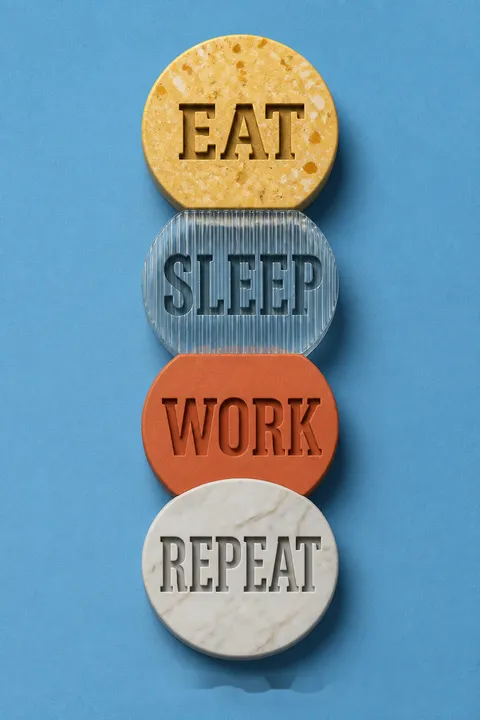
Eat Sleep Work Repeat receives mixed reviews, with an average rating of 3.65/5. Readers appreciate its practical advice for improving workplace happiness and productivity, backed by research and examples. Many find the tips useful, especially for office environments and managers. However, some criticize the book for being repetitive, geared towards specific work settings, or lacking new ideas. Positive aspects include its easy-to-implement suggestions, focus on work-life balance, and emphasis on team dynamics. Critics note that some advice may be challenging to implement without managerial support.
People Also Read





Glossary
Monk Mode Morning
Protected concentration timeA scheduled block, often in the morning, during which a worker is unavailable for routine email, calls, and meetings. The purpose is to protect demanding individual work from interruption. Teams can agree on shared periods and make themselves reachable for urgent matters through a separate channel.
Deep Work
Distraction-free demanding workProfessional activity performed with sustained concentration on a cognitively challenging task. In the book, this kind of focus supports meaningful progress and the development of complex ideas. It contrasts with fragmented work dominated by messages, interruptions, and frequent shifts between unfinished tasks.
attention residue
Attention left on unfinished workThe lingering mental focus on a previous task after a person switches to another one. For example, while drafting a presentation, someone may still be thinking about an unanswered email. This leftover attention makes it harder to concentrate fully and can reduce the quality and speed of subsequent work.
Sync
Trustful team connectionDaisley’s term for human connection and alignment among coworkers. It grows through trust, informal conversation, shared experiences, and opportunities to learn from one another. Sync is not simply frequent communication or formal meetings; it is the sense that colleagues can coordinate, exchange ideas, and rely on each other.
Results-Only Work Environment (ROWE)
Work organized around outcomesA workplace approach in which teams agree on clear results while employees decide how and when to accomplish them. It rejects attendance as a proxy for productivity. ROWE can increase autonomy for suitable work, but it may be a poor fit where physical presence or intensive collaboration is essential.
positive affect
Open, constructive mental stateA generally positive outlook that can make people more open to information, flexible in their thinking, and willing to help. It is not necessarily the same as obvious cheerfulness or a specific good mood. In Daisley’s account, it supports creativity and contributes to an energized team climate.
psychological safety
Safety to speak candidlyA shared belief that people can ask questions, report mistakes, request help, and challenge decisions without being humiliated or punished. It does not mean that standards are low or criticism is absent. Rather, it allows teams to discuss risks and errors openly enough to learn from them.
pre-mortem
Imagine failure before it happensA planning exercise in which a team imagines that a project has failed and identifies plausible reasons. Because the failure is hypothetical, participants can raise concerns without directly blaming a person or appearing disloyal. The team can then use the imagined causes to identify risks and prepare responses.
Buzz
Positive energy plus candorDaisley’s name for an energized team climate created by positive affect and psychological safety together. People feel sufficiently positive to explore ideas and sufficiently safe to question assumptions or admit mistakes. Cheerfulness without candor, or candor without warmth, falls short of this state.
About the Author
Other books by Bruce Daisley
Download PDF
Download EPUB
.epub digital book format is ideal for reading ebooks on phones, tablets, and e-readers.








