

Plot Summary
Prologue
A witch called the Matchweaver curses a newborn princess after her parents arrange a betrothal without consulting her. To keep their child from the witch, the king and queen hide her at the fae court, where she grows up believing she is half-fae and has no claim to Lore’s throne. The curse, the secret identity, and the marriage bargain are set in motion long before the princess understands any of them.
The brief opening gives the romance its fairy-tale machinery, but it also plants the book’s central conflict: adults turn a child’s future into a political problem before she can speak for herself. The Matchweaver’s grievance is bound to a real social function, not mere malice, while the parents’ secrecy converts protection into a lifelong injury. The hidden princess therefore begins inside a story already written by others. Her later struggle is not simply to choose a husband, but to claim authorship over a life inherited as a bargain.
The Hidden Princess
At the fae court’s winter solstice feast, Aurora, called Aury, slips away from the queen’s watchful guests and sees a black-haired warrior in a basin of water. Before she can make sense of the vision, Bathilda trips her, breaks the dragon-goddess necklace Werian gave her, and threatens further punishment.
Then the human king and queen reveal that Aury is their daughter, not a half-fae orphan: she is Princess Aurora Rose, heir to Lore, and likely a water mage. Hidden since infancy because the Matchweaver cursed her, she has been promised to Prince Filip of the mountain elves. A Wylfen force is again threatening Lore, so her marriage is expected to secure elven soldiers. Aury bargains for three weeks to train before the wedding.
Aury’s first revelation is double-edged: royal identity gives her status, but the adults presenting it immediately attach obligations to it. Her anger at her parents arises less from the marriage alone than from discovering that her childhood’s neglect and humiliation occurred alongside a deliberate political plan. The broken necklace makes that injury tangible, while the vision in water hints that her own power may exceed the role others assigned her. Her demand for training is an early act of self-definition, although she must still negotiate within the very system she resents.
A Prince's Hungry Kingdom
In the mountain kingdom of Balaur, Filip earns his nickname, Hatchet, when he stops his cousin Ivan from abusing a serving woman and defeats him in a public fight. The victory angers Ivan’s father, but Filip’s parents support his defense of their subject. Their more urgent news is that Filip has been betrothed to Lore’s hidden princess since childhood.
Balaur’s stores are nearly empty, and the treaty promises foothill farmland in exchange for the elven army’s help against the Wylfen. Filip resents leaving his cold homeland and the close-knit circle of Costel, Drago, and Stefan, yet he accepts the duty. He is curious about the unknown bride, but assumes she will be another sheltered human who cannot understand what his people need.
Filip’s first defining choice connects personal conduct to political obligation. He intervenes for a vulnerable subject without waiting for permission, yet his parents’ marriage announcement forces him to accept a different kind of service: leaving home so his people can eat. His resistance is not vanity about losing freedom so much as fear of being severed from the friendships and hardships that formed him. That fear parallels Aury’s, though he initially mistakes her for someone protected from deprivation. Their separate misunderstandings begin before they meet.
The Bride's First Escape
On the slow journey from the fae court, Aury outrides her royal escort, befriends the mare she renames Goldheart, and helps Rhianne, a left-handed village cobbler whom local superstition has made an outcast.
At Loreton Palace, she takes a roundabout route to avoid her parents’ attendants and collides with Filip in a corridor while he is dressed only in a bath sheet. Recognizing him as the warrior from her water vision, she retreats, then asks Hilda, Gytha, and Eawynn to glamour her into looking repellent.
At the feast, Filip sees through neither the trick nor her plan, but he does not recoil. Aury proposes giving Balaur its farmland without a marriage. Filip refuses because the treaty is already signed, leaving her determined to earn leverage at Darkfleot.
Aury’s escape attempts are partly comic, but they expose how little control she has over even the terms of her first meeting. Her kindness to Rhianne, another woman marked as improper by convention, shows the solidarity she rarely received herself. The glamour is an improvised defense against being treated as a bride before being treated as a person. Filip’s failure to reject her disguise unsettles that tactic: he responds to her forceful personality rather than the face she presents. Her proposed land-for-army arrangement shows that she is already thinking politically, even while rejecting the marriage’s personal cost.
A Staff, A Wolf
Aury arrives at Darkfleot, where Captain Godwin makes clear that royal rank will not protect her from military discipline. During her staff ceremony, she accidentally blasts water from the basin onto Filip, who has come to observe the Order.
The embarrassment does not cost her the staff, but it announces that her power is unpredictable. On the training grounds, Filip tries to teach Lore’s soldiers to use longbows; Godwin has them drop the unfamiliar weapons as dishonorable.
Filip answers with a demonstration: he draws a captured, abused scar wolf from its crate and uses orangebranch, the plant that once rewarded its training, to redirect it. The soldiers see a practical way to distract Wylfen war beasts. Godwin remains hostile, but Filip has begun building trust through evidence rather than argument.
Both protagonists confront institutions that confuse inherited custom with competence. Aury’s accidental blast reveals how little training she has received, but the Order judges her by whether she can learn rather than by her royal identity. Filip faces the opposite problem: his useful knowledge is discounted because he is an elf. His handling of the scar wolf reframes the animal as a victim of training, not an evil creature, and demonstrates his combination of tactical intelligence and restraint. The parallel establishes the book’s preferred test of authority: not title or tradition, but the ability to protect others under pressure.
The Dragon in the Thorns
While gathering scorchpepper leaves for a dessert he hopes Aury will enjoy, Filip finds a young dragon trapped and wounded in a thorn thicket. He cuts it free rather than taking its scales, and Aury rushes in expecting him to harm it. The fae women heal the dragon, which accepts their touch and then flies away.
Aury has to revise the stories that taught her to expect cruelty from mountain elves, though she remains wary of Filip’s motives. Meanwhile, her own lessons at Darkfleot go badly. She cannot move water on command, and memories of the Wylfen attack on the fae court disrupt her attempts to control ice. Her magic breaks the training fountain, revealing power without control and pain she has never acknowledged.
The dragon’s rescue makes prejudice harder for Aury to maintain because Filip’s conduct is visible, immediate, and costly in time and risk. Her suspicion does not vanish at once; she has learned that a single kind act cannot erase a lifetime of propaganda or abuse. The failed magic lessons echo that difficulty. Aury’s power is present, but trauma interrupts the discipline required to direct it. Both scenes challenge her habit of turning uncertainty into certainty: Filip is not simply a monster, and her own apparent incompetence is not proof that she lacks ability.
The Loom Reaches Back
Aury’s uncontrolled scrying lets her see the Matchweaver at her loom, where the witch burns Aury’s letter and renews her threat to make the princess and Filip sleep forever. Aury’s fae guardians admit they altered the original curse so a spinning wheel would cause enchanted sleep rather than death, with true love as the only known means of waking her.
A later message from the witch carries a hidden spinning-wheel spell; Hilda burns it before Aury can touch its spindle. The warning confirms that the Matchweaver can reach beyond her banished castle. At Darkfleot, Aury also learns that her staff bears rare runes for strength and ice, evidence that her failure to control magic does not mean she lacks power.
The threat turns the curse from distant folklore into an active constraint, while the altered version exposes the fae guardians’ long history of protecting Aury without being free to tell her why. Their secrecy resembles her parents’ concealment, but their intervention is also a genuine form of care, leaving Aury unsure how to distinguish protection from control. The staff’s rare runes offer a counterweight: her future is not wholly determined by the witch’s spell. Yet the power they promise will require emotional discipline, so the story links agency not to magical inheritance alone but to learning how to live with the past.
A Freedom Called Magelord
At Darkfleot’s Staff and Steel feast, Werian returns the repaired dragon-pearl necklace Bathilda broke and apologizes for keeping Aury’s identity secret, explaining that he believed silence protected her. Aury accepts that he is still the cousin and friend she loves.
Werian then shares a historical discovery: a water mage who becomes a captain and receives another captain’s sacrifice in battle can be named a Magelord. The rank allows its holder to choose a spouse or remain unmarried, placing personal decisions beyond the royal family’s command.
For Aury, it is a possible route to freedom, but it requires battlefield merit. Before she can pursue the plan, she learns Filip has been badly injured in a trap after Godwin sent him searching for a missing soldier.
Werian’s return repairs a relationship without erasing the injury caused by his silence. Aury can acknowledge both his loyalty and the cost of his choice, a more mature response than either unquestioning trust or permanent rejection. The Magelord title gives her a concrete alternative to passive obedience, but its requirement of sacrifice ties freedom to service rather than escape alone. That condition suits Aury’s emerging sense of responsibility. Filip’s injury immediately tests the distance she tries to maintain: the man she calls an obstacle has become someone whose danger matters to her.
Godwin Pays in Blood
Aury finds Filip near death, with a broken leg, rib, and deep wound from the sharpened stakes in Godwin’s trap. She brings Hilda, Gytha, and Eawynn to heal him, and Werian adds his magic when the fae women have spent much of their strength. Once Filip wakes, he helps Aury think of magic as a sequence of focused tasks rather than one overwhelming battle.
At Godwin’s questioning, Filip forces the captain to confess that he arranged the trap. Aury joins in sentencing him to lose his rank and an ear, then kitchen work. She and Filip begin acting as allies, while Filip’s soldiers use orangebranch and a net to practice capturing scar wolves alive instead of wasting arrows on them.
Aury’s response to Filip’s injury is a practical break in her defenses: she does not need to settle her feelings before choosing to save him. His advice later turns combat experience into a usable model for her magic, making their growing intimacy intellectually reciprocal rather than merely physical. Their joint punishment of Godwin also shows Aury testing royal authority for herself, not waiting for her parents to act. The wolf exercise extends the same ethic to warfare: defeating an enemy may require understanding how it has been conditioned, not simply meeting violence with more violence.
Snow Saves the Tavern
After days of failed lessons, Aury finally floods a training room by narrowing her attention as Filip taught her. Her next attempt at freezing water escapes her control and encases the other mages in ice, forcing Mildred to break the spell and teach Aury how to build mental barriers around her power. Soon a dragon circles Loreton, drawn to the tavern where Filip is confronting Godwin’s men.
Town guards attack it, and the frightened youngling sets the tavern roof alight while carrying Filip and Aury into the air. They jump onto a nearby roof; Aury gathers the street’s snow and smothers the fire without collapsing the building. The crowd cheers, and she kisses Filip, then pulls away before their attraction can decide her future for her.
Aury’s magic advances through both success and danger. The first flood follows deliberate focus, while the frozen classroom reveals that control is not simply a matter of wanting power strongly enough. Her teachers help her build boundaries, a literal magical skill that also reflects her guarded emotional life. The tavern fire then gives her a public test with immediate consequences: she must protect a town, not merely impress instructors. The kiss afterward is a choice made in exhilaration, but her retreat shows that desire has not yet resolved her fear of surrendering autonomy.
The Trial Finds a Captain
During the Mage Trials, Aury’s team uses controlled flooding to defeat Filip, who volunteers as their moving target, and she later sees an unclear vision of a dragon among mountain shapes while scrying. Filip recognizes the possible threat: the Wylfen may be using a dragon to cross the winter mountains.
Aury completes the final battlefield test despite being struck in the head, directing ice against the attacking force before exhaustion knocks her down. The Masters name her a captain of Lore’s armies. Her parents immediately announce that she and Filip will marry the next day, then travel to Balaur for a second ceremony. Aury has gained rank and power, but the title has not freed her from the marriage her parents still require.
The Trials convert Aury’s private development into a public claim to authority. Her success depends on collaboration, including the focus she learned from Filip and the distinct abilities of other mages. Yet the reward exposes the limits of institutional recognition: a captain’s pin does not give her control over her own marriage. The scrying vision also changes the scale of the conflict. A threat that once seemed to be a familiar invasion now includes a creature capable of overturning the armies’ plans, making Aury’s rare ability a source of strategic knowledge as well as danger.
Yarn at the Wedding
At Loreton Palace, Aury and Filip complete the kingdom’s first wedding ceremony, each giving the traditional vow despite knowing the Matchweaver still threatens them. As they leave the chapel, a black bird flies into Aury’s face, drops a strand of yarn, and bursts apart in the sky.
Filip recognizes the incident as a warning; Athellore dismisses it as a harmless bird, deepening Aury’s anger at her father’s refusal to take the curse seriously. Filip’s men and Aury’s fae guardians spread through the palace to watch for magic. That night, the room shakes with an unseen force. The disturbance vanishes before anyone can identify its source, but Filip sleeps beside Aury for protection, keeping a careful distance.
The first ceremony makes public what the couple has not fully chosen, and the supernatural warning prevents the celebration from feeling secure. Aury’s parents’ denial repeats the pattern that shaped her childhood: they treat her account as less important than their preferred version of events. Filip, by contrast, responds to the evidence by organizing protection without claiming ownership of her. Their night together therefore changes the meaning of intimacy. Care is shown through restraint and vigilance, not through an assumption that marriage grants access.
Two Crowns, One Bed
The journey to Balaur brings Aury closer to Filip’s people and the approaching war. Filip’s friend Costel prepares clay projectiles filled with break powder and goat’s blood, hoping to lure the Wylfen dragon into swallowing a sedative.
In Balaur, Aury sees the affection Filip’s parents bear him, then joins him in a second, more intimate ceremony involving a shared blood bowl, marriage rings, and the ceremonial drink. Filip translates the ritual and makes sure she understands its customs.
He also offers to abandon the traditional bundling, which would keep her wrapped until morning. Aury chooses to trust him, and they spend their wedding night together. For the first time, the marriage becomes both a political agreement and a relationship she wants.
The Balaur ceremony puts Aury inside a culture she once imagined only through frightening stories. Its bodily customs are unfamiliar, but Filip’s explanations and willingness to let her refuse transform ritual from coercion into negotiated participation. Aury’s choice does not erase the political pressure surrounding the wedding; rather, it gives her a moment of agency within it. The intimacy matters because it follows demonstrated trust, not because the ceremony magically settles the conflict. Their new bond will soon be tested by a misunderstanding created by the very freedom Aury has struggled to claim.
The Scroll Between Them
At dawn, Filip reads an old Lore scroll left with their breakfast and discovers the history of the Magelord title, including its power to choose or leave a spouse. He assumes Aury still intends to use it to escape him. Before she wakes, he rides with Costel, Drago, and Stefan to attack the Wylfen camp, carrying Costel’s experimental dragon lures.
Their plan fails when the dragon does not take the blood bait; it wakes, sees its dead human companion, and pursues them. Back in Balaur, Aury reads the same scroll and realizes Filip must have misunderstood her changed feelings. She writes him a note but cannot catch him before the armies march. Their separate journeys toward Dragon Wing Pass leave affection intact but communication broken.
The scroll functions as an object both lovers read through their oldest fears. Filip sees proof that Aury wants to leave him because he has been listening more closely to her stated need for freedom than to the intimacy they have just chosen. Aury sees the same text as an opportunity to tell him she no longer needs that escape. Neither interpretation is irrational; each is incomplete because they do not speak in time. The failed dragon-lure mission compounds the emotional fracture with military urgency, making a private misunderstanding dangerous against a looming battle.
Ice Over Dragon Wing
At Dragon Wing Pass, the Wylfen attack with scar wolves and a huge dragon. Aury uses the river to hinder the advance, and her water magic wounds the dragon’s foot, but the fighting breaks the allied formation and overwhelms the mages.
When Filip mounts the young dragon, Jewel, Aury joins her power with Sunniva and other mages to freeze the river, the enemy, and the dragon in a single vast spell. The mages free their own soldiers from the ice, then the warriors kill the stunned beast.
Aury releases the rest of the frozen field and catches Filip in a snowdrift after he falls from the sky. Once he wakes, Filip declares her a Magelord by sacrificing his wedding ring, then rides away, believing he has freed her from a marriage she never wanted.
The battle makes Aury’s private training consequential at the scale of nations. Her decisive spell succeeds only when she calls other mages into the work, but its reach nearly endangers allies as well as enemies. The victory is therefore not a simple proof of mastery; it is a crisis of judgment that demands coordination and restraint. Filip’s declaration turns his understanding of love into an act of relinquishment. He grants Aury the freedom she once demanded, but because he mistakes her earlier resolve for her present desire, his generosity becomes another painful decision made on her behalf.
The Matchweaver's Web
After returning to Loreton, Aury is caught by the Matchweaver’s spell: the palace and its inhabitants fall into enchanted sleep, while scarlet yarn and ivy bind the rooms. Filip, who has begun a solitary wandering, hears that the palace is under a dark enchantment and turns back.
He cuts through the witch’s magical threads until he finds Aury asleep in her chamber. The Matchweaver reveals within Aury’s enchanted vision that she had seen Aury and Filip matched in her loom, but attacked them because their parents ignored her authority.
Filip’s kiss wakes Aury. Together they fight a dragon formed from the witch’s yarn; Aury shapes an enormous ice blade and destroys it. The Matchweaver’s power breaks, releasing the sleepers and ending the curse.
The final enchantment makes the private consequences of royal arrogance impossible to ignore: the whole palace pays for a decision made by rulers who treated the Matchweaver’s role as disposable. Her revelation complicates the apparent moral simplicity of the conflict. She is genuinely invested in love and has been publicly slighted, but she turns that injury into collective punishment. Filip’s return is not a claim on Aury; he offers himself as whatever support she will accept. The old fairy-tale kiss becomes meaningful only after both have chosen, lost, and recognized one another.
A Chosen Union
With the curse broken, Aury returns Filip’s wedding ring to him and refuses to let the misunderstanding define their marriage. She tells her parents that the Matchweaver’s punishment cannot be separated from the harm that follows an assault on love itself. Rather than execute the witch, Aury and the rulers restrict her movements with a boundary of enchanted water guarded by mages, while still allowing people to seek her matchmaking.
The farmland promised to Balaur supports its people, and the allied kingdoms enjoy a period of peace after the Wylfen battle. In summer, Aury continues training her water magic beside the river while Filip remains at her side. Their future is no longer only a treaty: it is a partnership they have both chosen.
The ending does not equate reconciliation with forgetting. Aury remains angry at the Matchweaver and distrustful of her parents, yet chooses containment over vengeance because the witch’s role matters to the people who seek her help. This is a more complex exercise of power than simply defeating an enemy. The marriage likewise changes from an imposed mechanism into a mutual commitment, without pretending that the initial coercion was harmless. Aury’s continuing magical practice keeps the resolution open-ended: freedom is not a finished state but the repeated ability to make choices while accepting their consequences.
Analysis
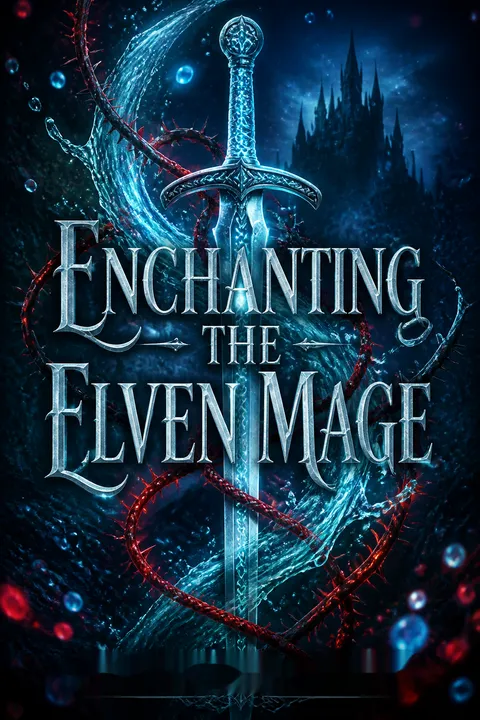
Enchanting the Elven Mage uses a fairy-tale curse to examine a distinctly political problem: what happens when other people call coercion protection, duty, or destiny. Aury is hidden to keep her alive, but the secrecy also leaves her vulnerable to contempt and prevents her from understanding her own inheritance. When she learns that she is a princess, the revelation does not repair that childhood; it gives her a new audience expecting obedience. Her ambition to become a Magelord is therefore not simple rejection of romance. She wants a form of agency that cannot be revoked by family or treaty.
Filip’s parallel struggle is less about personal sovereignty than communal survival. His people need land, his parents need an alliance, and his military skill makes him valuable precisely when he would rather remain among his friends. Their early antagonism grows from opposing myths: Aury has been taught that elves are predatory, while Filip assumes a human princess cannot understand scarcity. Concrete acts correct those assumptions more persuasively than speeches. Filip rescues a dragon; Aury saves a town; both learn to judge one another through choices under pressure.
The novel’s magic system externalizes emotional regulation. Aury’s water can become a flood, a weapon, or a shield, but only when she learns to focus rather than let fear dictate its force. That development is linked to her relationships: accepting help from Mildred, Sunniva, her fae guardians, and Filip does not cancel her independence. It enlarges what she can do. The battlefield makes this collective dimension literal when several mages combine their strengths.
The Matchweaver offers the sharpest complication. She protects the social meaning of love, yet her response to being ignored turns that ideal into coercive power. The novel does not excuse her vengeance, but it makes clear that institutions can be wounded by disrespect and still cause harm when they demand recognition through force. Aury’s final response, containing rather than executing the witch, shows authority tempered by consequence. The romance reaches its fullest meaning when both characters stop deciding what the other ought to want and choose one another without surrendering their capacity to act.
Review Summary
Enchanting the Elven Mage receives mixed reviews, with an overall rating of 3.7/5. Readers praise the unique Sleeping Beauty retelling, engaging fantasy world, and charming characters, especially Filip. However, some criticize Aury as immature and bratty. The romance and world-building are appreciated, but pacing issues and underdeveloped characters are noted. Many enjoy the magic, elves, and dragons, finding it a fun, light fantasy romance. Some readers wished for more depth and character development, while others found it a perfect escape.
People Also Read



Characters
Aurora Rose (Aury)
Hidden princess mageRaised at the fae court under a false identity, Aury enters adulthood with a sharp tongue, a deep attachment to animals, and little reason to trust anyone in authority. She resents being treated as a political asset and initially defines freedom as making decisions without a husband or family directing her. Her determination to train at Darkfleot comes from both ambition and a wish to prove that the neglected girl she was can become useful to her people. Aury’s water magic mirrors her emotional life: potent, difficult to contain, and strongest when she can focus rather than let fear govern it. She is brave without being fearless, and her humor often shields a sincere longing to belong.
Filip
Mountain elf heirA younger prince of Balaur, Filip is a fast, formidable fighter known as Hatchet, but his identity is not limited to violence. He protects subjects from abuse, values his close friends, and thinks strategically about how his people can survive scarce harvests and renewed war. Because Lore’s stories reduce elves to monsters, Filip often meets hostility before anyone knows him; humor and flirtation help him test whether people can see beyond it. He accepts an arranged marriage from duty, then has to learn that Aury’s resistance is not a challenge to be overcome. His tenderness, especially toward animals and Aury, exists alongside his capacity for decisive force.
Werian
Guarded fae confidantWerian is the Fae Queen’s son and Aury’s closest companion during her childhood at court. He shares her curiosity about the human world and gives her the affection she rarely receives from other fae. His loyalty is complicated by his position within a secret that adults insist must remain hidden, leaving Aury unsure whether care can coexist with concealment. Werian is clever, affectionate, and willing to help Aury understand her options, but he does not always have the freedom to tell her everything he knows.
The Matchweaver
Witch of the MageloomThe Matchweaver is a powerful witch whose enchanted loom identifies strong romantic matches and whose role carries public authority in Lore. She is proud of that responsibility and treats its recognition as essential, not ceremonial. Her ability to influence love gives her unusual social power, while her long life and formidable magic make affronts difficult to dismiss or contain. She can be generous in her work and terrifying in her punishments, a contradiction that makes her more than a simple fairy-tale villain. Her worldview treats respect for the loom as respect for love itself.
Hilda
Veteran fae protectorHilda is one of three fae women assigned to watch over Aury. Tall, disciplined, and battle-tested, she tends to express care through rules, warnings, and practical preparation rather than easy affection. Her protectiveness can feel like another form of control to Aury, especially because Hilda knows more about the princess’s past than she is permitted to reveal. She respects courage and expects Aury to withstand the dangers of military training, even when her bluntness makes that support difficult to recognize.
Gytha
Thorn-marked fae guardianGytha is a battle-scarred fae with thorn tattoos and a dry, teasing manner. She reads danger quickly and is willing to place herself between Aury and a threat, but she also challenges Aury rather than treating her as fragile. Her practical courage and irreverence make her a counterweight to Hilda’s strictness and Eawynn’s cheer. Gytha’s connection to the forests and their healing power reflects the fae’s intimate bond with the natural world.
Eawynn
Cheerful fae guardianEawynn is the warmest and most openly affectionate of Aury’s three fae protectors. She answers questions readily, worries aloud, and often tries to lighten tense moments with enthusiasm. Beneath that gentleness is a veteran of the Wylfen war who can use powerful magic and understands the risks facing Aury. Her kindness matters because Aury has learned to expect mockery or manipulation from the court; Eawynn offers care that is visible, though Aury still has to learn whether she can trust it.
King Athellore
Strategic human kingAury’s father and ruler of Lore, Athellore measures choices by their consequences for the kingdom and its military alliances. He believes the marriage to Filip is necessary to secure Balaur’s army and farmland, and he treats that necessity as a reason to override Aury’s objections. His failure is not a lack of political intelligence but an inability to see how secrecy and coercion have damaged the daughter he hopes to deploy for Lore’s survival. He is accustomed to command and struggles to distinguish protection from possession.
Queen Gwinnith
Pragmatic human queenGwinnith is Aury’s mother and co-ruler of Lore. She approaches the princess’s marriage as a fragile but necessary alliance, weighing it against the threat of renewed Wylfen attacks. Her manner is softer than Athellore’s, yet she also expects Aury to comply and initially minimizes the danger posed by the Matchweaver. Gwinnith’s carefulness is political, but it leaves her daughter feeling emotionally abandoned. Her presence illustrates how a ruler can be concerned for a child and still fail to treat that child as an independent person.
King Mihai
Mountain elf kingMihai rules Balaur with an awareness of its depleted stores and the physical hardship his people endure. He supports the marriage treaty because Lore’s farmland could prevent hunger, though he also wants Filip to develop the steadiness required of a leader. His slower, more cautious style differs from Queen Sorina’s political agility and Filip’s directness. The king’s illness during the winter adds urgency to decisions that might otherwise be delayed.
Queen Sorina
Mountain elf queenSorina is Filip’s mother, a politically perceptive ruler who recognizes the value of Lore’s farmland and the military partnership. She knows her son’s temperament and pushes him toward responsibilities he would rather avoid, but she also understands his courage and affirms his willingness to protect his subjects. Her strategic instincts help shape the alliance, while her personal affection for Filip gives the court’s calculations a human cost.
Mage Mildred
Demanding mage mentorMildred is an experienced instructor at Darkfleot who understands the danger of powerful magic without control. She insists that Aury train as a soldier rather than receive royal exemptions, and she recognizes that emotional injury can affect spellwork. Her directness is severe but not cruel; she expects discipline because the recruits may face lethal combat. Mildred’s own rare ability to scry makes her both a teacher and a cautionary mirror for Aury.
Sunniva
Measured fellow mageSunniva is a merchant’s wife training to serve Lore at the borders. Patient, observant, and fond of statistics, she brings a measured approach to magic and battle that complements Aury’s intensity. Her marriage is unconventional by local expectations, and she is frank about what she does and does not want from it. Sunniva supports Aury without flattering her, making their friendship a model of companionship that respects difference rather than demanding sameness.
Captain Godwin
Hostile military captainGodwin commands Lore’s soldiers and distrusts Filip’s methods, especially innovations that challenge local ideas of honor. He hides hostility beneath formal manners and encourages resistance to the elven prince’s authority. His actions reveal how prejudice can undermine military cooperation at the very moment it is most needed. Godwin values rank and tradition, but uses both to protect his own influence rather than improve the army.
Costel
Loyal elven strategistCostel is Filip’s oldest and most dependable friend, a thoughtful companion who remembers details others overlook. He supports Filip through political upheaval and battlefield danger, and his knowledge of materials and tactics helps the army develop new tools. Costel is physically less imposing than the other elves, but his ingenuity and loyalty make him indispensable. His steady friendship gives Filip a place to speak honestly without performing the confidence expected of a prince.
Drago
Battle-hardened elven companionDrago is one of Filip’s trusted fighters and travels with him from Balaur to Lore. His humor is rough and often directed at his friends, but he is alert to danger and willing to stand beside Filip when a mission turns risky. Drago’s practical loyalty helps make the elven retinue feel like a chosen family rather than a courtly entourage.
Stefan
Jovial elven companionStefan is part of Filip’s close circle of elven friends. He jokes freely, enjoys social encounters, and remains dependable when the group must train soldiers or face the Wylfen. His humor releases tension without disguising his courage. Like Costel and Drago, Stefan helps Filip retain a sense of home while political duty takes him far from Balaur.
Cuthbert
Reliable mage recruitCuthbert is a fellow trainee at Darkfleot, a large, good-natured recruit known for assigning people unwanted nicknames. He becomes a useful ally during the Trials and the later fighting, combining physical courage with water magic. His presence shows the ordinary recruits whose lives are at stake in the political conflict.
Rhianne
Outcast village cobblerRhianne is a skilled cobbler’s niece who takes over her uncle’s work while he is ill. Her left-handedness has made her an object of superstition in more than one village. Aury recognizes the injustice and treats her as a craftswoman rather than an omen, creating one of the princess’s first acts of solidarity among ordinary people.
Ivan
Cruel royal cousinIvan is Filip’s large, aggressive cousin, known for mistreating people beneath his station. His public abuse of a serving woman prompts Filip to intervene, bringing their longstanding family hostility into the open. Ivan represents inherited privilege stripped of responsibility.
Prince Dorin
Dragon-tracking elder heirDorin is Filip’s elder brother and heir to Balaur’s throne. He leads expeditions into the high mountains to track dragons and protect their young from poachers. Though absent from the central action, his knowledge of dragons is an important resource the characters hope to draw upon.
Mage Finn
Gruff water-magic instructorFinn teaches the recruits practical water magic, including flooding and the movement of water between vessels. His blunt manner can intimidate students, but he gives Aury a structured place to test her abilities. His lessons help distinguish raw magical force from controlled technique.
Plot Devices
The Matchweaver's curse
Threatens the hidden heirThe Matchweaver curses baby Aurora after the king and queen arrange a betrothal without consulting her. The fae alter the curse so a prick from a spinning wheel brings enchanted sleep rather than death, with a true-love awakening as the only known escape. The witch’s reach is later demonstrated through a spell hidden in a letter, a warning carried by a magical bird, and the enchantment that overtakes Loreton Palace. The curse drives the romance’s fairy-tale structure while making political disrespect physically dangerous. Its resolution depends on love freely recognized, not merely on the existence of an arranged match.
The Mageloom
Maps fated pairingsThe Matchweaver’s loom reveals strong romantic matches through its magical threads. It explains why she considers the king and queen’s decision an affront to her position, and why she believes her authority must be acknowledged. The loom is more than a prophecy machine: it embodies a social system in which love is managed by an official power. Its existence complicates the idea of destiny, since Aury and Filip are matched, but still must choose whether to trust and love one another. The device links romance to questions of consent and political legitimacy.
The mage staff and runes
Turns blood into commandWater-mage staves carry coral and runes associated with distinct strengths. Their magic answers a mage’s will, but uncontrolled commands can injure the caster and everyone nearby. Aury’s staff bears rare runes for strength and ice, foreshadowing her potential as a battlefield mage even when she initially cannot move water at all. The staff makes her training physical and concrete: she must learn to focus, direct, and limit her power. It also provides a visual marker of her changing identity, from a concealed royal daughter to a recruit and military leader.
The land-for-army treaty
Trades farmland for soldiersThe royal marriage contract binds Lore’s farmland at Balaur’s foothills to the mountain kingdom’s military support. Lore needs elven fighters against the Wylfen, while Balaur needs crops to replenish dwindling stores. This agreement gives Aury and Filip a shared practical purpose even when they reject the personal terms imposed on them. It also keeps their choices from being purely private: refusing the marriage could jeopardize food and security for entire populations. The treaty is the political pressure that makes their eventual partnership meaningful beyond romance.
The Magelord title
Makes freedom a battlefield prizeAn obscure historical rank gives a water mage unusual independence from royal and family demands. To qualify, the mage must earn a captaincy and receive another captain’s sacrifice after proving their worth in battle. Werian’s discovery gives Aury a route to a life not dictated by her parents, but it also ties her personal freedom to military service and risk. Filip later learns of the title through the same historical record and mistakes Aury’s earlier determination to pursue it for proof that she does not want him. The title therefore becomes both a political mechanism and the center of their most painful misunderstanding.
Kingdoms of Lore Series
About the Author



Download PDF
Download EPUB
.epub digital book format is ideal for reading ebooks on phones, tablets, and e-readers.








