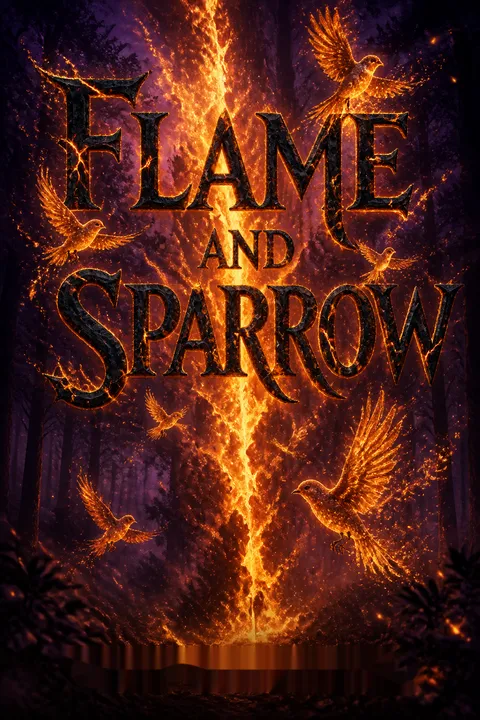


Plot Summary
Prologue
As a child, Karys accidentally set fire to a wooden god and her sister, Savna, saved her from the flames. Years later, Karys finds Savna’s bed soaked with blood and empty. She flees their farm with Andrel, a rebel leader, and Cillian, Savna’s closest friend, after divine beasts prowl the house.
A dead creature had appeared on their doorstep two weeks earlier, leaving a strange, metallic magic in its wake. Savna never returns. Over the next five years, Karys loses her father, her mother, and finally her hope of finding her sister alive. She makes the gods responsible for every loss, and promises to finish the rebellion Savna began.
The opening makes Karys’s hatred intimate before it becomes political. Her first encounter with divine power is a childhood fire, an accident her sister turns into survival; the later empty bed reverses that rescue and leaves Karys with no one to pull her clear. The prologue also establishes how grief hardens into a theory of the world: because the gods seem present at every loss, Karys treats vengeance as both proof of love and a route to control. The sparrow charm she takes from Savna is already a relic of attachment, not merely a tool.
A Temple Marked for Fire
Five years after Savna vanished, Karys breaks into a new temple in Cauldra to chart its rooms for Cillian, the rebel weapons-maker. Andrel, their persuasive ally, handles the guards while Cillian places three slow-burning bombs at structural weak points. Karys’s careful plan falters when she meets a young worshipper bearing the Moon Goddess’s mark.
She warns the girl that the temple is unsafe, then leaves her behind. The rebels escape before the charges detonate, but the blast destroys the building and kills six people. Karys has helped make her sister’s cause visible, as Andrel intended. Yet the death count follows her out of the city, and the girl’s absence from the fleeing crowd leaves Karys uneasy.
The operation exposes the gap between Karys’s precise methods and the moral certainty she borrows from her cause. She can map a building, calculate where it will fall, and exit before the blast, but she cannot make the civilians inside disappear from the consequences. Her warning to the marked girl is a small act of conscience, but not a rescue: Karys chooses the mission over the person in front of her. That choice becomes the story’s first fracture in her self-image. Her work is not simply resistance; it can reproduce the indiscriminate violence she condemns in the gods.
The Moon Finds Her
After the blast, Karys slips away with Andrel and Cillian, but later wanders through the ruined Morethian Manor and encounters the same Moon-marked girl. The girl has tracked Karys by the spell she planted during their first meeting. Armed men surround Karys, and a much larger force waits outside.
Karys hides the escape whistle meant to summon her allies, hoping they will flee rather than charge into an ambush. The soldiers drug her and take her to Cauldra. In prison, she counts guards and days, refusing to identify her accomplices even when interrogators offer food. After she defies them, a guard beats her until she loses consciousness. Her captors keep her alive for a public sacrifice.
The girl’s tracking magic converts Karys’s earlier encounter into a consequence she cannot undo. Karys had recognized the mark but treated the girl’s devotion as foolishness, overlooking the danger of a power whose purpose is finding what is lost. In prison, Karys relies on observation and pattern-making to recover a little control, but her refusal to betray the rebels also narrows her choices. She remains loyal while physically stripped of agency. The episode tests whether her identity as a fighter survives helplessness, and shows how easily a political enemy can turn her own habits of concealment against her.
The Pyre Bargain
Cauldra’s worshippers bind Karys to a pyre where the destroyed temple once stood. As flames climb around her, she sees the God of Fire in the realm between worlds, Eligas. He admits that he has intervened and is unimpressed by the humans’ sacrifice. Karys seizes the chance to propose a bargain: she will serve in his court if he lets her approach the gods she means to destroy.
He marks her and sends her back to the pyre. Cillian and Andrel arrive with smoke bombs and cut her free, though soldiers had delayed their rescue. Karys survives without a burn, and the flame mark reappears once she tells her friends what she has done. Her plan is no longer private.
Karys turns an execution into an infiltration strategy, but the bargain is less a triumph than a new form of captivity. She believes she is using the Fire God’s ambition, while he controls the terms, the mark, and the passage between realms. Her willingness to become a divine servant reveals how completely vengeance has narrowed her imagination: she can picture destroying the gods from within, but not a life outside the war. The rescue by her friends preserves her body, while the mark makes her decision public. She has crossed a line that her allies cannot pretend is merely another raid.
The Fire River Opens
After the rebels retreat to Hael, Karys studies her new mark with the scholar Zara and collapses from neglecting food and sleep. A river of fire and Gatterlen portal lights then appears, drawing her toward the divine realm. She leaves Cillian and Andrel behind, carrying Savna’s carved sparrow charm.
In Nerithyl, Karys meets Mairu, Goddess of Control, and Valas, God of Ice, who treat her as a curiosity and warn that Dravyn has not arrived. Dravyn eventually finds her and sends her along a trail of fire to a secluded dwelling. Rieta, his blunt attendant, brings food and supplies, while Karys starts mapping the unfamiliar grounds. She is inside the divine world, but still shut out of its rules.
The crossing gives Karys the access she wanted while stripping away the ordinary conditions that helped her feel competent. Her maps and routines become ways to resist disorientation, not simply expressions of an orderly mind. The sparrow charm carries Savna’s presence into a realm where Karys hopes to replace her, exposing the emotional contradiction at the heart of the mission: she wants to make her sister’s work her own, yet cannot stop using her sister’s objects as anchors. The divine court’s casual indifference is a new kind of threat. Karys has entered the gods’ territory without gaining their trust or understanding.
Moth and the Veilhound
Restless inside her fenced dwelling, Karys follows Moth, a small griffin who steals her diagrams and leads her to a Tower of Creation. There she finds a tapestry depicting the same antlered veilhound that died near her family’s farm before Savna vanished. Valas explains that the beast was created by the God of Death, Zachar.
Karys seeks Zachar for answers, but he reads her thoughts, drains her strength, and threatens to keep her in his territory. Dravyn arrives and forces Zachar to release her. Back at the palace, Dravyn finally explains the terms: Karys must pass trials set by the other courts and then survive the Tower of Ascension. Failure means she cannot return to mortal life. She accepts the risk rather than withdraw.
Moth’s mischief breaks the boundary Karys has been ordered to respect, but it also leads her to the first tangible link between the divine realm and Savna’s disappearance. Curiosity and grief operate as the same force: she pursues knowledge not because she is ready for it, but because uncertainty feels more unbearable than danger. Zachar’s mind-reading literalizes the exposure Karys fears, while Dravyn’s rescue complicates her assumption that divine power can only be used against her. The trials turn her improvised bargain into a binding structure. From here on, survival depends not only on courage but on learning rules that others refuse to explain.
The Crown in the Sky
Before the first trial, Mairu reveals that she has been disguising Karys as human, using the guise of Rieta to observe her. Karys confronts Dravyn, then chooses to continue rather than accept memory-erasing magic and return home. The Star Goddess, Cepheid, plunges her into a living map of the sky and gives her a timed task: find a crown in the future sky before a constellation’s mane disappears.
Karys searches the wrong reflection first, nearly runs out of time, then realizes she must find the brighter divine sky rather than the mortal one. She reaches its crown and pulls it free just as the ground gives way. She returns to the watching gods alive, holding the first relic her trials have yielded.
The trial makes Karys’s strength and limitation the same thing: she trusts patterns, but initially assumes the familiar sky is the only map that matters. Her survival depends on revising that assumption under pressure. This is not a rejection of her analytical nature; it is an expansion of it, an ability to update the model when evidence contradicts her first reading. Mairu’s deception sharpens the theme of appearances, but also exposes Karys’s own strategy of passing as someone she is not. The crown is earned through adaptation rather than force, offering an early alternative to the violence that has defined her sense of competence.
The Ocean’s Unquiet Beast
The Ocean God, Kelas, sends Karys across a rising causeway to a fortress and orders her to soothe an ocean-forged beast inside. Hydrus, a sea-made sword, helps her fight off smaller water creatures, but it cannot solve the larger problem. Karys notices that the beast tracks the sword because both carry the same ocean magic.
She throws Hydrus through a window and into the sea; the beast follows, dissolves into the water, and calms. Its pursuit has damaged the fortress, which collapses with Karys inside. Mairu secretly redirects the final wave so it does not drown her. Karys survives with a broken body and the sword, but the other courts now have grounds to accuse her of receiving help.
Karys succeeds by reading the creature’s attachment rather than defeating it, a crucial change in a story where violence has often passed for the only reliable answer. She sees a relationship between the sword and the beast’s behavior, then uses that connection to return it to its source. Yet the solution does not erase the cost: the fortress collapses, and Mairu’s covert aid places Karys in political danger. The trial’s meaning is therefore double. Intelligence can interrupt a destructive cycle, but insight alone does not control the institutions that judge the outcome. Karys wins the test while becoming more dependent on trust she does not yet know how to offer.
The Broken Bracelet
While Karys recovers from her injuries, Dravyn allows her to return briefly to the mortal realm. At Andrel’s manor, Cillian shows her an anti-divine knife made from a substance that drains magic, and explains that the rebels are developing more such weapons. Andrel expects Karys to help.
When she questions whether every god deserves to be killed, he seizes her and breaks her wrist, shattering the magic bracelet Dravyn gave her. Dravyn and Valas arrive, and Dravyn nearly kills Andrel before Karys stops him. She leaves with the gods, shaken by the brutality of her old ally and the fear in Cillian’s eyes. Back in Nerithyl, she begins to see that the cause she served may not be the cause she believed.
The broken bracelet is both a practical loss and a rupture in Karys’s inherited loyalties. Andrel’s violence makes visible what Karys had long rationalized as firmness in service of the rebellion. Her attempt to question the means is treated as betrayal, while Dravyn’s intervention gives her protection without demanding that she affirm his worldview. That distinction matters: Karys is not yet ready to trust the gods, but she can no longer treat every act of resistance as virtuous by definition. The scene also marks a shift in intimacy. Her safety now depends on a person she was trained to regard as the enemy.
Glass Graves, Stolen Years
As Karys heals, Dravyn takes her to memorials he made for his murdered siblings and admits that, after becoming the God of Fire, he destroyed the predominantly elven town of Ederis in revenge. He offers no excuse for the deaths, and Karys recognizes the same anger that has driven her own choices.
At the Edgelands, Dravyn explains that the Death God’s magic forms a barrier between realms. Then he reveals that Savna crossed into the divine world years earlier, stole objects, and escaped.
Veilhounds hunted her down after she returned to Avalinth. Karys had mistaken Savna’s month-long absence for another rebel mission. The discovery shatters her trust in both Dravyn, who withheld the truth, and the sister whose life she thought she understood.
The memorials prevent Dravyn’s past from being reduced to either a confession that absolves him or a villain’s résumé. He acknowledges mass violence while preserving the evidence of those he lost; Karys must hold remorse and responsibility together rather than sort him into a single category. Savna’s history applies the same pressure to Karys’s memory. Her sister’s secrecy may have been protective, but it also made Karys a participant in a conflict without informed consent. The revelation forces Karys to grieve not only Savna’s loss, but the collapse of the story she used to explain that loss.
The Tower Takes Its Due
Seeking evidence for herself, Karys rides Zell to the Tower of Ascension with the crown and Hydrus, which open separate doors. Inside, a keeper shows her two pools: one that erases memory and another that can transform whoever drinks from it. The second pool reflects Savna, then Karys, and the keeper confirms her sister stood there years earlier.
Karys collects some of its water but does not drink. As she flees, veilhounds pursue her across the Edgelands; Hydrus parts a river long enough for Zell to cross, and Karys fights off the beasts with the blade. Mairu intervenes to save her from a larger pack. Karys admits where she went, but keeps the water and her deeper suspicions from the court.
The pools present two tempting forms of escape: erase the past or become someone else. Karys refuses both, taking the water as evidence while preserving the burden of memory. The reflection of Savna offers no clean reunion; it instead confronts Karys with the certainty she thinks her sister possessed. The chase makes this private investigation physically costly, and Hydrus becomes more than a prize from a trial: it is a tool she must learn to wield without letting its magic command her. Karys is gathering knowledge, but secrecy is again becoming her method, repeating the very pattern that has hurt her.
The Knife Is Found
Zachar’s shadows enter Karys’s room and discover the anti-divine knife Cillian gave her. He brings it before Dravyn and demonstrates its power by draining a veilhound until it dies. Karys admits the rebels made the weapon and that she had intended to test it, though she had begun to reconsider. Dravyn sees only the original betrayal and sends her away for her own safety.
Karys carries the stolen water and relics toward the mortal realm, but rejects Moth when the griffin follows her, believing she has lost Dravyn for good. A human couple finds her unconscious and takes her in. Andrel arrives with armed companions, carries her back to the manor, and treats her exhaustion as proof that the gods have rejected her.
The knife makes Karys’s divided allegiance materially undeniable. Her changed intentions are real, but they cannot erase the purpose for which she accepted the weapon or the secrecy with which she kept it. Dravyn’s response is shaped by his own history of being too late to protect loved ones; sending Karys away is an attempt to prevent another loss, though it feels to her like abandonment. Her rejection of Moth extends that self-punishment. Andrel then exploits her isolation, presenting his interpretation of events as fact before she has recovered enough to challenge it.
The Sister’s Secret Weapon
At the manor, Cillian apologizes for not intervening when Andrel broke Karys’s wrist, then admits he suspects the anti-divine weapons were developed long before he joined the project. Karys asks about Savna’s secret trip to the divine realm, but Cillian claims not to have known. She confronts Andrel, feigning renewed loyalty to learn what he plans.
He admits Savna helped him develop weapons from stolen divine materials and that their group means to tear open a thin point in the veil at Miralith. After Karys refuses to commit, Andrel locks her in a room and releases potent wolfweed through the door. Karys’s body becomes paralyzed, but she cuts a small opening in the window and breathes fresh air until she can move again.
The revelations revise the meaning of Karys’s entire childhood without making her sister’s choices simple. Savna acted from conviction, but she also withheld information that shaped Karys’s life and left Andrel to decide when Karys was ready to know. Andrel’s confession shows that his protection has always had a political price: he values Karys most when her grief can be directed toward his project. The wolfweed turns that coercion into a literal condition of paralysis. Karys’s narrow air-hole is a modest, practical refusal to surrender, a survival strategy that allows her to wait for the moment when action becomes possible.
The Manor Escape
When Andrel enters to offer an antidote, Karys pretends to be helpless, then attacks him and claws his face. Moth bursts from the fireplace in flames, setting Andrel’s chair alight and giving Karys a chance to flee.
Cillian meets her on the stairs and lends her Nyxia, his mare, while promising to delay the pursuit. Karys retrieves the glass sparrow and Melithra’s water, which she had hidden apart from the rest of her divine keepsakes, then rides north. At Terrath, she disguises herself and gathers directions to Miralith from tavern patrons.
She reaches the veil, sees Andrel’s people poisoning it with their weapons, and realizes the barrier is close to collapse. When the Gatterlen lights appear, she jumps from the cliff into the path they reveal.
Karys’s escape is not a clean severing from the past. She still depends on Cillian, uses the skills Andrel helped teach her, and carries objects from both worlds. What changes is the purpose she gives those tools. Moth returns after she rejected him, offering loyalty without requiring a political explanation; Cillian, meanwhile, helps her despite the risks to himself. At Miralith, the attack becomes visible rather than theoretical. Karys chooses to return to the danger she fled because knowledge without intervention would leave both realms exposed. Her leap is a decision made with incomplete information, but no longer on behalf of someone else’s plan.
Across the Broken Veil
Karys lands in the drained remains of Zachar’s magical ocean, where lightning from the unsettled heavens threatens her. Valas rescues her and explains that the Death God’s protective magic has failed and a Storm Court spirit has died in the Edgelands. Karys warns that the mortal rebels’ poison is causing the damage and that a larger attack is building.
Valas leaves to confront Halar, while Karys finds Zell and rides toward Dravyn, who is fighting the Storm God. She reaches him and explains the danger she witnessed at the veil. Dravyn embraces her before the next electrical strike forces him to take her back to his palace. Their reunion gives them a moment of safety, but the threat has already breached the boundary between realms.
Karys returns not because her doubts have disappeared, but because the consequences of silence have become larger than the risk of rejection. Her knowledge is incomplete, yet it is actionable: the drained ocean, the dead spirit, and the poison at the veil form a causal chain the gods had not seen. Reuniting with Dravyn gives the emotional story a brief reprieve without resolving the political crisis. Their embrace matters because it is freely chosen after a rupture, not imposed by the mark or a bargain. Still, the immediate attack interrupts any easy reconciliation, keeping private repair subordinate to collective danger.
Poison on the Battlefield
At council, Karys maps the breach and urges caution, but the Storm and Ocean gods favor overwhelming force. A Star Goddess’s messenger then reports that the veil has fully broken. At the Edgelands, the Marr advance with veilhounds and other creatures.
Elven archers kill hounds with poison arrows, while portable devices release a mist that absorbs divine magic. Karys notices three soldiers tending the machines and rides Zell through the cloud, crushing device after device under his hooves.
After an elf wounds her with a poisoned arrow, she and Zell destroy more units and escape. The gods combine their powers once the air clears, forcing the attackers to retreat. Karys senses the battle was a diversion when the Sky Goddess’s magic flashes near the Tower of Ascension.
Karys’s position is no longer that of an observer translating one side to the other. She chooses the gods’ defense, but does so by identifying the specific mechanism that makes their power fail. Her mortal status becomes tactical rather than shameful: she can move through the poison that disables the Marr. The battle also shows why a show of force is insufficient. The gods can win a confrontation while remaining ignorant of the strategic objective that shaped it. Karys’s suspicion after the retreat is the product of accumulated knowledge, not paranoia; she recognizes that apparent victory may be the cover for a more consequential strike.
A Bomb Beneath Ascension
At the Tower of Ascension, Karys finds the Sky Goddess gravely wounded, dead veilhounds, and fallen elves, but no obvious assault. She spots retreating soldiers and realizes they have planted a delayed bomb. Andrel emerges with a bow, determined to stay until it detonates.
As he aims at her, Karys grabs the weapon and uses Dravyn’s bracelet to travel into Eligas, picturing the neutral refuge where Dravyn once rescued her. Andrel tackles her during the passage, disrupting the destination.
The bomb slips into a river between realms and explodes below them, damaging the pathways and dragging both into a second current. They emerge on a mortal shore, where Andrel stabs Karys through the chest before leaving her to die. The flask of Melithra’s water lies against her heart.
The bomb concentrates the novel’s conflict into one object: the rebel plan Karys once would have welcomed, now aimed at the infrastructure that sustains an entire divine realm. Andrel’s willingness to die beside it reveals how completely he has fused personal identity with historical revenge. Karys does not defeat him through superior strength; she uses a tool given by Dravyn to move the danger elsewhere, accepting an uncontrolled journey rather than allowing the tower to be destroyed. The cost is severe. She is stabbed, and the possibility of reconciliation seems gone. The water against her heart makes survival depend on the very power she once intended to weaponize.
The Water Rewrites Her
Dying on the shore, Karys drinks the water from Melithra. She wakes in the Tower of Ascension, where Malaphar, Solatis, and Belegor explain that the water has not erased her scars or history, but the God of the Shade considers her final trial passed. They reveal that Dravyn has offered a substantial part of his own power to make her transformation possible.
Karys could accept a mortal afterlife, but chooses to remain because she still has work to do. Malaphar gives her the power to ascend. When the transformation ends, Dravyn waits at the tower’s door. Karys reaches for him, and the warmth of their joined hands feels like home. She has not repaired the worlds, but she is no longer divided between them.
The final choice is not a reward for purity or a clean victory over grief. Karys arrives at ascension carrying scars, complicity, and a history she cannot edit. The water changes her future without making her past disappear, rejecting the fantasy that transformation requires forgetting. Dravyn’s gift also turns intimacy into material risk: he places part of his power in Karys’s hands rather than claiming ownership of her. Her decision to stay is therefore different from her first bargain. She is no longer entering the divine court to destroy it for someone else. She chooses a future she has helped shape, while the larger conflict remains unresolved.
Analysis
Flame and Sparrow builds its central conflict around the difference between remembering harm and allowing harm to dictate every future choice. Karys begins with a convincing political account of her grief: the gods have taken her family, so destroying them must be justice. The plot steadily complicates that account without dismissing the injuries beneath it. The Marr have committed real atrocities, including Dravyn’s destruction of Ederis, while Andrel’s rebellion becomes coercive and willing to endanger entire realms. Neither side can be reduced to innocent victim or absolute monster. Karys’s moral development comes from learning to judge actions without surrendering the history that shaped them.
Her habit of mapping is both a cognitive refuge and an ethical instrument. She studies temples, stars, creatures, and machines because patterns make danger legible. Early on, she mistakes legibility for control: she can calculate a temple’s collapse but cannot control who dies inside it. Later, the same attention helps her recognize that the ocean beast follows its matching sword, that poison devices are weakening divine magic, and that the first battlefield is a diversion. Her intelligence becomes most useful when she allows evidence to revise her assumptions.
Objects carry competing loyalties through the story. Savna’s sparrow protects Karys while keeping her attached to a sister she has turned into an ideal. The anti-divine knife embodies the cause Karys once embraced, then becomes proof of the trust she has violated. Melithra’s water offers transformation without erasing scars, so the ending refuses a clean slate. Karys can change without becoming untouched by what she has done.
The romance follows the same movement from possession toward consent. Dravyn initially keeps Karys at a distance and withholds crucial truths; Karys approaches him with plans to exploit his court. Their bond becomes meaningful only as each exposes guilt and accepts the other’s independent will. His gift of power does not resolve the war or absolve his past. It makes a shared future possible while leaving both characters responsible for what they build from the wreckage.
Review Summary
Flame and Sparrow receives mostly positive reviews, with readers praising its world-building, character development, and romance. Many appreciate the slow-burn enemies-to-lovers plot and found family dynamics. Some criticize pacing issues, particularly in the first third of the book, and occasional information overload. The main characters, Karys and Dravyn, are generally well-received, though some find Karys frustrating at times. Overall, readers enjoy the unique fantasy elements, spicy romance, and engaging storytelling.
Characters
Karys
The mapmaking rebelKarys is an elven woman whose exacting memory, love of diagrams, and instinct for pattern give her a practical edge in dangerous situations. Burn scars and retractable claws make her wary of being seen, while her sister’s carved sparrow offers comfort she rarely admits she needs. She has spent years turning grief into political purpose, convinced that destroying the gods is the only meaningful answer to what was taken from her family. Her curiosity pushes her past warnings, but it also lets her notice connections others overlook. Karys’s central struggle is distinguishing loyalty from self-erasure: she wants to honor her sister and protect her people without becoming a weapon in someone else’s hands.
Dravyn
The grieving Fire MarrDravyn is the young God of Fire and Forging, a former prince whose immense power can create beauty as readily as destruction. His controlled glasswork and carefully tended gardens reveal a patient, attentive side beneath his temper and reputation for violence. He carries grief from his mortal life and has built memorials rather than allowing loss to disappear into abstraction. Karys challenges his authority because she refuses to confuse power with moral rightness, and he is drawn to her unwillingness to flatter him. His guardedness comes partly from guilt and fear of failing those he cares about; he tends to protect first and explain later, a habit that creates as much distrust as safety.
Andrel
The rebel tacticianAndrel is a survivor of the destruction of his ancestral manor and one of the rebellion’s most confident strategists. His charm steadies frightened allies, while his cursed, unpredictable strength makes him physically dangerous even when he intends to be gentle. He sees the restoration of elven power as both political necessity and personal inheritance. Andrel has helped raise Karys within the resistance, and their closeness combines trust, shared danger, and unresolved attraction. He prizes decisiveness and tends to treat hesitation as a liability, which makes him a commanding leader but an uneasy confidant when Karys begins questioning the cost of their methods.
Cillian
The rebel inventorCillian is Savna’s closest friend and Karys’s longtime protector. A gifted weapons-maker, he approaches danger through design, testing, and practical ingenuity, while his citrus-scented calm hides a habit of sacrificing his own comfort for others. He has remained beside Andrel and Karys through years of resistance, often translating bold plans into workable devices. His loyalty is genuine, though his instinct to manage a crisis can make him withhold information or defer to stronger personalities. Karys trusts him as family, which gives his caution and silences particular emotional weight.
Savna
Karys’s absent sisterSavna is Karys’s elder sister, a fierce opponent of divine rule and the person who repeatedly protected Karys when they were young. She was close to Cillian and shared their father’s rebellious convictions. Karys remembers her as decisive, brave, and certain enough to make difficult choices seem possible. That image becomes both an inheritance and a burden: Karys measures herself against Savna even when she cannot know all the choices her sister made. Savna’s carved sparrow and the stories attached to her keep her emotionally present in Karys’s life.
Moth
The flame-tailed griffinMoth, formally called Ramoth, is a small griffin created by Dravyn. He is feathered, feline in his habits, acquisitive toward shiny objects, and prone to bursting into flame when emotions run high. His antics repeatedly disrupt Karys’s plans, but his affection is direct and unpolitical. He follows her across dangerous distances and offers companionship without demanding that she justify her divided loyalties. Moth’s imperfect design makes him a living example of Dravyn’s willingness to keep and care for a flawed creation.
Mairu
The Serpent GoddessMairu is the Goddess of Change and Control, a powerful shape-shifter whose humor can turn sharp when she is protecting her court. She is perceptive enough to recognize that appearances rarely reveal the whole person, and she uses that insight both to test and to help Karys. Her long familiarity with Dravyn and Valas gives her a sibling-like ease with them, though she can be secretive and intrusive. Mairu’s perspective stresses that change is powerful but rarely painless, a lesson she understands from lived experience rather than abstract doctrine.
Valas
The teasing Ice MarrValas is the God of Ice, Winter, and Rebirth, a mischievous court member who treats danger as an occasion for irreverence. His jokes often conceal acute perception: he notices political tension, reads people well, and sometimes nudges Karys toward truths she would rather avoid. He can be reckless, especially when curiosity or chaos appeals to him, but his loyalty to Dravyn and Mairu is durable. Valas’s easy manner makes him seem careless, yet he repeatedly takes real risks to protect others.
Zachar
The exiled Death MarrZachar is the young God of Death, whose skeletal features and shadow magic make him the most visibly unsettling member of the Shade Court. He can read minds, drain vitality, and command veilhounds, but his work at the borders of the realms has left him isolated from his fellow gods. Others regard him as a harbinger of danger rather than a colleague, and he answers that rejection with secrecy and provocation. His curiosity about Karys is both political and personal, making him an unpredictable source of information.
Kinnara
The northern war leaderKinnara is the eldest daughter of the House of Greymane and a pragmatic ally of the rebels. She has endured torture and carries visible scars, but her defining trait is strategic clarity: she argues that repeated attacks have brought retaliation onto elven communities. Kinnara favors new weapons and stronger defensive positions over romantic attachment to the old houses. Her disagreements with Andrel reveal that the resistance is not a unified movement, but a coalition divided over how to survive.
Rieta
The blunt palace attendantRieta serves Dravyn and manages the practical work of feeding, clothing, and treating those in his household. Blunt and frequently impatient, she is nevertheless attentive to Karys’s exhaustion and injuries. She knows the divine realm’s routines and remedies better than Karys does, and her no-nonsense care becomes a familiar point of stability. Rieta is distinct from Mairu, who can take her appearance; the confusion between them reflects how easily trust and identity can be manipulated in the divine courts.
Cepheid
The Star GoddessCepheid, the Goddess of Stars, is an oracle who treats the heavens as both map and instrument of judgment. Her trial tests a candidate’s ability to read shifting patterns under pressure rather than rely on one fixed interpretation. She is composed and exacting, and her starry appearance makes her seem less human than the Fire Court’s younger gods. Cepheid’s role is to test perception, not simply endurance.
Halar
The volatile Storm MarrHalar is the Storm God, a forceful and prideful member of the Sun Court. His power over storms and lightning is matched by a readiness to treat disagreement as a challenge to authority. He values decisive displays of strength and is impatient with caution, especially when it comes from someone he considers an outsider. Grief and anger can intensify his volatility, making him dangerous even when his underlying concerns are real.
Kelas
The Ocean MarrKelas is the God of the Ocean, whose command of water can reshape a battlefield. He is proud of his power and builds trials around control, endurance, and the relationship between a weapon and its wielder. His manner is direct, even when the task he sets is deliberately difficult. Kelas represents the divine courts’ competitive confidence, but his authority is not beyond challenge.
Armaros
The Healing MarrArmaros is the God of Healing, a composed figure whose magic can mend injuries that ordinary remedies cannot reach. He takes his obligations seriously and speaks against unnecessary destruction, even when other gods would prefer a swift show of force. His measured presence offers a counterweight to the courts’ pride and competition.
Saphiel
The Cauldra allySaphiel is a longtime rebel ally who helps coordinate Karys’s rescue from Cauldra and argues for moving the group to safety. She is practical and clear-eyed about the king’s growing reach.
Zara
The magic scholarZara is Saphiel’s cousin and a scholar of the earthbound magic left in elven bloodlines. Her research gives Karys a rare chance to investigate divine power through evidence rather than legend.
Malaphar
The God of the ShadeMalaphar is one of the three Creator gods and the source of knowledge in the world’s divine order. A strategic and enigmatic power, he is associated with the Shade Court and treats rules as things that can be interpreted rather than simply obeyed.
Solatis
The Goddess of the SunSolatis is one of the three Creator gods and the source of life. She is protective of the boundaries between divine and mortal power, wary of risks that could destabilize the realms.
Belegor
The God of StoneBelegor is one of the three Creator gods, credited with giving form to the worlds. His blunt, practical manner contrasts with Malaphar’s riddling and Solatis’s caution.
Plot Devices
Savna’s Sparrow
A keepsake that concealsThe carved sparrow was given to Savna by her father and carries a limited magical charge. Karys uses it to disguise her elven ears, soften the appearance of her scars, and alter other small details of her appearance. Its emotional role is as important as its practical one: Karys reaches for it in moments of fear because it connects her to the sister she has lost. The charm can hide Karys from ordinary observers, but it cannot make her past or identity disappear permanently.
The Flame Mark
A mark that links realmsDravyn places a flame-shaped mark on Karys when she bargains to enter his court. It signals her connection to his power, helps her pass between realms, and reacts to strong emotion and danger. Dravyn later gives her a magic bracelet that can guide her back to him. Together, mark and bracelet turn an abstract bond into a practical route, but they also make Karys’s movements detectable and tie her survival to someone she initially considers an enemy.
The Ascension Trials
Tests of perception and controlThe rival divine courts set trials for Karys before she can reach the Tower of Ascension. Cepheid’s star challenge requires her to identify the right sky and retrieve its crown; Kelas’s challenge asks her to cross a rising sea and calm a creature rather than kill it. The trials make Karys prove practical intelligence under pressure while exposing the political hostility surrounding her candidacy. The Tower’s pools offer transformation and memory loss, tying the possibility of ascension to what Karys chooses to keep.
Anti-Divine Weapons
Poison that consumes magicThe rebels develop blades, arrows, and devices infused with an inverse essence that drains divine magic. Cillian’s early knife demonstrates the principle on a magic-bearing stone, while later weapons kill veilhounds, weaken the Death God’s protective ocean, and neutralize the Marr’s attacks. The weapons transform rebellion from scattered sabotage into a threat to the structure of the realms. Karys’s knowledge and stolen relics may help her allies develop them further, making her attempt to infiltrate the gods inseparable from the danger they face.
The Veil and Eligas
A border between worldsEligas is the neutral space and network of paths between the mortal realm and the divine territories. The veil at Miralith normally helps keep those realms apart, while Zachar’s magical ocean reinforces the border. The rebels’ weapons poison and weaken the veil until living beings can cross directly, bypassing the routes that should redirect them. This boundary gives the story’s political conflict physical stakes: attacks on it threaten not only the Marr, but the pathways and realms connected to them.
Flame and Sparrow Duology Series
About the Author

Download PDF
Download EPUB
.epub digital book format is ideal for reading ebooks on phones, tablets, and e-readers.








