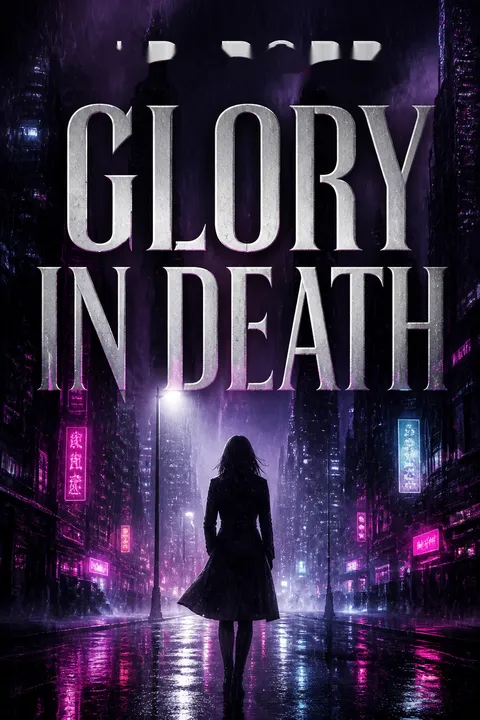


Plot Summary
The Prosecutor in Rain
Lieutenant Eve Dallas arrives at a rain-soaked West End crime scene and recognizes Cicely Towers, a respected prosecutor she has faced across many cases. Towers has been killed with a single slash to the throat. Her jewelry, cash, and handbag remain untouched, and no clear sign explains why a meticulous woman in an expensive suit was in a dangerous neighborhood after midnight.
Commander Jack Whitney makes Eve primary investigator, then admits that Towers was a close friend and his children’s godmother. He is grieving, but insists Eve must investigate him and his wife like anyone else. Her first search of Towers’s immaculate apartment turns up a dinner with George Hammett, not the late-night meeting that brought her to the West End.
The case begins with a collision between professional distance and personal recognition. Eve’s practiced attention to physical evidence cannot make Towers an anonymous body; the victim’s public role and Whitney’s grief sharpen the demand for justice while complicating the investigation. The untouched valuables resist the familiar logic of street crime, making the location itself a question rather than an explanation. Eve’s childhood, largely inaccessible even to herself, also shadows the scene: she understands violence as a fact of work, yet the story repeatedly tests what that clinical competence costs her. The mystery’s first engine is not simply who killed Towers, but why she chose to go alone.
Roarke in the Case
Before Eve can settle into the investigation, C. J. Morse uses her relationship with wealthy businessman Roarke to suggest that the case reaches into the city’s elite. Roarke had business connections to Towers, her former husband Marco Angelini, and Hammett, while Eve knows he has a past that sometimes skirts the law.
She questions him; he confirms that Towers sat on the board of his shipping company, Mercury, and insists its current operations are legitimate. He also offers investigative data, though Eve prefers official channels.
Morse’s insinuations infuriate her, so she gives reporter Nadine Furst an exclusive in exchange for leads and controlled updates. The bargain limits the gossip reporter’s influence, but also makes the murder investigation a contest over who controls its public story.
Roarke’s presence makes intimacy and investigative procedure difficult to separate. Eve believes him, yet knows that belief cannot replace the work required to clear him, and the media exploits precisely that tension. Her agreement with Nadine is a tactical response to an information economy in which silence can be edited into suspicion. The episode also establishes that public attention is not background noise: it shapes suspects’ reputations, pressures police leadership, and may reward the killer. Eve’s resistance to being made a social spectacle is therefore more than temperament. She wants the authority to define what is relevant, even as the case forces her to use the very machinery she distrusts.
The Missing Umbrella
Eve interviews Hammett, who confirms that he loved Towers and last saw her after dinner, then checks his account against the restaurant and cab records. At Towers’s building, electronic detective Ryan Feeney discovers that she erased her final recorded call before leaving home.
Eve retraces her route: Towers returned from dinner, changed clothes, took a matching purple umbrella, and traveled by subway to the Five Moons bar. A bartender remembers her waiting alone for nearly an hour, then leaving just before her estimated time of death.
The killer apparently took only the umbrella. A bouncer called Crack confirms that Towers had been seen near the bar, but offers no reliable account of her visitor. The erased call now points toward a private meeting, not a random attack.
Eve turns absence into evidence. The erased recording matters because Towers, a prosecutor accustomed to documenting professional contacts, deliberately removed a trace; the umbrella matters because it is the only object the killer took. Her reconstruction depends on ordinary details, a cab time, clothing, weather, waiting, which become more persuasive than grand theories. The method reflects Eve’s distinctive intelligence: she imagines the victim’s movements without confusing imagination with proof. Yet the private call also exposes a tension at the heart of Towers’s character. The woman who upheld public law chose to handle something alone, and that choice may have been shaped by love, pride, or fear.
A Family Under Strain
Eve questions Marco Angelini, Towers’s former husband and business partner, who stands to inherit her share of Mercury and other holdings. He claims he was home alone and says their divorce remained amicable. Roarke later reveals that Marco has suffered losses from bad investments, giving Eve a financial motive to examine.
Their son David also carries substantial gambling debts, while daughter Mirina is preparing to marry designer Randall Slade. At Cicely’s memorial, Roarke warns Eve that Slade and David owe money, then points her toward an old scandal involving Slade and a woman who died on a gambling station.
Slade admits the incident but denies recent contact with Towers. Eve leaves with several plausible motives and one crucial uncertainty: whether Towers discovered the old scandal and summoned Slade herself.
The Angelini family’s wealth does not protect it from dependency; it disguises it. Business contracts, inheritance, gambling debts, and a daughter’s marriage bind people who present themselves as independent. Eve reads those arrangements as possible motives, but the chapter’s deeper pressure comes from her own lack of a comparable family history. At the memorial, she watches people grieve through familiar rituals while she measures their accounts for inconsistencies. That habit is useful and costly. She can identify how affection might become leverage, yet has difficulty imagining what it means to be bound to someone by a history one cannot simply investigate or leave.
Diamonds and Distance
As suspicion circles the Angelinis, Roarke gives Eve a costly diamond, hoping she will accept both the gift and his declaration of love. She sees the gesture as pressure to abandon her apartment and become dependent on his wealth.
Roarke, exhausted by her refusal to name what she feels, tells her he wants a full commitment rather than a relationship she can retreat from whenever he leaves. He walks out, and Eve throws the necklace aside while insisting to herself that work comes first.
At the same time, she interviews Whitney’s wife, Anna, who describes Towers as a devoted mother and says she believed Towers’s relationship with Hammett was too casual to satisfy her. Eve hears the judgment more clearly than she admits, because intimacy with Roarke has become her own unresolved case.
The diamond condenses a conflict Eve cannot solve by gathering more evidence. She interprets generosity through the language of power because dependence has always seemed dangerous; Roarke experiences her caution as a refusal to trust his feelings. Neither position is reducible to simple selfishness. His ultimatum risks turning love into a test, while her insistence on self-sufficiency protects an identity built around competence and control. Anna’s account of Towers and Hammett provides a parallel: keeping a relationship tidy can protect autonomy while also withholding the intimacy another person hopes for. The plot’s romantic tension therefore mirrors the murder mystery’s central question of what people conceal, and why.
Another Throat Cut
Eve is still pursuing Towers’s private meeting when officers find Yvonne Metcalf, a rising actor, dead behind her building. Her throat was cut in the same manner, with no robbery or defensive struggle.
Morse arrives at the scene with a camera crew and broadcasts before Eve can control the story, while Roarke confirms that he and Yvonne once had a brief intimate relationship. Eve’s professional connection to Towers and personal connection to both victims make him an unavoidable subject, though she does not believe he killed them.
Dr. Mira studies the two cases and predicts another attack: the killer appears to want both the intimate control of a knife and the attention generated by prominent victims. She warns that Eve herself, now a familiar public figure, may be at risk.
The second murder changes the narrative’s scale. A private mystery becomes a serial pattern, and the similarity of the wounds makes spectacle part of the evidence. Mira’s profile interprets fame as a source of envy and a route to borrowed importance, but her warning also reflects the limits of prediction: a profile can identify danger without identifying a person. Eve resists being treated as a likely target because the possibility threatens her belief that vigilance can master risk. Roarke’s past with Yvonne intensifies that vulnerability, forcing Eve to distinguish emotional jealousy from investigative relevance. She must protect her judgment even when the case repeatedly touches the person she most fears losing.
The Call to Rome
Eve confronts Roarke about Yvonne, and their argument finally breaks her resistance: she admits she needs him and loves him, then agrees to make a shared home without surrendering her own space. Soon after, Mirina asks Eve and Roarke to travel to Rome.
There, Slade reveals that Towers called him shortly before her death. She had learned of his old gambling-station scandal and was furious that he had concealed it from Mirina; she intended to protect her daughter from marrying a man she could not trust.
Slade lied about the call because he feared the consequences. Roarke confirms that Towers had previously asked him to cut off gambling credit to Slade and David. Eve now understands why Towers erased the call and why her final trip was personal rather than professional.
This revelation gives the erased call an emotional motive without making Towers’s choice simple. She was acting as a mother, but also as a prosecutor who knew how damaging concealed wrongdoing could be. Her effort to protect Mirina relied on secrecy and direct confrontation, the same tools that left her vulnerable. The Rome visit also marks a shift in Eve’s own relational life: she can accept love without renouncing professional independence. That balance matters because the investigation will soon demand both. Roarke is no longer merely a source whose connections must be examined; he is someone whose insight and presence Eve chooses to trust.
The Wrong Woman Falls
Believing the killer wants media attention, Eve deliberately increases her own visibility through an interview with Nadine and appearances at public events. She hopes to draw the murderer toward her, though Roarke fears the risk.
A week later, while Eve is at Roarke’s home, a call sends her to Channel 75, where production editor Louise Kirski has been killed outside the building. Louise wore Nadine’s raincoat and had gone out to buy cigarettes; Nadine had lent it to her and remained inside to make calls.
Eve recognizes the coat and realizes the intended target was probably Nadine. Grief and guilt hit at once. She had invited the killer’s attention, but an innocent colleague paid for the mistake. Morse turns Louise’s death into another immediate broadcast.
Eve’s strategy exposes the ethical instability of using oneself as bait. She believes a controlled risk can force the killer into the open, but a crowded city makes control partly illusory. Louise’s death is especially painful because she is not a symbolic public figure or an abstract casualty; she is a working colleague whose ordinary errand intersects with Eve’s plan. Nadine’s survival does not erase the cost. The episode challenges Eve’s professional habit of assuming responsibility for outcomes while refusing to admit limits. Her guilt is morally serious, but it can also become a way to imagine that she possessed more control than she did.
The Angelini Trap
Channel 75 security footage places David Angelini at the station shortly before Louise’s murder. Eve learns that Anna Whitney had secretly lent him two hundred thousand dollars to cover debts, information she had withheld during earlier interviews.
David claims he witnessed the killing but fled in shock; he had also lied about being at the scene and offers Eve money to bury the matter. Investigators discover he had been negotiating a film project with Yvonne, giving him a link to all three cases.
Eve arrests him for obstruction, leaving the scene, and attempted bribery. During a search of the family townhouse, officers find a knife with David’s fingerprints and traces of his blood. Marco then confesses to all three murders, insisting he is protecting his son, while Eve doubts the confession.
David becomes a compelling suspect because his behavior is culpable even before the murder evidence is clear. He abandons a dying woman, lies to investigators, and tries to buy silence; those acts make his fear look like guilt. Anna’s loan reveals how protective love can quietly enable the very dependency it hopes to cure. Marco’s confession then makes fatherhood a competing explanation for the evidence: it could be a genuine admission, or a shield placed between a child and punishment. Eve’s challenge is to resist the emotional neatness of either story. The case has accumulated motives and family bonds, but the distinction between a plausible narrative and a provable one remains crucial.
The Wrong Suspect Released
The weapon found in David’s room is not a match for the murder blade, and Mira’s evaluation suggests David is more likely to flee trouble than commit calculated violence. New police chief Harrison Tibble orders Eve to release him rather than risk a weak case becoming a public spectacle. The decision leaves the killer free and turns the investigation back toward the streets.
Eve revisits the Five Moons and finds an albino drug user who remembers a man leaving in the rain with a bright umbrella and driving away in a polished small car. The witness cannot identify him, but the umbrella detail was never made public. It links her account to the object taken from Towers and gives Eve a concrete route away from the Angelinis.
The failed weapon match is more than a setback; it exposes the danger of allowing circumstantial coherence to harden into certainty. David’s lies and debts make a persuasive story, but the physical evidence refuses to support it. Tibble’s order forces Eve to accept that a good investigator must sometimes relinquish a theory before it becomes an institutionally convenient fiction. The witness’s imperfect testimony is valuable precisely because it contains a detail the press never received. Here the story contrasts polished explanations with damaged, partial perception. Eve’s task is not to find the witness who can tell a complete story, but to discover which fragments can be verified.
Morse Leaves His Trace
Eve notices that Morse described Louise’s eyes, though Officer Peabody found the victim’s face hidden beneath a hood and no one uncovered it before police arrived. Feeney’s checks reveal Morse’s sealed juvenile record: at ten, he killed a teacher’s dog after she gave him a poor grade.
His career history shows repeated clashes with women who advanced ahead of him, including Yvonne, and he drove the kind of small Rocket the witness described.
When Eve and Feeney search his apartment, Peabody finds a concealed compartment beneath the sofa holding Towers’s purple umbrella and Metcalf’s red-striped shoe. Nadine has disappeared after leaving the station without her protective detail. The evidence identifies Morse, but it does not yet tell the police where he has taken her.
The decisive clue is not a confession or an elaborate forensic breakthrough, but Morse’s assumption that his own version of events will be accepted. By describing a face no witness could have seen, he reveals himself through an excess of performance. His career resentment and childhood violence add context, not excuse: the pattern shows how entitlement can turn perceived slights into a private mythology of persecution. The stolen objects expose the same need to possess a piece of each victim’s public identity. Finding the evidence clarifies who the killer is, but Nadine’s disappearance shifts the immediate problem from proof to time.
The Parkside Broadcast
Morse contacts Eve from Greenpeace Park, holding Nadine at knifepoint and demanding she arrive alone. He boasts that he hacked police communications and confesses that he targeted women who challenged his ambition, including his mother, Towers, and Metcalf.
Eve reaches the park, draws his attention away from Nadine, and tries to disarm him, but Morse escapes into the trees and attacks her. Roarke arrives after Nadine directs him toward Eve.
As Morse gains control of the knife, Roarke tackles him; in their struggle, the blade enters Morse’s throat, killing him before police can take him to trial. Nadine survives, and medics treat Eve’s wounds. Walking away from the scene with Roarke, bruised and shaken, Eve hears him ask her to marry him and is left stunned.
The climax gathers the book’s competing forms of power into one physical confrontation. Morse wants the camera, the knife, and the final say; Eve counters by drawing him into attention while trying to preserve Nadine’s life. Roarke’s intervention saves Eve, but the killer dies before the legal process can answer for his crimes. That outcome grants immediate safety while withholding the public reckoning Cicely Towers spent her life defending. Eve’s injuries make vulnerability undeniable, and Roarke’s proposal arrives not as a polished romantic gesture but in the aftermath of shared danger. The ending leaves her response open, fitting a relationship that has advanced through difficult acts of trust rather than easy promises.
Analysis
Glory in Death asks how people convert private powerlessness into public authority. Towers commands a courtroom, Yvonne negotiates for a career-making role, Nadine controls a broadcast, and Eve directs an investigation. The killer experiences those women’s voices and visibility as a personal humiliation, then tries to replace their influence with the spectacle of their deaths. His murders are not only acts of violence; they are attempts to author the public narrative around them.
The novel counters that fantasy with competing forms of attention. Eve studies the dead carefully, while Morse turns them into images and ratings. The distinction is not that reporting is inherently exploitative or police work inherently pure. Eve herself uses the media as bait, and Louise’s death reveals the costs of treating visibility as a controllable instrument. The book is interested in the ethical residue left when a strategy succeeds only partially.
Its family relationships deepen the same problem. Anna’s loan, Marco’s protectiveness, Towers’s intervention, and Mirina’s grief show love operating as both shelter and concealment. Eve has almost no secure model for family, so she initially treats attachment as a threat to self-command. Her relationship with Roarke forces her to test whether dependence must mean submission. She does not abandon her work or resolve her trauma, but begins to accept that intimacy can coexist with agency.
The ending offers safety without perfect justice. Morse dies before a court can examine his confession, and Eve must live with the risk her plan placed on Louise. The killer is stopped, but neither the law nor private love can reverse what happened. The novel’s most durable insight is that responsibility matters even when control is incomplete: Eve’s duty is not to prevent every loss, which she cannot do, but to keep looking honestly after certainty fails.
Review Summary
Glory in Death is highly praised as an engaging, suspenseful sequel in the In Death series. Readers love the evolving relationship between Eve Dallas and Roarke, finding their chemistry electric. The murder mystery keeps readers guessing until the end. Many appreciate the futuristic setting without it overwhelming the story. Eve's character development and Roarke's unwavering support are highlights. Fans enjoy the series' consistent quality and look forward to continuing with future books.
People Also Read




Characters
Eve Dallas
The relentless homicide lieutenantEve is a New York homicide lieutenant whose attention to bodies, records, and human behavior makes her an formidable investigator. She trusts work more readily than intimacy, partly because her childhood is fractured by memories she cannot fully access. Her professional identity gives her discipline and purpose, but can also become a refuge from grief, fear, and dependence. Eve feels deeply for victims and their families, even when she disguises that feeling as irritation or procedure. Her relationship with Roarke unsettles her because it asks her to value herself beyond competence. She is not softened into passivity; she learns, haltingly, that accepting care need not mean surrendering autonomy.
Roarke
The wealthy, watchful partnerRoarke is an extraordinarily wealthy businessman with interests spanning legal commerce and less transparent corners of the economy. His intelligence, self-command, and instinct for reading people come from a childhood shaped by poverty and danger. He loves Eve intensely, but his desire for commitment can make him impatient with her need for distance. Rather than asking her to become someone else, he tries to build a life that accommodates her work and privacy. His connection to Towers, Yvonne, and the Angelinis makes him relevant to the investigation, while his willingness to help tests the boundaries between personal loyalty and professional evidence.
Cicely Towers
The formidable public prosecutorCicely Towers is a prominent prosecutor known for preparation, forceful advocacy, and a strong record of convictions. She is also a mother, a business partner, and a close friend to Commander Whitney, roles that complicate the clean public image of a tireless legal professional. Towers values competence and self-direction, and she appears to bring the same determination to private matters that she brings to court. Her relationships with her children, former husband, and lover form the human network around the investigation. She represents the tension between public duty and private loyalty, especially when protecting someone she loves seems to require acting outside ordinary channels.
C. J. Morse
The ambitious crime reporterMorse is a television reporter who understands how to make a story vivid and how to make himself its center. Competitive and resentful of colleagues who receive recognition, he treats advancement as a measure of personal worth. His polished on-air manner conceals a sharper, more calculating private self, and his rivalry with Nadine places him inside the same media world that shapes the investigation. Morse is skilled with technology and attentive to how audiences respond. His character illustrates the danger of confusing visibility with significance, and of turning every professional setback into proof that others are conspiring to deny him what he deserves.
Nadine Furst
The hard-news correspondentNadine is an experienced reporter with a strong instinct for a story and a competitive streak equal to Eve’s. She bargains for exclusives, guards her sources, and knows that broadcast news rewards speed as much as accuracy. Beneath that ambition, she forms real attachments to colleagues and takes their suffering personally. Her friendship with Eve is based on mutual usefulness as well as an emerging trust: each recognizes the other’s skill without pretending their professions share the same rules. Nadine’s public confidence does not make her immune to grief or danger; it gives her a way to keep working even when private feeling threatens to overwhelm her.
Ryan Feeney
Eve’s computer-savvy allyFeeney is an experienced electronic detection specialist and one of Eve’s oldest friends at work. His humor and habit of snacking soften a formidable technical mind, while his loyalty makes him willing to take on tedious searches and sensitive evidence. He knows Eve well enough to tease her about Roarke, but also recognizes when a case is cutting too close to her. Feeney’s skill with records, security footage, and locked systems repeatedly turns vague suspicion into testable information.
Jack Whitney
The grieving police commanderWhitney is Eve’s commanding officer, a seasoned leader who trusts her judgment and gives her authority in a difficult case. His friendship with Towers makes his grief personal, while his position requires him to maintain standards even when those standards touch his own family. He is protective of the people he loves and can let that protectiveness cloud his view of a suspect. His relationship with Eve is built on respect, candor, and the strain of asking a good officer to investigate people close to him.
Dr. Mira
The department’s perceptive profilerDr. Mira is a police psychologist whose calm, compassionate manner can make Eve more uncomfortable than a direct challenge. She studies behavior without reducing people to diagnoses and understands that a profile identifies possibilities rather than certainties. Mira respects Eve’s investigative ability, but also sees the exhaustion and unresolved trauma beneath her discipline. Her own history of surviving childhood abuse informs her patience with Eve, though she never treats empathy as a substitute for evidence.
Marco Angelini
The businessman and family patriarchMarco is Towers’s former husband, a powerful businessman, and the father of David and Mirina. He is controlled, proud, and accustomed to treating personal and commercial matters as negotiations. He values family continuity and remains financially linked to his former wife after their divorce. His composure makes it difficult for Eve to distinguish grief from concealment. Marco’s devotion to his children sits beside his insistence on control, creating a character who can interpret protection as a duty even when it carries serious consequences.
David Angelini
The indebted Angelini heirDavid is Marco and Towers’s son, a businessman accustomed to privilege and to others helping him manage the consequences of his choices. His gambling debts threaten both his finances and his pride. He resents his mother’s expectations while remaining dependent on the family network that supports him. David can be charming and cultured, but under pressure he becomes defensive and evasive. His position in the family makes him an important figure in the investigation, where inheritance, loyalty, and self-preservation overlap.
Mirina Angelini
The grieving bride-to-beMirina is Towers’s daughter and David’s sister. She works in fashion buying and is preparing to marry designer Randall Slade. More emotionally fragile than her mother, she tends to avoid personal crises until circumstances force her to face them. She loves her family and expects the people around her to protect it, but grief can turn that expectation into anger. Mirina’s relationship with her mother is affectionate and lively, grounded in the small shared plans of clothes, work, and a wedding.
Randall Slade
The designer with a hidden pastRandall is Mirina’s fiancé, a successful fashion designer whose work is distributed through the Angelini business. He is handsome, self-assured, and accustomed to presenting himself as someone who can manage a difficult situation. A history of gambling and a past scandal complicate that polished surface. Randall loves Mirina and fears losing her, which makes concealment feel safer to him than honesty. His relationship with Towers is shaped by the fact that she is both the mother of his future wife and a formidable judge of character.
George Hammett
Towers’s devoted companionHammett is a wealthy transportation businessman and Towers’s long-term lover. Elegant and thoughtful, he respects her independence but has not persuaded her to share his wish for a more settled partnership. His grief is visible in a way that Marco’s is not, though Eve correctly knows that grief alone cannot clear a suspect. He offers a view of Towers beyond the courtroom: a woman cherished by someone who understood both her strength and her distance.
Anna Whitney
The protective family friendAnna is Whitney’s wife and a close friend of Towers. A devoted mother and hostess, she values family loyalty and dislikes seeing loved ones exposed to hardship. Her instinct to help can lead her to make decisions privately, trusting that good intentions will be understood later. Anna’s warmth is genuine, but she can mistake shielding someone from consequences for helping them recover. Her perspective reveals the domestic relationships behind the public lives of the case’s central figures.
Mavis Freestone
Eve’s flamboyant old friendMavis is an exuberant singer and Eve’s longtime friend. Her changing hair, theatrical clothes, and appetite for spectacle are matched by a perceptive loyalty beneath the performance. Mavis can make Eve laugh when she has retreated too far into work, and she understands that friendship sometimes means interrupting a spiral rather than analyzing it. Her artistic ambitions give her a life distinct from Eve’s police world, while their affection survives their very different temperaments.
Peabody
The sharp-eyed uniformed officerPeabody is a capable uniformed officer with a strong sense of procedure and an observant mind. She approaches assignments seriously, even when their demands place her near a volatile investigation. Her patience and attention to physical surroundings allow her to notice what a more senior investigator might overlook. Peabody respects Eve’s authority while developing confidence in her own judgment.
Louise Kirski
The meticulous editorial technicianLouise is a Channel 75 editorial technician who works closely with Nadine and helps prepare broadcasts. She is skilled, cheerful, and in the early stages of building a life with her partner. Her work happens behind the camera, where precision matters but public recognition is scarce. Louise’s grounded, ordinary hopes provide a human counterweight to the fame and ambition dominating the investigation.
Yvonne Metcalf
The rising television actorYvonne is an award-winning actor whose growing fame has brought her into contact with reporters, producers, and powerful businesspeople. She is sociable and ambitious, yet not careless about her career; she treats opportunity as something to negotiate and cultivate. Her exuberant personality contrasts with Towers’s disciplined public image, though both women have strong ties to the people around them. Yvonne’s professional reach places her at the intersection of entertainment and media politics.
Summerset
Roarke’s severe household managerSummerset manages Roarke’s vast home and meets Eve’s informality with rigid disapproval. His devotion to Roarke is expressed through order, discretion, and a sense of responsibility for the household. Beneath his chilly manner, he is attentive to practical needs and capable of acting quickly when circumstances demand it.
Crack
The West End nightclub bouncerCrack is a flamboyant bouncer whose size and comic bravado make him memorable on the West End. He understands the neighborhood’s informal economy and is willing to trade local observations for money. His information is limited, but his account helps Eve establish where Towers waited.
Carolle Lee
The woman in Slade’s old caseCarolle Lee is a young woman whose death years earlier became entangled with Randall Slade’s gambling and reckless behavior. Her case survives in records and in the memories of those who were involved. She represents the lingering human cost of conduct that others would prefer to describe as a youthful mistake.
Harrison Tibble
The blunt new police chiefTibble is an imposing veteran officer newly responsible for the department. He distrusts weak cases and media-driven policing, and he speaks plainly when investigators become too emotionally invested. His bluntness can sting, but he values competent work and is willing to make difficult calls to protect the integrity of an investigation.
Plot Devices
The erased link call
A silence with motiveTowers deletes the recording of her last call before traveling to the West End. The missing data initially blocks Eve from identifying the person who summoned her, but the deletion itself narrows the possibilities: Towers was protecting the contact or the subject of their meeting. Later, Slade explains that Towers confronted him about his past and her daughter’s future. The erased call therefore functions both as a clue and as evidence of character. It shows Towers choosing a private, personal intervention rather than a formal legal response.
The stolen souvenirs
A killer’s identifying trailThe killer takes Towers’s purple umbrella and Metcalf’s red-striped shoe while leaving more valuable property behind. At first, these objects seem like arbitrary trophies. Mira interprets them as evidence that the killer wants a personal connection to each crime, while Eve uses them to distinguish the murders from robbery. The umbrella’s distinctive appearance also allows a street witness to corroborate part of Eve’s reconstruction. Hidden together in Morse’s apartment, the objects transform psychological pattern into physical evidence.
The public bait
Attention becomes a trapEve increases her visibility through Nadine’s coverage and prominent public appearances because she believes the killer seeks notoriety. The tactic is designed to draw him toward a well-known investigator, but it cannot control who else will be exposed. Louise is killed while wearing Nadine’s raincoat, and Eve believes the killer mistook her for the intended target. The device turns media attention into both investigative leverage and a moral hazard, forcing Eve to confront the difference between accepting personal risk and imposing risk on others.
The gambling debts
Family loyalty clouds motiveDavid’s debts and Slade’s old gambling scandal create plausible reasons for Towers to intervene and give Eve several tempting lines of inquiry. Anna’s secret loan shows that people around David have tried to shield him from consequences. Towers’s concern for Mirina helps explain why she accepted a private meeting, while Roarke’s past decision to cut off gambling credit links the business circle to the family crisis. The debts function as real pressures, but they also generate a false lead when the evidence against David appears stronger than it is.
The covered face
A witness contradicts himselfMorse claims to remember Louise’s eyes, although her hood covered her face until police arrived. Eve notices the inconsistency only after reviewing the scene and comparing the first witness accounts. The detail is small enough to sound like an ordinary reporter’s embellishment, but it reveals that Morse knows more than he could have learned from being the person who discovered her. His performance becomes evidence against him, linking his appetite for broadcast drama to his presence at the crime itself.
In Death Series Series





About the Author

Download PDF
Download EPUB
.epub digital book format is ideal for reading ebooks on phones, tablets, and e-readers.








