

Plot Summary
One of Six
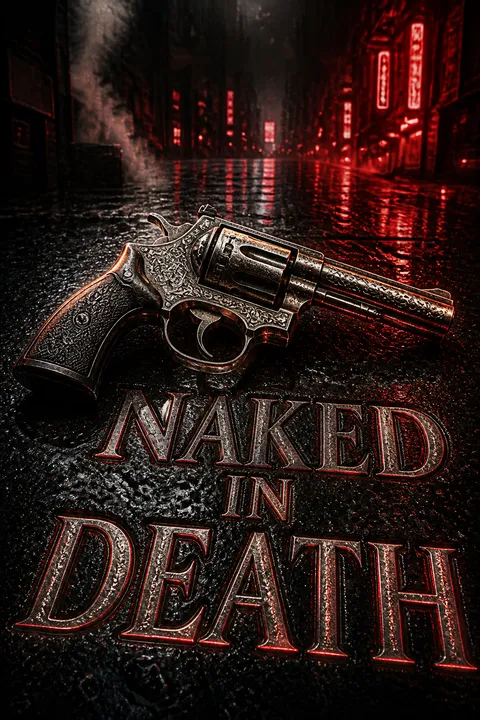
After killing a violent man who had murdered a three-year-old girl, New York lieutenant Eve Dallas expects the mandatory psychological review that follows a fatal police shooting. Instead, her commander sends her to investigate Sharon DeBlass, a licensed companion found posed naked in her apartment, shot with a rare antique revolver.
Eve reads the scene as deliberate theater: the killer has arranged Sharon's body, left the weapon, and called police himself so the discovery cannot be delayed. Beneath the sheets, Eve finds a sealed card marked as the first in a series. Its promise of five more victims turns an ugly homicide into a race. The blood also echoes the child Eve could not save, a memory she tries to shut away.
The opening makes Eve's professional competence inseparable from the wound she carries into the case. The new murder arrives precisely when she is trying to recover from another death, so the killer's spectacle lands on an already strained conscience. Sharon's arranged body and the numbered card show that violence here is not only an act but a message designed to control the people who witness it. Eve recognizes that performance quickly, yet her own memories threaten to blur the boundary between careful observation and personal anguish.
The Killer Sends Proof
Forensics finds no useful fingerprints or DNA, and the building's surveillance records contain a carefully edited gap around the time Sharon died. Eve learns that the killer knew her apartment and security system well enough to leave a second recording at her home.
The video shows Sharon alive shortly before the shots, then displays her body and repeats the numbered threat. Eve studies the recording for signs of panic but finds a perpetrator who has already cleaned the scene and controlled what police can see.
Interviews at Sharon's salon reveal that she had recently become excited about wealthy businessman Roarke, while her client records connect her to prominent figures. Her grandfather, Senator Gerald DeBlass, arrives demanding access to evidence and insisting that the investigation proceed on his terms.
The video turns evidence into a weapon: it does not merely document the crime, it invades Eve's private space and makes her an audience the killer can summon. The edited surveillance, clean scene, and intimate knowledge of Sharon's records suggest someone who understands both technology and human routines. Political pressure adds another form of control, as the senator tries to shape what investigators may know. Eve is therefore forced to work against two competing performances, the killer's theatrical confidence and DeBlass's public authority.
A Funeral, Then Roarke
At Sharon's funeral, Eve watches her estranged family grieve beneath a crowd of politicians and notices Roarke standing apart. He is a powerful business owner with an opaque past, yet he has come to mourn a woman he had only recently met. Eve challenges him after the service, and he offers her a place on his private flight back to New York.
During the trip, Roarke confirms their dinner in Mexico but denies having sex with Sharon; he also admits that he owns the building where she lived and collects antique firearms. His wealth gives him access, his collection may contain the murder weapon, and he has no witness for part of the relevant night. The encounter leaves Eve with a suspect she cannot dismiss and a man she cannot quite read.
The funeral works as an informal lineup of relationships and power. Eve studies who stands close, who avoids the coffin, and who appears to belong nowhere, using posture as evidence because grief rarely arrives in a clean statement. Roarke complicates that method: his presence is suspicious, but his reserve resembles Eve's own guardedness. Their first exchange establishes the novel's central tension between professional skepticism and attraction. She needs to treat him as a possible perpetrator even as his attention makes the interview feel less like a routine interrogation.
The Gun Room Kiss
Eve's early checks make Roarke look increasingly plausible: he owns Sharon's building, collects antique weapons, and has enough technical knowledge to understand its security. At his mansion, he lets her inspect his collection and take a Smith & Wesson matching the murder weapon for testing.
The cooperation does not dissolve her suspicion, especially when she sees how naturally he handles the firearms. Yet his attention unsettles her more than his answers do. In the weapon room, they kiss, and Eve pulls away before desire can compromise her investigation.
She leaves with the gun and the uneasy sense that her feelings have entered the case. Roarke keeps a button from her jacket rather than returning it, a private token of the connection neither has agreed to name.
The scene makes the danger of intimacy concrete rather than abstract: Eve removes evidence from Roarke's home while also allowing physical closeness that could undermine her impartiality. His collection embodies the distance between owning violence as an object and using it against a person, a distinction Eve must judge without yet knowing which side he occupies. Her withdrawal is not lack of desire but an assertion of professional identity. Roarke's concealed keepsake, meanwhile, hints that his composure is already giving way to attachment.
Lola's Room of Dolls
Eve reaches the apartment of Lola Starr, an eighteen-year-old companion whose toys and inexpensive belongings make the staged violence feel especially cruel. The killer has used a silenced antique pistol, arranged Lola among her stuffed animals, and left the next numbered threat.
Her client log points to a John Smith, but the false name gives Eve no identity. Soon another murder recording reaches Eve, and Roarke sees how deeply it affects her. After he finds her exhausted and shaken, she tells him about Mandy, the child she failed to save, and admits that she was glad to stop the girl's killer.
Roarke listens without asking her to excuse the feeling. Their attraction becomes physical that night, giving Eve a rare reprieve from nightmares while creating a new personal complication.
Lola's room collapses the distance that professional language can create between a case file and a person. The dolls, young age, and career ambition make the killer's chosen symbolism especially degrading: he uses a victim's surroundings to turn her into a prop. Eve's confession to Roarke is a different kind of exposure. She does not present herself as an untroubled officer, but as someone who fears that anger and relief may make her morally suspect. Their intimacy offers comfort, yet it also raises the stakes of every later decision about Roarke.
Testing and the Press
After postponing her required review, Eve finally undergoes physical tests, a reconstructed shooting scenario, and an interview with Dr. Mira. She passes, but refuses to explore the childhood abuse and lost memories that Mira identifies beneath her defensive control.
Meanwhile, Chief Simpson orders Eve to deny any connection between Sharon and Lola, then exposes her at a press conference when reporter Nadine Furst publicly links the murders. Eve refuses to lie outright and secures Nadine's cooperation after learning the reporter has received confidential case files and murder videos.
Away from the investigation, Eve discovers that her elderly neighbor Joe Finestein died after eating a poisoned pie his wife prepared. The bizarre domestic case briefly interrupts the mounting pressure, then another murder message restores the urgency.
Testing turns the police department's concern for public safety into an invasion Eve experiences as a loss of control. Mira can name the damage, but Eve is not ready to let that knowledge become a route into her past. Simpson's attempt to separate the murders shows how institutional authority can protect reputation instead of truth. Nadine offers a counterweight, but her access to leaked evidence also proves that the killer is manipulating the public narrative. The poisoned-pie incident provides a smaller, unsettling mirror: violence can hide inside ordinary domestic habits as easily as inside a staged crime scene.
A Gun Blames Roarke
Georgie Castle, a fifty-three-year-old companion who had once been married and hoped to write, becomes the third victim. Eve finds her beside a Ruger combat pistol and another numbered marker. Records show the weapon was registered to Roarke, making him a tempting suspect just as he is away at the FreeStar space station.
Eve verifies his location on a live transmission, then questions him when he returns. The apparent link dissolves: the gun was acquired through an unusual auction bid and delivered through a pickup system, leaving a trail someone could fabricate.
Dr. Mira's profile also rejects the idea that the killer would outsource a murder, since he needs to witness and record the act himself. Roarke is cleared, though the accusation wounds their growing trust.
The planted weapon is effective because it exploits both material evidence and Eve's private attachment. Its registration seems to settle the question at the moment when her judgment is under the most scrutiny, while Roarke's absence provides a decisive alibi only after she verifies it herself. Mira's profile restores a psychological logic to the investigation: the killer's satisfaction depends on presence, not merely outcome. Eve's willingness to follow the evidence against Roarke and then clear him demonstrates the cost of doing her job without allowing affection to dictate the result.
Simpson's Secret Account
Eve finds that the chief's efforts to obstruct her may be tied to Sharon's private leverage. A search of bank records uncovers a safe-deposit box and a list of names with payments beside them; Simpson appears among politicians, officials, and other powerful people.
Roarke helps Eve use his secure computer system to examine the chief's concealed financial records, where regular withdrawals match Sharon's listed blackmail payments. Before the evidence can become a case, Eve needs the diaries she believes Sharon kept.
Charles Monroe remembers that he once co-signed a separate deposit box for her under an alias. Feeney retrieves it and begins reviewing the entries. The records turn the investigation away from a lone predator's apparent targets and toward the family and political secrets surrounding Sharon.
The financial trail expands the meaning of corruption from individual appetite to a network sustained by silence. Simpson's regular payments suggest that Sharon used information as leverage, but the list cannot yet explain why the other victims were chosen. Roarke's illegal technical assistance makes their trust operational: Eve relies on his skills while remaining responsible for what she does with the results. The hidden diaries promise a more intimate kind of evidence than bank records, one capable of connecting public power to private harm.
The Family's Buried Crime
A frightened call brings Eve and Roarke to the DeBlass home, where Congresswoman Catherine finally reveals that her father sexually abused her from childhood. She believes he did the same to Sharon, who had confronted him and used the history to extract money.
Catherine's brother Richard and mother Elizabeth are devastated, while Eve promises to protect Catherine's young son. Feeney then finds Sharon's diary entry describing a paid sexual encounter with her grandfather on the night she died.
Eve arrests Senator DeBlass during his speech for three murders and the abuse of his daughter and granddaughter. On the flight back, the revelation cracks Eve's own defenses: she tells Roarke that she was abused as a child, cannot remember her early life, and wanted to kill DeBlass herself.
The revelation converts the family portrait from an arrangement of political loyalties into a structure of concealed abuse. Catherine's delayed testimony is shaped by the same coercion that protected her father: secrecy has made her feel responsible for what he did. Sharon's diary shows how she transformed imposed shame into leverage, though that power never made her safe. Eve's response is deliberately double-edged. She arrests DeBlass through evidence and procedure, then admits that her anger is personal, acknowledging both her own history and the ethical risk of confusing justice with revenge.
Rockman's Confession
DeBlass refuses to confess, and his lawyers challenge Catherine's account while Eve presses him with Sharon's diary. A judge releases the senator on his own recognizance after he suffers a heart episode, giving his political circle time to regroup.
Eve goes to Roarke's home, but he is away; back in her apartment, she finds Derrick Rockman waiting with an antique revolver. Rockman says DeBlass killed Sharon in a panic after she threatened exposure, then he helped erase the evidence and invented the later murders to disguise the first.
He claims to have arranged the senator's suicide and intends to kill Eve, rape her, and cast her death as the next installment of his pattern. While he talks, Eve secretly activates her recorder and keeps him explaining his role.
Rockman's threat exposes the danger of treating public loyalty as proof of moral character. He has served as DeBlass's polished aide, but his account reveals that he made the senator's first crime useful to his own ambitions and built an elaborate pattern around it. The distinction between the two killers matters: DeBlass's murder of Sharon began in panic, while Rockman turned concealment into a controlled sequence. Eve's recorder is a small act of agency inside an otherwise unequal encounter. She cannot yet overpower him, so she turns his vanity into evidence.
The Cat Turns the Fight
Rockman orders Eve to undress, but the cat she has taken in from Georgie brushes against his legs and breaks his aim. Eve drives into him, and they crash to the floor as he fights with military training and reaches for his gun. She claws at his face, keeps the recorder running, and struggles until his weapon fires, grazing her arm.
Feeney hears the transmission and brings officers to the apartment; Roarke arrives with him just as Rockman gains the advantage. Eve then turns the struggle, striking Rockman repeatedly before Feeney and Roarke pull her away. The recording captures Rockman's account, and police take him into custody for the murders of Lola and Georgie, his attack on Eve, and his role in the case.
The climax does not make Eve invulnerable; it makes her resourceful under a threat designed to reduce her to an object. Rockman's demand that she undress repeats the language of domination that shaped the crimes, but her refusal and counterattack disrupt his script. The cat's interruption is modest and contingent, not a miraculous rescue; Eve still has to seize the opening and survive the physical contest. Feeney's monitoring and Roarke's arrival show that her earlier choices to trust others have created a network capable of reaching her when she cannot call for help.
A Name for Survival
With Rockman arrested, Eve learns that DeBlass is dead by suicide, a fate Rockman says he arranged to protect the senator's reputation and his own plan. Eve is bruised, bleeding, and reluctant to seek medical care, but Roarke cleans her wounds and persuades her to rest at his home while police document the damaged apartment.
She tells him the cat helped save her and decides to call him Galahad, giving Georgie's abandoned companion a new place to belong. The ending does not settle the legal aftermath or erase Eve's memories of abuse. Instead, she lets Roarke carry her away from the scene and admits that his presence matters. After the case's violence, accepting care becomes the first small act she does not have to perform alone.
The resolution is deliberately personal rather than procedural. Rockman's capture ends the immediate danger, but Eve's old trauma and the political consequences of DeBlass's death remain beyond the final scene. Galahad's new name links survival to care: the cat is not a trophy from the case but a living responsibility Eve chooses to keep. Roarke's attention also changes form, moving from flirtation and pursuit toward practical tenderness. Eve has not surrendered her independence; she has begun to recognize that accepting help need not make her powerless.
Analysis
Naked in Death builds its mystery around the difference between violence as an impulsive act and violence as an authored performance. Sharon's murder begins with DeBlass's panic, while Rockman turns the aftermath into a planned series, borrowing the first crime's method and imagery to hide the difference between them. Eve's investigation succeeds when she questions the pattern rather than worshipping it: a shared profession and repeated staging do not prove a single psychology or a single hand.
The victims' work matters because it makes them socially legible as targets. DeBlass condemns prostitution in public while exploiting the women connected to it in private; Rockman uses misogyny to cast their deaths as deserved. Their rhetoric converts women's sexual autonomy into permission for male control. Sharon resists that control through money and exposure, but leverage cannot undo the original abuse or guarantee safety. Catherine's testimony reveals how family loyalty, political reputation, and silence can reinforce one another across generations.
Eve's emotional conflict gives the procedural plot its human measure. She believes a police officer must prevent harm, yet the case repeatedly confronts her with the limits of that belief: she cannot save Mandy, and she cannot prevent the first murder. Her growth is not a simple acceptance of helplessness. She learns that responsibility means acting on evidence, admitting when anger is personal, and allowing others to stand beside her without handing them her judgment. Roarke's wealth and command of systems could easily reproduce the power she distrusts, but he becomes valuable when he uses those resources in support of her choices. The ending offers no repaired past. It offers a captured killer, an adopted cat, and a woman beginning to imagine that being strong need not mean being alone.
Review Summary
Naked in Death receives mostly positive reviews, with readers praising the futuristic setting, strong characters, and intriguing mystery. Many appreciate Eve Dallas as a complex, tough protagonist and find Roarke compelling. The romance develops quickly, which some enjoy and others find too fast. Readers highlight the well-crafted plot, suspense, and world-building. Some criticize predictability or dislike certain character aspects. Overall, most reviewers express enthusiasm for continuing the series, finding it addictive and entertaining.
People Also Read








Characters
Eve Dallas
The relentless homicide lieutenantEve is a New York police lieutenant whose sharp observation and stubborn discipline make her effective in a department crowded with political pressure. She treats procedure as a promise to victims, but her sense of responsibility can become punishing: she expects herself to arrive in time, stop violence, and bear every consequence without help. Her childhood is largely inaccessible to her, leaving her wary of dependence and deeply uncomfortable with psychological scrutiny. The investigation forces her to distinguish professional judgment from personal rage, especially as her own history begins to surface. With Roarke, she discovers that intimacy can offer support without automatically taking away her autonomy, though learning to accept that remains difficult.
Roarke
The alluring industrialistRoarke is a wealthy, self-made Irish businessman whose interests range from technology and security to art and antique weapons. He is observant, controlled, and accustomed to shaping the circumstances around him, yet his confidence conceals a difficult past and a guarded approach to emotional attachment. His connection to Sharon makes him an obvious suspect, while his candor and practical help make him increasingly important to Eve. He respects competence and is drawn to Eve's refusal to be managed, even when her distance frustrates him. Their relationship challenges his habit of keeping people at arm's length and her belief that relying on someone must mean surrendering control.
Ryan Feeney
Eve's trusted technical allyFeeney is Eve's former partner and a senior officer in the Electronic Detection Division. His computer expertise helps her breach technical dead ends, while his familiarity with her lets him recognize when she is exhausted or in danger. He balances teasing affection with a veteran investigator's caution, especially when the evidence points toward people inside the police department. His loyalty is not blind agreement; he challenges Eve when her attachment to Roarke threatens to compromise her judgment, then supports her when the facts justify her decisions.
Commander Whitney
Eve's protective commanderWhitney commands Eve's division and understands how political power can distort police work. He protects her assignment when Chief Simpson tries to redirect the investigation, but he also expects her to remain accountable for her choices. His authority is tempered by experience: he knows when to insist on procedure and when to quietly give a capable investigator room to work.
Gerald DeBlass
The powerful family patriarchSenator DeBlass is an influential conservative politician who campaigns against prostitution, reproductive freedom, and the gun ban. He presents himself as a guardian of family and public morality, while his forceful manner demands obedience from relatives and colleagues alike. His political ambitions make him skilled at converting private events into public arguments. The family members around him respond to his authority in different ways, revealing how power inside a household can be protected by the same status that shapes a public career.
Derrick Rockman
The senator's polished aideRockman is DeBlass's disciplined, highly capable adjutant, a man whose smooth manners and careful restraint make him an effective political operator. He understands security, manages access to the senator, and rarely reveals more feeling than the moment requires. His history with a disbanded paramilitary group suggests an ideological commitment to forceful order. He believes in hierarchy and sees political influence as a means to remake society, an outlook that puts him in stark contrast with Eve's insistence on individual accountability.
Sharon DeBlass
The defiant licensed companionSharon is the senator's granddaughter, an intelligent and stylish licensed companion who chose a life that scandalized her politically prominent family. She enjoys sexual freedom and the sense of control her work gives her, but her confidence sits beside resentment, secrecy, and unresolved ties to relatives she has rejected. People who know her describe sharply different versions of her, suggesting someone practiced at using charm and reinvention to protect herself. Her private records and professional relationships become central to the investigation, making her presence felt through the choices she made and the secrets she kept.
Lola Starr
The ambitious young companionLola is a newly licensed companion who has left her family and adopted a glamorous professional identity. She imagines a future of wealth, fine clothes, and carefully chosen clients, while still keeping youthful comforts in her modest apartment. Her ambition reflects both independence and inexperience: she knows what she wants, but has only begun to understand the costs of pursuing it. Eve's discovery of Lola's belongings makes her more than a name in a sequence of crimes.
Georgie Castle
The companion turned writerGeorgie is a middle-aged licensed companion who entered the profession after a divorce and hopes to become a writer. Her daughter describes her as warm, determined, and difficult to dissuade once she has chosen a direction. Georgie has built an ordinary, affectionate home life around a career others might find surprising, refusing to let age or convention dictate what she may try. Her personal routines and family ties give Eve a different portrait of the profession from Sharon's glamour or Lola's youthful ambition.
Dr. Mira
The perceptive department psychiatristDr. Mira conducts police fitness evaluations and psychological consultations with calm persistence. She recognizes Eve's defenses without mistaking them for proof of weakness, and offers help without forcing disclosure. Her profile of the killer gives the investigation a human framework, translating repeated choices into motives of control and display. Mira represents a form of authority Eve distrusts but may eventually be able to use.
Mavis Freestone
Eve's irrepressible friendMavis is a flamboyant performer and Eve's closest friend outside the police force. Years earlier, Eve arrested her for petty theft; their relationship has since grown into an affectionate, candid friendship. Mavis's bright clothes and quick humor contrast with Eve's austerity, but she is more perceptive than her theatrical manner suggests. She encourages Eve to treat desire and companionship as human needs rather than weaknesses, while offering a place where Eve can speak without being evaluated as an officer.
Nadine Furst
The ambitious investigative reporterNadine is a sharp television journalist who wants a career-making story but is not indifferent to the people harmed by it. She detects the connection between the companion murders before the police can speak publicly and negotiates with Eve rather than simply airing confidential evidence. Her ambition makes her persistent, while her willingness to restrain publication shows that she understands a story can interfere with the justice it claims to serve.
Elizabeth Barrister
Sharon's grieving motherElizabeth is a successful attorney and Sharon's mother, a careful woman who has long struggled to bridge the distance between her daughter's choices and her own hopes for her. She is intelligent and self-questioning, but grief makes her confront how respect for privacy can become an excuse for not asking difficult questions. Her friendship with Roarke reflects the trust she places in people she believes can reach Sharon where she cannot.
Richard DeBlass
Sharon's conflicted fatherRichard is Sharon's father and Elizabeth's husband, a reserved attorney who has spent much of his life in the shadow of his powerful father. He supports personal freedom more readily than Senator DeBlass does, yet family loyalty and old patterns complicate his independence. When grief strikes, he tries to protect his wife and sister while confronting how little he understands about the harm inside his family.
Catherine DeBlass
The senator's political daughterCatherine is a congresswoman who followed her father's path into politics and built a disciplined public identity. Within her family, she is a sister, wife, and mother, roles that make private history difficult to separate from public responsibility. She is protective of her own household and wary of exposing painful matters, especially when disclosure could affect her child. Her position gives her both public credibility and a reason to fear the consequences of speaking openly.
Charles Monroe
Sharon's companion colleagueCharles is a licensed companion, Sharon's neighbor, and an occasional professional partner. He is charming, socially skilled, and accustomed to treating flirtation as both work and play. Beneath that ease, he was genuinely fond of Sharon and is willing to help Eve despite the risk of exposing private information. His forgotten role in one of Sharon's financial arrangements gives the investigation a practical lead.
Summerset
Roarke's exacting butlerSummerset manages Roarke's household with rigid formality and a strong sense of propriety. He distrusts Eve's rough manners and sees her as an awkward fit in Roarke's carefully ordered world. His reserve makes him a comic counterpoint to their growing familiarity.
Anna DeBlass
The senator's withdrawn wifeAnna is Senator DeBlass's wife and Sharon's grandmother. At the funeral she appears emotionally distant and chemically subdued, offering little access to what she knows or feels. Her silence reflects how thoroughly the family's public image has governed what may be acknowledged.
Sebastian
Sharon's salon confidantSebastian is Sharon's personal consultant at the exclusive Paradise salon. He remembers her routines, ambitions, and excitement about Roarke, providing Eve with a view of Sharon's private hopes beyond her client records. His theatrical style contrasts with the shock he feels when he learns she has died.
Hetta Finestein
The neighbor with a poisoned pieHetta is Eve's elderly neighbor, a proud home baker who cherishes the rituals of food and friendship. Her gentle manner conceals a hard judgment about her husband's selfishness and a disturbing capacity to turn domestic routine into punishment. Her brief case offers Eve a glimpse of violence hidden beneath ordinary household life.
Joe Finestein
Hetta's difficult husbandJoe is Hetta's husband and former bakery partner. In her account, he has grown irritable and dismissive since retirement, using small acts of selfishness to frustrate her pleasures. His marriage illustrates the quiet power struggles that can accumulate behind a respectable home.
Plot Devices
The numbered murder cards
A visible countdownThe killer leaves a numbered marker with each staged scene, announcing a planned series and forcing Eve to treat every new companion's appointment book as a possible warning. The count gives the crimes a public structure while concealing the individual motives beneath it. Because the killer also sends recordings, the markers are not merely clues. They are a way to dictate the pace of the investigation and make Eve feel watched.
Antique firearms and recordings
Violence as spectacleThe old weapons distinguish the crimes from ordinary modern homicide and point toward collectors, security expertise, and a deliberate interest in the past. The killer's recordings preserve his control over each scene after he has left it, delivering the images to Eve and sometimes to the media. Together, the guns and videos turn murder into staged proof, inviting investigators to study both the physical evidence and the perpetrator's performance.
Sharon's hidden diaries
Private history becomes evidenceSharon's personal diaries preserve intimate encounters, family secrets, and the leverage she used against powerful people. Her mother knows she kept them, but neither police searches nor ordinary bank inquiries locate them at first. Charles Monroe's memory of co-signing a deposit box under an alias gives Feeney a route to the records. The diaries connect Sharon's murder to her family and help reveal why her grandfather was in her apartment.
The false weapon trail
A suspect is framedA pistol registered to Roarke is left beside Georgie Castle, making his extensive collection and his relationship with Eve appear incriminating. The unusual auction and delivery trail gives Eve reason to investigate rather than accept the registration as proof. Roarke's verified location off-planet and the weapon's manufactured provenance expose the planted clue. The device tests whether Eve can honor both evidence and emotional attachment without allowing either to dictate the conclusion.
Police psychological testing
A hidden past resurfacesMandatory testing after a fatal police shooting places Eve inside a recreated version of the scene with the murdered child. Dr. Mira's interview identifies the connection between the case and Eve's childhood history, though Eve initially refuses to explore it. The tests first delay her work, then give her a controlled setting in which to confront what she believes about her use of force. Their deeper effect appears later, when she can acknowledge her own abuse to Roarke.
FAQ
Synopsis & Basic Details
What is Naked in Death about?
- A Future Noir Mystery: Naked in Death introduces Lieutenant Eve Dallas, a homicide detective in a futuristic New York City, as she investigates the brutal murder of Sharon DeBlass, a licensed companion and granddaughter of a powerful senator. The case quickly escalates into a hunt for a serial killer who leaves cryptic messages and antique weapons at his meticulously staged crime scenes.
- Unlikely Partnership Forms: Forced to navigate a politically charged investigation, Eve finds herself clashing with, and unexpectedly drawn to, Roarke, a mysterious and immensely wealthy Irish businessman who becomes a prime suspect due. Their complex relationship develops against the backdrop of the escalating murder spree.
- Confronting Personal Demons: As Eve races against time to stop the killer, she is also forced to confront her own traumatic past, including a recent justifiable homicide and deeply buried childhood abuse. The investigation becomes a crucible for her personal and professional identity, intertwining her quest for justice with her journey toward healing.
Why should I read Naked in Death?
- Compelling Protagonist's Journey: Readers are drawn into Eve Dallas's raw, unvarnished psyche as she battles both external criminals and internal demons. Her relentless pursuit of justice, coupled with her vulnerability and struggle with past trauma, makes her a deeply relatable and inspiring character, offering a profound exploration of resilience.
- Intriguing Futuristic World-Building: J.D. Robb crafts a richly detailed 2058 New York City, blending advanced technology like AutoChefs, tele-links, and VR with enduring human elements like crime, politics, and love. This blend creates a captivating backdrop that feels both familiar and excitingly new, enhancing the mystery with a unique atmosphere.
- Electrifying Romantic Tension: The dynamic between Eve and Roarke is a central draw, evolving from intense suspicion to undeniable passion. Their intellectual sparring, emotional vulnerability, and burgeoning trust create a powerful romantic arc that complements the thrilling mystery, making it a foundational read for fans of romantic suspense.
What is the background of Naked in Death?
- Futuristic Dystopian Undercurrents: The story is set in 2058, a future where societal reforms have legalized prostitution ("licensed companions") and banned most firearms, yet violence and corruption persist. This backdrop highlights the novel's exploration of whether technological and social advancements truly solve fundamental human failings, or merely shift their manifestations.
- Technological Integration & Critique: The world features ubiquitous personal computers, advanced security systems, automated services, and virtual reality, reflecting a society deeply integrated with technology. However, the killer's ability to manipulate these systems (e.g., doctored security discs, untraceable communications) subtly critiques the illusion of perfect control and privacy in a high-tech era.
- Political & Moral Landscape: The narrative is steeped in a political climate where conservative figures like Senator DeBlass wield immense power, advocating for "Morals Bills" and lamenting societal decline, even as they harbor deep personal corruption. This creates a stark contrast between public morality and private depravity, underscoring themes of hypocrisy and the enduring struggle between individual freedom and societal control.
What are the most memorable quotes in Naked in Death?
- "What's past is prologue.": This epigraph, attributed to William Shakespeare, immediately sets a thematic tone for Eve's journey, suggesting that her past traumas and the societal history of violence are not merely background but active forces shaping the present investigation and her personal development. It foreshadows the deep connections between past abuse and present crimes.
- "Violence is as American as cherry pie.": The second epigraph, from Rap Brown, offers a cynical, yet poignant, commentary on the enduring presence of violence despite societal advancements. It challenges the futuristic setting's veneer of progress, implying that certain human tendencies, particularly towards aggression, remain constant across eras.
- "I'm a cop. I can't afford to overlook anything, to assume anything.": Spoken by Eve to Roarke, this quote encapsulates her unwavering dedication to her professional ethics and her struggle to maintain objectivity, especially when her personal feelings become involved. It highlights her core identity and the immense personal cost of her commitment to justice.
What writing style, narrative choices, and literary techniques does J.D. Robb use?
- Third-Person Limited Perspective: The narrative primarily follows Eve Dallas's point of view, immersing readers in her thoughts, fears, and deductions. This choice allows for deep psychological insight into Eve's character, making her internal struggles and emotional growth central to the story, while maintaining the mystery by limiting access to other characters' inner worlds.
- Sharp, Economical Prose with Vivid Detail: Robb employs a direct and efficient writing style, characterized by concise sentences and impactful descriptions that quickly establish the futuristic setting and the grim realities of Eve's work. Despite its economy, the prose is rich in sensory details, from the "heavy hum of air traffic" to the "smell of cold, fresh earth," grounding the reader in Eve's world.
- Juxtaposition of Gritty Realism and Futuristic Romance: A key technique is the stark contrast between the brutal, often disturbing details of homicide investigation and the burgeoning, intensely passionate romance between Eve and Roarke. This juxtaposition heightens the emotional stakes, demonstrating how love and connection can emerge even in the darkest circumstances, and providing moments of tenderness amidst the violence.
Hidden Details & Subtle Connections
What are some minor details that add significant meaning?
- Eve's Faulty Car Heater: A seemingly trivial detail, Eve's constantly malfunctioning car heater (Document 1, Chapter 2, 5, 7) symbolizes her often uncomfortable, unglamorous life and her resistance to accepting help or luxury. Roarke's later act of secretly fixing it (Document 1, Chapter 15) is a subtle, non-verbal expression of care and understanding, highlighting his desire to provide comfort without her asking, a stark contrast to her self-reliance.
- Roarke's Kept Button: Roarke finding and keeping a button from Eve's drab gray suit (Document 1, Chapter 5, 14) is a potent symbol of his immediate, almost possessive fascination with her, even before their physical intimacy. It signifies his attention to small details about her and his unconventional attraction to her unadorned authenticity, foreshadowing his deep emotional investment.
- Sharon's Shoe Arrangement: Eve's meticulous observation that Sharon DeBlass's shoes were stacked in rows of four, not six (Document 1, Chapter 7), is a crucial, subtle detail that proves someone returned to the crime scene after the initial police sweep. This seemingly insignificant discrepancy becomes a vital clue, revealing the killer's arrogance and the depth of his planning, and validating Eve's sharp observational skills.
What are some subtle foreshadowing and callbacks?
- "Daddy" Motif and Lola Starr: Lola Starr's preference for clients who call her "Daddy" (Document 1, Chapter 4) subtly foreshadows the later revelation of Senator DeBlass's incestuous abuse of his daughter and granddaughter. This seemingly innocent detail becomes a chilling callback to the core trauma driving the entire murder spree, linking the victims' professional lives to the killer's twisted motivations.
- Roarke's "Old-Fashioned Quirk": Roarke's statement that he has an "old-fashioned quirk" of disliking "brutalizing women, in any form" (Document 1, Chapter 5) subtly foreshadows his innocence in the brutal murders. While initially a suspect, this personal code, combined with his later fury at the graphic photos of Lola Starr, establishes his moral boundaries and distinguishes him from the actual killer.
- Eve's Apartment Ownership: The revelation that Roarke owns Eve's apartment building (Document 1, Chapter 4) is a subtle power dynamic that initially makes him more suspicious but later becomes a symbol of his protective presence. His ability to access her apartment (Document 1, Chapter 8) shifts from a potential threat to a demonstration of his unwavering commitment to her, even when she pushes him away.
Who are the most significant supporting characters?
- Captain Ryan Feeney: Beyond his role as Eve's former partner and EDD chief, Feeney serves as Eve's moral compass and emotional anchor within the police force. His unwavering loyalty and willingness to bend rules for Eve (e.g., checking Roarke's background, providing emotional support during her breakdown) highlight the theme of found family and trust in a corrupt system.
- Dr. Mira: The police psychiatrist, Dr. Mira, is crucial not only for Eve's mandatory psychological Testing but also for providing the killer's profile. Her calm, insightful demeanor and ability to see through Eve's defenses (Document 1, Chapter 9) offer a professional counterpoint to Eve's raw emotions, symbolizing the importance of psychological understanding in both solving crimes and personal healing.
- Summerset, Roarke's Butler: Summerset, with his "implacably eyed" and "smug condescension" (Document 1, Chapter 5), acts as a gatekeeper and a foil to Eve, initially embodying the class divide and Roarke's privileged world. His gradual, subtle acceptance of Eve (e.g., putting her calls through to Roarke on FreeStar One, Document 1, Chapter 13) signifies Eve's growing importance in Roarke's life and the breaking down of social barriers.
Psychological, Emotional, & Relational Analysis
What are some unspoken motivations of the characters?
- Eve's Need for Control: Eve's relentless drive to solve cases and her aversion to psychological Testing stem from an unspoken, deep-seated need for control, a direct consequence of her traumatic, powerless childhood (Document 1, Chapter 9, 18). This motivation fuels her dedication but also creates emotional walls, making her reluctant to relinquish control in personal relationships or acknowledge her own vulnerabilities.
- Roarke's Desire for Connection: Beneath his enigmatic charm and immense wealth, Roarke is driven by an unspoken desire for genuine connection and a challenge that transcends material gain. His persistence with Eve, despite her initial hostility and professional boundaries, reveals his longing for a partner who is his intellectual and emotional equal, someone who "pulls something from me" (Document 1, Chapter 16).
- Senator DeBlass's Power-Hunger: Senator DeBlass's public moral crusades and political ambitions are deeply intertwined with an unspoken, perverse need for absolute power and control, particularly over women and his family. His abuse and subsequent murders are not just about sex or blackmail, but about maintaining a facade of moral authority while indulging his darkest desires, as revealed by Catherine's confession (Document 1, Chapter 17).
What psychological complexities do the characters exhibit?
- Eve's Trauma-Induced Amnesia and Coping Mechanisms: Eve exhibits complex psychological responses to her childhood trauma, including amnesia regarding her first eight years and a fierce dedication to her job as a coping mechanism (Document 1, Chapter 9, 18). Her internal conflict between professional detachment and emotional vulnerability, particularly after witnessing child abuse, highlights the psychological toll of her work and her struggle to integrate her past with her present identity.
- Roarke's Calculated Empathy and Protective Instincts: Roarke, despite his ruthless business acumen and mysterious past, displays a complex blend of calculated empathy and fierce protective instincts towards Eve. His ability to "read people quickly and accurately" (Document 1, Chapter 6) allows him to understand Eve's emotional state, and his actions, from fixing her heater to confronting Rockman, reveal a deep-seated need to care for her, challenging his own self-proclaimed aloofness.
- Rockman's Twisted Loyalty and Narcissistic Grandiosity: Derrick Rockman's character is a study in twisted loyalty and narcissistic grandiosity, believing himself to be the true architect of DeBlass's political power and the murders. His disdain for women and his enjoyment of the killings (Document 1, Chapter 19) reveal a profound sociopathy, where his actions are driven by a need for recognition and control, seeing himself as superior to both his victims and his "pawn" (Eve).
What are the major emotional turning points?
- Eve's Breakdown with Roarke: The most significant emotional turning point occurs when Eve, overwhelmed by the child murder case and her own resurfacing trauma, breaks down in front of Roarke (Document 1, Chapter 7). This moment of raw vulnerability shatters her carefully constructed emotional walls, allowing Roarke to see her true pain and initiating a profound shift in their relationship from professional suspicion to deep personal connection.
- Catherine DeBlass's Confession: Catherine's agonizing confession of her father's abuse (Document 1, Chapter 17) is a pivotal emotional turning point for the entire DeBlass family and for Eve. It transforms the case from a series of seemingly random murders into a deeply personal quest for justice against a monstrous figure, igniting Eve's protective instincts and solidifying her resolve.
- Roarke's Declaration of Love: Roarke's unexpected declaration, "I think I'm in love with you" (Document 1, Chapter 15), marks a major emotional shift, not just for Eve but for himself. It forces Eve to confront her own capacity for deep emotional connection, challenging her long-held belief that such feelings are a weakness, and signaling a new, vulnerable phase in both their lives.
How do relationship dynamics evolve?
- Eve and Roarke: From Adversaries to Intimates: Their relationship dynamically evolves from initial professional suspicion and intellectual sparring to a passionate, deeply intimate bond. Eve's initial distrust of Roarke, fueled by his status as a suspect and his mysterious nature, gradually gives way to grudging respect, then intense attraction, and finally, a profound emotional and physical connection built on mutual understanding and vulnerability (Document 1, Chapter 3, 10, 15).
- Eve and Feeney: Deepening Professional Trust: The long-standing partnership between Eve and Feeney deepens into an unbreakable bond of professional and personal trust. Feeney's unwavering support, his willingness to risk his career for Eve, and his emotional concern for her well-being (Document 1, Chapter 11) highlight their loyalty, evolving beyond mere colleagues to a familial connection that provides Eve with crucial stability.
- DeBlass Family: Exposure of Toxic Dynamics: The DeBlass family dynamics are revealed to be deeply toxic and abusive, evolving from a facade of respectability to public exposure of incest and murder. The strained relationships between Senator DeBlass and his children, particularly Catherine and Sharon, unravel to expose a pattern of control, fear, and silence, ultimately leading to their collective breakdown and the senator's downfall (Document 1, Chapter 17, 18).
Interpretation & Debate
Which parts of the story remain ambiguous or open-ended?
- The Full Extent of Eve's Childhood Trauma: While Eve's childhood abuse is revealed, the specific details of her first eight years remain largely ambiguous due to her amnesia (Document 1, Chapter 9, 18). This open-endedness leaves room for future exploration in the series, suggesting that her healing journey is ongoing and that the full psychological impact of her past is yet to be fully understood.
- Roarke's Complete Past and Moral Ambiguity: Despite revealing snippets of his past as a thief and smuggler (Document 1, Chapter 15), Roarke's full history remains largely ambiguous. His immense wealth, shadowy connections, and willingness to operate outside legal boundaries (e.g., hacking Simpson's accounts) leave a lingering question about the true nature of his morality and how much of his past he has truly left behind.
- The Future of Justice in a Corrupt System: While Senator DeBlass and Rockman are brought to justice, the story leaves open the question of whether the systemic corruption (e.g., Chief Simpson's blackmail, political interference) will truly be eradicated. The ease with which powerful figures manipulate the system suggests an ongoing struggle, implying that Eve's fight for justice is a continuous battle against entrenched power structures.
What are some debatable, controversial scenes or moments in Naked in Death?
- Eve's Decision to Sleep with Roarke While He's a Suspect: Eve's choice to engage in a sexual relationship with Roarke while he is still a primary suspect (Document 1, Chapter 10) is highly debatable from an ethical and professional standpoint. This controversial moment challenges traditional police procedural norms, highlighting Eve's impulsive nature and the intense, undeniable attraction that overrides her professional judgment, leading to significant career repercussions.
- The Justification of Hacking for Justice: Roarke's illegal hacking into Chief Simpson's financial records (Document 1, Chapter 16) to uncover blackmail evidence, at Eve's request, presents a controversial ethical dilemma. It raises questions about whether "the ends justify the means" in the pursuit of justice, blurring the lines between legal and illegal methods and challenging the integrity of the system Eve is sworn to uphold.
- The Portrayal of Prostitution as a "Licensed Companion" Profession: The novel's depiction of prostitution as a legalized, regulated profession for "licensed companions" (Document 1, Chapter 1) is a controversial aspect. While presented as a societal advancement for safety and health, the murders of these women, and the underlying disdain for them by characters like Rockman and DeBlass, spark debate about whether legalization truly elevates the profession or merely sanitizes its inherent vulnerabilities and societal stigmas.
Naked in Death Ending Explained: How It Ends & What It Means
- Justice Achieved, But Not Without Cost: The ending sees Senator DeBlass exposed as a serial abuser and murderer, committing suicide to avoid public humiliation, while his accomplice, Derrick Rockman, is captured and charged (Document 1, Chapter 19, 20). This brings a measure of justice for the victims, but DeBlass's suicide denies a public trial, leaving a bittersweet taste and highlighting the limitations of the legal system against powerful individuals.
- Eve's Personal Breakthrough and Healing: The climax forces Eve to confront her own childhood trauma, triggered by Rockman's taunts and the parallels to DeBlass's crimes (Document 1, Chapter 19, 20). Her violent outburst against Rockman and subsequent emotional breakdown with Roarke mark a significant personal breakthrough, allowing her to finally articulate her past abuse. This moment signifies the beginning of her healing journey, moving from suppressed pain to acknowledged vulnerability.
- Roarke and Eve's Relationship Solidified: Roarke's unwavering support during Eve's breakdown, his protective actions, and his explicit declaration of love (Document 1, Chapter 19, 20) solidify their relationship. The ending establishes them as a committed couple, with Roarke offering Eve a safe space and emotional anchor, symbolizing that even in a world of darkness and trauma, profound connection and love can be found and cherished.
In Death Series Series






About the Author

Download PDF
Download EPUB
.epub digital book format is ideal for reading ebooks on phones, tablets, and e-readers.








