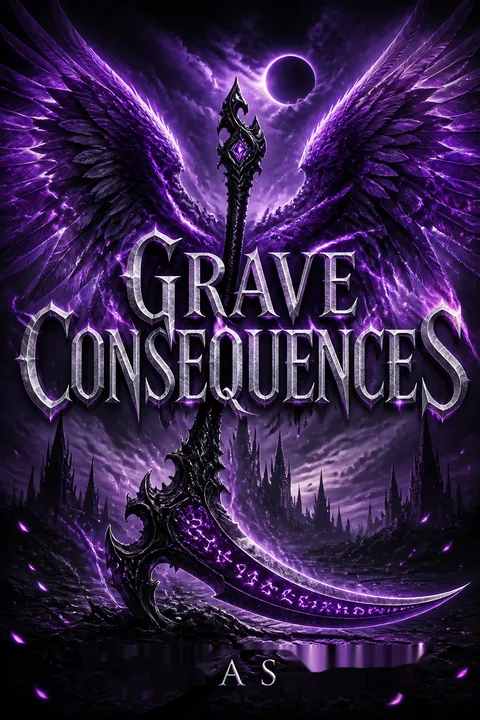


Plot Summary
White Room, Violet Wings
Delta Gates wakes battered in a blank white room, convinced that the four Hellgate Guardians who fought beside her have died. Grief turns to fury; she strikes the floor with her scythe until a golden-winged man storms in to defend his meditation room. Delta discovers purple wings on her own back, panics, and tries to escape with help from the man’s Irish attendant.
He instead has her dragged into a spiked dungeon. The demon Borf examines one of Delta’s feathers to identify her lineage. His verdict shocks both Delta and the winged stranger, Tazreel: Tazreel is her sire. Delta has arrived in Nihil, the powerful center of Hell, with no idea who she is or why anyone wants her.
Delta’s first response to catastrophe is to turn grief into action, even when the only target is a spotless floor. Her scythe is both the tangible remnant of the Guardians and the first instrument through which she can act in a world that has taken control from her. The revelation of Tazreel’s paternity does not immediately provide belonging. Instead, it converts her identity crisis into a custody dispute, with powerful beings treating her as evidence before they treat her as a person.
Pride's Unwanted Heir
Tazreel insists that Delta is his offspring, though he cannot explain how she was raised by humans or why her mother concealed her. His power forces her to recount the little she knows, while he searches old records of his lovers for clues. Because Nihil custom requires an Abdicated parent to present newly discovered offspring to the ruling circle, he orders Delta dressed for a gathering she does not want to attend.
The other demons treat the event as entertainment and discuss whether Tazreel will trade or sell her. Delta realizes that her new wings and rare appearance have made her valuable in a society that keeps harems called menageries. Her grief has no room to breathe, so she enters the party wary and determined not to be owned.
Tazreel frames parenthood as authority and public reputation, not care. His first instinct is to establish what Delta represents to his status, while Delta measures every exchange against the possibility of being traded. The party’s etiquette disguises a market logic: lineage, beauty, and power become social currency. Delta’s resistance is still reactive, but it marks an important shift. She no longer assumes that survival means complying quietly with whoever holds the stronger position.
The Scythe Knows Her Mother
At dinner with Tazreel’s circle, Delta struggles to answer questions about her sudden appearance and refuses the bizarre food placed before her. When her scythe manifests in her hand, the assembled Abdicated consider it an offense.
Lucifer, ruler of Hell and Tazreel’s close ally, recognizes the weapon and says he knows Delta’s mother. He protects Delta from punishment but withholds the identity in exchange for a bargain with Tazreel. Then Delta connects Lucifer to the Ophidian named by the attackers who killed her friends.
Lucifer’s amusement vanishes; he realizes something is wrong and disappears before explaining. Tazreel tries summoning the Guardians, calling in the wrong demons first. At last, Delta’s four companions arrive, alive, and she runs to embrace them.
The scythe changes the dinner from a social test into an investigation. Its presence links Delta to a history that even the powerful guests cannot fully reconstruct, while Lucifer’s sudden silence establishes that the Ophidian is more than a name from an attack. The Guardians’ return also unsettles Delta’s grief without erasing it. She had already begun mourning them as lost; their survival gives her back the people she loves, but leaves the cause of their apparent deaths and the sudden retreat of the attackers unexplained.
A Daughter on Display
The Guardians explain that the attackers overwhelmed them, then abruptly retreated, giving the injured men time to heal and search for Delta. Tazreel moves the gathering to a vast public revel and announces Delta as his newly discovered progeny.
When other Abdicated try to take the Guardians as companions, Delta claims them for herself. Tazreel objects, insisting that she must choose a powerful Nihil mate and accept his plans for her future. Delta counters that her contract with the Hellgate estate binds her to the Guardians, not to him.
She negotiates a return to the Mortal Realm, agreeing to answer Tazreel’s summons only when the Gate is not in danger. The group leaves Nihil together, and Delta chooses the people who have earned her trust over the father who claims authority by blood.
Delta’s public claim reverses the party’s assumption that she is the object being assigned. She names her relationships as a matter of choice, not rank, and uses the employment contract as leverage in a society that otherwise treats lineage as ownership. The scene also distinguishes protection from control: Tazreel may intend to shape her life, but the Guardians have repeatedly risked themselves without demanding obedience in return. Her decision is emotional and political at once.
Blood on the Portal
Back at the estate, Delta begins to recover her footing with the four Guardians, sharing the losses that shaped them and accepting the intimacy she had been too uncertain to pursue. The next morning, the group prepares to induct her at the mausoleum portal.
Delta discovers that she understands Hellion without realizing she has been speaking it, another sign that her former human life concealed more than she knew. Each Guardian cuts a palm and lets blood fall onto the portal stones; Delta follows, repeating their vow to protect the Gate.
The ritual shakes the mausoleum and consumes their blood. Everyone believes the bond has taken, and Delta welcomes the duty she once feared. But the Gate remains vulnerable, and her induction will later prove unable to make her a Guardian.
The blood rite gives Delta a deliberate answer to the helplessness of her arrival: she chooses a duty and marks that choice with the same bodily cost the Guardians have borne. Yet the ceremony’s apparent success conceals a structural mismatch. Delta wants to belong through service, but her hidden nature cannot be reduced to one portal or one role. The false assurance matters because it lets her act from commitment before she understands the limits of what commitment can bind.
The Trail to Purgatory
After the induction, Tazreel arrives with a way to trace Delta’s maternal bloodline. He coats her scythe with a tincture made from a demon’s hump, then the weapon pulls Delta, Tazreel, and the Guardians through a sudden portal.
They land at a fortress in Purgatory, headquarters of the Angelic Legion. Armed angels surround them and escort them inside. The Legion’s major, Louquin, recognizes Delta’s unusual purple coloring and scythe, then urgently summons his commanding colonel.
That colonel, Nefta, arrives with the same violet hair and wings as Delta. Tazreel and Nefta recognize each other as former lovers, and Delta realizes the Legion officer in front of her is connected to her birth. The reunion begins as a confrontation, not a welcome.
The tracking tincture turns an abstract question about origin into a physical journey, but the destination is not a private family refuge. It is a military institution that responds to Delta as a possible threat. Her resemblance to Nefta supplies the recognition Tazreel’s records could not, while the former lovers’ hostility prevents the revelation from becoming sentimental. Delta must enter her ancestry through public power structures, where even her face is treated as evidence.
The Angel in Purple
Nefta confirms that she gave birth to Delta after a brief affair with Tazreel, whom she knew under a false name. She left the infant with human parents because she believed Tazreel would use the child and she herself was unfit for motherhood. Before Delta can press her for more, a thunderstorm outside triggers memories of the night police told her that her adoptive parents had died in a crash.
Delta loses control of her breathing and relives the grief in front of both biological parents. Her four Guardians surround her, and Iceman steadies her until she can explain what the storm means. Nefta and Tazreel stop arguing long enough to hear her. Delta leaves the encounter with biological answers, but no easy reconciliation.
The storm collapses two family histories into one present-tense crisis. Delta has just learned that her biological parents concealed the truth, yet the grief that overwhelms her belongs to the people who raised her and died. Her body makes clear that biological disclosure cannot displace lived attachment. The Guardians’ calm, specific care contrasts with the birth parents’ initial dispute, exposing the difference between claiming a child and understanding what that child has endured.
The Name Beneath the Mask
Once Delta has recovered, Nefta explains that the scythe belongs to her maternal line and has been passed between women in her family. She recognizes the name Ophidian as the childhood title of Morax, a former friend thought dead, and suspects he is behind the attacks.
Before she can explain everything, the Guardians sense their Hellgate under assault. Delta demands that Tazreel open a portal, and he takes the group back to the estate. They race to the graveyard, where hundreds of demons surround the mausoleum without moving.
Their stillness makes the trap unmistakable: the horde is waiting for Delta. The first charge begins as soon as the Guardians leave cover, forcing Delta into another battle before she has learned what her scythe or her ancestry can do.
Nefta’s disclosure gives the Ophidian a personal history and makes the attack part of a larger pattern, but the revelation is cut short by immediate danger. Delta is denied the luxury of understanding before she must act. The silent demons sharpen that pressure: unlike a chaotic breach, their patience signals planning and a specific target. The sequence ties the family mystery to the Guardians’ practical responsibility, making Delta’s origins consequential to the Gate rather than merely private.
Two Hundred at the Mausoleum
The Guardians fight the first wave as a coordinated unit. Iceman rains ice blades, Echo uses shadows against flying attackers, Crux destroys demons from within, and Jerif shields them with fire. Delta uses her scythe to ash a flying demon, discovering that it can destroy her enemies on contact.
When a second force pours from the mausoleum, a giant cyclops knocks the Guardians aside while smaller demons pin Delta and bring out the capture net used in the earlier ambush.
She escapes their grip briefly, but a winged attacker snaps one of her wings, and the giant carries her toward the portal. Delta turns her fear into rage and unleashes dark light that destroys the cyclops. Nefta cuts her free, and Delta sees her and Tazreel fighting back-to-back against the Ophidian’s forces.
The battle first rewards teamwork, then strips away the protection that made Delta feel safe within the Guardians’ formation. Her capture repeats the earlier net attack, but this time her power answers when her body cannot. The dark explosion is not yet mastery; it is a survival response shaped by rage and desperation. Nefta’s intervention reveals another model of power: two enemies can coordinate effectively when a larger threat outweighs their feud.
The Ophidian Unmasked
Delta rejoins the Guardians, who are battered but alive, and they push toward Nefta and Tazreel as the remaining demons retreat. Delta tries to strike Morax, but he bends her attention and makes her hesitate, revealing a power that can interfere with free will.
Tazreel forces Morax to his knees and demands to know why he wants Delta. Morax admits he intends to use her to expand a realm he created and rule beyond Heaven, Hell, and the Mortal Realm. He freezes everyone in place, but Lucifer takes control of Tazreel’s body and breaks the paralysis.
Lucifer reveals that the armies of Heaven and Hell have already found and begun destroying Morax’s hidden realm. With his forces collapsing, Morax escapes into the sky. Delta and the Guardians survive, but the enemy who targeted her remains at large.
Morax’s threat is not simply superior force; it is the attempt to commandeer other people’s agency and make them instruments of his private order. Delta’s hesitation under his influence turns the concept of free will into a bodily danger. Lucifer’s intervention prevents the battle from becoming a simple victory: the hidden realm is being destroyed, yet Morax escapes. The resolution therefore reduces his immediate power without removing the central uncertainty of what he knows about Delta.
Blood Rewrites the Gate
After the battle, Nefta explains that Delta is an Annulus, a rare being able to reset souls, and that her mixed heritage makes her valuable to Morax. The scythe does not simply kill demons; it can return them to their beginning, while erasing a soul entirely requires several Annuli. Nefta also reveals that Delta cannot be permanently bound as a Hellgate Guardian, but can help restore the Gate itself.
At Hell’s Embrace, Delta follows memories stored in the marked skulls built into its doors. She cuts her palm and touches each skull, offering blood and thanks to the earlier Annuli who made the Gate. Purple fire reignites across the bones. The weakened portal strengthens, and a stretch of the dark passage blooms into a garden.
Delta’s identity shifts from a hidden pedigree into a dangerous function with moral consequences. Her scythe can alter the fate of souls, so every previous victory must be reconsidered as an act of resetting rather than killing. Nefta’s correction also separates service from possession: Delta cannot be assigned permanently to one Gate, but she can still repair it. The ritual makes inheritance a reciprocal practice, as Delta honors the dead instead of treating their power as an entitlement.
A Home Between Realms
With the Gate restored, Delta agrees to move into the Guardians’ mansion while preserving the house her adoptive parents left her. Iceman pays off its mortgages and arranges for a neighbor to watch it, giving Delta security without asking her to surrender her past.
She and the four Guardians grow into a shared relationship shaped by affection, teasing, and the knowledge that they nearly lost one another. Tazreel remains difficult, but begins making an effort to be present rather than merely issuing orders.
Delta also visits her parents’ graves, where Jerif leaves a flower chosen for her mother’s name and shares baseball scores with her father. Her life now includes two families, chosen and biological, though neither can erase the people she has lost.
The move is not a clean break from Delta’s human life. Keeping the house allows her to enter a new household without converting grief into something she must discard. Iceman’s financial gesture respects that distinction, while Jerif’s flower and baseball ritual show the Guardians learning how to approach her memories through action rather than consolation. The ending makes intimacy cumulative: Delta’s new life does not replace her first one, but learns to make room beside it.
Epilogue
Two months later, Delta is training and settling into life with the Guardians while the armies of Heaven and Hell hunt Morax. They have destroyed several of his bases, but he has escaped again, leaving behind records that point to a name: Medley.
Nefta recognizes it and turns pale. Morax has found another member of her family, Delta’s sister, and may be moving toward her as he once moved toward Delta.
The epilogue refuses the comfort of a completed victory. Delta has repaired the Gate and found a home, but Morax’s survival converts her hard-won stability into a new responsibility. The name Medley shifts the danger from Delta’s singular identity to a family line that has already been targeted and hidden. Nefta’s reaction also reframes her earlier secrecy: what looked like emotional distance was bound up with an attempt to protect a child from a threat she could not identify. The story closes by widening the stakes rather than resolving them.
Analysis
Grave Consequences makes identity a contested resource. Delta’s human upbringing, her connection to the Guardians, her biological parentage, and her capacity to alter souls all make competing claims on who she should be. Tazreel treats lineage as authority; Nefta treats concealment as protection; Morax sees Delta as an instrument for remaking the realms. Delta’s developing agency lies in refusing each claim when it tries to reduce her to a function.
The book repeatedly tests the difference between care and control. The Guardians protect Delta while allowing her to choose her role and relationships. Tazreel’s affection, where it appears, is entangled with status and command. Nefta’s secrecy was meant to shield Delta, but it also denied her knowledge of a danger she would eventually face. None of these motives is simple, and Delta’s responses remain grounded in the people who raised her, the people she loves now, and the duty she voluntarily accepts.
The scythe concentrates the story’s moral problem. It first appears to be a weapon that can turn enemies to ash; later, Delta learns that it resets souls and can be used to restore a damaged boundary between realms. Power is therefore not defined by force alone, but by understanding what an action does to another being’s future. The Gate repair makes this principle visible: Delta honors the dead Annuli, gives blood rather than taking power without acknowledgment, and revives a structure that protects lives beyond her own.
The ending offers emotional settlement without false closure. Delta finds a home with the Guardians and keeps the house of her human parents, refusing to make one family cancel the other. Yet Morax survives, and the discovery of Medley extends the threat into the next generation of hidden kin. Delta’s growth is not the end of vulnerability. It is the ability to act from chosen bonds while knowing that the larger conflict remains unfinished.
Review Summary
Grave Consequences receives mixed reviews, with an overall rating of 4.15/5. Readers praise the fast-paced plot, world-building, and steamy romance scenes. Many enjoy the humor and character development, particularly Delta's growth. However, some criticize Delta's immaturity and the excessive focus on sexual content. The book explores Delta's origins, her relationship with her demon guardians, and introduces new characters like Lucifer. While some found the ending satisfying, others felt it lacked depth. The cliffhanger ending and shift to a new protagonist in future books garnered mixed reactions.
People Also Read






Characters
Delta Gates
Reluctant Hellgate defenderDelta is a witty, stubborn graveyard worker who has spent years trying to rebuild after losing the parents who raised her. She tends to meet fear with jokes, defiance, or a practical task, even when those defenses cannot fully contain her grief. Her first instinct is to resist being told what she is supposed to become, but her loyalty to people in danger repeatedly draws her toward responsibility. Delta is also capable of revising her assumptions: she learns to accept help, acknowledge what she wants, and treat her unusual abilities as something to understand rather than deny. Her humor is not a lack of seriousness. It is a way to keep moving when the world becomes overwhelming.
Iceman, Rafferty
Steady blue GuardianRafferty, whom Delta calls Iceman, is the calmest of the four Hellgate Guardians and often the one who turns panic into a next step. His restraint is not emotional distance; it is a practiced way of carrying responsibility without spreading fear to the people around him. He watches for what others need, from protecting the Gate to helping Delta through a trauma response, and offers care without making it conditional on obedience. His history includes family expectations and a complicated relationship with the role he inherited. In the group, he provides steadiness, but his gentleness does not mean he lacks authority or conviction.
Crux
Flirt with a sharp tongueCrux is a playful, irreverent Guardian whose humor helps Delta feel less alone in unfamiliar surroundings. His apparent ease conceals the seriousness with which he approaches danger and the loyalty he feels toward his friends. He uses teasing and flirtation to break tension, but is also attentive to whether Delta feels safe and wanted. Unlike some of the others, he has a family life beyond the Gate, giving Delta a glimpse of how demons build ordinary routines alongside supernatural duties. Crux’s warmth is most visible in how readily he includes people, even when their differences might make them feel like outsiders.
Echo
Shadow-working confidantEcho is a shadow-wielding Guardian whose quiet attentiveness balances Crux’s exuberance and Jerif’s bluntness. He notices when Delta is frightened or ashamed and often responds through small, deliberate gestures rather than speeches. His own early loss of family makes him especially alert to the difference between sympathy and genuine presence. Echo has built a new family among the Guardians, and he treats belonging as something created through repeated acts of care. His powers can be playful or formidable, but his defining quality is his ability to read a room and offer the kind of closeness that does not demand explanation.
Jerif
Fierce fire GuardianJerif is a powerful, hot-tempered Guardian whose abrasive manner can conceal how carefully he watches over the people he loves. He pushes others hard, especially when he believes they are giving fear too much room, and his impatience can be both aggravating and clarifying. Underneath the gruffness is a strong sense of duty and a willingness to put himself between danger and his companions. He expresses tenderness more readily through action than confession, whether he is fighting beside Delta or honoring the people she has lost. His friction with Delta becomes a form of trust: she can challenge him without doubting his loyalty.
Tazreel
Proud Abdicated rulerTazreel is an ancient Abdicated who administers the sin of Pride and values reputation, control, and formal rank. He is vain, socially powerful, and accustomed to having his decisions obeyed. His relationships often begin as contests over status, and he treats responsibility as something that should follow hierarchy. Yet he is more than a caricature of arrogance: he has old friendships, a history of impulsive choices, and occasional flashes of battlefield courage. Delta’s refusal to defer to him unsettles his assumptions about authority. His challenge is to relate to others without turning every connection into a question of who has the right to command.
Nefta
Disciplined Legion colonelNefta is a high-ranking officer in the Angelic Legion, trained for strategy, combat, and command. She is direct and emotionally guarded, preferring clear decisions to comforting language. Her discipline can make her seem severe, but it also reflects a life shaped by danger and the need to act before circumstances close in. Nefta respects competence and expects others to meet the same standard she sets for herself. Her relationship with Tazreel is marked by old friction, while her military identity governs how she approaches nearly everything else. She must contend with the limits of treating every personal problem as a tactical one.
Lucifer
Amused ruler of HellLucifer is the King of the Underworld, an immensely powerful figure who can shift from playful amusement to chilling authority without warning. He enjoys bargains and theatrical timing, and he often lets other people reveal what they know before he offers anything in return. His affection for Tazreel and interest in Delta complicate his fearsome reputation, though neither makes him harmless. Lucifer understands more of the old order than he initially explains and is alert to threats that others mistake for rumor. He is both a political actor and a keeper of dangerous knowledge, using charm to conceal how carefully he weighs every consequence.
Morax
The elusive OphidianMorax is a powerful, unnerving figure known through the name Ophidian and the fear he inspires among those who encounter him. He is patient enough to organize attacks rather than rely on brute force alone, and he can unsettle people by exploiting their attention and desires. His ambition reaches beyond the established realms, making him dangerous not only as a combatant but as someone willing to violate boundaries others treat as fundamental. Morax’s confidence can read as charm until its coercive edge becomes clear. He represents a threat built from persuasion, planning, and the desire to make other beings serve a private vision.
Borf
Lineage-tasting SavorBorf is an ancient Savor who identifies demonic lineage by tasting a person’s essence, including through a feather. His blunt professional judgment breaks the deadlock between Delta and Tazreel, though his manner makes clear that he regards people as specimens as readily as individuals. Borf is not easily impressed, and his rarity of experience gives his conclusions unusual weight in Nihil.
Lousen
Nihil's theatrical dresserLousen is a colorful demon tasked with dressing Delta for Tazreel’s gathering. She is cheerful, observant, and more candid about Nihil’s customs than Tazreel is. Her warmth gives Delta a brief, practical ally in a house where most people are watching her for entertainment or advantage.
Strut
Perdition's exacting butlerStrut serves the Guardians at their estate with impeccable manners and a strong investment in keeping the house orderly. Delta’s mud, food habits, and improvisations frequently test his patience. Beneath the fussy presentation, he is dependable, manages the household, and adapts when the people he serves need practical help.
Louquin
Legion's senior officerLouquin is a Major in the Angelic Legion who serves under Nefta. He is professional and cautious around unexpected visitors, but his long friendship with Tazreel briefly softens the formality. When he recognizes Delta, he understands that her presence carries implications beyond a routine family search.
Avarice
Keeper of material greedAvarice is one of the Abdicated leaders responsible for the sin of material greed. His extravagant jewelry makes his preoccupation with wealth visible before he speaks. He enjoys gossip and games of influence, but he can also offer Delta practical help when Tazreel’s attention turns elsewhere.
Elle
Flirtatious Abdicated guestElle is a bold, sensual member of Tazreel’s inner circle who treats flirtation as both recreation and social leverage. She is quick to tease Delta and to needle Tazreel, but she also helps loosen the atmosphere when father and daughter turn a party into a confrontation.
Ace
The drowsy AbdicatedAce is a weary, slouched member of the Abdicated circle who watches the party with little visible enthusiasm. His dry presence and history of Tazreel’s pranks give the gathering a lived-in, long-standing familiarity.
Flint
Another Hellgate GuardianFlint is a Guardian from a different Hellgate who appears briefly when Tazreel tries to summon Delta’s companions. He recognizes Delta and her altered appearance, then is sent away before she can explain what happened to her own team.
Alder
Flint's fellow GuardianAlder serves beside Flint at another Hellgate. His distinctive flower and cautious manner mark him as a familiar face to Delta, though Tazreel’s hurried summoning gives him little time to help.
Medley
A name in Morax's recordsMedley is a name uncovered in the aftermath of the search for Morax. Its meaning is not immediately clear to Delta or the Guardians, but it draws a strong reaction from Nefta.
Plot Devices
Queen of Hearts
Scythe of blood and memoryDelta’s scythe is a practical weapon, a sign of her maternal heritage, and a conduit to inherited knowledge. It can take different forms, answers most readily to intense emotion, and eventually responds when Delta gives it a name. Markings on the Hellgate’s skulls trigger memories that teach her how to restore the portal. Nefta later explains that the scythe can reset souls, making its use morally and cosmically significant. Its shifting behavior mirrors Delta’s own uncertain relationship with power: it is not merely a tool she commands, but a legacy she must learn to interpret.
The Hellgate
Boundary under strainThe Hellgate connects Hell to the mortal world and depends on the Guardians’ power to remain stable. Its weakening allows unauthorized demons to attack through the portal, placing the estate and its human surroundings at risk. Delta initially believes her induction binds her to the Gate, but later learns that her nature prevents such a permanent assignment. She can still repair the structure itself. By following the earlier Annuli’s blood ritual at its marked skulls, Delta reignites the Gate and changes part of the surrounding passage into a living garden.
Bloodline tincture
A trail to Delta's originsTazreel applies a tincture made from a demon’s hump to Delta’s scythe, hoping to locate someone from her maternal line. The scythe pulls Delta and her companions into Purgatory, where the Angelic Legion is based. This device turns an uncertain biological question into a physical route, leading to Nefta and forcing Delta’s hidden lineage into the open. It also demonstrates that the weapon responds to connections older than Delta’s conscious understanding. Tazreel’s method is effective, but his decision to use it without waiting for Delta’s consent reflects his assumption that her origins are his to investigate.
Perdition contract
A bond used as leverageDelta’s agreement to guard the Hellgate gives her a claim that Tazreel cannot simply dismiss. In Nihil, she invokes the contract to argue that she belongs with the Guardians rather than under her biological sire’s command. The contract does not resolve their conflict or make Tazreel accept her choices, but it helps Delta negotiate her return to the Mortal Realm. It marks a key difference between her relationships: she has made a binding commitment through her own decision, rather than receiving a role through birth or social rank.
Morax's corrupted gift
Influence that threatens choiceMorax’s power grows from an ability meant to make others listen to important messages. He has distorted that gift until it can interfere with attention and free will, causing Delta to hesitate and nearly follow his lead. His influence explains why he can control a battlefield without relying only on strength, and it embodies the danger of turning communication into coercion. Lucifer’s intervention breaks the paralysis long enough for the others to act, but Morax’s escape ensures that the threat remains unresolved.
Hellgate Guardians Series
About the Author
Other books by Ivy Asher





Download PDF
Download EPUB
.epub digital book format is ideal for reading ebooks on phones, tablets, and e-readers.








