

Key Takeaways
Your mind runs at three speeds, but modern life uses only one
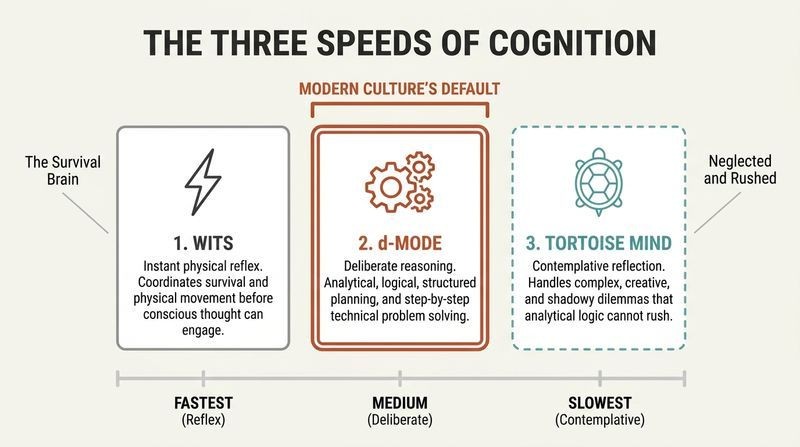
Claxton maps three processing speeds. The fastest is instant, physical reflex (he calls it your "wits"), like the body choreographing a motorcyclist's recovery from a skid before conscious thought catches up. The middle speed is deliberate reasoning: weighing options, building arguments, solving defined problems. Claxton labels this d-mode, where "d" stands for deliberation and, tellingly, for default. The third and slowest speed is contemplative, dreamy, ruminative.
Western culture has collapsed into d-mode. Just as roast potatoes burn if you crank the oven and mayonnaise curdles if you add oil too fast, some mental jobs cannot be rushed without breaking. Claxton argues we treat every human predicament as a technical problem to solve quickly, ignoring the leisurely tortoise mind that handles intricate, shadowy situations far better.
The framing anticipates Daniel Kahneman's later System 1 and System 2, but Claxton adds a crucial third register that Kahneman largely folds into System 1. What's striking is his cultural diagnosis: he ties the loss of slow thinking to "technopoly," Neil Postman's term for a worldview where efficiency and measurement crowd out judgment. The Ladakh example, where labor-saving tools paradoxically made villagers busier and shrank two-week weddings to a single day, echoes the economist Staffan Linder's "harried leisure class." One caveat: the boundary between reflex and deliberation is blurrier than three neat tiers suggest, and Claxton wisely warns this is not the tired left-brain, right-brain split.
For murky, ill-defined problems, patience outperforms cleverness

Match the tool to the problem. Claxton's central thesis is not that intuition beats reason, but that each fits different situations. D-mode excels when a problem is easily conceptualized: booking a holiday within a known budget, or proving the mutilated-chessboard puzzle is unsolvable by noticing the two removed corner squares share a color. But when you cannot even tell which questions to ask, such as managing a difficult team or deciding whether to change careers, forcing clarity backfires.
Confusion is the seedbed, not the enemy. Learning emerges from tolerating not-knowing rather than stamping it out. Claxton cites the Tao Te Ching: truth waits for eyes unclouded by longing. He warns that an intemperate need for certainty breeds vulnerability to dogma and demagoguery, while over-passivity breeds fatalism. Wisdom balances both.
This maps neatly onto the distinction between "tame" and "wicked" problems from design theory (Rittel and Webber): tame problems have clear stopping rules, wicked ones do not. Claxton's insight that certainty-craving fuels susceptibility to demagoguery finds support in psychology's research on "need for cognitive closure" (Kruglanski), which correlates with authoritarianism and stereotyping. The practical challenge he underplays is diagnostic: how does one know in advance whether a problem is tame or wicked? Often that judgment itself requires the slow mode. Still, the reframe is valuable, treating one's tolerance of ambiguity not as a personality quirk but as a trainable cognitive skill.
You can master complex patterns you could never put into words
Know-how precedes knowledge. Claxton calls this learning by osmosis: the brain-mind's ability to soak up subtle regularities without conscious understanding. In Berry and Broadbent's Oxford studies, people learned to control a simulated factory or sugar output by adjusting hidden variables. Their performance improved fast, but their ability to explain what they were doing lagged far behind, if it came at all. They often felt they were merely guessing while succeeding.
The undermind sees what consciousness cannot. In Pawel Lewicki's experiments, subjects got faster at locating a target digit that followed a fiendishly complex hidden sequence, yet nobody, not even psychology professors offered cash prizes, could articulate the pattern. Brazilian street children do complex mental arithmetic for their businesses despite failing school math tests. Practical intelligence shows almost no correlation with IQ.
This is the cognitive-unconscious literature that Arthur Reber championed under "implicit learning," and it dovetails with Michael Polanyi's dictum that we know more than we can tell. The street-children finding (Carraher, Nunes) launched the whole field of situated cognition, showing math ability is context-bound, not a portable general faculty. What's provocative is Claxton's implicit critique of formal schooling and standardized testing, which reward only the articulable fraction of competence. A tension worth noting: implicit knowledge is powerful but brittle, failing to transfer when surface features change. So osmosis and articulation are complements, not rivals, a nuance the takeaway's punchiness slightly flattens.
Overthinking a skill makes you choke; stop narrating your own moves
Premature articulation sabotages performance. When Claxton watched a twelve-year-old idly solve a Rubik's cube while chatting, turning faces with her teeth, he realized adults fail because they lurch into d-mode and try to figure it out. Some tasks are too complex for conscious logic. In R.S. Masters' golf study, players taught putting through explicit rules crumbled under pressure from an intimidating expert and cash stakes, while players who learned intuitively, minds occupied elsewhere, held steady.
Explanation can be negatively correlated with skill. In Wason's 2-4-6 experiment, students fixated on confirming an obvious rule (n, n+2, n+4) rather than testing it, and never discovered the real rule was simply "any ascending numbers." Articulating a wrong theory early then blinds you to the evidence. Coaching, Claxton says, is like making mayonnaise: add advice sparingly or the mind curdles.
The choking mechanism Claxton describes, reinvestment of conscious attention into automated skills, is now well documented in sports psychology (Beilock and Carr's work on "explicit monitoring"). The centipede paralyzed by being asked which leg moves first is the folk version. Wason's confirmation-seeking remains one of psychology's most replicated findings and underpins modern work on motivated reasoning. The actionable payoff is counterintuitive: under pressure, distract the analytical mind rather than engage it. This challenges the pervasive coaching assumption that verbalizing technique always helps. The scope limit: for novices learning genuinely rule-based material, explicit instruction still speeds early acquisition. Timing is everything.
Intuition is the undermind's educated guess, not a mystical oracle
Demystify the hunch. Claxton positions intuition between two errors: worshipping it as infallible angelic knowledge, or dismissing it as noise. Intuitions are good guesses, hunches the undermind throws up by quietly integrating past experience and present cues. They deserve serious but critical attention. Behind the scenes the mind finds an analogy that fits, which is why intuitions can be brilliantly right or, when the analogy misleads, confidently wrong.
Evidence the unconscious runs ahead of us. In Kenneth Bowers' accumulated-clues task, people's guesses converged on the hidden answer before they consciously knew it, a drift judges could detect but subjects could not. Shown degraded images, people guessed which was a real object better than chance even when they reported zero confidence. Nobel laureates repeatedly described insights arriving as images or a "guiding hand," never as logical chains.
Claxton's account aligns with Antonio Damasio's somatic marker hypothesis, where bodily signals bias decisions before conscious deliberation, and with Gary Klein's studies of firefighters and nurses whose expert intuition reads situations faster than they can justify. The crucial corrective he offers against pop-psychology intuition worship is calibration: intuition's reliability depends entirely on whether the underlying analogy fits, echoing Kahneman and Klein's joint verdict that intuition is trustworthy only in "high-validity environments" with repeated feedback. The Bowers convergence data is genuinely elegant evidence that partial, subthreshold solutions exist. The open question is how to distinguish a well-tuned expert hunch from a biased snap judgment in the moment.
Good ideas gestate on their own timetable; you host them, you don't build them
Creativity is pregnancy, not manufacture. Even the behaviorist B.F. Skinner compared "having" a poem to a mother bearing a child: she is a locus where genetic and environmental causes converge, not an engineer of the outcome. Ideas need a seed (curiosity piqued by an anomaly), a safe womb, and incubation time that cannot be rushed. Coleridge composed hundreds of lines of "Kubla Khan" in an opium doze.
Incubation works by letting fixation fade. In Steven Smith's studies, solving rebus puzzles improved 30% after a delay, whether or not people consciously worked during it, because wrong approaches died away. Threat, time pressure, and even large cash rewards shrink creativity: stressed subjects clung to an outdated water-jar solution and missed a simpler one. Too many carrots, like too much stick, poison insight.
The four-stage model Claxton invokes (preparation, incubation, illumination, verification) comes from Graham Wallas in 1926 and still frames creativity research. Modern work supports his mechanism: incubation benefits partly from "forgetting fixation" (Smith and Blankenship) and partly from spreading activation during mind-wandering (Baird and Schooler's default-mode-network studies). The reward-kills-creativity finding foreshadows Teresa Amabile's extensive research showing extrinsic incentives undermine intrinsic motivation and originality, and Sam Glucksberg's candle-problem experiments where cash prizes slowed insight. The practical lesson for knowledge workers and managers is uncomfortable in a deadline culture: protecting unstructured, low-pressure time is not indulgence but a precondition for the ideas organizations claim to want most.
You constantly perceive and act on information you never consciously see
The undermind stays in touch with the world. Claxton distinguishes awareness (picking up signals) from consciousness (what reaches the mind's eye). Driving twenty minutes absorbed in conversation, negotiating traffic flawlessly, proves how much intelligent action bypasses awareness. In Pittman and Bornstein's study, a job candidate's face flashed for four milliseconds (too brief to register) doubled the odds subjects picked that candidate, then confidently invented rational reasons for their choice.
Subliminal signals can override conscious control. In Patton's experiment, women with eating disorders ate twice as many biscuits after the message "Mummy is leaving me" was flashed subliminally, but not when it was shown long enough to see. When we know an influence is present we can guard against it; when it arrives pre-dissolved into perception, we simply trust it and confabulate a story.
The confabulation finding is one of psychology's most unsettling: Nisbett and Wilson's classic paper showed shoppers preferred the rightmost item in a row yet cited quality, never position. Claxton connects this to Michael Gazzaniga's split-brain "interpreter," the left hemisphere's relentless invention of plausible narratives for behavior it did not cause. The eating-disorder result should be read cautiously given the checkered replication history of subliminal-activation research, and Claxton is careful to note subliminal advertising is weaker than 1960s panic suggested. The durable insight is defensive: awareness of a bias is a partial inoculation against it, which is precisely why hidden manipulation, from priming to dark-pattern design, is potent.
Guessing beats trying when the signal is faint; self-consciousness jams the undermind
The two-threshold mind. Claxton proposes a lower threshold where the undermind activates and a higher one where information becomes conscious. Threat and self-scrutiny shove the conscious threshold up, gating out subtle knowledge. Tony Marcel found people detected faint flashes far better by blinking (automatic) than by saying "yes" (self-committing), and when told merely to guess rather than report accurately, accuracy leapt toward 100%.
The self is the bottleneck. In perceptual-defence studies, taboo words take longer to reach consciousness because they are recognized unconsciously first, then censored. Kunst-Wilson and Zajonc showed people who couldn't recognize shapes they'd seen could reliably say which they preferred. A blindsight patient, cortically blind, points accurately at lights he swears he cannot see, but only when it feels like a bizarre guessing game rather than genuine seeing.
This reframes performance anxiety as a cognitive gating problem, not mere nerves. The finding that lowering ego-investment ("just guess") unlocks capacity connects to flow research (Csikszentmihalyi), where self-consciousness dissolves, and to the "paradox of effort" in Zen archery and motor learning. Zajonc's mere-exposure and affective-primacy work ("preferences need no inferences") became foundational for dual-process affect research. Nicholas Humphrey's observation that monkeys use blindsight more readily than humans, because they lack an elaborate self-concept that finds ownerless percepts paradoxical, is a genuinely deep point about how selfhood can be cognitively costly. The takeaway for exams, auditions, and interviews: reduce the stakes framing internally to widen the attentional aperture.
Analyzing your preferences too hard makes you choose worse and regret it
Thinking can distort what you actually value. In Jonathan Schooler's jam study, people left alone ranked strawberry jams almost exactly as expert tasters did; those told to analyze their reasons diverged from the experts. Asked to pick an art poster, deliberators were significantly less satisfied weeks later than intuitive choosers. Analysis privileges whatever is easy to verbalize and downgrades non-verbal, sensory, and emotional factors that often carry the real weight.
Match reasoning to problem type. Schooler also found that thinking aloud never hurt performance on step-by-step analytical puzzles, but sharply damaged insight problems, where verbal chatter "causes a ruckus" in the front of the mind while the answer forms quietly in back. Describing a face halves later recognition accuracy, because words overshadow the holistic visual memory. Intuition generates; reason evaluates. Poincaré: we prove by logic, we discover by intuition.
Schooler's "verbal overshadowing" is a robust, preregistered-replicated effect, unusual for its era, and it reshaped how criminal-justice systems think about eyewitness lineups: asking witnesses to describe a face first can corrupt their recognition. Timothy Wilson extended the jam and poster work into his book Strangers to Ourselves, arguing introspection can construct rather than reveal preferences. The boundary condition matters: for choices dominated by a few quantifiable, verbalizable attributes (comparing mortgage rates), deliberation wins. Overshadowing bites when value is holistic and affective. This gives a usable heuristic: analyze spreadsheet decisions, sleep on aesthetic and relational ones. Claxton's balance, generate then evaluate, saves the argument from anti-rationalist overreach.
Slow seeing has four modes: detection, focusing, poetic sensibility, and mindfulness
Attention itself can be slowed and deepened. Claxton describes four contemplative ways of perceiving. Detection is the hunter's or diagnostician's patient reading of tiny clues; the Dalai Lama's physician diagnosed a heart defect purely by pulse, smell, and unhurried attention. Focusing, from psychotherapist Eugene Gendlin, means attending to a bodily felt sense, a vague physical shadow between throat and stomach that precedes words; clients who did this spontaneously made therapeutic progress.
The other two reset perception. Poetic sensibility is losing yourself in a sunset or a Beethoven quartet without grasping, which Keats called negative capability: remaining in uncertainty without irritable reaching after fact. Mindfulness is watching your own mind closely enough to catch smuggled-in assumptions. Teasdale's mindfulness training cut depressive relapse by letting people see gloomy thoughts as passing mental events, not truths, matching antidepressants without the side effects.
Claxton was writing in 1997, well before mindfulness became a wellness industry, and his framing is more rigorous than most of what followed. Teasdale, Segal, and Williams' mindfulness-based cognitive therapy is now a NICE-recommended relapse-prevention treatment, one of the field's strongest clinical validations. Gendlin's focusing has a smaller but real evidence base and prefigures modern interoception research linking bodily awareness to emotional regulation. The four-mode taxonomy is useful precisely because it resists collapsing all contemplative practice into "meditation." What's underexplored is how these modes interact or trade off; poetic absorption and vigilant clue-detection seem to demand opposite attentional postures, broad versus narrow, which the brain's arousal chemistry, as Claxton's neural chapters suggest, may toggle between.
Wisdom is good judgment in hard cases, and it needs the tortoise most
Wisdom reframes rather than picks sides. Claxton defines wisdom as good judgment in hard cases: situations too ambiguous, value-laden, and data-poor for d-mode. At A.S. Neill's Summerhill school, a boy faced harsh punishment for pestering two girls with towels until Neill quietly reframed it: the meeting had no right to interfere in a love affair, and the conflict dissolved into laughter. A besieged castle commander in 1334 threw his last ox stuffed with barley over the walls; the enemy, assuming endless provisions, gave up.
Wisdom sees through to shared human basics. The wise person is uncompromising about fundamental values but flexible and creative about means, holding "the big picture" while custom-building responses. It requires empathy without collusion, and the courage to wait, as therapist Robin Skynner did through a "winter" of feeling lost before intuitions formed.
Claxton's definition converges with the Berlin Wisdom Paradigm (Baltes and Staudinger), which operationalized wisdom as expert knowledge about the fundamental pragmatics of life, including tolerance of uncertainty and value relativism. The reframing move he prizes is the engine of narrative therapy and of principled negotiation (Fisher and Ury's "getting to yes" hinges on separating positions from underlying interests, exactly Neill's maneuver). Robert Kegan's point, quoted by Claxton, that holding knowledge as provisional requires "wrenching the self from its cultural surround," links wisdom to adult developmental stages. The bracing implication is that wisdom cannot be fast-tracked through information or cleverness; it demands the ambiguity-tolerance and slow rumination the whole book champions, which is why clever people so often act unwisely.
Analysis
Guy Claxton's 1997 book is a science-grounded polemic disguised as a gentle meditation. Its thesis, that a culture besotted with speed, articulation, and measurable output has amputated its own capacity for the slow, unconscious cognition underlying creativity and wisdom, was prescient. Written before the mindfulness boom, the replication crisis, and the default-mode-network revolution in neuroscience, it assembles cognitive science, poetry, and contemplative traditions into a single argument that has aged remarkably well.
The book's intellectual courage lies in refusing the easy dichotomies. Claxton is not an anti-rationalist; his repeated formula (intuition generates, reason evaluates) insists both are indispensable and that error lies in misapplication. This saves him from the romantic excess that sinks lesser "trust your gut" books. His concept of d-mode as a cultural default, not just a cognitive style, does real work: it explains why smart, well-informed institutions keep producing articulate incompetence and rain-dance strategic plans.
Where the book shows its age is empirical. Some pillars, particularly subliminal-activation studies like Patton's "Mummy is leaving me," belong to a literature since battered by failed replications. Claxton, to his credit, anticipates skepticism and leans on sturdier findings: Wason's confirmation bias, Schooler's verbal overshadowing, Berry and Broadbent's implicit learning, and Teasdale's mindfulness therapy have all held up or strengthened. His neural model of brainscape and wordscape is a plausible-hypothesis metaphor, not established fact, and he says so.
The deepest contribution is philosophical: relocating intelligence and identity into the "undermind," reversing Descartes' equation of self with conscious reason. Libet's free-will experiments, which Claxton deploys, still anchor that debate today. The practical stakes, education that builds resilience over articulateness, workplaces that protect unpressured time, remain largely unrealized, making the book less a period piece than an unfinished agenda.
Review Summary
Hare Brain, Tortoise Mind receives mostly positive reviews for its insights on intuitive thinking and the "undermind". Readers appreciate Claxton's scientific approach and connection to creativity, though some find the writing dense. Many praise its ideas on problem-solving, learning, and decision-making. Critics note it can be dry and overly academic at times. Overall, reviewers find it thought-provoking and valuable for understanding different modes of thinking, with particular relevance to education, business, and personal growth.
People Also Read







Glossary
d-mode
Deliberate conscious default thinkingClaxton's term for deliberate, conscious, purposeful reasoning: weighing options, building arguments, demanding clarity and justification. The "d" stands for both deliberation and default, because Western culture treats it as the only legitimate mode of thought. Excellent for well-defined, analyzable problems, but counterproductive for intricate, ambiguous, or emotionally rich predicaments that require slower ways of knowing.
the undermind
The intelligent unconsciousClaxton's coinage for the intelligent cognitive unconscious, distinct from the Freudian repository of repressed material. It detects subtle patterns, generates intuitions, perceives subliminal signals, and often runs ahead of conscious awareness. He deliberately avoids "the unconscious" at times to escape connotations of a wild or dangerous force, framing the undermind instead as a valuable, everyday resource.
learning by osmosis
Implicit pattern learning without wordsThe brain-mind's capacity to absorb subtle regularities from experience and improve performance without conscious comprehension or the ability to explain what has been learned. Demonstrated by factory-control simulations and Lewicki's hidden-pattern experiments, it is the most basic slow way of knowing, inherited from animals and active throughout life if left unimpeded by premature analysis.
felt sense / focusing
Attending to bodily pre-verbal meaningFocusing is Eugene Gendlin's technique of attending to a felt sense: a vague, unsegmented physical awareness located in the body's center, between throat and stomach, that precedes clear thoughts or emotions. Holding attention there patiently lets meaning form and shift, producing a bodily sense of release. Gendlin found this the active ingredient predicting success in psychotherapy.
negative capability
Staying in uncertainty without graspingKeats's phrase, adopted by Claxton, for the capacity to remain in uncertainties, mysteries, and doubts without any irritable reaching after fact and reason. It underpins poetic sensibility and creativity, requiring enough inner security to lose clarity and control without feeling one's identity threatened.
brainscape and wordscape
Neural landscape and its labelsClaxton's metaphor for brain organization. The brainscape is a landscape of experience-carved hollows where tightly bonded neuron clusters represent concepts. The wordscape is an overlaying layer of verbal labels (flags) that names some concepts. Because total neural activation is limited, activating words drains activation from the richer, feeling-laden non-verbal brainscape, explaining why heavy verbalizing can impoverish intuition and perception.
technopoly
Culture worshipping technical efficiencyNeil Postman's term, central to Claxton's cultural critique, for a society believing every problem has a technical solution, that efficiency and calculation trump human judgment, that what cannot be measured has no value, and that experts guided by data should direct affairs. It entrenches d-mode and marginalizes contemplation.
About the Author
Other books by Guy Claxton

Download PDF
Download EPUB
.epub digital book format is ideal for reading ebooks on phones, tablets, and e-readers.








