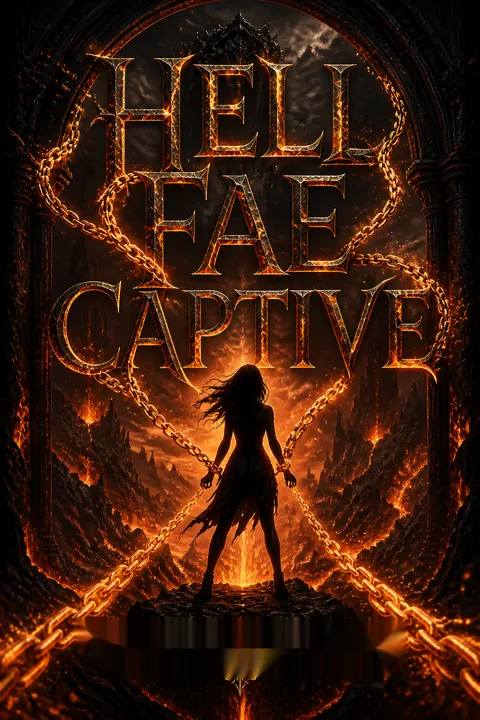


Plot Summary
Silver Against the Hounds
On her walk back from a campus party, Cami De la Croix, a Hell Fae and human Halfling trained by largely absent parents, faces another pack of Hellhounds sent to seize her. She drives a silver knife into one attacker and watches its blood smoke, a result unlike anything her pursuers expect.
Ajax, a powerful Midnight Fae Warden, arranged this last attempt after his other captors failed. He tells her the abductions are invitations to the Hell Fae bride trials, then traps her in dark magic and leaves her outside a hidden paradigm.
A coin marked with its entrance points her toward the gate. Cami studies the hostile landscape, finds the concealed passage, and crosses before its deadly boundary can claim her. Her resistance has brought her to Hell, not freed her.
Cami's first victory is tactical, not liberating: she survives by reading an attack faster than her captors expect, only to discover that competence makes her more valuable to the system pursuing her. Her parents' training has prepared her body for danger but not her consent for its use. Ajax's staged test establishes the Warden's divided position: he observes her as a captor, yet her ingenuity interests him. The coin turns survival into a threshold puzzle, introducing the story's recurring suspicion that apparent landscapes and straightforward choices conceal mechanisms designed by someone else.
The Contract Under Her Name
In the quarters Ajax assigns her, Cami finds her father's contract and learns that he traded her soul to settle the debts he owed Lucifer. The agreement bears her birthday, making her parents' bargain feel less like a sudden betrayal than the culmination of an upbringing built around weapons and self-reliance.
She searches for legal loopholes, but the ordinary rules reveal little. At the library, invisible figments bring her an ancient law book whose pages multiply as she reads.
She loses track of curfew, then accepts help from the beautiful stranger Melek when a Manticore attacks outside. He banishes the beast and returns her to her room. A cupcake marked as the Warden's gift then sends Cami into a thirty-six-hour sleep, leaving her unprepared for what comes next.
The contract gives Cami's captivity a precise cause: her father's freedom from spiritual debt has been purchased with her future. Her legal training becomes a form of resistance, but the library's living book refuses to behave like a stable code she can master. That tension matters: knowledge is available, yet its source and timing are controlled by others. Melek's rescue complicates the threat without dispelling it. He helps her survive, but neither explains his purpose nor earns her trust. The enchanted cupcake makes care indistinguishable from coercion, a pattern the novel repeatedly tests through gifts that offer real help while limiting Cami's choice.
The Prince Behind the Smile
When Cami wakes, a black dress and an escort bring her to the opening ceremony, where captives are displayed as numbered candidates before the Hell Fae audience. Melek stands beside Lucifer, revealing himself as the favored prince who had visited her room.
Lucifer's speech does more than persuade: his magic traps the women inside an invented sense of welcome and belonging. Cami recognizes that the scene is false and remembers the counterspell Melek had prompted her to use.
The star-shaped talisman he gave her helps her break free, while the rest of the field remains enchanted. Her defiance draws Lucifer's direct attention. Ajax hauls her away for punishment, and the charm is taken from her, leaving her isolated from the favors other candidates can solicit.
The ceremony transforms private coercion into spectacle. The candidates are not simply captured; they are made to experience captivity as consent, which exposes the political usefulness of enchantment. Cami's resistance depends on a contradiction: the prince's gift helps her reject the king's control, but using it gives the authorities grounds to punish her. Her public refusal also makes her legible as both a threat and an unusually promising candidate. The numbers, dress, and audience reduce women to objects for appraisal, while Cami's act of seeing through the illusion restores a measure of inward judgment, even as it worsens her external position.
The Siren's Near Song
Ajax takes Cami below the academy into detention, where Nightmare Fae once transformed for breaking Lucifer's deals now occupy guarded cages. He tests her nerve near a Siren tank; its song nearly draws her toward the creature, but Cami touches Melek's talisman and pulls herself away. Az, the Hell Fae Commander and a rare Black Phoenix, senses unusual enchantment in the pendant, so Ajax confiscates it for Lucifer.
Cami is then left in a cell whose luxurious furniture carries a spell meant to weaken its occupant. She rejects the sofas and sits on the worn rug instead. The choice frustrates Ajax and demonstrates that she is watching for hidden traps, not merely reacting to what looks comfortable.
The dungeon stages the difference between visible danger and attractive danger. Cami can identify bars and claws, but the velvet furniture and Siren song work by inviting her to surrender judgment. Her resistance is not simple fearlessness; she notices that pleasure can be engineered as a control mechanism. The confiscated talisman also marks a shift in the men around her. Az sees an unexplained quality in Cami that Ajax's official role cannot account for, while Ajax's disciplinary test begins to resemble an assessment of her potential. The cell's false comfort makes distrust a practical survival skill rather than a personality flaw.
Melek Binds Their Souls
Melek returns to Cami's cell with the law book and teaches her spells for shade, cooling, food, and improvised weapons, disguising instruction as reading. He then asks her to accept a vow of protection. Cami repeats the ancient words and seals the promise with a kiss on his cheek; the exchange creates a permanent spiritual bond, though she does not yet understand its full force.
Typhos, Lucifer's private name, feels the new connection and confronts Melek, his longtime mate. Furious that Melek tied his soul to a captive without consulting him, Typhos turns to his own magical book, which recalls his past Fall and Melek's loyalty through it. The memory persuades him to restrain his anger and trust Melek's decision, at least for now.
The vow makes protection reciprocal in a world where most relationships begin with ownership. Cami consents to the spoken promise, but the bond's permanence exceeds what she understands, preserving the novel's uncomfortable tension between choice and unequal knowledge. Melek acts from affection and strategy at once: he wants Cami alive, but the bond also gives him access to her spirit. Typhos's response reveals that his authority is tempered by dependence on Melek, whose loyalty has survived an earlier catastrophe. Trust here is not blind optimism; it is a choice grounded in shared history, made under pressure while the consequences remain uncertain.
Ajax Shares the Map
Before the first trial, Ajax finds Cami exhausted and gives her food, water, and a warning about the false lava crossing. He explains which creatures hunt in the Barren Lands, how Centaurs attack in packs, where poisonous plants and scarce water can be found, and why a Naga may disguise itself as someone trustworthy.
His help comes from an old wound: Cami's refusal to accept her fate recalls Emelyn, a rebel he could not save when Constantine Nacht's power froze him into helplessness. Ajax knows his attachment is dangerous, but he gives Cami practical knowledge anyway. Typhos opens a portal beneath every candidate and declares that no rules will protect them. Cami enters the trial carrying Ajax's advice and her own suspicion.
Ajax's briefing is the first time his authority serves Cami's survival rather than merely enforcing captivity. His warning is specific because his guilt is specific: Emelyn's death taught him to equate attachment with the risk of failing someone again. Helping Cami therefore exposes him to the very vulnerability he has tried to avoid. The trial's announcement of rulelessness sharpens that conflict. A system that withholds reliable rules rewards observation, but it also permits the powerful to shift the terms at will. Cami receives useful information, not safety; Ajax can prepare her for danger without changing who controls the arena.
The Lava Path Lies
The portal drops Cami into a scorched plain beneath two suns, where glowing supply stations tempt the candidates away from the marked route. She recognizes the mismatch between the promised gifts and the trial's design, then watches the stations dissolve into Centaurs.
The beasts attack after a gunshot, and Cami sees that their dark auras mark a different danger from the white-aura creatures that react only when provoked. When an armed clique led by Beatrix abandons less prepared women to the monsters, Cami steals a bomb and redirects the threat rather than leaving the vulnerable candidates to die.
She later finds an injured white-aura Centaur, removes the dagger with a spell, and follows his warning toward a lava pool. Remembering Ajax's caution, she tests the apparent hazard and jumps.
Cami's moral choice costs her the clean advantage of self-preservation. She acts against Beatrix's willingness to use weaker candidates as bait, then risks herself to help a wounded creature. Her interpretation of auras is still incomplete, but it gives her a provisional ethical map: response and intent matter more than a creature's frightening appearance. The lava pool becomes a threshold only because she tests the illusion rather than trusting the obvious path. This is the trial's central demand in miniature. Cami survives not by mastering every spell or defeating every enemy, but by revising her assumptions quickly enough to act.
The Minotaur's Maze
The lava portal sends Cami spinning into a maze of tunnels, where heat, thin air, and exhaustion nearly overwhelm her. She refuses to rely on Melek's spells, although they might ease the conditions, and navigates by listening, feeling the stones, and scenting the air at each crossing.
Minotaurs hunt through the passages, while false routes conceal the true exits. Cami corrects a wrong turn by noticing the food scent that marks the proper way through the final junction.
At the maze's end, a Minotaur in human form offers his hand and tastes her knuckles. He decides she is not a match for him, and a portal takes her away. Her return to the dungeon is abrupt, but she has survived both halves of the trial through attention rather than brute force.
The maze converts Cami's distrust into a cost as well as a defense. By refusing Melek's magic, she preserves independence but endures greater physical strain; her choice is understandable, not strategically free of consequence. Sensory attention replaces sight as the reliable guide, matching a story in which appearances repeatedly deceive. The Minotaur's tasting ritual also reframes the trial as a compatibility test rather than a simple execution, without erasing its lethal stakes. Cami's passage does not mean she has escaped the system or chosen a mate. It means she has learned enough of its hidden grammar to survive one more stage.
The Screen Goes Black
Watching the trial from his rooms, Ajax sees Cami's image vanish during the portals and concludes she has died. He breaks down under the weight of repeating the failure that haunts him from Emelyn's execution. During this vigil, his old friend Shade visits with a death stone from Shade's grandmother, Zen, and urges him not to confuse withdrawal with being healed.
Elsewhere, Typhos learns that Az cannot locate Cami's father, Pierre, deepening suspicion around the family bargain. Melek eventually tells Ajax that the dark screen marked a portal interval, not Cami's death, and that she is alive in her cell. The correction turns Ajax's grief into a second chance: Melek asks him to train Cami for the next trial, and Ajax agrees.
The black screen matters because Ajax reads incomplete information through the filter of his oldest trauma. The trial's technology does not cause his grief by itself; his certainty that loss is inevitable does. Shade's visit places friendship beside that isolation without forcing Ajax to accept comfort immediately. The missing father adds a separate uncertainty: Cami's origin and the bargain's full terms remain outside Typhos's reach. Melek's correction gives Ajax a chance to act differently, but it does not erase the past or guarantee success. His agreement is significant because he chooses responsibility again despite knowing how sharply loss can wound him.
A Bed Outside the Cell
Cami returns from the trial depleted, unable to rest comfortably on the dungeon rug. Melek brings a full meal and water, then makes a bargain: if she finishes them, he will arrange a proper bed and cooler air for the next three nights. While she eats, the living law book explains the courtship customs behind the Centaur and Minotaur tests, revealing that the ordeal measures compatibility as well as endurance.
Melek arranges for Cami to stay in Ajax's quarters, where Ajax gives her a bath, clothes, and breakfast. He admits that seeing her screen go dark made him believe she was dead, then offers to train her for the Netherworld trial. Cami accepts the help without abandoning her plan to escape.
Care becomes meaningful here because it is negotiated rather than disguised as a favor. Melek states the conditions of his offer, and Cami tests them before accepting, preserving a degree of agency inside captivity. The book's account of mating customs complicates her first assumption that every danger is designed solely for spectacle: the trials also sort candidates by affinity, though the coercive structure remains intact. Ajax's apology and practical kindness do not cancel his role in capturing her. Instead, they let Cami distinguish a person's actions from the system they serve, a distinction that may help her survive without requiring her to trust blindly.
The Phoenix Joins Them
While Ajax showers, Az arrives seeking the Warden as an outlet for the frustration of failing to track Pierre. He finds Cami instead, and his Black Phoenix instincts respond to her strength and arousal.
Ajax tries to protect her from Az's overwhelming power, but Cami chooses to remain and joins their sexual encounter. Ajax and Az turn their established, rough intimacy toward her, and Az's energy leaves Cami renewed rather than depleted. Afterward, Az warns her that Ajax may retreat emotionally, even if he will want her again.
Cami wakes beside Ajax and accepts that the encounter mattered to her, while still insisting that desire does not make her anyone's property. The intimacy deepens their entanglement but does not settle her future or the next trial.
This encounter makes the romance's consent problem visible rather than theoretical. Cami participates and expresses desire, yet Az's supernatural influence and the unequal power of captor and captive make uncomplicated consent impossible to assume. Ajax recognizes that danger and attempts to intervene, but his own desire pulls him back into the scene. The moment reveals how attraction can coexist with coercive conditions without resolving them. For Cami, pleasure offers relief from pain and a sense of chosen experience, but it is not equivalent to freedom. The men, meanwhile, use sex both to share intimacy and to regulate power, with Cami becoming the point where their private bond changes.
The Source Takes Her
After waking, Cami opens the law book and sees a history of Lucifer's Fall: Melek appears to betray him, Lucifer loses his wings, and the Hell Fae Source forms from the aftermath. The book's images become a vision, and Cami reaches toward the Source, drawing a tendril of its power into herself before realizing it is not hers.
The scene collapses; she wakes naked in her college dormitory, where ordinary objects feel strangely unfamiliar. Ajax and Az find her there, furious and demanding to know how she evaded Az's tracking for thirty days. Cami has no explanation for the missing time, the journey from Hell, or the power she touched. The novel ends before she can answer them, leaving her escape and her connection to the Source unresolved.
The book's historical vision turns Cami from observer into participant: she does not merely learn how Typhos's kingdom began, she touches the power that made it. Her instinct to withdraw when the Source darkens suggests that her perception can register a danger her conscious understanding cannot yet name. Waking in the familiar dormitory offers no stable return to normal life; the thirty-day absence makes home another unexplained threshold. The ending withholds the mechanism of her escape and the meaning of her contact with the Source, converting the book's repeated lesson about deceptive appearances into a literal rupture in Cami's world.
Analysis
Hell Fae Captive builds its danger from a precise contradiction: the trials are presented as a route to compatible mates, yet the candidates enter through contracts many did not choose and face lethal conditions designed by the men who benefit from them. That contradiction keeps the romance from sitting outside the plot's power structure. Food, shelter, magic, and sexual attention can all be genuine forms of care, but each arrives inside captivity, where the recipient must ask what the giver expects in return.
Cami's resistance is more than stubbornness. She treats rules as evidence, landscapes as puzzles, and other beings as individuals whose behavior may differ from their appearance. This habit lets her notice false supply points, read the Centaurs' auras, and find her way through the Minotaur maze. Her refusal to use Melek's spells, however, shows the cost of self-protection: independence can become dangerous when distrust blocks useful aid. The story does not resolve that tension by declaring trust inherently virtuous. It makes trust a choice that must be tested against conduct.
Ajax and Typhos mirror different responses to helplessness. Ajax withdraws to avoid repeating an earlier failure, then discovers that distance does not prevent grief. Typhos tries to make the world manageable through contracts and trials, while Melek answers uncertainty by creating bonds and playing long games. Their relationships suggest that control can preserve order without guaranteeing safety or consent. The final vision sharpens this problem: Cami touches the Source that underlies the realm, then wakes in a place that should be familiar but no longer feels secure. The book ends not with escape completed, but with the old question enlarged: who gets to define what Cami is, and what her power will mean?
Review Summary
Hell Fae Captive received mixed reviews, with an overall rating of 4.33/5. Readers praised the unique storyline, world-building, and character development. Many enjoyed the reverse harem elements and steamy scenes, particularly the MM content. However, some readers were disappointed by the lack of focus on the female lead's relationships. The book was noted for its cliffhanger ending and intense plot twists. Criticisms included unexpected MM content and a perceived mismatch between marketing and actual content. Despite divided opinions, most readers expressed excitement for the sequel.
Characters
Camillia De la Croix
Defiant Halfling captiveCami is a twenty-one-year-old Halfling, born to a Hell Fae father and a human mother. Her parents raised her with weapons, combat skills, and a blunt expectation that she would survive without their help. That upbringing makes her observant and difficult to intimidate, but it also leaves her with little reason to trust authority or accept care. She studies rules for loopholes, tests what others call impossible, and resists being treated as a prize. Her sharp humor helps her hold onto herself when fear or attraction threatens to overwhelm her. Cami's central struggle is not simply to stay alive, but to preserve the right to decide what survival means.
Ajax
Grieving Midnight WardenAjax is a powerful Midnight Fae who serves Lucifer as Warden of the captive realm and jailer of dangerous Nightmare Fae. A disciplined fighter with a dry, provocative manner, he prefers control and distance to emotional exposure. The memory of Emelyn, a woman he could not save, has shaped his belief that caring for others invites another failure. Cami disrupts that defense because her rebellious bearing recalls his past without being reducible to it. Ajax often expresses concern through practical acts, such as food, warnings, and training, even while insisting he has no personal stake. His conflict lies in choosing whether responsibility can be an act of connection rather than a path back to helplessness.
Melek
Strategic Virtuous princeMelek is Lucifer's extraordinarily beautiful prince and longtime partner, a being whose angelic appearance conceals a taste for bargains, provocation, and intricate games. He observes Cami with unusual interest and offers help in forms that are both useful and difficult to interpret. His knowledge of ancient magic and his ability to read the living law book make him a guide to the realm, but he rarely explains his full intentions. Melek's playfulness is not frivolity: it lets him test people while keeping his own vulnerability obscured. He is devoted to Typhos and willing to risk conflict with him, yet his instinct to protect Cami suggests that his curiosity may carry consequences he has not fully disclosed.
Typhos, called Lucifer
Deal-making Hell KingTyphos is the Hell Fae King whom Cami knows publicly as Lucifer. He governs through contracts, controls access to the Hell Fae Source, and designs the bride trials to find compatible mates for a population with few female members. He presents himself as a pragmatic ruler who must satisfy his subjects, but his decisions shape the lives and deaths of those who enter his realm. His bond with Melek is ancient and deeply intimate, making Melek's independent choices both a source of friction and a test of Typhos's trust. Beneath the king's command lies a history of betrayal and loss that informs his need to manage danger before it can reach the people he loves.
Azazel, called Az
Phoenix-born commanderAz is Typhos's Commander, a formidable fighter whose rare Black Phoenix and Paradox Fae heritage gives him unusual power. He is direct, serious, and comfortable with danger, often using combat and sexual intensity as ways to channel force that might otherwise overwhelm him. His close bond with Typhos and his physical relationship with Ajax place him inside the realm's most consequential loyalties. Az's Phoenix is selective, responding strongly to strength and vitality rather than simple beauty. He is a relentless tracker and enforcer, though his certainty about his own instincts can make him dangerous to those who do not fit neatly into his expectations.
Feyre of the House of Iron
Knife-wielding rivalFeyre is a silver-haired candidate with pointed ears, dark eyes, and the ability to produce blades through magic. She tests Cami with a thrown knife but also recognizes her reflexes and potential. Feyre carries herself as someone who understands that apparent weakness can be fatal, and she moves among the candidates with guarded confidence. Her actions suggest a complicated position within the competition: she can be threatening without being simply cruel, and she does not readily offer allegiance.
Jade
Generous, vulnerable candidateJade is a sweet-natured candidate whose beauty attracts attention and gifts from potential suitors. She is trusting enough to lend her protective talisman to Beatrix, even when the arrangement makes her vulnerable. Her softness is not stupidity, but it leaves her exposed in a contest where other women treat supplies and alliances as leverage. Cami notices Jade's predicament and feels the pull to intervene, making Jade an early test of Cami's instinct to protect others.
Beatrix
Calculating candidate leaderBeatrix leads an armed group of well-prepared candidates and treats the trial as a contest of resources and tactical advantage. She pressures Jade to lend her a talisman and uses less-equipped women to draw danger away from her own group. Her choices expose the cruelty that survival games can reward: Beatrix is not merely confident, she is prepared to make other captives bear the risk. She provides Cami with a sharp contrast between strategic competence and moral restraint.
Shade
Concerned former friendShade is one of Ajax's oldest friends, now living a very different life with a mate and child. He understands Ajax's instinct to retreat from grief and visits despite their distance. His delivery of Zen's death stone comes wrapped in cryptic advice, but his concern is straightforward: Ajax should not mistake isolation for recovery. Shade gives the story a view of the life Ajax might have maintained if he had not withdrawn into the Warden's role.
Zenaida, called Zen
Paradigm-making seerZen created the hidden paradigm that now houses the Hell Fae trials. A powerful seer with Midnight Fae and Fortune Fae heritage, she once designed the realm as a refuge for persecuted Quandary Bloods. Her agreement with Lucifer allows the kingdom to serve a new purpose, though her gifts and riddles imply that she sees more than she says. Zen is connected to Ajax through Shade and offers him care indirectly, respecting his distance while refusing to assume it means he needs no one.
Pierre De la Croix
Debt-bound absent fatherPierre is Cami's Hell Fae father, a mixed-heritage fae who has relied on Lucifer's protection and power. He trained Cami to fight and survive, but his lessons did not prepare her for the fact that he would bargain with her life. His choice to offer her in settlement of his spiritual debts defines Cami's deepest betrayal. The contrast between his practical instruction and his willingness to use her as payment makes his idea of parenting feel more like preparation for a crisis than care.
Cami's mother
Human co-signerCami's unnamed human mother shares responsibility for the bargain that places Cami in Lucifer's realm. Her history of abuse and her relationship with Pierre help explain the guarded, survival-focused household Cami grew up in, but she remains absent when Cami needs answers. That absence leaves Cami to interpret her parents' choices without hearing their reasons.
Emelyn
Rebel from Ajax's pastEmelyn was a courageous woman in Ajax's past whose defiance of Midnight Fae prejudice left a lasting mark on him. Her story is tied to the persecution of Quandary Bloods and to the moment Ajax learned how helpless he could be against overwhelming power. For him, she represents both principled resistance and the cost of standing beside someone in danger.
Constantine Nacht
Persecuting Midnight rulerConstantine Nacht was a former Midnight Fae ruler who condemned mixed and powerful bloodlines as abominations. His persecution of Quandary Bloods and control over the people around Ajax shaped the grief and guilt that still govern the Warden's choices. He represents political cruelty disguised as the defense of order.
Sir Bachen
Gambling gargoyle escortSir Bachen is a blunt gargoyle who escorts Cami to the opening ceremony and later helps her in the dungeon by warning her away from enchanted furniture. His small size disguises a stubborn confidence, and his gambling with Ajax and Az gives him a comic independence from the realm's hierarchy.
Plot Devices
Lucifer's soul contracts
Turn debt into captivityLucifer's bargains bind fae through spiritual debts, protection, and power rather than ordinary money. Cami's father uses her as the price of his release from what he owes, so the contract supplies the inciting cause of the story and makes her captivity legal within Hell's order. The trials then extend the bargain into a selection process for mates. Contracts provide the king with a language of consent, but the women affected may never have chosen the terms themselves. Cami's legal instincts drive her to search for loopholes, while the missing details about her father's location keep the agreement's consequences unresolved.
The hidden paradigm
Prison disguised as academyZen's paradigm is a concealed magical world built inside the Hell Fae realm, modeled on a Midnight Fae academy and repurposed as a prison and training ground. Its architecture expands beyond what the exterior suggests, and its courtyards, plants, birds, and gargoyles can become lethal. Curfews and doors control movement, while portals connect the academy to trial landscapes and hidden realms. The paradigm makes confinement feel like a navigable campus, tempting Cami to trust familiar structures. Its shifting geography reinforces the need to test appearances rather than assume a path is safe.
The living law book
Reveal only needed knowledgeThe ancient book responds to magic and to the needs of its reader, translating some material, creating additional pages, and selecting subjects without an ordinary table of contents. It can show laws, magical practices, Nightmare Fae customs, and the history of the Hell Fae Source. Cami can read it despite the book's connection to Typhos, making her ability itself a mystery. The book is not a neutral manual: what it reveals arrives at moments that can redirect attention or expose a truth before Cami is ready to understand it. Its final vision leaves her with knowledge and danger rather than a clear explanation.
Talisman and soul vow
Protection with a priceMelek's star-shaped talisman amplifies Cami's ability to resist Lucifer's enchantment, but using it draws scrutiny and costs her access to the charm. Melek later offers a different form of protection, a vow sealed through ancient words and a kiss. The vow links their souls, creating a lasting connection that neither can treat as a casual gift. Together, the objects and promises distinguish material assistance from magical obligation. Cami wants help without surrendering agency, while Melek sees intimacy and protection as strategic tools as well as expressions of attachment.
Mirages and aura-sight
Separate danger from appearanceThe trials use mirages to disguise supply stations, false exits, and even scenes of violence. Cami sometimes perceives auras that help her distinguish between hostile Nightmare Fae and creatures that react only when threatened. The ability is not a complete answer: she misreads situations and must test her judgments against what creatures actually do. This device turns perception into an ethical skill. Cami's success depends on questioning what she sees, noticing intention, and revising her interpretation before fear or desire makes the decision for her.
Hell Fae Series




About the Author




Download PDF
Download EPUB
.epub digital book format is ideal for reading ebooks on phones, tablets, and e-readers.








