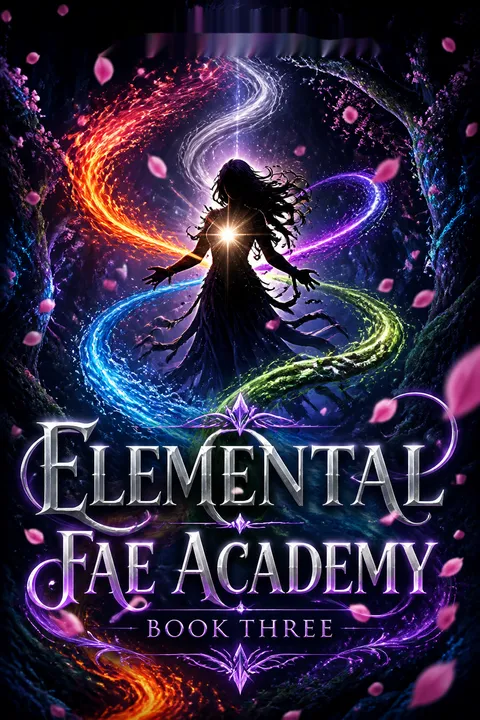


Plot Summary
Prologue
Exos brings Claire Summers, a Halfling able to wield all five elements, the truth she feared: her mother, Ophelia, is alive. He and Cyrus suspect Ophelia used Mortus as a puppet and may be behind the illnesses weakening the Earth Fae.
The news unsettles Claire, who believed her mother dead and has already lost too much to her schemes. Exos must return to the Spirit Kingdom to claim his crown, and Claire chooses to go with him, both to make their bond permanent and to face the family history that has begun to threaten every fae kingdom.
The opening makes intimacy and political danger inseparable. Claire’s mother is not merely a private wound: her survival may explain a spreading crisis that threatens whole peoples. Claire’s decision to accompany Exos therefore tests whether love can become a deliberate form of courage, rather than an escape from danger. The prologue also establishes the story’s central uncertainty: Claire must decide whom to trust before she knows what her mother has done, or who may be using her name. Her resolve is personal, but its consequences will reach far beyond her relationships.
Vows Behind Closed Doors
On the morning of the coronation, Exos chooses a private bedroom ceremony instead of a public altar. Cyrus guides the vows while Exos binds Claire’s spirit to his, making their connection permanent after months of separation and the danger of losing him. The ceremony completes Claire’s bond with the Spirit element, but it does not exclude her other mates.
Vox, Titus, and Sol sense the change through their shared connections and accept it. For Claire, the vows are not a retreat from the threat posed by her mother. They are a promise that she will face it with Exos beside her, and that their bond will not be easily broken again.
The private ceremony turns a royal rite into a choice made on intimate terms. Exos does not ask Claire to perform for a depleted kingdom; he makes their bond the center of the day, then leaves public recognition to the coronation. Claire’s immediate consent is shaped by remembered loss, but it is not simply fear of separation. She has come to understand that commitment can give her strength without reducing her independence. The other mates’ acceptance matters too: the bond is not framed as possession that displaces the group, but as one connection added to a larger, unusual structure of care.
The Spirit Crown
At the Spirit Kingdom’s town square, Cyrus leads the ceremony that passes the shared Spirit source to Exos, the rightful heir who had once refused the crown so his brother could rule. The transfer is brief, but its force fills the square and strengthens Exos’s connection to the element. Claire feels that power through their new bond, gaining access to the source alongside him.
The surviving Spirit Fae celebrate with a feast, a rare gathering in a kingdom still scarred by the deaths of most of its people. Claire sees how much the community needs more than a ruler: it needs reasons to gather and imagine a future. As the feast ends, she senses her mother reaching toward her, but cannot yet understand the message.
The coronation is both a transfer of authority and a measure of what has been lost. A ceremony that might ordinarily display abundance instead gathers a small population whose survival makes celebration politically meaningful. Exos’s delayed acceptance of the crown shows that duty can be deferred for love or family, but not indefinitely. Claire’s access to the source expands her influence while binding that influence to another person’s responsibility. The faint, confusing impression of Ophelia at the feast complicates the celebration: even at a moment of communal renewal, the past is trying to make contact.
A Lesson in Death
Back at the Academy, Claire resumes training with Elana, the Chancellor who has mentored her in Spirit magic. Elana demonstrates what she calls the other side of Claire’s element by conjuring an old, dead fae through a bowl of mist. The spirit cannot speak clearly, and Claire senses its distress rather than treating it as a magical tool.
When she asks whether it is in pain, Elana ends the summoning and insists that spirits merely imitate life. Claire agrees outwardly, but the lesson leaves her uneasy. She also notices Elana using water despite being understood to possess only Spirit magic. Claire cannot explain the contradiction, and an invisible pressure even prevents her from asking Elana directly whether the Academy is in danger.
The lesson establishes a moral distinction between power and permission. Elana teaches Claire to regard a summoned spirit as an instrument, while Claire’s instinct is to attend to the being’s suffering. That difference is not merely a dispute over technique; it foreshadows the ethical danger of treating lives as resources. Claire’s inability to voice her suspicions compounds the lesson’s unease. She is technically powerful but still positioned as a student before an authority figure, so uncertainty becomes difficult to test. The unexplained water magic is a concrete inconsistency, but Claire lacks the knowledge and confidence to interpret it.
The Peach Grove
While Claire is troubled by her lesson, Sol takes her to a secluded grove he has grown for her between the Spirit and Earth Quads. Peach trees, flowers, and a World Tree make the place a refuge from the Academy’s upheavals. Sol admits that his power can reach a royal source, but he has been afraid to use it because of the destruction caused by a relative who once abused similar access.
Claire does not demand that he prove himself; she tells him he should not mistake fear for control. She also confides that she senses her mother nearby, though Sol cannot find her with his own magic. Their quiet intimacy gives Claire comfort, but neither can dismiss the sense that Ophelia is trying to reach her.
Sol’s grove turns his affection into a physical act of cultivation. He offers Claire a place where life is deliberately protected, unlike the wounded lands that surround them. His fear of inherited power echoes Claire’s own struggle to master abilities she did not choose, allowing the two to recognize control as more than restraint. Claire’s confidence in him does not erase his caution; it makes room for him to reconsider what that caution costs. The grove also gives the story a counter-image to the Spirit Kingdom’s devastation: restoration can begin privately, through attention and care, before it becomes a public project.
The Ball's Empty Corridor
At the Solstice Ball, Claire attends with Sol and Vox, whose uncertainty about his growing air power shadows an otherwise welcoming evening. When Claire leaves the ballroom alone, she follows a voice into a garden scented with flowers from her childhood. Ophelia appears in a ghostly form and warns her not to trust Elana, but vanishes before she can explain.
Claire’s mates find her shaken on the ground. Back in their dorm, she describes the warning and recalls how Elana made her summon a suffering spirit. Cyrus admits he has distrusted the Chancellor for years, and Exos confirms that Elana’s unexplained use of water has also troubled him. The group agrees to investigate and to make it easier for Ophelia to contact Claire again.
The ball moves Claire from public acceptance to private alarm. The fae community’s growing welcome offers a glimpse of belonging, but the garden recalls her human childhood and becomes the setting for a warning that unsettles that welcome. Ophelia’s message is incomplete, so it creates suspicion rather than certainty. The important shift is social: Claire’s mates compare what each has noticed instead of asking her to dismiss her instincts. Cyrus’s longstanding mistrust and Exos’s observation of Elana’s water magic turn scattered anomalies into a shared question. The group’s decision to listen to Ophelia marks the beginning of an investigation, not yet a verdict.
Vox Breaks the Windlock
Vox brings Claire to his family’s Air Kingdom home, where his father, Notus, objects to her being a Halfling and to Vox’s circle of mates. His grandfather Malichi is kinder, but the family’s obsession with recovering its standing makes the visit painful. Vox explains that Malichi once lost control after receiving access to the air source, a disaster that left the family disgraced.
When Notus threatens to have Claire removed, Vox finally stops suppressing his own power. He unleashes enough wind to wreck the room and refuses to let his parents dictate whom he loves. Then, at a sacred site above the kingdom, he and Claire complete their bond amid the source’s winds. The bond quiets his power and gives him a future chosen by himself.
Vox’s conflict is not simply rebellion against a cruel parent. He has built his identity around restraint because his family’s history makes power seem synonymous with catastrophe. Notus reinforces that fear by treating Claire as a threat to status, while Malichi’s presence offers a living reminder that inherited shame need not determine every choice. Vox’s release of the wind is dangerous, but it is also an act of self-authorship: he stops confusing obedience with control. The bond with Claire does not cure his anxiety by magic alone. It gives him a relationship in which his power can be acknowledged rather than hidden.
Sol's Buried Fear
While Claire is away, Sol’s fear for her grows into an uncontrolled outburst at the Academy. He lashes out during a fight with Titus, who refuses to let him hide behind anger. Sol finally explains that his mother and sister died after a Spirit Fae damaged their souls, leaving him with scars he cannot see and memories he cannot fully reach.
He survived the same years of illness without understanding why, and he fears Claire’s Spirit training could repeat the harm. Titus helps repair the staff Sol breaks, and Vox backs the others’ trust in Claire, but Sol’s distress remains unresolved. His fear is not dislike of Claire; it is the reflex of someone who has learned that an unseen force can destroy a family without explanation.
Sol’s outburst reveals how trauma can distort a person’s reading of present danger. He sees the possibility of Spirit magic harming Claire and responds as though the harm is already occurring, because his own history offers no clear account to correct that expectation. His missing memories make the fear harder to challenge: he cannot identify the attacker or distinguish what he knows from what he imagines. Titus’s broken staff becomes a small but consequential object, first damaged in anger and then repaired through shared elemental effort. The scene does not resolve Sol’s distrust; it makes its cost visible to the people who want to help him.
The Source Takes Claire
Exos and Cyrus guide Claire into the spirit plane to find Ophelia, explaining that Spirit Fae can perceive the souls and elemental sources beneath ordinary life. They show Claire how the bonds of her five mates appear there, and how a powerful Spirit Fae might reach another soul.
When Exos breaks the restraints holding Ophelia, Claire is swept into the elemental core itself. She finds her mother there, terrified and warning her to flee from an unnamed woman.
Claire returns to her body only after remaining breathless for ten minutes, leaving Exos and Cyrus convinced they nearly lost her. The encounter proves that Ophelia is trying to communicate, but it also demonstrates that Claire’s growing access to the sources can carry her into danger she cannot yet control.
This episode makes knowledge physically hazardous. Claire’s lesson gives her a clearer understanding of Spirit power, but the source is not a neutral classroom; its pull overwhelms her and briefly separates her from her body. Exos and Cyrus can guide her toward it, yet even their expertise cannot guarantee a safe return. Ophelia’s warning adds urgency without supplying a usable explanation, so Claire gains both insight and uncertainty. The scene also complicates the idea that power is simply a gift: access can connect Claire to others, but it can also place her beyond the reach of the people who love her.
The Midnight Fae's Warning
Cyrus arranges a meeting with Kols, a Midnight Fae prince, hoping to identify the magic Elana used on the dead spirit. Fortune Fae Gina briefly appears at the nightclub and cryptically tells Claire that the fae’s balance depends on removing a dark presence.
Kols then explains that the silent, suffering spirit Claire encountered points to necromancy, a form of dark magic requiring an affinity his kind associates with Midnight Fae. He says such mixed bloodlines are forbidden because they can upset the balance between supernatural powers.
Cyrus and Exos connect that explanation to Elana’s secret use of water and to Ophelia’s warning that someone part Dark Fae is using her. Kols offers them a forbidden text so they can learn how to recognize and resist the magic.
Kols’s explanation gives the group a framework, not proof. His account of forbidden bloodlines helps explain why Elana might hide an affinity, but it also reveals how fear of difference is maintained through political rules. Gina’s prophecy-like warning adds a second, more oblique source of information, leaving Claire to navigate between evidence and prediction. The dark-magic text becomes a practical response to their uncertainty: rather than relying only on suspicion, the group seeks knowledge that might protect them. This turning point expands the conflict beyond one Academy mentor, showing that the rules governing supernatural communities can themselves create the secrecy and resentment that make danger harder to detect.
The Plague's True Hand
Back at the Academy, Earth Fae begin collapsing with the same wasting sickness that devastated the Spirit Fae. Aflora, Sol’s closest family, lies unconscious among them, and Claire follows her bond to the source of the attack.
She reaches the spirit plane and finds Ophelia imprisoned beneath Elana’s home. Ophelia reveals that Elana has been draining the Earth Fae and trapping the dead, while falsely blaming her for the plague. Elana attacks, and Claire’s struggle to protect her mother and the captive souls brings down the house.
Her mates dig through the ruins and free both women; Cyrus and Exos stabilize Ophelia, while the sick Earth Fae begin to recover. Elana escapes the collapse, but the supposed plague is exposed as deliberate theft of life and power.
The revelation changes the meaning of the sickness from natural disaster to organized violence. Ophelia’s testimony reverses the accusation that has defined her absence, while Aflora’s collapse gives the threat an intimate cost for Sol. Claire’s discovery does not arrive through official investigation or a reliable authority; it comes through the very spirit power Elana has taught her to use. Yet the resulting confrontation is chaotic, and the house’s collapse leaves the rescuers with partial answers and an escaped enemy. The section exposes how public narratives can be engineered: a captor can make the victim appear responsible by controlling both the evidence and the story told about it.
Fire Seals a Promise
After the rescue, Mortus cannot remember the two decades Elana controlled him, and Ophelia is too damaged to explain what she knows. Exos studies Kols’s books and discovers that Elana has been feeding the death fields with the souls she steals.
He blocks her access, making himself a likely target. With the Academy preparing for another attack, Cyrus argues that Claire needs the strength of all five elements. Titus and Claire complete their bond in the Fire Fae’s room, with Exos leading the vows.
Titus’s element strengthens Claire, and their union gives her a firmer hold over fire. Yet Claire and Sol’s own bond remains unsettled: he wants to ask her properly, while she is still preoccupied by her mother’s condition and the threat approaching them.
The aftermath makes preparation feel morally complicated. Claire’s power can grow through intimacy, but the people around her risk turning that intimacy into a tactical requirement. Titus’s bond is freely wanted and emotionally meaningful, yet it occurs under pressure from an impending assault. Sol’s hesitation introduces another necessary distinction: love does not require abandoning a person’s preferred timing. Exos’s decision to block the death fields is similarly double-edged. It limits Elana’s access to stolen souls, but it also makes him a target. The group is trying to protect others while repeatedly making choices that increase its own exposure.
Sol Opens His Wound
Sol’s mistrust erupts when he accuses Cyrus and the Spirit Fae of being capable of the harm that scarred him. Claire is devastated that he could imagine her using her power against him. Sol chooses to show her his damaged spirit instead of offering an apology alone.
Claire enters his soul and eases the pain without trying to erase it; he accepts that her touch feels safe, even though his fear of Spirit magic remains. They agree to complete their bond, and Sol prepares the peach grove for their ceremony.
Before it can happen, Ophelia wakes in terror, and the group learns that Elana’s attack is imminent. Exos admits he has made himself bait by sealing the death fields. Claire postpones the vows so Sol’s bond will not be overshadowed by the coming danger.
Sol’s repair begins when he risks being witnessed rather than demanding that Claire reassure him from a distance. Claire’s response respects the difference between soothing pain and erasing history; she can offer comfort, but she cannot make his past disappear. Their agreement to mate is therefore grounded in trust, not in a sudden cure. The postponed ceremony also resists the idea that greater power always justifies immediate action. Claire and Sol recognize that a meaningful promise needs room to be chosen freely. Meanwhile, Ophelia’s awakening and Exos’s admission pull private healing back into the public crisis, forcing the couple to defer their future without abandoning it.
The Academy's Dead Army
Claire wakes from a nightmare warning that Elana is coming with the dead, and the Academy’s defenders take their positions. Elana attacks from several directions with animated corpses and illusions.
Claire sees Ophelia apparently dying and leaves her post, only to realize the vision is false after she has killed the fae guarding her mother. She then finds Exos unconscious and reaches Elana’s hidden chamber through tunnels Mortus remembers. Below ground, Claire defeats Elana by entering her thoughts, drawing on the elemental core, and combining the elements she commands.
She destroys Elana’s body and releases the trapped souls from the death fields, allowing them to pass on. The attack ends, but the dead guards and the cost of Claire’s choices remain part of the victory.
The climax tests Claire’s greatest strength, empathy, by turning it into a weapon against her judgment. Elana’s false image of Ophelia exploits the bond Claire cannot bear to ignore, drawing her away from the planned defense and causing real deaths. Claire’s victory therefore cannot be reduced to a clean triumph of power. She must recognize the illusion, choose where her presence matters most, and face the harm done while she was deceived. The final use of all her elements is effective because the story has established her bonds and training beforehand. By freeing the trapped dead, Claire defeats not just Elana’s body but the system of captivity that sustained her magic.
The Memory Beneath Earth
After Elana’s defeat, Claire and Sol finally complete their bond beneath the World Tree. The union opens the memory Sol could never recover: as a child, he defended Aflora from Elana, and the Earth source scarred his spirit to shield him from her dark magic. The source also sealed his memory until he was ready to face it.
Claire experiences the event through Sol’s eyes, and he wakes with the truth and renewed access to his power. Together, the mates help restore the damaged Academy. The new Council asks Exos to lead it, appoints Claire as an adviser to the elemental sources, and offers teaching roles to Sol, Vox, and Titus. Claire chooses to remain where her whole mate-circle can stay together, while Ophelia and Mortus remain to recover.
Sol’s recovered memory gives his trauma a cause, but it does not turn suffering into a neat lesson. The source protected him and Aflora, yet its protection came at the cost of his understanding and left him to live with unexplained grief. Claire’s presence lets him revisit the memory without being alone inside it. That change parallels the wider restoration: the Academy is rebuilt through shared labor, and authority is reorganized around service rather than inherited prestige alone. Claire’s decision to remain with her mates is also a choice about belonging. She does not return to a single home or role; she helps shape a community that can hold her many ties.
Epilogue
Cyrus’s coronation makes official what his bond with Claire has already made personal: he becomes Water King, and Claire stands beside him as queen. After the formal celebration, Cyrus brings her to his quarters, where the other four mates join them.
Their private celebration emphasizes the shape of the life they have built: no single bond erases the others, and the five men share their attention with Claire on her own terms. The story closes with the circle together, while the Academy’s rebuilding and the restored flow of Spirit Fae life point toward a future beyond survival.
The epilogue offers a romantic resolution without narrowing the story’s expanded political world. Cyrus’s crown settles one question of succession, but Claire’s place beside him matters because it is chosen within a circle that already includes other royal and elemental ties. The private celebration recasts authority as generosity: Cyrus’s first act as king is to share joy rather than claim exclusive possession. This ending also returns to the series’ intimate mode after the public scale of the battle and Council decisions. The group’s union is not an escape from responsibility; it is the source of the mutual support that makes those responsibilities bearable.
Analysis
The novel links intimacy to political power, but it does not treat that link as automatically liberating. Claire’s bonds strengthen her command of the elements, yet they also make her vulnerable to separation, fear, and the expectations of royal duty. The central ethical question is therefore not whether power should be used, but whether it can be exercised without turning other people into instruments. Elana’s methods answer that question negatively: she treats souls as fuel, controls people through hidden magic, and hides exploitation behind a language of unity. Claire’s resistance begins with a different habit, noticing suffering even when a mentor calls it irrelevant.
The plot’s repeated contrasts between cultivation and extraction sharpen this conflict. Sol grows a peach grove; Elana drains whole communities. Claire and her mates repair what has been damaged by combining their abilities, while Elana builds strength by isolating victims and trapping the dead. These images make the story’s account of leadership unusually material. A ruler is not defined only by access to a source or a crown, but by what happens to the lives around them.
The romances also model competing forms of care. Exos’s protection can become unilateral strategy, Cyrus’s bluntness can feel like command, and Sol’s fear can make him distrust the very people who love him. Their bonds deepen when they risk honesty and allow Claire to choose, rather than treating devotion as a substitute for consent. Sol’s recovered memory is especially significant because healing does not erase his history; it changes what he can know about it and who can accompany him through it.
Finally, the resolution rejects the idea that one extraordinary person should govern alone. Claire’s unusual power matters, but the surviving Academy, the rebuilt community, and the shared work of her mate-circle make recovery possible. The book’s hopeful claim is not that love prevents catastrophe. It is that relationships built on care, accountability, and chosen responsibility can make power answerable to life.
Review Summary
People Also Read


Characters
Claire Summers
Five-element queenClaire is a human-raised Halfling whose unusual access to all five elements makes her a student, political concern, and potential bridge among fae communities. Her instinct is to protect the vulnerable, even when her curiosity or compassion carries her toward danger. She is not naturally cautious, but she learns that courage needs judgment and that asking for help does not diminish her agency. Her relationships with Exos, Cyrus, Vox, Titus, and Sol form a plural bond rather than a contest for exclusive affection. Claire is also shaped by grief over her friend Rick and by uncertainty about her absent mother. She grows into leadership by treating power as a responsibility to living beings, not a license to command them.
Exos
Spirit king and mateExos is a Spirit Fae royal, Cyrus’s brother, and one of Claire’s most protective mates. He has the patience of a teacher and the strategic instincts of a ruler, but his composure can conceal how much he fears losing Claire. For years he delayed claiming his throne, partly to support Cyrus and partly because kingship would demand a different life. His connection to Spirit gives him deep knowledge of souls and the source, making him an essential guide for Claire. Exos values duty, yet his choices show that duty is not always the same as public ceremony. He wants Claire beside him as a partner, not merely a symbol, and must learn to share risks rather than make every protective decision alone.
Cyrus
Water prince, future kingCyrus is a Water Fae royal, Exos’s brother, and Claire’s first established royal mate. He is confident, sharp-tongued, and comfortable using humor to hide how seriously he takes responsibility. His experience as a ruler gives him political knowledge and an instinct for strategy, though his bluntness can leave others feeling managed rather than heard. He often pushes Claire to confront danger and understands the unusual stakes of her bonds, but he also shows tenderness through practical protection and steady presence. His relationship with Exos combines rivalry, affection, and long familiarity. Cyrus’s unresolved succession places him between the life he has chosen and the duties waiting in his own kingdom.
Vox
Guarded air heirVox is a lean, observant Air Fae whose reserve masks strong feeling. He is often the practical voice in Claire’s circle, quick to assess risks and reluctant to ask others to manage his problems. His family history has taught him to fear uncontrolled power, so he relies on discipline even when it becomes a form of denial. Claire’s bond challenges that strategy by making his suppressed abilities harder to ignore. Vox is devoted to her, but he also values fairness and the right to choose one’s own life. His arc is driven by the tension between inherited shame and personal responsibility: he wants to prove he can wield strength without repeating the mistakes that damaged his family.
Titus
Fire mentor and protectorTitus is a formidable Fire Fae fighter, Claire’s mate, and a source of direct, physical reassurance. He is bold, teasing, and quick to meet conflict head-on, but his bravado is matched by a strong instinct to protect the people he loves. He often serves as the emotional anchor of the group, grounding Claire when the other men’s royal concerns and strategic arguments become overwhelming. Titus respects strength and expects people to speak plainly, which makes him an effective sparring partner and an impatient one. His growing trust in the wider mate-circle lets him cooperate with rivals rather than treating every disagreement as a challenge. He brings warmth and humor to a story crowded with danger.
Sol
Earth royal in hidingSol is a massive Earth Fae whose quiet devotion is expressed through cultivation, shelter, and physical care. He is strong enough to move the ground, yet cautious about his own abilities and reluctant to let others see the hurt beneath his anger. His close bond with Aflora comes from shared family history, and his relationship with Claire gives him a chance to trust without hiding his fear. Sol’s temper can rise quickly when he believes someone is in danger, especially when Spirit magic is involved. Beneath that reaction is a need to understand painful experiences that remain obscure to him. He is not simply the group’s gentle giant; he is a guarded survivor learning to accept help and use power without shame.
Elana
Chancellor and mentorElana is the Academy’s Chancellor and Claire’s Spirit mentor, an experienced leader who presents herself as patient, humane, and committed to guiding younger fae. Her authority gives her unusual influence over students and the Council, while her age and knowledge make her difficult to read. She offers Claire training and speaks as though she understands what it means to be judged for one’s nature. That apparent sympathy complicates Claire’s early uncertainty about her. Elana represents the power a trusted teacher holds: she can shape what a student believes about magic, morality, and belonging. Her public role makes any unexplained behavior especially consequential.
Ophelia
Missing Spirit motherOphelia is Claire’s long-absent mother, whose disappearance has left Claire with questions about family, loss, and the history of the fae kingdoms. Her name is linked to painful events that Claire does not yet understand, making her presence in the story both intimate and politically charged. Claire wants answers from her, but also has to confront the possibility that maternal love and past harm may coexist. Ophelia’s importance lies in the emotional gap she leaves in Claire’s life as much as in the larger mystery surrounding her. She is a figure of unresolved family history, not simply a source of explanation.
Mortus
Displaced academy professorMortus is a stern Fire Fae professor and senior figure at the Academy. His manner is authoritative, and his position gives him influence over students and political affairs. He has a long history with the Spirit Fae and an association with Ophelia that remains difficult for others to interpret. The story presents him as someone whose identity is bound to institutional duty, but whose personal history may complicate the judgments people make about him. Mortus’s lost time and fractured sense of self give him a vulnerability that contrasts with his imposing public role.
Aflora
Earth heiress and friendAflora is a young Earth Fae royal and Sol’s closest surviving family. She is warm, socially generous, and skilled at making others feel welcome, including Claire, who often finds fae society difficult to navigate. Her royal position carries political weight, although she is more comfortable expressing herself through friendship and craft than through formal authority. Aflora’s connection to Sol is familial and deeply rooted in shared history. She helps Claire feel that the Academy can become a community rather than merely a place of tests and threats.
Kols
Midnight Fae princeKols is a powerful Midnight Fae royal who knows Cyrus and Exos through political and social encounters. He is self-assured, perceptive, and willing to bend the rules when he believes the situation warrants it. His knowledge of dark magic gives Claire’s circle a way to interpret phenomena that Elemental Fae training does not explain. Kols does not pretend to be an intimate friend, but he is a useful ally who can translate between supernatural traditions. His measured irreverence makes him comfortable challenging assumptions without becoming careless about the danger.
Gina
Fortune Fae seerGina is a Fortune Fae whose visions arrive in fragments and whose warnings often sound like riddles. She is socially bold, playful, and difficult to pin down, even when she offers information that may matter. Gina’s gift gives her access to possible futures, but it does not make her explanations straightforward or her own path easy to control.
Notus
Vox's disapproving fatherNotus is Vox’s father, an Air Fae who cares intensely about family status and political respectability. He expresses fear as anger and expects his son to serve the family’s ambitions. His fixation on reputation puts him at odds with Vox’s need to make independent choices.
Tempest
Vox's gentle motherTempest is Vox’s mother, a gentle Air Fae who tries to soften the conflict between her husband and son. Her kindness can become a way of accommodating Notus rather than challenging him, leaving Vox caught between affection for her and frustration with the family’s expectations.
Malichi
Exiled Air patriarchMalichi is Vox’s grandfather, an older Air Fae whose past mistakes brought disgrace to the family. He remains wry and affectionate, and he offers Vox a less judgmental presence than Notus. His history serves as a warning about the cost of power without control.
Feather
Spirit Fae elderFeather is an elder among the surviving Spirit Fae and helps organize the feast for Exos’s coronation. Her practical care gives the small community a way to celebrate together despite the losses that have left the kingdom nearly empty.
River
Water Fae studentRiver is a Water Fae student and one of Titus’s acquaintances. Curious about human life and eager to learn, he helps connect the Academy’s different elemental groups and later joins the effort to prepare students for danger.
Glacier
Aflora's Water Fae suitorGlacier is a Water Fae who accompanies Aflora to the Solstice Ball. His presence hints at a possible romance, though his attention is often diverted by the unfamiliar food and social bustle around him.
Ignis
Claire's Academy rivalIgnis is one of the students involved in the hostility Claire faces at the Academy. Her rivalry contributes to Claire’s early sense that she is being watched and judged, although the full circumstances behind the students’ actions are unclear at first.
Plot Devices
The Five-Element Bond Circle
Power through chosen bondsClaire’s bonds with Exos, Cyrus, Vox, Titus, and Sol connect her to Spirit, Water, Air, Fire, and Earth. The bonds transmit emotion and, as they deepen, strengthen her access to each element. They also create a shared network through which the group can sense danger and support one another. The device makes romance consequential to the fantasy plot: Claire’s relationships affect her capacity to act, while the men’s distinct strengths help her remain grounded. The bonds are not interchangeable, and the story repeatedly asks whether intimate commitment can coexist with autonomy and consent.
The Elemental Sources
Access to primal powerEach element has a source or core from which royal fae can draw power more directly than ordinary fae. Claire’s bonds allow her to approach these sources, but doing so can overwhelm her or place her beyond the reach of her physical body. The sources explain the difference between elemental skill and royal authority, and they make the characters’ training politically important. They also impose limits: access demands control, and a person who seeks power without regard for others risks harming both themselves and the wider community.
The Spirit Plane
A path through living soulsThe spirit plane lets Spirit Fae perceive souls, elemental ties, and routes to the sources. Exos and Cyrus use it to teach Claire how fae life is connected and how a strong Spirit Fae might influence another being. It is also the means by which Claire tries to find Ophelia and by which Elana reaches beyond ordinary physical defenses. Because the plane is alluring and dangerous, each visit demands purpose and guidance. It makes abstract questions about power concrete: a soul can be encountered as a living presence, but contact can become manipulation when consent is ignored.
The Death Fields
A prison for stolen soulsThe death fields are a Spirit Kingdom territory associated with the dead and with the immense losses suffered by the Spirit Fae. For much of the story, the illness and sterility affecting fae appear to be a plague connected to Ophelia. The fields eventually become central to understanding the stolen souls and the source of the crisis. Their existence raises the stakes of Spirit magic: preventing a soul from moving on affects not only the dead but the future vitality of the living. Their protection and release become essential to ending Elana’s hold over the kingdoms.
The Fortune Prophecy
A warning with reversed meaningA Fortune Fae prophecy describes a half and five, a plague descending on the fae, and death as the cure. The wording initially sounds like a prediction of catastrophe, encouraging fear among the royals who know how much power Claire can access. Its eventual meaning is less a command than a description of the crisis: Claire’s unusual connection to all five elements allows her to confront the force behind the apparent plague. The prophecy adds pressure without removing choice. Claire acts because she chooses to protect others, not because the words guarantee that she will.
Elemental Fae Academy Series

About the Author
Download PDF
Download EPUB
.epub digital book format is ideal for reading ebooks on phones, tablets, and e-readers.








