


Plot Summary
The Armada at Delos
Akila sees a Felldust fleet so vast that his rebel ships seem almost useless, yet he rallies his crews to defend Delos rather than abandon its people. First Stone Irrien means to conquer and hold the Empire, and he uses a captured sailor’s public execution to make his invasion’s cruelty plain. Elsewhere, Thanos kills his half-brother Lucious, who had helped bring the invasion into motion.
Grief gives him no time to bury Lucious: he must reach Ceres before Felldust does. He escapes a tavern brawl and crosses Port Leeward’s dust-choked streets, only to find the harbor packed with more ships and no clear passage home. The threat is no longer a raiding force. It is a country arriving to take another.
The book begins with three competing responses to overwhelming power. Akila accepts the likely cost of defending strangers; Irrien treats violence as both policy and theater; Thanos discovers that a personal victory over Lucious cannot stop a political catastrophe already in motion. Their choices establish the story’s central pressure: private loyalties matter, but the invading fleet operates on a scale no single act of courage can control. Irrien’s deliberate spectacle also reveals that fear is not incidental to his rule. He uses it to make submission seem like the only rational choice.
Stephania Takes the Castle
As war horns sound, Stephania abandons her plan to flee Delos and turns the nearly empty castle into an opportunity. With her handmaiden Elethe, she tricks the dungeon guards, poisons them, frees imprisoned nobles and servants, then leads her followers against the remaining rebels.
From a balcony, Stephania orders arrows and knives into a battle between imperial guards and combatlords, killing allies as well as enemies to secure the castle. She keeps Ceres alive, but uses a poison to cut her off from the powers in her Ancient Ones blood.
Ceres wakes in a cramped stone pit, unable to bend its bars or summon her former strength. Stephania has not simply captured a rival; she has removed the source of the authority that made Ceres difficult to control.
Stephania’s coup shows how political power can be assembled from other people’s immediate needs. She frees nobles, then makes their gratitude serve her bid for control; she presents calculated violence as rescue. Ceres’s lost power sharpens the conflict by separating physical capacity from moral authority. The poison does not make her forget what she believes, but it makes those beliefs harder to defend with force. Stephania understands symbols as instruments, so stripping Ceres of her exceptional ability is also an attempt to recast her as ordinary, vulnerable, and therefore available for punishment.
Sartes Learns to Lead
Away from Delos, Ceres’s younger brother Sartes guides former conscripts from village to village, returning food and helping people displaced by Lucious’s earlier destruction. When Sartes teaches refugees to stand together against Felldust, Leyana, a young woman traveling with the convoy, insists on learning to fight too.
Their growing affection becomes plain when she kisses him, and Sartes begins to understand that protecting her cannot mean treating her as helpless. A messenger soon brings the news that Stephania has retaken the castle and captured Ceres.
Sartes refuses to send his people into danger by command, but his companions choose to go with him. Leyana joins the return to Delos as well, making their new bond a partnership in risk rather than a promise of safety.
Sartes’s leadership grows through a tension he cannot solve by issuing orders: he wants to protect people, but protection without their consent would reproduce the control he opposes. Leyana’s insistence on learning to fight turns romance into a test of whether he can respect her agency. His convoy also gives the rebellion a practical alternative to the Empire’s rule: food, returned conscripts, and local defense. The messenger’s news converts that patient work into an urgent rescue, forcing Sartes to choose between the community he serves and the sister whose cause first drew him into the struggle.
Felene Sails Back Wounded
Felene escapes the knife Stephania put in her back, but the wound worsens as she sails toward Delos. She knows a healer might give her a better chance of surviving, yet turns toward the city because Stephania’s betrayal has become an unpaid debt. Rather than approach Delos alone, Felene joins a small Felldust convoy and passes herself off as another fighter heading to the invasion.
On the way, she coughs blood and learns that the wound is infected, with a metal fragment still lodged inside. Even after a healer warns that she is dying, Felene asks Akila for a way through the blockade. She has stopped imagining an easy future for herself; the remaining time, however short, is for reaching Stephania.
Felene’s decision is not simple fearlessness. She understands the likely outcome and proceeds because retreat would leave her feeling that Stephania’s violence had gone unanswered. Her response makes revenge both a motive and a narrowing of possibility: she can no longer imagine rest as a meaningful alternative. Yet her insistence on moving alone also echoes the self-reliance that has kept her alive. The wound gives that independence a cost the plot will not let her evade. Felene is not suddenly transformed into a conventional hero; she chooses a dangerous act of loyalty and retribution in the language she knows best.
Jeva Calls the Ancestors
In Port Leeward’s cave ports, Thanos finds a group of thugs attacking Jeva, a Bone Folk woman who fights with a bladed chain. He helps her drive them off, and she agrees to bring him to her people, though their captain refuses to risk his crew for Delos. Thanos needs an army, so he asks the Bone Folk to fight Irrien in return for imperial gold and land.
The offer fails: they distrust Felldust, but they do not want to leave the lands of their ancestors. Jeva returns to the Bone Folk’s ritual hall and tells them that Ceres carries the blood of the Ancient Ones, whose voices still matter to their people. They agree to fight for her, despite knowing the fleet’s strength may kill them. Thanos gains allies, but not a safe or certain way home.
The alliance depends on Thanos learning that another people’s commitments cannot be translated into his own terms. Gold and territory seem persuasive to him, but the Bone Folk understand their land through ancestral belonging, not as a disposable reward. Jeva’s intervention succeeds because she connects Ceres to a history that already commands their attention. This makes the alliance emotionally and politically different from hired service: the Bone Folk accept danger because they believe the cause touches their own inheritance. Thanos gains support by listening to Jeva, though the fleet he gathers remains a risk rather than a guarantee.
A Throne Built on Fear
Stephania turns Ceres’s imprisonment into a public lesson. She has the skulls of the combatlords displayed in their training space, then makes Ceres fight without her lost powers and lets guards beat her when she falters. She cuts Ceres’s hair and keeps her alive as a bargaining piece for Irrien.
Beyond the pit, Stephania consolidates her rule: she forces Queen Athena to kneel, prepares a lookalike to deceive the First Stone, and orders scholar Cosmas to reveal what he knows.
When Cosmas resists, Stephania threatens the books he treasures, learning that Thanos appears in the royal genealogy and that his mother may have fled to Felldust. She also seeks a way to escape her bargain with the sorcerer Daskalos, whose life may be hidden in an object. Cosmas dies without giving her a solution.
Stephania treats control as the ability to define what others are allowed to value. She uses Ceres’s body and the combatlords’ remains to make resistance appear futile, while using Cosmas’s books to reach information ordinary torture could not obtain. Her rule is clever, but its cleverness is defensive: she relies on disguises, leverage, and violence because she trusts neither institutions nor people. The Daskalos bargain exposes the limit of that strategy. Stephania can manipulate a court and seize a castle, yet she has promised something she cannot simply command back, and Cosmas’s death leaves her with knowledge but no remedy.
Akila Loses the Harbor
Akila keeps his smaller fleet alive by luring Felldust ships away from the main force, then tries to strike Irrien’s flagship while it is exposed. Irrien has anticipated the maneuver. His ship turns to meet Akila’s galley, using hooked projections to tear at its oars and leave it slow and damaged.
Akila fights across the wrecked decks and reaches Irrien, but the First Stone tricks him into lowering his guard and drives a sword into him. Irrien kicks the wounded commander overboard and wins the naval contest. With Akila’s fleet in tatters, Felldust breaks the harbor chain and lands troops on Delos. The invaders begin a systematic assault, while Stephania’s castle still stands apart from the city and its growing violence.
Akila’s defeat is not caused by a lack of courage or competence. Irrien understands the tactic and adapts, turning Akila’s own willingness to close the distance into an opening. Their duel makes the difference between the commanders visible: Akila’s care for his men gives his leadership its force, while Irrien regards attachments as weaknesses to exploit. The harbor chain’s failure then turns a tactical loss into a civic crisis. Once the fleet enters Delos, the conflict shifts from defense of the coast to the survival of people inside a city that is being conquered street by street.
The Gate Opens Inward
Sartes and his companions try to reach the castle through the old tunnels, but imperial guards ambush them in a chamber built around a shaft of reflected light. Sartes is knocked unconscious, and Stephania’s forces capture him and the others.
During Ceres’s next staged fight, Leyana slips Sartes a knife, allowing him to cut himself free and escape with her. He finds his father, Berin, and proposes opening a castle gate so the invaders will create enough confusion for a rescue.
Berin understands the cost, but after watching his daughter suffer, he breaks the gate’s weak welds and pulls its bolt. As the attackers pour into the castle, Ceres refuses to fight for Stephania’s entertainment. The combatlords refuse too, and together they fight the guards and flee the pit.
This sequence turns the story’s architecture into a moral choice. The tunnels that once offered secret access become a trap; the castle gate, supposedly its protection, becomes an instrument Berin deliberately reverses. He does not mistake opening it for victory. He accepts that chaos may harm innocents because the established order has already made his daughter’s suffering part of its design. At the same time, Leyana’s hidden knife and the combatlords’ refusal show people acting together without waiting for a ruler’s permission. Their resistance creates a chance to escape, not a clean solution.
Ceres Refuses the Spectacle
Once free of the training pit, Ceres regains her father and Sartes amid the fighting and follows Stephania into the tunnels. Sartes, Leyana, Berin, and the remaining combatlords head toward a safer exit, while Ceres presses on alone after her enemy. Near a hidden route out of the city, Felene has already caught Stephania and is holding her under the water in a fountain.
Felene explains that she crossed the sea to settle the betrayal that left her wounded. She has also killed Elethe, who approached her as if their former closeness might still matter. Ceres stops Felene from continuing to drown Stephania. The two women share a desire to end her threat, but Ceres chooses execution over prolonged revenge and prepares to strike.
Ceres’s interruption of Felene matters because it separates justice from the pleasure of making an enemy suffer. She does not excuse Stephania or deny Felene’s injury; she refuses to let cruelty become the method by which either woman defines herself. Felene’s killing of Elethe reveals how deeply betrayal has damaged her capacity to trust, even when affection may be genuine. Ceres’s choice is not serene forgiveness. She still intends to kill Stephania, but wants to do it without turning punishment into a spectacle that repeats the abuse she endured.
The Fountain's Last Bargain
Thanos reaches the city with the Bone Folk attacking Felldust’s fleet behind him. He slips ashore and meets Queen Athena, now hiding in the streets after Stephania expelled her from the castle. Athena tells him how to find the tunnel exit Stephania is likely to use and reveals that Thanos’s mother fled to the cloud palaces.
At the fountain, Thanos arrives just as Ceres prepares to execute Stephania. He stops her because Stephania is carrying his child, then rejects Stephania’s attempt to revive their marriage or recruit him to seize Irrien’s power.
Thanos refuses both reconciliation and murder, insisting that they leave Stephania alive but behind. Stephania answers by shouting for Felldust’s soldiers, summoning the danger she had hoped to manipulate into a new alliance.
Thanos’s return forces Ceres to confront a conflict that cannot be settled by identifying one person as wholly good and another as wholly evil. He does not defend Stephania’s crimes; he draws a boundary around the unborn child and around the kind of person he will become if Ceres kills them both. His refusal to join Stephania’s political scheme also clarifies that compassion is not renewed trust. Athena’s information gives Thanos a separate future to pursue, while Stephania’s alarm exposes her persistent belief that other people’s lives can be made into instruments of her survival.
Felene's Final Stand
Stephania’s warning brings Felldust warriors into the fountain’s clearing. She tries to stab Thanos and Ceres, but Felene steps between them and takes the wound. As Thanos and Ceres flee, they leave Stephania bound with Felene, who uses her remaining strength to fight off the soldiers long enough to keep them moving.
Irrien arrives after Felene has fallen. Before she dies, she identifies Stephania, preventing the former queen from passing herself off as someone else.
Stephania immediately tries to turn the encounter into an alliance, offering Irrien her knowledge and a marriage that might unite their power. Irrien cuts her bonds, then rejects the offer and makes her his slave. Stephania’s talent for bargaining cannot protect her once she has no leverage.
Felene’s final action is not a simple redemption, nor does it erase her killing of Elethe. She chooses to spend what remains of her life protecting the people she once blamed for complicating it. Her last disclosure also denies Stephania one last disguise, turning information into a weapon against the person who has so often used it to control others. Stephania still tries to convert danger into political opportunity, but Irrien understands the difference between a useful offer and actual power. Her capture shows how quickly the strategist’s language fails when she meets a ruler who does not need to negotiate.
Delos Falls Behind Them
Ceres and Thanos make for the waterfront, exhausted and injured, while Felldust troops pursue them through Delos. They fight through a small group of soldiers and find Berin, Sartes, Leyana, and the surviving combatlords waiting in a boat.
At the water’s edge they discover Akila, still alive but badly wounded, with Irrien’s sword lodged in him. Ceres pulls the blade free, then uses its weight to hold off the soldiers long enough for Thanos and the others to carry Akila aboard.
The survivors sail from the city as Felldust tightens its hold. Delos burns only in patches, a sign that its conquerors intend to keep and control it rather than merely raid it. Ceres leaves behind people she cannot save and faces an uncertain refuge with the few she can.
The escape resolves the immediate rescue while refusing the comfort of a military victory. Ceres saves Akila and reaches the people she loves, but the city she fought to free is falling under a more openly predatory power. Her use of Irrien’s sword briefly turns the invader’s symbol against his soldiers, yet it cannot reclaim Delos. The ending therefore shifts the emotional register from triumph to grief and responsibility. Ceres survives not because she has recovered her extraordinary powers, but because others help carry her, defend her, and make room for her to keep choosing what comes next.
Analysis
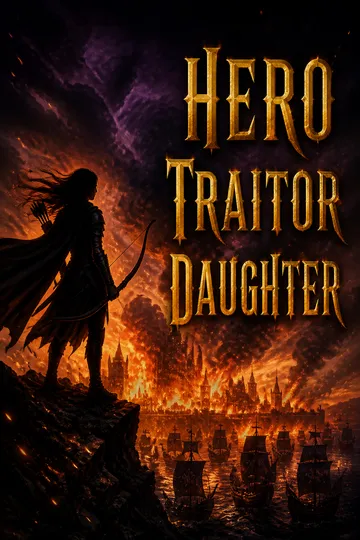
Hero, Traitor, Daughter makes the struggle for freedom collide with a more immediate question: what can a person do when the institutions they oppose collapse before anything better is ready to protect people? Ceres and the rebellion have challenged an unjust Empire, but Felldust’s invasion turns that victory into an opening for conquest and enslavement. The book refuses to make the rebellion’s cause sufficient protection against the consequences of war. Ceres must face the people left behind even when she cannot save them all.
Stephania offers a dark countertheory. She believes safety comes from control, so she reads people accurately and uses that knowledge to secure power. Her intelligence is real, but it serves a worldview in which trust is always a liability and other people’s needs are leverage. Irrien’s rule shares her appetite for domination while revealing the limit of her political skill: she can bargain only while she possesses something he wants. The difference between them is less moral than structural. Each treats power as the right to take; Irrien simply has the army to enforce his terms. Thanos, Ceres, Sartes, and Akila answer violence in different ways. Thanos tries to preserve life without pretending that forgiveness repairs harm. Ceres must distinguish justice from retaliatory cruelty. Sartes learns that leadership means allowing others to choose danger with him, while Akila’s loyalty makes his men willing to fight an enemy they cannot defeat conventionally. Felene’s final choices complicate any clean division between heroism and vengeance: she acts from old wounds, but also spends her remaining strength protecting others.
The ending is deliberately provisional. Ceres escapes Delos, not the consequences of losing it. Her supernatural power remains absent, her community is scattered, and the invaders have taken the city. Survival is not the same as victory, but the survivors have preserved the relationships and capacity for choice from which resistance might begin again.
Review Summary
Hero, Traitor, Daughter receives mixed reviews averaging 3.94 stars. Readers criticize repetitive plotlines, captured-and-escaping character cycles, and predictable scenarios. Many find the book too short at 187 pages, feeling like filler rather than meaningful progression. Common complaints include relentless battle sequences, lack of character development, and exhausting pacing. Some appreciate the action-packed storytelling and cliffhanger endings, while others feel the series should have concluded earlier. Positive reviewers praise the suspense and recommend continuing for invested readers.
Characters
Ceres
Powerless rebel leaderCeres is the young leader of the rebellion and bears the blood of the Ancient Ones, a source of power that has made her a formidable defender of Delos. Her commitments are concrete: she wants people freed from imperial control and believes strength should protect rather than dominate. That conviction can make her stubborn, especially when an enemy’s continued existence seems to endanger everyone around her. Her relationships with Thanos and her siblings give her reasons to trust beyond the battlefield, while her public role makes every personal decision politically consequential. Ceres is most compelling when she has to act without relying on supernatural force, because courage, restraint, and judgment must then carry the weight her powers once did.
Thanos
Reluctant royal heirThanos is a prince divided between the life he was raised to inherit and the people he has chosen to defend. He is capable of decisive violence, yet killing Lucious does not make him feel victorious; grief and responsibility persist beside relief. His love for Ceres repeatedly draws him into danger, but his compassion also extends to people whose choices trouble him, including Stephania and Athena. That generosity can appear indecisive, particularly when the consequences of mercy fall on others. Thanos’s strongest instinct is to keep people from becoming tools in another person’s struggle for power. His search for his mother and his uncertain claim to the throne sit alongside, rather than replace, his immediate loyalty to Ceres.
Stephania
Ambitious castle rulerStephania is a noblewoman whose intelligence lies in reading what people want and turning those wants into obligations. She can be charming, observant, and strategically patient, but she regards dependence as danger and power as the surest defense against betrayal. Her ambition is not merely vanity: she believes a woman in a brutal political world must seize control before others seize it from her. That belief lets her describe cruelty as necessity and treat loyalty as something to manage rather than reciprocate. Her ties to Thanos, Ceres, and Elethe place her in intimate conflicts as well as political ones. Stephania is dangerous because she understands people well, yet mistakes understanding them for having the right to use them.
Akila
Rebel fleet commanderAkila is a veteran fighter from Haylon who commands loyalty through camaraderie rather than distance or fear. He knows his fleet is badly outnumbered, but he refuses to treat Delos’s people as someone else’s problem. His humor helps his crews face danger without pretending it is small, and his tactical skill makes him willing to harry an enemy rather than meet overwhelming force head-on. Akila’s attachment to his sailors is also a vulnerability an opponent can exploit. Still, he does not confuse command with ownership: his men follow because they trust the person asking them to risk their lives. His presence connects the rebellion’s fight in Delos to the earlier liberation of Haylon.
Sartes
Young rebel commanderCeres’s younger brother, Sartes leads former conscripts through villages damaged by the war. He is still learning how to command, and his concern for Leyana makes him protective to the point of hesitation. Rather than force the people around him to fight, he earns their trust by distributing supplies and teaching them to defend one another. When Ceres is taken, he accepts the danger of returning to Delos and helps devise a desperate rescue. Sartes’s courage is less polished than his sister’s, but his instinct to build cooperation gives it a distinctive shape.
Felene
Wounded pirate avengerFelene is a thief and sailor who has survived by trusting her skill more than anyone else’s promises. She is quick, funny, and adept at turning danger into an opening, but closeness unsettles her because it gives betrayal a sharper edge. Her encounter with Thanos makes her consider a life guided by more than the next theft, even as she resists the idea that she could be a hero. Felene’s pursuit of Stephania is driven by anger, wounded pride, and a desire to settle debts on her own terms. Her hard exterior hides a capacity for loyalty that she rarely knows how to express.
Irrien
Conquering First StoneIrrien is the First Stone of Felldust, a calculating commander who sees invasion as a chance to build an empire rather than collect plunder and return home. He studies opponents closely and treats fear as a strategic tool. In battle, he values strength and cunning, but his dependence on appearing invulnerable makes any visible weakness dangerous to him. Irrien is not a mindless brute: he understands politics, spectacle, and the value of a reputation. His vision of order, however, rests on enslavement and the premise that the strong are entitled to take what they can hold.
Jeva
Bone Folk emissaryJeva is a Bone Folk warrior and ritual initiate who helps Thanos approach her people. She fights with a bladed chain and meets outsiders with justified suspicion, having seen contempt become violence too often. Her people’s reverence for the dead shapes her understanding of duty, land, and courage. Jeva is frank about the dangers of seeking the Bone Folk’s aid, but she also recognizes that Ceres’s ancestry matters to them in a way Thanos’s offers of wealth cannot. Her judgment turns a failed negotiation into a possible alliance.
Leyana
Sartes’s steadfast partnerLeyana travels with Sartes’s convoy and refuses to let his desire to protect her define what she can do. She learns to fight because she wants to stand beside him as an equal, not wait passively for him to return. Her composure under pressure becomes practical as well as emotional: she helps Sartes escape captivity and remains committed to rescuing Ceres. Leyana brings tenderness into a story where affection often becomes leverage, while insisting that love should not mean surrendering agency.
Berin
Smith and devoted fatherBerin, Ceres and Sartes’s father, is a smith whose practical craft becomes a form of resistance. He helps reinforce Delos and fights with the tools he knows, but his deepest decisions are shaped by his children’s safety. When the castle’s defenses become an instrument of Ceres’s torment, Berin considers the human cost of changing them rather than treating a gate as merely a military problem. His steadiness gives his children support without taking their choices from them.
Queen Athena
Displaced imperial queenAthena is the former queen of the Empire and mother of Lucious. She has spent much of her life navigating court power through rank, caution, and control, and she has often treated Thanos as a political complication rather than family. The invasion strips away the protections her title once provided, forcing her to survive without servants or authority. Athena remains calculating, but hunger and grief make the human cost of her decisions harder to ignore. Her knowledge of the court and its hidden routes continues to matter even after she loses the throne.
Elethe
Stephania’s handmaidenElethe is Stephania’s close attendant, trusted with dangerous errands and the details of her mistress’s plans. Her skill at deception and willingness to act make her more than a background servant; she helps shape what Stephania can accomplish inside the castle. Her loyalty exists within a relationship marked by hierarchy and dependence, where service can offer intimacy but also leaves little room for equal power. Elethe’s connection to both Stephania and Felene makes her presence part of the story’s tangled question of what trust costs.
Lucious
Fallen imperial princeLucious is Thanos’s half-brother and the Empire’s favored prince, raised amid privilege and political entitlement. His ambition and cruelty make him a threat to those around him, while his family tie to Thanos turns their conflict into something more painful than a simple contest for the throne. He represents the way royal status can protect destructive behavior until someone is forced to confront it directly.
Cosmas
Keeper of royal knowledgeCosmas is an elderly scholar who guards the Hall of Knowledge and believes that information should serve the Empire as a whole, not merely whoever holds the throne. His books are both his life’s work and the vulnerability Stephania exploits. He knows fragments of royal ancestry and sorcery, but refuses to confuse possession of facts with loyalty to a ruler.
Daskalos
Sorcerer with a bargainDaskalos is a sorcerer from Felldust whose bargain with Stephania places her child and future under an uncertain threat. The stories about him suggest a form of magic that makes ordinary assassination useless. He remains distant from the main battles, but his agreement gives Stephania a private danger she cannot solve by taking a throne.
The Ship Captain
Thanos’s cautious allyThe unnamed captain who carries Thanos understands the cost of risking a crew against Felldust. He cares for Thanos but refuses to confuse loyalty with reckless obedience. His caution forces Thanos to seek other allies, and his ship provides a temporary route toward the people Thanos hopes to save.
Plot Devices
The Ancient Ones’ blood
Power and ancestral claimCeres’s descent from the Ancient Ones gives her supernatural power and makes her a symbol beyond the rebellion. Stephania’s poison removes that power, exposing how much Ceres’s reputation depends on it. The Bone Folk, however, understand the bloodline through their own relationship with the ancestors, so it helps Thanos win their aid. The device therefore functions in two different ways: as an ability that can be taken away and as a lineage whose meaning remains even when Ceres cannot use its magic.
Stephania’s power-stripping poison
Turn strength into vulnerabilityStephania uses a poison that blocks Ceres’s Ancient Ones abilities rather than merely exhausting her. Ceres recognizes that this is different from the temporary depletion she has suffered before, and repeated attempts to reach her power fail. The poison allows Stephania to imprison and torment a rival who had previously been difficult to overpower. Its effects reshape the action: Ceres must rely on combat training, allies, and judgment instead of supernatural force.
The Bone Folk’s ancestor rites
Turn ancestry into allianceThe Bone Folk’s ritual ash marks a visitor’s willingness to enter their sacred space, while their public forum gives priests and community members authority to judge who may speak. Thanos initially fails to persuade them with gold and land because those offers ignore their ancestral ties. Jeva invokes Ceres’s Ancient Ones blood, giving her people a reason to fight that belongs to their own worldview. The rite and the lineage together transform a failed appeal into a dangerous alliance.
Delos’s hidden tunnels
Routes into and out of powerThe tunnels beneath Delos serve as smuggling paths, escape routes, and potential approaches to the castle. Their secrecy first seems to offer Sartes and the rebels a way past the walls, but Stephania’s guards turn one passage into an ambush. Later, the same underground network lets Stephania flee and gives Ceres a route to pursue her. The tunnels make control of information and local knowledge materially important: those who know the paths can evade a fortified surface, but they can also be trapped in darkness.
Daskalos’s hidden life
Threat beyond the invasionCosmas tells Stephania that old accounts describe Daskalos as concealing his life within an object, making him difficult to kill by ordinary means. Stephania has already made a bargain with the sorcerer involving her child and seeks knowledge that might let her escape it. The device gives her ambition a limit: power over a castle cannot necessarily overcome a magical contract. Because Cosmas dies before locating the relevant records or offering a solution, this danger remains unresolved within the book.
Of Crowns and Glory Series



About the Author

Download PDF
Download EPUB
.epub digital book format is ideal for reading ebooks on phones, tablets, and e-readers.








