

Plot Summary
Prologue
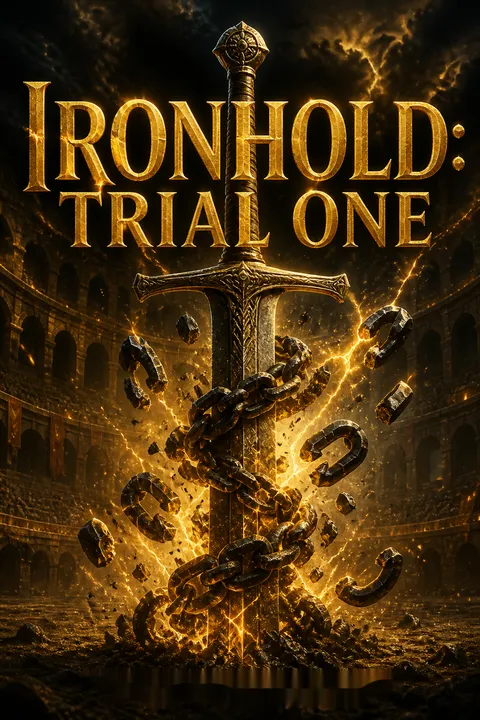
At Ironhold, the young noble Alaric Blackthorn challenges the much larger gladiator Grak after Grak insults his family. Their bout turns dangerous when Grak uses dust and kinetic magic to pin Alaric in place.
Alaric escapes with an illusion, appears behind his opponent, and kills him with a single stroke. Lord Commander Darius Bloodhawk declares Alaric the winner, knowing that Ironhold’s rules bend around a noble family’s influence even when the fortress claims to treat every fighter alike.
The opening presents Ironhold as a place where violence is both spectacle and governance. Alaric’s victory depends on speed, illusion, and a willingness to kill, but Darius’s response also establishes that the arena’s supposed equality has limits: Alaric’s birth protects him from the consequences that might follow another gladiator. The scene prepares a contrast with Lyra, whose instinct is to preserve life rather than turn conflict into performance. It also introduces the central bargain of the series: power can win a person status inside the system, yet the system decides who is allowed to wield that power without punishment.
The Bear at Seatide
Lyra Thornwind has learned healing from her mother, Arla, in the poor coastal village of Seatide. When a starving bear enters the settlement, Lyra approaches instead of fleeing. She senses the animal’s fear and hunger, then persuades the fisherman Benkan to surrender the salmon he owes Arla. The bear takes the fish and leaves, sparing the villagers further harm.
But the Aetherian official who witnessed the rescue is not satisfied with gratitude. His own magic detects Lyra’s unusual connection to animals, and he orders soldiers to seize her. Arla urges her daughter to escape before they force their way inside. Lyra runs, but her attempt to reach the village square ends with soldiers catching her and claiming her for the empire.
Lyra’s first decisive act grows directly from her healer’s ethic: she sees danger as a reason to help, not as permission to abandon others. The bear is not simply a threat to be defeated; its hunger has been worsened by human settlement and imperial expansion. Lyra’s sensitivity lets her respond to the cause beneath the violence. The rescue therefore exposes both her gift and the empire’s defining contradiction. Aetheria praises magic as a source of greatness, yet treats gifted people beyond its civic center as resources to be collected. Lyra’s compassion saves lives locally and makes her vulnerable to a system that converts care into evidence of ownership.
A Collar for Magic
The soldiers fasten an iron collar around Lyra’s neck and chain her to other captives, including Naia, a young woman whose healing talent was exposed while tending her father. As the convoy marches toward Aetheria, a prisoner breaks away. The official has him pinned down and killed in a ritual meant to transfer his power to a purple stone, making escape seem less like a risk than a sentence.
After days on the road, the captives reach the immense capital, then pass its marble splendor for the grey fortress of Ironhold. There, Lord Commander Darius Bloodhawk explains that the prisoners will train for the colosseum. Those who survive five seasons can earn freedom and citizenship; those judged unfit may be sold or forced into service.
The collar makes the empire’s abstract claim over magic physically intimate: Lyra cannot forget her new status because it is sealed against her skin. Naia’s capture confirms that the official is pursuing talents, not crimes, while the execution of the fleeing prisoner demonstrates how casually that pursuit can become lethal. The capital’s contrast between marble grandeur and Ironhold’s prison stone turns political ideology into architecture. Aetheria offers freedom as a conditional reward, but only after captives perform violence for the city. The promise is not empty, yet it is designed to make survival depend on serving the very authority that has taken away their choice.
The First Ironhold Mark
Darius puts the newcomers through exhausting runs, strength tests, balance drills, and weapon practice, while experienced gladiators drive them onward with switches. Lyra keeps moving and helps Naia endure the trials, even as other recruits collapse and are removed.
A veteran named Gyra dismisses Lyra as too slight to survive, and Ironhold’s trainers make clear that those who fail may be sold rather than released. Darius eventually brands the remaining trainees with a circular mark on the shoulder, warning that disobedience can bring another burn.
Each completed season will add a stripe; five stripes promise freedom. Lyra and Naia are left with a brutal new measure of hope: their bodies are now counted as property, but endurance may still open a path out.
Ironhold’s selection process makes endurance look like a personal virtue while concealing how thoroughly the institution controls the terms of survival. Lyra’s persistence matters, but it is elicited through hunger, exhaustion, and threat. The brand condenses this logic into a mark that is both a wound and a promise: it records ownership now and advertises conditional citizenship later. Lyra’s support for Naia is a small refusal to accept Ironhold’s competitive isolation. By helping another captive continue, she treats survival as something that can be shared, even in a system designed to make each person responsible only for their own escape.
Friends Among Rivals
While Gyra harasses Lyra and Naia during practice, Rowan intervenes and then helps Lyra correct her sword grip. He was once enslaved by a noblewoman, and a scar across his cheek records her violence; his earth magic gives him an advantage in combat, but his instinct is to protect people weaker than himself.
Lyra later encounters Alaric Blackthorn, the noble from the prologue, in the bathhouse. His vanity and flirtation irritate her, though his ease around danger is unmistakable.
In a gallery devoted to heroic gladiators, the cruel young noble Vex corners Lyra and tries to exploit her slave status. Alaric steps in, and Vex releases her rather than challenge a better-connected rival. Lyra sees that Ironhold’s hierarchy reaches beyond the fighting pits.
The relationships introduced here offer competing ways to navigate a coercive order. Rowan responds to his own history of abuse by intervening for others, while Alaric uses family rank and demonstrated skill to redirect danger. Neither approach dismantles the hierarchy, but each gives Lyra a different kind of protection. Vex’s threat shows that the collar does more than identify her as a captive; it invites others to treat her consent as negotiable. Lyra’s discomfort with both the arena and its nobles keeps her from mistaking charm or rescue for equality. Her emerging alliances are real, but they exist inside a structure that can turn affection and status into leverage.
The Shadow Cat's Strike
When Darius pairs Lyra against another recruit, she drops her practice sword rather than attack. The refusal earns her a brutal beating, and Naia heals her afterward while insisting that Lyra must learn to defend herself.
Searching Ironhold’s lower levels, Lyra finds Stefano tending a wounded shadow cat and discovers that the animal trusts her enough to accept her touch. Soon after, the trainers put Lyra into a live-steel bout against Vex, who sends a storm of floating knives at her.
Lyra can dodge and snag some blades with her fishing net, but cannot bring herself to stab him. The shadow cat leaps down from the chains above the pit and attacks Vex. Darius declares Lyra the victor, mistaking her bond with the animal for deliberate command.
Lyra’s refusal to fight is not passivity so much as a moral boundary: she will not pretend that violence becomes harmless because an institution calls it training. Ironhold answers that boundary with pain, attempting to teach obedience through the body. The shadow cat offers a different kind of relationship, one based on attention and trust rather than command. Yet its intervention also brings Lyra a victory that the authorities interpret in the language they understand, as a weapon under her control. The gap between what Lyra experiences and what Darius believes will become consequential. Her gift can protect her, but the more useful it appears to Ironhold, the less safely she can define what it means herself.
Ravenna's Quiet Test
After the bout, the free gladiator Ravenna invites Lyra to her rooms and uses her mind-affecting talent to draw her into an unusually trusting conversation. Ravenna suspects that Lyra did more than speak to the shadow cat, and her probing leaves Lyra confused about what she wants.
Alaric arrives, breaks Ravenna’s influence, and takes Lyra away. He explains that Ravenna can manipulate minds, a reminder that even friendly attention in Ironhold may conceal a magical advantage.
As the first colosseum trials approach, the fighters learn that Lyra’s opening opponent will be a beast and that a later bout will require her to fight alongside a partner. The schedule gives her little time to master her weapons or decide how much she can trust the people around her.
Ravenna’s scene complicates the idea of consent in a place where nearly everyone has been deprived of ordinary control. Her power makes Lyra’s uncertainty legible as something another person can exploit, while Alaric’s intervention restores Lyra’s ability to interpret the encounter for herself. But rescue does not create uncomplicated trust: Alaric has his own ambitions and habits of provocation. The approaching schedule turns these interpersonal tensions into practical risks. Lyra will need cooperation to survive, yet the games repeatedly reward concealed motives and unilateral power. Her challenge is not simply to identify enemies, but to maintain judgment in relationships where magic can alter what another person feels or believes.
The Ironhide's Changed Course
On the first festival day, the gladiators parade through Aetheria to cheering crowds before entering the colosseum. Lyra sees prisoners fed to shadow cats as an opening spectacle. Naia survives her own bout by letting an axe-wielding opponent wound her, then healing herself long enough to strike back; Gyra is among the dead.
Lyra faces the Ironhide, an enormous, iron-skinned beast whose horn can pierce armor. Her net and trident cannot stop its charge, and she is driven toward the arena wall.
Instead of attacking again, Lyra reaches into the creature’s fear and memories of captivity. She understands that it does not want to kill her, only to survive. When she soothes it, the Ironhide walks with her to its gate, and the emperor declares her victorious.
The Ironhide bout transforms Lyra’s apparent weakness into a different way of reading danger. Her first attempts follow the arena’s logic: weapon against body, strength against strength. They fail because the beast’s violence is not a strategy she can outmatch. The breakthrough comes when she recognizes its history of capture and coercion, placing its fury in a context the crowd refuses to see. Her victory does not satisfy the spectacle’s demand for blood, which makes the emperor’s recognition politically charged. Lyra survives by declining the role of killer and refusing the arena’s false choice between domination and death. At the same time, her deeper connection to the creature suggests that her gift reaches beyond ordinary speech.
A Noble's Bet
After the Ironhide bout, a nobleman named Marus accuses Lyra of costing him money by winning without killing the beast. Lady Elara Moonshadow intervenes, then takes Lyra aside. She explains that the post-bout gatherings are not merely celebrations: nobles seek proximity to successful gladiators to borrow their prestige and cultivate future influence.
Elara had bet on Lyra when others expected her to die, and she now sees her survival as evidence of unusual potential. Lyra is wary of becoming another noble’s asset, but Elara’s account helps her understand that the colosseum is also a political marketplace. Gladiators are watched, wagered upon, and courted because their abilities may later serve powerful families and the empire.
Elara reframes the arena’s glamour as an economy of borrowed power. The nobles do not merely consume the fighters’ bodies as entertainment; they convert attention, victories, and association into political advantage. Marus’s anger exposes the bluntest form of that exchange, where Lyra’s survival matters less to him than the lost wager. Elara offers a more sophisticated version, seeing her as a future connection worth cultivating. Lyra’s suspicion is therefore psychologically sound, not simply a refusal of help. She is beginning to distinguish between care and investment, while recognizing that in Aetheria even admiration may be a method of acquiring influence over someone who has no formal freedom.
The Birds See First
On the next day of trials, Zara uses her control of water to defeat her opponent, while Rowan loses a blindfolded bout after a thrown spear catches him. Lyra then faces Braxus, a powerful fighter who cuts her while driving her across the sand.
She reaches for the carrion birds circling above and begins to perceive the fight through their many angles of sight. Their warnings help her anticipate Braxus’s movements. When they reveal an opening, Lyra tangles his sword with her net and drives her trident into him.
Braxus dies, leaving Lyra shaken by the fact that she has killed to survive. Lady Elara later tells her that her ability is a forbidden form of beast-whispering and that its practitioners are feared as potential threats to the emperor.
The birds’ perspective gives Lyra a tactical advantage, but it also makes the killing feel less purely individual. Her body acts within a wider field of perception, and the flock’s hunger for what follows unsettles her sense of agency. The arena calls this victory; Lyra experiences it as a moral rupture. Elara’s revelation expands that rupture into a political danger: Lyra’s gift has a history the empire wants suppressed, and her unusual power may make her valuable to factions beyond the arena. The tension is not between violence and innocence in the abstract. It is between Lyra’s need to survive, her refusal to normalize killing, and a regime that interprets uncontrolled power as a threat to its authority.
Trust Under the Bandages
After Rowan returns wounded from his blindfolded fight, he insists that Naia heal other gladiators before him. Lyra stitches his side with the practical skill she learned from Arla, and Rowan admits that he sought excuses to stay near her. They kiss, then stop when his injury makes further intimacy painful.
That night, Lyra follows Finn and hears him agree to abandon her in their coming doubles bout in exchange for Vex sparing him. Alaric advises her that there is no reliable proof to use against Vex, and even suggests killing Finn before withdrawing the idea. On the march to the arena, Lyra tells Finn she knows of the arrangement and urges him to fight beside her, though she cannot promise they will win.
The chapter places two forms of vulnerability beside one another. Rowan trusts Lyra with his injured body and admits a desire that is not an attempt to possess her; their intimacy pauses when pain makes it necessary, marking mutual care as different from the coercion Lyra has encountered. Finn’s bargain, by contrast, grows from the logic of self-preservation he learned as a thief. Lyra recognizes the danger but refuses Alaric’s suggestion that she solve it through murder. Her appeal to Finn is an ethical gamble: she cannot remove the threat, only ask him to choose solidarity over the survival plan Vex has offered.
The Betrayal Breaks
In the doubles bout, Vex’s floating knives and Lazlo’s speed-enhanced strength force Lyra to defend herself while Finn keeps his distance. When Finn suddenly attacks Vex instead of carrying out their bargain, he wounds him and briefly gives Lyra room to fight. Vex retaliates with a barrage of knives, killing Finn. Lyra is left against Lazlo until the shadow cat emerges through the arena’s shadows and kills him.
Wounded, the cat is then stabbed by Vex. Lyra drives her trident into Vex to stop him, but when the emperor orders her to finish the helpless man, she refuses and throws down her dagger. The officials carry Vex away for treatment, while Lyra leaves the sand having survived the season without obeying the final demand to kill.
The bout compresses the book’s central moral pressures into one sequence of choices. Finn’s reversal does not erase his earlier fear; it shows that he can still choose action when he sees Lyra standing against the same threat. His death makes that choice costly rather than triumphant. Lyra’s bond with the shadow cat saves her again, but its injuries make power feel reciprocal and dangerous, not like a convenient weapon. Finally, she distinguishes killing in immediate defense from killing a defeated opponent on command. By refusing the emperor, she challenges the arena’s claim that survival requires total obedience, even though that refusal may make her more politically exposed.
One Stripe, Four Remain
At the season’s closing ceremony, Darius adds a stripe to Lyra’s shoulder mark, recording her first completed season and leaving four more between her and freedom. The surviving gladiators return to Ironhold, where a feast lets them celebrate life and remember the dead.
Alaric warns Lyra that refusing the emperor’s order has made her a target, then kisses her before retreating behind his usual teasing manner. The next morning, Vex renews his contempt, while Ravenna offers Lyra a cautious friendship.
Elara visits Lyra privately and admits that beast-whisperers risk losing their human sense of self when they connect too deeply with animals. Lyra accepts Elara’s offer to teach her control, choosing knowledge despite her distrust of the covenant.
The stripe turns survival into an incremental contract: Lyra has earned one mark, not freedom, and the remaining four seasons still belong to a system that can alter the rules around her. The feast joins mourning to celebration without resolving either; the dead remain present among people who must return to training. Lyra’s refusal to execute Vex has also changed the social meaning of her victories, making her more visible and more dangerous to powerful observers. Her decision to accept Elara’s instruction is not a conversion to the covenant’s cause. It is a strategic attempt to understand a power that already affects others and may affect her in return.
Epilogue
After the games, the surviving gladiators march to a temple, where Emperor Tiberius VI presents their combat as a holy service to Aetheria. Priests and crowds surround the ceremony, while the bodies of fallen fighters hang on spikes as offerings.
The emperor praises strength and magic, promises citizenship to those who survive five seasons, and warns that withholding sacrifice risks divine punishment. Lyra hears the political threat beneath the religious ceremony. She has survived one season, but she remains determined not to let the empire’s language of glory turn her into the killer it wants.
The temple procession converts the arena’s violence into official theology. The emperor’s account presents the gladiators as willing participants in sacred duty, even though Lyra and many others were captured and compelled to fight. The bodies displayed beside the temple make the cost visible while the ceremony assigns that cost a meaning useful to the state. Citizenship remains the promised reward, but it is conditional on repeated service and submission to the emperor’s interpretation of the games. Lyra’s resistance is therefore not only personal guilt about killing. It is a refusal to let authority decide that coercion becomes honorable when wrapped in ritual.
Analysis
Ironhold: Trial One asks what survival costs when a state controls both the threat and the definition of virtue. Aetheria presents the colosseum as proof of strength, but its fighters include people seized from villages, enslaved by nobles, or cornered into choosing the arena over execution. The five-season path to citizenship is therefore both a real possibility and a disciplinary instrument: it gives captives a future to pursue while requiring them to perform the violence that legitimizes the empire.
Lyra’s central conflict is not a simple refusal of violence. She wants to live, and the arena forces her to kill when her life is threatened. Her more precise boundary is between defending herself and carrying out violence as spectacle or obedience. She can kill Braxus in the midst of combat, but refuses to execute the helpless Vex at the emperor’s command. That distinction does not make her morally untouched. It lets her retain responsibility for how she acts, rather than allowing Aetheria to rename every act of violence as duty.
Her animal connection offers an alternative model of power. Lyra survives by perceiving fear, hunger, and history in creatures the empire has captured and trained to kill. Her gift is relational rather than purely instrumental: animals help her, but remain beings with their own needs and risks. The injured shadow cat makes this reciprocity tangible. Lyra’s power can protect her, yet it can also expose others to harm and bind her more deeply to the arena’s violence.
The book’s political world is held together by competing forms of interpretation. Darius sees potential fighters; spectators see entertainment; nobles see prestige and investment; the emperor sees a ritual that sustains authority. Lyra’s danger grows as her ability becomes legible to these observers. The season ends with a victory, but not release. She has learned that survival requires skill, alliances, and knowledge, while preserving the harder task of deciding what she will not become.
Review Summary
Ironhold features Lyra, a healer with beast-speaking magic who is captured and forced to become a gladiator. Reviews average 3.84/5 stars. Readers appreciate the fast-paced plot, gladiator trials, and magical elements, but criticize the main character's naivety, shallow character development, and rushed pacing. Many find the writing simple and straightforward, with an underdeveloped love triangle. The book is considered an easy, light read best suited for young adults, with mixed opinions on whether to continue the series.
Characters
Lyra Thornwind
Reluctant beast-whispererLyra is a village healer whose instinct is to approach suffering rather than turn away from it. Her connection to animals begins as a modest talent, but she is unusually receptive to their fear, needs, and perceptions. That sensitivity gives her a way to survive Ironhold without accepting its claim that strength must mean cruelty. Lyra is not fearless: she doubts her own combat ability, grieves when she kills, and worries about the people and creatures drawn into her struggles. Her central tension is practical and moral. She wants to live, but does not want survival to erase her capacity for care or make her an instrument of the empire.
Rowan
Earth-touched, steadfast protectorRowan is a strong young gladiator with a minor connection to the earth, which lets him sense movement and alter the ground beneath an opponent. He was enslaved before arriving at Ironhold, and a noblewoman’s violence left a scar across his face. His experience makes him alert to the ways power disguises itself as entitlement, but it has not made him indifferent to other people’s suffering. He trains Lyra because he believes she deserves a chance to survive, even when her reluctance frustrates him. Rowan’s strength is paired with an ethic of responsibility: he wants to protect others without treating them as possessions or making their lives expendable.
Alaric Blackthorn
Glory-seeking noble illusionistAlaric is a noble-born gladiator with illusion magic, considerable skill, and a talent for making his confidence seem effortless. He entered Ironhold for glory rather than because he was captured, which separates his experience from Lyra’s and Rowan’s. His teasing manner often conceals a sharp awareness of danger, and he intervenes when Lyra faces threats that others might ignore. At the same time, he is accustomed to a world where status and force can settle disputes, and he does not share Lyra’s hesitation about violence. His attraction to her is real but difficult to read beneath his vanity and performance, leaving their connection charged with both interest and uncertainty.
Naia
Quiet healing-hearted allyNaia is a young woman captured after her healing ability was discovered. Her talent, called vitomancy, lets her repair wounds in herself and others, but it does not remove pain or make her limitless. She becomes Lyra’s closest early ally, helping her endure the road to Aetheria and recover from Ironhold’s punishments. Naia is gentler in manner than many fighters, yet her survival requires a hard practical streak: in the arena, she is willing to endure injury while waiting for a chance to strike back. Her care is generous, but the cost of using it leaves her physically depleted, making her compassion a resource she must learn to protect.
Darius Bloodhawk
Ironhold's hard commanderDarius is the commander responsible for training and housing Ironhold’s gladiators. He understands the fortress from the inside, having once been a prisoner himself, but that history has not led him to dismantle its brutal rules. He measures recruits by their endurance and willingness to fight, and he uses the brand to make the cost of disobedience unmistakable. Darius can recognize skill and promise, yet he treats people as part of a system whose purpose is to feed the colosseum. His authority is neither wholly arbitrary nor compassionate: he maintains order by making the fighters understand that their lives are always subject to someone else’s decision.
Lady Elara Moonshadow
Covenant's courtly guideElara is a politically astute noblewoman who watches the arena for signs of unusual ability. She recognizes that Lyra’s connection to animals may be stronger than Lyra herself understands and offers help through the secretive Spectral Covenant. Elara is composed, observant, and careful about what she reveals, presenting knowledge as both a gift and a means of influence. Her interest in Lyra appears sincere, but she also has a cause and a strategic view of what Lyra might become. That mixture makes her neither a simple mentor nor an obvious enemy. She represents the possibility of learning outside Ironhold’s control, along with the risks of accepting guidance from someone with undisclosed aims.
Vex
Entitled noble rivalVex is a high-born gladiator who believes family lineage and arena prestige entitle him to deference. His kinetic magic lets him control weapons at a distance, giving him a dangerous advantage in combat. He treats captured fighters as socially inferior and sees Lyra’s unusual gift as a challenge to the status he assumes is his by birth. Vex is proud, vindictive, and attentive to public reputation; being embarrassed matters to him almost as much as losing. His contempt is not merely personal. He embodies a hierarchy in which noble privilege can shape who is protected, who is threatened, and whose power is considered legitimate.
Ravenna
Mind-bending noble gladiatorRavenna is a free gladiator from a noble family whose magic can influence other people’s minds. She is elegant, socially skilled, and attentive to the political uses of reputation. The games offer her a route toward greater wealth, status, and advantageous marriage, so she treats spectacle as a serious investment. Ravenna can be warm toward Lyra, but her talent makes even friendliness difficult to interpret without caution. She understands that alliances in Ironhold are fragile because people may someday be matched against one another. Her poise is a form of self-protection, allowing her to move through a dangerous world without pretending that danger has disappeared.
Zara
Defiant water-wielding scrapperZara is an athletic gladiator from the western forests who can control water, though her ability depends on having water available to manipulate. She carries small vials so that a dry arena does not leave her powerless. Direct, energetic, and impatient with cruelty, she helps Lyra practice close combat and encourages her to trust her instincts. Zara does not romanticize the games; she treats preparation as the only available route to another day alive. Her confidence can steady her friends, but it is grounded in practical limits, not invulnerability.
Finn
Thief with illusion magicFinn is a quick-moving young man with illusion magic and the habits of someone who has survived by reading danger before it reaches him. He was caught stealing in Aetheria and chose the arena over execution. His instincts make him alert to bargains, escape routes, and unequal odds, though they also make trust difficult. Finn uses misdirection both in combat and in conversation, and his humor can soften the strain of Ironhold without making him careless. He understands that a clever plan is only useful if it leaves him alive, a belief that shapes how he approaches the people around him.
Stefano
Keeper of arena beastsStefano tends the animals kept beneath Ironhold for the games. He uses healing magic on injured creatures and understands the danger of treating them as tame simply because they are confined. When he sees Lyra’s unusual ease with a wounded shadow cat, he welcomes her into the beast pens. Stefano offers her a rare space where attention to animals is useful rather than mocked, even though he knows her path is likely to lead back to the arena.
Arla
Practical village healerArla is Lyra’s mother and Seatide’s healer. Without magical healing, she relies on herbs, stitching, and hard-earned judgment, insisting that care sometimes means telling patients what they do not want to hear. Her work teaches Lyra to treat wounds without confusing kindness with softness. Arla understands the danger of Aetherian power better than her daughter does, and her warnings reveal the precariousness of life in a conquered village.
Tiberius VI
Emperor of AetheriaTiberius VI rules the Aetherian Empire and presides over the colosseum’s public rituals. He appears at key moments as the authority whose decisions determine whether defeated fighters receive mercy. His power is reinforced by the empire’s religious language, which casts sacrifice as service to the gods. Tiberius does not need to address every gladiator personally; officials and announcers carry out the machinery of his rule, making his distance part of his authority.
Gyra
Veteran training bullyGyra is an experienced gladiator with two season marks and a reputation for intimidating newcomers. She is physically powerful and confident in the hierarchy of Ironhold, using that confidence to belittle Lyra and Naia. Her presence shows how the fortress’s brutality is enforced not only by commanders but also by fighters who have learned to wield its rules against those below them.
Lazlo
Speed-enhanced arena bruiserLazlo is a large gladiator whose kinetic talent lets him move with surprising speed while wielding an oversized sword. In the arena he is paired with Vex, making him a threat to opponents who might otherwise focus on the knives. His combination of strength and acceleration forces fighters to keep moving rather than rely on distance alone.
Benkan
Indebted Seatide fishermanBenkan is a fisherman whom Lyra stitches up after he cuts his arm. He complains about the pain and worries that Aetherian demands will leave his family without food. Though reluctant to pay in coin, he ultimately gives up a valuable salmon when Lyra needs it to draw the bear away from the village.
Lord Marus
Grievance-prone arena gamblerMarus is a wealthy nobleman whose attention to the games is sharpened by betting. He resents Lyra when her survival costs him money, revealing how the arena’s human stakes can become secondary to the spectators’ private profit. His reaction helps Lyra see that the crowd does not need to hate the gladiators in order to treat their suffering as entertainment.
Grak
Brutal training-pit challengerGrak is the large gladiator who challenges Alaric in the prologue after insulting Alaric’s family. He relies on physical strength and limited kinetic magic, making him a sharp contrast to Alaric’s speed and illusions. Their bout introduces the lethal showmanship of Ironhold before Lyra’s story begins.
Plot Devices
Ironhold's season marks
Freedom measured in stripesIronhold brands each selected gladiator with a circular mark, then adds a stripe for every completed season in the colosseum. Five seasons promise freedom and Aetherian citizenship, giving the captives a visible measure of progress. The mark also carries a threat: Darius can burn the fighters again if they disobey. It turns time into a contract the gladiators cannot negotiate, making their bodies both a record of survival and proof of the empire’s claim over them.
The Aetherian stone
Magic as imperial propertyAetheria’s power is tied to a sacred stone housed in the city’s temple, which the empire presents as the source from which magic flows outward. Officials search conquered lands for people with magical gifts and bring them back to the capital. The stone’s religious and political significance helps explain why Aetheria treats gifted outsiders as resources to be absorbed or eliminated. It also links the arena’s violence to the empire’s larger claim that magical power belongs under its control.
Lyra's beast connection
Shared perception, not commandLyra initially understands her talent as the ability to communicate with animals. In practice, her connection can deepen into shared feeling and perception, allowing her to soothe a frightened beast or draw on the viewpoints of nearby birds. The ability helps her survive when ordinary weapons fail, but it does not make animals obedient tools. Their own needs and dangers remain part of the connection. The revelation that Lyra may be a powerful beast-whisperer changes how the empire and the Spectral Covenant might regard her.
The colosseum
Spectacle conceals coercionThe colosseum stages the gladiators’ fights as both public entertainment and sacred ceremony. Festival processions turn the fighters into celebrities before they are sent into bouts where the audience demands blood. Nobles use the games to display status, place bets, and cultivate ties to successful combatants. For captives, the arena is also the only path the empire offers toward eventual freedom. This layered function lets Aetheria describe coercion as glory and political control as religious tradition.
The Spectral Covenant
Secret training for the fearedThe Spectral Covenant is a hidden group that seeks to help people with the rare gift of beast-whispering understand and develop their abilities. Elara presents it to Lyra as a source of instruction outside the official system, while warning that the gift is feared because it may threaten imperial authority. The covenant offers Lyra a way to learn what her power can do, but Elara’s guarded disclosures leave questions about the group’s motives and the risks of trusting it.
About the Author

Download PDF
Download EPUB
.epub digital book format is ideal for reading ebooks on phones, tablets, and e-readers.








