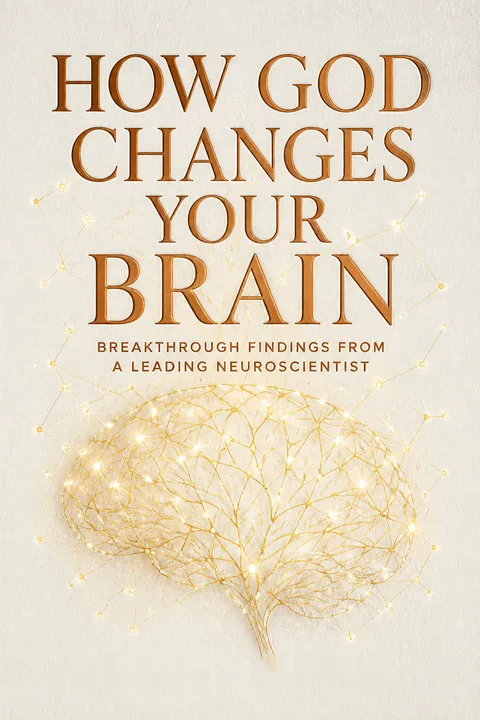


Key Takeaways
Contemplating God changes your brain, but neuroscience cannot verify God
Belief leaves a trace. The book’s central claim is that sustained contemplation, prayer, and meditation alter brain activity and may reshape neural connections. The authors call the brain’s capacity to change in response to experience neuroplasticity. In their account, thinking about God recruits systems involved in attention, emotion, memory, and a sense of reality. The same basic principle applies to other absorbing ideas, from science to music.
A boundary matters. Brain imaging can show patterns associated with a spiritual experience. It cannot establish whether God exists beyond the person having that experience. A comforting, vivid sense of divine presence is neurologically real as an experience, but that fact alone does not settle what caused it.
The distinction between an experience and its explanation is the book’s most important intellectual safeguard. A brain-based account need not reduce spirituality to “nothing but neurons,” just as describing the neural basis of seeing does not make the seen world imaginary. But neural activity cannot independently adjudicate between a divine cause and a brain-generated interpretation. The strongest reading is therefore modest: spiritual practice can change how people feel, attend, and behave, while metaphysical conclusions remain open to other forms of argument.
Twelve minutes daily helped memory patients improve after eight weeks
A mechanic tries meditation. Gus, an industrial mechanic with memory problems and no interest in religion, joined a study of Kirtan Kriya, a short practice combining breathing, repeated sounds, and finger movements. He practiced for twelve minutes a day for eight weeks. The researchers reported increased activity in areas linked to attention and emotional regulation. On a timed cognitive test, Gus’s completion time fell from 107 seconds to 68.
Promising, not conclusive. Across the participants, the authors report average improvements of 10 to 20 percent in measures including recall, concentration, and verbal fluency. This was a small, preliminary study, not proof that meditation prevents dementia or reverses disease. Its practical message is narrower: a brief, repeated routine may exercise attention and coordination, even without religious belief.
Gus’s story is persuasive because it replaces the image of meditation as an activity reserved for spiritual specialists with an ordinary person pursuing a concrete goal. The combination of sound, movement, breath, and concentration may also help explain why the exercise felt accessible. Yet a notable before-and-after improvement in a small study cannot establish how much came from the practice itself, repeated testing, or participants’ expectations. The sensible takeaway is experimentation with realistic hopes, not a promise of cognitive protection.
Use spiritual practices even when you leave their theology behind
Technique and belief can separate. The memory study taught Kirtan Kriya without asking participants to adopt its spiritual meaning. The authors also compare brain scans of Franciscan nuns practicing Centering Prayer with scans of Buddhist meditators. Though their beliefs differed, the two groups showed some similar changes during contemplative practice.
Different rituals, different states. The book contrasts focused prayer and meditation, which involved greater frontal-lobe activity in the authors’ studies, with glossolalia, or speaking in tongues, a spontaneous religious vocal practice. The latter was associated with reduced frontal activity and stronger emotional intensity. These observations suggest that spiritual practices are not neurologically interchangeable, even when they serve a shared purpose. They also suggest that secular versions can retain useful elements such as focused attention, repetition, and controlled breathing.
Separating a practice from its theology creates room for religious and secular people to use similar methods without pretending their beliefs are the same. It also invites a useful question: which ingredients matter most? Repetition, breath regulation, movement, expectation, and group setting could each contribute in different ways. That complexity is a strength, not a flaw, provided findings are not oversold. Similar activation patterns do not prove identical experiences, and different brain patterns do not prove that one ritual is more spiritually authentic than another.
Ask what God means before assuming two people believe alike
One word, many models. The authors’ online Survey of Spiritual Experiences gathered nearly 1,000 responses, including detailed accounts from more than 300 people. Participants used thousands of different words to describe their experiences, with little shared vocabulary. In a separate Baylor survey discussed in the book, respondents’ images of God clustered into four broad profiles: authoritarian, critical, distant, and benevolent. The authors add a mystical conception that the survey’s questions did not capture well.
Labels conceal variety. Adults’ drawings of God ranged from human faces to abstract shapes, nature scenes, and blank pages. The authors argue that beliefs change with experience, development, and culture. A religious label therefore cannot reliably tell someone else what a person values, feels, or believes about the divine.
The work makes a strong case for asking open questions rather than treating identity labels as complete descriptions. That insight applies well beyond religion: people often use the same word while attaching different histories and commitments to it. The surveys also have limits. Online respondents are self-selected, and categories such as “benevolent” simplify beliefs that may shift with circumstance. Still, the book’s central corrective is valuable: disagreement may sometimes concern different meanings hidden beneath familiar words, not simply opposing answers to one shared question.
Feed compassion deliberately before fear and anger hijack judgment
Two wolves, one choice. The book retells a story of a child torn between selfishness and generosity. His grandfather describes two inner forces and explains that attention and action strengthen one or the other. The authors use the tale to frame a neurological tension between fast threat responses and brain systems involved in reflection, empathy, and self-control.
Anger spreads. In their model, the amygdala helps process threat, while the anterior cingulate cortex links emotion with attention and social understanding. They argue that compassionate contemplation can support calmer responses, while angry rhetoric can provoke defensiveness and an “us versus them” outlook. Their target is not firm belief itself, but using beliefs to justify hostility or coercion. How people treat outsiders matters more than the label they claim.
The two-wolves image works because it turns an abstract account of self-regulation into a question about repeated choices: which response receives practice? The authors’ emphasis on anger as socially contagious also directs attention away from debating doctrine alone and toward the emotional climate of groups. The neural story should not be read as a simple switch, however. Empathy, fear, and judgment involve interacting systems, and moral behavior also depends on social rules and material conditions. Compassion is a discipline, not a guarantee against conflict.
Treat felt reality as powerful experience, not proof of external truth
The brain builds a map. The authors describe perception as an internal model assembled from sensory information, emotion, memory, and expectation. They propose that sustained focus can make an idea feel increasingly real, and point to unusual thalamic activity in experienced meditators as a possible clue. In this account, a spiritual experience can feel as immediate and compelling as an ordinary perception.
Feeling real is not verification. The authors explicitly acknowledge that their research cannot determine whether a perceived God exists outside the mind. Their idea that contemplation makes concepts seem real is an interpretation of brain findings, not a test of the concept’s truth. That distinction applies equally to religious convictions, secular ideologies, and personal goals: mental force can explain certainty without validating its object.
This is a useful epistemic warning for any subject that produces intense conviction. The brain does not merely record the world; it organizes information into a workable interpretation, and that interpretation can feel self-evident. The key question is not whether an experience feels real, but what kinds of evidence could distinguish competing explanations. The book’s thalamus proposal is intriguing, yet an observed pattern cannot by itself establish the mechanism the authors suggest. Their more durable point is humility about the limits of introspection.
Exercise attention with movement, learning, social contact, and relaxation
Train more than one circuit. The authors recommend eight ways to support brain health: smiling, intellectual activity, relaxation, yawning, meditation, aerobic exercise, dialogue, and faith. Their larger point is that brain exercise can be physical, cognitive, social, or contemplative. The memory practice illustrates this blend by pairing focused attention with breathing, sound, and finger movement.
Choose what you can sustain. The book favors a regular, personally meaningful routine over an idealized program that becomes a burden. It suggests beginning with a clear intention, relaxing the body, and paying close attention to thoughts or sensations. Even short sessions can be a starting point, though the authors expect more frequent practice to produce greater effects. The suggested activities differ in how strongly their benefits are supported, so they should not be treated as equivalent prescriptions.
The broad menu is an advantage: someone who dislikes sitting meditation can still build attention through movement, conversation, or challenging learning. The most useful principle is variety paired with consistency, because no single activity exercises every capacity named in the book. The evidence behind the recommendations is uneven, however. The authors’ enthusiasm for yawning, for example, outruns the certainty of the findings they cite. Readers can keep the practical spirit while prioritizing activities with clear personal value and avoiding medical claims that exceed the evidence.
Carry meditation into dialogue by slowing speech and listening
Calm becomes interpersonal. Compassionate Communication is the authors’ structured exercise for bringing relaxation and attention into a conversation. Participants first settle their bodies, hold a kind thought about the other person, and imagine a respectful exchange. They then speak briefly in turns, keeping attention on breathing and listening rather than trying to win.
A small study offers a signal. In workshops with strangers, the authors report an 11 percent improvement on an intimacy measure after the exercise, including a 20 percent increase in willingness to feel close to an unfamiliar person. The results are preliminary, but the procedure is concrete: slow down, speak in short turns, listen without interruption, and return attention to the body when defensiveness rises. For serious disputes, the book also recommends agreeing on a time and taking a break if anger escalates.
The exercise converts private mindfulness into a social skill. Short turns reduce the chance that one person’s long explanation overwhelms the other, while deliberate pauses create room to register tone and feeling. Its value is not that a ritual makes disagreement disappear, but that it changes the conditions under which disagreement unfolds. The workshop result is encouraging rather than definitive, especially because the study is small and the participants were willing volunteers. The method is best treated as conversational practice, not a substitute for safety or professional support in harmful relationships.
Let optimism energize action, then test it against reality
Faith is not magic. The authors use faith broadly to mean trust that a worthwhile future is possible, whether that trust rests on God, science, relationships, or oneself. They argue that optimism can support motivation and resilience, but reject the claim that positive thoughts make the universe deliver wealth or success. Imagining a goal matters because it can help focus attention and plan action, not because thought alone changes external events.
Convert belief into steps. The book’s sequence is practical: identify what matters, keep attention on it, seek help from other people, and act. The authors also warn that excessive optimism can hide risk. A hopeful belief should therefore be checked against evidence and adjusted when it encourages dangerous choices or ignores obstacles.
This distinction separates useful optimism from magical thinking. A positive expectation can help someone begin, persist, and recruit support, but it cannot replace skills, opportunity, or feedback. The book’s own emphasis on taking action prevents its account of faith from collapsing into a promise that desire controls outcomes. A sound practice pairs an inspiring future image with a sober review of constraints. Hope is most useful when it increases agency without making a person less willing to notice danger or revise a plan.
Stay curious about beliefs, and judge conviction by treatment of outsiders
Understanding has limits. In the closing reflection, Newberg compares the gap between humanity and a possible infinite God to the gap between a person and a dog. The analogy is not evidence for God; it is a reminder that a finite mind may be poorly equipped to describe what exceeds its experience. The book’s recurring image of people touching different parts of an elephant makes a similar point: partial perspectives can conflict without any one perspective capturing the whole.
Behavior remains visible. The authors do not ask readers to settle the existence of God. They ask them to examine what their beliefs produce: compassion and service, or fear and exclusion. Religious, atheist, and agnostic views can all be held with humility or weaponized with certainty. Curiosity about other people’s meanings is therefore a practical form of pluralism.
The ending resists an easy verdict and instead makes uncertainty ethically consequential. If no person can claim a complete view of ultimate reality, then intellectual humility is not merely polite; it limits the temptation to force others into one’s own account. The conduct-based standard also avoids assuming that religious identity predicts virtue. Still, good intentions do not erase the effects of institutions or doctrines, so behavior should be judged in context, including who holds power and who bears the cost. Curiosity opens dialogue, while accountability keeps it honest.
Analysis
The book’s most durable contribution is not a neural explanation of God, but a disciplined separation of three questions: what people experience, what brain activity accompanies that experience, and what the experience implies about reality. The first two are open to observation; the third exceeds what brain imaging can establish. Newberg and Waldman state this limit, even as some of their language about the thalamus, empathy, and spiritual development can make tentative interpretations sound more settled than they are.
That tension reflects the book’s hybrid design. It moves from scan studies and surveys to practical exercises, then to an argument for pluralism. The strongest bridge between those parts is behavioral rather than metaphysical: repeated attention may shape emotional habits, and habits influence how people respond to others. Gus’s memory study illustrates a plausible, testable benefit of structured practice, while Compassionate Communication turns the book’s concern with empathy into a social procedure. Neither result proves that contemplation has a unique spiritual mechanism. Attention, expectation, motor coordination, repetition, and social context are plausible contributors that would need to be isolated.
The evidence also varies in strength. A small before-and-after study, self-selected online narratives, and broad claims about long-term health cannot support the same level of confidence. The authors sometimes generalize from neural correlates to moral qualities, as if one brain region could serve as a compassion center. Such simplifications help readers follow a complex subject, but they risk making distributed, context-sensitive processes appear like switches.
Read critically, the book offers a valuable practical thesis: contemplative routines can be meaningful whether understood religiously or secularly, but their worth is best assessed by their observable effects, including attention, emotional regulation, and conduct. Its pluralism is strongest when it invites curiosity without treating all claims as equally evidenced. The brain can illuminate how belief becomes powerful in a life. It cannot, on its own, certify belief as true.
Review Summary
How God Changes Your Brain explores the neurological effects of spiritual practices like meditation and prayer, regardless of specific religious beliefs. The authors present research showing how contemplating God or engaging in spiritual activities can positively impact brain function, mental health, and overall well-being. While some readers found the book insightful and practical, others criticized it for oversimplification and potential bias. The book offers meditation techniques and exercises for improving cognitive function and emotional regulation, making it appealing to both religious and non-religious readers interested in the science of spirituality.
People Also Read









Glossary
Neuroplasticity
the brain’s capacity to changeNeuroplasticity is the brain’s ability to alter its activity and connections in response to experience, learning, stress, and repeated practice. The authors use the term to explain how sustained contemplation and meditation may change neural functioning. Plasticity does not mean every practice produces permanent change, or that a brain scan proves the meaning or truth of an experience.
Kirtan Kriya
a sound-and-movement meditationKirtan Kriya is a meditation rooted in northern Indian spiritual traditions. In the version discussed in the book, practitioners repeat four sounds while regulating their breathing and touching the fingers to the thumb in sequence. The authors studied a twelve-minute daily practice over eight weeks with people reporting memory problems, without requiring participants to adopt its religious meanings.
Anterior cingulate cortex
a thought-emotion coordination regionThe anterior cingulate cortex is a brain region involved in several processes, including attention, monitoring conflict, emotional regulation, and aspects of social awareness. The authors emphasize its connections between cognitive and emotional systems and link its activity to empathy and compassion. It is not a single-purpose compassion center, and its many functions make simple interpretations of scans difficult.
Thalamic asymmetry
uneven activity between thalamiThalamic asymmetry refers to unequal activity between the brain’s left and right thalamus. The authors report observing this pattern in experienced meditators and propose that it may relate to a changed sense of reality. They present this as an interpretation, not proof that meditation creates a separate reality or that a spiritual object exists outside the mind.
Relaxation response
a focused calming practiceThe relaxation response is a method associated with Herbert Benson. A practitioner sits comfortably, breathes slowly, and repeats a personally calming word, phrase, or sound while returning attention to it when distracted. The authors describe it as a way to reduce stress and maintain focused awareness, with versions that can be used within religious or secular settings.
Centering Prayer
a Christian contemplative practiceCentering Prayer is a Christian form of contemplation associated with a medieval tradition and reintroduced to modern practitioners by Thomas Keating and other Trappist monks. Practitioners sit quietly and orient attention toward God, allowing thoughts and feelings to arise without trying to control or analyze them. The book compares its studied brain patterns with those found in Buddhist meditation.
Glossolalia
spontaneous religious vocalizationGlossolalia is the academic term for speaking in tongues, a practice found in Pentecostal religious settings and other ecstatic traditions. In the authors’ study, participants spoke spontaneously rather than focusing on a repeated phrase or silent contemplation. The authors report a brain-activity pattern different from the one observed during focused meditation, while noting that the experience carries deep meaning for practitioners.
Survey of Spiritual Experiences
an online spiritual-experience surveyThe Survey of Spiritual Experiences was an online questionnaire created by the authors to gather descriptions of spiritual experiences alongside information about participants’ beliefs and backgrounds. By the end of 2007, it had collected responses from nearly 1,000 people, with more than 300 detailed experience accounts. Its open-ended format revealed diverse descriptions, but its voluntary online sample cannot represent everyone.
Compassionate Communication
mindfulness practiced in conversationCompassionate Communication is an exercise developed by the authors to bring relaxation, attention, and goodwill into dialogue. Participants settle themselves, imagine a respectful exchange, then speak in brief turns while listening and returning attention to breathing. The authors report preliminary workshop findings suggesting increased willingness to feel close to strangers. They also adapt the method for couples and conflict resolution.
FAQ
What's How God Changes Your Brain about?
- Exploration of Neuroscience and Spirituality: The book delves into how spiritual practices impact brain function, merging insights from neuroscience with spirituality.
- Impact of God on the Brain: It argues that contemplating God can alter brain structure, enhancing emotional and cognitive health, regardless of religious beliefs.
- Practical Applications: Offers exercises and techniques to improve physical, mental, and spiritual health, making it accessible to a broad audience.
Why should I read How God Changes Your Brain?
- Scientific Insights: Provides a unique perspective by combining scientific research with spiritual practices, appealing to both skeptics and believers.
- Practical Techniques: Includes actionable advice on meditation and communication to enhance cognitive and emotional well-being.
- Understanding Spirituality: Helps readers comprehend the complexities of spirituality and its influence on personal beliefs and behaviors.
What are the key takeaways of How God Changes Your Brain?
- Neuroplasticity and Spirituality: Emphasizes that spiritual practices can enhance the brain's ability to change, leading to mental health improvements.
- Diverse Perceptions of God: Highlights how personal images of God affect emotional and cognitive responses, promoting empathy and reducing conflict.
- Health Benefits: Links regular spiritual practices to improved physical and emotional health, including stress reduction and cognitive enhancement.
What are the best quotes from How God Changes Your Brain and what do they mean?
- "God can change your brain.": Suggests that spiritual contemplation can lead to significant neurological changes, impacting mental health.
- "The more you think about God, the more you will alter the neural circuitry in specific parts of your brain.": Highlights how thoughts and beliefs shape brain structure and function.
- "Compassion appears to be an evolutionary adaptive process.": Indicates that compassion enhances social cohesion and is biologically imperative.
How does How God Changes Your Brain explain the relationship between spirituality and brain function?
- Neural Mechanisms of Spirituality: Details how spiritual practices activate specific brain regions, affecting emotional and cognitive processing.
- Impact of Contemplation: Spiritual contemplation fosters new neural connections, enhancing mental health and emotional resilience.
- Spiritual Practices and Health: Provides evidence that practices like meditation reduce stress and promote balanced brain function.
What specific methods or exercises does How God Changes Your Brain recommend?
- Meditation Techniques: Recommends practices like Kirtan Kriya to enhance cognitive function and emotional health.
- Compassionate Communication: Introduces exercises to improve interpersonal relationships and reduce conflict.
- Mindfulness Practices: Suggests incorporating mindfulness into daily activities to enhance self-awareness and reduce stress.
How does How God Changes Your Brain address the concept of God and personal beliefs?
- Diverse Images of God: Explores how personal experiences and cultural influences shape unique images of God.
- Impact on Behavior: Discusses how perceptions of God influence behavior, emotional health, and social interactions.
- Encouraging Tolerance: Advocates for understanding diverse beliefs to reduce conflict and promote harmony.
What neurological changes occur when someone engages in spiritual practices according to How God Changes Your Brain?
- Increased Brain Activity: Spiritual practices enhance activity in brain regions linked to emotional regulation and cognitive function.
- Neurochemical Changes: Alters neurotransmitter levels, improving mood and reducing anxiety and depression.
- Long-term Benefits: Regular practice leads to lasting changes in brain structure, promoting resilience against cognitive decline.
How does How God Changes Your Brain differentiate between meditation and prayer?
- Definitions and Practices: Defines prayer as communication with a deity and meditation as a contemplative practice for awareness.
- Neurological Effects: Explains that different forms activate various brain regions, leading to distinct outcomes.
- Common Goals: Both practices enhance emotional well-being and promote a sense of connection.
What role does compassion play in How God Changes Your Brain's discussion of spirituality?
- Evolutionary Perspective: Argues that compassion is biologically imperative for social cohesion and well-being.
- Spiritual Practices: Highlights that practices like meditation foster compassion and reduce negative emotions.
- Practical Applications: Provides exercises to cultivate compassion and enhance interpersonal interactions.
How can I incorporate the teachings of How God Changes Your Brain into my daily life?
- Set a Daily Practice: Commit to regular meditation or mindfulness exercises, gradually increasing duration.
- Seek Social Support: Engage with a community to enhance the effectiveness of spiritual practices.
- Stay Mindful: Practice mindfulness in everyday activities to focus on the present moment.
What challenges might I face when trying to change my spiritual practices as suggested in How God Changes Your Brain?
- Neural Resistance: The brain may resist changes due to established pathways, making new habits difficult.
- Emotional Discomfort: New practices can evoke anxiety or discomfort, especially if they challenge existing beliefs.
- Need for Persistence: Significant changes require time and consistent effort, necessitating commitment and patience.
About the Author
Other books by Andrew B. Newberg


Download PDF
Download EPUB
.epub digital book format is ideal for reading ebooks on phones, tablets, and e-readers.








