

Key Takeaways
Treat a brain scan as evidence of experience, not proof of God.
A moment made measurable. Andrew Newberg and Eugene d’Aquili studied experienced meditators using SPECT, an imaging method that tracks blood flow in the brain. A meditator signaled an intense moment by tugging a string, allowing researchers to inject a tracer and later estimate activity around that time. Scans showed a recurring pattern: activity decreased in a rear parietal region the authors call the orientation association area, which helps distinguish the body from surrounding space. Buddhist meditators described unity with creation; Franciscan nuns described closeness to God.
A finding, not a verdict. The researchers proposed that reduced sensory input may blur the brain’s sense of self and other. Their small study supports a connection between brain activity and spiritual experience. It cannot establish whether the experience reveals an external divine reality.
The useful distinction is between explaining an experience and dismissing it. Every perception, from a sunset to a prayer, depends on neural activity, so finding a brain correlate does not make an experience unreal. But the reverse inference is equally risky: a neural pattern associated with unity cannot show that the universe itself is one, or that God is present. The study is compelling as a demonstration that intense spiritual states can be investigated empirically. Its small sample, indirect measurement, and reliance on participants’ reports make it a starting point, not a neurological photograph of the divine.
Your brain builds the world you experience from fragments.
Reality arrives in pieces. The brain does not receive a complete picture of the world. It processes separate streams of sight, sound, touch, memory, and emotion, then combines them into a coherent experience. The authors illustrate the challenge with an early robot that treated each new camera image as a wholly different world. A small X taped onto a door confused it so completely that it no longer recognized the door. Human brains handle such changes effortlessly because their evolved networks connect and interpret information at many levels.
Perception is assembled. A dog becomes more than an image when sound, smell, memory, and feeling identify it as a familiar pet. That perception is neurologically constructed, but construction does not mean fabrication. The brain is the means by which the world becomes knowable to a person.
This account anticipates a central idea in contemporary cognitive science: perception is not passive recording but active interpretation constrained by incoming signals. The robot story makes the point vivid because its failure is not lack of data, but lack of a model that can preserve meaning across changing views. Human perception is more flexible, though not infallible. Expectations and memories can also mislead, which is why shared observation and instruments matter. The book’s strongest implication is epistemic humility: the experienced world is real to us, yet it is never encountered from outside the brain’s interpretive machinery.
When uncertainty hurts, the mind turns plausible causes into shared myths.
A need to explain. The authors call the brain’s drive to organize experience the cognitive imperative. Uncertainty can provoke anxiety, and the mind searches for causes and patterns that make events understandable. Their imagined prehistoric hunter hears a twig snap and infers a leopard. The animal may be absent, but treating the possibility as real can prompt a lifesaving escape. The mind is built to reach useful interpretations, not to wait for perfect certainty.
From explanation to myth. The authors describe myth as a story that addresses an existential worry, frames it through opposing forces, and offers a resolution. Neanderthal graves containing supplies for the dead suggest that early humans imagined life beyond death. Myths can ease fears about mortality and suffering, whether or not their stories are literally true.
The cognitive imperative helps explain why stories feel necessary rather than ornamental. In decision science, a plausible explanation can be valuable when delay is costly, as in the hunter’s imagined danger. The same tendency can also produce false alarms, conspiracy theories, or rigid beliefs. A story that reduces anxiety is not automatically accurate. The book’s framing is most persuasive when it separates myth’s psychological function from the truth of any particular doctrine. Myths can organize experience, transmit values, and create shared identity; their comfort should invite inquiry, not exempt them from it.
Make meaning physical: ritual lets beliefs become sensations.
Rhythm changes experience. At a cathedral concert, businessman Bill found himself howling along with recordings of wolves, joined by hundreds of listeners. The authors interpret the event as ritual-like: repetition, music, setting, and shared action helped strangers feel part of a group. Across cultures, rituals use patterned movements, sounds, and gestures to mark an occasion as special and coordinate participants.
Belief enters the body. The authors propose that rhythmic behavior affects emotional and autonomic activity, while ritual’s symbols give those sensations meaning. A prayer, chant, or procession can make a religious promise feel immediate rather than merely abstract. Ritual also has social functions, including reinforcing group identity and cooperation. In this account, it joins a story people believe with a bodily experience that seems to confirm it.
Ritual is a technology of attention as much as a statement of belief. Repeated movement, synchronized sound, and shared timing can coordinate a group without requiring every participant to hold identical private thoughts. This helps explain why a concert, a ceremony, and a sporting event can all produce a sense of collective belonging. The book’s account adds a spiritual interpretation to that bodily and social effect, but the interpretation should not be mistaken for proof of supernatural causation. A ritual can deepen solidarity, yet solidarity can bind people to exclusionary causes as readily as generous ones.
Self-transcendence may be a brain capacity, not a diagnosis.
A proposed neural route. The authors use deafferentation to describe a brain region receiving reduced sensory input. They propose that meditation or ritual may limit input to the orientation association area, softening the felt boundary between self and world. Their unitary continuum describes experiences ranging from everyday absorption in music to intense mystical states. Passive meditation aims to quiet thought; active contemplation concentrates attention on an object or deity. In the authors’ model, either route can alter the sense of self, though in different ways.
Not automatically illness. A 1975 survey reported that more than a third of respondents had felt close to a spiritual force that seemed to lift them beyond themselves. The book distinguishes joyful, coherent mystical experiences from often frightening, disruptive psychotic states. Similarities exist, but similarity alone does not make them identical.
The continuum is valuable because it avoids treating mystical experience as an exotic event wholly separate from ordinary absorption. It also provides a vocabulary for comparing meditation, music, and intense devotion without declaring them interchangeable. The proposed neural mechanism remains a hypothesis: scans that show altered activity do not directly demonstrate sensory signals being blocked, nor explain why a particular person experiences a state as sacred. The distinction from psychosis is likewise clinically useful but cannot be reduced to whether an experience feels pleasant. Context, distress, functioning, and persistence all matter when judging mental health.
Religious communities can ease fear through belonging, practice, and shared control.
Faith offers more than belief. The book reviews research linking religious participation with better physical and psychological health, including lower rates of some risky behaviors and stronger social support. It suggests several possible mechanisms: communities reduce isolation, religious norms may encourage moderation, and contemplative practices can calm bodily stress responses. In one 1975 survey, people reporting mystical experiences also scored above average on measures of psychological well-being.
Meaning can restore agency. Religion may help people face mortality and uncertainty by placing hardship within a larger order and offering practices for responding to it. Early groups could gain practical advantages from shared rules, mutual aid, and rituals that strengthened cooperation. These findings describe associations and plausible pathways, not proof that belief itself causes better health or that every religious community is beneficial.
The social explanation matters because it gives religion a public, observable dimension alongside private conviction. Belonging, regular gatherings, mutual aid, and shared norms can support health even when members disagree about theology. Yet selection effects complicate the evidence: people with stronger health, family ties, or resources may be more able to participate, and religious communities vary widely in their effects. The book is strongest when it treats health benefits as several possible mechanisms rather than as a divine endorsement. A practice can offer comfort and structure while still carrying costs for people excluded or constrained by its rules.
Hold God-concepts as symbols of realities no single tradition can own.
One experience, many readings. The authors argue that mystical accounts across traditions share themes of unity, timelessness, and diminished ego. Yet people interpret such experiences through their inherited ideas: a Christian may describe union with Christ, while a Buddhist may describe awakening to oneness without a personal deity. The authors call the deepest, undifferentiated state Absolute Unitary Being, or AUB. They suggest that named gods and doctrines may be culturally shaped interpretations of a reality that cannot be fully captured in words.
Pluralism without sameness. This view challenges claims that one tradition has exclusive access to truth. It does not mean that religions teach identical things or that every belief is harmless. The book presents interspirituality, a dialogue that respects distinct traditions while exploring their shared spiritual concerns, as a possible alternative to religious rivalry.
The metaphorical approach can make room for genuine religious difference without treating every tradition as a failed version of one dominant faith. It also resembles a familiar problem in philosophy of language: a symbol can point toward something without containing it. The difficulty is that the book moves from similarities in reports to a shared underlying reality, a claim the reports alone cannot establish. Similar experiences may reflect common human biology, cultural exchange, or both. Still, holding theological language as interpretive rather than exhaustive can temper certainty and make interfaith conversation more intellectually honest.
Let neuroscience explain how spiritual experience happens, not decide what exists.
Science also interprets. The book argues that scientific knowledge depends on measurements and theories, while every measurement is interpreted through human perception and concepts. The authors therefore compare scientific explanations to stories that organize observations, not to an unmediated view from nowhere. This does not make science arbitrary: its methods test claims against evidence and allow correction. It does mean that brain research can describe the conditions of an experience without settling whether its apparent object exists independently.
A careful boundary. The authors do not claim that SPECT scans prove God. They argue that mystical states are neurologically real and that a higher reality remains possible, though unproven. Their proposed field of neurotheology studies how brain, body, belief, ritual, and religious life interact, while leaving ultimate metaphysical questions open.
The boundary between mechanism and ontology is the book’s most durable contribution. Explaining how the brain experiences a tree does not show that trees are unreal; likewise, identifying neural processes during prayer does not settle whether prayer reaches anything beyond the person. But the analogy has limits: scientific models earn credibility through public testing and revision, while metaphysical claims may not be testable in the same way. Neurotheology is most productive when it clarifies what can be measured, what is inferred, and what remains a philosophical or theological commitment.
Analysis
The book’s central achievement is not a neural proof of God, but a change in the question. Instead of asking whether spirituality is either supernatural or a symptom, it treats religious experience as a real event in human life whose neural conditions can be studied. That move is valuable because it protects two ideas at once: experiences have biological mechanisms, and identifying those mechanisms does not by itself settle what they mean.
Its narrative makes this argument memorable by moving from Robert’s meditation scan to perception, myth, ritual, mysticism, and religion. The sequence links private experience to social life: the brain constructs a world, searches for causes, turns answers into stories, and uses ritual to make stories felt and shareable. This is a powerful synthesis, but parts of its explanatory machinery are more speculative than the story’s confidence can suggest. The proposed role of a particular parietal region, the detailed account of sensory blockage, and the evolutionary link between transcendence and sexual response are hypotheses, not findings established by the imaging studies described.
A crucial distinction is between neural correlation, psychological function, and metaphysical truth. Imaging can associate a reported state with patterns of activity. Psychological research can investigate how belief, practice, or community relates to well-being. Neither step confirms that the perceived divine exists outside the mind, nor disproves it. The authors often acknowledge this distinction, though their philosophical discussion sometimes leans toward a shared ultimate reality more strongly than the evidence warrants.
The most useful contemporary reading is therefore neither reductionist nor credulous. Treat the brain as the necessary medium through which human beings know anything, including spiritual experience. Then ask separately what the experience does, how reliably it is interpreted, and what claims it can support. This approach leaves science and religion in conversation without pretending they answer every question by the same methods.
Review Summary
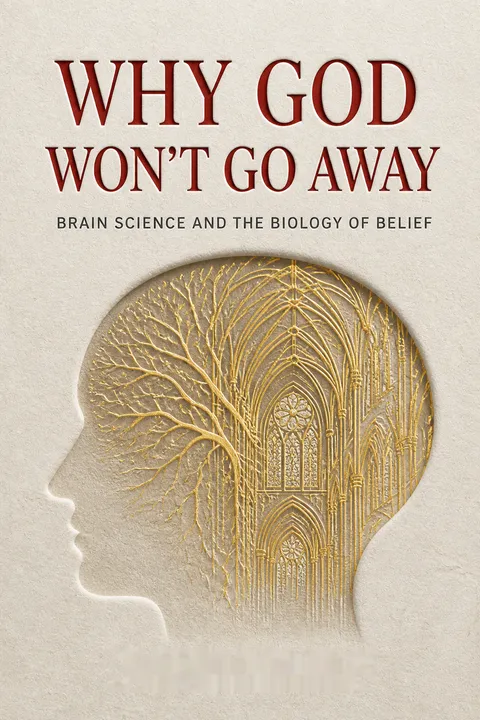
Why God Won't Go Away explores the neurological basis of religious experiences through brain imaging studies. Readers find the book's scientific approach intriguing, offering insights into how spiritual practices affect brain function. Some appreciate the attempt to reconcile science and religion, while others criticize the authors' speculative conclusions. The book is praised for its accessible explanation of complex neuroscience concepts but criticized for potential bias towards spirituality. Overall, readers find the exploration of the brain's role in religious experiences thought-provoking, even if not fully convincing.
People Also Read







Glossary
cognitive imperative
drive to make senseThe authors’ term for the brain’s persistent, biologically grounded drive to organize experience and resolve uncertainty. When an event has no obvious cause, the mind searches for an explanation, sometimes settling on a plausible story. The authors argue that this impulse helps account for the human tendency to create myths about existence, death, and suffering.
cognitive operators
general mental functionsThe authors’ label for broad functions through which the mind interprets experience, including identifying causes, contrasts, quantities, wholes, and emotional significance. These are not separate brain structures. They describe coordinated operations supported by multiple regions, which help turn sensory information into meaningful judgments, stories, and beliefs.
orientation association area
self and space processingThe authors’ accessible name for a region in the posterior parietal lobe involved in orienting the body in space and distinguishing the self from what is outside it. They propose that reduced input to this area may weaken the ordinary sense of bodily boundaries during some meditative or mystical experiences.
deafferentation
reduced neural inputA neurological term for a brain region receiving diminished input from other parts of the nervous system. The authors use it in a model of spiritual experience: if the orientation association area receives less sensory information, it may become less able to define the boundaries between the self and the surrounding world. The proposed role in meditation is a hypothesis.
unitary continuum
range of unity experiencesThe authors’ model placing experiences of absorption and self-transcendence along a spectrum. Mild examples include being deeply absorbed in music or a group ritual; more intense examples include mystical states in which the sense of self and separation from the world becomes greatly reduced. The model treats these experiences as differing in degree, not as wholly separate kinds.
Absolute Unitary Being
proposed ultimate unityThe authors’ term for a proposed extreme state of awareness in which distinctions between self and other, subject and object, and individual things disappear. They compare it with concepts such as Nirvana and the Tao, while acknowledging that neuroscience cannot establish whether the state reveals an ultimate reality or describes a brain-generated experience.
neurotheology
study of brain and religionAn interdisciplinary approach to the relationship between brain function and religious life. In the book, it includes the study of mystical experience, belief, myth, ritual, community, morality, and spiritual practice. The authors present it as a way to investigate how biological processes shape religious experience without assuming that neuroscience alone can answer theological questions.
interspirituality
dialogue across spiritual traditionsA term cited from Wayne Teasdale for respectful exchange among religious traditions that recognizes shared spiritual concerns without erasing their differences. In the book’s account, interspirituality does not create a uniform new religion. It aims to make insights and practices from different traditions available for dialogue and mutual understanding.
FAQ
1. What is Why God Won't Go Away by Andrew B. Newberg about?
- Explores spirituality and neuroscience: The book investigates the neurological basis of religious and mystical experiences, proposing that the human brain is biologically wired for spirituality.
- Introduction to neurotheology: It introduces the emerging field of neurotheology, which studies the relationship between brain function and spiritual experience.
- Core hypothesis: Newberg argues that spiritual experiences are real, measurable brain states, not just emotional or cultural phenomena.
- Bridges science and religion: The book seeks to explain why belief in God and spiritual experiences persist across cultures and history.
2. Why should I read Why God Won't Go Away by Andrew B. Newberg?
- Bridges science and faith: The book offers a rare synthesis of neuroscience and spirituality, appealing to both skeptics and believers.
- Groundbreaking research: It presents pioneering brain imaging studies that capture the neurological basis of spiritual states.
- Accessible and thought-provoking: Written in an engaging style, it invites readers to reconsider their views on consciousness, belief, and reality.
- Practical relevance: The book addresses everyday religious practices, community, morality, and emotions, making it relevant to personal and social life.
3. What are the key takeaways from Why God Won't Go Away by Andrew B. Newberg?
- Spirituality is biologically rooted: The human brain has evolved mechanisms that compel spiritual belief and experience.
- Brain activity validates spiritual states: Mystical and religious experiences correspond to measurable changes in brain function, especially in areas related to self-perception and emotion.
- Myth and ritual are essential: Myths and rituals are neurologically grounded, helping humans resolve existential questions and foster social cohesion.
- Science and religion can coexist: Understanding the biology of belief offers a new framework for appreciating the connection between mind, brain, and the quest for meaning.
4. What are the best quotes from Why God Won't Go Away by Andrew B. Newberg and what do they mean?
- “The mind is what the brain does.” This quote encapsulates the book’s central thesis that all mental and spiritual experiences are rooted in brain activity.
- “Spirituality is as much a part of human nature as sex, intelligence, or emotion.” It highlights the argument that the urge for spirituality is hardwired into our biology.
- “The mystical experience is biologically, observably, and scientifically real.” This statement affirms that mystical states are not mere illusions but have a measurable neurological basis.
- “God is ultimately unknowable, a metaphor for the Absolute Unitary Being.” This reflects the book’s view that all religious images of God are symbolic attempts to grasp an ineffable reality.
5. What scientific methods does Andrew B. Newberg use in Why God Won't Go Away to study spirituality?
- SPECT brain imaging: The authors used single photon emission computed tomography (SPECT) to measure blood flow in the brains of meditators and nuns during peak spiritual experiences.
- Timed meditative state capture: Subjects signaled their peak spiritual moments, allowing precise timing of brain scans to capture the height of spiritual absorption.
- Comparative analysis: Brain activity during normal states was compared to activity during meditation or prayer, revealing consistent patterns linked to mystical states.
- Empirical approach: This scientific rigor lends credibility to the study of spirituality and supports the book’s central claims.
6. What is the orientation association area (OAA) and its significance in Why God Won't Go Away by Andrew B. Newberg?
- Defines self vs. world: The OAA, located in the posterior superior parietal lobe, helps the brain distinguish the self from the external world.
- Decreased activity during mysticism: During peak spiritual states, the OAA shows reduced activity, leading to a loss of self-boundaries.
- Explains mystical unity: This neurological change may cause the brain to perceive the self as boundless and interconnected with all existence, matching descriptions of mystical experiences.
- Central to neurotheology: The OAA’s role is a cornerstone in the book’s argument for the biological basis of spiritual states.
7. How does Why God Won't Go Away by Andrew B. Newberg define the relationship between brain and mind?
- Brain creates the mind: The brain is the physical organ processing sensory, cognitive, and emotional data, while the mind is the phenomenon arising from this activity.
- Unity of mind and brain: The book argues that mind and brain are inseparable, like seawater and wave energy forming a single wave.
- Spirituality is brain-based: All spiritual experiences, including perceptions of God or the soul, occur within the brain’s neural pathways.
- Implications for belief: This view grounds spirituality in biology, making it scientifically investigable.
8. What are “cognitive operators” in Why God Won't Go Away by Andrew B. Newberg and how do they relate to spirituality?
- Mental organizing functions: Cognitive operators are general analytical functions of the mind that organize thoughts and feelings, enabling complex interpretation of the world.
- Key operators: The book highlights eight, including holistic, reductionist, causal, binary, existential, and emotional value operators.
- Role in myth and belief: Causal and binary operators are crucial for myth-making, helping the mind resolve existential fears by framing problems as opposites and finding resolutions.
- Neurological basis for myth: These operators, supported by specific brain regions, biologically compel humans to create and believe in myths.
9. How does Why God Won't Go Away by Andrew B. Newberg explain the human compulsion to create myths and religious stories?
- Myth as existential resolution: Myths arise from the mind’s need to resolve unanswerable questions like death, suffering, and meaning.
- Neurological architecture: The parietal lobe and language centers support the cognitive operators necessary for myth-making.
- Universal resonance: Myths unify logical and intuitive brain functions, producing a “ring of truth” that feels like ultimate reality.
- Cross-cultural similarities: This explains why myths are strikingly similar across different cultures and eras.
10. What role do rituals and rhythmic behaviors play in spirituality according to Why God Won't Go Away by Andrew B. Newberg?
- Neurological mechanism: Rituals use rhythmic, repetitive behaviors to stimulate the limbic and autonomic nervous systems, altering brain activity and emotional states.
- Inducing unitary states: Rituals can blur the boundaries of self and induce transcendent experiences by triggering deafferentation in the brain’s orientation area.
- Health and social benefits: Rituals reduce stress, foster feelings of calm, and strengthen group identity, supporting both individual and collective well-being.
- Foundation for religion: Rituals physically enact myths, making spiritual beliefs feel real and immediate.
11. How does Why God Won't Go Away by Andrew B. Newberg describe mysticism and its neurological basis?
- Mysticism defined: Mysticism is the process of achieving conscious union with the Absolute, involving the dissolution of the separate self.
- Neurological correlates: Mystical experiences involve altered brain states where normal boundaries of time, space, and self dissolve.
- Mental health connection: Research shows that genuine mystical experiences are linked to higher psychological well-being and clearer self-identity.
- Distinction from pathology: Mystical states are joyful and voluntary, unlike the confusion and fear often seen in psychosis.
12. What is Absolute Unitary Being in Why God Won't Go Away by Andrew B. Newberg and why is it important?
- Ultimate mystical state: Absolute Unitary Being is a state of pure, undifferentiated awareness without self, time, or space, described by mystics as the essence of ultimate reality.
- Neurological explanation: It results from complete deafferentation of the brain’s orientation areas, leading to the dissolution of the self.
- Cross-cultural concept: Known as Nirvana, Tao, or Brahman-atman, it represents the absolute oneness of all existence.
- Philosophical implications: This state challenges materialistic assumptions and suggests that awareness can exist independently of the self and the material world.
About the Author
Other books by Andrew B. Newberg
Download PDF
Download EPUB
.epub digital book format is ideal for reading ebooks on phones, tablets, and e-readers.








