

Key Takeaways
Hippie outsiders kept quantum interpretation alive until physics could use it
A neglected question returns. Before World War II, leading quantum physicists argued over what their equations said about reality. After the war, military research and rapidly growing university classes rewarded calculation and practical results. Interpretive questions were squeezed from courses and textbooks, even though the theory remained puzzling. In the 1970s, a loose circle of young physicists revived those questions, often in settings far from conventional departments.
An unlikely contribution. The group’s interest in psychic claims and Eastern thought did not make those claims true. Its consequential work was keeping foundational questions in circulation, especially Bell’s theorem and entanglement. Kaiser’s point is not that hippies alone rescued physics, but that their persistent, unconventional engagement helped preserve ideas that later supported quantum information science.
The history is a useful corrective to the idea that scientific progress is simply a relay race from one accepted result to the next. Research agendas depend on what institutions reward, teach, and fund. When practical calculation dominates, a conceptual question can look idle even if it later becomes technically fertile. The counterculture setting also complicates a simple opposition between science and its critics: some outsiders rejected scientific authority, while these physicists wanted more room to ask what science meant. That does not vindicate every fringe claim. It shows why a field benefits from keeping questions open while requiring evidence for answers.
Create small intellectual communities when official channels have no room
A group born from a gap. In 1975, Berkeley graduate students Elizabeth Rauscher and George Weissmann began weekly meetings for people curious about quantum theory’s meaning. They called the circle the Fundamental Fysiks Group. Its members included physicists with elite training, but many had poor job prospects as federal support and physics enrollments fell. In 1971, more than a thousand physicists sought jobs through a placement service that listed only 53 openings.
Conversation as infrastructure. The meetings offered what coursework and career pressures did not: time to follow difficult questions, test half-formed ideas, and hear criticism from peers. The group’s Friday discussions helped connect experimentalists such as John Clauser with theorists and students. Informality did not guarantee good conclusions, but it gave neglected problems a community in which they could be developed.
The group illustrates a basic feature of collaborative thought: a room can be intellectual infrastructure. A question that feels career-threatening in a formal seminar may become discussable among peers who share the risk. This is especially important for young researchers, who often lack both authority and institutional security. The example also carries a caution. A tight community can encourage exploration, but shared enthusiasm can reinforce weak assumptions. Its value depends on allowing dissent, careful argument, and contact with people outside the circle.
Use Bell's theorem to test locality, not to claim telepathy
A mathematical boundary. Bell’s theorem asks whether quantum predictions can be reproduced by a theory in which distant particles carry pre-existing properties and measurements at one location do not affect the other. For pairs of entangled particles, quantum mechanics predicts correlations that violate a limit imposed by that kind of local hidden-variable theory. Entanglement means that the combined system has linked measurement outcomes, even when its parts are separated.
A result with limits. John Clauser and collaborators tested these predictions experimentally in 1972, finding results consistent with quantum mechanics. The correlations are real, but they do not let a person send a controllable message faster than light. Members of the Berkeley group helped bring Bell’s overlooked work to attention, while physicists including Clauser and Philippe Eberhard clarified what the results did and did not imply.
Bell’s theorem is powerful partly because it turns a philosophical disagreement into a measurable constraint. It does not tell researchers which complete interpretation of quantum mechanics is correct, and it does not establish that every proposed explanation is equally plausible. That distinction matters whenever a striking scientific result is used to support a much broader claim. The theorem shows that a familiar picture of independent local properties cannot reproduce quantum correlations. It does not provide a shortcut from quantum weirdness to paranormal causation.
Let speculative questions generate tests, but make evidence carry the claim
The psi connection. Several members explored psi, a term for purported abilities such as telepathy, remote perception, and psychokinesis. At Stanford Research Institute, physicists Harold Puthoff and Russell Targ reported experiments in which subjects tried to describe distant locations. This practice became known as remote viewing. The claims attracted government funding and attention from physicists interested in whether quantum nonlocality might offer an explanation.
Interest is not confirmation. The Berkeley group tried to repeat the remote-viewing studies in 1975 but found no statistically significant results. Uri Geller’s spoon-bending claims also came under pressure from magicians who demonstrated ordinary tricks that could imitate them. Jack Sarfatti withdrew his initial endorsement of Geller after seeing such demonstrations. The episode shows both the value of investigating unusual claims and the need to separate a possible research question from evidence that it is true.
The group’s best methodological impulse was to ask whether unusual reports could be tested rather than dismissed by reputation alone. Its weakest impulse was sometimes to move too quickly from a possible effect to a preferred physical explanation. A rigorous experiment can investigate a claim without endorsing it, and a failed replication can be informative without proving that every related claim is impossible. The useful standard is proportionality: confidence should track the quality, repeatability, and independence of the evidence.
Borrow unconventional support without mistaking access for validation
New patrons, new rooms. With university jobs and federal support dwindling, physicists sought help from wealthy individuals and alternative institutions. Werner Erhard, whose est seminars made him a prominent self-help entrepreneur, funded the Physics/Consciousness Research Group. Engineer Arthur Young and toy manufacturer Henry Dakin hosted discussion groups, while the Esalen Institute in Big Sur provided a regular setting for workshops on Bell’s theorem and reality.
A mixed ecosystem. Government interest in psi research also supported Puthoff and Targ’s work at SRI, although this was not the same as direct funding for every Berkeley activity. The unusual support let researchers meet and exchange ideas. It also made their work vulnerable to patrons’ priorities and public controversy. Separate conferences financed by Erhard’s foundation drew leading mainstream physicists, showing how unusual funding could support serious research without making every claim associated with its source credible.
Funding is not a neutral background condition. A patron can create time, space, and continuity for work that conventional agencies neglect. The same arrangement may shape which questions receive attention and make researchers dependent on an individual’s interests. This history cautions against judging research solely by the identity of its sponsor, whether respectable or eccentric. Better questions concern intellectual independence, transparent methods, and whether other researchers can examine the results.
Build networks that move ideas beyond journals and departments
An informal circulation system. Ira Einhorn, a Philadelphia counterculture organizer with contacts in science, business, and publishing, helped distribute preprints and essays by the Berkeley physicists. Bell Telephone employees handled copying and postage for his mailings. His list grew to more than 300 people in over 20 countries, carrying papers to readers who might never encounter them in a standard journal.
A fragile channel. The network also connected physicists with publishers and audiences beyond academia. It ended abruptly after police found Holly Maddux’s body in Einhorn’s apartment and he was arrested. Bell Telephone stopped the mailings, and later efforts did not match the original network’s reach. The story shows how much intellectual exchange can depend on informal connectors, and how vulnerable such exchange is when it lacks durable institutions.
A scientific community is partly a communications system. Ideas need routes through which they can be noticed, criticized, and adapted. Einhorn’s network reached across professional boundaries at a time when ordinary journals were inhospitable to interpretive work. Its weakness was the same as its strength: a small number of people could move material quickly, but the system depended on personal relationships and corporate goodwill. Durable networks need both initiative and continuity.
Translate quantum physics widely, but keep metaphor distinct from proof
Books carry the questions. Fritjof Capra’s The Tao of Physics compared modern physics with Eastern mystical traditions. It reached readers who rarely encountered quantum foundations in standard courses; by 1983, about half a million copies were in print. Gary Zukav’s The Dancing Wu Li Masters and other popular books also brought Bell’s theorem, uncertainty, and quantum puzzles to large audiences.
Analogy has limits. Capra’s book helped some physics teachers attract students and build courses around interpretation. Critics, however, argued that it grouped distinct religions together and selected quotations that made physics and mysticism seem more alike than the evidence warranted. The books succeeded as invitations to learn, but their metaphors could blur distinctions between mathematical claims, spiritual ideas, and scientific proof.
Popular explanation is not merely a simplified version of expert knowledge. It changes which questions appear important and who feels entitled to ask them. Capra’s success gave students an entry point into material that their courses often omitted. Yet analogy can be a bridge or a trap: a resemblance in language does not establish a shared mechanism or truth. The strongest science communication makes the invitation vivid while labeling where the comparison stops.
A failed faster-than-light scheme can expose a powerful quantum rule
A proposed shortcut. Nick Herbert and other group members wondered whether entangled particles could carry messages faster than light. Herbert’s FLASH design tried to use a laser to amplify one photon into many copies, making its state easier to detect at a distant receiver. The proposal failed, but its precise design gave physicists a concrete problem to analyze.
A limit becomes clear. The no-cloning theorem states that an unknown, arbitrary quantum state cannot be copied perfectly. Quantum mechanics is linear, so a device cannot duplicate every possible input state in the way FLASH required. Physicists including GianCarlo Ghirardi, Tullio Weber, Bill Wootters, and Wojciech Zurek developed related arguments. Their work turned a failed communication scheme into a clearer understanding of quantum theory.
The productive part of a mistaken idea is not the mistake itself. It is the way a detailed proposal makes hidden assumptions inspectable. Herbert’s design forced physicists to ask exactly what a quantum amplifier could do, and which operations the theory forbids. This is a strong model of theoretical criticism: replace a vague rejection with a specific impossibility argument. The history should not, however, be recast as evidence that every implausible proposal deserves equal attention.
Turn quantum limits into encryption that exposes eavesdropping
A physical security check. The BB84 protocol, devised by Charles Bennett and Gilles Brassard in 1984, uses photon polarization to help two parties create a shared secret key. They publicly compare which measurement bases they used, keep results from matching choices, and check a small sample for interference. If an eavesdropper measures the photons, the quantum states are disturbed, raising the chance of detection.
The crucial constraint. The no-cloning theorem prevents an eavesdropper from making perfect copies of arbitrary unknown quantum states and forwarding the originals untouched. That gives quantum key distribution a security principle rooted in physics rather than only in the practical difficulty of solving a mathematical problem. Demonstrations in Vienna in 2004 and Geneva in 2007 used quantum encryption for a bank transfer and electronic voting.
This is a striking example of a limitation becoming an engineering resource. Conventional encryption often depends on attackers lacking enough computational power; quantum key distribution instead uses detectable disturbance as part of its design. That does not mean every surrounding computer system is invulnerable, or that a secure key automatically secures every device and procedure. The achievement is narrower and more interesting: certain attempts to learn the key leave evidence because measurement changes the system.
Clauser's landmark Bell test still could not secure him a physics post
Data were not enough. John Clauser’s 1972 experiment tested Bell’s theorem and found results consistent with quantum mechanics, yet many physicists dismissed the topic as not real physics. Clauser struggled to find an academic position. Even Alain Aspect’s more refined experiments in the early 1980s did not immediately trigger a broad rush into quantum foundations.
Recognition required a shift. As physics budgets, class sizes, and curricula changed, interpretive questions gradually returned to seminars and textbooks. The group’s work, the experiments, and the availability of new forums all contributed. The history challenges a simple story in which decisive evidence automatically wins acceptance. Data need instruments, communities, teachers, and institutions willing to treat the question as worth pursuing.
Scientific evidence has force, but it does not circulate by itself. Researchers must be able to publish results, obtain jobs, train students, and persuade colleagues that a problem belongs within the field. Clauser’s experience makes the distinction between experimental success and professional recognition concrete. At the same time, institutional resistance is not proof that a rejected idea is correct. Evidence earns lasting authority through sustained testing and criticism, not through marginal status alone.
Review Summary
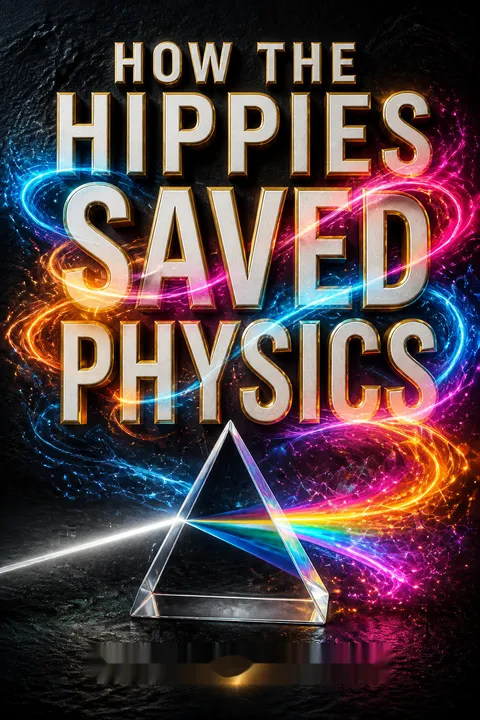
How the Hippies Saved Physics received mixed reviews. Some readers found it fascinating, praising Kaiser's blend of science history and counterculture exploration. They appreciated the insights into quantum physics and the Fundamental Fysiks Group's role. Others felt the book exaggerated the hippies' impact on physics and found it lacking in scientific depth. Critics noted the focus on fringe ideas and personalities rather than mainstream physics developments. Overall, readers valued the book's unique perspective but disagreed on its significance to physics history.
People Also Read








Glossary
Fundamental Fysiks Group
Berkeley foundations discussion groupAn informal circle of physicists and students organized in Berkeley in 1975 by Elizabeth Rauscher and George Weissmann. The group met regularly to discuss the interpretation of quantum mechanics, especially Bell’s theorem, entanglement, and questions about consciousness. Some members also pursued parapsychology and New Age ideas. Its discussions helped keep quantum foundations in circulation during a period when many physicists avoided the subject.
Bell's theorem
Test of local hidden variablesA result showing that theories in which distant particles have pre-existing properties and obey local influences cannot reproduce all the correlations predicted by quantum mechanics. Experiments on entangled particles can test the differing predictions. Violations of Bell inequalities support quantum predictions over local hidden-variable models, but they do not allow controllable faster-than-light communication.
Entanglement
Correlations linking quantum systemsA condition in which a combined quantum system has properties that cannot be fully described as independent properties of its separate parts. Measurements on separated components can show strong correlations, even when the components no longer interact. Entanglement is central to Bell’s theorem and to technologies such as quantum information processing and quantum key distribution.
No-cloning theorem
Rule against perfect quantum copiesA quantum-mechanical result stating that no device can make perfect copies of an unknown, arbitrary quantum state. Copying a state can work for certain known or restricted sets of states, but not for every possible input. The limit blocks proposed ways to exploit entanglement for faster-than-light messaging and helps make quantum key distribution sensitive to eavesdropping.
BB84 protocol
Quantum key distribution methodA protocol proposed by Charles Bennett and Gilles Brassard in 1984 for creating a shared secret key using photon polarization. The parties compare measurement bases over a public channel, retain results from compatible choices, and test a sample for disturbance. Because measurement can alter an unknown quantum state, interception can reveal itself through errors in the sample.
No-signaling theorem
Entanglement cannot send messages fasterA result that operations on entangled systems cannot be used to transmit controllable information faster than light. Although measurement outcomes can be correlated across large distances, each observer’s local results appear random until records are compared through an ordinary communication channel. The theorem reconciles quantum nonlocal correlations with the absence of faster-than-light messaging.
Delayed-choice experiment
Measurement choice made after passageA thought experiment associated with John Wheeler in which an experimenter chooses how to measure a quantum particle after it has passed through an earlier part of the apparatus. The choice determines which experimental pattern is recorded, such as interference or path information. The setup explores how measurement arrangements shape the applicable quantum description; it does not show that people can send signals into the past.
Remote viewing
Attempted perception of distant targetsA claimed psi ability in which a person describes a location or target without ordinary sensory access to it. In studies at Stanford Research Institute, a subject described impressions while an outbound team visited a selected site. Reports were compared with target locations by judges. The findings were disputed, and a Berkeley group’s attempted replication did not produce statistically significant results.
Participatory universe
Wheeler's observer-involving viewJohn Wheeler’s view that observers are not entirely detached from the physical world they investigate. The choice of measurement affects which properties of a quantum system can be recorded, leading Wheeler to describe observers as participants. Wheeler extended the idea into broader claims about reality and the universe, claims that remain distinct from the narrower experimental fact that measurement arrangements affect quantum outcomes.
FAQ
What's How the Hippies Saved Physics about?
- Quantum Revival: The book explores how the counterculture of the 1960s and 1970s, particularly the hippie movement, influenced the revival of interest in quantum physics. It highlights the contributions of physicists who engaged with philosophical questions about quantum mechanics.
- Fundamental Fysiks Group: Central to the narrative is this informal assembly of physicists who discussed the implications of quantum theory, including Bell's theorem and nonlocality, aiming to reconnect physics with broader philosophical and spiritual questions.
- Cultural Context: The book situates these scientific discussions within the broader cultural upheaval of the time, illustrating how the psychedelic and New Age movements intersected with scientific inquiry.
Why should I read How the Hippies Saved Physics?
- Unique Perspective: The book offers a fresh perspective on the intersection of science and counterculture, showing how unconventional ideas can influence mainstream scientific thought.
- Engaging Storytelling: David Kaiser weaves a narrative that is both informative and entertaining, filled with anecdotes about key figures in the physics community and their unconventional pursuits.
- Relevance to Modern Science: The themes explored, such as the nature of reality and consciousness, remain relevant today as physicists continue to grapple with the implications of quantum mechanics.
What are the key takeaways of How the Hippies Saved Physics?
- Interconnectedness of Science and Culture: The book emphasizes that scientific progress is often influenced by cultural and philosophical movements, challenging the traditional view of science as an isolated discipline.
- Importance of Philosophical Inquiry: Kaiser argues that philosophical engagement with scientific concepts is essential for deeper understanding, as demonstrated by the Fundamental Fysiks Group's discussions.
- Legacy of the Fundamental Fysiks Group: Their contributions laid the groundwork for modern developments in quantum information science, illustrating the value of interdisciplinary collaboration.
What is Bell's theorem, and why is it significant in How the Hippies Saved Physics?
- Definition of Bell's Theorem: It posits that if quantum mechanics is correct, then particles that have interacted can remain connected in ways that defy classical notions of locality.
- Implications for Nonlocality: The theorem challenges traditional views of causality and locality in physics, suggesting a fundamentally interconnected universe.
- Connection to the Fundamental Fysiks Group: The group engaged deeply with Bell's theorem, using it to explore broader questions about consciousness and the nature of reality.
How did the hippie movement influence physics, according to How the Hippies Saved Physics?
- Cultural Shift: The hippie movement encouraged a cultural shift that embraced alternative ways of thinking, including spirituality and holistic approaches to understanding reality.
- Formation of the Fundamental Fysiks Group: The movement inspired the formation of this group, where physicists could freely discuss and speculate on the implications of quantum mechanics.
- Funding and Support: The counterculture provided new sources of funding and support for unconventional research, allowing the group to pursue ideas that traditional funding sources would have deemed too fringe.
Who were the key figures in the Fundamental Fysiks Group?
- Ira Einhorn: Known as the "Unicorn," he facilitated communication among physicists and promoted ideas linking quantum physics with consciousness.
- Jack Sarfatti: Known for his bold ideas about superluminal communication and quantum entanglement, he played a significant role in the group's discussions.
- Fritjof Capra: Author of The Tao of Physics, his work bridged modern physics and Eastern mysticism, influencing many in the group.
How did the Fundamental Fysiks Group contribute to the revival of interest in quantum mechanics?
- Challenging Conventional Wisdom: The group actively questioned established scientific norms and explored unconventional ideas, revitalizing discussions around quantum mechanics.
- Fostering Collaboration: By creating a supportive community, the group encouraged collaboration among physicists, philosophers, and New Age thinkers.
- Influencing Future Research: Their discussions and experiments laid the groundwork for future research in quantum mechanics, including quantum information science.
What role did the CIA and military funding play in the narrative of How the Hippies Saved Physics?
- Funding for Parapsychology: The CIA and military funding supported research into parapsychology and psi phenomena during the Cold War, creating an environment for exploring unconventional ideas.
- Connection to the Fundamental Fysiks Group: Members often found themselves at the intersection of these military interests and their own explorations of consciousness and quantum mechanics.
- Impact on Scientific Inquiry: This involvement illustrates how political and military interests can shape scientific inquiry, raising questions about the motivations behind research.
What is the no-cloning theorem, and why is it important?
- Definition of No-Cloning Theorem: It states that it is impossible to create an identical copy of an arbitrary unknown quantum state, a fundamental principle of quantum mechanics.
- Implications for Quantum Communication: The theorem underpins the security of quantum encryption methods, ensuring that information cannot be copied or intercepted without detection.
- Impact on Quantum Information Science: It has become a foundational principle, influencing research and applications in quantum computing and secure communications.
How did the cultural context of the 1960s and 1970s affect the physicists discussed in How the Hippies Saved Physics?
- Counterculture Influence: The movement encouraged questioning authority and traditional norms, resonating with physicists' desire to explore unconventional ideas.
- Interdisciplinary Connections: The blending of science with philosophy, spirituality, and alternative lifestyles was characteristic of the era, inspiring a holistic approach to scientific inquiry.
- Resistance to Mainstream Science: The cultural context created tension with the established scientific community, which often viewed their ideas as fringe or unscientific.
What experiments did John Clauser conduct, and what were their outcomes?
- First Experimental Test of Bell's Theorem: Clauser's 1972 experiment tested quantum mechanics against local hidden-variable theories, supporting quantum mechanics.
- Subsequent Experiments: He continued to refine his experiments, addressing criticisms and improving methodology, laying the groundwork for future research.
- Recognition and Impact: Despite initial skepticism, Clauser's experiments are now foundational in quantum mechanics, influencing both theoretical and experimental physics.
How does How the Hippies Saved Physics relate to contemporary discussions in physics?
- Ongoing Relevance of Quantum Foundations: The book highlights foundational questions in quantum mechanics, which remain relevant as physicists grapple with quantum theory's implications.
- Cultural and Scientific Intersections: The interplay between culture and science is increasingly recognized in discussions about science's role in society, evident in interdisciplinary research.
- Legacy of the Fundamental Fysiks Group: Their influence is seen in modern physics education and research, emphasizing philosophical inquiry and exploration of unconventional ideas.
Download PDF
Download EPUB
.epub digital book format is ideal for reading ebooks on phones, tablets, and e-readers.








