


Key Takeaways
Treat right and wrong as context-sensitive perceptions, not final destinations.
Two kinds of logic. De Bono contrasts rock logic, which sorts things into fixed categories such as right and wrong, with water logic, which asks how an idea fits the circumstances and what it leads to. A pen has no single, permanent value: its usefulness depends on who needs it and what they need to write. The point is not that every judgment is equally good. It is that conclusions based on one set of conditions may not hold under another.
Context changes the answer. The book uses Japanese business leaders who cooperate as industry peers, then compete fiercely for customers. De Bono sees no contradiction: each relationship fits a different setting. He argues that this contextual approach can help people move beyond winner-takes-all judgments in human affairs, where values and circumstances are rarely identical.
What's striking is the distinction between a judgment and the conditions that support it. In law, medicine, and public policy, outcomes often depend on context, so stating assumptions can make disagreement more useful. But contextual judgment cannot replace every firm boundary. Rights and safety rules sometimes need to remain stable precisely because powerful actors can redefine circumstances to suit themselves. The practical lesson is to ask both what principle applies and what relevant conditions might change its application. Water logic is most persuasive as a supplement to clear rules, not as permission to improvise without limits.
Use patterns for speed, but test what they make you overlook.
Fast recognition has a price. De Bono models the brain as a system that organizes experience into patterns. Once a pattern forms, a small cue can activate a much larger interpretation. This makes ordinary life manageable: a plate is recognized from different angles without conscious measurement, and familiar tasks do not need to be worked out from scratch.
A cue can mislead. The same shortcut can turn an incomplete scene into a confident story. De Bono describes a helper bending over an injured woman who is wrongly assumed to have caused her injury. The observer sees a familiar arrangement and fills in the missing cause. Labels and stereotypes work similarly: they can direct attention toward a ready-made explanation before the details are examined.
This account connects with predictive processing, the idea that perception combines incoming signals with expectations built from prior experience. Such expectations are not defects by themselves; without them, recognition would be slow and noisy. The risk comes when confidence is mistaken for direct observation. In eyewitness accounts, workplace judgments, and online media, a useful check is to separate what was actually noticed from what the mind inferred. De Bono's pattern model is a helpful explanation of that danger, though it should be treated as a broad model of perception rather than a complete neurological account.
A creative answer can be obvious afterward and unreachable beforehand.
Patterns hide side roads. De Bono argues that thought tends to follow the most established route through a pattern. Other routes may be invisible until some new entry point brings them into view. This is why an idea can seem obvious once discovered, even though ordinary reasoning did not lead to it. Humour illustrates the switch: a joke redirects the listener to an alternative interpretation, which then makes sense in retrospect.
Insight is a change of route. De Bono calls deliberate movement across established patterns lateral thinking. He distinguishes it from simply improving an argument along the same route. The book describes how a new way of thinking helped Olympic organizer Peter Ueberroth develop concepts for the 1984 Los Angeles Games, which had faced the risk of financial failure. Creative thinking, in this view, can be practiced rather than left entirely to luck or genius.
The distinction between generating an idea and justifying it is valuable. Research and invention often involve a leap, followed by careful checking, rather than deduction alone. Hindsight can obscure that difference: once an idea works, its path appears more inevitable than it was. Still, not every surprising detour is a breakthrough. Creativity needs selection, evidence, and implementation, or novelty becomes noise. De Bono's case is strongest when lateral thinking is understood as a way to generate candidates for consideration, not as a guarantee that an unusual idea is useful.
Use provocation to step outside the route your mind already follows.
Give thought a jolt. De Bono uses po to mark a provocation: a deliberately unusual statement that is not offered as a literal conclusion. A prompt such as imagining square-wheeled cars can interrupt familiar assumptions. The thinker then uses movement, a separate operation from judging, to explore what the provocation might suggest. In the book's example, the thought leads toward suspension that lets a vehicle move more smoothly over uneven ground.
Chance can provide an entry. Random entry applies the same principle by bringing an arbitrary word into a problem. De Bono describes pairing cigarette design with traffic lights, which suggested a warning band on a cigarette to mark a point for reconsidering or stopping. The odd association is not the finished answer. It is a way to activate ideas that routine analysis might not reach.
The method resembles deliberate variation in design: introduce a constraint or an unexpected component, then see what new possibilities become thinkable. Its strength is procedural. It gives a team something to do when discussion is circling familiar options. Its limitation is equally important: randomness does not make an idea sound, ethical, or feasible. The useful sequence is disruption, exploration, and evaluation. Without that final scrutiny, a provocative session can produce entertaining nonsense and mistake energy for progress.
Insert structured pauses before attention hardens into certainty.
Attention can be directed. De Bono argues that what people notice depends partly on which patterns are ready to activate. A simple instruction to look for one feature in a crowd can make that feature suddenly stand out. His CoRT programme teaches deliberate attention tools, including looking for positives, negatives, and points of interest, considering consequences, and examining other people's views.
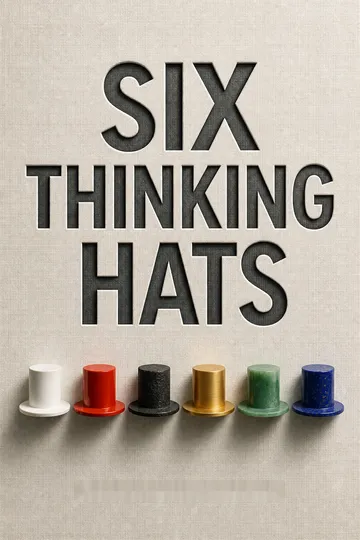
A pause widens the view. The Six Thinking Hats method creates separate contexts for a discussion: participants take turns focusing on information, feelings, risks, benefits, new possibilities, or the process itself. Rather than mixing every kind of thinking into one argument, the group gives each a defined moment. De Bono also proposes po as a zero-hold, a pause that delays an immediate reaction so that more information can be taken in before a familiar response takes over.
Structured attention is a practical response to a real problem: people cannot notice every relevant factor at once, and group discussion often rewards the fastest objection. Separating modes of thought can make overlooked information visible and reduce premature conflict. The same principle appears in checklists and structured decision reviews, which protect attention from predictable omissions. These tools are not neutral by magic; the chosen lenses determine what gets airtime. A group still needs to ask whose perspectives are missing and whether the categories fit the decision at hand.
Pair analysis with design when no single cause can be removed.
Analysis has a boundary. When a problem has a clear, removable cause, analysis can point to a direct fix: remove a pin from a shoe, for example. But social and organizational problems often involve many interacting causes, or causes that cannot simply be eliminated. De Bono argues that collecting and sorting more data will not automatically generate a new way forward, because people interpret data through ideas they already have.
Design asks what comes next. Instead of only diagnosing what is wrong, design starts from the situation as it exists and creates a workable route forward. The book's queue example adds a paid faster-service option, giving people a choice rather than merely optimizing the existing line. Likewise, changing a system's incentives can alter behavior without requiring a perfect explanation of every motive.
The distinction between diagnosis and design maps onto a familiar divide in engineering and public policy. Causal knowledge helps explain how a system behaves; design asks which intervention is likely to improve it. Complex problems often demand both, with small trials used to learn how a proposed change behaves in practice. De Bono is right that analysis alone can become an excuse for delay. Yet design without diagnosis can shift costs onto people who were not considered. Good practice alternates between understanding the system, proposing an intervention, and checking its effects.
Replace false binaries with a scale of fit and circumstance.
Two boxes can distort a spectrum. De Bono argues that categories such as friend and enemy, innocent and guilty, or democracy and dictatorship can force complex situations into a misleading either-or. Once a person is placed in one category, the other may seem impossible, even when relationships or evidence are mixed. He points to the Scottish verdict of not proven as an example of a legal category between guilt and innocence.
Good things can turn bad. The Laffer curve illustrates another weakness in fixed categories: more of a beneficial thing is not always better. Increased taxes may raise revenue up to a point, then reduce it; greater efficiency can make an organization brittle if it loses all spare capacity. De Bono calls attention to this pattern with the analogy of salt: a useful amount improves a meal, while too much ruins it.
Spectrums and thresholds help represent situations that binary labels flatten. In policy, for example, a measure can be beneficial at one level and harmful at another, while the turning point depends on the setting. This makes explicit criteria more useful than slogans about more or less. But binaries also have legitimate uses: clear categories can protect people, coordinate action, and prevent endless negotiation over urgent decisions. The task is not to abolish them. It is to notice when a convenient classification has been mistaken for a complete description.
Change rules when institutions reward the wrong game.
Incentives shape conduct. De Bono calls the tendency to play by a system's rules, even when the result undermines its broader purpose, ludecy. It need not involve greed or bad character. Lawyers pursuing large settlements, politicians avoiding unpopular choices, and businesses optimizing for short-term stock movements may each be responding rationally to the incentives around them.
Organizations can lose their purpose. A bureaucracy created to accomplish a task may become focused on preserving itself, because avoiding visible mistakes is safer than proposing changes. De Bono connects this to short-term thinking: quarterly business reports, election cycles, and daily news deadlines all reward near-term results. Criticizing individuals may miss the point. If the rules consistently produce the same unwanted behavior, changing the rules may matter more than asking people to behave better.
This argument aligns with institutional economics and public-choice theory, which study how incentives shape behavior even when participants are not malicious. It encourages a shift from moralizing about bad actors to examining what the system makes rational. However, incentives rarely explain everything. Professional norms, leadership, and public scrutiny can change behavior too, and redesigned rules can create new distortions. The strongest application is diagnostic: identify what success is measured by, who bears the cost, and which behaviors the current setup quietly rewards.
Teach doing and thinking skills, not only facts and critique.
Knowledge does not operate itself. De Bono argues that education often teaches subject matter and evaluates students' ability to analyze or criticize it, while leaving practical thinking skills implicit. Yet life requires people to identify relevant factors, set priorities, consider consequences, generate alternatives, and make decisions. He calls this capacity operacy, the skill of putting knowledge into action.
Practice makes thinking visible. The CoRT programme, short for Cognitive Research Trust, teaches thinking directly through structured exercises. Tools include looking at consequences and considering other people's points of view. De Bono reports that students' self-image can shift from seeing themselves as simply intelligent to seeing themselves as people who can improve their thinking. The claim is that thinking should be taught as a skill, not assumed to emerge automatically from studying other subjects.
The distinction between knowing content and using it is central to education design. Students may understand a principle in class yet struggle to apply it in an unfamiliar setting, so explicit practice can help make thinking strategies available. Transfer is not automatic, though: a tool learned in one lesson may not appear in a different subject or real-world decision unless teachers help students recognize when it applies. Teaching thinking also requires evidence of learning, not just a named curriculum. The proposal is most convincing when skills are practiced across contexts and assessed through actual decisions.
Reserve capacity for redesign before the next crisis forces it.
The next step inherits the past. De Bono argues that systems tend to build on what is already in place, because each decision is made from a particular starting position. A sequence of sensible small steps can still lead to a structure that is hard to change. He compares this to arranging shapes one by one: an early choice may need to be undone before later pieces can form a better whole.
Change needs room. The book describes society as fully committed, with no spare time, people, or resources for new approaches. Education illustrates the problem: adding thinking skills means taking time from an already crowded curriculum. De Bono proposes a middle path between gradual evolution and disruptive revolution, which he calls provolution: deliberate, cumulative change aimed at improvement rather than destruction. History remains useful, but resources also need to be directed toward future design.
This is an argument for slack as a condition of adaptation. A system that uses every resource for immediate demands may perform efficiently under familiar conditions yet lack room to experiment when those conditions change. Organizations use research budgets and pilot projects for this reason, although they can become symbolic if they are disconnected from real decisions. De Bono's account also warns against treating every inherited structure as inevitable. Still, redesign has costs and uncertain outcomes. Useful change preserves the ability to learn, tests alternatives, and makes space for revision rather than betting everything on a single blueprint.
Analysis
The book's central move is to shift attention from the correctness of conclusions to the way conclusions become available. De Bono argues that perception is not a transparent reading of the world. A brain that organizes experience into patterns gains speed and coherence, but those same patterns shape what is noticed, what is ignored, and which explanations feel obvious. On this account, logic can rigorously develop a conclusion while leaving its starting perceptions untouched. That is why argument often strengthens disagreement instead of dissolving it.
The most useful consequence is a broader conception of thinking. Analysis and criticism remain valuable, but they cannot do the work of generating alternatives, redesigning systems, or deliberately changing perspective. De Bono offers practical counterweights: provocation, random entry, attention-directing tools, structured discussion, and direct instruction in thinking. These methods make creativity less mystical and more like a practice that can be attempted, evaluated, and improved. His institutional analysis extends the same idea: people often follow incentives that preserve an organization or game even when those outcomes frustrate its purpose.
The scientific case needs more restraint than the social and practical argument. A simple self-organizing model can illuminate pattern recognition, context, and insight without being a full account of how the brain works. Contemporary cognitive science supports the broad point that prior expectations shape perception, but that does not establish all of de Bono's neurological explanations. Likewise, the critique of argument risks understating its democratic role. Adversarial scrutiny can expose misconduct, give minority positions a hearing, and prevent an appealing design from escaping evidence.
The strongest reading, then, is not to replace rock logic with water logic, but to use each where it fits. Stable rules are necessary for accountability; contextual judgment is necessary when situations vary. Critique helps test proposals; generative thinking supplies proposals worth testing. The book's lasting challenge is to stop treating one mode of thought as sufficient. Better thinking means coordinating perception, analysis, imagination, and action, while remaining alert to the blind spots each mode creates.
Review Summary
I Am Right You Are Wrong receives mostly positive reviews, with readers praising its thought-provoking ideas on perception, creativity, and alternative thinking methods. Many find it life-changing and insightful, appreciating de Bono's challenge to traditional Western logic. Some criticize the writing style as repetitive or difficult to follow. Reviewers highlight concepts like "water logic" and lateral thinking as particularly valuable. While some find the ideas dated, many still consider the book relevant and transformative in approaching problem-solving and communication.
Glossary
Rock logic
Fixed-category reasoningDe Bono's name for reasoning that treats identities and categories as stable and sharply bounded. It relies on distinctions such as right or wrong, true or false, and is or is not. This mode is useful for clear decisions and formal systems, but can distort situations whose meaning depends on circumstances.
Water logic
Context-dependent reasoningDe Bono's alternative metaphor for reasoning that attends to circumstances, relationships, and outcomes. Like water taking the shape of its surroundings, an idea is judged by how well it fits a situation and what it leads to. Water logic is not meant to imply that every choice is equally valid.
Self-organizing system
Information organizing itselfAn active information system in which interactions among inputs and the system's structure produce patterns without an external operator directing each step. De Bono uses this as a model for how the brain may organize experience, recognize patterns, and produce perception. The model is a broad account of system behavior, not a complete description of brain anatomy.
Lateral thinking
Pattern-changing idea generationDe Bono's term for methods that deliberately move thought across established patterns to generate new concepts or perceptions. It contrasts with simply following a familiar line of reasoning. Techniques such as provocation and random entry provide unfamiliar starting points, which are then explored and assessed for useful ideas.
Po
Provocation or pause signalA word De Bono introduced to signal an unusual statement that should be explored rather than judged literally. A po statement can interrupt an established pattern and open a route to new ideas. De Bono also uses the word to suggest a pause that delays an automatic reaction, allowing attention to remain open.
Movement
Exploring an idea's directionA thinking operation that explores where an idea might lead instead of immediately judging whether it matches existing assumptions. In lateral thinking, movement helps a thinker use a provocation as a starting point and develop any useful implications. It does not mean accepting the provocation as true or abandoning later evaluation.
Zero-hold
Pause before pattern selectionDe Bono's proposed capacity to take in information without immediately following the most familiar interpretation or emotional response. He compares it to having a neutral position in thought. The signal po can create a practical pause, although a living brain cannot literally stop all pattern-forming activity.
Operacy
Skill in putting knowledge to workDe Bono's term for the practical thinking skills needed to act effectively, rather than merely possess information. Operacy includes considering consequences, identifying relevant factors, setting priorities, defining objectives, and taking other people's interests into account. He argues that education should teach these abilities explicitly.
CoRT
Direct thinking-skills programmeShort for Cognitive Research Trust, CoRT is a structured programme created by De Bono to teach thinking as a skill. Its lessons use practical tools to direct attention, such as examining positive, negative, and interesting aspects of a proposal, considering consequences, or exploring other people's perspectives. The book describes it as a school programme rather than simply a theory of thinking.
Six Thinking Hats
Structured modes of group thoughtA De Bono method that assigns a group distinct modes of attention in sequence. Participants consider information, feelings, risks, benefits, alternatives, and the management of the thinking process as separate tasks. The method aims to reduce unproductive argument by helping a group focus on one kind of thinking at a time.
Ludecy
Playing by a system's rulesDe Bono's term for pursuing a game according to the incentives and rules as they are written, even when the result may conflict with the system's broader purpose. A lawyer, politician, or company may behave this way without unusual selfishness. The concept directs attention toward the rules that make a particular strategy rational.
Provolution
Cumulative designed changeDe Bono's proposed term for change that is more deliberate and far-reaching than gradual evolution but less destructive and abrupt than revolution. It describes incremental steps guided by a constructive aim, rather than steps focused on defeating an enemy or preserving the status quo. The concept emphasizes changing perceptions and systems without first destroying them.
Stratal
Layered statements for perceptionA form of communication De Bono proposes to sensitize attention through several brief statements placed alongside one another. The statements need not form an argument, reach a conclusion, or remove every contradiction. Their purpose is to build a layered impression of a subject, somewhat as poetry can combine images to shape an overall perception.
Hodics
Notation for flow logicDe Bono's name for a system of notation intended to represent water logic, especially how circumstances and conditions shape the way situations flow toward outcomes. The book gives only a brief introduction, explaining that the term derives from a Greek word for road. It does not provide enough detail to use hodics as a complete formal system.
FAQ
1. What is I Am Right, You Are Wrong by Edward de Bono about?
- Explores thinking habits: The book critiques traditional Western thinking rooted in logic, argument, and dichotomies, arguing these are inadequate for modern problems.
- Focus on perception: De Bono emphasizes the importance of perception as a self-organizing system, which shapes beliefs and thinking beyond logic.
- Proposes a New Renaissance: He calls for a shift from logic-based to perception-based thinking, grounded in brain science and creativity.
- Advocates new thinking methods: The book introduces practical tools like lateral thinking to foster creativity and more effective problem-solving.
2. Why should I read I Am Right, You Are Wrong by Edward de Bono?
- Challenge traditional logic: The book helps readers recognize the limitations of logic-based thinking, especially in human affairs and societal issues.
- Understand perception’s role: It offers insights into how perception shapes beliefs and why logic alone cannot change deeply held views.
- Learn creative thinking skills: Readers are introduced to lateral thinking and other methods to enhance creativity and innovation.
- Societal and personal relevance: The book provides a framework for improving decision-making in education, democracy, and daily life.
3. What are the key takeaways from I Am Right, You Are Wrong by Edward de Bono?
- Limitations of logic: Traditional logic is effective for technical problems but fails in complex, human-centered issues.
- Perception over argument: Changing perception is more powerful than winning arguments for meaningful change.
- Lateral thinking is essential: Creativity and innovation require deliberate methods to break out of established patterns.
- Need for new thinking culture: Societal progress depends on adopting flexible, context-dependent thinking habits.
4. What are the main concepts introduced in I Am Right, You Are Wrong by Edward de Bono?
- Rock logic vs. water logic: Rock logic is rigid and absolute, while water logic is flexible and context-sensitive, better reflecting real-world complexity.
- Self-organizing patterning system: The brain forms patterns that shape perception, beliefs, and thinking.
- Lateral thinking: A method to provoke new ideas by deliberately disrupting established thought patterns.
- Dichotomies and absolutes: The book critiques the tendency to think in sharp opposites, which oversimplifies reality and fosters conflict.
5. How does Edward de Bono define and contrast “rock logic” and “water logic” in I Am Right, You Are Wrong?
- Rock logic: Represents traditional, absolute, and dichotomous reasoning, relying on fixed categories and rules.
- Water logic: Emphasizes fluid, circumstance-dependent, and pattern-based reasoning, mirroring how perception works in the brain.
- Real-world application: Water logic is better suited for handling ambiguity, complexity, and change in real-life situations.
- Encourages flexibility: De Bono advocates adopting water logic to move beyond rigid thinking and foster creativity.
6. What is lateral thinking according to I Am Right, You Are Wrong by Edward de Bono?
- Deliberate pattern disruption: Lateral thinking involves intentionally moving sideways across established thought patterns to generate new ideas.
- Use of provocations: Techniques like “po” (provocation) and random entry are used to break habitual thinking and stimulate creativity.
- Practical applications: Lateral thinking has been successfully applied in business, education, and problem-solving contexts.
- Beyond critical thinking: It complements and goes beyond critical thinking by focusing on idea generation and innovation.
7. How does I Am Right, You Are Wrong by Edward de Bono explain the brain’s self-organizing patterning system?
- Active information processing: The brain organizes incoming information into patterns, sequences, and loops without external direction.
- Pattern asymmetry: Neural patterns are asymmetric, enabling phenomena like humour, insight, and lateral thinking.
- Circularity and beliefs: Circular neural patterns reinforce beliefs, making them resistant to change by logic alone.
- Thresholds and context: Perception and attention are influenced by context, emotions, and readiness states in the brain.
8. What is Edward de Bono’s critique of traditional logic and argument in I Am Right, You Are Wrong?
- Passive, static system: Traditional logic treats information as static and manipulated externally, unlike the brain’s dynamic patterning.
- Creates false dichotomies: It relies on absolutes and mutually exclusive categories, oversimplifying complex realities.
- Limits creativity: The focus on argument and critical thinking discourages constructive, generative thinking.
- Reinforces polarization: Logic-based argument often leads to win/lose situations and entrenched positions rather than genuine progress.
9. How does I Am Right, You Are Wrong by Edward de Bono address the role of language in thinking?
- Language as communication: Language is excellent for communication but limited as a thinking system.
- Fixed categories: Words package reality in fixed ways, restricting perception and reinforcing dichotomies.
- Persuasion over exploration: Language is often used for argument and persuasion, not genuine exploration of ideas.
- Need for new terms: De Bono suggests inventing new words to express complex concepts and expand thinking.
10. What does I Am Right, You Are Wrong by Edward de Bono say about intelligence, critical thinking, and their limitations?
- Intelligence vs. thinking skill: Intelligence is potential, but effective thinking is a skill that must be developed.
- Intelligence trap: Highly intelligent people may become trapped defending their views, avoiding creative exploration.
- Critical thinking’s limits: Critical thinking is mainly fault-finding and does not foster new ideas or paradigm shifts.
- Need for generative thinking: Progress requires constructive, creative, and design thinking alongside critical analysis.
11. How does I Am Right, You Are Wrong by Edward de Bono explain the impact of dichotomies and polarization on society?
- Sharp opposites: Thinking in dichotomies (right/wrong, friend/enemy) simplifies reality but fosters conflict and misunderstanding.
- False polarization: Rigid categories exclude middle grounds, leading to unnecessary confrontation and human misery.
- Difficulty with opposites: The mind struggles to hold abstract opposites, reinforcing polarization in concrete experiences.
- Advocates new concepts: De Bono recommends creating concepts that cut across dichotomies and adopting water logic for flexible thinking.
12. What practical methods and recommendations does Edward de Bono offer in I Am Right, You Are Wrong for improving thinking?
- Teach perceptual skills: Explicitly teach perceptual and lateral thinking in education to broaden attention and creativity.
- Balance thinking approaches: Combine critical, generative, and design thinking for better problem-solving and innovation.
- Reform institutions: Recognize and reform how education, democracy, bureaucracy, and media perpetuate traditional thinking habits.
- Adopt water logic: Embrace flexible, context-dependent reasoning to better handle complexity and ambiguity in real life.
About the Author
Other books by Edward de Bono




Download PDF
Download EPUB
.epub digital book format is ideal for reading ebooks on phones, tablets, and e-readers.








