

Key Takeaways
Train thinking to find the next useful action, not just more facts
Thinking has a job. De Bono treats everyday thinking as the work of turning an unfamiliar situation into one familiar enough to respond to. Living things do this through instinct, learning, and understanding. Instinct supplies fixed reactions; learning builds responses through experience or through other people’s knowledge; understanding adapts what is already known to a new situation. It is a skill, not simply a measure of intelligence or education.
A small experiment exposes it. In the Black Cylinder Experiment, about 1,000 people were asked to explain why a black cylinder toppled, with little information and no chance to inspect it. Their explanations revealed habits of thought, not just knowledge of cylinders. The point is to examine the mind at work, especially when certainty is impossible and a decision is still required.
The useful shift here is from treating thought as a storehouse of correct answers to treating it as a process for navigating uncertainty. That resembles decision theory, where the quality of a choice depends partly on what information is available and what action must be taken, not on exhaustive knowledge. The cylinder task also makes a persuasive teaching device because it separates the reasoning process from specialist subject matter. Its limitation is equally important: one artificial puzzle cannot establish how people think in every real-world domain. It works best as a prompt for noticing habits, not as a definitive test of thinking ability.
Choose the shallowest explanation that safely tells you what to do
Explanation has five depths. De Bono’s levels range from simply describing what happened, through vague placeholders and naming a mechanism, to describing how it works and giving full details. For a car, one might say it moves, that some device drives it, that it uses petrol, explain energy reaching the wheels, or describe the engine’s components. Each level answers a different need; more detail is not automatically more useful.
Match detail to the decision. A cook can boil an egg without explaining albumen chemistry. A scientist may need that depth for a research question. De Bono compares explanations to bridges of different strengths: use one strong enough for the crossing at hand. A black box is something used reliably without knowing its inner workings, such as a television operated with its controls. Practical competence often depends on knowing what input produces the needed result.
This is a powerful antidote to the assumption that understanding always means unpacking every mechanism. Engineering routinely relies on modularity: a user can operate a device through a reliable interface while specialists investigate its internals. The key qualifier is reliability. A black box is useful when its input-output behavior is predictable and the stakes are understood. If a machine behaves unexpectedly, or a decision carries serious consequences, the missing internals may matter. The practical standard is not simply minimum effort, but enough explanation to act while retaining a route to deeper investigation when the situation demands it.
Keep vague placeholders alive until they reveal better questions
A blurry idea can keep thought moving. De Bono calls words such as mechanism, device, or something “porridge words.” They do not explain much, but they let a person describe an unknown, ask about it, and avoid choosing a premature answer. A requiron is his temporary label for the still-unknown thing that must meet a set of requirements. For the cylinder, those requirements might include acting after a delay and remaining hidden inside it.
Thought moves in two ways. Carry-on follows an established chain of ideas; connect-up starts with a destination or question and searches for a route to it. Temporary bundles of features can lead to a named idea, but familiar names can also trap thought by making one possibility seem final. A vague placeholder is valuable when it supports exploration, not when it disguises ignorance as a finished explanation.
The distinction between a working placeholder and a real explanation is crucial. In scientific modeling, an unknown variable can make a problem tractable before its value is measured; in design, a provisional requirement can guide exploration before a solution exists. The danger is reification: once a placeholder receives a confident-sounding name, people may mistake the label for a mechanism. De Bono’s advice is most useful when paired with a question such as, “What observation would make this vague idea more precise?” That turns productive ambiguity into a bridge toward learning rather than a comfortable stopping point.
Audit five predictable thinking errors before trusting a conclusion
The mind makes patterned mistakes. De Bono’s five categories are not simply failures of intelligence. They arise from ordinary ways of moving between ideas:
1. Monorail mistake: jumping from one idea to the next while missing conditions that matter.
2. Magnitude mistake: a connection is plausible, but the effect is too small or too large.
3. Misfit mistake: the explanation does not match available clues.
4. Must-be mistake: certainty freezes an idea and blocks alternatives.
5. Miss-out mistake: evidence from one part of a situation is treated as the whole.
Use each as a check. “A shift in weight makes things topple” may omit the base and balance conditions. More police might affect crime, but the number added matters. A photo of an officer striking someone may omit what happened immediately before it. The categories help turn a vague suspicion of bad reasoning into a specific question about what was skipped.
The five errors are memorable because they diagnose different failure modes: invalid transitions, scale mismatch, poor fit, premature closure, and incomplete sampling. That resembles risk analysis, where a team asks not only whether a plan is coherent, but also what assumptions, magnitudes, and omitted cases could invalidate it. The categories are best used as prompts rather than as a complete taxonomy. A single argument can contain several at once, and a label alone does not show which conclusion is false. The next step is evidential: identify the missing condition, measurement, or perspective that would test the claim.
Ask what makes an idea feel right before calling it true
“Right” can mean four things. Emotional rightness is the feeling produced by a line of thought. Logical rightness means its parts fit together. Unique rightness appears when one explanation seems best because no rival has been imagined. Recognition rightness is the confidence that a situation matches a known pattern, as when a doctor recognizes a familiar illness. Each can guide action, but none alone proves that an idea matches reality.
Notice the hidden basis. A political argument may feel convincing because it uses morally charged words, even if its evidence is thin. A tidy theory may be internally consistent while resting on a mistaken starting assumption. De Bono’s village-Venus example makes the uniqueness problem vivid: a person who has seen only one candidate cannot compare her with imagined rivals. Naming the source of confidence helps keep a useful judgment from becoming a claim of absolute truth.
Separating these forms of confidence is valuable because people often treat a feeling of certainty as evidence of accuracy. Modern accounts of judgment likewise distinguish confidence, coherence, and external calibration: an explanation can feel compelling, fit its own assumptions, and still be wrong about the world. Recognition is indispensable in skilled work, since experts often notice patterns quickly, but fast recognition can also reproduce familiar biases. The practical question is therefore not whether confidence is legitimate, but what supports it and what could overturn it. This preserves expertise without turning familiarity into infallibility.
Use absurd ideas as stepping-stones, not as answers
Creativity needs room to be wrong. In the cylinder experiment, only about one person in ten offered more than one explanation. De Bono argues that the need to be correct at every step discourages alternatives. Humour can loosen that constraint: a suggestion that a tiny man inside the cylinder staggered and tipped it is absurd, but it may prompt a workable thought about an internal weight or changing balance. He calls a deliberately unworkable stepping-stone an intermediate impossible.
PO makes the move deliberate. This word marks a proposal as a provocation rather than a claim to truth. It can loosen an accepted view or generate an unlikely starting point from which a practical idea emerges. De Bono also argues that vague early categories can create links between ideas that precise categories keep separate. Imagination supplies possibilities; testing is still needed to find which are useful.
This approach resembles divergent and convergent stages in creative work. During divergence, suspending immediate judgment can increase the range of options; during convergence, constraints and evidence help select and refine them. The distinction prevents a common confusion: permission to generate an idea is not evidence for it. The book’s surprising claim that mental blurriness can aid creativity is best read as a claim about flexible associations, not as a recommendation for imprecision everywhere. Precision matters when verifying a solution. The creative advantage comes from delaying closure long enough for an unexpected connection to appear.
Treat every YES or NO as provisional outside closed systems
Rejection helps, but it can stop inquiry. The YES/NO system lets people discard ideas that conflict with evidence, logic, or preference, then act on what remains. But it has costs: an adequate answer can end the search too soon, rejected ideas can keep their negative label after circumstances change, and complex judgments get forced into rigid either-or categories. De Bono links this sharp division to the arrogance of treating a conclusion as beyond improvement.
Use flexible confidence instead. He distinguishes retardant doubt, which prevents action until certainty arrives, from propellant doubt, which permits a reasonable first move while staying ready to adjust. Absolute certainty is justified within a closed system, such as mathematics with agreed starting rules. Everyday interpretations are open systems, so a useful conclusion should remain revisable rather than becoming a command that everyone else must accept.
This is a practical account of how a decision tool can become a social weapon. Binary judgments speed coordination, but they can erase degrees of uncertainty and make dissent look like defiance. In safety-critical settings, explicit confidence levels and review points help preserve action without pretending every decision is final. Still, provisional thinking should not become indecision: some choices require commitment under incomplete evidence. The strongest version of the book’s proposal is disciplined revisability, a willingness to act on the best current view while specifying what new information would justify changing it.
Look for disconfirming clues, not just evidence that fits
Attention shapes the apparent facts. People do not inspect an entire situation at once. They select an area, notice some details, and build an explanation from them. In the cylinder experiment, the loud crash suggested a heavy object, while the abrupt fall counted against explanations involving slow sagging. Those details were easy to miss if a person had already settled on a light cylinder or a gradual shift.
Move between clues and ideas. A clue can suggest an explanation, support it, or rule it out. Once an idea takes hold, however, people tend to notice confirming details and neglect awkward ones. Scientists try to expose theories to observations that might defeat them; practical decision-makers usually need a quicker, good-enough answer. De Bono’s bandwidth analysis offers a middle path: state what can be concluded within a defensible range, even when the fine detail is unknown.
The account anticipates a central problem in research and investigation: observations are not gathered or interpreted independently of the questions people bring to them. Searching for evidence that could falsify a hypothesis is a useful corrective because it makes the theory vulnerable to the world, rather than merely compatible with selected facts. Yet disconfirmation is not always straightforward. Measurements can be noisy, and a failed prediction may reflect an auxiliary assumption rather than the central explanation. The practical lesson is to seek contrary evidence while stating which assumptions and uncertainties shape the interpretation.
Map each person’s starting picture before arguing about conclusions
Disagreement may begin before reasoning starts. De Bono’s Think-2 approach asks people to lay out the concerns, assumptions, and time horizons shaping their views instead of immediately trying to defeat one another’s conclusions. In a labor dispute, a union representative may focus on current wages and workers’ costs, while a manager considers next year’s profit, market share, and future strikes. Their arguments can clash because each is reasoning from a different map.
Find overlap before persuasion. A father and daughter discussing marijuana may attach very different meanings to the same behavior: he sees a possible path toward lasting harm, while she sees an occasional social practice among peers. Mapping those pictures does not make every belief correct. It shows what each person needs addressed and where a bridge might be built. The method is to identify the distinct starting points, acknowledge them, then search for shared concerns or new ideas linking them.
This method has clear affinities with conflict mediation and perspective-taking: before negotiating a solution, parties make their interests and assumptions visible. It can reduce the false impression that one side is irrational when each is optimizing around different costs or time scales. Mapping is not the same as granting equal validity to every claim, however. Some beliefs are factually mistaken or impose harm on others. A productive conversation therefore combines respectful diagnosis of each person’s frame with evidence, accountability, and a shared standard for judging outcomes.
Analysis
The book’s enduring contribution is its insistence that ordinary thought deserves direct study. Its central object is not formal logic but the mental work of acting with limited information: interpreting a situation, choosing a level of explanation, and deciding when to stop. The Black Cylinder Experiment gives that argument a concrete stage. Because participants cannot inspect the object, their explanations reveal how quickly people convert fragments into coherent stories, and how readily coherence becomes confidence.
The most useful ideas form a connected sequence. People select an area of attention, move among existing concepts, and settle on a recognizable account that makes action possible. Those same operations create predictable vulnerabilities: a missed condition, a mistaken scale, a poor fit, a frozen conclusion, or an incomplete picture. De Bono’s alternatives, vague placeholders, and provocative thinking tools are attempts to interrupt premature closure without abandoning practical judgment. His Think-2 method extends the point socially: arguments often fail because people are reasoning from different starting maps, not because one side has failed to follow logic.
Some claims should be treated as heuristics rather than established laws. The experiment illustrates possible habits, but its artificial conditions do not demonstrate that every discipline or person reasons in the same way. The contrast between sharp and blurry minds, and the broad characterization of science and everyday thinking, also risks simplifying complex practices. Scientists act under constraints, and practical decisions sometimes require deeper analysis than the immediate situation seems to demand.
Still, the book offers a valuable discipline: distinguish an explanation from the action it enables, a coherent story from a verified account, and confidence from proof. Its most constructive message is neither that certainty is impossible nor that every view deserves equal weight. It is that conclusions should be strong enough to guide action and flexible enough to improve when overlooked evidence, alternative interpretations, or other people’s starting points become visible.
Review Summary
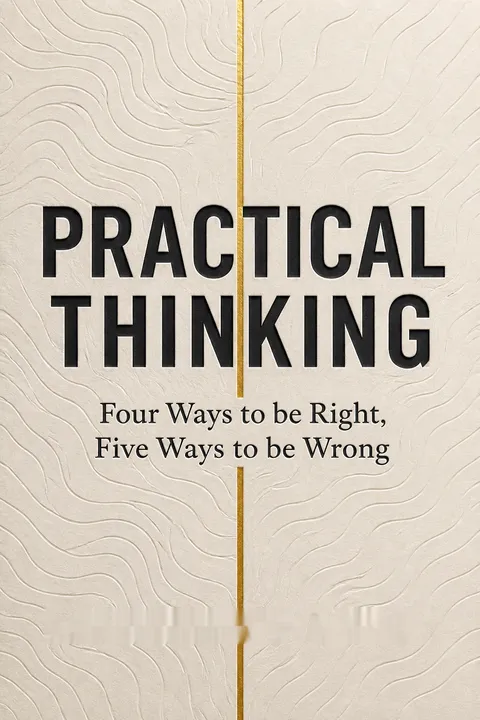
Practical Thinking receives mixed reviews, with an average rating of 3.76/5. Readers appreciate de Bono's insights on decision-making, understanding, and thinking processes. Many find the book's ideas valuable and thought-provoking, particularly the concepts of "ways to be right/wrong" and "levels of understanding." Some readers note similarities to de Bono's other works but still find value in the different perspectives offered. Critics mention issues with readability, repetitiveness, and outdated language. Overall, the book is seen as a useful guide for improving practical thinking skills.
People Also Read

Glossary
Understanding
Making the unfamiliar actionableThe process of interpreting an unfamiliar situation through ideas or responses already available, so that a person can decide what to do. De Bono distinguishes understanding from simply collecting information: its practical purpose is to turn the unknown into something recognizable or manageable, while acknowledging that familiar ideas can distort the new situation.
Porridge words
Useful vague placeholdersBroad, imprecise words such as mechanism, device, or something. They can describe an unknown without pretending to explain its inner workings, help a person ask questions before knowing the exact answer, and connect ideas that otherwise seem unrelated. Their usefulness depends on treating them as temporary aids, not as complete explanations.
Requiron
Name for an unknown requirementDe Bono’s temporary word for the thing being sought before it has been identified. A requiron represents a bundle of requirements, such as needing to act silently, after a delay, and within a limited space. Giving the unknown a provisional name lets thought proceed without committing to a specific object or mechanism.
Black box
Usable without knowing internalsA device, process, or idea whose internal workings are unknown or ignored, even though its effects can be used. A person may operate a television without understanding its electronics, for example. Black boxes make action possible without complete knowledge, but their usefulness depends on knowing which inputs reliably produce which effects.
Carry-on
Follow an established thought pathOne of de Bono’s two basic thinking processes. Carry-on means moving along a sequence of ideas already linked by experience or memory, as when one thought naturally leads to the next. It is efficient but can keep thought confined to familiar routes, rather than guiding it toward a new goal.
Connect-up
Link a starting point to a goalA thinking process that begins with a current situation and a desired destination, then searches for a connection between them. Questions and problems specify the destination, even when it is vague. Unlike carry-on, which follows an established chain, connect-up gives thought direction toward something not yet known.
Four ways to be right
Four sources of felt rightnessDe Bono’s categories for why a thought may feel right enough to guide action: emotional response, logical consistency, apparent uniqueness when no alternative is imagined, and recognition of a familiar pattern. These forms of confidence can be useful, but none by itself guarantees that an explanation accurately represents reality.
Five ways to be wrong
Five recurring reasoning errorsDe Bono’s labels for common errors arising from ordinary thinking: moving between ideas while omitting conditions, overlooking the size of an effect, using an explanation that does not fit the clues, freezing a conclusion through certainty, and applying a partial view to the whole situation. The categories are diagnostic prompts, not a complete inventory of human error.
PO
Tool for provocation and escapeA word de Bono proposes to mark a statement as a provocation rather than a claim that must be accepted or rejected. PO can loosen attachment to a familiar point of view or introduce an intentionally unlikely idea as a starting point. Its purpose is to generate movement toward new possibilities, which still require testing.
Intermediate impossible
Unworkable idea used as a stepping-stoneAn idea that is not viable as stated but can help generate a workable one. For example, imagining an absurd hidden creature toppling an object may prompt a practical question about changing its internal balance. The idea is useful as a temporary route to discovery, not as evidence or as a final solution.
Think-2
Map perspectives before debatingA method for handling disagreement by laying out each person’s starting assumptions, concerns, and interpretations before arguing over conclusions. Participants look for differences, overlap, and possible bridges between their perspectives. It is intended to reveal when apparently shared topics are actually being understood through different frames.
Bandwidth analysis
Set defensible limits on conclusionsA way to reason from incomplete information by establishing the broad range of conclusions that available clues support. It does not claim to know every detail or predict an exact outcome. Instead, it distinguishes what can be said with reasonable confidence from what remains outside the evidence.
de Bono’s 1st law
Ideas cannot use all available informationDe Bono’s claim that an idea formed while information arrives over time cannot make the best possible use of all that information, because its structure develops incrementally. New evidence may therefore justify reorganizing the idea rather than merely adding details. He uses this principle to support insight and the possibility of reframing.
de Bono’s 2nd law
Certainty may reflect missing alternativesDe Bono’s claim that an explanation can seem proven simply because no one has imagined a competing account. The inability to think of an alternative is not the same as evidence that no alternative exists. The principle encourages people, particularly in uncertain fields, to generate rival explanations before treating one account as uniquely correct.
Named-ideas and bundle-ideas
Fixed labels and temporary groupingsA named-idea is a familiar, stable concept gathered under a single label, such as clock or government. A bundle-idea is a temporary collection of features or relationships that has not yet acquired a settled name. Bundles help explore an unfamiliar situation, while established names make recognition and action easier but can constrain interpretation.
YES/NO system
Accept or reject ideasThe habit of evaluating ideas through acceptance and rejection. It helps people choose, build logical sequences, and act decisively. De Bono argues that it can also end inquiry once an answer is merely adequate, make rejected ideas hard to reconsider, and encourage rigid categories or excessive certainty in situations that remain open to change.
FAQ
1. What is "Practical Thinking" by Edward de Bono about?
- Everyday thinking focus: The book explores how people actually think in daily life, rather than how philosophers or logicians believe they should think.
- Black Cylinder Experiment: De Bono uses his famous Black Cylinder Experiment to analyze real-world thinking processes and mistakes.
- Four ways to be right: The book introduces four practical ways people feel "right" in their thinking, such as emotional and logical rightness.
- Five ways to be wrong: It also identifies five major mistakes in thinking, showing how errors are a natural part of the mind’s operation.
- Practical skill, not talent: De Bono argues that thinking is a skill to be developed, not an inborn gift, and provides tools to improve it.
2. Why should I read "Practical Thinking" by Edward de Bono?
- Improve everyday decisions: The book helps readers recognize and avoid common thinking errors in daily life, from work to relationships.
- Understand your own mind: It offers insight into how your mind works, making your thought processes more visible and manageable.
- Actionable thinking tools: De Bono provides practical frameworks and terminology (like "porridge words" and "black boxes") to discuss and improve thinking.
- Boost creativity and problem-solving: The book encourages creative, flexible thinking and shows how to generate alternatives and new ideas.
- Challenge arrogance and rigidity: It warns against the dangers of certainty and arrogance, promoting open-mindedness and continuous improvement.
3. What are the key takeaways from "Practical Thinking" by Edward de Bono?
- Thinking is a skill: Anyone can improve their thinking by understanding and practicing specific processes, not just relying on intelligence or education.
- Four ways to be right: Emotional, logical, unique, and recognition rightness are the main ways people feel correct in their thinking.
- Five ways to be wrong: Monorail, magnitude, misfit, must-be, and miss-out mistakes are common and arise naturally from how the mind works.
- Use of "porridge words" and "black boxes": Vague terms and incomplete understanding are not just ignorance—they are essential tools for moving thinking forward.
- Importance of humility: Recognizing the limits of your own rightness and being open to alternatives is crucial for better thinking and decision-making.
4. How does Edward de Bono define the four ways to be right in "Practical Thinking"?
- Emotional rightness (currant cake): Feeling right because an idea matches your emotions or values, often triggered by "goody-goody" words.
- Logical rightness (jig-saw puzzle): Assembling ideas so they fit together logically, regardless of whether the starting assumptions are correct.
- Unique rightness (village Venus): Believing an explanation is right simply because you can’t imagine an alternative—certainty from lack of imagination.
- Recognition rightness (measles): Feeling right because a situation matches a familiar pattern or diagnosis, allowing for immediate action.
5. What are the five major mistakes in thinking according to "Practical Thinking" by Edward de Bono?
- Monorail mistake: Moving directly from one idea to another without considering other factors or necessary conditions.
- Magnitude mistake: Getting the size or scale of an effect wrong, even if the direction of thinking is correct.
- Misfit mistake: Jumping to conclusions that don’t actually fit the available facts or evidence.
- Must-be mistake (arrogance): Fixating on an idea with certainty, shutting out alternatives and stopping further development.
- Miss-out mistake: Drawing conclusions from only part of a situation and applying them to the whole, often due to selective attention.
6. What is the Black Cylinder Experiment and how does it illustrate thinking in "Practical Thinking"?
- Simple unexplained event: Participants are asked to explain why a black cylinder falls over, with minimal information and no chance to investigate.
- Raw thinking exposed: The experiment reveals how people generate explanations with limited data, mirroring real-life situations.
- Levels of understanding: Responses illustrate the five levels of explanation, from simple description to full technical detail.
- Common thinking errors: The experiment highlights the prevalence of the five major mistakes in thinking, even among highly educated people.
- Process over content: It shows that the way people think is more important than the specific subject matter they’re considering.
7. What are the five levels of understanding or explanation in "Practical Thinking" by Edward de Bono?
- L–1: Simple description—Just stating what happened, with no explanation.
- L–2: Porridge words—Using vague terms like "mechanism" or "device" without specifics.
- L–3: Give it a name—Identifying a process or cause by name (e.g., "gravity," "magic") without details.
- L–4: The way it works—Describing the general process or cause-and-effect, but not the specific mechanism.
- L–5: Full details—Providing a detailed, step-by-step explanation or model of what happened.
8. How does Edward de Bono describe the basic thinking processes in "Practical Thinking"?
- Carry-on: Continuing along a familiar pattern or sequence of ideas, based on memory or habit.
- Connect-up: Deliberately linking two separate ideas or filling in gaps, often by asking questions or setting goals.
- Movement between ideas: Thinking is seen as moving from one idea to another, either passively (carry-on) or actively (connect-up).
- Use of porridge words: Vague terms help keep thinking moving when specifics are lacking, acting as bridges or placeholders.
- Importance of questions: Setting up a destination (even a vague one) allows for purposeful connection and problem-solving.
9. What are "porridge words" and "black boxes" in "Practical Thinking," and why are they important?
- Porridge words: Vague, formless terms (like "mechanism," "thing," "device") that allow thinking to proceed when specifics are unknown.
- Black boxes: Systems or processes that are used effectively without understanding their internal workings—focus is on input and output.
- Tools for ignorance: Both concepts let people act and think effectively despite incomplete knowledge, enabling progress and action.
- Cross-links and flexibility: Porridge words create connections between ideas, preventing thinking from getting stuck or too rigid.
- Leap-frogging detail: These tools allow people to "jump over" areas of ignorance and keep moving toward solutions.
10. How does "Practical Thinking" by Edward de Bono address creativity, imagination, and insight?
- Creativity as lateral movement: Creativity is defined as moving sideways to generate new ideas, not just following logical sequences.
- Imagination’s four aspects: Includes vivid mental imagery, generating alternatives, seeing things differently, and creative fantasy.
- Insight and discontinuity: Insight involves a sudden switch to a new way of seeing things, often breaking from established patterns.
- Role of mistakes: Being wrong or using "intermediate impossibles" can be essential steps toward creative breakthroughs.
- PO as a tool: De Bono introduces "PO" as a word to provoke new thinking and escape the rigidity of the YES/NO system.
11. What is the YES/NO system in "Practical Thinking," and what are its limitations?
- Basis of thinking: The YES/NO system is the main tool for accepting or rejecting ideas, leading to sharp polarization and quick decisions.
- Practical advantages: It provides speed, decisiveness, and clarity in thinking and action.
- Limitations: It encourages stopping at "good enough" answers, creates permanent labels, and fosters arrogance and rigidity.
- Dangers of certainty: The system can lead to the "arrogance of righteousness," where people become closed to alternatives or improvement.
- Need for alternatives: De Bono advocates for tools like "PO" and humor to break out of the YES/NO trap and encourage creative, flexible thinking.
12. What are the best quotes from "Practical Thinking" by Edward de Bono and what do they mean?
- "Everyone is always right. No one is ever right." — Each person’s thinking is right in their own context, but absolute rightness is unattainable; humility and openness are essential.
- "Proof is often no more than lack of imagination in providing an alternative explanation." — Certainty often comes from not being able to think of other possibilities, not from true correctness.
- "An idea can never make the best use of available information." — Because ideas develop over time, they are always limited by the sequence and amount of information available when formed.
- "The sharp-brained outlook can never establish new ideas because it does not mess around, never makes mistakes, and is completely trapped by existing ideas." — Creativity requires flexibility, mistakes, and the willingness to explore beyond established patterns.
- "Just as black boxes allow us to use a mechanism without really knowing how it works so porridge words allow us to make definite statements or ask definite questions when we do not really know what we are talking about." — Both concepts are essential for practical thinking and progress, even in the face of ignorance.
About the Author
Other books by Edward de Bono



Download PDF
Download EPUB
.epub digital book format is ideal for reading ebooks on phones, tablets, and e-readers.








