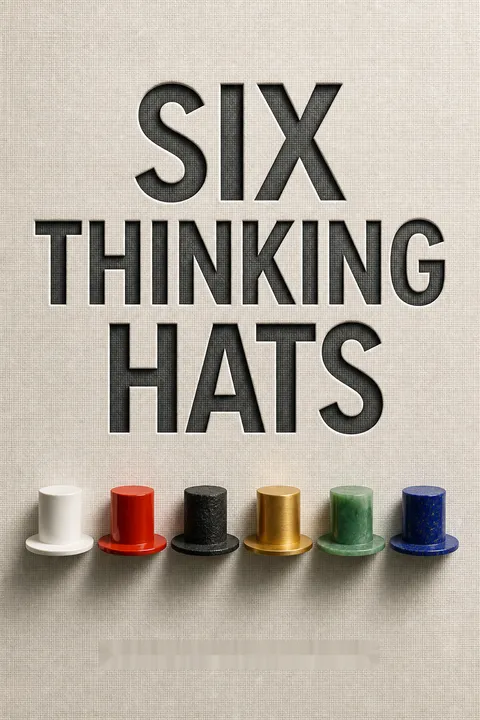


Key Takeaways
Make everyone inspect the same question before arguing over answers
Change the direction together. De Bono’s central proposal is to replace point-by-point combat with parallel thinking: at any moment, everyone examines the issue from the same angle. The group can switch angles deliberately, rather than making each person defend a fixed position. Imagine four people viewing a house from different sides and insisting that their view is the whole truth. Having everyone look at each side in turn reveals more of the building and makes disagreement less personal.
Separate the work. The Six Thinking Hats give the group simple signals for those shifts. White attends to information, red to feelings and intuition, black to risks, yellow to potential value, green to new possibilities, and blue to managing the thinking. The author reports that some organizations shortened meetings dramatically, including one project discussion reduced from thirty days to two. These are reported cases, not controlled proof, but they illustrate the method’s intended payoff: less arguing over who is right, more shared examination of what might work.
The method’s sharpest move is procedural: it changes what participants are doing before it asks them to change what they believe. That resembles structured turn-taking in deliberation, where a common task can reduce the reward for interruption and rhetorical point-scoring. It also makes disagreement easier to inspect, since competing claims can be recorded side by side. The limitation is that shared attention does not guarantee shared judgment. Groups still need clear evidence standards and a way to handle unequal authority, especially when one person controls the agenda.
Use the hats as temporary roles, never as labels for people
Make behavior switchable. The hats are directions for a particular stretch of thinking, not personality types. A cautious person is not assigned to be the permanent black-hat thinker, and the most imaginative person does not own green-hat time. Everyone in the group tries each requested mode, drawing on the knowledge and experience of all participants.
Protect the person, direct the behavior. A facilitator can ask the group to stop testing an idea for danger and instead search for its benefits. The request is easier to accept because it concerns the current task, not someone’s character. De Bono compares this to acting: a performer can take on different roles without changing identity. The game-like convention also redirects status-seeking. Participants can demonstrate skill by making useful contributions in each mode, rather than by defeating colleagues in argument.
This is a practical distinction between identity and action. In organizational psychology, behavior-specific feedback is generally easier to use than a fixed label because it points toward something changeable. The hat metaphor supplies a shared, low-drama cue for that shift. Its success depends on fair facilitation: if the leader uses a hat to silence unwelcome criticism or demand artificial positivity, the neutral signal becomes a tool of control. The method works best when every mode is genuinely available to everyone, including the person with the least formal power.
Separate observed information from belief, inference, and advocacy
Build the information map first. White-hat thinking asks what is known, what is missing, and how missing information could be obtained. It aims to report rather than persuade. A rise in sales is information; saying that customers bought more because of a health trend is an explanation that needs separate support. Keeping these apart makes it harder to smuggle a preferred conclusion into a supposedly neutral fact.
Label uncertainty honestly. De Bono allows both checked information and claims believed to be true but not yet verified, provided their status is clear. A tentative report can help generate questions, but an important decision may require checking it first. He also warns against flooding a discussion with every available detail. Ask focused questions, give the needed level of precision, and distinguish a measured pattern from a confident prediction about what will happen next.
This is a useful antidote to a familiar reasoning error: treating an interpretation as though it were part of the observation. Separating data, confidence, and explanation makes later disagreement more productive because participants can identify whether they dispute the measurement or its meaning. The framework also anticipates good data practice, where provenance and uncertainty matter as much as a headline number. Neutrality, however, is an aspiration rather than a guarantee. Choices about what to measure, include, or leave out can shape a supposedly factual account, so the questions used to gather information deserve scrutiny too.
Give feelings a brief, legitimate turn before they distort the room
Name the reaction directly. Red-hat thinking makes room for emotion, intuition, and hunches without requiring people to produce a logical defense. De Bono argues that feelings do not disappear when a meeting declares them irrelevant; they can instead influence judgments indirectly. A participant might simply report unease about a deal or enthusiasm for a proposal. The facilitator should not immediately demand reasons, since that turns a feeling report into an argument.
Treat intuition as input, not proof. A seasoned professional’s instinct may compress experience that is difficult to explain, but intuition can also mislead. The author uses roulette to make the point: a run of one color does not change the odds on the next spin. Feelings can reveal values, hesitation, or interpersonal strain; they can also shift as people see the issue differently. Recording them makes them visible without giving them automatic authority.
The red hat addresses a subtle problem in decision-making: emotion often enters through tone, selective evidence, or resistance while being denied a legitimate place in the conversation. Naming a reaction can make those influences easier to examine, and the refusal to demand an instant justification helps prevent people from inventing tidy explanations for messy feelings. Still, an intuition should not be treated as a hidden source of truth. Its value depends on the person’s relevant experience, the stakes, and whether the hunch can be tested before action.
Schedule skepticism so it catches failure without swallowing possibility
Give caution its own turn. Black-hat thinking looks for logical weaknesses, risks, ethical problems, and conflicts with available resources or past experience. It is not simply dislike in formal dress: a useful concern should have a reason that can stand apart from the speaker’s mood. A proposal to cut prices, for example, might be challenged by evidence that earlier discounts reduced margins without increasing sales enough to compensate.
Use criticism to improve the design. De Bono values this mode because overlooking a serious danger can be costly. But criticism is easy to overuse, especially when people treat finding faults as the whole job. A scheduled black-hat period lets the group examine risks thoroughly, then move on. Some objections can help reshape an idea rather than kill it. New possibilities can be considered in their proper turn instead of being rejected at birth.
A dedicated risk review resembles practices in engineering and safety planning, where imagining failure is useful precisely because it is bounded and purposeful. The distinction between attacking a proposal and identifying a repairable weakness is especially valuable: one closes discussion, the other contributes to design. The danger is that a timed session can create false reassurance if participants mistake a list of risks for a complete risk assessment. Expertise, dissenting voices, and follow-up checks still matter, particularly when consequences are severe or difficult to reverse.
Make optimism do useful work: find benefits, then explain their odds
Search deliberately for value. Yellow-hat thinking asks what an idea could make better and how it might be put into practice. This is not the same as feeling cheerful, nor is it permission to claim that everything will succeed. The thinker looks for benefits, proposes ways to achieve them, and gives reasons for expecting them. De Bono argues that this mode needs deliberate practice because people often notice a plan’s dangers more readily than its less obvious advantages.
Separate possibility from probability. Speculative benefits can be recorded even when uncertain, but their likelihood should be made clear. A distant possibility may still deserve attention if it suggests a worthwhile opportunity or a way to improve the odds. The best-case scenario can reveal an idea’s maximum value; it should then be tested against realistic conditions. Constructive optimism means proposing a next step, not merely hoping the outcome turns out well.
This approach usefully distinguishes optimism from positive mood. A team can search for upside while remaining honest about uncertainty, which broadens the option set without pretending the evidence is stronger than it is. The idea also counters a common asymmetry: risks often arrive as specific objections, while benefits remain vague unless someone is tasked with articulating them. A best-case scenario is a useful discovery tool, but it can anchor expectations. It should be paired with plausible scenarios and explicit assumptions before resources are committed.
Treat odd ideas as stepping-stones, not proposals to accept literally
Generate before judging. Green-hat thinking is the deliberate search for alternatives, new concepts, and different ways to frame a problem. It asks participants to spend time trying, not to guarantee that a brilliant idea will appear. De Bono’s lateral-thinking technique called movement means using an idea to see where it leads rather than immediately measuring whether it is already practical.
Use provocation to escape familiar patterns. The author’s term “po” marks an idea offered to provoke thought, not as a finished recommendation. For instance, imagining that shoppers are paid to buy things can prompt questions about rewards or purchasing incentives. A random word can serve the same purpose by giving thought an unexpected starting point. Once a promising direction emerges, the group can develop it, assess its value, and examine its risks. The strange suggestion is a tool for exploration, not a demand for literal implementation.
The strongest insight here is that creativity needs protection from premature evaluation, but it also needs a route back to reality. Movement offers that bridge: an implausible prompt becomes useful when it reveals a principle, a neglected option, or a testable variation. This resembles exploratory search in design, where rough prototypes help expose assumptions before a polished solution exists. The technique is not a substitute for domain knowledge, and random prompts can produce noise. Their value depends on disciplined interpretation and on a clear problem to return to.
Let a blue-hat facilitator set focus, sequence, and next actions
Manage the process, not the answer. Blue-hat thinking is the oversight of the thinking itself. It defines the question, sets a useful focus, selects which modes to use, and keeps the group from drifting into an argument. A facilitator can ask whether the meeting needs more information, more alternatives, or a summary of what has been established.
Make the session fit the task. There is no single mandatory order for the hats. A group can choose a short sequence suited to a dispute, a decision, or an exploration, and it need not use every mode. De Bono recommends beginning and ending with blue-hat attention: first clarify the purpose and plan; at the close, capture conclusions, unresolved questions, and next steps. The facilitator usually monitors the process, but participants can also make procedural suggestions.
This role turns a meeting from an unstructured exchange into a designed activity. It connects to facilitation methods that distinguish task management from subject-matter contribution, reducing the chance that one person’s preferred topic quietly takes over. The book’s flexibility is a strength because a rigid sequence can waste time. Yet the facilitator’s power is substantial: choosing the focus and order can steer outcomes. A transparent agenda, permission to challenge the process, and a record of unresolved issues help keep structure from becoming manipulation.
End meetings with a map, a decision, or the missing evidence
Choose after exploring. The hats are meant to build a fuller picture before the group selects a course of action. Information, emotional responses, benefits, and risks each add a different kind of input. Once those elements are visible, a decision can become easier to explain, even if people do not share identical preferences. The author compares this to choosing a route after seeing a map rather than arguing from partial memories of the roads.
Make uncertainty actionable. Sometimes the discussion will not support a decision. The final blue-hat review should say why: perhaps a key fact is missing, the options serve competing values, or the future remains too uncertain. That is still a useful outcome if the group identifies what to learn, test, or discuss next. De Bono reports that a couple used the method to decide on a house quickly after hours of inconclusive discussion, illustrating its intended shift from circular talk to an explicit result.
A meeting need not end with forced consensus to be productive. A clear account of what is known, what remains disputed, and what evidence would change the decision can improve both accountability and follow-through. This also guards against a common organizational failure: mistaking discussion for progress. The method’s promise that choices may feel obvious should be understood cautiously. A well-organized map clarifies trade-offs, but it cannot resolve conflicts of interest or values by itself. The group must still decide whose priorities count and who bears the consequences.
Analysis
Six Thinking Hats is best understood as a practical protocol for directing attention, not as a complete theory of reasoning. Its main contribution is to separate tasks that ordinary meetings blend together: gathering information, expressing reactions, testing risk, identifying value, generating alternatives, and managing the discussion. The colored labels make those shifts memorable and socially usable. Participants can move between modes without being assigned permanent identities, while the facilitator can interrupt an unproductive pattern without accusing a person of being difficult.
The argument against adversarial discussion is strongest when a group is trying to explore a complicated problem rather than litigate a settled claim. Debate can reward selective evidence and defensive performance; parallel attention encourages people to add observations without having to rebut every prior speaker. Yet argument is not merely a bad habit. It can expose contradictions, clarify burden of proof, and help groups contest authority. A sound use of the method therefore treats structured exploration as a complement to adversarial scrutiny, not as a universal replacement.
The book’s six modes also differ in epistemic status. Facts and risks invite evidence; feelings are reports about experience; creative provocations are prompts; benefits are forecasts. Treating all contributions as equivalent would be a mistake. A facilitator should preserve these distinctions, label uncertainty, and ensure that the strongest claims receive appropriate verification. Otherwise the method can make a meeting orderly while leaving its reasoning weak.
De Bono supports the method with striking organizational anecdotes and productivity claims, including reports of meetings becoming much shorter. The text does not supply enough detail about measurement, comparison groups, or selection effects to establish those numbers as general results. The more credible promise is procedural: a shared vocabulary can reduce repetition, surface neglected perspectives, and clarify the next question. Its effectiveness depends on thoughtful facilitation, candid participation, and a willingness to record unresolved disagreement rather than manufacture agreement. Used that way, the hats are less a magic decision machine than a compact operating system for collective attention.
Review Summary
Six Thinking Hats presents a method for structured thinking using six different perspectives, represented by colored hats. While some readers found it insightful and practical for problem-solving and decision-making, others felt it was overly simplistic or difficult to implement. Many appreciated the concept of examining issues from multiple angles but criticized the book's repetitive nature. Some readers noted its potential usefulness in meetings and brainstorming sessions, while others questioned its real-world applicability. Overall, reviews were mixed, with ratings ranging from 1 to 5 stars.
People Also Read




Glossary
Six Thinking Hats
Six modes for directed thinkingA method for separating thinking into six temporary modes, each identified by a color. The modes direct attention toward information, feelings and intuition, caution, potential benefits, creative alternatives, or management of the thinking process. Individuals or groups can use one mode at a time, either on its own or in a sequence suited to the task.
Parallel Thinking
Shared direction of attentionA way of exploring a subject in which participants examine the same aspect at the same time rather than defending opposing positions throughout the discussion. Different views can be recorded alongside one another, and the group can shift its shared focus to examine another aspect. The aim is to build a broader picture before choosing a course.
Lateral Thinking
Changing established thought patternsA deliberate approach to generating new concepts and perceptions by moving beyond familiar patterns of thought. It uses techniques such as provocation and movement to create alternative starting points. The goal is not simply to criticize an existing idea or follow a logical chain, but to find a route to a different way of seeing or solving a problem.
Movement
Use an idea to exploreA creative-thinking practice in which an idea is treated as a starting point for further thought rather than judged immediately for correctness or practicality. A thinker asks what the idea suggests, what principle it contains, or where it might lead. The exploration can yield a different, more useful concept than the original idea.
Po
Signal for a provocationA word Edward de Bono introduced to mark a statement as a provocation offered to stimulate new thinking, not as a conventional proposal to accept or reject. The signal gives participants permission to explore an unusual or deliberately illogical idea through movement. The value lies in what the prompt helps the thinker discover, not in its literal feasibility.
Creative pause
Deliberate search for alternativesA chosen interruption in routine thinking to ask whether another approach might exist, even when there is no obvious problem or reason to stop. The pause counters the tendency to accept the first adequate answer and move on. It creates a specific opportunity to search beyond familiar options and consider whether a better alternative is available.
Operacy
Thinking directed toward actionDe Bono’s term for the practical, action-oriented side of thinking. It concerns what will happen if a course is taken, whether it can be carried out, and how people and circumstances may respond. Operacy distinguishes real-world thinking, where action and consequences matter, from analysis that only describes a situation or offers an explanation.
FAQ
What's "Six Thinking Hats" about?
- Concept Overview: "Six Thinking Hats" by Edward de Bono introduces a method for group discussion and individual thinking involving six colored hats. Each hat represents a different mode of thinking.
- Purpose: The method aims to simplify thinking by allowing individuals to focus on one aspect at a time, such as emotions, facts, or creativity.
- Application: It is used to improve decision-making, problem-solving, and communication by encouraging parallel thinking rather than argument.
- Outcome: The book provides a structured approach to thinking that can lead to more productive meetings and clearer thinking processes.
Why should I read "Six Thinking Hats"?
- Improved Thinking Skills: The book offers a practical framework to enhance your thinking skills, making you more effective in both personal and professional settings.
- Enhanced Communication: By understanding and applying the Six Hats method, you can facilitate better communication and collaboration in group settings.
- Decision-Making: It provides tools to make more balanced and well-considered decisions by examining issues from multiple perspectives.
- Creativity and Innovation: The method encourages creative thinking and the generation of new ideas, which can be beneficial in problem-solving and innovation.
What are the key takeaways of "Six Thinking Hats"?
- Six Modes of Thinking: The book outlines six distinct modes of thinking, each represented by a colored hat: White (facts), Red (emotions), Black (caution), Yellow (optimism), Green (creativity), and Blue (control).
- Structured Approach: It emphasizes the importance of focusing on one type of thinking at a time to reduce confusion and enhance clarity.
- Parallel Thinking: Encourages parallel thinking, where all participants focus on the same type of thinking simultaneously, leading to more comprehensive exploration of ideas.
- Practical Application: The method is widely applicable across various fields, from business meetings to educational settings, and can be used by individuals and groups alike.
How does the Six Thinking Hats method work?
- Hat Colors and Functions: Each hat color represents a different type of thinking: White for facts, Red for emotions, Black for caution, Yellow for optimism, Green for creativity, and Blue for process control.
- Sequential Use: The hats can be used in sequence to explore a subject thoroughly, ensuring all aspects are considered.
- Role-Playing: Participants can switch hats to adopt different perspectives, which helps in understanding and addressing complex issues.
- Facilitator's Role: Typically, a facilitator guides the process, ensuring that the group adheres to the hat sequence and maintains focus.
What is the significance of each hat in the Six Thinking Hats method?
- White Hat: Focuses on data and information, asking what is known and what needs to be known.
- Red Hat: Allows expression of emotions and feelings without justification, capturing intuitive responses.
- Black Hat: Identifies potential problems and risks, ensuring caution and critical evaluation.
- Yellow Hat: Looks for benefits and values, promoting optimism and positive thinking.
- Green Hat: Encourages creativity and new ideas, exploring possibilities and alternatives.
- Blue Hat: Manages the thinking process, setting objectives and ensuring discipline.
How can the Six Thinking Hats method improve decision-making?
- Comprehensive Analysis: By using each hat, decision-makers can explore all facets of a problem, leading to more informed decisions.
- Balanced Perspective: The method ensures that both positive and negative aspects are considered, reducing bias.
- Structured Process: Provides a clear framework for decision-making, which can lead to quicker and more effective outcomes.
- Encourages Creativity: The Green Hat promotes innovative solutions, which can be crucial in complex decision-making scenarios.
What are some practical applications of the Six Thinking Hats method?
- Business Meetings: Can be used to structure meetings, ensuring all viewpoints are considered and discussions are productive.
- Education: Helps students develop critical thinking skills by examining topics from multiple perspectives.
- Problem-Solving: Facilitates creative solutions by encouraging diverse thinking styles.
- Conflict Resolution: Provides a neutral framework for discussing contentious issues, reducing personal conflicts.
What are the best quotes from "Six Thinking Hats" and what do they mean?
- "Thinking is the ultimate human resource." This emphasizes the importance of developing thinking skills as a valuable asset.
- "The biggest enemy of thinking is complexity, for that leads to confusion." Highlights the need for simplicity in thinking processes to avoid confusion and enhance clarity.
- "The Six Thinking Hats method may well be the most important change in human thinking for the past twenty-three hundred years." Suggests the revolutionary impact of the method on traditional thinking approaches.
How does the Six Thinking Hats method encourage creativity?
- Green Hat Focus: Specifically dedicated to creative thinking, encouraging the generation of new ideas and alternatives.
- Safe Environment: Provides a safe space for proposing unconventional ideas without immediate criticism.
- Structured Creativity: By allocating time for creative thinking, it ensures that creativity is a deliberate part of the process.
- Provocation and Movement: Encourages the use of provocations to break free from traditional patterns and explore new possibilities.
How does the Six Thinking Hats method handle emotions in decision-making?
- Red Hat Role: Allows participants to express emotions and feelings openly, acknowledging their role in decision-making.
- No Justification Needed: Emotions are expressed without the need for justification, ensuring they are considered as part of the process.
- Emotional Awareness: By making emotions visible, the method helps in understanding their impact on decisions.
- Balancing Logic and Emotion: Ensures that both logical and emotional aspects are considered, leading to more balanced decisions.
What are the challenges of implementing the Six Thinking Hats method?
- Initial Resistance: Participants may initially resist the structured approach, preferring traditional methods of discussion.
- Discipline Required: Requires discipline to adhere to the hat sequence and maintain focus on the designated thinking mode.
- Facilitator's Role: Effective implementation often depends on a skilled facilitator to guide the process and manage transitions between hats.
- Cultural Differences: May need adaptation to fit different cultural contexts, as communication styles and openness to expressing emotions can vary.
How can organizations benefit from adopting the Six Thinking Hats method?
- Enhanced Collaboration: Encourages team members to contribute diverse perspectives, leading to more comprehensive solutions.
- Improved Efficiency: Structured thinking can reduce meeting times and increase productivity by focusing discussions.
- Better Problem-Solving: Facilitates creative and critical thinking, leading to innovative solutions and improved problem-solving capabilities.
- Cultural Shift: Promotes a culture of open communication and balanced decision-making, which can enhance organizational effectiveness.
About the Author
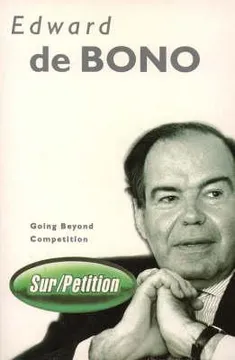
Other books by Edward de Bono




Download PDF
Download EPUB
.epub digital book format is ideal for reading ebooks on phones, tablets, and e-readers.








