


Key Takeaways
Make your mind attractive through the way you explore a conversation
Conversation is the display. De Bono’s opening image contrasts a glamorous party guest who cannot hold anyone’s interest with an unassuming man surrounded by lively talk. The point is not that appearance or intelligence never matters. It is that a mind becomes visible to others through how it listens, responds, imagines, and explores ideas with them.
The skill is learnable. A beautiful mind, as the book defines it, is not a private storehouse of clever thoughts. It is a mind whose use can be appreciated by other people. Curiosity, creativity, and empathy matter more than impressive credentials or an encyclopedic memory, and the habits can be practiced at any age.
The opening reframes conversation as a social expression of thinking, not a contest in which the most informed person wins. That is a useful corrective to status-driven talk: the listener experiences a mind through its attention and responsiveness. It also makes the promise practical. Anyone can improve the quality of an exchange without acquiring a new identity or a dazzling biography. The claim has a boundary, though. Attractive conversation is not a substitute for integrity or expertise when decisions carry real consequences. Charm can clarify a mind, but it can also disguise a shallow or manipulative one.
Find where another person is right before deciding where they are wrong
Agreement takes work. The book rejects both reflexive praise and reflexive contradiction. A more useful response is to look for the conditions under which a claim makes sense: particular circumstances, values, or experiences may support part of it even when the broad version seems false. For example, relatives or a matchmaker might help people meet in an isolated community, without making forced marriage acceptable.
Enter their reasoning. De Bono calls the other person’s network of perceptions, needs, values, and experience a logic bubble. Understanding that bubble can reveal why a view seems reasonable from inside it. The aim is not to surrender one’s judgment. It is to locate real agreement, state its limits, and then offer an honest view of what remains unresolved.
This method resembles perspective-taking in negotiation: first identify the assumptions that make a position coherent, then discuss the assumptions rather than attacking the person. It can lower defensiveness while improving the accuracy of disagreement. Crucially, understanding is not endorsement. A position may be internally consistent and still rest on false premises or harmful priorities. The distinction protects empathy from becoming appeasement. A useful test is whether the listener can restate the other person’s reasons in terms that person would recognize before adding a qualification or objection.
Disagree with the leap, not the person
Separate claim from inference. A statistic can be accurate while the conclusion attached to it is not. The book gives a historical comparison of incarceration rates, with the United States figure far above the European figures it cites. That difference alone does not establish that Americans commit more crime: sentencing practices, detection, and time served could also affect the totals. The relevant challenge is to the inference, not to the speaker’s intelligence.
Calibrate certainty. Disagreement can mean that a statement is false, that evidence is incomplete, that another explanation is possible, or that a prediction is uncertain. A trend may continue, but opposing forces can change it. Replacing certainty with a measured likelihood keeps a possibility open without pretending it is established. Polite wording helps the discussion examine the reasoning instead of escalating into a personal contest.
The key discipline is to identify the precise point of failure. In statistical reasoning, correlation, measurement, and causal explanation are different questions; a large number does not answer all three. The book’s examples make that distinction memorable, though its figures belong to its publication period and should not be treated as current data. The broader habit remains sound: ask what the evidence measures, what else could produce it, and how strong a conclusion it supports. This approach is rigorous without requiring the social theater of a takedown.
Name the real source of disagreement before trying to settle it
A difference may be legitimate. People can disagree because they use different criteria, see the situation from different positions, hold different values, or draw on different experiences. A debate about the best route, for instance, cannot be settled until best is defined: fastest, shortest, easiest, or most scenic. Two people may each describe a real side of the same situation rather than one being simply wrong.
Put views side by side. State each position clearly, then ask what produces the difference. Is it a factual question that can be checked, a personal preference, a value priority, or a forecast about the future? Look for evidence or a definition that can reconcile the views. If the disagreement remains, make its basis clear and accept that the parties may reasonably differ.
This is a form of conceptual hygiene: many arguments persist because participants use the same word for different standards. Clarifying the criterion can dissolve a dispute before anyone needs to change a belief. The method also respects pluralism without treating every claim as equally true. A claim about what happened can be checked; a claim about what matters may require explicit trade-offs; a prediction remains uncertain. The challenge is to avoid labeling every uncomfortable factual disagreement a mere difference in perspective. Clarification should sharpen inquiry, not provide an easy exit from it.
Listen for information, reasoning, and side paths worth exploring
Listen on two tracks. Attend both to the main point the speaker is trying to make and to useful details that may matter independently. A passing mention of a community support group, for example, may be worth exploring even if it does not prove the speaker’s argument. Repeating the point back in fresh words checks understanding and gives the speaker a chance to correct a misreading.
Ask with a purpose. De Bono distinguishes shooting questions, which check a limited answer such as yes or no, from fishing questions, which invite an open response. Ask where a statistic came from, how large the sample was, or what explanation the speaker favors. Then request more detail on the part that genuinely interests you. Questions should open inquiry, not disguise an accusation.
Active listening is often treated as a courtesy, but here it is also an information-gathering strategy. Restating a claim can expose hidden ambiguity while preserving the relationship, and questions can reveal the difference between direct observation, hearsay, and interpretation. The two-track approach is especially useful because a speaker’s argument can fail while their story still contains valuable information. Still, questions are not automatically neutral. A rapid sequence of narrow checks can feel like cross-examination. The listener’s tone and purpose determine whether questions invite elaboration or put someone on trial.
Replace opposing speeches with a shared sequence of thinking
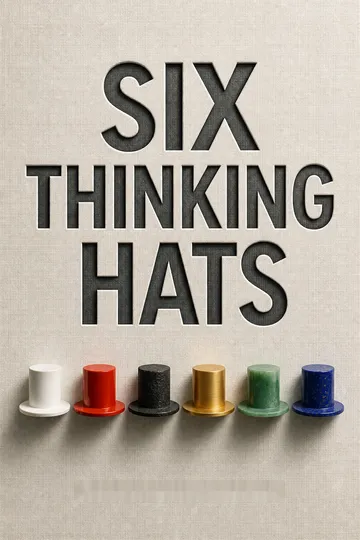
Think in parallel. De Bono’s parallel thinking asks everyone to examine the same aspect of a subject at the same time, rather than defend competing cases. Its Six Thinking Hats provide a simple structure: white focuses on available information and gaps; red gives room to feelings and intuition; black tests risks and weaknesses; yellow searches for benefits; green generates possibilities; blue organizes the process and summarizes the result.
Use the sequence deliberately. A group might first clarify what it knows, surface reactions, test dangers, identify potential value, generate alternatives, and then decide what remains to be done. De Bono reports dramatic reductions in meeting and negotiation time in organizations using the method. Those are his reported examples, not guarantees. The practical value is that each person is invited to contribute more than criticism.
The hats work as a coordination device: they make the group’s current task visible and reduce the impulse to mix evidence, emotion, evaluation, and invention in every sentence. That resembles structured problem-solving methods in which teams separate diagnosis from solution generation. It can help quieter participants contribute because a creative suggestion is expected rather than treated as an invitation to attack. The sequence should remain a tool, not a ritual. A facilitator must still invite dissent, check evidence, and prevent a shared format from creating false consensus.
Extract the concept, then invent other ways to deliver it
Look beneath the method. A concept is the operating idea behind a practical arrangement. A parking meter, for example, can be understood not only as a way to collect fees but as a way to let more people use scarce parking spaces over a day. Once the purpose is clear, alternatives can be imagined and compared. The concept is broader than any single device, but it must remain specific enough to guide action.
Generate before judging. Lateral thinking is De Bono’s deliberate approach to escaping routine patterns. One technique uses a provocation, a knowingly implausible statement that prompts a new direction. In the book’s river-factory example, imagining that a factory sits downstream of its own discharge suggests that it must protect its own water supply. A surprising idea is a starting point, not proof that an idea will work.
This pairing of abstraction and invention is one of the book’s strongest practical moves. Naming the purpose behind a familiar tool helps prevent people from mistaking the current method for the only possible one. The provocation technique similarly makes novelty a process rather than a personality trait. Yet idea generation and evaluation require different standards. An unexpected proposal may reveal a neglected constraint, but it can also be impractical or costly. The method is most productive when imagination is given room first, followed by explicit tests of feasibility, benefit, and unintended effects.
Treat feelings as signals about values, not proof of facts
Feelings shape attention. The book argues that values influence what people like, fear, and choose, while strong emotions can narrow perception toward details that confirm an existing belief. Adjectives such as lazy or dangerous often reveal a speaker’s judgment more than they establish an objective description. Naming a reaction as a feeling makes it easier to examine without mistaking it for evidence.
Make the trade-offs visible. A business proposal may look attractive to someone seeking promotion and burdensome to a colleague expecting more work. The proposal is the same, but their priorities differ. Decisions can involve competing values such as fairness, loyalty, safety, cost, or recognition. State which values matter most, and remain willing to revise an opinion when new information or a clearer account of another person’s priorities changes the picture.
The distinction between emotional information and factual proof is valuable because it avoids two familiar mistakes: dismissing emotion as irrational, or treating sincerity as evidence. Feelings can reveal what a person stands to lose or protect, which is often essential to understanding a decision. At the same time, emotion-driven attention can make confirming examples vivid and contrary examples invisible. The practical safeguard is not emotional suppression but separation: record the reaction, identify the value behind it, and assess factual claims on their own evidence. This supports both empathy and better judgment.
Use curiosity to make thin knowledge and ordinary topics engaging
Interest is a practice. A lively exchange does not require every participant to be an expert. If another person knows more, listen openly, ask questions, and build a discussion around one intriguing detail. De Bono’s Zulu Principle recommends developing deep knowledge of an unusual subject so it can supply memorable facts and comparisons. His Mirror Strategy describes collecting what many people say about a subject and reflecting it back, while being clear about where the information came from.
Make room for possibility. A what-if question can turn a plain topic into exploration, and a small story can make an abstract idea concrete. Stories illustrate that something can happen, but one anecdote cannot establish how common it is. Curiosity works best when it combines lively speculation with honesty about what is known, guessed, or merely imagined.
This advice treats expertise as one resource among several. Questions, analogies, and careful uncertainty can make an exchange valuable even when knowledge is uneven. The emphasis on unusual details also recognizes that memorable information often travels better than broad summaries. The danger is that quirky facts can become conversational decoration or be repeated without verification. The book’s caution about stories is important: vividness is not representativeness. A good conversationalist can use an anecdote to open a question while resisting the temptation to let it settle one.
Keep talk alive with deliberate turns, useful detours, and gentle humor
Give others room. Interruptions can break a speaker’s thread, especially when they serve an ego rather than the discussion. A factual correction or a brief signal of doubt may be necessary, but a long interruption can wait until the next turn. The book describes using visible markers to show speakers when their allotted time is ending, a practical reminder that conversation needs fair distribution of airtime.
Choose the route by purpose. A serious discussion benefits from staying focused, while casual conversation can follow a worthwhile detour. Current events, work, and shared interests offer easy openings; if a topic stalls, change direction rather than forcing it. Relevant humor can release tension or make an idea memorable. It should clarify or enliven the exchange, not humiliate someone or derail a sensitive conversation.
Conversation depends on both content and turn-taking. The book’s distinction between purposeful discussion and social exploration helps explain why a tangent can be either a distraction or the best part of an evening. Simple time signals are useful because they make a group norm visible instead of leaving every speaker to infer when to stop. There is a tension between structure and spontaneity: too little structure lets dominant voices take over, while too much can make casual talk feel managed. The right balance depends on the stakes, the group, and whether everyone has a genuine chance to contribute.
Practice conversation as a skill, not a performance
Rehearse the habits. De Bono recommends practicing rather than assuming that understanding a technique means being able to use it. His Conversation Club brings people together regularly to discuss prepared topics, participate, and observe how the exchange unfolds. Members might practice identifying the concept beneath a proposal or spelling out why two views differ. The point is not to crown a winner. The achievement is a better exploration and a more enjoyable use of thought.
Choose a useful stance. The book contrasts battle, ego, and passive agreement with learner, explorer, constructive, and playful attitudes. Entering a discussion to learn something or design a way forward changes what counts as success. A conversation can still end without agreement, but it need not end without clearer distinctions, new information, or a better question.
The practice model recognizes that conversational skill is procedural: people learn it by doing, noticing effects, and adjusting. Observation is especially useful because habits like interrupting or defending a position often feel invisible to the person displaying them. Group practice can make these patterns discussable without assigning permanent identities such as smart, dull, or difficult. Its limits are worth keeping in view: formal exercises cannot reproduce every emotional or institutional pressure of real disputes. They can, however, provide a low-stakes setting for building habits that are harder to improvise under pressure.
Analysis
The book’s central contribution is a shift in what conversation is for. Instead of treating talk as a contest in which participants defend positions, it treats conversation as shared cognitive work: gathering information, clarifying values, testing interpretations, generating options, and deciding what deserves attention. The shift is practical because it changes the next move available to a speaker. Rather than answer a claim with a counterclaim, one can ask what evidence supports it, identify a condition where it holds, or explore what each person means by a word such as best. The book is unusually attentive to perception. It recognizes that people do not merely disagree about facts; they may notice different facts, assign them different importance, or evaluate them through distinct experiences and values. That insight anticipates a useful distinction in contemporary reasoning: empirical disputes need better evidence, while normative disputes need explicit priorities and trade-offs. Treating both as simple matters of logic invites frustration. Treating both as pure personal preference invites relativism. The book’s conversational tools help separate them, though the separation is never perfect.
Its strongest practical framework, the Six Thinking Hats, externalizes mental tasks so a group can intentionally move among evidence, feeling, caution, benefit, creativity, and process. This can widen participation and reduce repetitive adversarial exchanges. Yet procedure does not guarantee truth. A team can systematically examine a bad premise, and a facilitator can use structure to suppress dissent as easily as to invite it. Good use therefore depends on intellectual honesty, accurate information, and permission to challenge the agenda itself.
The book’s older social examples and sweeping cultural generalizations should be treated as period-bound illustrations, not dependable contemporary evidence. That limitation does not erase the durable method. Its lasting lesson is to make the reasoning visible: distinguish observation from inference, possibility from certainty, and disagreement from difference. A beautiful mind is not one that never errs. It is one that helps a conversation become more accurate, more imaginative, and more humane without pretending those goals always coincide.
Review Summary
How to Have a Beautiful Mind received mixed reviews. Many readers found it insightful, offering practical advice on improving conversation skills and developing a more attractive mind. Some praised its easy-to-understand language and useful tips for social interactions. However, others criticized it as basic or repetitive, suggesting it's better suited for beginners or young adults. Several reviewers appreciated de Bono's emphasis on open-mindedness and respectful disagreement. Overall, the book seems to divide opinion based on readers' prior knowledge and expectations.
People Also Read






Glossary
logic bubble
another person’s reasoning contextThe set of perceptions, values, needs, and experiences that makes a person’s position seem logical to that person. The term encourages a listener to understand the context behind a view before judging it. Understanding the bubble does not require agreement; it can reveal where a claim is reasonable, limited, or based on assumptions that need examination.
parallel thinking
shared, coordinated explorationA way of discussing a subject in which participants examine the same aspect at the same time, rather than making opposing cases. The group might focus together on information, then risks, then benefits, and then alternatives. The goal is a fuller joint exploration, not a debate with a winner and loser.
The Six Thinking Hats
six modes of group thinkingA framework that assigns six colored hats as prompts for different kinds of thought. White focuses on information, red on feelings and intuition, black on caution, yellow on benefits, green on creative possibilities, and blue on organizing the process. In a group, participants use the same hat at a given time so attention is coordinated.
lateral thinking
deliberate pattern-breaking thoughtA set of deliberate methods for moving beyond routine mental patterns and generating fresh ideas. Rather than relying only on analysis of the options already visible, lateral thinking introduces provocations or unexpected starting points. The resulting idea may be unlikely or even initially implausible, but it can open a direction that can then be examined and tested.
Po
signal for a provocationA word De Bono uses to mark a provocation: a statement recognized as false, impossible, or deliberately unusual, offered to stimulate new thinking. It tells listeners not to assess the statement as a normal factual claim. Instead, they explore what useful idea might emerge by moving forward from it.
fishing questions
open-ended information seekingQuestions whose answers are not known in advance and are not limited to yes or no. They invite a range of relevant responses, such as asking what explanation someone thinks best accounts for an event. They are useful when the questioner wants to explore a subject rather than verify one specific detail.
shooting questions
closed-answer checksQuestions designed to check a specific point with a limited answer, usually yes or no. They are useful for verifying a claim or narrowing down possibilities. A shooting question differs from an open-ended inquiry because the questioner already knows what is being checked and has a restricted range of expected answers.
Zulu Principle
specialize in an unusual subjectA conversational strategy of developing substantial knowledge in a subject that few others know well, such as Zulu history or language. Specialized knowledge can provide distinctive examples and comparisons in many discussions. The principle does not mean pretending to be an expert broadly; it recommends building depth in a limited, memorable area.
Mirror Strategy
reflect gathered views backA method of listening to what several people say about a subject, organizing those observations, and presenting the resulting account back to others. It resembles a mirror because it reflects existing knowledge and opinions in a clearer, consolidated form. The method depends on care about sources, since repeating an inaccurate account can reproduce its error.
OPV
consider another person’s viewpointA CoRT thinking tool whose initials stand for Other Person’s Viewpoint. It asks a thinker to deliberately consider how a situation appears to someone else, including that person’s likely concerns, values, and perceptions. The aim is to broaden the picture, not to assume that the other person is correct or that every perspective is equally supported.
FAQ
What's "How to Have a Beautiful Mind" about?
- Focus on Mind's Beauty: The book emphasizes the importance of having a beautiful mind, which is more attractive than physical beauty. It suggests that a beautiful mind can be developed through creativity, imagination, and empathy.
- Conversational Skills: Edward de Bono provides practical advice on how to enhance conversational skills to make one's mind more appealing and engaging in social situations.
- Techniques and Methods: The book introduces various techniques, such as the Six Thinking Hats and lateral thinking, to improve thinking and communication.
- Mind's Appeal: It argues that a beautiful mind is independent of age and can grow more attractive with wisdom and experience.
Why should I read "How to Have a Beautiful Mind"?
- Enhance Communication: The book offers strategies to improve your conversational skills, making interactions more engaging and meaningful.
- Develop Creativity: It provides tools to foster creativity and imagination, which are essential for a beautiful mind.
- Practical Advice: Edward de Bono's methods are practical and can be applied in everyday conversations to make them more interesting.
- Personal Growth: Reading the book can lead to personal development by encouraging empathy and understanding in discussions.
What are the key takeaways of "How to Have a Beautiful Mind"?
- Agree and Disagree: Learn how to agree and disagree politely and constructively, focusing on understanding rather than winning arguments.
- Be Interesting: The book emphasizes the importance of being interesting in conversations by using information, speculation, and creativity.
- Listening Skills: It highlights the value of listening attentively to gain new insights and perspectives.
- Use of Six Hats: The Six Thinking Hats method is a key takeaway, providing a structured way to explore different aspects of a topic.
How does Edward de Bono define a "beautiful mind"?
- Appreciated by Others: A beautiful mind is one that can be appreciated by others, often through engaging and thoughtful conversation.
- Not About Intelligence: It doesn't require a high IQ or extensive knowledge but rather the ability to use creativity and empathy.
- Independent of Age: A beautiful mind can grow more attractive with age, as it gains wisdom and experience.
- Conversational Focus: The beauty of the mind is reflected in how one converses, making interactions more appealing.
What is the Six Thinking Hats method in "How to Have a Beautiful Mind"?
- Parallel Thinking: The method encourages parallel thinking, where everyone looks at a problem from the same perspective at the same time.
- Six Hats: Each hat represents a different mode of thinking: White (information), Red (emotions), Black (caution), Yellow (benefits), Green (creativity), and Blue (process control).
- Structured Exploration: It provides a structured way to explore a subject thoroughly, avoiding the pitfalls of argument-based thinking.
- Widely Used: The method is used in business and education to enhance decision-making and problem-solving.
How can I be more interesting according to "How to Have a Beautiful Mind"?
- Share Information: Use unusual or intriguing information to capture interest in conversations.
- Speculate and Imagine: Engage in "what if" scenarios to explore possibilities and stimulate discussion.
- Connect Ideas: Make connections between different topics to enrich the conversation.
- Creativity and New Ideas: Introduce new ideas and perspectives to keep discussions lively and engaging.
What role do emotions play in "How to Have a Beautiful Mind"?
- Red Hat Thinking: Emotions and feelings are given a formal place in thinking through the Red Hat, allowing for their expression without needing justification.
- Influence on Perception: Emotions can direct attention and influence perception, highlighting the importance of managing them.
- Decision-Making: Emotions are crucial in decision-making, as they link values to situations and guide choices.
- Balance Needed: While emotions are important, they should be balanced to avoid overly selective perception.
How does Edward de Bono suggest we handle disagreements in "How to Have a Beautiful Mind"?
- Politeness and Respect: Disagree politely and gently, focusing on understanding the other person's perspective.
- Errors and Logic: Identify errors in logic or selective perception without being confrontational.
- Explore Differences: Lay out the reasons for differences and seek to reconcile them if possible.
- Challenge Certainty: Encourage the shift from certainty to possibility, opening up room for discussion.
What are the concepts discussed in "How to Have a Beautiful Mind"?
- Concepts as Parents: Concepts are seen as the parents of practical ideas, helping to generate new thoughts and solutions.
- Levels of Concept: Concepts can vary in specificity, from broad to specific, and should be used appropriately.
- Types of Concepts: Different areas have their own concepts, such as business, value, and mechanism concepts.
- Vagueness and Completeness: Concepts may seem vague but are essential for understanding and innovation.
How does "How to Have a Beautiful Mind" suggest we improve listening skills?
- Active Listening: Pay attention and show genuine interest in what is being said to gain maximum value.
- Repeat Back: Summarize and repeat back what you have heard to ensure understanding and show engagement.
- Ask Questions: Use questions to clarify, explore further, and show interest in the conversation.
- Notice Language: Pay attention to the words and adjectives used, as they reveal the speaker's feelings and perspectives.
What are the best quotes from "How to Have a Beautiful Mind" and what do they mean?
- "A discussion should be a genuine attempt to explore a subject rather than a battle between competing egos." This quote emphasizes the importance of collaboration over competition in conversations.
- "Beauty is something that can be appreciated by others." It highlights that a beautiful mind is one that others find engaging and appealing.
- "If you never change your mind, why have one?" This encourages openness to new ideas and the willingness to adapt one's thinking.
- "I do, therefore I matter." It suggests that action and contribution are what give significance to one's existence.
How does "How to Have a Beautiful Mind" address the concept of values?
- Core Values: Some values are fundamental and do not change with circumstances, such as honesty and integrity.
- Circumstantial Values: Other values may shift in priority depending on the situation, like friendship versus honesty.
- Different Perspectives: Recognize that different parties may have varying values, which can influence discussions.
- Personal and Organizational Values: Understand the distinction between personal values and those of organizations or cultures.
About the Author
Other books by Edward de Bono





Download PDF
Download EPUB
.epub digital book format is ideal for reading ebooks on phones, tablets, and e-readers.








