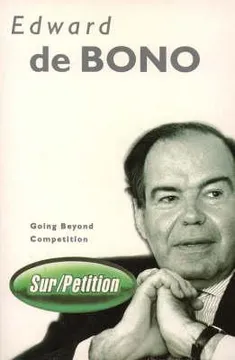


Key Takeaways
Use competition to survive, then invent a race customers value
Survival is only the floor. De Bono defines sur|petition as creating a distinctive source of value instead of competing only on the same measures, such as price or product quality. Ordinary competition pressures businesses to keep up; sur|petition aims to make a customer choose for a reason rivals have not yet matched. In a proposed example, Ford could acquire city parking facilities and make parking part of the value of owning a Ford. The car would no longer be judged only as engineering.
Create a different contest. A value monopoly is a distinctive advantage based on what customers value, not an illegal restriction on rivals. It can be temporary: competitors may copy the offer. The strategy therefore needs continued development, not just a clever first move.
What's useful here is the shift from benchmarking rivals to designing the whole customer proposition. Modern platform businesses often compete through an ecosystem of complementary services, not one superior feature, which echoes the parking example. Yet a distinctive value proposition can slide into lock-in or exclusion. A business should ask whether its advantage creates genuine customer benefit, or merely makes switching painful. The distinction matters because the same structure that helps a company escape price wars can also limit consumer choice if the value is mostly captured by the provider.
Build value around the buyer's life, not just the product
Values live in context. Integrated values are benefits created by fitting a product or service into a customer's wider circumstances, habits, and priorities. De Bono describes three broad phases of business: first, making a product available; second, competing with similar products; and third, designing value around how people actually live. The concept of living benefits changed life insurance by making 75 percent of benefits available when a policyholder developed a potentially fatal illness, rather than reserving all payment for after death.
Reframe what is sold. The Swatch helped revive Swiss watches by making them serve as affordable style and self-expression, not merely timekeepers. Integrated value is not simply adding features. It asks what role the offer can play in the customer's world, including needs customers may not have articulated.
This approach resembles service design, which studies the experience surrounding an object rather than treating the object as the whole product. It also anticipates co-creation: value emerges through use, in a particular setting, rather than being fully contained in what a company manufactures. The caution is that companies can presume too much about people's lives. A plausible story about a customer's needs is still a hypothesis. Direct observation, varied customer input, and small-scale trials help distinguish an insight from a stereotype.
Keep efficiency and quality as foundations, not the whole strategy
Maintenance cannot create direction. De Bono does not dismiss efficiency, problem solving, cost control, or quality. He argues they maintain a business's baseline, but cannot guarantee that the business is doing something customers will continue to value. Cutting labor can even destroy value: in a tuna plant, reducing staff left more meat on the fish skeletons, so the apparent savings were offset by lost product. Efficiency can also remove slack that an organization needs to adapt.
Make room for venture. De Bono groups essential business responsibilities as competence, control, care, and creativity. The first three support sound operations; creativity develops new value. He warns against four forms of complacency: settling for adequate results, retreating during downturns, assuming success proves mastery, and failing to imagine alternatives.
The argument maps neatly onto the organizational challenge of exploiting what already works while exploring what might work next. Operational excellence protects reliability, but excessive optimization can make an organization fragile when demand or technology shifts. The counterpoint is that exploration is not automatically wise: constant novelty wastes resources and can undermine trust. A sound management system protects a modest, explicit capacity for experimentation while preserving quality and cost discipline. The difficult question is not whether to maintain or change, but how much attention and capital each deserves.
Use information to test ideas, not to substitute for them
Data needs a question. De Bono argues that information improves decisions only up to a point. More data can clarify a choice, but it can also bury the useful signal and postpone action. His claim is not that information is unimportant; it is that analysis usually evaluates possibilities already conceived rather than reliably inventing new ones. If a competitor offers car rebates, simply collecting more details may lead to matching the rebate instead of asking what else could make a car more valuable.
Imagine, then investigate. De Bono uses an example of an apparent link between decaffeinated coffee and heart problems: one possible explanation is that people already worried about their health choose decaf. The observation prompts a hypothesis to examine. In this view, concepts guide attention, and information helps test or refine them.
The strongest insight is that evidence is interpreted through a model. In science, a hypothesis makes observations meaningful, while new observations can revise the hypothesis. The relationship is reciprocal, not a one-way choice between imagination and data. De Bono's distinction can be overstated: exploratory analysis may reveal patterns people did not anticipate, especially when tools can search large datasets. But a discovered correlation is not yet an explanation or a strategy. Human judgment remains essential for asking what the pattern means and whether acting on it creates value.
Train creativity as a repeatable business skill, not a lucky accident
Break familiar patterns deliberately. De Bono calls his method serious creativity: structured ways to generate ideas, based on the view that perception settles into familiar patterns and needs a deliberate nudge to reach alternatives. In one lateral-thinking exercise, a random word such as “nose” prompted a copier team to imagine using scents to signal a machine fault. The word was not relevant by itself; it gave the mind a different starting point.
Move beyond the provocation. A provocation is an intentionally unlikely statement used to disrupt habitual thinking. De Bono's “po” marks such a statement as a prompt, not a proposal to accept literally. The next step is movement: exploring what the prompt might lead to. His example of giving police more “eyes” led toward neighborhood watch, where residents help notice and report local concerns.
The method provides a useful counterweight to meetings where ideas are judged before they are developed. It resembles divergent thinking exercises in design practice: first widen the possibility space, then evaluate what is workable. Random prompts can loosen assumptions, but they do not guarantee insight, and an energetic idea session can still produce noise. The value comes from pairing an unusual stimulus with a clear focus, skilled facilitation, and a route for testing ideas. Creativity becomes organizationally serious when it has both permission to explore and a path to implementation.
Find value in context, convenience, identity, and overlooked needs
Value belongs to someone. De Bono names the deliberate creation of benefits valufacture. A value is not an abstract feature: it depends on who benefits, under what circumstances, and how the benefit is perceived. He highlights four powerful value drivers: convenience, quality of life, self-importance, and distraction. A watch can provide timekeeping, but it may also signal status or act as jewelry. A useful assessment separates the money spent from the nonfinancial value delivered, rather than treating price as a complete measure of worth.
Look beyond averages. Bonus Bonds, restricted-use rewards for employees, could feel more personally gratifying than the same amount added to wages, because they encouraged spending on something for oneself. De Bono's value notation is a way to compare financial inputs and returns with nonfinancial inputs and benefits. Its purpose is to make trade-offs visible, not to pretend every benefit has a precise price.
This account connects to behavioral economics: people respond to framing, identity, and circumstances, not only to objective product performance. It also explains why a technically excellent product can fail if its advantage matters little to the intended buyer. The ethical boundary is important. Perceived value can help people recognize a real benefit, but it can also be manipulated through status anxiety or misleading claims. Responsible value design should clarify who benefits, who bears the cost, and whether the promised experience holds up in ordinary use.
Give concept development its own pipeline, budget, and authority
Treat concepts as an asset. Concept R&D is De Bono's proposal for deliberately developing business concepts, with a role distinct from technical research or corporate strategy. Technical R&D creates technological possibilities; concept R&D explores ways of organizing products, services, and customer benefits. Strategy then selects among possibilities for action. A concept group should not monopolize ideas: it should help people across the organization generate and develop them.
Make the work visible. De Bono proposes four activities: catalog existing and emerging concepts, generate new ones, develop promising candidates, and test their benefits. A Creative Hit-List can identify specific areas needing fresh thinking, including opportunities that are not current problems. He suggests that large organizations give concept work formal status and offers 5 percent of a technical R&D budget as a possible benchmark.
Separating exploration from selection is a powerful organizational design choice. Teams judged only on near-term delivery tend to favor predictable improvements, while a dedicated concept function can protect early-stage possibilities. The arrangement works only if it stays connected to operating teams, customers, and decision-makers. Otherwise, it risks becoming an innovation department that generates presentations rather than change. De Bono's budget suggestion is best treated as a prompt for deliberate investment, not a universal formula: the right scale depends on the business, its risks, and its opportunities.
Keep multiple concepts alive until tests reveal which deserves investment
Do not marry the first idea. De Bono distinguishes concept generation from problem solving. A problem may invite a quick fix, but designing a new source of value calls for several parallel concepts. If the first version has a flaw, a different underlying approach may be better than endless repairs. His audio-newspaper example considers cassette delivery, retail sales, and a broadcast recorder with a subscription mechanism. Each approach changes the practical and commercial design.
Test the promise. Testing should be part of concept design, with clear measures such as time saved, cost reduced, or ease of use. A trial can mislead if participants are unusually enthusiastic or resistant, so the test conditions matter. De Bono also warns that organizations can overlook useful products that do not fit current priorities. Gore-Tex is cited as an opportunity that DuPont did not initially plan to develop.
This is close to portfolio thinking: uncertainty is handled by comparing options rather than placing every bet on the first persuasive proposal. It also resembles iterative design, where prototypes reveal information that discussion alone cannot provide. The discipline is to distinguish a concept's central promise from its first implementation, so a flawed prototype does not kill a sound possibility. Still, parallel exploration has a cost. Clear decision rules, learning goals, and stopping criteria keep experimentation from becoming an excuse to avoid choosing.
Analysis
Sur|petition is a business book built around one durable distinction: operational competence keeps a firm in the contest, while deliberately designed value can change what the contest is about. Its most practical contribution is not the coined terminology by itself, but the sequence of questions it imposes. What is merely a baseline? What does the customer value in context? Which concepts could create that value? How can they be developed and tested?
The book's strongest move is to treat concepts as a productive asset rather than as a by-product of marketing, strategy, or individual genius. Its critique of problem-centered management is persuasive because organizations naturally reward urgent repair: failures are visible, whereas unexploited possibilities are not. The proposed structures, especially a champion and a concept-development function, give that less visible work a home. The emphasis on following through also prevents creativity from being confused with idea production alone.
There are limits. The text sometimes presents broad claims about national cultures, executive habits, and the brain with more certainty than its examples can establish. Its case studies are illustrative, not controlled comparisons, and the business figures belong to the period in which the book was written. Its suggestion that data analysis cannot generate ideas is also too categorical. Data exploration can expose unexpected patterns, though interpreting them still requires concepts, judgment, and testing.
The distinction between a value monopoly and a conventional monopoly is strategically useful but not self-validating. A company may create value and then use its position to restrict choice, collect excessive rents, or make exit difficult. The consumer benefit must remain part of the test. Likewise, integrated value can depend on an accurate account of people's circumstances, not a marketer's convenient story about them.
Read as a managerial discipline, the book argues for balance rather than novelty for novelty's sake: maintain the operating system, deliberately create alternatives, test benefits, and give promising concepts enough authority to reach the market. Its most current challenge is organizational: can a firm protect exploration without insulating it from evidence or accountability?
Review Summary
Readers generally praise Sur|petition as an insightful book on business strategy and creativity. Many find it relevant decades after publication, highlighting its focus on value creation and systematic methods for disruptive innovation. Some reviewers note its emphasis on conceptual thinking over traditional analysis. While most appreciate its ideas on staying ahead of competitors, a few find it overly technical. The book receives particular acclaim for its discussion of complacency in business and its potential consequences. Overall, readers value its unique perspective on competition and innovation.
Glossary
Sur|petition
Value beyond direct rivalryDe Bono's term for seeking business success by creating distinctive value rather than competing only on shared measures such as price or quality. Competition helps establish a survival baseline; sur|petition aims to give customers a reason to choose an offer that competitors do not yet provide. The advantage may require continued development because rivals can copy it.
Integrated values
Value fitted to lifeBenefits created by connecting a product or service to the customer's wider circumstances, habits, and priorities. Integrated values go beyond a product's technical features or a simple comparison with competing products. The business asks how its offer fits into the customer's life and what useful role it can play there.
Valufacture
Deliberate creation of valueDe Bono's term for the intentional creation and formation of values, by analogy with the production of physical goods. It means designing benefits for particular people and circumstances rather than assuming value will arise automatically from manufacturing, efficiency, or promotion. The process considers who benefits, what they perceive, and what trade-offs the offer creates.
Serious creativity
Deliberate, structured idea generationA systematic approach to creative thinking that uses deliberate methods to move beyond familiar patterns of perception. De Bono distinguishes it from simply waiting for inspiration or relaxing inhibitions. Techniques such as random prompts and provocations create alternative starting points, which thinkers then explore for practical possibilities.
Concept R&D
Organized concept developmentA proposed organizational function for systematically cataloging, generating, developing, and testing business concepts. It differs from technical research, which develops technologies, and corporate strategy, which selects among options. Its purpose is to expand the range of useful possibilities and help concepts move toward practical evaluation without reserving idea work for a single department.
Lateral thinking
Deliberate shifts in perspectiveDe Bono's method for moving away from established patterns of thought to generate alternatives. Instead of relying only on analysis within a familiar frame, lateral thinking introduces a different starting point or an unusual prompt, then explores what that shift might reveal. It is intended as a learnable skill, not a talent limited to naturally imaginative people.
Provocation
Unusual prompt for new pathsAn intentionally implausible statement used to disrupt habitual thinking, not a claim meant to be accepted as true. De Bono uses the marker “po” for a provocative operation. The thinker then explores what the statement might suggest and whether a useful concept can be developed from it.
Movement
Exploring where an idea leadsA thinking operation used after a provocation. Rather than judging the statement immediately as correct or incorrect, the thinker follows its implications, associations, and possible benefits to see whether they lead to a workable idea. Movement gives provocative thinking an active next step instead of leaving it as mere absurdity.
Creative Hit-List
Specific targets for fresh thinkingA written list of focused areas where an organization needs new ideas. It can include problems, opportunities for improvement, and topics that have not been examined recently. De Bono recommends keeping the items concrete enough to guide creative work and limiting the list so urgent problems do not crowd out all other opportunities.
Value notation
Map of costs and benefitsA visual system proposed by De Bono for distinguishing financial inputs and returns from nonfinancial inputs and values delivered. It is meant to help people compare what a business spends with what customers, workers, or communities gain. The notation highlights trade-offs and relationships; it does not make every kind of value objectively measurable.
About the Author
Other books by Edward de Bono






Download PDF
Download EPUB
.epub digital book format is ideal for reading ebooks on phones, tablets, and e-readers.








